A Novel Approach for Detection of Node
Failure in Mobile Communication
N .Vishal 1 , D.Venkata Subbaiah2
PG Student, Department of CSE, Andhra University, Visakhapatnam, India
Research Scholar, Department of CSE, Andhra University, Visakhapatnam, India
ABSTRACT: Wireless Sensor Networks are emerging as a promising and interesting areas. WSN consists of large number of homogeneous or heterogeneous nodes which communicate through wireless medium and works to sense or monitor the environment. The number of sensor nodes in a network can vary from hundreds to thousands.The nodes sense data from environment and sense these data to the gateway node.Mostly WNSs are used for applications such as military and disaster monitoring. As many nodes are present in WSNs, there will be a probability of node failure.To enhance the node failure detection schemes that systematically combine localized monitoring implementation of novel probabilistic approach that combines localized monitoring,location estimation and node collaboration to detect the node failure in mobile wireless networks.Detecting the node failure in mobile networks is very challenging because the network topology can be highly dynamic,the network may not be always connected, and the resources are limited.We propose a distributed localized faculty sensor detection algorithm where each sensor identifies its own status to be either “good” or “faculty” which is then supported by its neighbors as they also check the node behavior as they also check the nodes behavior. Finally, the algorithm is tested under different number of faculty sensors in the same area.Our paper results demonstrate that the time consumed to find out the faculty nodes in our proposed algorithm is relatively less with a large number of faculty sensors existing in the network.
KEYWORDS: mobile wireless networks, node detection, node failure.
I. INTRODUCTION
Wireless sensor networks have seen tremendous advances and utilization in the past two decades. Starting from petroleum exploration, mining, weather and even battle operations, all of these require sensor applications. One of the main reason for the growing popularity of wireless sensors is, with out manual intervention they can work in the areas.. All the user needs to do is to gather the data sent by the sensors, and with certain analysis extract meaningful information from them. Usually sensor applications involve many sensors deployed together. These sensors form a network and collaborate with each other to gather data and send it to the base station. The base station acts as the control center where the data from the sensors are gathered for further analysis and processing. The nodes in the wireless sensors are used for monitoring physical or environmental conditions.These nodes combine with gateways and routers to create a WSN system.The topology of the WSNs can vary from a simple star network to an advanced wireless mesh network. The propagation technique among the nodes of the network could be routing or flooding. The power of the wireless sensor networks lies in the capability to deploy large numbers of small nodes that assemble and configure themselves. In addition to drastically decreasing the installation costs, wireless sensor networks have the capability to dynamically adapt to changing environments. Adaptation mechanisms can lead to changes in network topology or can cause the network to shift between different modes of operation.
on network connectivity have limited applicability. The detection must be done in a conserving manner due to the limited sources like computation, battery life and communication.
II. LITERATURE SURVEY
A Self-Managing Fault Management Mechanism for WSN
In this approach a new fault management mechanism was proposed to deal with fault detection and recovery. It proposes a hierarchical structure to properly distribute fault management tasks among sensor nodes by heavily introducing more self-managing functions. The proposed failure detection and recovery algorithms have been compared with some existing related algorithm and proven to be more energy efficient.
The proposed fault management mechanism can be divided into two phases: Fault detection and diagnosis.
Fault recovery.
Fault Detection and Diagnosis:To efficiently detect the node sudden death, our fault management system employed an active detection mode. In this approach, the message of updating the node residual battery is applied to track the existence of sensor nodes. In active detection, cell manager asks its cell members on regular basis to send their updates. Such as the cell manager sends “get” messages to the associated common nodes on regular basis and in return nodes send their updates. This is called in-cell update cycle. The update_msg consists of node ID, energy and location information.
Fault Recovery: After nodes failure detection (as a result of self-detection or active detection), sleeping nodes can be awaked to cover the required cell density or mobile nodes can be moved to fill the coverage hole. A cell manager also appoints a secondary cell manager within its cell to acts as a backup cell manager. Cell manager and secondary cell manager are known to their cell members. If the cell manager energy drops below the threshold value (i.e. less than or equal to 20% of battery life), it then sends a message to its cell members including secondary cell manager. It also informs its group manager of its residual energy status and about the candidate secondary cell manager. This is an indication for secondary cell manager to stand up as a new cell manager and the existing cell manager becomes common node and goes to a low computational mode.
III. METHODOLOGY
EXISTING SYSTEM
Mobile wireless networks have been used for many mission critical applications, including search and rescue, environment monitoring, disaster relief, and military operations. Such mobile networks are typically formed in an Ad-hoc manner, with either persistent or intermittent network connectivity. Nodes in such networks are vulnerable to failures due to battery drainage, hardware defects or a harsh environment. Detecting node failures is important for keeping tabs on the network. It is even more important when the mobile devices are carried by humans and are used as the main/only communication mechanism.
Disadvantages of Existing System:
1. Node failure detection in mobile wireless networks is very challenging because the network topology can be highly dynamic due to node movements. Therefore, techniques that are designed for static networks are not applicable.
2. The network may not always be connected. Therefore, approaches that rely on network connectivity have limited applicability.
3. The limited resources (computation, communication and battery life) demand that node failure detection must be performed in a resource conserving manner.
we propose a novel probabilistic approach that judiciously combines localized monitoring, location estimation and node collaboration to detect node failures in mobile wireless networks. Specifically, we propose two schemes. In the first scheme, when a node A cannot hear from a neighboring node B, it uses its own information about B and binary feedback from its neighbors to decide whether B has failed or not. In the second scheme, A gathers information from its neighbors, and uses the information jointly to make the decision.
Our approach has the advantage that it is applicable to both connected and disconnected networks. Our schemes achieve high failure detection rates, low false positive rates, and low
communication overhead.
IV. RESULTS
The initial algorithm was implemented in a 100 X 100 unit network topology and the detection accuracy & False Alarm Rate were determined. The shortcomings of the algorithm were identified and overcome by using clustering in the network.
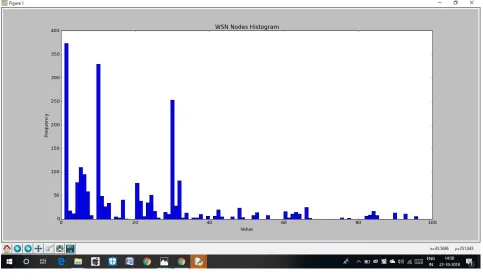
Fig 1: WSN Nodes Histogram
The occurrence of the node are shown in the form of graph chat.The values are taken on the x-axis and the frequency is taken on the y-axis.
The values are taken from a range of 20. The frequency is taken from a range of 50.
Fig 2: Node Detection
Detection accuracy for percentage of fault probability, where θ1=0.75, θ2=0.8,δ=1, no of reading taken=3,
connectivity=10
This shows that there is a gradual decrease in the detection accuracy and increase in the false alarm rate(FAR) because of increase in arbitrary sensor readings that come under the threshold(mainly in case of permanent faulty nodes where reading is 0).
V. CONCLUSION
problem by taking fault tolerance as a measure of percentage of total connectivity. We then have introduced another variable called fault disambiguation variable. This confirms that nodes of same zone form a cluster and consider readings of the neighbors hence formed. This algorithm is useful for fault detection when an event occurs because otherwise the data would be considered as faulty.
REFERENCES
[1] Jinran Chen, Shubha Kher and Arun Somani. Distributed Fault Detection of Wireless Sensor networks, Dependable Computing and Networking LabIowa State UniversityAmes,Iowa .pages75-84,Computer Network,2006.
[2] D. Blough, G. Sullivan, and G. Masson. Faultdiagnosis for sparsely interconnected multiprocessor systems. In In 19th Int. IEEE Symp. on FaultTolerantComputing, pages 62–69. IEEE Computer Society, 1989.
[3] F. Koushanfar, M. Potkonjak, and A. Sangiovanni-Vincentelli. On-line fault detection of sensor measurements. In Sensors, 2003. Proceedings of IEEE, pages 974–979 Vol.2,2003.
[4] X. Luo, M. Dong, and Y. Huang. On distributed fault-tolerant detection in wireless sensor networks. IEEE Transactions on Computers, Jan2006. [5] Akyildiz, I.F.; Su, W.; Sankarasubramaniam, Y; Cayirci, E. Wireless sensor networks:a survey.Computer Networks 2002.
[6] M. Ding, D. Chen, K. Xing, and X. Cheng. Localized fault-tolerant event boundary detection in sensor networks. In Proceedings of IEEE INFOCOM 2005,2005.
[7] F. Koushanfar, M. Potkonjak, and A. Sangiovanni-Vincentelli. Fault-tolerance in sensor networks.In Handbook of Sensor Networks. CRCpress, 2004.
[8] B. Krishnamachari and S. Iyengar. Distributed bayesian algorithms for fault-tolerant event region detection in wireless sensor networks. IEEE Transactions on Computers,53(3):241–250, March 2004.
[9] Mahmood and E. J. McCluskey. Concurrent error detection using watchdog processors-a survey.Computers, IEEE Transactions on, 37(2):160– 174, Feb 1988.
[10] S. Marti, T. J. Giuli, K. Lai, and M. Baker. Mitigating routing misbehaviour in mobile ad hoc networks. In MobiCom ’00: Proceedings of the 6th annual international conference on Mobile computing and networking, pages 255–265, New York, NY,
USA, 2000. ACM Press.
[11] Perrig, R. Szewczyk, V. Wen, D. E. Culler, andJ. D. Tygar. SPINS: security protocols for sensor netowrks. In Mobile Computing and Networking, pages 189–199, 2001.
[12] L. B. Ruiz, I. G. Siqueira, L. B. e Oliveira, H. C. Wong, J. M. S. Nogueira, and A. A. F. Loureiro. Fault management in event-driven wireless sensornetworks.InMSWiM’04: