International Business and Accounting Research Journal
Volume 3, Issue 1, January 2019, 15-36
http://ibarj.com
Moderating Influence of Stakeholder Knowledge on the Relationship
between Social Reporting and Sustainability Accounting in the Tea Sector in
Mount Kenya Region
Sylvester Onyango
, Stephen Wanyoike Muchina, Stephen Irura Ng'ang'a
DOI: http://dx.doi.org/10.15294/ibarj.v3i1.52
Department of Business & Entrepreneurship, School of Business, Karatina University, Kenya
Info Articles
___________________________ History Articles: Submitted 1 November 2018 Revised 15 December 2018 Accepted 8 January 2019 ___________________________ Keywords: Sustainability Accounting; Social Reporting; Stakeholder Knowledge; Tea Factories __________________________________Abstract
__________________________________________________________________________________________
In accounting, financial reporting dominantly focus on profits. There is growing pressure on social sensitivity of accounting. Sustainable Development Goals advocate for concern to the environment. Some researchers have endeavored to demonstrate how accountancy need to respond to the social concerns beyond traditional goal of profit maximization that singles out shareholders from the many stakeholders. However, these studies have been deficient in addressing the moderating influence of stakeholder knowledge on the relationship between social reporting and sustainability accounting which this study explores. The study adopted Mixed Methods Research of survey design. The target population comprised of the factory unit managers and accountants as the key informants, drawn from tea factories of Mount Kenya region. The sample was obtained by simple random and stratified sampling techniques. Questionnaire was the main data collection instrument. Data analysis entailed simple binary and hierarchical multiple logistic regression analysis using SPSS. Study results was presented in frequencies, percentages and skewness for descriptive and binomial regression output for inferential statistic. The study found out that tea factories practice social activities that they incur costs which were treated as overhead costs and benefits were derived by tea factories. There was a statistically significant influence of social reporting on sustainability accounting; which was insignificantly moderated by stakeholder knowledge. The study findings were of significant to organizations’ strategies to respond to social externalities which in accounting terms affect the organizations profits in the long run. The study recommends tea factories adopt an integration of social reporting and financial reporting without much focus on stakeholder knowledge.
Address Correspondence:
E-mail: [email protected]
p-ISSN 2550-0368 e-ISSN 2549-0303
Onyango, Sylvester et al / International Business and Accounting Research Journal 3 (1) (2019) INTRODUCTION
Conventional Accounting has continued to dominate the field of accounting among theorists, ideologists and practitioners for as long as the age of accounting. It is clear that traditional accounting and liberal economists lay emphasis on the interest of the suppliers of capital to an organization [1]. The main aim of this fundamental focus is to ascertain the measurements of financial performance of an organization based on its asset capacity and claims against what the business owns. Accountants aim to report higher profit as a sole indicator of an organization’s success. Other factors kept constant, purely concentrating on profits means neglect of sources of resources which are scarce. This translates to environmental deteriorations and which human welfare is based [1].
The study conducted by [2] in oil and gas companies in Indonesia revealed a positive relationship between company social undertakings and economic performance. He further found that employment of costs towards the environment conservation; are associated with social performance of the company to obtain its legitimacy from the larger community, this being a contrast of governments efforts in introducing programs that try to foster legitimacy of an organization to the community. The organization has no other choice but to engage in reporting the social and environmental engagements. Generally, the externalities have an impact on financial performance of an organization [3]. This is further affirmed by [4] that non-inclusion of information on externalaties cause incompleteness in the financial performance so reported of an orgainization. However, [5] points out that Spanish concessinaries provide a low quality level of environmental reporting and only do so because of administrative reforms.
In the African context, studies have been conducted to explore the impact of social reporting on organizational activities. The study by [6] found out that social accounting reveals the impact of organizational development activities in the community in Nigeria even though the technique of social accounting is not so common in the country
because stakeholders are not adequately informed on the effectiveness and efficiency of reporting audit and accountability information. The level of environmental disclosures is specifically low among listed manufacturing companies in Nigerian Stock Exchange (NgSE) [7]. Human Resources are drawn from the society and need to be carefully accounted for in a calculated step since they drive all other resources in the organization [8]. The use of social accounting approaches improves transperancy, accountability and compliance in the organization and encourages the integration of social objectives into the strategic plans.
Kenya being among developing countries has not been an exception in the field of social reporting. The study by [9] found out that Corporate Social Reporting (CSR) is of merit and that firms involved in manufacturing, construction and allied sector of the Nairobi Stock Exchange (NSE) practice CSR. The activities found to be most practiced by the manufacturing and construction firms were community welfare, staff welfare and environmental conservation. A further study of firms in NSE of Kenya further supported that firms are engaging in social disclosures [10]. The study conducted by [11] established that companies commit part of their profits in long term projects, for example, supporting schools in construction of buildings, creating scholarship programs, putting up medical health centers for employees, sponsoring sporting activities, and striving for continuous product improvement.
These studies have revealed that accounting world is changing face. They have layed emphasis on the social reporting which aim at disclosing accountability of an organization to its sorrounding community. While the social reporting still remains dummy in most organization, some scholars have posited that it be made compulsory with adoption of a unifying standard world wide. This has been advocated by United Nations Environmental Program (UNEP) in collaboration with World Bank (WB). The underlying relational being creation of legal framework for social reporting. Organizations are practising social reporting with three main motives in mind; legitimacy motive (image bulding), sustainability (altruism), and bottom line (profitability) [12]. In all the studies since 1980s
Onyango, Sylvester et al / International Business and Accounting Research Journal 3 (1) (2019) when intensive social accounting began, there has
been little attention to explore social reporting beyond the normal expectations of reports on conventional financial performance of organizations and enterprises and influence of the social parameters on sustainability accounting in food processing industry beyond secondary data extracted from listed companies in stock markets. This forms the aim of the research in the agricultural sector of tea sector in Mount Kenya Region which draws a lot of its resources from the environment and labour from the social parameters.
Statement of Problem
Studies have been conducted advocating for the inclusion of the social issues into annual reports in order to improve financial reporting to cater for stakeholder values [13]. The study conducted by on Bangladesh companies showed merits of environmental accounting and environmental reporting to organizations. The exploratory study by [14] on companies listed on Euronet Stock Exchange (ESE) found improved quality of social reporting [15] including its efficacy. This has led to social accounts being created to realign the reporting of with emergence of international bodies like Global Reporting Initiative (GRI) that shows format of preparation of integrated reporting to supplement International Accounting Standards Board formats.
In Kenya social reporting practices has been noted [16] [17]. Social Accounting Matrix (SAM) has hence emerged from such integrations [18] to form Integrated Economic Accounts (IEA). Several studies have further been conducted on companies listed in Nairobi Stock Exchange to differentiate conventional accounting from social reporting and its relation with financial performance [9]. Social accounting and profitability show mixed results according to [19] who studied social reporting in oil industry in Kenya. Other studies [20] [21] have explored on factors influencing social reporting and sustainability accounting that include stakeholder value, ethical practices, ownership structure [21], and value creation [22]. National Environmental Management Authority (NEMA) has outlined regulations with which organizations
need to comply with social issues [23]. However disclosure of social aspects and environmental issues of economic activities still remains voluntary in Kenya.
The trends in the previous studies is the use of secondary data derived from stock markets. Most of these studies are skewed towards construction and manufacturing companies. Little attempt if any has been made to use primary data from stakeholders in ascertaining social accounting levels. Further, a gap still remains on the influence of methods of reporting on sustainability accounting as moderated by stakeholder knowledge. This study was hence conducted to address this gap by using primary data obtained from the tea factories’ selected stakeholders bearing knowledge on accounting.
Objective of the Study
The specific objectives of the study were to: i) establish the relationship between social
reporting and sustainability accounting
ii) determine the moderating influence of stakeholder knowledge on the relationship between social reporting and sustainability accounting
Research Hypothesis
The research aimed to test the following hypothesis:
iii) there is no significant relationship between social reporting and sustainability accounting iv) there is no significant moderating influence of
stakeholder knowledge on the relationship between social reporting and sustainability accounting
LITERATURE REVIEW
The study conducted theoretical and empirical review of literature. Theoretical review was anchored under Shareholder theory and Stakeholder theory while empirical review was based on sustainability accounting, social reporting and stakeholder knowledge.
Onyango, Sylvester et al / International Business and Accounting Research Journal 3 (1) (2019) Shareholder Theory
The theory lays much emphasis on reporting to the shareholders alone in reference to profits. It only focuses on the shareholder as the sole party affected by the organization’s economic activities. Shareholders want the managers to maximize organization’s economic value towards their interest [24]. However, such values are threatened during great economic depressions. Shareholder is just one of the many stakeholders that organization need to look at in terms of accounting and that concentration on shareholders is done at the detriment of other stakeholders. Hence the study reviews stakeholder theory in the next section. Stakeholder theory was reviewed to fill the gaps of shareholder theory.
Stakeholder Theory
The study [25] stresses on stakeholder democracy in the aspect of the firm’s control and governance in the community. His argument is that managers need to put aside skewed cognitive self-interests and plan for the distributive objective of balancing interests and wellbeing of all stakeholders [26] of the business by apportioning benefits to them. It is found out that most firms’ actions are in consistency with the predictions of stakeholder theory [27]. Such actions augment Social Corporate Performance (SCP) that in turn leads to improved financial performance of firms [28]. In as much as stakeholder theory increases SCP, it is anonymous with CSR theory [29].
Stakeholder theorists [30] emphasize that stakeholder theory is simply for managerial purposes. It is an instrument for measure of how to run a firm and as well a standard for evaluating the manager’s decisions. Such decisions are made inclusive of accountants. On the other hand, all firms bear social obligation to manage all stakeholders despite whether or not they have expertise. This makes stakeholder theory a practical theory [29] since it emphasizes that treated stakeholders share the organization’s valuable information which transforms to good attitude hence loyalty. Loyalty will mean that there are stable profits in every financial year that contributes goodwill.
For the purposes of disclosures in accounting, this study pinpoints more on stakeholder theory that was described by [31] as supporting the inclusiveness of several stakeholders in a bond with the organization [32]. It is therefore sole responsibility of accounting is to relay information in addressing stakeholder’s risk management [33].
Sustainability Accounting
Sustainability is a concept that encompasses both present and forthcoming generations which envisages that the needs of the people be met. The needs which goes beyond normal profit, are both social and environmental [34]. Sustainability hence entails meeting the needs of the present generation without interfering with the quality of life of the future generations. Sustainability accounting is a term used to refer to gathering, analysis, interpretation and communication of information related to sustainability of an organization’s financial and economic dealings [35] and the purposes of such information to those who bear interest in them [36]. According to [37] sustainability accounting has materialized from the philosophical debates and has emerged from conceptual developments in the field of accounting [35]. This is both an extension of conventional accounting and a new accounting field in entirety [37].
Traditional system of accounting is a sticker of internal inventory and flow of financial information and value on the statement of business position and profits and loss on statement of comprehensive income [38]. These internal reporting relates to the shareholders alone. [38], further states that sustainability accounting reports shows costs and benefits accruing from performances on economic, sociocultural and environmental engagements. The magnitude with which stakeholders continue to pile up pressure in relation to organizational responsibility disclaimers, offer a good incentive towards organizational sustainability, to a much extent lead to effectiveness. Such pressures are guiding organizations to put in strategic management and sustainability reporting for stability in offering healthy and stable products [39]. The 2012 United
Onyango, Sylvester et al / International Business and Accounting Research Journal 3 (1) (2019) Nations Conference on Sustainable Development
(Rio+20) further asserted that sustainability reporting in general is an enabling factor for businesses to foster Green Economy [40].
Sustainability Accounting can be categorized into two: Internal Sustainability Accounting (ISA) and External Sustainability Accounting (ESA). The ISA creates clear visibility between the linkage of unseen costs and benefits and those of financial performance within the context of the institutional operations [38]. ESA on the other hand deal with externalities which are not covered in the organization’s financial accounts.
Sustainability accounting takes dimension of economic feasibility while incorporating social responsibility aspects and environmental sensitivity [41] in which proponents are putting pressure for better quality of information regarding sustainable practices [42]. The three proponents are not cost-free but bear economic trade-offs and opportunity costs between each other’s contents. The social element and environmental components still carry economic viability [43] hence it is important that accountants consider accounting sustainability as part of strategic and routine decision making [42].
Accountants, especially the management accountants, have a role to facilitate decision making at the strategic level management [42]. Annually throughout the centuries, the management accountant has had his role skewed towards financial disclosure, taxation and auditing which is internally related to the internal control of the organization. This function sidelines the sustainability in accounting to the externalities. In order to achieve this, accountants can use such tools as triple bottom line disclosure, EMAS [42], and balance scorecard [44], techniques which are also confirmed by [45] as workable for accountants towards measuring sustainability accounting. The management accountant’s role as influencer of decision making is one enough a strategic sustainability focus. While participating in strategy formulation, mission statement and vision declaration of the organization, management accountants need to play an active role in sustainability accounting right at this point [46]. The organization should hence develop concrete
goals towards achieving sustainability accounting [47]. Numerous reason exist justifying the need for accountants’ engagement in sustainable development. First, there are new jurisdiction advancing towards sustainable development for organizations, secondly, the global pressure from international leaders pushing for organization’s sustainability knowledge, and thirdly is the unwavering call for accountants to put in forefront the practices of sustainable development [48]. Social Reporting
Social reporting entailed the preparation of information concerning organization’s social activities in the community. Such social accounts contain a mix of both quantifiable and non-financial information and descriptive non-non-financial information; apart from the financial information itself that dominates the traditional accounts [49]. Social accounting is a term which has seen evolution in its definition since it was first coined by Linowess in 1968 when he defined “socioeconomic accounting” in an attempt to bring in new facets of accounting which include the aspects of sociological, political and economics of accounting whose curvature surpasses the conventional accounting [50]. The term social accounting was used synonymously alongside other terms like Corporate, Social, Ethical and Environmental Reporting (SEER) [51], social and environmental accounting, corporate social reporting, non-financial reporting; and entailed the act of communicating the impacts of an organization’s economic actions to the society and the environment to a specific group of interested group of people in the society and to the entire society (Gray et al 1987, noted by [52]. Despite the different definitions of social reporting, this paper defines social reporting as the art and science of practicing and communicating sociopolitical actions of an organization to the stakeholders to permit decision making.
The study by [53] found that companies need to disclose social information relating to number of employees and the approximate pay, meeting employee needs, concern of disabled employees, arranging for pension, charity and donations. Apart from just reporting on social
Onyango, Sylvester et al / International Business and Accounting Research Journal 3 (1) (2019) factors, the organizations need to practically sell in
the market safety products, partner with human rights, maintain customer relations and ensure a satisfied workforce, be in good relationship with the government, build good rapport with the community and ensure a a condusive working environment for all employees [54]. When employees are incorporated in management development activities, there is an increased value of each individual to the organization in accordance with human resource accounting (HRA) [55]. Measuring human capital including intellectual capital (IC) [56] is of merit in reflection of competitive human capital and being strategic which is achieved by valuing and reporting for it in financial terms [57]. The organizations need to report on human capital related matters like training and development [58]. Social reporting is therefore a variable that the study explored its influence on sustainability accounting in the aspects of sociopolitical actions.
Stakeholder Knowledge on Accounting Reporting Individuals and/or group of individuals bearing the likelihood of affecting or being affected by the business activities of the organization are the stakeholders of that organization [38]. Stakeholders share valued information which disintegrates into purchasing of products (the customers), provision of incentives (the community), provision of funds and good financial terms (the financiers), holding of stock and having direct interest to the organization (the shareholders), putting concerted effort within the organization on assigned responsibilities (the employees) [29]; analyzing and making information available in discernable form (financial analysts) [59]. It is further notes that reporting to stakeholders about social factors pools together the resources and efforts [60] of the stakeholders to the organization’s achievement of its objectives. The stakeholders hence relate to each other in one way or another while interacting to the organization in the way of attitude [61]. It is important to include into the financial reports the information to which all stakeholders have interest.
The study treated shareholder knowledge as the awareness that the stakeholders have about social disclosures. The awareness of how the components of social accounting, environmental accounting, and disclosures is good influence of what the organizations choose to disclose to the interested parties [62]. The awareness is intensified when done through the media [62], although media reports both negative and positive impacts of the organization, the accountant’s report only captures the positive aspects of the organization’s social actions. Further, the presence of legal provisions may also lead to creation of awareness of social reporting and sustainability accounting among stakeholders [63]. Lack of knowledge by awareness may hence limit the extent to which accountants will report on sustainability accounting [64]. The study hypothesized that stakeholder knowledge moderates the influence of social reporting on sustainability accounting.
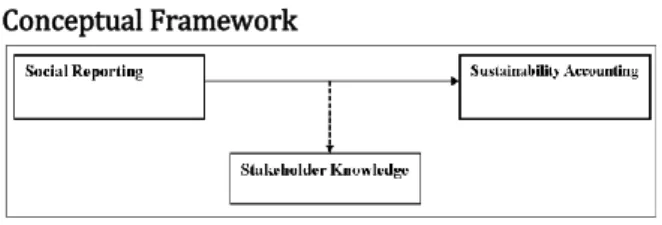
Conceptual Framework
Figure 1. Conceptual Framework
The studies that have been conducted concerning social reporting have much concentrated on demonstrating why the organizations should undertake it. Such reports are aimed at stakeholders who in the long run need timely and complete information which they can rely upon to make informed decision both socially and economically. However, how social reporting influence sustainability accounting as interplayed by shareholder knowledge, as demonstrated in the conceptual framework, still remains scanty. This study sought to explore this gap as anchored under stakeholder theory.
METHODS
Traditionally, empirical accounting researchers have either opted for the basis of quantitative or qualitative methodology,
Onyango, Sylvester et al / International Business and Accounting Research Journal 3 (1) (2019) triangulation, or mixed method designs during the
stages of collection, analysis, presentations and interpretations of accounting research data [65]. Researchers like [66] after undertaking theoretical review found out that mixed methods need checking for validity and reliability of research data at all stages. Webb [67]in his unobtrusive measures found meritious outcomes of adopting mixed method designs which includes improving validity of constructs.
The study adopted Mixed Method Research (MMR) design which was coiled into existence approximately the year 2000 [68]. Some researchers like [69] have referred to MMR as the third methodological movement which has gained imminence use among researchers. Adoption of MMR for this study was justified by the fact that it provided greater discernment [70] in the understanding of social reporting while determining its influence on sustainability accounting. MMR design assisted in obtaining varied data in order to draw informed conclusions and arrive at future research areas as the researcher was not be pegged on one research design alone [71] [72]. In this context, the study found it even better to term MRR as Mixed Method Accounting Research (MMAR), [73].
MMR did away with the weaknesses that would have been encountered when singly working with quantitative or qualitative research designs [74] which bore other rationales like the respondent’s enrichment, integrity in measurements, and improving significance of findings [75]. The study further narrowed down to two kinds of MMR: convergent parallel MMR [76] which helped to collect and collate quantitative data with qualitative data [77]; and embedded MMR QUAN(qual) [78] as quoted in in [79] which accommodated collection of quantitative and qualitative data at the same time [70]. The quantitative research was used to towards analyzing the objectives that led to either reject or accept the hypothesis while qualitative research supported the hypothesis [80]. It is noted by [81] that there has been paradigm shift from a conventional framework to positivist research where scientific model is tested and inferences made, this is based on quantitative research. The
study was endeavored to get the stakeholder opinion and attitude towards social accounting and reporting, this could only be achieved by applying qualitative research method [82] which captured the reality in details while ecological issues observed in their natural settings [62]. It is worth to note that qualitative research was emic in nature [83]. Emic kind of research reveals unique opinions of the society [84] which this study looked at social factors in social accounting.
The study further used survey strategy that enabled the researcher to get the same type of data from a large group of respondents in a standardized manner and checked for the pattern trend in the data that assisted in generalizing [85] the research findings to the population [86]. Survey strategy is a sub-set of descriptive studies which fitted the study and also linked to deductive approaches that is majorly applicable in business inquiries and management research [87]. Sample survey cemented and facilitated data collection and analysis and that large amount of data could be drawn from a vast population with great economy. The study derived information by asking questions [88] from respondents as guided by the research questionnaire. The survey design was very prudential in collating qualitative data whose analysis is very possible quantitatively using statistical techniques [89] [90] [91]. The objectives of this study aimed at finding relationship between variables (social reporting, stakeholder knowledge and sustainability accounting) which was possible to obtain in data collection using survey strategy [92].
Study area
The study was carried in Mount Kenya Region, Kenya. Mount Kenya region encompass five regions where tea is grown. These counties include Nyeri, Meru, Embu, Kirinyaga, Tharaka Nithi, Murang’a, and Kiambu. Tea is grown in these areas in altitudes of 4900 feet to 5100 feet. The climate bear temperatures that range as low as 12oc in
June-August and high 27oc in January-March and
September-October; with annual rainfall of 500ml-1500ml which favor tea farming. Majority of the people engage in tea farming as economic activity. There is widespread smallholder tea farming
Onyango, Sylvester et al / International Business and Accounting Research Journal 3 (1) (2019) around Mount Kenya Region. Kenya Tea
Development Agency and other players in the area have continued to practice social reporting endeavored at sustainable tea production. With such practices, stakeholders in the area still show little satisfaction of the economic, social and environmental reporting; this informed the choice of Mount Kenya region as the study area.
Sample Size
In order to obtain a sample of tea factory unit managers and accountants, the researcher used Nassiuma sample size formula of obtaining a representative of the population. Nassiuma’s formula has three factors determining the sample size which include population (N), coefficient of covariance (c), and standard error (e). It is acceptable in most surveys a covariance ranging from 21% to 30% and standard error of 2% to 5% [93].
(1) Where n=Sample size
N=Population
c=covariance (coefficient of variation) e=standard error
In the above, n was the required sample size while N was the total number of respondents. The population divided into two strata of tea factory unit managers and accountants and further in form of counties. Selection of sample size from a stratified population for this study was best suitable using Nassiuma’s formula.
Sampling Technique and Procedure
Stratified sampling was applied. The stratified sampling enabled inclusion of all subgroups in the sample [94]. The stratified sampling was useful in supplementing randomization which enhances MMR (both quantitative and qualitative studies) to be undertaken. Stratification was conducted by grouping the respondents into strata called counties. Most of the tea factories are grouped in regions by the tea authorities but the study used strata of counties.
Data Collection Instruments
The research utilized both primary and secondary data. Primary data was obtained using semi-structured questionnaires. The questionnaire was used due to its quick ability to administer and it highly convenience the respondents who could fill it at their own free time [95]. Matrix questions in the questionnaire were utilized to measure perceptions on a Likert scale [94]. The selection of questionnaire as the main research instrument for data collection was premised on the fact that the study was a survey using MMR. The question; therefore had the capability of turnaround in data collection which was economical [79].
Data Collection Procedures
The researcher sought authority from the university, which was granted. Using the university authorization letter, the researcher applied for research permit from National Commission for Science and Technology (NACOSTI) as per Science and Technology Act, Chapter 250 of the Laws of Kenya. The government through its advisory institution NACOSTI permitted the researcher to conduct research in six counties which included Kiambu, Murang’a, Nyeri, Kirinyaga, Embu, Meru and Laikipia. The Government research permit had regulation that the research permit be presented to County Commissioner and County Director of Education for every county mentioned before the researcher embarked on research in a particular county. A go ahead was accorded the researcher by the County Commissioners and County Director of Education for Nyeri County, Kiambu County, Murang’a County, Kirinyaga County, Embu County and Meru County. However, the research was not conducted in Laikipia County as per the permit but was done Tharaka Nithi County instead, since Laikipia County rarely had tea industries.
Data Analysis
Chi-square test of independence was performed at five percent level of significance in evaluating first and second hypothesis. The hypothesis were stated as null, otherwise alternative as outline below:
There is no association between social
Onyango, Sylvester et al / International Business and Accounting Research Journal 3 (1) (2019)
There is an association between social
reporting and sustainability accounting
There is no moderating influence of
stakeholder knowledge on the relationship between social reporting and sustainability accounting
There is a moderating influence of stakeholder
knowledge on the relationship between social accounting and sustainability accounting The null hypothesis stated that a given values of methods of social reporting, it cannot predict sustainability accounting while the alternative hypothesis stated that the social reporting can predict the continuity of sustainability accounting. The analysis of null hypothesis involved computing Chi-square test statistics in finding out the association between independent variable ) measured on levels of influence and dependent variable ) measured in terms of sustainability. This is defined by the formula below [96]:
∑⌊( , , , )⌋
(2) Where: is the test statistic
, is the observed frequency of the independent
variable (i) at a level of influence and dependent variable (d) at level of sustainability
, is the expected frequency of the independent
variable (i) at a level of influence and dependent variable (d) at a level of sustainability
The expected frequency , was calculated using
the formulae below [96]:
, ⁄
(3)
Where , is the expected frequency of level of
influence of social reporting (i) and level of sustenance of sustainability accounting for dependent variable (d)
is the total number of observations in the sample at given level of influence for independent variable (i)
is the total number of observations in the sample at a given level of sustainance for the dependent variable (sustainability accounting). is the sample size
The counts of the composite scores were determined and the SPSS command ‘weight cases’ applied to weigh the counts. In a cross-tabulation, the test statistic was distributed as on degree of freedom. The probability value of the chi-square output was then compared with the predefined five percent level of significance. This was used to test for association between sustainability accounting as the output variable and social reporting as the predictor variables.
The study further explored simple logistic regression to model the relationship between the levels of influence of independent variable on dependent variable’s sustainability. Logistic regression is most applied when modelling binary response variables [97] in social sciences, the study had sustainability accounting converted in binary responses. This study involved ascertaining the association of social reporting and sustainability accounting at 5% level of significance. When the dependent variable follows a Bernoulli distribution and assumes either continuous or categorical values, then it is recommended that such data be analyzed using regression technique [97].
The dependent variable (sustainability accounting) was binary and hence could only assume two values 1 and 0 with probabilities and respectively. Hence, the dependent variable follows a Bernoulli distribution with ; that sustainability accounting is “sustainable.”
This meant that where , , , ,
(4)
When the above equation was converted to least squares, bounded by range of , an equation similar to Least Squares was obtained as ̂ ̂ ̂ where was the expected probability that for a given value of and that expected values of Y are asymptotic, then p took the following probability [98] equation:
̂
(5)
Where exp stand for exponent function, also written as . The above equation was then subjected to logit transformation having
Onyango, Sylvester et al / International Business and Accounting Research Journal 3 (1) (2019) unbounded range so as to obtain simple binary
logistic regression model as given below: [ ] {
}
(6)
In order to infer the binary regression results, the study used the test statistic with the hypothesis that: the null hypothesis against alternative hypothesis
The influence of social reporting on the sustenance of the sustainability accounting was tested at 95% confidence interval and 5% level of significance. The SPSS output for p-value was compared with the 0.05 where p-values less than 0.05 was treated as significant and that the predictor variable significantly influenced the sustenance of the dependent variable. The test was applied in testing the influence of social reporting on sustainability accounting. The p-values less than 0.05 denoted that methods of reporting, social reporting and environmental reporting, individually, influenced sustainability accounting.
The influence of the independent variable on the dependent variable was first ascertained by use of standard multiple regression in which the independent variables were entered into the analysis simultaneously as factors after setting the reference categories of the dependent variable. The moderator and the independent variables were then checked for interactions after where hierarchical regression was conducted to find out the moderating effect at 95% confidence interval and 5% level of significance.
The study adopted multiple logistic regression model below: { } (7) Where: , , RESULTS AND DISCUSSION
Relationship between Social Reporting and Sustainability Accounting
This section presents the analysis of the relationship between social reporting and sustainability accounting. It begins by looking at the financial implication of practicing social reporting by the tea factories. The financial implication was checked in terms of whether cost is incurred and the benefits gained out of such undertakings. Social reporting was measured in terms of human capital and community outreach. The items that measured social reporting were then analyzed in terms of means and standard deviation in order to determine the degree to which respondents agree with them. Means of means were finally worked out to obtain the single opinion of respondents on social reporting. The counts for means was computed to determine the proportion of respondents perceiving the influence of methods of reporting on sustainability accounting as low, medium or high. These counts were then cross-tabulated with binary response of sustainability accounting, which were then recoded and weighted to run Chi-square and simple binary regression analysis in order to test the second hypothesis.
Social Reporting in the Tea Sector
The subsection presents the determination of the value of the independent variable, social reporting. The subsections first begin by looking at the financial implication of the social reporting. Financial implication was looked under sub-variables human capital and community outreach. The respondents were asked to state in a binary statement whether cost are incurred and benefit are derived from human capital undertakings. The descriptive statistics indicated that majority of the respondents agreed that costs are incurred and benefits derived from the items that measured social reporting; however, they derived benefit from such protection of intellectual property as supported by 80.9% of the respondents while very little cost is directly incurred by the individual tea factory. The results of the descriptive binary-response items under human capital is presented in Table 1.
Onyango, Sylvester et al / International Business and Accounting Research Journal 3 (1) (2019) Error! No text of specified style in document.
ITEM
Financial Implication to the Tea Factory Are costs incurred? Do you derive any
benefit?
Yes No Yes No
N % N % N % N
Tea Factory Human Capital
Tea factory supports youth and youth affairs 55 80.9 13 19.1 53 77.9 15 22.1 Tea factory create wealth to the community 51 75.0 17 25.0 52 76.5 16 23.5 Tea factory creates and expand employment opportunities 67 98.5 1 1.5 66 97.1 2 2.9
Tea factory facilitate training and development for its employees
67 98.5 1 1.5 67 98.5 1 1.5 Tea factory generates businesses 60 88.2 8 11.8 60 88.2 8 11.8 Tea factory protects intellectual property 1 1.5 67 98.5 55 80.9 13 19.1 The study findings indicated that the tea
factory incurred cost towards undertaking the human capital elements which included supporting the youth and youth affairs, wealth creation to the community, employment creation and expansion, development of its employees and business generation. However, it was revealed that the tea factory did not incur cost in protecting intellectual property. This was confirmed by the by the interview schedule in which some FUMs stated that the procedure in processing of tea was predefined and any innovation arose from tea research institutes since the tea factories are centrally managed. It was found out that the tea factory
derived financial benefits by undertaking the human capital items.
The study further explored the financial implication of community outreach as a sub-variable of social reporting where the items were measured in a binary-response of yes and no. The descriptive statistics indicated that the items that measured community outreach had the respondents agreeing that costs are incurred and benefits derived. All the respondents (100%) supported that tea factory continuously develop and improve infrastructure and also derive benefit from it as supported by 95.6% of the respondents. The results are as presented in Table 2.
Error! No text of specified style in document.
ITEM
Financial Implication to the Tea Factory Are costs incurred? Do you derive any
benefit?
Yes No Yes No
N % N % N % N %
Tea Factory Community Outreach
Tea factory offer education sponsorship 67 98.5 1 1.5 64 94.1 4 5.9 Tea factory have gender balance programs 59 86.8 9 13.2 62 91.2 6 8.8 Tea factory has put in place health facilities and participate
in community health care
12 17.6 56 82.4 56 82.4 12 17.6 Tea factory has put up community based projects 66 97.1 2 2.9 66 97.1 2 2.9 Tea factory has constructed recreational facilities 15 22.1 53 77.9 15 22.1 53 77.9 Tea factory has put campaigns on gender vulnerability 18 26.5 50 73.5 51 75.0 17 25.0 Tea factory ensures air quality is maintained 58 85.3 10 14.7 58 85.3 10 14.7 Tea factory has created central services and facilities for
the community
61 89.7 7 10.3 62 91.2 6 8.8 Tea factory continuously develop and improve
infrastructure
68 100 0 0.0 65 95.6 3 4.4 The study revealed that the tea factories
incurred costs in education sponsorship, gender balance programs, community based projects,
maintenance of air quality, creation of central services and facilities and development of infrastructure. However, there was an indication
Onyango, Sylvester et al / International Business and Accounting Research Journal 3 (1) (2019) that the tea factories does not incur costs on
putting up health facilities and community health, recreational facilities. The study found out that the tea factory derive financial benefits from all the community outreach items except on recreational facilities.
The mean analysis of items measuring the sub-variable human capital was conducted to determine the extent to which the respondents agreed with the items as being undertaken by the tea factory. The output had a mean of four and small standard deviations for the first to the fourth item indicating that the respondents agreed that tea factories supported youth and youth affairs; created wealth to the community; creates and
expand and employment opportunities; facilitated training and development for its employees; the tea factories generate businesses from its operations. The sixth item had a relatively large standard deviation indicating that the respondents agreed on a varied opinion that the tea factory undertake intellectual property protection. The fifth, sixth and eighth items; however, had a mean of four with a large standard deviation of 1.180 indicating that the respondents were much divided in their agreement that the tea factory undertook construction of recreational facilities. The items which were measured in a five-Likert scale have the results presented in Table 3.
Error! No text of specified style in document.
ITEM N SD D N A SA MEAN SD
Tea Factory Human Capital Tea factory supports youth and youth
affairs 68 2 (2.9%) 5 (7.4%) 8 (11.8%) 36 (52.9%) 17 (25.0%) 3.90 .964 Tea factory create wealth to the
community 68 1 (1.5%) 1 (1.5%) 10 (14.6%) 31 (45.6%) 25 (36.8%) 4.15 .833 Tea factory creates and expand
employment opportunities 68 0 (0.0%) 0 (0.0%) 5 (7.4%) 31 (45.6%) 32 (47.0%) 4.37 .731 Tea factory facilitate training and
development for its employees 68 1 (1.5%) 0 (0.0%) 2 (2.9%) 40 (58.8%) 25 (36.8%) 4.29 .670 Tea factory generates businesses 68 1
(1.5%) 0 (0.0%) 9 (13.2%) 37 (54.4%) 21 (30.9%) 4.13 .751 Tea factory protects intellectual property 68 3
(4.4%) 3 (4.4%) 13 (19.1%) 26 (38.3%) 23 (33.8%) 3.93 1.055 The study revealed that tea factory
undertook the human capital items in which costs were incurred and benefits derived. These costs either reduces the profits of the factories or some factories simply budget for them under contingency liabilities.
There was an analysis of the items that measured the social reporting elements under
community outreach by the tea factory. The fifth, sixth and eighth items had a mean of four with a large standard deviation of 1.180 indicating that the respondents were much divided in their agreement that the tea factory undertook construction of recreational facilities. The results are as presented in Table 4.
Error! No text of specified style in document.
ITEM N SD D N A SA MEAN SD
Tea Factory Community Outreach
Tea factory offer education sponsorship 68 1 (1.5%) 4 (5.9%) 2 (2.9%) 42 (61.8%) 19 (27.9%) 4.09 .824 Tea factory have gender balance programs 68 2
(2.9%) 7 (10.3%) 1 (1.5%) 41 (60.3%) 17 (25.0%) 3.94 .976 Tea factory has put in place health facilities
and participate in community health care 68 2 (2.9%) 6 (8.8%) 5 (7.4%) 41 (60.3%) 14 (20.6%) 3.87 .945
Onyango, Sylvester et al / International Business and Accounting Research Journal 3 (1) (2019) Tea factory has put up community based
projects 68 2 (2.9%) 4 (5.9%) 1 (1.5%) 40 (58.8%) 21 (30.9%) 4.09 .910 Tea factory has constructed recreational
facilities 68 5 (7.4%) 9 (13.1%) 5 (7.4%) 34 (50.0%) 15 (22.1%) 3.66 1.180 Tea factory has put campaigns on gender
vulnerability 68 19 (27.9%) 28 (41.2%) 11 (16.2%) 6 (8.8%) 4 (5.9%) 1.93 0.292 Tea factory ensures air quality is
maintained 68 4 (5.9%) 6 (8.8%) 6 (8.8%) 36 (52.9%) 16 (23.6%) 3.79 1.087 Tea factory has created central services
and facilities for the community 68 2 (2.9%) 8 (11.8%) 4 (5.9%) 35 (51.5%) 19 (27.9%) 3.90 1.039 Tea factory continuously develop and
improve infrastructure 68 1 (1.5%) 4 (5.9%) 1 (1.5%) 23 (33.8%) 39 (57.3%) 4.40 .900 The study found that the tea factory
undertook community outreach activities of education sponsorship, gender balance programs, participation in community health care, undertaking community based projects, air quality control and infrastructure development. However, the study revealed that the tea factory did little campaign on gender vulnerability and putting up recreational facilities. The findings link up well with the statements that the tea factory commit funds in undertaking the community outreach activities as had previously been discussed.
Summary statistics was then conducted to find the overall respondent’s perception of the social reporting items undertaken by the tea factory. The summary statistics in Table 5 indicated that the mean of means of social reporting was four with a small standard deviation of 0.9438.
Error! No text of specified style in document. Perception Frequency Mean of means 4.0093 Mean of standard deviation 0.9438 Skewness -1.2840 Kurtosis 2.3152
The mean of means revealed that the respondents agreed that social reporting elements were undertaken by the tea factory.
The value of social reporting was computed as counts after transforming the five-point Likert scale into three-point categorical measure. The five-point Likert scale was in the range (1-strongly disagree, 2-disagree, 3-neutral, 4-agree, 5-strongly agree). The mean of five-point Likert scale was recoded into three-point categorical scale for purposes of running Chi-square and simple binary
logistic regression. The level of influence was obtained using three-point categorical scale that was arrived by transforming the Likert values 1-2 to represent Low (1), 3 to represent Medium (2) and 4-5 to represent High . The terms “Low”, “Medium” and “High” connote the extent of influence of social reporting after which counts were determined. Table 6 indicated that majority of the respondents (58.8%) felt that social reporting had a strong influence on sustainability accounting. The results are as indicated in Table 6.
Error! No text of specified style in document. Perception Frequency Percent
Weak 12 17.6
Moderate 16 23.5 Strong 40 58.8 Total 68 100.0
The study hence revealed that the practice of social reporting in terms of human capital items and community outreach items had a contributing influence in the sustenance of the sustainability accounting.
Sustainability Accounting in the Tea Sector
The values of sustainability accounting were obtained by recoding the Likert scale measuring the respondent’s perception on the level of sustainability accounting in the tea sector. This was done by recording the mean of composite scores as unsustainable (1-3) that was represented by (0) and sustainable (3.1-5) that was represented by (1). The counts of the measure revealed that more respondents perceived the practice of
Onyango, Sylvester et al / International Business and Accounting Research Journal 3 (1) (2019) sustainability accounting as sustainable as shown
in Table 7.
Error! No text of specified style in document. Perception Frequency Percent Unsustainable 28 41.2
Sustainable 40 58.8
Total 68 100.0
The results showed that a slight majority of the respondents (58.8%) agreed that sustainability accounting is sustainable while others (41.2%) disagreed that sustainability accounting is within the tea factory’s financial capability to be practiced to foreseeable future. These results shows that sustainability accounting is sustainable when practiced by the tea factories. The association
between social reporting and sustainability accounting was computed as discussed in the next subsection.
Association between Social Reporting and Sustainability Accounting
The strength of influence of social reporting was compared with sustenance of sustainability accounting by cross-tabulating the variables. The results indicated that the respondents who felt that the influence of social reporting was weak, believed that it does not support sustainability accounting. The majority (48.5%) respondents who felt that the strength of influence of social reporting was strong also believed that it is was sustainable. The results which are presented in Table 8.
Error! No text of specified style in document.
Strength Unsustainable Sustainable Total
Frequency Percentage Frequency Percentage Freq. %
Weak 12 17.6 0 0.0 12 17.6
Moderate 9 13.3 7 10.3 16 23.6
Strong 7 10.3 33 48.5 40 58.8
Total 28 41.2 40 58.8 68 100.0
It was found out that sustainability accounting was much influenced by increasing strength of social reporting. When social reporting is intensified and constantly practiced, sustainability accounting is greatly improved and its sustenance assured.
The relationship for social reporting and sustainability accounting was tested on a hypothesis that there was a significant influence of social reporting on sustainability accounting in tea factories of Mount Kenya region. The null hypothesis was stated as:
There is no significant relationship between social reporting and sustainability accounting in the tea sector of Mount Kenya Region
The Chi-square test of independence was run to examine the association between social
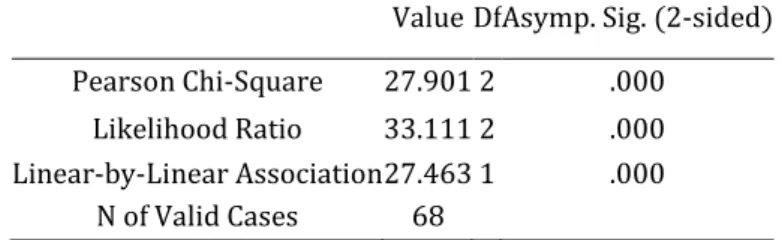
reporting and sustainability accounting. The Chi-square test of independence revealed that the probability values were less than the level of significance as in Table 9. The null hypothesis was hence rejected and the study concluded that there was a significant association between social reporting and sustainability accounting as evidence by Pearson chi-square . , . .
The findings were also confirmed by Likehood Ratio value in which ( . , . ). The output also revealed that linear by linear association between the variables was significant . , . . The results are presented in Table 9.
Onyango, Sylvester et al / International Business and Accounting Research Journal 3 (1) (2019) Error! No text of specified style in document.
Value Df Asymp. Sig. (2-sided) Pearson Chi-Square 27.901 2 .000
Likelihood Ratio 33.111 2 .000 Linear-by-Linear Association 27.463 1 .000
N of Valid Cases 68 The study findings hence confirmed that there was a statistically significant association between social reporting and sustainability accounting. This means that the practice of social reporting assist in communicating social activities of tea factories which hence build sustainability reporting.
The influence of social reporting on sustainability accounting was further explored by running a simple binary logistic regression model. The output in Table 10 confirmed that social reporting had significance influence on
sustainability accounting ( . , ) at five percent level of significance. Further, the simple binary regression indicated that the sustainability odds ratio of sustainability accounting at 95% confidence level for methods of reporting was 9.598 with confidence interval of . . . This means that social reporting was 9.598 times more likely to increase sustenance of practicing sustainability accounting as compared to absence of social reporting. The results are as shown in Table 10.
Error! No text of specified style in document. Variables in the Equation
B S.E. Wald df Sig. Exp(B) 95% C.I.for EXP(B) Lower Upper
Step 1a SR 2.262 .524 18.620 1 .000 9.598 3.436 26.809
Constant -5.116 1.345 14.481 1 .000 .006 The model produced is presented below:
{
} . .
(8)
These results were confirmed by the interview schedule in which some accountants asserted that sustainability accounting can only be pursued to sustainable level when items of social reporting are practiced by committing costs and the whether benefits are derived or not, the items need to be communicated to the stakeholders.
Multiple logistic regression was run in order to test for the moderating influence of stakeholder
knowledge on the relationship between the social reporting and sustainability accounting in tea factories of Mount Kenya region. The output showed that stakeholder knowledge does insignificantly influence the relationship between social reporting and sustainability accounting ( . , ) at five percent level of significance while the social reporting significantly influence sustenance of sustainability accounting. The results are presented in Table 11:
Table 11. Moderating Influence of Stakeholder Knowledge on the relationship between Social Reporting and Sustainability Accounting
Onyango, Sylvester et al / International Business and Accounting Research Journal 3 (1) (2019) Independent Variable
B S.E. Wald df Sig. Exp(B) 95% C.I.for EXP(B) Lower Upper SR 2.252 .524 18.433 1 .000 9.504 3.400 26.565 SK -.090 .484 .034 1 .853 .914 .354 2.360 SK by SR -.385 .853 .204 1 .652 .680 .128 3.624 Constant -4.864 1.898 6.567 1 .010 .008
a. Variable(s) entered on step 1: MR, SR, ER. The results indicated that it is not
mandatory that stakeholders gain accounting knowledge in order for social reporting to be done by tea factories. This means that tea factories and other organizations need to practice social reporting so as to accommodate several stakeholder interests in which this lead to integrated reporting that highly support sustainability accounting.
Discussion
Social reporting was analyzed based on human capital and community outreach which were interrogated in terms of whether the tea factory undertake activities of human capital and community outreach in which costs are incurred and benefits derived.
The study findings indicated that the tea factory incurred cost towards undertaking the human capital elements which included supporting the youth and youth affairs, wealth creation to the community, employment creation and expansion, development of its employees and business generation. Human capital investment takes a significant proportion of costs of operation of a business. These are the labor costs in terms of salary, recruitment, retention, and development of employees [99]. Some studies suggest that the costs of human capital is actually the cost incurred to acquire people and develop employees [100]. When the costing is wrongly done, it disorients the measurement on return on investments by various stakeholders [100] It was found out that the tea factory derived financial benefits by undertaking the human capital items. However, it was revealed that the tea factories did not incur cost in protecting intellectual property. This was confirmed the by the interview schedule in which some FUMs stated that the procedure in processing of tea was predefined and any innovation arose
from tea research institutes. It has been established that accounting for intellectual property poses challenge to many accountants in its valuation [101]. The tea factories in question lack autonomy, they are managed centrally employing same policies and strategies. This kills room for innovation at factory level and hence need for accounting for intellectual property rights and such intangible asset if not accounted for may cause risk to an entity [102]. The intellectual property are provided for under IAS38 but other standards like IFRS and FAS still lack framework of accounting for it.
The study revealed that the tea factory undertook the human capital items which included support of youth and youth affairs, wealth creation, employment creation and expansion, training and development of tea factory employees and business generation. The interview conducted revealed that the elements need to be integrated into the annual financial reports since they are practiced by the tea factories, this was stated by some of the accountants. The study findings are consistent with findings by [2] that studied on companies’ response to operational externalities which indicated that companies have social exposure. Organizations derive value from human capital disclosure which can improve company’s valuation in the market [103].
The study revealed that the tea factories incurred costs in community outreach activities like education sponsorship, gender balance programs, community based projects, maintenance of air quality, creation of central services and facilities and development of infrastructure. However, there was an indication that the tea factories do not incur costs on putting up health facilities and community health, recreational facilities and protection of gender vulnerability. The study found out that the tea factories derive
Onyango, Sylvester et al / International Business and Accounting Research Journal 3 (1) (2019) financial benefits from all the community outreach
items except on recreational facilities. The practice of such activities has been found to attract better employees and lower risks of turnover, and this enable organizational innovation and growth. These community outreach activities lead to creation of social capital which become intangible resources that a business owe the stakeholders [104].
The study concluded that there was a significant association between social reporting and sustainability accounting as evidence by Pearson chi-square as . , . .
The findings were also confirmed by Likehood Ratio value in which ( .5 , . ). The output also revealed that linear by linear association between the variables was significant .5 , . . The study
findings hence confirmed that there was a statistically significant association between social reporting and sustainability accounting. These findings are consistent with the results of survey conducted by KPMG on 4100 companies in 41 countries and which also confirmed that social reporting is growing. Study by [105] also found that social reporting has influence on sustainability accounting These social elements practised and reported by companies include community outreach activities, employment creation and charity work [105]. Another study has observed that social reporting, apart from benefiting stakeholders, is of importance to the organization since it improves financial performance, leads to reduced cost of oepration, improves commitment by staff, ehance chances of innovation and promote organizational brand [106]. The study also established that there was no siginificant moderating influence of stakeholder knowledge on the association between social reporting and sustainability accounting. This finding is contrary to the [108] which stated that social accounting, reporting and auditing is an appropriation for stakeholder involvement in terms of knowledge appropriation.
CONCLUSION
The study concluded that tea factories incur costs in undertaking social reporting elements. The study categorizes these costs as social costs. These costs can be reasonably estimated and are hence material in the accounting of an organization. Since the social costs are material and pegged on a future occurrence, the social costs hence according to the study is a contingency liability and need to be considered in the financial reports of the tea factories. However, the study indicated that stakeholder knowledge is not a withholding factor to the practice of social reporting as an influencer of sustainability accounting. Social reporting also leads to benefits both for the tea industries and the stakeholders. The benefits are in form of community outreach and human capital development in the tea factories. Since the social reporting practice leads to social benefits, the study also concluded that it leads to social assets. These social assets and social liabilities hence need to be included in the annual report for the support of sustainability accounting. Social reporting statistically significantly influence sustainability accounting in the tea sector in Mount Kenya region. Social practice, however, is not hindered by stakeholder knowledge since what matters most is the benefits that the tea industries and stakeholders enjoy from its practice.
The study recommends the practice of social reporting by the tea factories since it was found to affect industries’ long term activities. The social practice brings social assets to the tea industries and hence is financially prudent to be reported in the annual reports so that sustainability accounting is assured. Tea industries are also recommended not to do costly activities of educating stakeholders on social reporting since such stakeholder education do not have significant moderating influence on the relationship between social reporting and sustainability accounting. The value creation for stakeholders means that the tea industries value also increases in the long run, hence the recommendation for social reporting practice by the tea industries.
REFERENCES
Onyango, Sylvester et al / International Business and Accounting Research Journal 3 (1) (2019)
Accountability," World Academy of Science and Technology, pp. 1119 - 1125, 2010. [2] S. Dewi, "Social & Environmental Accounting,"
International Journal of Scientific & Technology Research, vol. 3, no. 3, pp. 2277-8616, 2014.
[3] C. Dasculus, J. C. Lungu, F. Colceag and R. Guse, "The Externalities in Social Environmental Accounting," International Journal of Accounting and Information Management, vol. 18, no. 1, pp. 19 - 30, 2010.
[4] D. Dana , "Environmental Information in Financial Statement," Journal of Competitiveness, vol. 1, pp. 20-31, 2009.
[5] B. Acerete, F. Llena and J. Moneva, "Environmental Disclosure in Financial Statements: An Anlaysis of Spanish Toll Motorway Concessioneries, Transportation Research," Spain, 2011.
[6] A. N. Onunze, "Social Accounting: A Method of Assessing the Impact of Nigerian Enterprise Development Activities," Abuja, 2009.
[7] U. Uwalomwa and J. Jarafu, "Coporate Environmental Disclosures in the Nigerian Manufacturing Industry," An International Multidisciplinary Journal, Ethiopia, vol. 6, no. 3, pp. 78 - 83, 26 July 2012.
[8] C. E. Ezeagba, "The Need of Inclusion of Human Resource Accounting in The Balance Sheet," An Internaltional Multidisciplinary Journal, Ethiopia, pp. 377 - 392, April 2014. [9] C. I. Mwangi and O. J. Jerotich, "The Relationship between Corporate Social Responsibility Practices and Financial Performance of Firms in the Manufacturing, Construction and Allied Sector of the Nairobi Securities Exchange," International Journal of Business, Humanities and Technology, vol. 3, no. 2, pp. 81-89, 2013.
[10] A. O. Odhiambo, "The Effect of Social and Environmental Accounting on the Financial Performance of Companies Listed in Nairbi Stock Exchange," University of Nairobi Press, Nairobi, 2015.
[11] I. Mwasa, F. N. Sira and L. Maina, "Social Accounting Practises Among Kenyan Firms," International Journal of Social Sciences and Entrepreneurship, vol. 1, no. 11, pp. 144 - 152, 2014.
[12] P. S. Bronn and D. Vidaver-Cohen, "Corporate Motives for Social Initiatives: legitimacy, sustainability, or tripple bottom line?," Journal of Business Ethics, vol. 87, pp. 91-109, 2009.
[13] R. Gray, "Social, Environmental and Sustainability Reporting and Organizational Value Creation? Whose Value? Whose Creation?," Accounting, Auditing and Accountability Journal, vol. 19, no. 6, pp. 793-819, 2006. [14] C. L. Lungu, C. Caraniani, C. Dascalu and R. G. Guse,
"Exploratory Study on Social and Environmental Reporting of European Companies in Crisis Period," Accounting and Management Information System, vol. 10, no. 4, pp. 459-478, 2011.
[15] C. I. Lungu, C. Caraiani, C. Dascula and F. Colceag, "Social and Environmental Performance Disclosures and Correlations to Company Characteristics," in Proceedings of the Fifth International Conference on Accounting & Management Information System, 2010. [16] D. K. Tarus, "Corporate Social Responsibility
Engagements in Kenya: Bottom line or Rhetoric?," Journal of African Business, vol. 16, no. 3, pp. 289-304, 2015.
[17] M. Wachira, "Determinants of Corporate Social Disclosures in Kenya: A Longitudinal Study of Firms Listed in Nairobi Security Exchange," European Scientific Journal, vol. 13, no. 11, pp. 112-132, 2017.
[18] W. Omolo, "Construction of Social Accounting Matrix of Kenya," Government Publishers, Nairobi, 2014.
[19] A. O. Nkawatei, "Relationship between Social Accounting Practises and Profitability: The Case of Oil Industry in Kenya," University of Nairobi Press, Nairobi, 2011.
[20] D. N. Wanjala, "Factors that Influence Corporate Social Responsibility Programmes Among the Commercial Banks in Kenya," Kenyatta University Press, Nairobi, 2011.
[21] G. D. Barako, H. Phil and Y. H. Izan, "Factors Influencing Voluntary Corporate Disclosures," Corporate Governance, vol. 14, no. 2, pp. 107-125, 2009.
[22] D. Barako, "Determinants of Voluntary Disclosures in Kenyan Companies Annual Reports," African Journal of Business Management, vol. 1, no. 5, pp. 113-128, 2007.