Summarization: Generating Descriptive Summaries of
Geo-Located Entities
Ahmet Aker
A thesis submitted in fulfilment of requirements for the degree of Doctor of Philosophy
to
Department of Computer Science University of Sheffield
Declaration
I hereby declare that this thesis is of my own composition, and that it contains no material previously submitted for the award of any other degree. The work reported in this thesis has been executed by myself, except where due acknowledgement is made in the text.
In this work we investigate the application of entity type models in extractive multi-document summarization using the automatic caption generation for images of geo-located entities (e.g. Westminster Abbey, Loch Ness, Eiffel Tower) as an application scenario. Entity type models contain sets of patterns aiming to capture the ways the geo-located entities are described in nat-ural language. They are automatically derived from texts about geo-located entities of the same type (e.g. churches, lakes, towers). We collect texts about geo-located entities from Wikipedia because our investigation show that the information humans associate with entity types pos-itively correlates with the information contained in Wikipedia articles about the same entity types.
We integrate entity type models into a multi-document summarizer and use them to address the two major tasks in extractive multi-document summarization: sentence scoring and summary composition. We experiment with three different representation methods for entity type mod-els: signature words, n-gram language models and dependency patterns. We first propose that entity type models will improve sentence scoring, i.e. they will help to assign higher scores to sentences which are more relevant to the output summary than to those which are not. Secondly, we claim that summary composition can be improved using entity type models.
We follow two different approaches to integrate the entity type models into our multi-document summarizer. In the first approach we use the entity type models in combination with existing standard summarization features to score the sentences. We also manually categorize the set of patterns by the information types they describe and use them to reduce redundancy and to produce better flow within the summary. The second approach aims to eliminate the need for manual intervention and to fully automate the process of summary generation. As in the first approach the sentences are scored using standard summarization features and entity type models.
However, unlike the first approach we fully automate the process of summary composition by simultaneously addressing the redundancy and flow aspects of the summary.
We evaluate the summarizer with integrated entity type models relative to (1) a summarizer using standard text related features commonly used in summarization and (2) the Wikipedia location descriptions. The latter constitute a strong baseline for automated summaries to be evaluated against. The automated summaries are evaluated against human reference summaries using ROUGE and human readability evaluation, as is a common practice in automatic summarization. Our results show that entity type models significantly improve the quality of output summaries over that of summaries generated using standard summarization features and Wikipedia baseline summaries. The representation of entity type models using dependency patterns is superior to the representations using signature words and n-gram language models.
This work would have never been possible without advice, help and support from many excellent people. I was very fortunate to work under the supervision of Prof. Robert Gaizauskas, and I greatly profitted from our many discussions and meetings, his insightful comments on the work and his enthusiasm for it, as well as from his support in all the ways I needed during this PhD. I am very thankful for these. Thanks also to Prof. Mark Sanderson, Dr. Horacio Saggion, Dr. Guy Brown and Dr. Mark Hepple for important comments on my experiments and reading suggestions. I thank Dr. Trevor Cohn for collaboration and many discussions from which I learned a lot. During my PhD I was a member of the NLP lab of the University of Sheffield, where I was fortunate to work with several great people. I thank Dr. Adam Funk, Dr. Kamutha Swampillai and Dr. Mark Greenwood for their practical help and useful discussions. Dr. Georg Struth and Dr. Kirill Bogdanov from the Verification and Testing group of the Computer Science Department helped me understand some math problems and offered solutions I couldn’t think of. I am very grateful for this. Outside my lab and the department I was fortunate to work with and learn from several great people. I thank Dr. Xin Fan, Dr. Elena Lloret, Dr. Laura Plaza and Pino diFabrizio for collaborations which were both fruitful and fun.
My PhD was indirectly funded by the TRIPOD project supported by the European Commission under the contract No. 045335, and and I gratefully acknowledge this support. I also would like to thank Mama (Dr. med. Olga Nesic), Baldiz Edina Kurtic, Baldiz Lejla Kurtic, Dr. Mesude Bicak, Dr. Asmaa El Hannani, Dr. Azza Al-Maskari, Dr. Mariam Kiran, Yasin Efe, Murad Abouammoh, Rafet Ongun and Dilan Paranavithana for participating in the manual evaluations and the tedious model summary collection activities. I think without their help, especially of Mama and Baldiz Edina, I would never have finished my experiments. I also would like to thank Babo, Dr. med. Adem Kurtic, for collecting all my publications on his special shelf. To fill
this shelf is a challenging goal but the idea of achieving this one day made me always strive to publish more.
None of this work would have been even initiated, let alone completed without help, support and love from my family. I thank my wife, Emina, who has always given me the most of love, help and support. My daughter, Nur, and my son Dzemal have been a source of inspiration and provided more than enough motivation to continue. Finally, thanks to Him, to my mother, my father, my sisters and my brother.
Declaration i
Abstract iii
Acknowledgements v
Chapter 1 Introduction 1
1.1 Application Scenario – Automatic image captioning . . . 2
1.2 Aims and Scope . . . 5
1.2.1 Sentence Scoring . . . 6
1.2.2 Summary Composition . . . 7
1.3 Hypotheses and Contributions . . . 8
1.4 Thesis Structure . . . 10
Chapter 2 General Overview of Automatic Summarization 15 2.1 Automatic Document Summarization . . . 15
2.2 Summarization Techniques . . . 17
2.2.1 Non-Transformational Techniques . . . 17
2.2.2 Transformational Techniques . . . 28
2.3 Automated Summary Evaluation . . . 36
2.3.1 Intrinsic Evaluation . . . 36
2.3.2 Extrinsic Evaluation . . . 39
2.4 Summary . . . 39
Chapter 3 Overview of Methodology and Resources 41 3.1 Methodology Steps . . . 41
3.1.1 Step 1: How Humans describe Geo-located Entity Types . . . 41
3.1.2 Step 2: Building Corpora for Geo-located Entity Types . . . 42
3.1.3 Step 3: Building Geo-located Entity Type Models for Summarization . 43 3.1.4 Step 4: Evaluation . . . 44 3.2 Resources . . . 45 3.2.1 Summarizer . . . 45 3.2.2 Web Documents . . . 47 3.2.3 Baseline Summaries . . . 48 3.3 Summary . . . 49
Chapter 4 How Humans describe Geo-located Entity Types 51 4.1 Related work . . . 52
4.2.1 Mechanical Turk . . . 52
4.2.2 Experimental Design . . . 53
4.2.3 Question Preprocessing . . . 55
4.3 Analysis . . . 57
4.3.1 Is there a set of attributes that people generally associate with geo-located entity types? . . . 57
4.3.2 Is each set of attributes specific to a particular entity type or shared be-tween several entity types? . . . 61
4.3.3 Discussion . . . 63
4.4 Summary . . . 64
Chapter 5 Building Corpora for Geo-located Entity Types 65 5.1 Wikipedia as a resource for building entity type text corpora . . . 65
5.2 Building entity type text corpora from Wikipedia . . . 70
5.2.1 Entity type text corpora collection procedure . . . 70
5.2.2 Evaluation . . . 74
5.2.3 Related Work . . . 75
5.3 Summary . . . 78
Chapter 6 Model Summaries 79 6.1 The Image Set . . . 80
6.2 Model Summaries . . . 82
6.4 Collection Procedure . . . 84
6.5 Evaluation . . . 86
6.6 Summary . . . 88
Chapter 7 Entity Type Models for Multi-Document Summarization 89 7.1 Signature Words . . . 90
7.2 Language Models . . . 91
7.3 Dependency Patterns . . . 93
7.4 Entity Type Model Features . . . 96
7.4.1 Signature Words . . . 96
7.4.2 Language Models . . . 96
7.4.3 Dependency Patterns . . . 97
7.5 Dependency Patterns for Redundancy Reduction and Sentence Ordering . . . . 97
7.6 Training and Testing procedure . . . 99
7.6.1 Training the Prediction Model . . . 99
7.6.2 Testing . . . 100
7.7 Evaluation . . . 100
7.7.1 ROUGE Assessment . . . 101
7.7.2 Readability Assessment . . . 103
7.7.3 Discussion . . . 105
7.9 Summary . . . 109
Chapter 8 Addressing the Challenges of Summary Composition 111 8.1 Summary Composition as Search Problem . . . 112
8.2 Searching for the Most Informative Summary . . . 113
8.3 Searching for the Least Redundant Summary . . . 115
8.3.1 Dynamic Filter to Reduce Redundancy . . . 116
8.3.2 A* Search with Redundancy Reduction . . . 118
8.4 Searching for a Well Ordered Summary . . . 121
8.4.1 Generating Information Type Flow Models . . . 122
8.4.2 Using Information Type Flow Models in Summary Generation . . . 125
8.4.3 Related Work . . . 127
8.5 Training and Testing procedure . . . 128
8.5.1 Training the Prediction Model . . . 129
8.5.2 Overview of Training and Testing procedure . . . 129
8.6 Evaluation . . . 130
8.6.1 A Comparison Between Different Approaches for Training . . . 131
8.6.2 Integration of Redundancy Features . . . 134
8.6.3 Integration of the Sentence Ordering Feature . . . 136
8.6.4 Discussion . . . 140
Chapter 9 Conclusion and Future Work 145
9.1 Summary . . . 145
9.2 Contributions . . . 148
9.2.1 Attributes for Geo-located Entity Types . . . 148
9.2.2 Creating Entity Type Models . . . 150
9.2.3 Entity Type Models for Sentence Scoring and Summary Composition . 151 9.2.4 Integration of Training and Search . . . 154
9.2.5 Applications . . . 155
9.3 Future Work . . . 156
Appendix A Different Heuristics Used in A* Search 159
1.1 The Panofsky-Shatford mode/facet matrix, Shatford (1986) . . . 4
1.2 Papers published within the thesis. . . 13
4.1 Geo-located entity types used in the experiment. . . 55
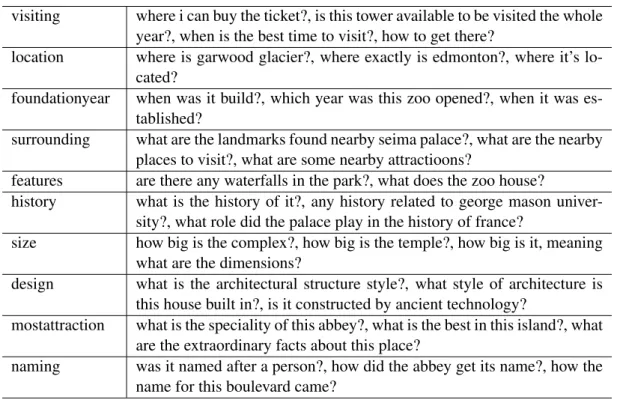
4.2 Top ten attributes with related questions. . . 55
4.3 Attributes used to categorize the questions: attribute name (questions count in each attribute, percentage of the total number of questions) . . . 56
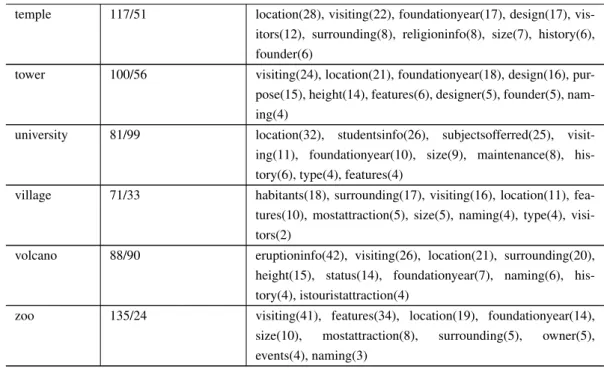
4.4 Statistics about attributes in each entity type. . . 60
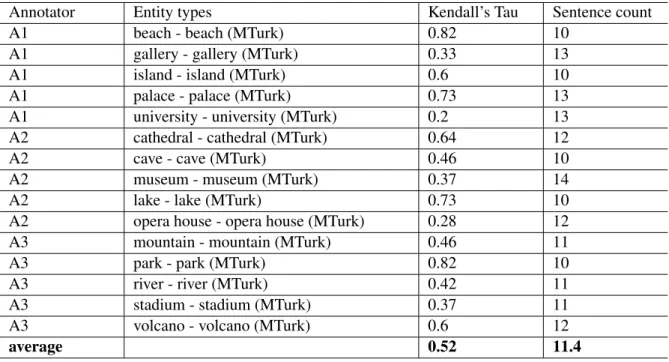
4.5 Kendall’s Tau correlation results for the urban entity types. . . 63
4.6 Kendall’s Tau correlation results for the rural entity types. . . 63
5.1 Results of analysis of Wikipedia articles. . . 69
5.2 Kendall’s Tau correlation results of attributes from Wikipedia articles and MTurk survey. . . 70
5.3 Entity types and the accuracy of the categorization. . . 75
5.4 Entity types (80 urban and 27 rural types) identified by our Is-A patterns along with the number of articles in each corpus. . . 76
5.5 DBpedia Categories related to locations. . . 77
6.1 Image entity types, number of different entities and the number of model sum-maries for each entity type. Entity types in bold are rural types. . . 81 6.2 Wikipedia entity types not covered by the image entity type set. Entity types in
bold are rural types. . . 82 6.3 Example description aboutKorean War Veterans Memorialfrom VirtualTourist
descriptions. . . 84 6.4 Example model summary about Edinburgh Castle with 199 words. . . 86 6.5 Readability five point scale evaluation results. In total the columns sum to 489. 87 7.1 Example sentence for dependency pattern. . . 95 7.2 Five frequent patterns from the entity type corporariverandvolcano. . . 95 7.3 Model, Wikipedia baseline and isStarter+LMSim-2+DepCat summary for Eiffel
Tower. . . 101 7.4 ROUGE scores for each single feature and Wikipedia baseline. The numbers 1
and 2 after the model featuresSigMSimandLMSimindicate the use of uni-gram (1) or bi-gram (2) version of those models. . . 101 7.5 ROUGE scores of feature combinations which score moderately or significantly
higher than dependency pattern model (DpMSim) feature and Wikipedia baseline. 103 7.6 Readability evaluation results: – Wikipedia baseline (W), isStarter + LMSim-2
(SLM) and isStarter + LMSim-2 + DepCat (SLMD) . . . 104 7.7 Readability evaluation results showing only the percentage values of summaries
which achieved scores at levels four or above. . . 104 7.8 Example of sentences which express the type of an entity. . . 106 7.9 Groups of entity types. . . 108 7.10 ROUGE scores of featuresLMSim−2,LMSim−2g,DpMSimandDpMSim−g(g
8.1 ROUGE scores obtained on the training data. . . 133 8.2 ROUGE scores obtained on the testing data. . . 133 8.3 Experimental results. In each row the results were obtained with the prediction
model trained on the metric of that row. . . 135 8.4 Example summary about the Akershus Fortress. This summary is generated
using the setting JRT. . . 135 8.5 Readability evaluation results. . . 137 8.6 Readability evaluation results showing only the percentage values of summaries
which achieved scores at levels four or above. . . 138 8.7 Rouge Experimental results after integration of sentence ordering (J RT F). . . 139 8.8 Example summary for the Akershus Castle. This summary is generated using
1.1 Image of Matterhorn taken from http://de.m.wikipedia.org. . . 3
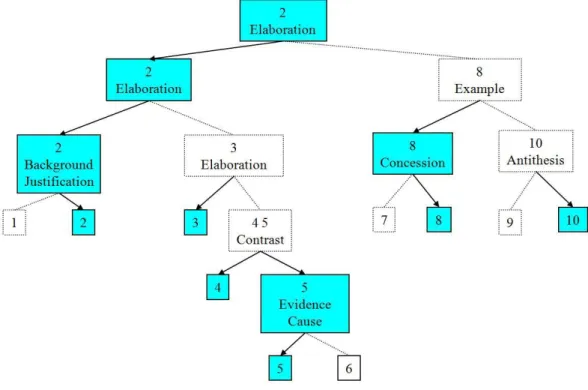
2.1 RST tree example. The filled leaf boxes are regarded as nucleus and the others as satellites Marcu (1997a). . . 35
4.1 Design of the online MTurk experiment. Because of space limitations the figure shows only text fields for four questions. However, in the experimental design there were 10 such text fields. The image is taken from Wikipedia. . . 54
5.1 Step 1 automaton. . . 71
5.2 Step 2 automaton. . . 72
5.3 Entity types identified from Wikipedia . . . 74
5.4 Wikipedia infobox for Yosemite National Park. . . 76
6.1 Model Summary Collection . . . 85
8.1 Search graph for extractive summarization. . . 114
8.2 Learning the redundancy thresholdR. . . 121
A.1 Example of the A* search graph created to find the two top scoring summaries of length ≤ 7 when summarising four sentences with scores of 4, 3, 2 and 1 respectively and lengths of 5, 4, 3 and 1 respectively. Theh1heuristic was used and the score and heuristic scores are shown separately for clarity. Bold nodes were visited while dashed nodes were visited but found to exceed the length constraint. . . 161 A.2 Efficiency of A* search search is roughly linear in the number of sentences in the
document set. The y axis measures the search graph size in terms of the number of edges in the schedule and the number of nodes visited. Measured with the final parameters after training to optimise ROUGE-2 with the three different heuristics and expanding five nodes in each step. . . 162
Introduction
Automatic text summarization aims to represent the topics found in one or more input documents to the user in a condensed form and so to reduce the time effort the user would spend for reading all the documents. As described in Chapter 2 in extractive text summarization this is achieved by selecting a subset of sentences from the document collection which are concatenated to form the summary. The goal is that the summary should contain the most relevant information from the input documents without unnecessary repetitions, and be coherent and readable.
As outlined in Chapter 2 a summary can be generated from a single document or multiple doc-uments. In both cases it is possible to distinguish between generic and query-focused text sum-marization. In generic text summarization the summary content is determined only based on the content of the input documents. In the case of query-focused text summarization the summarizer is given a natural language query as input which is used by the summarizer to bias its sentence selection towards the pieces of information closely related to that query. The query can take any form. For instance, the query can be an open-ended question about a person such as “Who is X?”, as formulated in the Document Understanding Conferences (DUC), withXbeing the name of a person (Nenkova & McKeown 2011).
To help extract facts about the person one could consider using a person type model. Such a model might capture what facts are typically provided about persons and also the ways these are described in existing texts. When generating a summary about a specific personX the person type model could then be used to bias the summarizer’s sentence selection. In addition, the person type model could be used to mark each sentence with the type of information it contains, such asdate of birth. This would help the summarizer to compose the summary by selecting sentences with unique facts and thus reduce redundancy within the summary. Finally, the model
could be used to order the sentences in the summary. For example, a sentence that contains the information about the date of birth of a person could be marked by the model as preceding the sentence containing the date of death of that person. Applying such relationships between the sentences during the summary composition can lead to more coherent summaries and avoid the common problem that the summary reads like a heap of information without any meaningful connection between the sentences.
In this work we use query-focused text summarization to generate a summary for an entity expressed in the query. Instead of a person we use a geo-located entity in the query. Geo-located entities are static features of the built or natural landscape, for example a building, a bridge, a mountain or a river. We create geo-located entity type models to bias the summarizer’s sentence selection but also for redundancy reduction and sentence ordering within the summary. Our models are learned off-line from existing texts about different entities of the same type such as church, river, mountain, etc. We apply our summarizer to the task of generating captions for images pertaining to geo-located entities.
1.1 Application Scenario – Automatic image captioning
The number of images available electronically is growing exponentially with the rapid develop-ment of online photo sharing services and increasing prevalence of digital cameras and camera phones. Additionally, many legacy photographs and other images are stored or archived. Ef-fective access to these images is only possible if they are searchable, which presupposes that images are indexed and easily identifiable. However, typically, only limited textual information is available with each image, usually in form of a set of keywords assumed to describe an image. Alternatively, it could be that no textual information is provided, but the images are only tagged with geo-coordinates and compass information. Such a small or non-existent amount of textual information associated with an image is of limited usefulness for image indexing, organization and search. What would be useful is a means to automatically generate or augment captions for images on the basis of minimal input information. The generated captions could then be used for indexing purposes.
Automatic image captioning is a challenging task not least because it is not straightforward to decide what to include in a caption. One can capture any kind of object in the universe with an image, so the content of an image can be virtually anything we can see (abstract objects made by photo-montage are left out of consideration). However, most objects are multi-faceted and it is not clear which aspects of the image the caption should address. For example, if we take an
Figure 1.1: Image of Matterhorn taken from http://de.m.wikipedia.org.
image of theMatterhorn(Figure 1.1), one could say that the image shows “a mountain covered with snow” or “Matterhorn” if it is known that it is Matterhorn. Alternatively, an interpreta-tive description could be given, e.g. one could say that the image shows challenge, difficulty etc. To make the interpretation the person writing the description needs more knowledge about Matterhorn. Therefore, such descriptions can vary from individual to individual and depending on the task of use of the description as each individual will have different knowledge about the object(s) shown in the image and a different interpretation of this knowledge. In addition, the task or context of use will also have impact on the resulting descriptions.
To gain insight into what types of descriptions humans associate with images, a substantial number of investigations into how to classify images or image contents in categories have been carried out. As a result, many classification schemas or analyses dedicated to categorization of image-related information have been proposed (e.g. Armitage & Enser (1997), Eakins (1998), J¨orgensen (1998), Jaimes & Chang (2000), etc.). However, the classification schema proposed by Panofsky (1972) and modified by Shatford (1986) shown in matrix in Table 1.1 has been used as the direct or indirect basis for all these works in the field of image classification.
Attempts towards automatic generation of image captions, which mostly address thewhatand whofacets of the Panofsky-Shatford matrix have been previously reported. They can be divided intotext-basedandcontent-basedimage caption generation approaches. Text-based approaches generate image captions solely using texts related to the image and do not take image features such as colour, texture, position, etc. into consideration. The content-based methods take image-related texts as well as the image features as input and output image captions based on these two input resources.
Table 1.1: The Panofsky-Shatford mode/facet matrix, Shatford (1986)
Facets\Modes Specific Of Generic Of About
WHO? Individually named
persons, animals, things,...
Kinds of persons, ani-mals, things Mythical beings (Generic/Specific), Abstractions mani-fested or symbolized by objects or beings
WHAT? Individually named
events
Actions, conditions Emotions, Abstractions manifected by actions, events
WHERE? Individually named
ge-ographic location
Kind of place geo-graphic or architectural
Places symbolized (Generic/Specific), Ab-stractions manifested by locale
WHEN? Linear times; dates or
periods
Cyclical time; seasons, time of day
Emotions or abstrac-tions symbolized by or manifested by time
To our knowledge the work of Deschacht & Moens (2007) is the only text-based approach in image captioning. The authors automatically generate image captions using associated text such as existing image captions, video transcripts or surrounding text in web pages. They try to identify entities (names of persons and objects) shown in the image. To do this they first detect persons and objects in the associated text by applying automatic named entity recognition. Then they rank the identified entities (person and object names) by assigning them salience weights (the importance of an entity in a text based on word statistics) and visualness measures (how likely an entity will be present in the image). Entities above a threshold of these measures are taken as captions for the image.
In contrast to Deschacht & Moens (2007), several different content-based approaches (Mori et al. 2000, Barnard & Forsyth 2001, Duygulu et al. 2002, Barnard et al. 2003, Pan et al. 2004, Feng & Lapata 2008, Farhadi et al. 2009, Feng & Lapata 2010c,b,a, Farhadi et al. 2010, Yao et al. 2010) use a combination of text resources related to the image and low level image features to generate captions. Although there are differences in problem formulation and application, the common idea presented by these studies is (1) to relate words or greater units such as sentences from the immediate textual context of an image to features or attributes extracted from the image and (2) use the high co-relating text units as description of the image content.
The main drawback of these approaches is that they rely on texts associated with images. How-ever, the associated text may have little semantic agreement with the content of the image, which
can result in captions which do not describe the image at all (Marsh & White 2003). Using these “wrong” captions for indexing purposes, for instance, can, according to Purves et al. (2008), be misleading to image retrieval. More importantly, these approaches assume that there exists a text associated with an image. This could be the case if the image has been obtained from a document, for example, or has some existing description or caption describing its content. However, this need not be the case. In the case where there is no document associated with the image or no immediate text that describes its content exists, these techniques are not applicable. Captioning images with little or no associated text information is precisely the scenario which we are concerned with in this work.
1.2 Aims and Scope
We use query-focused, extractive multi-document summarization to generate captions or sum-maries for geo-located entities. Extractive multi-document summarization aims to present the most important parts of multiple documents to the user in a condensed form by identifying the most relevant sentences from these documents and presenting them in the same form which they have in the original documents (Jones 1999, Mani 2001).
In our system the documents to be summarized are web-documents retrieved using the name of the geo-located entity shown in image (e.g. Eiffel Tower) as a query. The resulting image caption has the form of a short description or summary of the web-documents about the place in the image, which distinguishes it from captions in form of lists of keywords generated in much previous work (e.g. (Duygulu et al. 2002, Barnard et al. 2003, Pan et al. 2004, Farhadi et al. 2009)). Therefore, in the remainder of the thesis we use the terms caption, (image) description and summary interchangeably.
Extractive multi-document summarization is presented with several challenges. First of all, it is necessary to distinguish between summary-relevant and summary-irrelevant sentences. This is referred to assentence scoringorsentence ranking. Summary-relevant sentences are those which are candidates for inclusion in the final summary and thus should be ranked or scored by the summarizer more highly than the summary-irrelevant sentences. Once the sentences are scored there is the challenge of composing the final summary from these sentences, so that 1) the summary is informative, i.e. contains the most relevant pieces of information without exceeding a predefined length, 2) does not contain redundant information and 3) is fluent to read. Constructing such a summary from a subset of scored sentences will be referred to as summary composition.
While related work on automatic summarization usually tackles these challenges independently, in this work we address all jointly. Therefore, the first aim of this work is to investigate how sentence scoring can be improved using models of how people organize and describe knowledge about geo-located entities in their environment. The second goal is then to address the challenges of summary composition by integrating this knowledge. To this end we outline a framework which jointly addresses the maximisation of summary informativeness, redundancy reduction and improving the sentence ordering within a summary.
1.2.1 Sentence Scoring
Previous work has identified several text-based features which are commonly used in sentence scoring (see Chapter 2). These features are “universal” text features, in the sense that they capture a topic and other general properties of a text independently of what a text is about, and what kind of issue the summary should address. They may work well in some domains or genres, but not in others. For example, thesentence positionfeature indicates the position of the sentence within its document, so that e.g. the first sentence in the document gets the highest score, and the score decreases towards the end of the document. This feature has been found useful in the news genre. For news articles the first sentences in the article are worth including in the summary because they usually summarize the entire article (Baxendale 1958, Kupiec et al. 1995, Teufel & Moens 1997). However, Kim et al. (2007) note that this feature was not useful for scoring sentences in biomedical research papers. What may be useful in every domain is to capture how people think about the entities, events and general topics of this domain. This involves identifying the types of information people associate with the topics of the domain and scoring the sentences which address them more highly. Unlike the direct text features, this involves a level of abstraction above the text, as sentences need to be categorized according to the information types they address. However, by doing so the foci of interest within a domain can be captured and addressed in the summaries, which may improve their quality.
For this reason, in addition to using the features commonly used for sentence scoring in previous work, our multi-document summarizer biases the sentence scoring according to anentity type model. Using entity type models in sentence scoring is central to our approach. It derives from the fact that humans can categorize things they see in their environment. Cognitive psychology has offered several theories and substantial empirical evidence for existence of categories or concepts and an explanation of what constitutes them (Eysenck & Keane 2005). These theories agree that concepts are characterized by sets of attributes, although they differ in whether a set of attributes is necessary and sufficient to define a concept (defining-attributes theories) or whether
the concepts are more fuzzy in their specification in terms of attributes (prototype theories), so that some instances are more representative of a concept than others.
If humans use concepts to organize the knowledge about the world, then we assume that they will have ways to describe these concepts in natural language. We argue that to build a good summary about a geo-located entity (e.g. Eiffel Tower, Westminster Abbey, etc.), we need to select sentences which address the attributes specific to the concept this entity can be categorized into (e.g. tower, church, etc.). This can be achieved if the sentence selection is biased according to an entity type model.
Entity type models are automatically derived from texts describing entities of the same type and contain sets of patterns aiming to capture the ways the entities are described in natural language. We investigate whether entity type models can help our summarization system to perform better sentence scoring.
1.2.2 Summary Composition
We investigate two different ways of composing the final summary from scored sentences: (1) learning a model based on the actual automatic summaries that discriminates between good and bad summaries and (2) integrating summary informativeness, redundancy reduction and summary fluency into the composition process.
For learning the model to discriminate between good and bad summaries, i.e. the prediction model, we investigate the idea of integrating the training of the model and the summary compo-sition within a single framework. The advantage of having such a framework is that the predic-tion model for distinguishing between good and bad summaries is trained on the actual outputs of the summarizer. Thus the prediction model is trained to optimize the actual summary quality. In this way our work departs form related work where there is no connection between the train-ing and summary composition. In this case the prediction model does not optimize the summary quality but some other peripheral objective, so this does not guarantee that the prediction model will successfully distinguish between good and bad summaries.
Finally, we investigate whether we can formulate the summary composition as a search method that finds the subset of scored sentences in the input documents which combined lead to the most informative, least redundant and most fluent summary.
1.3 Hypotheses and Contributions
This work aims to investigate the ways in which entity type models can be integrated into a multi-document summarization system and to propose a framework which tackles summariza-tion challenges in an integrated manner, with training and search tasks addressed simultaneously. Several hypotheses underlie this work.
1. Geo-located entity types are characterized by sets of attributes, some of which are type specific and others are shared between types: Although this seems evident based on the concept definitions made by theories mentioned above, the evidence for catego-rization of entities into types in these theories comes from domains such as furniture or colours (Rosch 1999). Geo-located entity types such asmountain, lake, etc. were in-vestigated by Smith & Mark (2001). The authors analyse how non-experts conceptualize geo-located entities by asking them to suggest entity types after seeing an geo-located entity-related phrase such asnatural Earth formation. With this study the authors demon-strate that entity types of the natural landscape form a part of human cognitive inventory about geo-located entities. However, they do not investigate what characteristics or at-tributes humans associate with different entity types. We aim to investigate how humans characterize geo-located entity types in terms of sets of attributes, which may be specific to single entity types (e.g. church), or shared between entity types of similar function (e.g. church and temple).
2. Entity type models can be derived from existing text resources:We claim that relevant attributes which characterize entity types are present in existing online collections of text resources, so that entity type models can be derived from these text resources.
3. Entity type modeling improves sentence scoring: We claim that incorporating entity type models into a summarizer’s sentence scoring will significantly improve summary quality over using standard text related features. However, whether this is the case might also depend on the way entity type models are derived and represented. To test this hy-pothesis, we evaluate three methods for approximating entity type models: a) signature words, b) n-gram language models and c) dependency patterns.
4. Entity type modeling can be used for redundancy reduction and improving sentence ordering within a summary:We hypothesize that it is not only the attributes which char-acterize an entity type, but also the ordering of these attributes, which is relevant when generating a description of an entity. Therefore, we claim that entity type models can be
used to automatize information ordering within a summary and improve summary coher-ence. Furthermore, we claim that entity type models can be used to control information duplication and so reduce redundancy within a summary.
5. Having a model trained on actual outputs of the summarizer improves the summary quality over methods in which such a model is not trained on the automatic sum-maries: When there is no connection between training of a model for predicting good and bad summaries and the actual summarizer’s output, it is not guaranteed that the model later performs the prediction correctly. By carrying out summary composition with the training of the model intact, we ensure that the model is learned in such a way that the best scoringwhole summaryunder the model has a high score under an evaluation metric. Therefore, we hypothesize that these summaries will have higher quality than summaries generated by methods in which training and summary composition are two independent steps.
By testing these hypotheses this work makes a number of novel contributions.
It introduces the idea of entity type modeling to automatic multi-document summarization by investigating whether entity type models can improve both sentence scoring and summary com-position. To do this the work contributes a detailed account of how entity type models for summarization can be derived, starting from the description of how humans conceptualize geo-located entities and the investigation of the extent to which this information is retrievable from existing text resources, and ending with the evaluation of three different representation methods for entity type models.
Given that conceptualization is a general feature of human thinking, the idea of entity type modeling is not limited to geo-located entity description generation, but also applies to other domains and genres. Therefore, our technique is suitable not only for image captioning but in any application context that requires summary descriptions of instances of entity classes, where the instance is to be characterized in terms of the features typically mentioned in describing members of a class.
A further contribution of this work is that it aims to address automatic summarization challenges in a single integrated framework. We offer entity type modeling as a method for improving sentence scoring and also use it to reduce redundancy, maximize informativeness and control sentence ordering within the output summaries. Furthermore, our approach unifies training and summary composition and proposes a framework which can be used for generation of optimized summaries.
Finally, the summarization framework developed in this work presents a working summarization system which can be used for automatic image captioning. As such it can be turned into an application for smart phones for example, which automatically generates image descriptions for an image of any geo-located entity taken using the phone. As smart phones are equipped with GPS and compass, the geo-referencing information necessary to generate image descriptions using our system is provided. The application would be interesting for all users seeking to find information about a geo-located entity just by taking its picture.
Furthermore, our system can be used for caption generation or caption augmenting for many pictures archived electronically. As previous work suggests, having more information about the content, i.e. short description, of the place in picture would improve the image’s retrievability. In our earlier work we have shown that this is indeed the case (Aker, Fan, Sanderson & Gaizauskas 2012).
1.4 Thesis Structure
This thesis is organized as follows:
In Chapter 2 (General Overview of Automatic Summarization) we review related work in au-tomatic document summarization. The review addresses the two challenges in auau-tomatic text summarization: 1) the identification of summary-worthy sentences (sentence scoring) and 2) the generation of informative and readable summaries (summary composition). For sentence scoring, we discuss a number of text related features used in previous work, against which we evaluate the performance of our summaries biased by entity type models. For summary compo-sition, we introduce several previous approaches to informativeness maximization, redundancy reduction and achieving summary coherence. Furthermore, we summarize different approaches for evaluation of automatically created summaries.
In Chapter 3 (Overview of Methodology and Resources) we outline the steps undertaken to address our research questions and the resources needed for summary generation and evaluation. We proceed in four steps: 1) collecting attributes associated with geo-located entity types; 2) analysing existing text resources to establish whether, and if so how these attributes are described in existing texts; 3) exploring methods of geo-located entity type model representation and their exploitation in summarization; and 4) evaluating our summarization techniques. The resources we describe in this chapter are our summarization system, the baseline summaries and the input web-documents from which we generate the automated summaries.
Chapter 4 (How Humans describe Geo-located Entity Types) describes an online user survey which aims to understand what information types (attributes) humans associate with geo-located entity types. This chapters aims to test our first hypothesis that geo-located entity types are characterized by sets of attributes, some of which are entity type specific and others are shared between entity types.
In Chapter 5 (Building Corpora for Geo-located Entity Types) we compare the information con-tained in Wikipedia articles about geo-located entities to the attributes humans associate with entities identified in Chapter 4. By doing so we test our second hypothesis that entity type mod-els can be derived from existing text resources. This justifies the use of Wikipedia as a resource containing existing geo-located entity descriptions for deriving entity type models. Furthermore, we describe and evaluate a method for the automatic collection of articles about geo-located en-tity types (so called enen-tity type corpora), from which we derive enen-tity type models.
Chapter 6 (Model Summaries) describes a set of human generated model summaries of geo-located image descriptions. These model summaries are used for computing the ROUGE eval-uation metric and are also used in training the summarizer. This data set contains 937 model summaries for 307 different geo-located entities. The model summaries are evaluated based on manual readability evaluation, and are comparable in quality to those reported by the Document Understanding Conference (DUC)1, a standard challenge for summarization assessment.
Chapter 7 (Entity Type Models for Multi-Document Summarization) introduces the methods of entity type modeling and evaluates the usefulness of entity type modeling in sentence scoring and summary composition. The chapter explains signature words, language models and relational dependency patterns, which we use to represent entity type models derived from entity type corpora. Furthermore, it describes how these models are used by our summarization system to bias sentence scoring and to decide which information types should be included in the summary and in which order, addressing redundancy and sentence ordering. We evaluate the automatically generated summaries obtained by different entity type models using ROUGE and also a human readability evaluation and discuss the results.
In Chapter 8 (Addressing the Challenges of Summary Composition) the fully automatic system for summary generation is presented, with particular emphasis on the challenges of summary composition: redundancy reduction and sentence ordering. We describe a novel framework that
1
integrates all summarization challenges when producing automated summaries. In this frame-work the entity type models are used for scoring the sentence, to reduce the redundancy and to derive information order between the sentences in the summary and improve its fluency. Finally, in Chapter 9 (Conclusion and Future Work) we conclude with a summary and discuss the results of our experiments in relation to our research questions and hypotheses. We also further discuss our contribution to related work in summarization and image captioning and outline possible future directions.
Table 1.2: Papers published within the thesis. Chapter 4 (How Humans
describe Geo-located En-tity Types)
Aker, A. and Gaizauskas, R. (2011), Understanding the types of information humans associate with geographic objects, in Pro-ceedings of the 20th ACM International Conference on Informa-tion and Knowledge Management (CIKM), pp. 1929-1932. Chapter 4 (How Humans
describe Geo-located En-tity Types)
Aker, A, Plaza, L. and Lloret, E. (2013): Do humans have con-ceptual models about Geographic Objects? A user study. Journal of the American Society for Information Science and Technology (JASIST). ISSN: 1532-2890.
Chapter 5 (Building Cor-pora for Geo-located En-tity Types)
Gornostay, T. and Aker, A. (2009), Development and implemen-tation of multilingual object type toponym-referenced text cor-pora for optimizing automatic image description, in Proceedings of the 15th International Conference on Computational Linguis-tics , May 27-31, Bekasovo, Russia.
Chapter 6 (Model Summaries)
Aker, A. and Gaizauskas, R. (2010), Model summaries for location-related images, Proceedings of the International Confer-ence on Language Resources and Evaluation (LREC).
Chapter 7 (Entity Type Models for Multi-Document
Summarization)
Aker, A. and Gaizauskas, R. (2009), Summary generation for toponym-referenced images using object type language models, Proceedings of the International Conference on Recent Advances in Natural Language Processing (RANLP) pp. 6-11.
Chapter 7 (Entity Type Models for Multi-Document
Summarization)
Aker, A. and Gaizauskas, R. (2010), Generating image descrip-tions using dependency relational patterns, in Proceedings of the 48th Annual Meeting of the Association for Computational Lin-guistics (ACL), pp. 1250-1258.
Chapter 8 (Addressing the Challenges of Summary Composition)
Aker, A., Cohn, T. and Gaizauskas, R. (2010), Multi-document summarization using A* search and discriminative training, in Proceedings of the 2010 Conference on Empirical Methods in Natural Language Processing (EMNLP), Association for Com-putational Linguistics, pp. 482-491.
Chapter 8 (Addressing the Challenges of Summary Composition)
Aker, A., Cohn, T. and Gaizauskas, R. (2012), Redundancy re-duction for multi-document summaries using A* search and dis-criminative training. Workshop on Automatic Text Summariza-tion of the Future, Spain, 2012.
General Overview of Automatic Summarization
In this chapter we review related work in automatic document summarization. Although our work focuses on query-focused, extractive multi-document summarization, a number of pro-posed methods and ideas which we explore in this work have been developed within other summarization paradigms, e.g. single document summarization or abstractive summarization. Therefore, the chapter first briefly introduces the different summarization approaches and parad-igms used in previous related work (Section 2.1). Next, the review focuses on summarization techniques (Section 2.2). We distinguish between techniques which perform the summariza-tion without transforming the document structure into another representasummariza-tion (Secsummariza-tion 2.2.1) and approaches which first apply a structure transformation of the document and then perform sum-mary generation based on the new representation of the input document (Section 2.2.2). Finally, Section 2.3 describes the ways in which automatically generated summaries can be evaluated.
2.1 Automatic Document Summarization
Automatic document summarization aims to present the most important parts of a document to the user in a condensed form (Jones 1999, Mani 2001). Two different approaches to automatic document summarization have been developed: extractive andabstractive. In extractive doc-ument summarization the most important sentences from the input docdoc-ument are taken as the condensed form of the document and presented to the user in the order they occur in the original document until a stipulated summary length or compression ratio is reaches. The compression ratio indicates the number of sentences or words, relative to the number of complete sentences or words in the text, that the summary should contain. By contrast abstractive approaches aim to rephrase the content identified as relevant in fewer words than the original text.
Extractive and abstractive summaries can be indicativeor informative (Mani 2001, Nenkova & McKeown 2011). Indicative summaries give only an indication about the topic in the input document, so that the reader can decide whether or not to read the entire document based on the indications. Informative summaries aim to capture all the topics presented in the document, so that in an ideal case the reader does not need to read the original documents.
An automated summary can be generated from a single document or from multiple documents. Single document summarization can identify sentences relevant to the topic of document or relevant to a given query and present them to the user in a condensed form (Mani 2001). The aim of themulti-document summarizationis to summarize multiple documents to enable a reader to get a quick overview of their content.
Summary generation in both single and multi-document summarization tasks involves different stages. Jones (1993), for instance, describes a two step approach as: (1) source text represen-tation and (2) summary generation. In step (1) the input text(s) or source is pre-processed and assigned scores. These scores form the basis for deciding which parts of the text(s) are relevant to be included in the automated summary. We refer to this process asSentence scoringor Sen-tence ranking. In step (2) the scores are used to distinguish between relevant and less relevant information and a summary is constructed from the relevant information. We call this stage Summary composition.
Summary composition is presented with several challenges, which seem to be more difficult to tackle in multi-document summarization than in single document summarization. As Goldstein et al. (2000) argue, an ideal multi-document summary would be one that contains the main topic shared by all the documents only once. In addition it should also include the information relevant to this main topic which is unique to each document. To achieve this is, according to Goldstein et al. (2000), more challenging than single document summarization.
One of the challenges is the high degree of redundancy – repetition of same information – in in-formation contained in different documents related to the same topic. Multiple documents about the same topic are likely to repeat information, whereas a single document will only contain the topic relevant information once and support it with some background knowledge. Furthermore, if the multiple documents report about related events happened in different time spans, then the ordering of the information becomes an additional problem for a multi-document summarizer. The releasing time of the documents can also cause the problem of information overwriting, i.e. information in earlier released documents may become less important or incorrect. This is less likely to occur in single document summarization.
Finally, a multi-document summary must be coherent and cohesive. Both coherence and co-hesion refer to how well-structured and well-organized a description is. A well-structured and well-organized description is the one that does not just contain a heap of related information, but is built from sentence to sentence to a coherent body of information about a topic. In sin-gle document summarization the information ordering from the original input document can be taken as a guide to order the selected pieces of information in the final summary. The sentences in the output summary are usually presented in the same order they occur in the input document in order to have a more coherent and cohesive summary. However, if a summary is to be gen-erated from multiple documents, this is no longer possible, so that information ordering for the automated output summary presents a significant challenge.
2.2 Summarization Techniques
In this section we describe different techniques used for summary generation. We distinguish between techniques which do not transform the document into another representation (Section 2.2.1) and methods which require such a transformation as a first step for generating the sum-mary (Section 2.2.2).
2.2.1 Non-Transformational Techniques
Non-transformational techniques are those which do not transfer the document content or struc-ture into another representation but directly work on the document content as it is input to the summarizer. Such methods treat each sentence separately and compose the summary by extract-ing a subset of sentences from the input document.
As the first step the non-transformational techniques require feature extraction from the input sentences. In the next step for each sentence its feature values are combined to compute a sentence score. In the final step the sentence scores are used in summary composition, i.e. selecting a subset of sentences from the input document. In this final step it is also important to ensure that the resulting summary does not have redundant content and is coherent.
In this section we first discuss a number of features used in previous work. Later in our exper-imental chapters we compare the performance of our summaries biased by entity type models against summaries produced using only these features. We also review different ways related work has performed feature combination to compute sentence scores. Finally, we describe re-lated work in summary composition and discuss how they solve the redundancy reduction and
summary coherence problems that subsequently we address in a single integrated summarization framework. The methods we will describe are used both in single and multi-document extractive summarization.
Features for Sentence Scoring
Word Frequency The work of Luhn (1958) was pioneering in the area of text summarization. Luhn automatically generates literature abstracts using a single feature, word frequency. He argues that the relevant information in a text document is expressed by repetition of certain words that are indicators for the topic in the document. These topic bearing words are referred to assignificant words. Luhn uses two different boundary values to distinguish between significant and non-significant words, so called high frequency and low frequency borders. Any word whose word frequency in the document is higher or lower than these border values is regarded as non-significant, and the words whose values are between the border lines are the significant ones. Luhn uses the significant and non-significant words for scoring sentences, i.e. any sentence in the document containing significant words is scored higher than a sentence containing non-significant words. The extracts are generated by selecting the sentences with highest scores. By setting the lower and upper borders Luhn (1958) aims to avoid considering very frequent words (e.g. non-content words such as the, a, etc.) or very rare words in sentence scoring. Both the lower and the upper border are pre-defined based on observation of word frequency distributions in the input documents.
Sentence Position The position of each sentence in the document is a further sentence scoring feature which was introduced early in text summarization research by Baxendale (1958) and continues to be widely used in more recent studies. Baxendale (1958) regards the first and the last sentences of a paragraph as summary relevant. He reports a survey where 200 paragraphs were manually analyzed and concludes that in 85% of the paragraphs the topic sentence (sentence that is capturing the topic) was in the first position and in 7% of the cases in the final position. Edmundson (1969) who works with scientific documents uses sentence position in the same way as Baxendale (1958) and introduces further positions in the document in which the sentences are regarded as more salient than others. Specifically, he assigns extra rewards to sentences which occur under certain headings such as introduction, purpose or conclusion. In both studies the common hypothesis is that sentences occurring in the specified positions are more likely to summarize the topic of the document and are thus relevant for inclusion in an automated summary.
Lin & Hovy (1997), however, argue that documents in different genres and domains have dif-ferent structures, so that it could be difficult to find the relevant sentences in the documents with predefined positions. Using a training set containing documents with topic keywords and manually generated extracts, the authors automatically learn the positions of relevant sentences. For each sentence, asentence position yield is computed which holds information about how many distinct words the sentence shares with the topic words and the words from the manually generated extracts. Then for each document anoptimal position policy(OPP) is generated that combines the information about the paragraph number (Pm) and the position of a sentence (Sn)
within this paragraph (Pm, Sn). The same OPPs resulting from different documents are added
together, and each OPP is sorted according to the sentence yield score. The authors compare the generated OPPs with OPPs obtained from unseen data from the same genre and domain. They also used the trained OPPs to generate extracts from the unseen data and compare them with the extracts from the training data. Both comparisons indicate high correlations, so the authors argue that OPPs are a way of dynamically learning the salient sentence positions in documents regardless of what genre and topic the documents are from. The authors integrated the idea of OPP into their summarization system SUMMARIST (Hovy & Lin 1998).
Cue Phrases/Words Edmundson (1969) uses different sets of cue words (bonus wordsthat are positively relevant,stigma wordsthat are negatively relevant andnull wordsthat are irrelevant) to assign scores to sentences. The sentence score is computed by a weighted combination of bonus, stigma or null words scores appearing in the sentence. Some example cue words used by the author aresignificant,impossibleandhardly.
Units larger than words are investigated by Pollock & Zamora (1975). They use phrases as cues to perform sentence rejection and selection. The authors use a hand-crafted phrase list that is matched against the input document sentences extracted from scientific papers. Sentences which match positive marked phrases such as our work, reported here orthis study, present workare kept for further processing, and sentences which match negative marked phrases such aspreviouslyorprevious workare deleted.
Title Words Edmundson (1969) also introduces the idea of using title words as a sentence scoring feature, scoring sentences that contain words from the title and subsection headings more highly than sentences that do not include these terms. The rationale behind this is the hypothesis that writers reuse words from the title and subsection headings in subsequent sentences when they write their articles.
Recently reported analyses of relatedness between titles and content in news articles confirm this hypothesis, suggesting that title words are indeed a useful feature for text summarization. Lopez et al. (2011) analyzed 300 titles of news articles and showed that 66% of the title words occur in the articles. A related investigation was performed by Aker, Kanoulas & Gaizauskas (2012) aiming to collect comparable corpora in different languages for statistical machine translation. The authors use titles to compare news articles in different languages, translating them into English to assess their comparability, i.e. whether or not they are about the same topic. They perform this comparison on titles only, as well as on the entire news articles. Their results suggest that comparability between the titles entails comparability between documents, leading to the conclusion that titles are representative of the entire news document content.
Key Phrases Kutlu et al. (2010) experiment with generic single document summarization us-ing key phrases. The authors work with Turkish texts and extract the base noun phrases which contain head noun and zero or more pre-modifying adjectives and nouns from the input docu-ment as key phrases. To obtain the key phrases the base noun phrases are extracted through a noun phrase extraction toolkit reported in Kalaycilar & Cicekli (2008) and then scored and fil-tered based on frequency in the document and length in words. Sentences are scored according to the following equation:
ScoreS =
|KP sfound inS|
|nounsfound inS| (2.1)
whereSis a sentence in the input document,KPis a key phrase. The denominator counts the total number of nouns in the sentenceS. For scoring the sentence only the 10 most frequentKPs extracted from the entire document are used. By limiting the number of key phrases to a small number the authors ensure that they score only the topic related sentences higher than the topic unrelated ones.
Centroid of Document Cluster In the centroid method each document in a set or cluster of documents is represented by a vector of terms, which is also called the vector space model of a document (Salton et al. 1975). The vectors do not contain the actual terms but numerical values representing the significance of terms in the document. The common representation of terms within the vector space model is thetf*idf measure (Manning et al. 2008). To computetf*idf the following equation is used:
(tf∗idf)i,j =tfi,j∗idfi (2.2)
where(tf∗idf)i,j is thetf ∗idf value of wordiin a documentj. The term frequencytfij is
the frequency count of a wordioccurring in the documentj.
The inverse document frequency,idfi, is a measure of a termi’s distribution over a set of
docu-ments (Salton & Buckley 1988). It is computed as:
idfi= log
|D| |{d:wi∈D}|
(2.3) where|D|represents the corpus size (number of documents in the corpusD), and the denomi-nator is the number of documents where wordioccurs.
After representing each documentdwith a vectord, the centroid of the document clusterDcan be computed as follows: C = 1 |D| X d∈D d (2.4)
As shown in Equation 2.4 the centroid of a document cluster is the sum of individual document vectors divided by the total number of documents in the cluster.
Radev et al. (2004) use the cosine metric (see below) and compares every sentence in the input documents to the centroid. The resulting similarity score is used to score the sentence.
Query-focused or Query-based Method In the query-focused or query-based method a query is input along with the documents to be summarized to the summarizer. The query represents the user’s interest in the input documents expressed through, e.g. a list of words. Each sentence in the input documents is scored according to its similarity to the query (see e.g. Saggion & Gaizauskas (2004)). One of the most widely used similarity metrics between the query and a sentence is thecosine similarity measure introduced by Salton & Lesk (1968). The cosine similarity requires that both the query and the sentence are represented as vectors and gives the cosine angle between these two vectors. If the angle is1, the query and the sentence are identical, while0indicates that these two text units have zero words in common. Similarly to the centroid method described earlier, query and sentence can be represented as vectors oftf*idf
term weights. Equation 2.5 shows the cosine similarity calculation between a queryq and a sentenceS.
cos(q, S) =
P
i
(tf ∗idf)i,q∗(tf∗idf)i,S
r P i∈m ((tf∗idf)i,q)2∗ r P i∈n ((tf∗idf)i,S)2 (2.5)
The computation of vector similarities is affected by the way the vector space model is con-structed. If, for instance, words are taken as they occur in the input texts, then this will have an impact on the similarity results, as morphological variants of the words will be regarded as dissimilar. To avoid this problem stems or lemmas (e.g. go is the lemma of going) of the words can be taken or knowledge from different thesauri can be applied to link words based on different relations such as synonymy. Linking words has been proposed for highlighting similar-ities between syntactically different but semantically equivalent text units (Resnik 1995, Jiang & Conrath 1997, Lin 1998, Hatzivassiloglou et al. 2001, Banerjee & Pedersen 2003, Gurevych & Strube 2004, Erkan & Radev 2004, Mihalcea et al. 2006).
Feature Combination for Sentence Scoring
The features are used to score sentences in the input text(s), and the scores are used to decide which sentences to include in the final summary. However, if more than one feature is used to score sentences, the question arises as to how to combine the different scores returned by the different features to compute a final score.
In the literature the linear combination of all feature scores is the most widely used approach for this purpose (Edmundson 1969, Radev et al. 2001, Saggion & Gaizauskas 2004, Zajic et al. 2005). Edmundson (1969), for instance, uses the following formula to compute a final score for each sentence.
Score(S) =w1∗location+w2∗cue+w3∗key+w4∗title (2.6)
The symbolsw1tow4are the weights for the four sentence features: location, cue, key and title. They express how strongly a single feature contributes to the final score. Edmundson (1969) sets the values of the feature weights manually. However, choosing the weight values manually, has the disadvantage that other possible combinations of weights which may lead to better results are
not tested. To achieve the best summary results all combinations of the weights have to be tested. However, manual value selection for the weights is a time consuming task and makes it almost impossible to cover all possible value combinations and select the best one. Therefore, attempts to determine the contribution of scoring features to the final sentence score automatically have been explored.
Kupiec et al. (1995), for instance, experimented with classification machine learning methods and used a Naive Bayesian classifier to learn the combination of their sets of features. They showed that combining all features using the classifier resulted in better results compared to us-ing the features separately. Followus-ing Kupiec et al. (1995), other machine learnus-ing approaches such as Decision Trees, Hidden Markov Models (HMM), Neural Networks, Support Vector Machines (SVM) etc. have been investigated to classify a sentence as summary-worthy or not (Chuang & Yang 2000, Mani & Bloedorn 1998, Zhou & Hovy 2003, Hirao et al. 2002). Summary-worthy sentences are then used to generate the final summary.
A classifier-based approach only decides if a sentence is summary-worthy or not. However, since there might be more summary-worthy sentences than the final summary should contain, it is difficult to decide which ones to include in the final summary. To avoid this problem, Learning To Rank (LTR) methods have been applied to the problem of combining features (Amini et al. 2005, Amini & Usunier 2009, Fisher & Roark 2006, Toutanova et al. 2007, Wang et al. 2007, Metzler & Kanungo 2008). In LTR sentences are ranked in, e.g., descending order so that the top ranking sentence is regarded as the most summary-relevant one and the sentence at the bottom is considered as least summary-relevant. A summary can be then constructed by selecting then top ranking sentences.
Another approach to sentence ranking is to use regression methods, as investigated by Ouyang et al. (2011). As a regression model they used Support Vector Regression (SVR) (Vapnik 2000) and showed that it outperformed classification (SVM (Vapnik 2000)) and LTR (ranking SVM (Joachims 2002b)) methods.
Summary Composition
In the summary composition phase a subset of sentences from the input documents are concate-nated to form a summary. In this phase the sentence score computed as described in the previous section is used to bias the sentence selection towards sentences with high scores. However, this step has to also ensure that while performing the sentence selection the final summary is (1) the
most informative summary, (2) that has least redundancy and (3) is most fluent to read. In this section we sketch each of these challenges and will revisit them in Chapter 8.
Finding the most informative summary A summary must be shorter than the input text(s). How short a summary should be is usually controlled by the number of words or sentences the summary should contain (Paice 1980) or by the compression rate (Radev et al. 2004). The compression rate, expressed as a percentage, specifies what proportion of the input text(s) should be used in the summary.
These constraints on the summary length mean that typically not all sentences identified as summary-worthy based on their scores can be included in the summary. In selecting the sen-tences which should be included in the output summary, the first challenge is to create the most informative summary, i.e. a summary which contains the most relevant pieces of information without exceeding a predefined length.
The entire task of summary composition and thus also its subtask of maximizing summary in-formativeness can be regarded as a search problem, in which the best sentences, in this case the sentences which maximize the summary informativeness, are selected from the entire set of summary-worthy candidate sentences. Related work has addressed the search problem using non-inferenceandinferencetechniques.
The non-inference techniques assume that including sentences with highest scores will solve the problem of summary informativeness. Therefore, the simplest and the most widely used non-inference approach to finding the most informative summary is to perform the search using a greedy algorithm which selects each sentence in a decreasing order of sentence score until the desired summary length is reached (see e.g. (Paice 1980, Saggion & Gaizauskas 2004, Saggion 2005)). Alternatively, some studies use heuristic strategies and prefer sentences based on posi-tion in document or lexical clues (Edmundson 1969, Brandow et al. 1995, Hearst 1997, Ouyang et al. 2011). A third group of non-inference approaches applies genetic algorithms to the search problem (Orasan 2003, Alfonseca & Rodr´ıguez 2003, Liu et al. 2006, Riedhammer et al. 2008). All non-inference approaches only ensure that highest scoring sentences are included in the sum-mary. However, by doing this it is not guaranteed they will also lead to the best summary as this strategy may lead to highly redundant summaries particularly in multi-document summarization. In the inference-based approach more sophisticated techniques are investigated to address the search problem. McDonald (2007), for instance, addresses the search problem using Integer Lin-ear Programming (ILP). In his ILP problem formulation he adopts the idea of Maximal Marginal