
A SYSTEM FOR GENERATING ANALYZERS AND ITS APPLICATIONS
by
Junghee Lim
A dissertation submitted in partial fulfillment of the requirements for the degree of
Doctor of Philosophy
(Computer Sciences Department)
at the
UNIVERSITY OF WISCONSIN–MADISON
ACKNOWLEDGMENTS
I am indebted to the many people who made this thesis possible. First and foremost, my deepest gratitude goes to my advisor, Prof. Thomas Reps. This thesis would not have been possible without his guidance. His inspiration, motivation, immense knowledge, and enthusiasm in research have motivated all his advisees, including me. I am especially grateful for his patience and his best efforts to teach me how to be a good researcher, and his ungrudging advice and encouragement to complete my graduate study.
I would also like to thank him for an unforgettable year in Europe when he was taking me along during his sabbatical. The year I spent in Paris was the most interesting time in my life. I am very grateful for his sincere care concerning the fact that I was spending that year separate from my husband.
He has provided continuous help and encouragement in many respects other than research as well. I will never forget the thoughtful flowers he gave me every year remembering my dad. Whenever I was having a hard time in many respects, he was willing to listen to me, stand by me, and give the strength to overcome the adversities. It was one of the luckiest things in my life to have him as my advisor. I could not have imagined having a better advisor and mentor for my graduate study and research.
I would like to dedicate this thesis to my family. Without their constant support and uncon-ditional love, I could not have completed my graduate study. My father never stopped spiritually supporting me from thousands of miles away, even in the moment suffering from his health prob-lem. I feel a heartfelt sadness that I couldn’t stay by him at the moment he passed away. He must have been very proud of me. I am thankful for my mother staying healthy and helping me have
peace in my mind. They have been a constant source of love and encouragement and supported me spiritually throughout my life.
Most importantly, I am heartily thankful to my husband, Dr. Min-Sik Kim, for making me laugh when I needed it and for making available his support in a number of ways. I would also like to thank my sister and brother, and my parents and sisters and brother in law for their love and support. My dissertation would have been meaningless without my family.
My sincere thanks also goes to my undergraduate advisor, Prof. Jaejin Lee, for introducing me to research and helping come to graduate school. His thoughtful and valuable advices in various respects were the foundation for my graduate research.
I would like to show my gratitude to Prof. Susan Horwitz, Prof. Somesh Jha, Prof. Ben Liblit, and Prof. Karu Sankaralingam for serving on my final defense committee. Their encouragement, and insightful comments and questions helped me improve this thesis.
I have received so much help from past colleagues in Prof. Reps’s research group. I thank Gogul Balakrishnan, Akash Lal, Nick Kidd, Denis Gopan, and Alexey Loginov for their constant advice and feedback that helped in developing my research work. Furthermore, I would like to thank present and former colleagues in PL group, Evan Driscoll, Aditya Thakur, Matt Elder, Tushar Sharma, Prathmesh Prabhu, Tycho Andersen, Emma Turetsky, Bill Harris, Ben Farley, Anne Mul-hern, Cindy Rubio Gonzalez, Piramanayagam Arumuga, and Tristan Ravitch for always finding the time to attend my practice talks and give feedback. Also I would like to thank my present and former co-workers and advisors in GrammaTech, Prof. Tim Teitelbaum, David Melski, Suan Hsi Yong, Thomas Johnson, and Radu Gruian. Special thanks go to Prof. Shan Lu and Wei Zhang, with whom I enjoyed collaborating. Lastly, I offer my regards and blessings to all other friends who supported me in any respect during my graduate study.
My dissertation research was supported by NSF under grants CCF-0524051, CCF-0540955, CCF-0810053, and CCF-0904371; ONR under grants N00014-01-1-0708, N00014-01-1-0796, and N00014-09-1-0776; AFRL under contracts FA8750-06-C-0249 and FA8750-05-C-0179; a do-nation by GrammaTech, Inc.; and a Symantec Research Labs Graduate Fellowship.
Any opinions, findings, and conclusions or recommendations expressed in this document are those of the author, and do not necessarily reflect the views of the agencies and institutions that provided support for the work.
TABLE OF CONTENTS
Page
LIST OF TABLES . . . viii
LIST OF FIGURES . . . . ix
ABSTRACT . . . xvi
1 Introduction . . . . 1
1.1 The Challenge of Software Defects . . . 3
1.2 Program-Analysis Approaches . . . 4
1.3 Machine-Code Analysis . . . 7
1.4 Transformer Specification Language (TSL) . . . 8
1.4.1 Semantic Reinterpretation . . . 11
1.4.2 Technical Contributions Incorporated in theTSLCompilation Process . . . 14
1.5 Overview of Applications of theTSLSystem . . . 15
1.5.1 Static-Analysis Components . . . 15
1.5.2 Symbolic-Analysis Components . . . 16
1.5.3 MCVETO: A Refinement-Based Model Checker for Machine Code . . . . 18
1.5.4 BCE: Analyzing Bot Executables . . . 18
1.6 Contributions and Organization of the Dissertation . . . 20
2 Machine-Code Analysis . . . 21
2.1 Challenges in Machine-Code Analysis . . . 25
2.1.1 CodeSurfer/x86 . . . 27
2.2 File-Format Extractor (FFE/x86) . . . 28
2.2.1 Programming Styles . . . 30
2.2.2 User-Supplied Information . . . 32
2.2.3 First step . . . 33
2.2.4 Augmenting an HFSM with Information from Static Analyses . . . 37
2.2.5 Filtering . . . 40
Page
2.2.7 Experimental Results . . . 45
2.2.8 Related Work on Recovering Input/Output Information . . . 46
2.2.9 Discussion ofFFE/x86 . . . 47
2.3 ConSeq . . . 48
2.3.1 Program Slicing in ConSeq . . . 52
2.3.2 Evaluation . . . 55
2.3.3 Discussion ofConSeq . . . 56
2.4 Motivation for a New System for Implementing Machine-Code Analyses . . . 57
3 Transformer Specification Language . . . 61
3.1 Overview of theTSLSystem . . . 63
3.1.1 TSLfrom anISS’s Standpoint . . . 64
3.1.2 TSLfrom an Analysis Developer’s Standpoint . . . 72
3.2 Various Aspects of a Common Intermediate Representation . . . 75
3.2.1 Two-LevelCIR . . . 75
3.2.2 Execution Over Abstract States . . . 78
3.2.3 Paired Semantics . . . 81
3.3 TSL-Generated Analysis Components . . . 84
3.3.1 Creation of a TA Transformer Evaluator for VSA . . . 85
3.3.2 Creation of a TC Transformer Generator for ARA . . . 85
3.3.3 Def-Use Analysis (DUA) . . . 87
3.3.4 Creation of a UB Transformer Generator for ASI . . . 87
3.3.5 Quantifier-Free Bit-Vector (QFBV) Semantics . . . 88
3.4 Measures of Success . . . 90
3.5 Related Work . . . 94
3.5.1 Semantic Reinterpretation . . . 94
3.5.2 Instruction-Set-Description Languages . . . 96
3.5.3 Systems for Generating Analyzers . . . 98
4 Symbolic Analysis via Semantic Reinterpretation . . . 100
4.1 Semantic Reinterpretation . . . 104
4.2 A Logic and Two Programming Languages . . . 108
4.2.1 L: A Quantifier-Free Bit-Vector Logic with Finite Functions . . . 108
4.2.2 PL : A Simple Source-Level Language . . . 111
4.2.3 MC: A Simple Machine-Code Language . . . 113
4.3 Symbolic Analysis for PL via Reinterpretation . . . 114
4.4 Symbolic Analysis for MC via Reinterpretation . . . 126
Appendix
Page
4.6 Incorporating Non-Determinism . . . 133
4.7 Implementation and Evaluation . . . 138
4.8 Related Work . . . 140
4.9 Conclusion . . . 146
5 Case Studies . . . 149
5.1 MCVETO . . . 150
5.1.1 Background on Directed Proof Generation (DPG) . . . 153
5.1.2 MCVETO . . . 155 5.1.3 Implementation . . . 160 5.1.4 Experiments . . . 161 5.1.5 Related Work . . . 163 5.1.6 Conclusion . . . 164 5.2 BCE . . . 165
5.2.1 Botnet-Command Extractor (BCE) . . . 168
5.2.2 Background on Directed Test Generation and Overview ofBCE . . . 172
5.2.3 Program Exploration using Control-Dependence Information . . . 174
5.2.4 Using Nondeterminism to Sidestep System Calls . . . 183
5.2.5 Extracting Type Information . . . 184
5.2.6 Implementation . . . 188 5.2.7 Experiments . . . 188 5.2.8 Limitations . . . 191 5.2.9 Related Work . . . 192 5.2.10 Conclusion . . . 193 6 Conclusion . . . 194 LIST OF REFERENCES . . . 200 APPENDICES Appendix A: User Guide forTSL . . . 213
LIST OF TABLES
Table Page
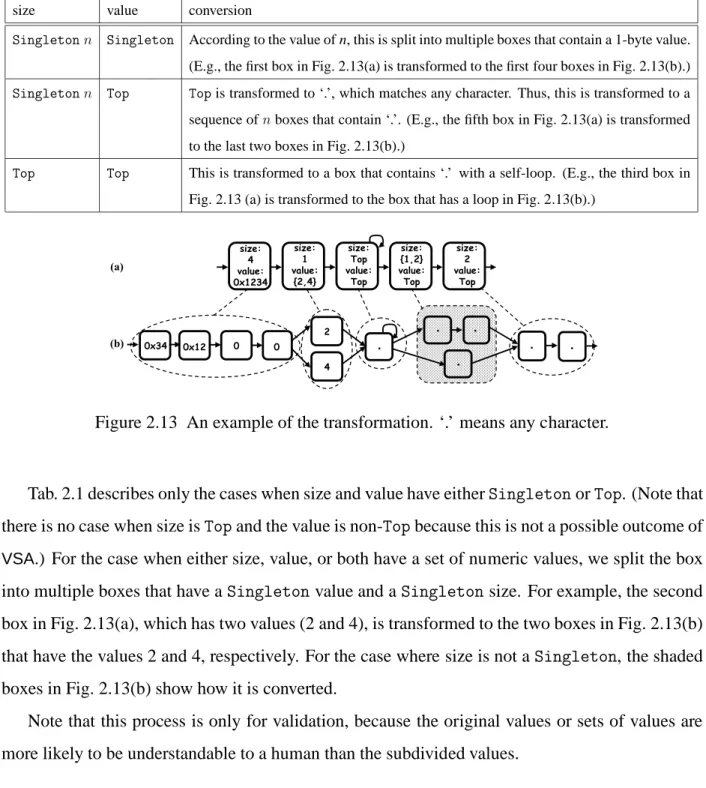
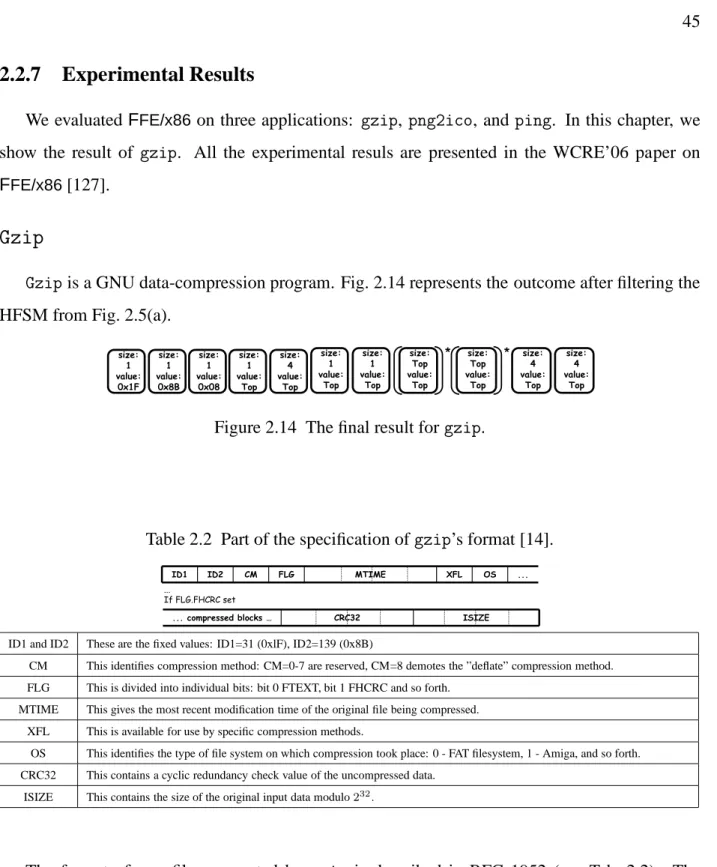
2.1 Transformation of boxes. . . 44 2.2 Part of the specification ofgzip’s format [14]. . . 45
3.1 Parts of the declarations of the basetypes, basetype-operators, and map-access/update functions for three analyses. . . 73 3.2 Transformers generated by theTSLsystem. . . 73
4.1 Experimental results. Key: CE = time for concrete execution; SE = time for symbolic execution; SMT = solver time; |ϕ|= avg. number of constraints found; Div. = diver-gence rate; CD+SE = time for concrete + symbolic execution (when run in lock-step); Dist. = avg. distance before a diverging test diverges. TF/TAdenotes the ratio of the
times (CE+SE+SMT) for the faithful version and the approximate version. (All times are in seconds.) . . . 142
A.1 Reserved exported functions; a complete list of reserved export functions can be found in233 A.2 Parts of the declarations of the basetypes, basetype-operators, and map-access/update
LIST OF FIGURES
Figure Page
1.1 The interaction between theTSLsystem and a client analyzer. The grey boxes
repre-sentTSL-generated analysis components. . . 10
1.2 Code fragment that swaps twoints; . . . 11
1.3 Application of the abstract transformers created by the sign-analysis reinterpretation to the initial abstract stateσ0 ={x7→neg, y 7→pos}. . . 13
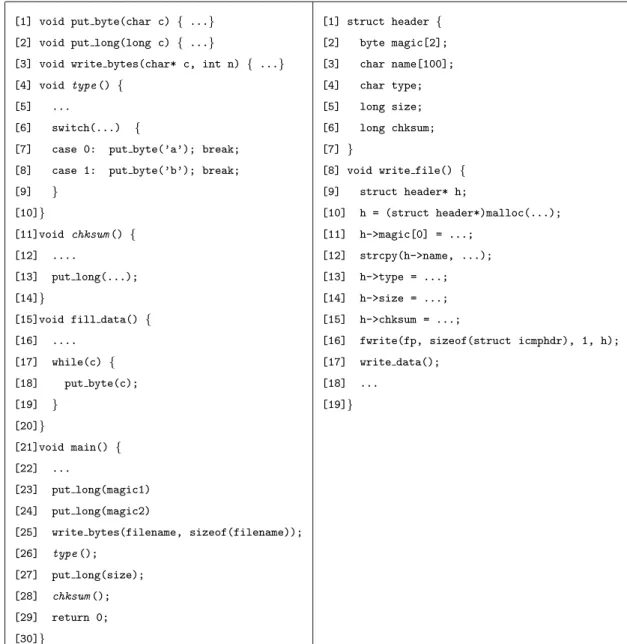
2.1 (a) An example that uses individual writes. (b) An example of a bulk write. . . 31
2.2 (a) An FSM, (b) A hierarchical FSM. . . 33
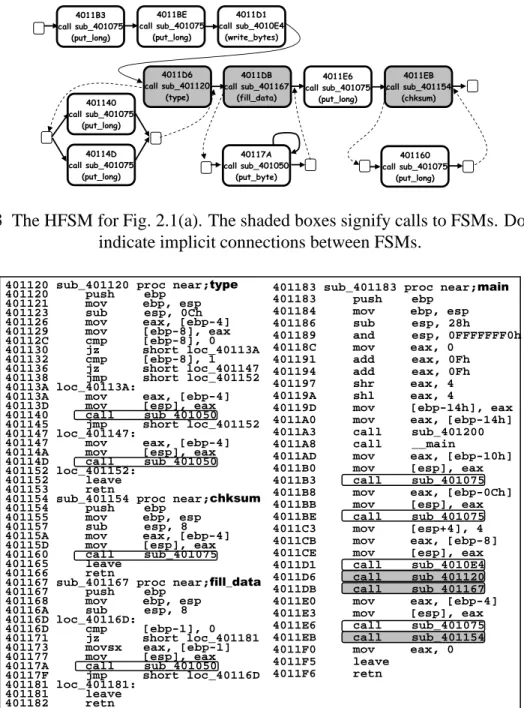
2.3 The HFSM for Fig. 2.1(a). The shaded boxes signify calls to FSMs. Dotted lines indicate implicit connections between FSMs. . . 35
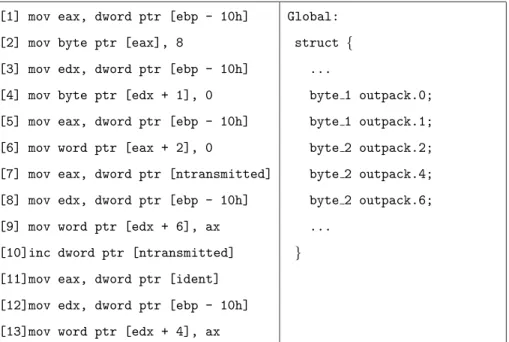
2.4 The disassembled code for Fig. 2.1(a). Transparent boxes indicate output operations, and shaded boxes indicate calls to sub-FSMs. . . 35
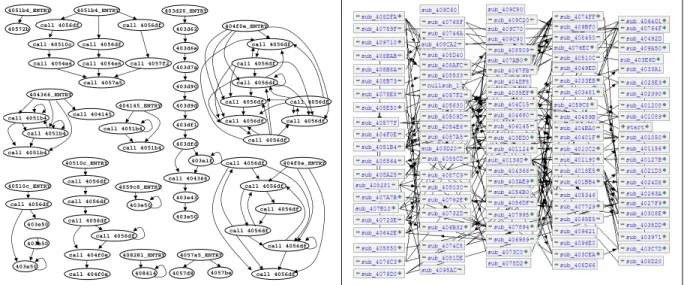
2.5 (a) The HFSM forgzip. (b) a fragment of the call graph ofgzip. . . 36
2.6 Organization of CoderSurfer/x86, and howFFE/x86interacts with its components. . . 36
2.7 An example code fragment; put byte is a output function, and call sites that call it are output operations. . . 37
2.8 How to obtain information fromVSA. . . 38
2.9 Code fragment used to illustrate the use ofASIinformation. . . 40
2.10 (a) The disassembled code fragment for Fig. 2.9, (b) The outcome ofASI. . . 41
2.11 An example of simplification. . . 42
Figure Page 2.13 An example of the transformation. ‘.’ means any character. . . 44 2.14 The final result forgzip. . . 45
2.15 The common three-phase error-propagation process for most concurrency bugs (ob-tained from [191]). . . 49
2.16 An overview of theConSeqarchitecture (obtained from [191]). . . 52
2.17 Static slicing (right) and the distance calculation (left; obtained from [191]). . . 53 2.18 Two snippets ofVSAandASIimplementations in CodeSurfer/x86; EvalVSA/
Updat-eVSAStateandCollectMemAccessesare otherIA32-specific procedures forVSAand ASI, respectively;ASImakes use of the information fromVSA. . . 58
2.19 The description of the PowerPC instruction lwbrx (obtained from the PowerPC instruction-set manual [27]). . . 59 3.1 The interaction between theTSLsystem and a client analyzer. The grey boxes
repre-sentTSL-generated analysis components. . . 64
3.2 A part of the Intel manual’s specification ofIA32’saddinstruction. . . 65 3.3 Syntax of constants of primitive type. . . 66
3.4 (a) A part of theTSLspecification ofIA32concrete semantics, which corresponds to the specification of addfrom the IA32 manual. Reserved types and function names are underlined, (b) A part of theCIRgenerated from (a); TheCIRis simplified in this presentation. . . 67 3.5 An example of the specification of anARMconditional-move instruction inTSL. . . . 69
3.6 A method to handle theSPARCregister window inTSL. . . 70
3.7 How aTSL-generated analysis component (interpInstr♯) is invoked in a solver that uses classical worklist-based value propagation. . . 74
3.8 A fragment of thePowerPCspecification for interpretingBCx instructions (BC,BCA, BCL,BCLA). . . 76 3.9 An example of factoring inTSL. . . 77
Appendix
Figure Page
3.10 The translation of the conditional expression “let answer = a ? b : c”. . . 79 3.11 (a) A recursiveTSL function, (b) The translation of the recursive function from (a).
For simplicity, some mathematical notation is used, including⊔(join),`(widening),
⊑(approximation), and⊥(bottom). . . 80
3.12 (a) A part of the template class for paired semantics; (b) an example ofC++ explicit template specialization to create a reduced product. . . 82 3.13 A fragment ofupdateState. . . 83
3.14 An example for trace-splitting . . . 89 3.15 Time (in seconds) and the total/maximum number of memory allocations for getting
TSL-generatedARAtransformers and hand-coded transformers. . . 91
4.1 (a) Code fragment that swaps twoints; (b) code fragment that swaps twoints using pointers; (c) possible before and after configurations for code fragment (b): the swap is unsuccessful due to aliasing; (d) x86 machine code (in Intel syntax) corresponding to (a). . . 105 4.2 Application of the abstract transformers created by the sign-analysis reinterpretation
to the initial abstract stateσ0 ={x7→neg, y 7→pos}. . . 108 4.3 The factored semantics ofL. . . 110 4.4 The factored semantics of PL. . . 112
4.5 An extended semantics of PL to accommodate the outcome of “divide-by-zero” exe-cution. . . 114 4.6 The factored semantics of MC. . . 115
4.7 Standard types of the PL meaning functions, and the reinterpreted types used to obtain an implementation of symbolic evaluation. . . 117
4.8 Symbolic evaluation of Fig. 4.1(a) via semantic reinterpretation, starting with the
StructUpdateUid = (∅,{Fρ′ ←֓ Fρ}). . . 117
4.9 Symbolic evaluation of Fig. 4.1(b) via semantic reinterpretation, starting with a
Appendix
Figure Page
4.10 Simplifications performed by access and update. The operations ≡, 6=, and =. de-note equality-as-terms, definite-disequality, and possible-equality, respectively. (The possible-equality tests, “k1 =. k2”, are really “otherwise” cases of three-pronged com-parisons.) . . . 123
4.11 Example of symbolic composition. . . 125
4.12 (a) A simple source-code fragment written in PL; (b) the MC code for (a). . . 129 4.13 An algorithm to obtain a path-constraint formula that characterizes which initial states
must follow pathπ. . . 131
4.14 Conversion of a recursively defined instruction—portrayed in (a) as a “microcode loop” over the actions denoted by the dashed circles and arrows—into (b), an explicit loop in the control-flow graph whose body is an instruction defined without using recursion. The three microcode operations in (b) correspond to the three operations in the body of the microcode loop in (a). . . 131
4.15 In a symbolic evaluation of the trace from Start to P, the three path constraints obtained from the branch instructions at B0, B1, and B2 constrain the values of
FchoiceMap(0),FchoiceMap(1), andFchoiceMap(2), respectively. To create a new initial state that causes a concrete execution of the program to follow the same path, except to branch the opposite way at B2 (to reach Q), we need the satisfying assignment re-turned by the theorem prover to satisfy the constraints onFchoiceMap(0)andFchoiceMap(1) and the negated constraint onFchoiceMap(2). . . . 137 4.16 The number of (non-blank) lines of C++ that are generated from the TSL
specifica-tions of the x86 and PowerPC instruction sets (as of Apr. 2010). The number of (non-blank) lines ofTSLare indicated in bold. . . 138 4.17 Directed-test-generation algorithm used for comparing the divergence rates of the
faithful and unfaithful symbolic-evaluation primitives. . . 141
5.1 The general refinement step across frontier (n, I, m). The presence of a witness is indicated by a “” inside of a node. . . 154
5.2 The formula for Pre(I, ψ), where ψ is update 32 8 LE 32(M, R(ebp) − 8) +
update 32 8 LE 32(M, R(ebp)−12) = 10, obtained by evaluatingψ on the sym-bolic stateS′ = [M 7→ update 32 8 LE 32(M, R(eax),5), R 7→R]. For brevity, the
following notational shorthands are used in the formula:p=R(eax),x=R(ebp)−8,
Appendix
Figure Page
5.3 MCVETOexperiments. The columns show whetherMCVETOreturned a proof, coun-terexample, or an AE violation (Outcome); the number of instructions (#Instrs); the number of concrete executions (CE); the number of symbolic executions (SE), which also equals the number of calls to theYICESsolver; the number of refinements (Ref), which also equals the number of Preα computations; and the total time (in seconds).
*SMC test case. **Exceeded twenty-minute time limit. . . 162 5.4 (a) (top left) A snippet of the EvilBot source code, (b) (bottom left) alternative source code,
(c) (right) the assembly code of (a). . . 166 5.5 (a) A simple example program; (b) the command string constructed based on the information
obtained from BCE; (c) a sequence of API calls obtained from BCE; (d) another simple example; (e) constant examples provided byBCE; (f) the symbolic expression obtained from BCEfor the argumentn; (g) the constraint obtained fromBCE. . . 169 5.6 An example for whitebox fuzz testing . . . 174
5.7 An example to show control dependences.. . . 177
5.8 Two trace trees; (a) A trace tree without CDI; (b) a trace tree with CDI; the circles represent branch nodes; the solid arrows represent possible paths to explore; the half-shaded circles represent nodes labeled as eitherNf orNt. . . 177
5.9 An example in which it is necessary to choose an alternative candidate as a new path; the source code ofstrcmpis inlined in this example. . . 178 5.10 (a) An example with independentif-statements (and thus an exponential number of paths).
(b) An example more typical of bot code (with a linear number of paths). . . 180 5.11 (a) A dependence graph; (b) a trace tree when sub-trees are pruned using
control-dependence graph (a); (c) another control-control-dependence graph; (d) the trace tree when sub-trees are pruned using control-dependence graph (c). . . 182 5.12 A simple example for pruning. . . 182
5.13 A simple example for modeling a system call. . . 183 5.14 (a) The prototypes of getaddrinfo, ADDRINFO, and sockaddr in; (b) an example code
Appendix
Figure Page
5.15 BCEexperiments. The columns, in order, are: the number of instructions (#Instrs); the percentage of nodes marked as eitherNf orNtin the final trace tree; the number
of unique traces ending with at least one API call; the number of commands for which BCE provides symbolic expressions; the total number of iterations to identify the traces; the average trace length; the average time taken for concrete execution; the total time taken for concrete execution; the average time taken for symbolic execution; the total time taken for symbolic execution; the average time taken for path exploration; the total time taken for path exploration; and the total time taken in seconds. The experiments were run on a Intel P41.79GHz machine with1.49GB RAM. . . 189 5.16 BCEexperiments. The table reports results for four configurations of BCE: (1) “w/
CDI” and “w/ Pruning”, (2) “w/o CDI” and “w/ Pruning”, (3) “w/ CDI” and “w/o Pruning”, and (4) “w/o CDI” and “w/o Pruning”. The numbers reported in each col-umn are the number of unique traces ending with API call(s), the total number of iterations, and the percentage of iterations that resulted in a trace ending with API calls. The experiments were run on a Intel P41.79GHz machine with1.49GB RAM; the symbol “+” after the number of iterations means that BCEwith the configuration did not finish (i.e., program exploration could continue infinitely even if all possible commands had been identified.) . . . 189 A.1 Syntax of constants of primitive phyla. . . 216
A.2 BasetypeOperators . . . 226
A.3 Library functions on the primitive phyla. In this table, i’s are integer parameters, s’s areSTRparameters, andb’s areBOOLparameters; MEMMAP32 8is a reinterpretable map-type whose original type isMAP[INT32,INT8];m’s areMAP-type parameters. . 227
A.4 ATSLspecification of a simplifiedIA32concrete semantics; reserved types and func-tion names are underlined. . . 238
A.5 TheCIRgenerated from Fig. A.4. (The superscript # is used to abbreviate the actual generated names used in theTSLimplementation.) . . . 238 A.6 Required operators that an abstract domain must provide for aTSL reinterpretation;
T: the abstract domain for a maptype;K T: the key type of the map-typeT;D T: the datum type of the map-type T; TVL::Bool: a three value logic (FALSE, ONE, and MAYBE); . . . 239
Appendix
Figure Page
A.8 An example ofC++explicit template specialization to create a reduced product. . . 240 A.9 A fragment ofupdateState32. . . 240
ABSTRACT
As computers have become a pivotal component of daily lives, computer safety, reliability, and security issues have become enormously important. A considerable amount of recent research in program analysis and software engineering has been carried out on techniques and tools for finding software bugs and security vulnerabilities, and on checking computer-safety properties. Most of this research has focused on analyzing source code. Recently, machine-code analysis has begun to receive great attention both because source code is often unavailable and because there can be mismatches in various ways between source code and the machine code generated from the source code.
The tools and techniques for analyzing machine code are, in principle, language-independent. However, their implementations are often tied to one specific instruction set. Retargeting them to another instruction set can be an expensive and error-prone process. This dissertation describes a system that I developed, calledTSL (for “Transformer SpecificationLanguage”) that provides a systematic solution to the problem of creating retargetable tools for analyzing machine-code. The TSL system is a meta-tool, or tool generator, that automatically creates different abstract interpreters for machine-code instruction sets. The system addresses the problem of supporting multiple instruction sets by providing a YACC-like mechanism for creating key components of machine-code analyzers. The TSL system takes a single, unified description of the concrete op-erational semantics of an instruction set, which is specified inTSL, a strongly typed, first-order
functional language, and automatically creates implementations of different abstract interpreters for the given instruction set.
TSLprovides a fixed set of base-types and operators, as well as map-types with map-access and (applicative) map-update operations. TheTSLcompiler generates a common intermediate repre-sentation that allows the meanings of the input-language constructs to be redefined by supplying alternative interpretations of the base-types, map-types, and the operations on them (“semantic reinterpretation”). Because all the abstract operations are defined at the meta-level, a semantic reinterpretation is independent of any given instruction set defined inTSL. Therefore, each imple-mentation of an analysis component’s driver serves as the unchanging driver for use in different instantiations of the analysis component for different instruction sets. TheTSLlanguage becomes the specification language for retargeting that analysis component to different instruction sets.
As an application of theTSLsystem, we developed a novel way of applying semantic reinter-pretation to automatically create symbolic-analysis primitives for symbolic evaluation, weakest-liberal precondition, and symbolic composition. Furthermore, using the TSL system, as well as the TSL-generated symbolic-analysis primitives, we developed a machine-code verification tool, calledMCVETO, and a concolic-execution-based program-exploration tool, calledBCE.
• MCVETO addresses a large number of issues that arise when developing model-checking tools for machine code, for which standard techniques used in source-code model-checking tools would be unsound if applied to machine code.
• What distinguishes the work onBCEis that it makes use of control-dependence information to make program exploration goal-directed toward a given set of targets.
Chapter 1
Introduction
As computers have become a pivotal component of daily lives, computer safety, reliability, and se-curity issues have become enormously important. To address these issues, a considerable amount of research has been carried out recently in the programming-language and software-engineering communities on techniques for finding software bugs and security vulnerabilities, and on checking computer-safety properties. This work has led to a large number of program-analysis techniques and tools. Essentially all of the results described in the literature are, in principle, language-independent; however, their implementations are often tied to one specific language. Retargeting them to another language (as well as implementing a new analysis for the same language) can be an expensive and error-prone process. For machine-code analyses, having a language-dependent implementation is even worse than for source-code analyses because instruction sets usually con-tain several hundred kinds of instructions, and a given instruction set often has special features not found in other instruction sets.
This dissertation describes a system that I developed, called TSL (for “Transformer SpecificationLanguage”), which helps in the creation of tools for analyzing machine code. The TSL system is a meta-tool, or tool generator, that automatically creates different abstract inter-preters for machine-code instruction sets. The system addresses the problem of supporting multiple instruction sets by providing a YACC-like mechanism for creating key components of machine-code analyzers. The TSL system takes a single, unified description of the concrete operational semantics of an instruction set, and automatically creates implementations of different abstract interpreters for the given instruction set.
An instruction set’s concrete semantics is specified inTSL’s input language, which is a strongly typed, first-order functional language with a datatype-definition mechanism for defining recursive datatype, plus deconstruction by means of pattern matching. Writing a TSL specification for an instruction set is similar to writing an interpreter in first-order ML.
TSLprovides a fixed set of base-types and operators, as well as map-types with map-access and (applicative) map-update operations. From aTSLspecification, theTSLcompiler generates a com-mon intermediate representation (CIR) that allows the meanings of the input-language constructs to be redefined by supplying alternative interpretations of the base-types, map-types, and the oper-ations on them (“semantic reinterpretation”). Because all the abstract operoper-ations are defined at the
meta-level, semantic reinterpretation is independent of any given instruction set defined in TSL. Therefore, each implementation of an analysis component’s driver serves as the unchanging driver for use in different instantiations of the analysis component to different instruction sets. TheTSL language becomes the specification language for retargeting that analysis component for different instruction sets. Thus, to create M ×N analysis components, theTSL system only requires M
specifications of the concrete semantics of an instruction set, andN analysis implementations, i.e.,
M +N inputs to obtainM ×N analysis-component implementations.
Applications. As one application of the TSL system, we developed a novel way of applying semantic reinterpretation to automatically create symbolic-analysis primitives for symbolic eval-uation, weakest-liberal precondition, and symbolic composition (see Chapter 4). Furthermore, using theTSLsystem, as well as theTSL-generated symbolic-analysis primitives, we developed a machine-code verification tool, calledMCVETO(§5.1), and a concolic-execution-based program-exploration tool, calledBCE(§5.2).
• MCVETO addresses a large number of issues that arise when developing model-checking tools for machine code, for which standard techniques used in source-code model-checking tools would be unsound if applied to machine code. These include (i) the absence of pre-built control-flow graphs and call graphs; (ii) the absence of meta data, such as information about variables, types, and aliasing; (iii) the absence of a fixed association between addresses and
instructions (e.g., instruction aliasing and self-modifying code); and (iv) extensive use of arithmetic on addresses in machine code.
• What distinguishes the work onBCEis that it makes use of control-dependence information to make program exploration goal-directed toward a given set of targets.
The remainder of this chapter is organized as follows: §1.1 discusses the challenge of software defects. §1.2 discusses a few of the approaches in the program-analysis literature that address the problem of software defects. §1.3 focuses on machine-code analysis and the challenges in implementing machine-code analyses.§1.4 presents an overview of theTSLsystem.§1.5 provides a short description of many of the applications to which I have applied TSL. §1.6 presents the organization of the dissertation and the contribution of each chapter.
1.1
The Challenge of Software Defects
Computers are pervasive in modern life, and are pivotal components in a wide range of con-texts, such as (to name just a few) financial systems, power systems, manufacturing systems, asset-management systems, health-care systems, and many critical systems (e.g., nuclear reac-tors, weapons systems, and aircraft collision-avoidance systems). Computer-safety, reliability, and security issues have become enormously important because software defects and security
vulnera-bilities in computer systems can have severe consequences.
Software defects (bugs) and violations of computer-safety properties can cause critical failures (e.g., computer-system crashes) or other serious failures in a computer system (e.g., malfunctions due to mis-computations), which can result in severe damage both in financial terms and even in lives lost. We will mention just two cases of software bugs that had extreme consequences. For instance, in 1996, some problems with a rocket-launch software system caused a rocket that was set to deliver a payload of satellites into Earth orbit to veer off its path right after launch and self-destruct. This accident caused a loss of more than $370 million [3]. In one deadly incident in 1994 in Scotland, a system error caused a Chinook helicopter to crash, and all 29 passengers were killed [1].
Creating a correct and reliable computer system is becoming extremely difficult. As computer systems become more and more complex, even experienced software developers are prone to in-troducing bugs into their products; therefore, the potential for damage of the kind mentioned above continues to be a serious problem.
A security vulnerability in a software component is a flaw that can possibly be exploited by an adversary to create or install malware (such as viruses, worms, Trojans, bots, or back doors) or spyware; for conducting illegitimate activities, such as damaging and disrupting victims’ com-puters; stealing confidential information, including passwords, credit-card numbers, and personal information; destroying important data; and even taking control of a compromised computer.
Annual worldwide economic damages from malicious software (malware) exceed $13 billion according to a survey conducted by Computer Economics in 2007 (available in the 2007 Malware
Report: The Economic Impact of Viruses, Spyware, Adware, Botnets, and Other Malicious Code
[2]). This amount includes only direct damages, such as loss of revenue due to loss or degraded performance of systems, labor costs to analyze, repair and cleanse infected systems, and loss of user productivity. Total damages would be substantially increased when indirect damages are considered.
Anti-malware technology is fairly effective in defending against many types of malware threats. However, traditional signature- and heuristic-based anti-malware technologies are often easily evaded, and thus no longer enough because there has been a significant increase in the number of zero-day attacks [22]. Zero-day attacks exploit security vulnerabilities that are unknown to oth-ers (including the original software developer), and for which no security fix is available at hand. Therefore, it becomes more important to detect and fix security vulnerabilities before software products are deployed, or before an adversary can exploit them to attack computer systems.
1.2
Program-Analysis Approaches
Program-analysis technology provides a promising approach to addressing the problems of finding bugs and security vulnerabilities, and for validating software systems. A considerable amount of recent research in the programming-languages and software-engineering communities
has led to techniques for (i) finding bugs, (ii) finding security vulnerabilities, and (iii) checking computer-safety properties. In these tools, program analysis conservatively answers the question “Can the program reach a bad state?”. Although one cannot make an absolute distinction among those areas, which are closely related to each other, some of the related work in these areas can be summarized as follows:
• Finding bugs/generating test cases. DART (Directed Automated Random Testing) is a tool for automated testing [93]. To detect bugs that can cause program crashes and assertion violations,DART uses a combination of concrete execution and symbolic execution to sys-tematically explore a program’s state space. It uses symbolic execution to find inputs that direct execution along alternative paths.
CBI(Cooperative Bug Isolation) is a feedback-directed approach to finding bugs [124]. In-strumented applications are deployed to the general public, and then some statistical methods are applied to mine returned data for information about root causes of failures.
There are several other analysis tools for bug-finding and test-generation [52, 104, 119].
• Finding security vulnerabilities. BOON [181] is a static-analysis technique for determining
whether a C program can index an array outside its bounds. CQual [88] is a type-based analysis tool that provides a lightweight, practical mechanism for specifying and check-ing properties of C programs. It uses type qualifiers to perform taint analysis, and detects format-string vulnerabilities in C programs. Eau Claire [64] is a tool for finding common se-curity problems like buffer overflows, file-access race conditions, and format-string bugs. It uses a theorem prover to create a general specification-checking framework for C programs. Livshits proposed a static-analysis technique for detecting security vulnerabilities that stem from unchecked input in Java applications [130]. There are several other analysis tools for finding security vulnerabilities [37, 122].
• Checking safety properties. Havelund et al. presented a system called Java PathFinder, a
model-checker for Java bytecode programs [100]. Ball et al. developed the Static Driver Verifier (SDV), which analyzes device-driver source code to determine whether there is a path in the driver that violates a kernel API usage rule [47]. MOPS uses model-checking
techniques to check certain kinds of security properties, represented as a finite-state automata [63]. There are many other analysis tools in this space [57, 63, 76, 102, 186]. These tools are based on static analysis, which is used to determine a conservative answer to the question “Can the program reach a bad state?”
These tools all focus on analyzing source code written in high-level languages, such as C, Java, etc. However, the problem of analyzing machine code to find bugs and security vulnerabilities, and to recover other information about their execution properties, has been receiving increased attention for the following reasons:
• Computers do not execute source code. Instead, the actual code that a computer executes is the machine code produced by a compiler (and an optimizer) from the source code. In the process of compiling and optimizing source code, subtle flaws depending on low-level, platform-specific details, such as memory layout, can be introduced. Consequently, there can be various vulnerabilities that are invisible in the original source code. Also, programs may be modified to insert malicious code. Balakrishnan et al. referred to such a situation as the WYSINWYX phenomenon (What You See Is Not What You eXecute) [38, 39, 41].
• Source code is often unavailable to analyze. For instance, Commercial-Off-The-Shelf (COTS) applications are typically delivered as stripped machine code (i.e., neither source code nor symbol-table/debugging information is provided). Also, malicious code such as bots and backdoors are in binary form and no source code for them is available.
• A program can be written in more than one language, which complicates the lives of develop-ers of source-level tools. Also, when a program contains inlined assembly code, source-code analysis typically either ignores that part or does not push the analysis beyond it, which can make the results of the analysis unsound.
• Analyses based on source code typically make unchecked assumptions, e.g., that the program is ANSI-C compliant. This often means that an analysis does not account for behaviors that are allowed by the compiler (e.g., arithmetic is performed on pointers that are subsequently used for indirect function calls; pointers move off the ends of arrays and are subsequently dereferenced; etc.).
In these situations, the availability of good source-level analysis tools is irrelevant; instead, one needs tools capable of analyzing machine code.
1.3
Machine-Code Analysis
The aforementioned issues that arise when analyzing source code disappear when analyzing machine code. Furthermore, machine-code analysis has the advantage that it can provide more accurate information than a source-level analysis can because, for many programming languages, certain behaviors are left under-specified by the semantics. In such cases, a source-level analysis must account for all possible behaviors, whereas an analysis of machine code generally only has to deal with one possible behavior, namely, the one for the code sequence chosen by the compiler. Chapter 2 discusses machine-code analysis in more detail.
There have been several specialized analyses of machine code developed to identify aliasing relationships [80], data dependences [36, 70], targets of indirect calls [79], values of strings [68], bounds on stack height [159], and values of parameters and return values [190].
In contrast to such specialized analyses, Balakrishnan and Reps [38, 41] developed ways to address all of these problems by means of an analysis that discovers an over-approximation of the set of states that can be reached at each point in the executable—where a state means all of the components of a state: values of registers, flags, and the contents of memory. Moreover, their approach is able to be applied to stripped executables (i.e., neither source code nor symbol-table/debugging information need be available).
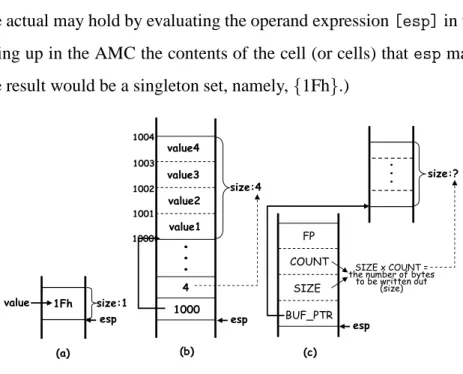
Challenges in implementing machine-code analysis. Machine-code analysis presents many new challenges. For instance, at the machine-code level, memory is one large byte-addressable array, and an analyzer must handle computed—and possibly non-aligned—addresses. It is crucial to track array accesses and updates accurately; however, the task is complicated by the fact that arithmetic and dereferencing operations are both pervasive and inextricably intermingled. For instance, if local variablexis at offset –12from the activation record’s frame pointer (registerebp), an access onx would be turned into an operand [ebp–12]. Evaluating the operand first involves
pointer arithmetic (“ebp–12”) and then dereferencing the computed address (“[·]”). On the other hand, machine-code analysis also offers new opportunities, in particular, the opportunity to track low-level, platform-specific details, such as memory-layout effects. Programmers are typically unaware of such details; however, they are often the source of exploitable security vulnerabilities. Many of the algorithms used in software model checkers that work on source code [47, 49, 102] would be unsound if applied to machine code. For instance, before starting the verification pro-cess proper,SLAM[47] andBLAST[102] perform flow-insensitive (and optionally field-sensitive) points-to analysis. However, such analyses often make unsound assumptions, such as assuming that the result of an arithmetic operation on a pointer always remains inside the pointer’s original target. Such an approach assumes—without checking—that the program is ANSI C compliant, and hence causes the model checker to ignore behaviors that are allowed by some compilers (e.g., arithmetic is performed on pointers that are subsequently used for indirect function calls; pointers move off the ends of structs or arrays, and are subsequently dereferenced). A program can use such features for good reasons—e.g., as a way for a C program to simulate subclassing [172]—but they can also be a source of bugs and security vulnerabilities.
Although techniques developed in prior work on machine-code analysis are, in principle, language-independent, they have typically only been instantiated for one instruction set (mostly the IntelIA32instruction set). This situation is actually typical of much work on source-code program analysis, too: even though the techniques described in the literature are, in principle, language-independent, their implementations are often tied to a specific language or intermediate represen-tation. This state of affairs reduces the impact that good ideas developed in one context have in other contexts. The situation is more serious for low-level instruction sets, because (i) instruction sets usually contain several hundred instructions, and (ii) there are a variety of architecture-specific features that are incompatible with other architectures.
1.4
Transformer Specification Language (
TSL
)
To address the issues mentioned above, my work has aimed to provide a systematic way of im-plementing analyzers that work on machine code. As part of my research, I developed a language
for specifying the semantics of an instruction set, along with a run-time system to support dynamic analysis, static analysis, and symbolic analysis of executables written in that instruction set. This work advances the state of the art because it allows multiple analysis components to be created automatically from a single specification of the concrete operational semantics of the language to be analyzed. The system, calledTSL(for “TransformerSpecificationLanguage”), has two classes of users: (1) instruction-set-specification (ISS) developers and (2) analysis developers. The for-mer are involved in specifying the semantics of different instruction sets; the latter are involved in extending the analysis framework. In designingTSL, we were guided by the following principles:
• There should be a formal language for specifying the semantics of the language to be an-alyzed. Moreover, ISS developers should specify only the abstract syntax and a concrete operational semantics of the language to be analyzed—each analyzer should be generated automatically from this specification.
• Concrete syntactic issues—including (i) decoding (machine code to abstract syntax), (ii) encoding (abstract syntax to machine code), (iii) parsing assembly (assembly code to abstract syntax), and (iv) assembly pretty-printing (abstract syntax to assembly code)—should be handled separately from the abstract syntax and concrete semantics.1
• There should be a clean interface for analysis developers to specify the abstract semantics for each analysis. An abstract semantics consists of an interpretation: an abstract domain and a set of abstract operators (i.e., that performs abstract interpretations of the operations of TSL).
• The abstract semantics for each analysis should be separated from the languages to be an-alyzed so that one does not need to specify multiple versions of an abstract semantics for multiple languages.
Each of these objectives has been achieved in theTSLsystem: TheTSLsystem translates theTSL specification of each instruction set to a common intermediate representation (CIR) that can be used to create multiple analyzers. Each analyzer is specified at the level of the meta-language (i.e.,
1The translation of the concrete syntaxes to and from abstract syntax is handled by a generator tool, calledISAL
by reinterpreting the operations ofTSL), which—by extension toTSLexpressions and functions— provides the desired reinterpretation of the instructions of an instruction set.
Client Analyzer
M Instruction-Set Specifications
TSL System
N Analysis Components
• • •
interpInstr1interpInstr2 interpInstrN
• • •
Figure 1.1 The interaction between theTSLsystem and a client analyzer. The grey boxes representTSL-generated analysis components.
TheTSLsystem provides two dimensions of parameterizability: different instruction sets and different analyses. Each ISS developer specifies an instruction-set semantics, and each analysis developer defines an abstract domain for a desired analysis by giving an interpretation (i.e., the implementations ofTSLbasetypes, basetype-operators, and map-access/update functions). Given the inputs from these two classes of users, the TSL system automatically generates an analysis component. Thus, to createM ×N analysis components, theTSLsystem only requiresM speci-fications of the concrete semantics of instruction sets, andN analysis implementations (Fig. 1.1), i.e.,M +N inputs are used to obtainM×N analysis-component implementations.
Many for the price of one! In Fig. 1.1, once one has theNanalysis implementations that are the core of some client analyzer A, one obtains a generator that can create different versions A/M1,
A/M2, . . . at the cost of writing specifications of the concrete semantics of instruction setsM1,M2, etc. Thus, each client analyzerAcreated using analysis components generated via TSL acts as a “YACC-like” tool for generating different versions ofAautomatically.
s1:x=x⊕y;
s2:y=x⊕y;
s3:x=x⊕y;
Figure 1.2 Code fragment that swaps twoints;
1.4.1
Semantic Reinterpretation
TheTSLsystem is based on factoring the concrete semantics of a language into two parts: (i) a client specification, and (ii) a semantic core. The interface to the core consists of certain base types, function types, and operators (sometimes called a semantic algebra [166]), and the client is expressed in terms of this interface. This organization permits the core to be reinterpreted to produce an alternative semantics for the subject language.2
Semantic Reinterpretation for Abstract Interpretation. The idea of exploiting such a factor-ing comes from the field of abstract interpretation [73], where factorfactor-ing-plus-reinterpretation has been proposed as a convenient tool for formulating abstract interpretations and proving them to be sound [134, 144, 148]. In particular, soundness of the entire abstract semantics can be established via purely local soundness arguments for each of the reinterpreted operators.
The following example shows the basic principles of semantic reinterpretation in the context of abstract interpretation. We use a simple language of assignments, and define the concrete semantics and an abstract sign-analysis semantics via semantic reinterpretation.
Example 1.1 [Adapted from [134].] Consider the following fragment of a denotational semantics, which defines the meaning of assignment statements over variables that hold signed 32-bit int 2Semantic reinterpretation is a program-generation technique, and thus we follow the terminology of the
partial-evaluation literature [108], where the program on which the partial evaluator operates is called the subject program. In logic and linguistics, the programming language would be called the “object language”. In the compiler literature, an object program is a machine-code program produced by a compiler, and so we avoid using the term “object programs” for the programs thatTSLoperates on.
values (where⊕denotes exclusive-or):
I ∈Id E ∈Expr::=I |E1⊕E2 |. . .
S ∈Stmt::=I =E; σ∈State=Id→Int32
E :Expr→State→Int32
EJIKσ =σI
EJE1⊕E2Kσ=EJE1Kσ⊕ EJE2Kσ
I :Stmt→State→State
IJI =E;Kσ=σ[I 7→ EJEKσ]
By “σ[I 7→ v],” we mean the function that acts like σ except that argument I is mapped tov. The specification given above can be factored into client and core specifications by introducing a domain Val, as well as operators xor, lookup, and store. The client specification is defined by
xor:Val→Val→Val lookup:State→Id→Val store :State→Id→Val→State
E :Expr→State→Val
EJIKσ =lookupσ I
EJE1⊕E2Kσ =EJE1KσxorEJE2Kσ
I :Stmt →State →State
IJI =E;Kσ=storeσ IEJEKσ
For the concrete (or “standard”) semantics, the semantic core is defined by
v ∈Valstd =Int32
Statestd =Id→Val
lookupstd=λσ.λI.σI
storestd=λσ.λI.λv.σ[I 7→v]
xorstd=λv1.λv2.v1⊕v2
Different abstract interpretations can be defined by using the same client semantics, but giving different interpretations to the base types, function types, and operators of the core. For example,
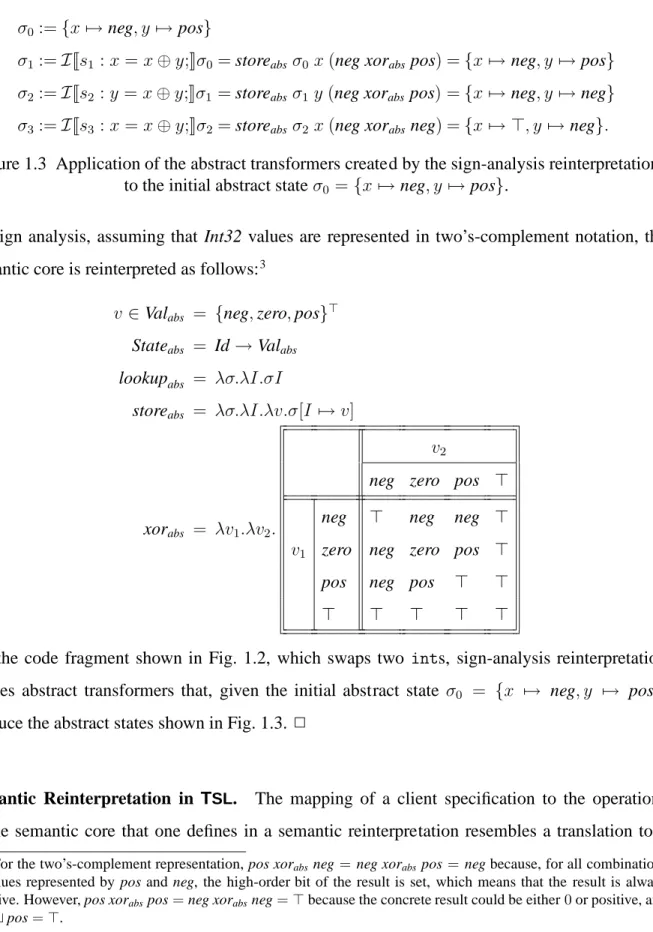
σ0:={x7→neg, y 7→pos}
σ1:=IJs1 :x=x⊕y;Kσ0=storeabsσ0x(neg xorabspos) ={x7→neg, y 7→pos}
σ2:=IJs2 :y=x⊕y;Kσ1 =storeabsσ1y(neg xorabspos) ={x7→neg, y 7→neg}
σ3:=IJs3 :x=x⊕y;Kσ2=storeabsσ2x(neg xorabsneg) ={x7→ ⊤, y 7→neg}. Figure 1.3 Application of the abstract transformers created by the sign-analysis reinterpretation
to the initial abstract stateσ0 ={x7→neg, y 7→pos}.
for sign analysis, assuming that Int32 values are represented in two’s-complement notation, the semantic core is reinterpreted as follows:3
v ∈Valabs = {neg,zero,pos}⊤
Stateabs = Id→Valabs
lookupabs = λσ.λI.σI
storeabs = λσ.λI.λv.σ[I 7→v]
xorabs = λv1.λv2.
v2
neg zero pos ⊤
neg ⊤ neg neg ⊤
v1 zero neg zero pos ⊤
pos neg pos ⊤ ⊤
⊤ ⊤ ⊤ ⊤ ⊤
For the code fragment shown in Fig. 1.2, which swaps two ints, sign-analysis reinterpretation creates abstract transformers that, given the initial abstract state σ0 = {x 7→ neg, y 7→ pos}, produce the abstract states shown in Fig. 1.3. 2
Semantic Reinterpretation in TSL. The mapping of a client specification to the operations of the semantic core that one defines in a semantic reinterpretation resembles a translation to a
3For the two’s-complement representation, pos xor
absneg=neg xorabspos=neg because, for all combinations
of values represented by pos and neg, the high-order bit of the result is set, which means that the result is always negative. However, pos xorabspos=neg xorabsneg=⊤because the concrete result could be either0or positive, and
common intermediate representation (CIR) data structure. Thus, another approach to obtaining “systematic” reinterpretations that are similar to semantic reinterpretations—in that they apply to multiple subject languages—is to translate subject-language programs to a CIR, and then create various interpreters that implement different abstract interpretations of the node types of theCIR data structure. Each interpreter can be applied to (the translation of) programs in any subject lan-guageLfor which one has defined anL-to-CIRtranslator. Compared with interpreting objects of aCIRdata type, the advantages of semantic reinterpretation (i.e., reinterpreting the constructs of the meta-language) are
1. The presentation of our ideas is simpler because one does not have to introduce an additional language of trees for representingCIRobjects.
2. With semantic reinterpretation, there is no explicitCIRdata structure to be interpreted. In essence, semantic reinterpretation removes a level of interpretation, and hence generated analyzers should run faster.
1.4.2
Technical Contributions Incorporated in the
TSL
Compilation Process
The specific technical contributions incorporated in the part of theTSLcompiler that generates theCIRcan be summarized as follows:• Two-Level Semantics: The notion of a two-level intermediate language [149] has been used to generate the CIR in a way that reduces the loss of precision that could otherwise come about with certain reinterpretation. To address this issue, theTSLcompiler performs binding-time analysis [108] on the TSL specification to identify which values can always be treated as concrete values, and which operations should therefore be performed in the concrete domain (i.e., should not be reinterpreted). §3.2.1 discusses more details of the two-level intermediate language along with binding-time analysis.
• Abstract Interpretation: From a specification, theTSLcompiler generates aCIRthat has the ability (i) to execute over abstract states, (ii) possibly propagate abstract states to more than one successor in a conditional expression, (iii) compare abstract states and terminate abstract
execution when a fixed point is reached, and (iv) apply widening operators, if necessary, to ensure termination. §3.2.2 contains a detailed discussion of these issues.
• Paired Semantics: TheTSLsystem allows easy instantiations of reduced products by means of paired semantics. TheCIRcan be instantiated with a paired semantic domain that couples two interpretations. Communication between the values carried by the two interpretations may take place in the TSL base-type operators. §3.2.3 discusses more details of paired semantics.
1.5
Overview of Applications of the
TSL
System
The capabilities of the TSL system have been demonstrated by writing specifications for both the IA32and PowerPC instruction sets, and then automatically creating a variety of analy-sis components from each of the specifications—including dynamic-analyanaly-sis components, static-analysis components and symbolic-static-analysis components from each of the specifications. The TSL-generated static-analysis components have been used to develop a parameterized version of CodeSurfer/x86. That is, using TSL, one can create CodeSurfer/M by writing a specification of the concrete semantics of instruction setM (§1.5.1). The dynamic-analysis and symbolic-analysis components generated usingTSLhave been used to develop the semantic primitives (§1.5.2) used in (parameterized versions of) a model-checking tool for machine code (§1.5.3) and a concolic-execution-based tool for analyzing bot executables (§1.5.4).
1.5.1
Static-Analysis Components
The TSL system has been applied to creating the analysis components employed by CodeSurfer/x86 [39], which is a static-analysis framework for analyzing stripped x86 executables. TheTSL-generated analysis components include value-set analysis [38, 41], affine-relation analy-sis [38], def-use analyanaly-sis (for memory, registers, and flags), and aggregate structure identification [42].
• Value-Set Analysis (VSA). VSAis a combined numeric-analysis and pointer-analysis algo-rithm that determines a safe approximation of the set of numeric values and addresses that
each register and memory location holds at each program point [41]. A memory region is an abstract quantity that represents all runtime activation records of a procedure. To represent a set of numeric values and addresses,VSAuses value-sets, where a value-set associates each memory-region with a map from abstract locations to strided intervals. A strided interval represents a set of numbers with a lower bound, an upper bound, and a stride [160].
• Affine-Relation Analysis (ARA). An affine relation is a linear-equality constraint between integer-valued variables. ARA finds all affine relationships that hold in the program, for a given set of variables. This analysis is used to find induction-variable relationships between registers and memory locations; these help in increasing the precision ofVSA when inter-preting conditional branches [38].
• Aggregate-Structure Identification (ASI). ASIis a unification-based, flow-insensitive al-gorithm to identify the structure of aggregates in a program [42]. For each instruction, the TSL-generated analysis component generates a set ofASIcommands, each of which is ei-ther a command to split a memory region or a command to unify some portions of memory (and/or some registers). At analysis time, a client analyzer typically applies the generated ASI-command generator to each of the instructions in the program, and then feeds the result-ing set ofASIcommands to anASIsolver to refine the memory regions.
• Quantifier-Free Bit-Vector (QFBV) semantics. QFBVsemantics provides a way to obtain a symbolic representation—as a formula in first-order quantifier-free bit-vector logic—of an instruction’s semantics.
• Def-Use Analysis (DUA). Def-Use analysis collects all the definitions and uses of state components (memory-locations, registers, and flags) for each instruction.
These analysis components have been put together to create a system that essentially duplicates CodeSurfer/x86.
1.5.2
Symbolic-Analysis Components
Symbolic analysis has been an effective technique for testing and verifying programs because of the power that they provide in exploring a program’s state space. The TSL system has been
applied to creating implementations of the basic primitives used in certain kinds of verification and testing tools that are based on symbolic program analysis. By “symbolic program analysis”, we mean logic-based techniques to analyze state changes along individual program paths. This is in contrast to the situation addressed by many abstract-interpretation/dataflow-analysis techniques, which usually consider the problem of analyzing the effects of a collection of program paths— e.g., to identify program invariants. The basic primitives used in symbolic analysis are functions that perform forward symbolic evaluation, weakest precondition, and symbolic composition by manipulating formulas.
The conventional approach to implementing systems that use symbolic analysis is to write each of the three symbolic-analysis functions by hand for the programming language of interest. Our goal was to develop a method to create implementations of symbolic-analysis primitives eas-ily, so that they can be made available for different subject languages—particularly for different machine-code instruction sets. Such instruction sets typically have (i) several hundred instruc-tions, (ii) a variety of architecture-specific features that are incompatible with other architectures, and (iii) the ability to perform address arithmetic and dereferencing of addresses, which means that memory states can have complicated aliasing patterns. Consequently, our goal was to generate implementations of such primitives automatically from a specification of the subject language’s concrete semantics.
Semantic reinterpretation for symbolic analysis. As a new application for semantic reinterpre-tation, we created implementations of the basic primitives used in symbolic program analysis. The aforementioned techniques and tools in the literature apply symbolic analysis to programs writ-ten in languages with pointers, aliasing, dereferencing, and address arithmetic. We demonstrate that the reinterpretation technique provides a way to create symbolic-analysis primitives for such languages.
WithTSLeach reinterpretation is defined at the meta-level, by reinterpreting the collection of TSLbase types, function types, and operators. When a reinterpretation is performed in this way, it is independent of any given subject language. Consequently, with our implementation, all three of
the symbolic-analysis primitives can be generated automatically for every instruction set for which one has aTSLspecification.
1.5.3
MCVETO
: A Refinement-Based Model Checker for Machine Code
We usedTSLto develop a model checker for machine code, calledMCVETO(Machine-Code VErification TOol). MCVETO uses directed proof generation [98] to find either an input that causes a (bad) target state to be reached, or a proof that the bad state cannot be reached. (The third possibility is thatMCVETOfails to terminate.) What distinguishes the work onMCVETOis that it addresses a large number of issues that have been ignored in previous work on software model checking, and would cause previous techniques to be unsound if applied to machine code.
In our implementation, we restricted ourselves to use only language-independent techniques. In particular, we used a technique for generating automatically some of the key primitives of MCVETO’s analysis components from descriptions of an instruction set’s syntax and semantics [125, 126]—i.e., (a) an emulator for running tests, (b) a primitive for performing symbolic ex-ecution, and (c) a primitive for the pre-image operator. In addition, we developed language-independent approaches to the issues discussed above. Consequently, our system acts as aY ACC-like tool for creating versions of MCVETO for different instruction sets: given an instruction-set description, a version ofMCVETOis generated automatically. We created two such instantiations ofMCVETOfrom descriptions of the Intel x86 and PowerPC instruction sets.
MCVETOis described in full detail in [174, 175]. §5.1 describes my contributions toMCVETO.
1.5.4
BCE
: Analyzing Bot Executables
An increasing number of computers have been compromised by attacks from across the world to become part of malicious botnets [25]. Botnets seriously undermine computer security and reliability by conducting illegitimate activities, such as performing large-scale distributed denial-of-service attacks; identity theft; sending spam, trojans, and phishing emails; distributing pirated media; and performing click fraud. Moreover, botnets can quickly grow by using worms to attack
vulnerable systems. During the time between an announcement of a vulnerability and a patch for the vulnerability, the potential for bot infiltration is particularly high.
The Internet security research community has made significant efforts to identify botnets, to collect data on their activities, and to develop techniques for detection, mitigation, and disruption. Some bots try to avoid detection by using slow-spreading infection techniques. Some use multi-ple levels of indirection to make it harder to understand the botnet’s structure. There have been several techniques to detect bots by monitoring network traffic to obtain temporal/spatial behavior statistics. Network-based and behavior-based approaches have several drawbacks: the approaches are (i) costly (runtime overhead to monitor network traffic, space overhead for storing packet logs, etc.), (ii) easily evaded, and (iii) not able to recover the structure of a botnet. Some detection techniques rely on well-known bot communication signatures: a lot of bot code is reused, and thus the commands and authentication mechanisms are widely known. However, attackers can easily modify the command-and-control language used by their bots to raise the bar for detection and control.
Using the TSLsystem, we have developed a tool called BCEfor extracting botnet-command information from bot executables. BCE aims to provide useful information from analysis of bot executables by automatically extracting proper inputs that trigger malicious behavior. Applications of the information recovered include observing and analyzing malicious behaviors, as well as identifying command sequences that can be used at either the network or host level to mitigate botnets.
A typical way to analyze the behavior of a bot is to run the executable and observe its actions. To carry this out, however, one needs proper inputs that trigger malicious behaviors. Some widely known commands are often used for this purpose. However, attackers can easily change their com-mands to evade such an approach. It is a hard problem to obtain such inputs by manually stepping through the executable. BCEautomates the extraction of information about botnet commands, and the arguments to commands, by driving the bot executable toward places where system calls are invoked.
1.6
Contributions and Organization of the Dissertation
The specific technical contributions of our work, along with the organization of the dissertation, are summarized as follows:
In Chapter 2, starting off the discussion on the advantages of machine-code analysis over source-code analysis and the challenges of machine-code analysis, we introduce CodeSurfer/x86 followed by an overview of two applications to which I applied CodeSurfer/x86—FFE/x86 and ConSeq. Lastly, we discuss the motivation for the main contribution of the dissertation, namely theTSLsystem.
In Chapter 3, we present the TSLsystem in detail. TSLwill be presented from two perspec-tives: (i) how to write aTSL specification (from the point of view of instruction-set-specification developers), and (ii) how to write domains for (re)interpreting theTSLbase-types (from the point of view of analysis developers). We also summarize the applications to which TSL has been used, including various static-analysis components that duplicate the hand-written ones used in CodeSurfer/x86, and discuss the leverage that we obtained throughTSL.
In Chapter 4, we discuss the techniques that we developed to automatically create three symbolic-analysis primitives, and describe how the TSL system was used for that purpose. In particular, we show how semantic reinterpretation can be applied to create analysis functions that compute formulas for forward symbolic evaluation, weakest precondition, and symbolic composi-tion.
In Chapter 5, we present case studies, includingMCVETO, a model-checking tool for machine code, which uses the symbolic-analysis primitives generated from the TSL system, and BCE, a concolic-execution-based application, which extracts information about botnet commands from bot executables.
Chapter 2
Machine-Code Analysis
Computers do not execute source code; they execute machine code generated from source code by the combined efforts of the compiler, the optimizer, and the linker. The compiler and the optimizer make certain choices when generating machine code, depending on the target platform; therefore, there can be mismatches in various ways between what is actually executed on the processor and what a programmer really intends in her source code. Balakrishnan et al. refer to such a phenomenon as WYSINWYX (“What You See Is Not What You eXecute”) ([41], [45] and [40,§1]).
The following example (obtained from [38]) shows a security vulnerability introduced due to the WYSINWYX phenomenon:
memset(password, 0, len); free(password);
The password in clear text is stored in a dynamically-allocated buffer. Because the password is sensitive information, to minimize the lifetime of the password, the programmer tries to zero-out the buffer by callingmemsetbefore returning it to the heap by callingfree. However, thememset
call might be eliminated by a compiler that performs useless-code elimination, based on the rea-soning that the program never uses the value written by the call on that function. Unfortunately, if this happens, sensitive information would be exposed in the heap.
As the above example illustrates, various vulnerabilities can be introduced by the compiler and the optimizer due to the idiosyncrasies inherited from a myriad of platform-specific features and various artifacts of the compiler and optimizer. These include (i) memory-layout details (i.e.,
![Figure 2.15 The common three-phase error-propagation process for most concurrency bugs (obtained from [191]).](https://thumb-us.123doks.com/thumbv2/123dok_us/1602385.2716684/71.918.154.776.178.324/figure-common-phase-error-propagation-process-concurrency-obtained.webp)
![Figure 2.16 An overview of the C onSeq architecture (obtained from [191]).](https://thumb-us.123doks.com/thumbv2/123dok_us/1602385.2716684/74.918.130.790.170.337/figure-overview-c-onseq-architecture-obtained.webp)
