The Challenges of E-Commerce Implementation for Saudi SMEs:
Case Study of Retail Sector in Riyadh
Khaled Mohammed Alqahtani1 Pingping Song2*
1.School of Business, Shaqra University, 11662 Riyadh, P.O. Box 88058, Saudi Arabia
2.School of Humanities, Shandong Agriculture and Engineering University, 250100, No.866, Nongganyuan Road, Licheng District, Jinan City, China
Abstract
With the rapid growth of information globalization, e-commerce has been increasingly popular in the last decade. For developing countries, e-commerce plays an instrumental role in gaining more benefit from trade. Therefore, e-commerce would help developing economies to obtain a solid foothold in the multilateral trading system. The service of e-commerce also would enhance the effectiveness and efficiency in the business domain and enables cost-reduction measures on commercial expenditure. This research focuses on the e-commerce adoption for small and medium-sized enterprises (SMEs) in Saudi Arabia. The objective of this study is to identify realistic challenges and barriers of implementing e-commerce in Saudi Arabia. The collection of primary data was from 153 SMEs of retail sector in Riyadh, based on purposive sampling technique. Secondary data from previous academic studies was deployed for this research as well. After the analysis of received data, six key barriers of e-commerce implementation for Saudi SMEs were identified: Cost of Launching an E-e-commerce Venture; Cultural Influences; Lack of Professionals; Incomplete Logistics Distribution Systems; Imperfect Information and Communication Technology; Fear of Risk Taking and Failure. This is 26.14%, 24.84%, 16.34%, 13.73%, 12.42% and 6.53% of the research sample respectively.
Keywords: e-commerce, small and medium-sized enterprises, Saudi Arabia, challenges and barriers
1. Introduction
E-commerce, which relies on various information and communication technologies (ICT), has the potential to integrate diverse economies into the global economy and improve trade efficiency around the world (UNCTAD, 1999). Unlike the essential requirement to run a business from a physical building, e-commerce does not request for storage spaces, insurance, or infrastructure investment on the part of the retailer. The only pre-requisite is a well-designed web storefront to attract more customers. Hence, e-commerce would allow for higher profit margins as the cost of running a business is clearly less. Furthermore, the successful implementation of e-commerce might help to facilitate the enterprises’ global expansion (Hidayat, 2004).
Owing to the proliferation of internet, the adoption of e-commerce has been increasingly important and become an ongoing issue at a global level. The acceleration of e-commerce is further highlighted by the emergence of social commerce and the fast development of information-based system (Minges, 2002). Most technologies, including e-commerce were developed in Western countries that have very different backgrounds to Saudi Arabia (Unhelkar, 2003). Moreover, a number of e-commerce benefits have been realized by many organizations, but there is still a degree of skepticism of e-commerce and its advantages in developing countries (Odedra-Straub, 2003). Although SMEs is regarded as a fundamental part of economies, this new stream of e-commerce has not given enough attention by SMEs in developing countries (Raman and Yap, 1996).
There are a limited number of studies on the adoption of e-commerce for SMEs in developing countries, especially in the Middle East (Chowdhury, 2003). Therefore, this study aims to investigate the situation of e-commerce in Saudi Arabia and analyze the challenges of its implementation, using SMEs from retail sector in Riyadh as a case study.
2. Literature review
2.1 Basic definition of SMEs in Saudi Arabia
The Central Department of Statistics and Information (CDSI) defines small firms as those with 5-19 employees and an annual turnover of between 1.3 million US dollars and 6.7 million US dollars. Companies with more than 20 staff and a turnover of between 6.7 million US dollars and 33.3 million US dollars are considered by the CDSI to be medium-sized enterprises. The role that SMEs played in the prosperity of national economy has been significant. Saudi SMEs account for more than 90% of total enterprises in the Kingdom. Specially, 48% of SMEs are engaged in retail and hotel businesses, 24% in construction field, 15% in industrial manufacturing sector, 7% in social services and 6% in other different businesses (John, 2014).
2.2 Basic concept of e-commerce
There are many different definitions of e-commerce found in the literature. In a broad sense, e-commerce can be referred to as “a general concept covering any form of business transaction or information exchange executed
using information and communication technologies” (Whitely, 1998). E-commerce draws on technologies such as mobile commerce, electronic funds transfer, supply chain management, internet marketing, extranet and intranet, online transaction processing, electronic data interchange, inventory management systems and automated data collection systems (Johnston, 1998). E-commerce is not only limited to servicing consumers online such as buying/selling over the internet, but also involved in collaborating with business partners and exchanging business documents such as transferring products/services/ information through different computer networks (Turban et al., 2006). Owing to its broad coverage, e-commerce is often regarded as e-business (Barness and Hunt, 2001).
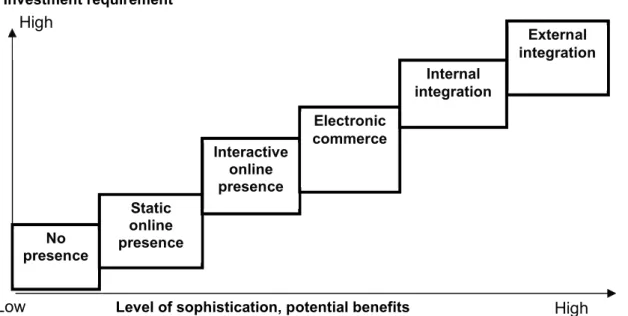
Figure 1: The Model of E-business Growth (Source: McKay and Marshall, 2004, p.11)
Figure 1 above describes the growth model of e-business for enterprises. At the initial phase, many organizations start with a static online presence. In this stage, firms use the online presence simply for information dissemination to the other party. Therefore, there is only uni-directional communication and typical information, including contact details, products/services information, shareholder information and job opportunities. Moving up from the initial phase to an interactive online presence, companies have two-way communication with the other party over the internet. In addition to acquiring corporate information, customers can place orders online and provide their feedbacks. The interactive site also may offer personalized information to the customers and capture their profiles. However, transactions still cannot be completed online until the emergence of electronic commerce stage. In the e-commerce stage, customers are able to complete business transactions online and enterprises are capable of managing their business round-the-clock and handling the logistics efficiently. This phase is led by the development of Business-to-Consumer (B2C) e-commerce (Mckay, and Marshall, 2004).
In the next stages of internal and external integration, enterprises have integrated their online systems with information technology to manage their related business activities. They usually have established both internal and external collaboration to integrate various business processes. These stages are associated with Business-to-Business (B2B) e-commerce, whose primary concentration is to increase the efficiency of supply chain management. Many e-commerce initiatives have been introduced in the recent years within diverse industrial sectors, including Just-in-Time (JIT) for the manufacturing industry, Quick Response (QR) for the textile industry, Efficient Consumer Response (ECR) for the grocery industry, Collaborative Planning, Forecasting and Replenishment (CPFR) for different industries (Mckay, and Marshall, 2004).
This model of e-business growth indicates that the higher the stage achieved by SMEs, the higher the Level of sophistication, potential benefits
Investment requirement
High
High
Low
No presence Static online presence Interactive online presence Electronic commerce Internal integration External integration(Barness and Hunt, 2001). All these aspects will influence the bottom line performance of SMEs, leading to obtain their competitive advantages (Singh, 2000).
In fact, a large number of SMEs in Saudi Arabia have merely achieved either the static online presence or the interactive online stage. Owing to the limited researches on e-commerce of Saudi SMEs, this study provides further insight and evaluation on e-commerce implementation in the Kingdom.
3. Research methodology
The quantitative study method by structured questionnaires is used for this research. This structured questionnaire is designed to look into the challenges of e-commerce implemented by SMEs in Saudi Arabia. All questionnaires are written in English and then translated into Arabic by the first author. To avoid the dispersion of data collection, SMEs from retail sector in Riyadh are considered only.
The data collection is divided into three stages. At first, SMEs in Riyadh are viewed as a research base. As the capital city of Saudi Arabia, Riyadh is the largest city and a prosperous economic centre with dynamic expansion of SMEs. Furthermore, SMEs involved in retail business is confirmed as the research sample. The retail sector in Saudi Arabia is the largest one among Gulf Cooperation Council (GCC), which reached around 300 billion SAR (approximately 80 billion US dollars) in 2016. The retail sector accounts for 21.5% of total employment provided by all private sectors. Due to the majority of the Kingdom’s demographic base under the age of 24, the purchasing power of young people is increasing nowadays. Because of economic stability and high purchasing power, the growth of retail sector will be very strong and considerable. Lastly, 400 questionnaires were distributed by emails in May 2017, while 218 feedbacks were received until October 2017 and only 153 of them were valid. The rate of valid response was 38.25%. The received data was analyzed by SPSS.
4. The analysis of data results
The description of data results is shown as follows (see Table 1 below). There are six key factors that hinder the development of e-commerce investigated in this research, including cultural influences, imperfect information and communication technology, incomplete logistics distribution systems, fear of risk taking and failure, lack of professionals, cost of launching an e-commerce venture.
Table 1. Key Variables and Number of Respondents
Source: Summarization from 153 SMEs of Retail Sector in Riyadh
From the table 1, we can see that 38 (24.84%) of SMEs emphasize cultural influences impede the e-commerce progress. The imperfect ICT and the incomplete logistics distribution systems are also regarded as constraints, accounting for 12.42% and 13.73% of the research sample respectively. Furthermore, 10 (6.53%) of SMEs fear of failure or do not want to take the risks for e-commerce. Additionally, 25 (16.34%) of SMEs lack the professionals of e-commerce and 40 (26.14%) of them stress that the cost of launching an e-commerce venture is a main problem.
5. The discussions of data results
The discussions of data results are explained in Chart 1 below. Chart 1 illustrates that the cost issue is the most dominating factor impeding the e-commerce implementation. Because of the recent economic downturn impacted by declining oil prices, the predicament in financing SMEs has been exacerbated in Saudi Arabia. However, the development of e-commerce strongly depends on telecommunication infrastructures (Dedrick et al., 1995).The cost of accessing the telecommunication facilities is quite expensive for most SMEs in the Kingdom. This is always complained by the managers of SMEs as well.
Chart 1.The Main Challenges of E-commerce Adoption
Source: Summarization from 153 SMEs of Retail Sector in Riyadh
Moreover, cultural influences and the shortage of professions are other two main barriers next to the cost problem. Specially, culture affects the style and behavior of consumption. For instance, the Saudis consider shopping as a recreation. They are resistant to provide personal data online, and they prefer to purchase something face-to-face. Therefore, the e-commerce is relatively difficult to nurture in the kingdom. Likewise, the differences of culture and business philosophies across Saudi Arabia have also been viewed as barriers to restrict the applicability and transferability of e-commerce models designed by some developed countries (Molla, 2005; John, 2014). In addition, the high-educated workers with technical and managerial skills are a key for SMEs to develop any new business. However, the level of education and the popularization of IT skills in Saudi Arabia lag behind the developed countries (Jennex et al., 2004). As a result, the shortage of high-qualified professionals with experience in managing e-commerce has exerted adverse impacts on the growth of e-commerce.
The imperfect information and communication technology as well as incomplete logistics distribution systems hamper the e-commerce adoption. The imperfect information and communication technology decreases the perceived security and easiness of e-commerce. For example, without a well-functioning website, it would be difficult for SMEs to attract more customers. Similarly, without giving adequate infrastructures to protect the security and privacy of e-commerce, customers would not feel confident about the integrity of payment process for online purchase. This could severely influence the trust of Saudi people to embrace e-commerce. Moreover, there is no fast, efficient and competitive delivery system as a support for e-commerce in Saudi Arabia.
Owing to the weak anti-risk ability of SMEs, e-commerce would bring more risks and threats to SMEs than large enterprises. Surprisingly, it is not a great challenge from the perspective of “risk taking or fear of failure” for launching e-commerce businesses, representing only 6.53% of the total respondents. This indicates that Saudi SMEs have increasingly realized the important role of e-commerce played in the long-term development of their firms. On the other hand, SMEs in Saudi Arabia are more willing to exploit the potential of e-commerce to improve their business operations.
5. Conclusion
This study aims to investigate the existing challenges and difficulties of e-commerce implementation in Saudi Arabia, filling current gap in the literature. Because of the negative effects by economic depression in the Kingdom, the financial burden for SMEs has been much heavier than before. Saudi SMEs cannot afford the high cost of launching an e-commerce venture, which is the main obstacle of their e-commerce adoption. Furthermore, the culture influences limiting the development of e-commerce are also identified, such as a preference for face-to-face shopping experience. Moreover, the imperfect information and communication technology seriously impacts the willingness of Saudi SMEs to carry out e-commerce. The incomplete logistics distribution systems lead to the difficulty in coordinating home delivery, hampering the sustainable growth of e-commerce. Additionally, Saudi SMEs are in urgent need of the professionals with managing e-commerce experience and skill. However, the fear of risk taking and failure in e-commerce is not regarded as a dominating challenge for
References
Abdolvand, N. and Kurnia, S. (2005). The EPC Technology Implications on Cross Docking, San Diego International Systems Conference, USA.
Barness, S. and Hunt, B. (2001). E-Commerce and V-Business, Butterworth Heinemann, England.
Chowdhury, A. (2003). “Information Technology and Productivity Payoff in the Banking Industry: Evidence from the Emerging Markets”, Journal of International Development, 15(6), 132-143.
Dedrick, J., Goodman, S. and Kraemer, K. (1995). “Little Engines that could: Computing in Small Energetic Countries”, Association of Computing Machinery, 35, 21-26.
Hidayat, M. (2004). Indonesia Kampiun Cyberfraud: Pemerintah Jangan Diam Saja, detiki-Net. [Online]
Available at:
http://jkt1.detikinet.com/index.php?fuseaction=detik.read&tahun=2004&bulan=3&tgl=19&time=1759&idn ews=116255&idkanal=110.
Johnston, R.B. (1998). Trading Systems and Electronic Commerce, Eruditions Publishing.
Jennex, M. E., Amoroso, D.L., and Adelakun, O. (2004). B2B E-Commerce Infrastructure Success Factors for Small Companies in Developing Countries, Idea Group Inc.
John, S. (2014). SMEs in Saudi Arabia: How the Supreme Economic Council Can Support SME Growth in the Kingdom. [Online] Available at: http://susris.com/2014/05/20/news-2014-05-20/.
Minges, M. (2002). Kretek Internet: Indonesia Case Study. [Online] Available at: http://www.apjii.or.id/dokumentasi/id_cs.pdf.
Mckay, J. and Marshall, P. (2004). Strategic Management of Business. London: John Wiley and Sons.
Molla, A. (2005). Exploring the Reality of E-Commerce Benefits among Businesses in a Developing Country, University of Manchester, Precinct Centre, Manchester, UK. [Online] Available at: URL:http://www.sed.manchester.ac.uk/idpm/publications/wp/di/index.htm.
Odedra-Straub, M. (2003). “E-commerce and Development: Whose Development?” Electronic Journal on Information Systems in Developing Countries, 11(2), 1-5.
Raman, K. and Yap, C. (1996). “From a Resource Rich Country to an Information Rich Society: An Evaluation of Information Technology Policies in Malaysia”, Information Technology for Development, (7), 109-131. Singh, A. D. (2000). Electronic Commerce: Some Implications for Firms and Workers in Developing Countries,
International Institute for Labor Studies, Geneva.
Turban, E., King. D., Lee J K. and Viehland D. (2006). Electronic Commerce: A Managerial Perspective, Prentice Hall.
Whitely, D. (1998). E-Commerce: Strategy, Technologies and Applications, McGraw Hill.
Unhelkar, B. (2003). Understanding the Impact of Cultural Issues in Global e-Business Alliances, 4th International We-B Conference, 24-25 Nov, Perth, Western Australia.
United Nation Conference on Trade and Development, (1999). “Can Electronic Commerce be an Engine for Global Growth? Electronic commerce and the integration of developing countries and countries with economies in transition”, International Trade, 19(23), Geneva.