R E S E A R C H A R T I C L E
Open Access
Development and psychometric testing of a scale
assessing the sharing of medical information and
interprofessional communication: the CSI scale
Emmanuelle Anthoine
1,2, Christelle Delmas
1, Julie Coutherut
3and Leïla Moret
1,2*Abstract
Background:Interprofessional collaboration is essential in creating a safer patient environment. It includes the need to develop communication and coordination between professionals, implying a better sharing of medical information. Several questionnaires exist in the literature, but none of them have been developed in the French context. The objective was to develop and test the psychometric properties of the communication and sharing information (CSI) scale which assesses specifically interprofessional communication, especially the sharing of medical information and the effectiveness of communication between members of the team.
Methods:The questionnaire construction process used a literature review and involved a panel of voluntary professionals. A list of 32 items explored the quality of shared information delivered to patients and the effectiveness of interprofessional communication. The study was conducted in 16 voluntary units in a University Hospital (France), which included medical, surgical, obstetrics, intensive care, pediatrics, oncology and rehabilitation care. The scale-development process comprised an exploratory principal component analysis, Cronbach’sα-coefficients and structural equation modeling (SEM).
Results:From these 16 units, a total of 503 health professionals took part in the study. Among them, 23.9% were physicians (n = 120), 43.9% nurses (n = 221) and 32.2% nurse assistants (n = 162).
The validated questionnaire comprised 13 items and 3 dimensions relative to“the sharing of medical information” (5 items),“communication between physicians”(4 items) and“communication between nurses and nurse assistants” (4 items). The 3 dimensions accounted for 63.7% of the variance of the final questionnaire. Their respective Cronbach’s alpha coefficients were 0.80, 0.87 and 0.81. SEM confirmed the existence of the 3 latent dimensions but the best characteristics were obtained with a hierarchical model including the three latent factors and a global“communication between healthcare professionals”latent factor, bringing the 8 items linked to communication together. All the structural coefficients were highly significant (P < 0.001).
Conclusions:This self-perception CSI scale assessing several facets of interprofessional communication is the first one developed in the French context. The development study exhibited excellent psychometric properties. Further psychometric analysis is needed to establish test-retest reliability, sensibility to change and concurrent validity.
Keywords:Interprofessional communication, Patient information, Patient safety, Questionnaire, Psychometric properties, Scale validation
* Correspondence:[email protected]
1PHU11, Public Health Department, University Hospital, Saint-Jacques
Hospital, 85, rue Saint-Jacques, Nantes Cedex 44093, France
2EA 4275 SPHERE: bioStatistics, Pharmacoepidemiology and Human Sciences
Research team, Faculty of Pharmaceutical Sciences, University of Nantes, Rue Gaston Veil, Nantes 44000, France
Full list of author information is available at the end of the article
Background
In recent years, much attention has been paid to quality and safety of hospital care. Many authors have argued that this depends on an organization that ensures the continuity of information and interprofessional collabor-ation [1,2]. In fact, team working seems to play a major role in creating safer patient care [3,4]. The collaboration between physicians and nursing staff has been widely studied, in particular in intensive care units [5-7]. In in-tensive care units, it has been shown that effective collab-oration between health care professionals will improve patient outcomes, as well as reduce medical errors, In addition, good cooperation between nurses and physicians is a characteristic of the “magnet hospitals”, which have lower nurse turnover and greater job satisfaction [5,8,9].
Although numerous studies have documented the bene-fit of effective team collaboration, especially between nurses and physicians, a collaborative model between phy-sicians and nurses continues to be the exception [5,10]. The lack of collaboration and communication, and its con-sequent negative impact on the provision of healthcare and patient outcomes has been pointed out for years [11,12].
Several authors have defined and modeled this complex and multidimensional phenomenon of interprofessional collaboration [13-16]. Among existing definitions of this concept, Henneman [14] described it as “labouring to-gether, sharing communication and decision-making …” as Baggs and Schmitt [13]. For these authors, collabor-ation means “nurse and physician cooperatively working together, sharing responsibility for solving problems and making decisions to formulate and carry out plans for pa-tient care”. More recently, interprofessional collaboration has been defined as“the process of developing and main-taining a partnership between a team of health profes-sionals and a client in a participatory, collaborative and coordinated approach to share decision-making around health and social issues”[17].
Most of the authors agree that the field of interprofes-sional collaboration includes the need to develop com-munication and coordination between professionals, and to better share medical information and problem-solving strategies. The Canadian Interprofessional Health Col-laborative (CIHC) developed an integrative approach composed of six competency domains: interprofessional communication, patient-centred care, role clarification, team functioning, collaborative leadership and interpro-fessional conflict resolution [16]. The two first domains support the others. Communication skills seem to be essential for all professionals and involve the ability to communicate effectively with others, especially those from other professions. Furthermore a study concluded that “physicians are from Mars and nurses are from Venus”, noting that the lack of communication can be attributed to various reasons [18]. There are indeed
many reasons, ranging from the nature of the nurse-physician relationship to differing work philosophies, responsibilities, social status or culture, gender inequal-ity, and competence of nurses [18-20]. Casey underlines that physicians and nurses train separately, keep separ-ate patient records, report to different hierarchies, read different journals, and use different jargon [21]. More-over, a study carried out by our team showed that nurses do not know what the patient has been told, that this information is not recorded in the patient’s file, and that as a result it is difficult for them to adapt what they say to patients, which in turn has an impact on the quality and coherence of the information actually deliv-ered [22]. However, information provided to patients has become a central part of care provision. Patients want to be involved in their own health care, and they cannot make the right decisions about treatment if they are not sufficiently informed about the possible side effects and complications, as well as how their treatment might affect their daily lives. In hospitals, multiple interactions exist, which in general involve several physicians as well as para-medical professionals, who may or may not be working in a structured team. This work organization, involving many different health professionals, not only requires good com-munication but also effective coordination of the different actions undertaken, in order to avoid repetition, inconsist-ency, or incoherence in caring for patients.
So, improvement programs for healthcare professional practices, focusing on communication and collaborative practices, are imperative to develop quality and safety of hospital care. To bring about change, professionals need to assess their levels of team collaboration, in particular their communications skills to share medical informa-tion so as to ensure coordinainforma-tion and continuity of care.
intensive care units. Moreover, only a few have been psychometrically well validated. So the absence of such an instrument in the French context has made it challenging for hospitals to measure interprofessional communication. The main objective of this paper is to develop and test the psychometric properties of the communication and sharing of information (CSI) scale which assesses a major facet of interprofessional collaboration in hospital settings, that is to say, interprofessional communication. Interpro-fessional communication includes the sharing of medical information and the effectiveness of communication be-tween members of the team (physicians, nurses and nurse assistants), and is recognised as a major factor of interest in quality and safety management practices.
Methods
Instrument development (November 2008–May 2009) The first step was to identify instruments used to meas-ure physician-nurse collaborative practices, especially those interested in communication and sharing informa-tion about patients and participating in decision-making concerning patient care. A literature search was carried out using Pubmed® using the following terms: nurse-physician, professionals, communication, collaboration, cooperation, sharing of information, questionnaire, scale, instrument and validation. When the study was con-ducted, only the papers published in English or French between 1990 and 2007 were examined. Several instru-ments have been developed and validated but none of them were specifically designed to answer our objective. Based on the literature review, a draft questionnaire com-piled 33 items related to the dimensions of these instru-ments related to interprofessional communication, but none of them explored sharing of information. After the elimination of redundancies, we were left with 12 items.
The second step involved a panel of voluntary profes-sionals (composed of 12 senior and junior physicians, 4 head nurses, 1 nurse and a director). The first meeting used the brainstorming methodology to generate ideas questioning good practices of sharing of medical infor-mation. All the ideas were then compiled from which 8 specific items were created. The second meeting was dedi-cated to a brainstorming concerning items generation re-lated to interprofessional communication. The first list of 12 items was completed by the professionals’views: they added 12 more items. These items were not new ideas but specific or completed interprofessional communication items by exploring relationships between identified profes-sionals (for example, the original item from Minvielle [24] was divided into 2 items:“it’s easy to discuss patients with medical staff” and in “it’s easy to discuss patients with nursing staff”. This item was specified as follows:“it’s easy to discuss patients with medical staff”,“it’s easy to discuss patients with a head nurse”, “it’s easy to discuss patients
with nurses”, “it’s easy to discuss patients with nurse assistants”).
Another meeting, which concerned the last part of the questionnaire, asked if tools for the sharing of information delivered to patients in units existed, and asked profes-sionals about their proposals and needs for conducting improvement actions. Finally a meeting allowed to review the items of the questionnaire for clarity and content validity.
A list of 63 items in four parts was retained. The two first parts (32 items) explored the quality of information sharing delivered to patients and interprofessional com-munication. Response choices were a 4-point Likert-scale format. Items concerning characteristics of the sample were added: occupation, working hours, experience in the unit (number of years), experience in the hospital (number of years), age and sex. To ensure face validity (level of un-derstanding, acceptability and time required to complete the questionnaire), the questionnaire was pilot tested by 5 health professionals (1 physician, 2 nurses and 2 nurse as-sistants). Three items were modified slightly in response to their comments.
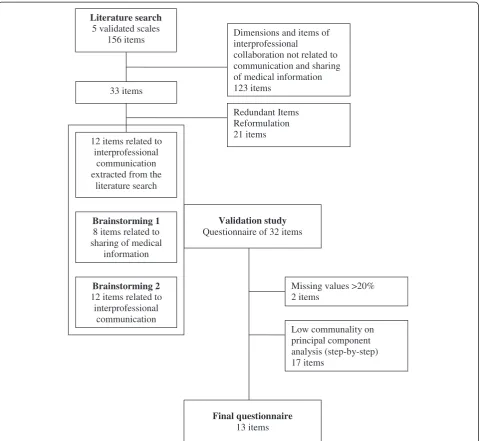
The Flow chart provided in Figure 1 shows the qualita-tive and quantitaqualita-tive phases of the scale development and validation (Figure 1).
Testing the questionnaire (June - July 2009)
The study was conducted in 16 voluntary units in medi-cine, surgery, obstetrics, intensive care units, pediatrics, oncology and rehabilitation care in the Nantes Univer-sity Hospital (France).
Scale-construction process (construct and convergent validity, reliability)
divergent validity (correlation of each dimension item with all the other items in the other dimensions <0.40) and correlations between dimensions [35]. Cronbach’s α-coefficients were computed for evaluating internal consistency [34,36]. In order to ensure known group validity, a comparison of scores was done between units where a regular interprofessional meeting exists (i.e. a definite organization of interprofessional collaboration) and others that don’t have regular meetings. The final questionnaire was provided as an Additional file 1.
Score calculation
Four response choices were offered, from never to always, with points attributed to each one (0, 1, 2 or 3), with
higher values corresponding to better interprofessional communication. Individual scores for all professionals who responded to at least half of the items plus one in a dimension were calculated by additioning the responses to the items and then dividing that value by the number of items completed. The mean score for a dimension was the sum of individual scores divided by the number of respon-dents. Scores ranged from 0 to 100.
Structural equations modelling (SEM)–partial least squares (PLS) approach
Structural equation modeling was performed to confirm factorial structure and unidimensionality of the dimen-sions. SEM is a comprehensive statistical approach to 33 items
Dimensions and items of interprofessional
collaboration not related to communication and sharing of medical information 123 items
12 items related to interprofessional
communication extracted from the
literature search
Redundant Items Reformulation 21 items
Brainstorming 1
8 items related to sharing of medical
information
Brainstorming 2
12 items related to interprofessional
communication
Validation study
Questionnaire of 32 items
Literature search
5 validated scales 156 items
Missing values >20% 2 items
Low communality on principal component analysis (step-by-step) 17 items
Final questionnaire
[image:4.595.59.539.88.529.2]13 items
test hypotheses about relationships among observed and latent variables (dimensions) [37]. Parameter estimation used the PLS approach developed by Wold [38]. Results were read in two steps: evaluation of the quality of the measurement model in each dimension, with commu-nality indexes which have to be superior or equal to 50% [39]; and then evaluation of the quality of the structural model, with redundancy indexes. Finally, the GoF index (Goodness of Fit) evaluated the quality of the global model. It had to be superior or equal to 0.9.
Characteristics of the sample were described by comput-ing percentages, means, standard deviations and ranges. All study analyses were computed using R 2.15.1 and SPAD 5.6. SEM was performed using XLSTAT - PLSPM.
Ethical and consent considerations
All physicians, nurses and nurse assistants were invited to participate by their head nurses. All professionals re-ceived a questionnaire accompanied by a letter in which the purpose of the study was explained. They were asked to return the questionnaire anonymously in a drop box on the ward. Participation was voluntary, filling in the questionnaire was considered as informed consent.
According to the articles L1121-1 and R1121-2 from the French code of public health, IRB approval was unnecessary.
Results
Characteristics of the sample
A total of 503 health professionals participated from 16 units of Nantes University Hospital. Among them 23.9% were physicians (n = 120), 43.9% nurses (n = 221) and 32.2% nurse assistants (n = 162). Participation rates were respectively 22%, 41% and 30% for a global rate of par-ticipation of 30%.
The majority of the sample were women (82.2%). Mean ± standard deviation (SD) age of the respondents was 37.2 ± 9.3 years and median was 36 years. Median [range] years of experience in the hospital was 8 years [0–40], and median [range] years of experience in the unit was 4 years [0–30].
Scale-construction process
Among the 32 items, 2 were removed because their missing values rates were superior to 20%. They con-cerned the good communication between physicians when sharing information (22.8%) and the good commu-nication between nurses and nurse assistants (27.9%).
No item had Pearson’s correlation coefficients with an-other item exceeding 0.6.
Five successive exploratory PCAs were then performed on the 30 remaining items and this led to the identifica-tion of three dimensions according to the scree plot. Seventeen items were removed step-by-step because of
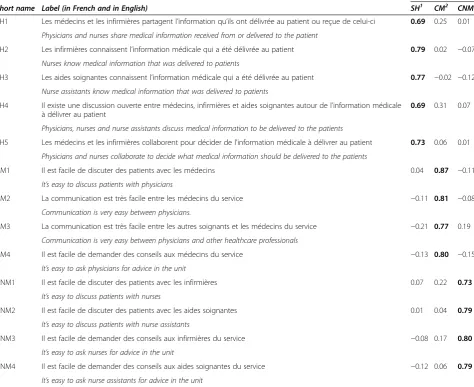
their low factor loadings on one of the three factors or because they exhibited factor loadings on both (Figure 1). No item maximized Cronbach’sα-coefficient and all the 13 remaining items had factor loading >0.60 within their own dimension.
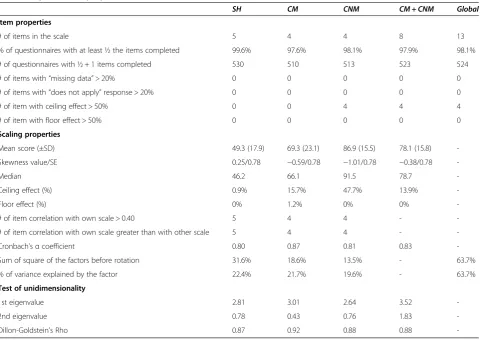
The final questionnaire was a 13 items scale (Table 1). The first dimension was composed of five items explor-ing the sharexplor-ing of medical information between health-care professionals and accounted for 22.4% of the variance. The second one, which explored the effective-ness of communication between medical staff members, was composed of four items and accounted for 21.7% of the variance. The third one, which explored the effect-iveness of communication between nurses and nurse assistants, was composed of four items and accounted for 19.6% of the variance. Their respective Cronbach’s α-coefficients were 0.80, 0.87 and 0.81. Correlations be-tween items within a given dimension all exceeded 0.40 and correlations between one item and those of other dimensions were <0.40. The statistical parameters were reported in Table 2.
Moreover, in some units the sharing of medical infor-mation had already been developed thanks to regular interprofessional meetings. In order to ensure known group validity, a comparison of the“the sharing of med-ical information between healthcare professionals” score was done between those units and others. It was signifi-cantly higher (p < 0.01) in units having this specific organization (53.2 ± 10.5) than in others (45.7 ± 6.1).
Based on scores ranging from 0 to 100, mean (± SD) scores were 49.3 ± 17.9 for“the sharing of medical infor-mation between healthcare professionals” dimension, 69.3 ± 23.1 for “the effectiveness of communication be-tween medical staff members”dimension and 86.9 ± 15.5 for “the effectiveness of communication between nurses and nurse assistants” dimension. Results are reported in Table 2.
Structural equations modelling (SEM)
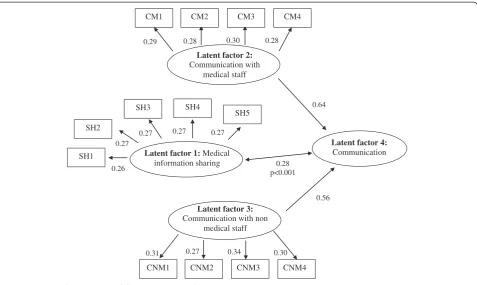
SEM confirmed the existence of 3 latent dimensions (“ 1-The sharing of medical information between healthcare professionals”,“2-The effectiveness of communication be-tween medical staff members”and“3-The effectiveness of communication between nurses and nurse assistants”), but the best characteristics were obtained with a hierarch-ical model including the three latent factors and a global
“The communication between healthcare professionals” latent factor, bringing 2 dimensions together (Figure 2)
Discussion
Our study produced the validated CSI scale consisting of 13 items and 3 subscales measuring several elements of interprofessional communication, including the sharing of medical information between healthcare professionals, communication between physicians and communication between nurses and nurse assistants. Confirmatory ana-lysis (SEM) supported the possibility of calculating a global score of communication between healthcare professionals bringing together the two dimensions related to interpro-fessionals’communication. This self-perception question-naire is the first one developed in the French context. It exhibited excellent psychometric properties. The results of this study provide evidence for high construct, divergent and discriminant validity. Internal consistency was over
0.80 as recommended [34,36]. Items had strong factor loadings with the three principal component analysis-identified factors and accounted for more than 2/3 of the variance. For modelling, the PLS approach was chosen because of the non-normality of the data [38]. The statistical validation strategy presented herein fol-lows most of the recommendations of ‘good practice’ for score validation [40].
[image:6.595.61.536.112.499.2]This scale is short and easy to use. It explores health-care professionals’perception of their ability to commu-nicate and to share medical information delivered to patients. These dimensions are key factors in patient sat-isfaction and safety [1-3]. The instrument is usable by the whole team, including nurse assistants and is not limited to intensive care units.
Table 1 Results of PCA using varimax rotation
Scale dimensions
Short name Label (in French and in English) SH1 CM2 CNM3
SH1 Les médecins et les infirmières partagent l’information qu’ils ont délivrée au patient ou reçue de celui-ci 0.69 0.25 0.01
Physicians and nurses share medical information received from or delivered to the patient
SH2 Les infirmières connaissent l’information médicale qui a été délivrée au patient 0.79 0.02 −0.07
Nurses know medical information that was delivered to patients
SH3 Les aides soignantes connaissent l’information médicale qui a été délivrée au patient 0.77 −0.02 −0.12
Nurse assistants know medical information that was delivered to patients
SH4 Il existe une discussion ouverte entre médecins, infirmières et aides soignantes autour de l’information médicale à délivrer au patient
0.69 0.31 0.07
Physicians, nurses and nurse assistants discuss medical information to be delivered to the patients
SH5 Les médecins et les infirmières collaborent pour décider de l’information médicale à délivrer au patient 0.73 0.06 0.01
Physicians and nurses collaborate to decide what medical information should be delivered to the patients
CM1 Il est facile de discuter des patients avec les médecins 0.04 0.87 −0.11
It’s easy to discuss patients with physicians
CM2 La communication est très facile entre les médecins du service −0.11 0.81 −0.08
Communication is very easy between physicians.
CM3 La communication est très facile entre les autres soignants et les médecins du service −0.21 0.77 0.19
Communication is very easy between physicians and other healthcare professionals
CM4 Il est facile de demander des conseils aux médecins du service −0.13 0.80 −0.15
It’s easy to ask physicians for advice in the unit
CNM1 Il est facile de discuter des patients avec les infirmières 0.07 0.22 0.73
It’s easy to discuss patients with nurses
CNM2 Il est facile de discuter des patients avec les aides soignantes 0.01 0.04 0.79
It’s easy to discuss patients with nurse assistants
CNM3 Il est facile de demander des conseils aux infirmières du service −0.08 0.17 0.80
It’s easy to ask nurses for advice in the unit
CNM4 Il est facile de demander des conseils aux aides soignantes du service −0.12 0.06 0.79
It’s easy to ask nurse assistants for advice in the unit
1
SH dimension: Medical information sharing between healthcare professionals.
2
CM dimension: communication between physicians.
3
Nevertheless, there are a number of study limitations concerning the methodology of the study. First, the study sample was chosen by convenience and may not be representative of the variety of settings and of the general population of healthcare workers. Although our study included several different kinds of units, it was not exhaustive. Selection bias may be present because healthcare professionals who have a particular interest in promoting interprofessional communication are perhaps more likely to have responded to the questionnaire. However, while the rate of participation by healthcare professionals was amply sufficient to obtain relevant data for the validation study, it cannot be seen as a reliable estimate of the perception that professionals have in the Nantes university hospital, and so our results cannot be generalised. As this was the first time that nurse assis-tants were interviewed on this large sample, it may ex-plain why they, in particular, were reluctant to respond. Secondly the date at which the survey was conducted (June and July), close to the holiday period, could also be a factor that reduced the response rate. The reasons why some professionals did not answer the question-naire remain to be explored. The sample is issued from a big university hospital in one region of France only,
and results might be different in other hospitals and re-gions. The application of the findings to all hospitals is therefore limited.
[image:7.595.59.540.98.438.2]A number of limitations concerning the instrument development can also be noted. First, the expert review of the items, from outside experts, did not occur to val-idate the items in the initial instrument. Secondly, our instrument only explored two facets of the concept of interprofessional communication, that is to say the shar-ing of information and communication between team members. Moreover interprofessional communication is measured within a multi-disciplinary practice perspec-tive, and not within a collaborative practice perspective. Thirdly, we hypothesized that health professionals understand and can articulate what constitute interpro-fessional communication. Finally, Table 2 showed that the dimension related to communication between nurses and nurse assistants had an important ceiling effect and that the distribution of the score was not normal. A fur-ther validation process is required to reduce this ceiling effect, for example a test of a new response pattern. Fur-ther psychometric analysis is also needed to establish test-retest reliability, sensitivity to change, concurrent validity and cross-cultural validations in other countries.
Table 2 Psychometric properties of the CSI scale
SH CM CNM CM + CNM Global
Item properties
# of items in the scale 5 4 4 8 13
% of questionnaires with at least ½ the items completed 99.6% 97.6% 98.1% 97.9% 98.1%
# of questionnaires with ½ + 1 items completed 530 510 513 523 524
# of items with“missing data”> 20% 0 0 0 0 0
# of items with“does not apply”response > 20% 0 0 0 0 0
# of item with ceiling effect > 50% 0 0 4 4 4
# of item with floor effect > 50% 0 0 0 0 0
Scaling properties
Mean score (±SD) 49.3 (17.9) 69.3 (23.1) 86.9 (15.5) 78.1 (15.8)
-Skewness value/SE 0.25/0.78 −0.59/0.78 −1.01/0.78 −0.38/0.78
-Median 46.2 66.1 91.5 78.7
-Ceiling effect (%) 0.9% 15.7% 47.7% 13.9%
-Floor effect (%) 0% 1.2% 0% 0%
-# of item correlation with own scale > 0.40 5 4 4 -
-# of item correlation with own scale greater than with other scale 5 4 4 -
-Cronbach’sαcoefficient 0.80 0.87 0.81 0.83
-Sum of square of the factors before rotation 31.6% 18.6% 13.5% - 63.7%
% of variance explained by the factor 22.4% 21.7% 19.6% - 63.7%
Test of unidimensionality
1st eigenvalue 2.81 3.01 2.64 3.52
-2nd eigenvalue 0.78 0.43 0.76 1.83
-Moreover, our items might also be validated by comparing them against the descriptors for the CIHC’s interprofes-sional competency domain [16], and our findings should be completed by more work considering others dimensions of interprofessional collaboration assessment. According to authors, developed instruments propose specific dimen-sions about coordination [28,29], cooperation [29], partner-ship [29], problem solving, decision making process [29,30], and leadership [25,41].
Conclusion
The CSI scale exploring interprofessional communica-tion should assist researchers and quality managers who wish to assess levels of effective communication in clin-ical units. It should help team members to explore how they work and share information together in order to enhance their healthcare practices. The sharing of med-ical information within the healthcare team ensures the quality of information delivered to the patient. Con-versely, absence of cohesion and inconsistencies between physicians and nursing staff, and their different modes of expression towards the patient, often generate anxiety and result in insufficient information reaching the pa-tient. One line of approach is therefore the improvement of communication between physicians and nurses/nurse assistants. They could both benefit from a better defin-ition of their roles, by undertaking further training in conflict-resolving, in effective methods of asserting their
own opinions and knowledge, in listening skills, and in conducting collaborative ward rounds. These methods for training teams, in order to improve interpersonal skills, have already been validated in the field of aviation or other industries, and in hospitals they have also shown their value in improving the quality and safety of care delivered to the patient.
Additional file
Additional file 1:Communication and sharing of information Scale (CSI scale).
Competing interests
The authors declare that they have no competing interests.
Authors’contributions
EA realized the statistical analysis, interpretation of results, and took part in writing the manuscript. CD made a review of the literature and has been involved in drafting the manuscript. JC has been involved in the design of the study and in the data collection. LM conceived the study, coordinated the study and took part in writing the manuscript. All authors have read and approved the final manuscript.
Acknowledgements
We thank all health professionals (physicians, head nurses, nurses and nurse assistants) who participated in the study. We also thank Kerry Ure Breton, who participated in the translation of the manuscript in English. The study was funded by the“Département général de l’offre de soins”(DGOS, French Ministry of Health).
SH1 SH2
SH3 SH4
SH5
0.26 0.27
0.27 0.27 0.27
Latent factor 1:Medical
information sharing
0.31 0.27 0.34 0.30
Latent factor 3:
Communication with non medical staff
0.56
Latent factor 4:
Communication
0.64 Latent factor 2:
Communication with medical staff CM1
0.29 0.28 0.30 0.28
CM2 CM3 CM4
CNM1 CNM2 CNM3 CNM4
[image:8.595.60.538.88.373.2]0.28 p<0.001
Author details
1
PHU11, Public Health Department, University Hospital, Saint-Jacques Hospital, 85, rue Saint-Jacques, Nantes Cedex 44093, France.2EA 4275 SPHERE: bioStatistics, Pharmacoepidemiology and Human Sciences Research team, Faculty of Pharmaceutical Sciences, University of Nantes, Rue Gaston Veil, Nantes 44000, France.3Centre Fédératif Prévention Dépistage, University Hospital, Bâtiment Le Tourville, Nantes Cedex 44093, France.
Received: 16 April 2013 Accepted: 4 March 2014 Published: 13 March 2014
References
1. Krogstad U, Hofoss D, Hjortdahl P:Doctor and nurse perception of inter-professional co-operation in hospitals.Int J Qual Health Care2004, 16:491–497.
2. Cook RI, Render M, Woods DD:Gaps in the continuity of care and progress on patient safety.BMJ2000,320:791–794.
3. Firth-Cozens J:Cultures for improving patient safety through learning: the role of teamwork.Qual Health Care2001,10(Suppl 2):ii26–ii31. 4. Firth-Cozens J:Multidisciplinary teamwork: the good, bad, and
everything in between.Qual Health Care2001,10:65–66.
5. Baggs JG, Schmitt MH, Mushlin AI, Mitchell PH, Eldredge DH, Oakes D, Hutson AD:Association between nurse-physician collaboration and patient outcomes in three intensive care units.Crit Care Med1999, 27:1991–1998.
6. Manias E, Street A:Nurse-doctor interactions during critical care ward rounds.J Clin Nurs2001,10:442–450.
7. Thomas EJ, Sexton JB, Helmreich RL:Discrepant attitudes about teamwork among critical care nurses and physicians.Crit Care Med2003,
31:956–959.
8. Vahey DC, Aiken LH, Sloane DM, Clarke SP, Vargas D:Nurse burnout and patient satisfaction.Med Care2004,42:II57–II66.
9. Shortell SM, O’Brien JL, Carman JM, Foster RW, Hughes EF, Boerstler H, O’Connor EJ:Assessing the impact of continuous quality improvement/ total quality management: concept versus implementation.Health Serv Res1995,30:377–401.
10. Aiken LH, Sloane DM, Sochalski J:Hospital organisation and outcomes.
Qual Health Care1998,7:222–226.
11. Fagin CM:Collaboration between nurses and physicians: no longer a choice.Acad Med1992,67:295–303.
12. Rosenstein AH, O’Daniel M:Disruptive behavior and clinical outcomes: perceptions of nurses and physicians.Am J Nurs2005,105:54–55. 13. Baggs JG, Ryan SA, Phelps CE, Richeson JF, Johnson JE:The association
between interdisciplinary collaboration and patient outcomes in a medical intensive care unit.Heart Lung1992,21:18–24.
14. Henneman EA:Nurse-physician collaboration: a poststructuralist view.
J Adv Nurs1995,22:359–363.
15. Baggs JG:Development of an instrument to measure collaboration and satisfaction about care decisions.J Adv Nurs1994,20:176–182. 16. Orchard CA, Bainbridge L:A National interprofessional competency
framework.36th edition. ; 2010.
17. Orchard CA, Curran V, Kabene S:Creating a Culture for Interdisciplinary Collaborative Professional Practice.Online: Medical Education; 2005:10. 18. Puntillo KA, McAdam JL:Communication between physicians and nurses
as a target for improving end-of-life care in the intensive care unit: challenges and opportunities for moving forward.Crit Care Med2006, 34:S332–S340.
19. Cadogan MP, Franzi C, Osterweil D, Hill T:Barriers to effective communication in skilled nursing facilities: differences in perception between nurses and physicians.J Am Geriatr Soc1999,47:71–75. 20. MacKay RC, Matsuno K, Mulligan J:Communication problems between
doctors and nurses.Qual Assur Health Care1991,3:11–19.
21. Casey N, Smith R:Bringing nurses and doctors closer together.BMJ1997, 314:617–618.
22. Moret L, Rochedreux A, Chevalier S, Lombrail P, Gasquet I:Medical information delivered to patients: discrepancies concerning roles as perceived by physicians and nurses set against patient satisfaction.
Patient Educ Couns2008,70:94–101.
23. Copnell B, Johnston L, Harrison D, Wilson A, Robson A, Mulcahy C, Ramudu L, McDonnell G, Best C:Doctors’and nurses’perceptions of
interdisciplinary collaboration in the NICU, and the impact of a neonatal nurse practitioner model of practice.J Clin Nurs2004,13:105–113. 24. Minvielle E, Dervaux B, Retbi A, Aegerter P, Boumendil A, Jars-Guincestre
MC, Tenaillon A, Guidet B:Culture, organization, and management in intensive care: construction and validation of a multidimensional questionnaire.J Crit care2005,20:126–138.
25. Shortell SM, Rousseau DM, Gillies RR, Devers KJ, Simons TL:Organizational assessment in intensive care units (ICUs): construct development, reliability, and validity of the ICU nurse-physician questionnaire.Med Care1991,29:709–726.
26. Hojat M, Herman MW:Developing an instrument to measure attitudes toward nurses: preliminary psychometric findings.Psychol Rep1985, 56:571–579.
27. Dougherty MB, Larson E:A review of instruments measuring nurse-physician collaboration.J Nurs Adm2005,35:244–253.
28. Dougherty MB, Larson EL:The nurse-nurse collaboration scale.J Nurs Adm
2010,40:17–25.
29. Orchard CA, King GA, Khalili H, Bezzina MB:Assessment of
interprofessional team collaboration scale (AITCS): development and testing of the instrument.J Contin Educ Health Prof2012,32:58–67. 30. Ushiro R:Nurse-physician collaboration scale: development and
psychometric testing.J Adv Nurs2009,65:1497–1508.
31. Kenaszchuk C, Reeves S, Nicholas D, Zwarenstein M:Validity and reliability of a multiple-group measurement scale for interprofessional
collaboration.BMC Health Serv Res2010,10:83.
32. Fayers PM, Machin D:Quality of life: the assessment, analysis and
interpretation of patient-reported outcomes.2nd edition. Chichester, UK: John Wiley & Sons Ltd.; 2007.
33. Labarere J, Francois P, Auquier P, Robert C, Fourny M:Development of a French inpatient satisfaction questionnaire.Int J Qual Health Care2001, 13:99–108.
34. Nunnaly JC:Psychometric theory.New York: McGraw-Hill; 1978. 35. Campbell DT, Fiske DW:Convergent and discriminant validation by the
multitrait-multimethod matrix.Psychol Bull1959,56:81–105. 36. Cronbach LJ:Coefficient alpha and the internal structure of tests.
Psychometrika1951,16:297–334.
37. Hoyle RH:Structural equation modeling: concepts, issues and applications.
Thousand Oaks, CA: Sage publications; 1995.
38. Wold H: InSoft modeling: the basic design and some extensions, Volume 2. Edited by Jöreskog KG, Weld H. Amsterdam, North-Holland; 1982. 39. Fornell C, Laker DF:Evaluating structural Equation models with
unobservable variables and measurement error : algebra and statistics.
J Mark Res1981,18:39–50.
40. Coste J, Fermanian J, Venot A:Methodological and statistical problems in the construction of composite measurement scales: a survey of six medical and epidemiological journals.Stat Med1995,14:331–345. 41. Adams A, Bond S, Arber S:Development and validation of scales to
measure organisational features of acute hospital wards.Int J Nurs Stud
1995,32:612–627.
doi:10.1186/1472-6963-14-126
Cite this article as:Anthoineet al.:Development and psychometric testing of a scale assessing the sharing of medical information and interprofessional communication: the CSI scale.BMC Health Services Research201414:126.
Submit your next manuscript to BioMed Central and take full advantage of:
• Convenient online submission
• Thorough peer review
• No space constraints or color figure charges
• Immediate publication on acceptance
• Inclusion in PubMed, CAS, Scopus and Google Scholar
• Research which is freely available for redistribution