This is a repository copy of
Synthesis of general Chebyshev characteristic function for
dual (single) bandpass filters
.
White Rose Research Online URL for this paper:
http://eprints.whiterose.ac.uk/83307/
Version: Accepted Version
Proceedings Paper:
Musonda, E and Hunter, IC (2015) Synthesis of general Chebyshev characteristic function
for dual (single) bandpass filters. In: IEEE MTT-S International Microwave Symposium
2015. International Microwave Symposium 2015, 17-22 May 2015, Phoenix, Arizona, USA.
IEEE . ISBN 978-1-4799-8275-2
https://doi.org/10.1109/MWSYM.2015.7166710
[email protected] https://eprints.whiterose.ac.uk/
Reuse
Unless indicated otherwise, fulltext items are protected by copyright with all rights reserved. The copyright exception in section 29 of the Copyright, Designs and Patents Act 1988 allows the making of a single copy solely for the purpose of non-commercial research or private study within the limits of fair dealing. The publisher or other rights-holder may allow further reproduction and re-use of this version - refer to the White Rose Research Online record for this item. Where records identify the publisher as the copyright holder, users can verify any specific terms of use on the publisher’s website.
Takedown
If you consider content in White Rose Research Online to be in breach of UK law, please notify us by
Synthesis of General Chebyshev Characteristic Function for Dual
(Single) Bandpass Filters
Evaristo Musonda
1, Student Member IEEE, Ian Hunter
1, Fellow IEEE
1
Institute of Microwaves and Photonics, School of Electronic and Electrical Engineering, University of
Leeds, Leeds LS2 9JT, UK
Abstract— A new synthesis method for the generation of the generalized Chebyshev characteristic polynomials has been presented. The general characteristic function is generated by linear combination of elementary Chebyshev characteristic functions. The characteristic function is suitable for synthesis of dual bandpass filters as well as direct synthesis for single bandpass filters.
Index Terms—Dual-band Filters, Generalised Chebyshev, Minimum Phase Networks,
I.INTRODUCTION
There has been increasing interest in the past decade in the area of multi-passband filters. In particular dual band filters offers flexibility as well as efficiency in the utilization of communication resources. Many important contributions have been made to the methods of designing of dual band filters [1-3].
The previous methods outlined in [2, 3] involve some form of frequency transformations to generate a lowpass transfer function suitable for dual band filters. Similar lowpass filters for dual band filters may be designed using change of variable based on classical work in [4]. In this paper, however, methods of direct generation of the general Chebyshev lowpass transfer function for dual passband filters will be explained. The outlined method offers a simple and intuitive approach to synthesis of dual (or direct synthesis of single) band filter networks by linearly combining simple elementary characteristic functions.
In section II the generation of the basic prototype characteristic functions is described followed by the method of computing the characteristic polynomials in section III. Finally, a design example is given in section IV.
II.CHARACTERISTIC FUNCTION
For any given filter network, the power transfer function may be defined as [5],
where k is a constant, the monic polynomials, and
are the reflection and transmission (containing the transfer function’s transmission zeros) characteristic polynomial respectively, all dependent on the frequency variable rad/s. Let the characteristic function be defined as
where, is the degree of the filter network. It may be shown then that for Chebyshev characteristic functions the characteristic function can be found from the linear
combination of number of low degree basic characteristic
functions based on the following equation,
where (integer) is the corresponding weighting number to
the basic characteristic function . Thus the problem of
determining the higher degree rational polynomial , is
reduced to determining some unique lower degree basic
characteristic functions which act as basic building
blocks for higher degree polynomials. Each of the basic prototype is defined by the number and positions of transmission zeros. The overall characteristic function may be
obtained by further expansion of as presented below after
a bit of mathematical manipulations,
Now the term in is conveniently re-written as
where is simply the numerator of and
is the polynomial containing the critical (cut-off) points. is
the polynomial that results from the factorisation and
is simply the denominator of . The next sections
show how the basic prototypes may be determined.
A.Basic prototypes for minimum phase lowpass filters
The term accounts for a pair of imaginary turning points. The other turning points are provided by the term
and the extra zeros provided by this expression
are just the cut-off points at and , which
are cancelled out by the denominator term
. is a constant and is the
inner cutoff in the normalized domain. By solving this differential equation, the general solution of the characteristic function for minimum phase filter networks is obtained. It
may be shown that the solution to may be written as,
proving the synthesis equation where the basic prototypes
are
From (8) for to be an even degree rational
polynomial in , i.e.
Thus , and , must be either zero or positive integers.
Also from , the number of transmission zeros at the origin
for T is
By assigning different integer values including zero to ,
and , different linear combinations of functions in may
be obtained as unique solutions to the differential equation
. given by is thus the general solution to the
differential equation defined by . There are only two
equations in , and i.e. and . Thus one of the
three scalars may be chosen and the other two may be
determined from and . One suitable choice is as
follows: For choose , then solving
and simultaneously yields,
For choose , then solving and simultaneously yields,
The different scalars values are summarized in table I. In this
work, the nomenclature is adopted to depict
an degree characteristic function with transmission
zeros at some general complex frequencies, including purely
real and imaginary (real frequency), and number of
transmission zeros at the origin. This yields family of solutions based on the number of transmission zeros at the
origin ( ). It is interesting to note that the first
characteristic function in is simply the even degree
Achieser-Zolotarev characteristic function [6]. The well-known Chebyshev even degree characteristic functions may be obtained from this class by simply setting the parameters
and . Additionally, the second
prototype in is a well-known function in the design of
filters e.g. used in [2] and also used as a conventional normalised bandpass transformation [7]. Therefore, Table I
gives all possible transmission zeros at the origin ( ) for
any given minimum phase lowpass filter of degree ( even).
B.Basic prototypes for symmetrical lowpass filters
The three basic prototypes derived in II (A) are used in design of general Chebyshev characteristic function for symmetrical
networks. In general an basic prototype characteristic
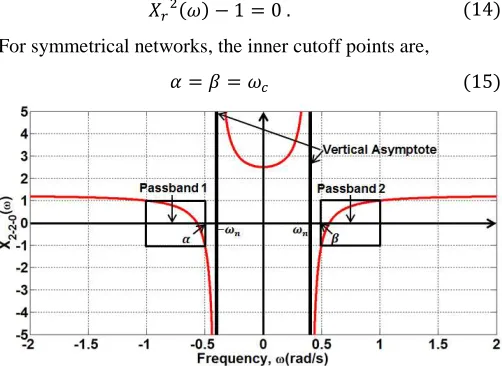
function may be determined analytically by solving a set of non-linear simultaneous equations based on the behavior of the function and its known values at the critical points, (i.e.
as depicted in Fig. 1) using,
[image:3.612.316.567.338.521.2]For symmetrical networks, the inner cutoff points are,
Fig. 1 Example of a plot of the basic characteristic function in II (B)
For example consider a second degree basic prototype for direct synthesis of bandpass filters or synthesis of symmetrical dual band filters shown in Fig. 1 given by,
Since from Fig. 1, X and X ,
then two simultaneous equations may be formed and solved
for unknown coefficients p and as
Hence the basic symmetrical characteristic function with the
transmission zeros prescribed at is given by,
In fact all the basic prototypes may be found in this way and for symmetrical networks are summarized in Table II. Note
that for the prototype, for and
for .
C.Basic prototypes for asymmetrical lowpass filters
Similar to the method used for symmetrical prototypes, asymmetrical basic prototypes may be determined and are tabulated in Table III in terms of the required polynomials.
TABLE III: ASYMMETRICAL NETWORK BASIC PROTOTYPES
Prototype ( ) and Position of Dependent
Transmission Zero
Inner Stopband, Lower Stopband,
Upper Stopband
if is infinite
if is finite
III.CHARACTERISTIC POLYNOMIALS
Once the basic prototypes are determined, the computation of the overall characteristic function is fairly straight forward
from . The weighting integer numbers is the designer’s
choice depending on the number and positions of transmission zeros required from a given elementary function of table II.
By substituting in , the reflection polynomial is
obtained as follows:
Thus the reflection polynomial is computed by successive application of the general recursive technique [5] with initial
conditions and and defined by
where all the parameters are as defined above. is used for
basic prototypes and repeated times for each prototype,
each time using the previous results to compute the
polynomials in . Finally
The monic polynomial is obtained from the prescribed
For monic polynomials and their normalizing
parameter and respectively are computed at points in -
plane where both s-parameters and are known
(e.g. ) so that the unitary condition [7] and the
prescribed return loss level are satisfied. Once the characteristic polynomials are determined, the rest of the synthesis process follows from the standard filter theory in [8].
IV.DESIGN EXAMPLE
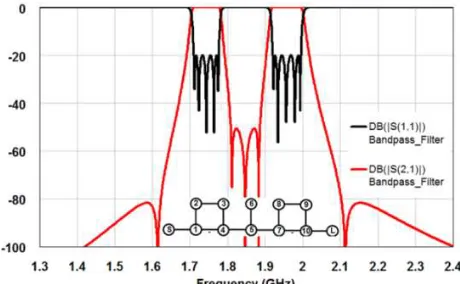
A symmetrical dual passbands with cutoffs at 1710-1785 & 1920-1995MHz and 20 dB passband return loss were designed. Using the lowpass to bandpass transformation, the
inner cutoff is . The prescribed transmission
zeros were at . Since the dual band is
symmetrical, the following lowpass prototypes were linearly
combined according to based on the basic prototypes of
table II: , and with weighting
numbers , and respectively. The first
prototype only provides transmission zeros at infinite, the second provides the required single transmission zero at the origin and the last prototype provides the two pairs of symmetrical transmission zeros - applied iteratively depending
on .
This gives an overall lowpass characteristic
function. Using the general recursive formulae the
characteristic polynomials were determined as in Table IV in
complex variable . Then cascaded synthesis was used to
extract the element values and the coupling matrix generated as shown below. The bandpass simulation and topology are shown in Fig. 2.
Fig. 2 Bandpass Simulation of the dual band filter in IV with its topology.
V.CONCLUSION
The method of generating the general Chebyshev characteristic function used in the design of relatively close-spaced dual passband filters has been outlined. Linear combinations of the elementary characteristic functions (based on transmission zeros placement) allow high order characteristic functions to be determined.
ACKNOWLEDGEMENT
This work was supported in part by the Beit Trust, the University of Leeds, Leeds, UK, RS Microwave Inc., Butler, NJ, USA, Radio Design Limited, Shipley, West Yorkshire, UK and The Royal Academy of Engineering, London, UK.
REFERENCES
[1] X. Fei, "Direct Synthesis Technique for Dual-Passband Filters: Superposition Approach," Circuits and Systems II: Express Briefs, IEEE Transactions on, vol. 60, pp. 267-271, 2013. [2] L. Juseop and K. Sarabandi, "A Synthesis Method for
Dual-Passband Microwave Filters," Microwave Theory and Techniques, IEEE Transactions on, vol. 55, pp. 1163-1170, 2007.
[3] G. Macchiarella and S. Tamiazzo, "Design techniques for dual-passband filters," Microwave Theory and Techniques, IEEE Transactions on, vol. 53, pp. 3265-3271, 2005.
[4] H. Orchard and G. C. Temes, "Filter design using transformed variables," Circuit Theory, IEEE Transactions on, vol. 15, pp. 385-408, 1968.
[5] R. J. Cameron, C. M. Kudsia, and R. R. Mansour, Microwave filters for communication systems: fundamentals, design, and applications. Hoboken, N.J: Wiley-Interscience, 2007.
[6] R. Levy, "Generalized rational function approximation in finite intervals using Zolotarev functions," Microwave Theory and Techniques, IEEE Transactions on, vol. 18, pp. 1052-1064, 1970.
[7] I. Hunter, Theory and design of microwave filters: IET, 2001. [8] R. J. Cameron, "General coupling matrix synthesis methods for
Chebyshev filtering functions," Microwave Theory and Techniques, IEEE Transactions on, vol. 47, pp. 433-442, 1999.
Coupling Matrix for Dual Band Filter
TABLE IV DUAL BAND FILTER
CHARACTERISTIC POLYNOMIALS ( AND
[image:5.612.325.555.53.195.2] [image:5.612.54.292.445.550.2]