ResearchOnline@JCU
This file is part of the following work:
Abdulhassan Alshomali, Mohammad Azeez (2018)
Open source software GitHub
ecosystem: a SEM approach.
PhD Thesis, James Cook University.
Access to this file is available from:
https://doi.org/10.25903/5c3eb27776753
Copyright © 2018 Mohammad Azeez Abdulhassan Alshomali
The author has certified to JCU that they have made a reasonable effort to gain
permission and acknowledge the owners of any third party copyright material
included in this document. If you believe that this is not the case, please email
OPEN SOURCE SOFTWARE GITHUB ECOSYSTEM: A SEM APPROACH
Thesis submitted by
MOHAMMAD AZEEZ ABDULHASSAN ALSHOMALI B.A., Al-Mustansiryia University, College of Education, Iraq
M.A., Al-Mustansiryia University, College of Science, Iraq
for the degree of Doctor of Philosophy in the College of Business, Law & Governance
James Cook University
Statement of Access
I, the undersigned, author of this work, understand that James Cook University will make this thesis available for use within the University Library and, via the Digital Theses Network, for use elsewhere.
I understand that, as an unpublished work, a thesis has significant protection under the Copyright Act and;
I do not wish to place any further restriction on access to this work.
Statement of Sources
Declaration
I declare that this thesis is my own work and has not been submitted in any form for another degree or diploma at any university or other institution of tertiary education. Information derived from the published or unpublished work of others has been acknowledged in the text and a list of references given.
Electronic Copy
I, the undersigned, the author of this work, declare that the electronic copy of this thesis provided to the James Cook University Library, is an accurate copy of the print thesis submitted, within the limits of the technology available.
Statement on Contribution of Others
The following contributions of others to the intellectual, physical and written work of this research higher degree thesis are gratefully acknowledged
Stipend support: Al-Mustansiryia University, Collage of Science, Iraq Honoraria: James Cook University, College of Business, Law & Governance
James Cook University Graduate Research School (GRS)
Supervisor: Dr. Jason Holdsworth Professor John Hamilton Dr. Singwhat Lee
Statistical support: Professor John Hamilton Dr. Singwhat Lee
Editorial Assistance: Dr. Jason Holdsworth Professor John Hamilton
ACKNOWLEDGEMENTS
First and foremost, praises and thanks to ALLAH (God), the almighty, merciful and passionate, for His blessings throughout my research work to complete the research successfully.
I owe my deep sense of gratitude to my primary advisor Dr. Jason Holdsworth for his help, advice, and support. I offer my sincerest gratitude to my secondary advisors Professor John Hamilton, and Dr SingWhat Tee, for their advice, support, enthusiasm and faith in me. I attribute the level of my PhD thesis to their encouragement and effort.
Nobody has been more important to me in the pursuit of this repo than the members of my family. I would like to thank my brothers; whose love and guidance are with me in whatever I pursue. Most importantly, I wish to thank my loving and supportive wife and my three wonderful children, Arwa, Ali and Mustafa, who provide unending inspiration.
ABSTRACT
Open source software (OSS) is a collaborative effort. Getting affordable high-quality software with less probability of errors or fails is not far away. Thousands of open-source projects (termed repos) are alternatives to proprietary software development. More than two-thirds of companies are contributing to open source. Open source technologies like OpenStack, Docker and KVM are being used to build the next generation of digital infrastructure. An iconic example of OSS is ‘GitHub’ - a successful social site. GitHub is a hosting platform that host repositories (repos) based on the Git version control system.
GitHub is a knowledge-based workspace. It has several features that facilitate user communication and work integration. Through this thesis I employ data extracted from GitHub, and seek to better understand the OSS ecosystem, and to what extent each of its deployed elements affects the successful development of the OSS ecosystem. In addition, I investigate a repo’s growth over different time periods to test the changing behavior of the repo. From our observations developers do not follow one development methodology when developing, and growing their project, and such developers tend to cherry-pick from differing available software methodologies.
elements, and I determine the path strength contributions of each element to determine the OSS repo’s activity level.
SEM is a multivariate statistical analysis technique used to analyze structural relationships. This technique is the combination of factor analysis and multiple regression analysis. It is used to analyze the structural relationship between measured variables and/or latent constructs.
This thesis bridges the research gap around longitude OSS studies. It engages large sample-size OSS repo metadata sets, data-quality control, and multiple programming language comparisons. Querying GitHub is not direct (nor simple) yet querying for all valid repos remains important - as sometimes illegal, or unrepresentative outlier repos (which may even be quite popular) do arise, and these then need to be removed from each initial OSS’s language-specific metadata set.
Eight top GitHub programming languages, (selected as the most forked repos) are separately engaged in this thesis’s research. This thesis observes these eight metadata sets of GitHub repos. Over time, it measures the different repo contributions of the deployed elements of each metadata set.
fork may generate new ideas, create a new repo, and then draw some original repo developers off into this new software development direction, thus retarding the original repo’s commit (activity) level progression.
Multiple intermittent and minor version releases exert lesser GitHub JavaScript repo commit (or activity) changes because they often involve only slight OSS improvements, and because they only require minimal commit/commits contributions. More commit(s) also bring more changes to documentation, and again the GitHub OSS repo’s commit (activity) level rises.
There are both direct and indirect drivers of the repo’s OSS activity. Pulls and commits are the strongest drivers. This suggests creating higher levels of pull requests is likely a preferred prime target consideration for the repo creator’s core team of developers.
TABLE OF CONTENTS
Statement of Access ii
Statement of Sources iii
Electronic Copy iv
Statement on Contribution of Others v
ACKNOWLEDGEMENTS vi
ABSTRACT vii
LIST OF TABLES xiii
LIST OF FIGURES xiv
LIST OF APPENDICES xv
LIST OF ABBREVIATIONS AND ACRONYMS xvi
CHAPTER
1 INTRODUCTION 1
1.1 Introduction 1
1.2 OSS Ecosystem 4
1.3 GitHub 8
1.4 GitHub ecosystem 12
1.5 Research Gap, Questions and Objectives 14
1.6 Thesis Layout 16
2 LITERATURE REVIEW 17
2.1 Introduction 17
2.2 Understanding the GitHub Ecosystem 19
2.3 Previous research studies 23
2.3.1 OSS development methods 23
2.3.2 GitHub Repo Measures 25
2.3.3 Thesis links to the literature 29
2.3.4 Mining GitHub and Challenges 29
3 RESEARCH METHODOLOGY 33
3.1 Introduction 33
3.2 Thesis Dataset 33
3.3 MATLAB program - developed for Querying GitHub 35
3.4 Study Design 36
3.5 Phase one- case study one 37
3.5.1.1 Phase one- Rate of Change 42 3.5.1.2 Phase one- Comparative analysis 42
3.5.1.3 Statistical tools 43
3.6 Phase Two -Case study two 44
3.6.1 Case study two-Data collection 44
3.6.2 Case study two - Structural Equation Model 49
3.7 Phase two-Validation 53
4 RESULTS 54
4.1 Introduction 54
4.2 Phase one 54
4.2.1 Pilot study – Rate of Change (ROC) 56
4.2.2 Pilot study – ANOVA 57
4.2.3 Pilot study – Tukey-Kramer 58
4.3 Phase Two 59
4.3.1 Path Analysis Model 59
4.3.2 Models Validation 70
5 DISCUSSIONS 71
5.1 Phase one- Pilot study 71
5.2 Phase two - Structural path analysis study 71
5.2.1 SEM structural paths 71
5.2.2 SEM structural path comparison 80
5.3 Standardized total effects model’s comparison 85
5.4 GitHub programming languages summary 87
5.5 Summary 89
6 CONCLUSIONS 91
6.1 Current Implication of Research 91
6.1.1 Theoretical Implications 91
6.1.2 Practical Implications 92
6.2 Future Implications and opportunities for Research 94
6.2.1 Measurement aspect 94
6.2.2 Theoretical aspect 95
6.2.3 Management Aspect 95
6.3 The Research Outcomes of this Thesis 96
6.4 Practical conclusion 99
APPENDICES 116
LIST OF TABLES
Table Page
Table 2-1 Summary of previous studies regarding this thesis. 29
Table 3-1: The top ten GitHub repos for JavaScript, Java, and Python 41
Table 3-2: GitHub repository data attributes and associated meanings. 46
Table 3-3: The data sample of case study two: Top 20 Repos of Python language 48
Table 4-1: JavaScript data set collected over six timeframes*. 55
Table 4-2: Java Commit data set collected over six timeframes*. 55
Table 4-3: Python Commit data set collected over six timeframes*. 56
Table 4-4: JavaScript normalized data. 56
Table 4-5: Java normalized data. 56
Table 4-6: Python normalized data. 57
Table 4-7: Result of applying ANOVA to JavaScript normalized data. 58
Table 4-8: Result of applying ANOVA to Python normalized data. 58
Table 4-9: Result of applying ANOVA to Java Language normalized data. 58
Table 4-10: Tukey-Kramer results for three GitHub languages. 59
Table 4-11: GitHub dataset – the top 1600 repos for the top eight languages. 61
Table 4-12: Bootstrap validation values for eight programming language models 70
Table 5-1: The appearance of GitHub elements SEMs path for eight programming
languages. 82
Table 5-2: Standard total effects for Commits (across all eight OSS programming
LIST OF FIGURES
Figure Page
Figure 1-1:Natural versus software ecosystem suggested by Mens, et al. (2014). 5
Figure 1-2: Categorisation of OSS resources. 7
Figure 1-3: GitHub software development ecosystem framework. 12
Figure 2-1: Various aspects of a GitHub repo 19
Figure 2-2: Classification of Repository developers. 21
Figure 3-1: The two-phase methodology. 37
Figure 3-2: Phase 1 case study one processes. 38
Figure 3-3: General Steps in Data Collection Process. 44
Figure 3-4: Variables name and types used in structural model. 51
Figure 4-1: JavaScript programming language Path Model. 62
Figure 4-2: Python Programming Language Path Model. 63
Figure 4-3: Java Programming Language Path Model. 64
Figure 4-4: C++ Programming Language Path Model. 65
Figure 4-5: C# Programming Language Path Model. 66
Figure 4-6: CSS Programming Language Path Model. 67
Figure 4-7: PHP Programming Language Path Model. 68
Figure 4-8: Ruby Language Path Model. 69
LIST OF APPENDICES
Page
LIST OF ABBREVIATIONS AND ACRONYMS
AGFI Adjusted Goodness of Fit Index AMOS AMOS is statistical software
AMOS Analysis of a Moment Structures (software) ANOVA Analysis of Variance
API Application Program Interface API Application program interface ASD Agile Software Development AVE Average Variance Extracted C# C Sharp (programing language)
C++ C Object-Oriented (programing language) CCQM Component Quality Model
CFA Confirmatory Factor Analysis CFI Comparative Fit Index
CMC Computer-Mediated Communications COTS Commercial of the Shelf
CSS Cascading Style Sheets (programing language)
CSV Comma Separate Value
DF Degree of Freedom
EFA Exploratory Factor Analysis GFI Goodness of Fit Index IFI Incremental Fit Index
JAVA General-purpose computer programming language JavaScript Programing Language
JS Java Script programing language
MATLAB Matrix Laboratory (Programing Language) NATO The North Atlantic Treaty Organization NFI Normative Fit Index
OSS Open Source Software
OSSD Open Source Software Development OSSECO Open Source Software Ecosystem
PHP Hypertext Preprocessor (programing language) POSSD Phase Role Skill Responsibility
Repo Repository
REST REST-Representational State Transfer, (internet protocol) RMSEA Root Mean Square Error of Approximation
ROC Rate of Change
Ruby Programing language SECO Software Eco System SECO Software Eco-System
SEM Structural Equation Modelling
SPSS Statistical Package for the Social Science (software)
SVN Subversion
TK Tukey Kramer (statistical test)
TLI Tucker-Lewis Index
CHAPTER 1
1 INTRODUCTION
1.1 Introduction
Software is a collection of executable programming code, connected libraries, and support documentation (Cosentino & Cabot, 2017; Haigh, 2011). The process of developing a software product includes initial development of software, maintenance and updates, until the desired software product is developed, which also satisfies the expected requirements. Software and hardware developments affect the way we live.
Today, world depends heavily on software. Software development methodologies attracts researchers to research in that field. The first conference to widely discuss this issue was the NATO conference in 1968 (Randell, 1996). The conference investigated software modelling approaches, and sequential methodology emerged as a key early software development methodology (Papadopoulos, 2015).
Sequential methodology divided software development into consecutive stage requirements, analysis study, design, implementation and maintenance (Atoum & Bong, 2015). Such traditional software development methodologies have been deployed to overcome software problems, and to deliver satisfying end-user solutions. Here, the software should suitably meet the end-user requirements and be deemed to be sufficiently correct, robust, flexible, reusable and efficient (Atoum & Bong, 2015).
(Tachizawa & Pozo, 2012). This approach has embedded time-related risks, which can lead to budget over-runs. Another risk lies in the lack of flexibility typically required particularly when end-users change their requirements during, or after the sequential software development stages (Papadopoulos, 2015).
In 2001 The Agile Software Development (ASD) methodology was introduced to overcome the drawbacks of traditional methods. ASD is easy to understand and implement. It requires the customer to be involved during all stages of software development. It offers flexibility in requirement changing (Amir et al., 2013). Although ASD is considered a good solution for building software that satisfies customers (Dingsøyr et al., 2012), it still can exceed its estimated timeline and budget - particularly where there is a lack of reusability, extensive testing and documentation sometimes fails. This encourages researchers to search for new and better software models (Shah et al., 2012).
Software is ubiquitous, cellular devices, shopping and selling, banking and finance, construction and logistics and most governmental or learning institutes each utilize specific purpose-built software (Qassimi & Rusu, 2015). Today some traditional software fails (Papadopoulos, 2015) because it has not transformed to ASD formats, or because it could no longer deliver the solution required.
researchers typically develop or modify existing models to build quality software within an affordable budget, and within a chosen timeframe.
Open source software (OSS) represents a different methodology of software that is built and distributed through the Internet (Lin & Serebrenik, 2017). OSS refers to software that is developed, tested, or improved through public collaboration. It is distributed with the idea that it must be shared with others, ensuring an open future collaboration. OSS repos are typically built, maintained and tested by a teamed network of global and geographically-distributed open-source community volunteer programmers (Bose & Thakur, 2013; Olson & Rosacker, 2012).
OSS offers an array of co-operative global testing environments where code is dynamically tested, de-bugged and fixed cooperatively between developers (Chou & He, 2011; Sarka & Ipsen, 2017). NOKIA, IBM and Microsoft enlist OSSD within their product develop cycles (Diaz et al., 2009). Although a firms’ involvement advances the ranking of OSS repos, it could lower project quality, because firms put corporate constraints to OSSD practices (Hertel& Herrmann, 2003). But research into OSSD cycles remains scant (Jones, 2014).
motivates many programmers, users, and businesses towards continuance contributions into repos (Lakhani & Von, 2003; Capra, et al., 2011; Choi & Yi, 2015). OSS is not used alone when designing entire software repos because it is by nature chaotic (Siau & Tian, 2013).
Although software (prosperity or open) is well constructed, occasionally program failures can cost lives and/or money (Boin & Fishbacher-Smith, 2011; Coelho & Valente, 2017). The important gap in OSS research is how to sidestep software failures.
As can be seen from the above, software has developed over the last few years very rapidly from traditional development methodology through to Agile methodology. Once OSS launched no general methodology existed. Instead there exists many software related publications that discuss development methodology for OSS and for OSSD ecosystem platforms such as GitHub (Kalliamvakou et al., 2016). GitHub represents the largest OSS development industry (Bose & Thakur, 2013). To better understand the current trends (and advancements) in OSS, the OSS ecosystem is investigated in next section.
1.2 OSS Ecosystem
is also a software ecosystem of programmable language application types. This software ecosystem is now termed ‘SECO’ (Manikas & Hansen, 2013).
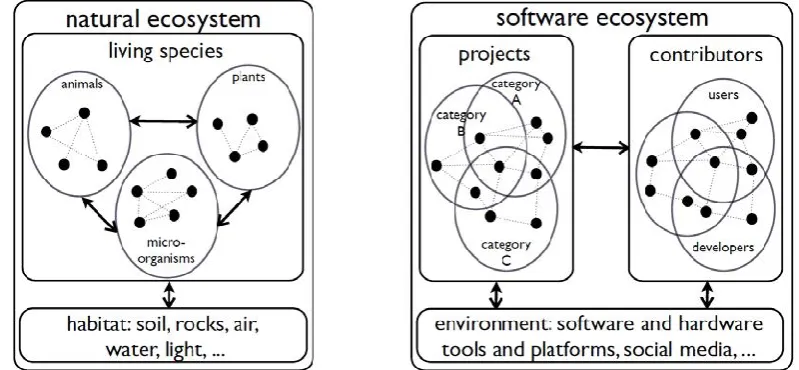
SECO is a field of increasing importance in research and industry. There is no standard analytical model for it (Manikas & Hansen, 2013). Mens et al. (2014) define and compare software ecosystems against natural (biological) ecosystems. They also draw a representation of software against natural ecosystems - as illustrated in Figure 1-1.
Figure 1-1: Natural versus software ecosystem suggested by Mens, et al. (2014).
[image:22.595.130.530.276.461.2]Mens et al. (2014) suggests Figure 1-1 can represent both a SECO, and an OSS ecosystem (OSSECO).
SECO can be readily deployed as a tool to analyze OSS ecosystems - as it may have strategic, and/or technical, and/or economic advantages. In other words, SECO can help in understanding the different resources across which an OSS may be operating (Franco-Bedoya et al., 2017).
OSS
R
es
our
ce
Traditional
Collaboration tools
Mailling list
Social networking
Management system
Version Control system
Documentation Tools Wikis, read me files, and other
Non traditional
Adopter feedback
OSS surveys
Business Resources
Sales reports, Desision making notes
Market share reports
Manufacture
resources Hardware and networking technologies
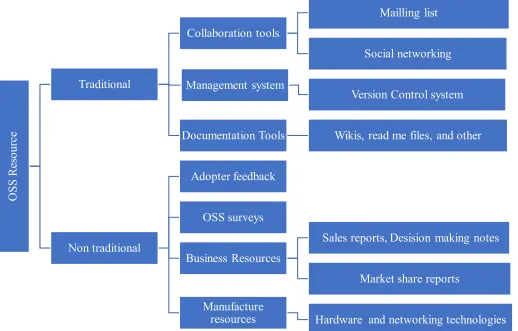
[image:24.842.176.694.79.410.2]As suggested in Figure 1-2, business resources such as: sales reports, decision-making notes, expert interviews, can directly affect the OSS ecosystem, and vice versa. For example, Amazon has turned almost every successful open source repo into a commercially available, and well-managed service. This has encouraged many developers to join OSS communities like GitHub.
There are many definitions for an OSS ecosystem, and each represents different points of view. Song, et al. (2016) define an OSS ecosystem through technical connectivity between repos, and/or coding, and/or graphical perspectives. According to Song, et al., (2016), interactions and associations collected from varieties of data (and sources), create a new OSS ecosystem. Song, et al. (216) states that, online posts are the foundation element when analyzing an evolution across an OSS development.
“A software ecosystem comprises a set of business, project, and activities that function
as a single unit, instead of each participating activity acting individually.” This definition is offered in Kilamo et al. (2012). Franco-Bedoya et al. (2017), define a software ecosystem as “one placed in a heterogeneous environment, whose border is a set of niche players, and the keystone player is an OSS community around a set of related repos, and within an open-source (common) platform” (Franco-Bedoya et al., 2017).
1.3 GitHub
source software developers (OSSDs) ranging from: professionals to students, from major software companies to small Indie (independent) developers. GitHub provides an environment for developers to share their work, as well as offering its environment for others to use, adapt, and get help when seeking to advance or improve their work (Lanubile et al., 2010).
GitHub repos are diverse in: format, repo-size, development-cycle-stage, releases-count, change-frequency, and changeability. GitHub houses over 20M users and 57M repos (Sharma et al., 2017). It draws worldwide crowd-sourced coding contributors - each with unique individual levels of expertise, into an environment that allows the adding of valuable inclusions into its large number of ongoing software development repos (Tsay et al.,2014b).
GitHub simplifies social coding by providing a web interface to each repo, and the administration tools needed for repo collaboration. GitHub Members can follow each other, obtain updates for repos, rate each other's work and communicate (publicly or privately). Important terms used in GitHub include: pull-request, fork, and merge. A developer creates a repo. Its content is organized into branches, a “master” branch represents the “production code”. Other branches are used for repo contributors to experiment with new features, and for the restructuring of existing features.
developer gets a complete copy of the content - which they can use for their own purposes. Also, they can ‘fork’ a repo to get a complete copy of the content placed into a new repo - that they own, A fork (or sometimes called branch), is a repo that has been copied from one member's account to another member's account. Forks, and branches, allow a developer to make modifications without affecting the original code. This might represent: (1) a fracture in the ecosystem, or (2) a way for contributors from the original repo to work more independently / safely away from the original content - GitHub uses the Git SVN tool - the tool’s workflow is complex and error-prone (SVN is abbreviation of ‘Subversion’, Subversion is an open-source version control system that is typically used to manage the collections of files that make up software repos.), or (3) a way for a non-contributor of the original repo to make suggestions and to prove whether their ideas are useful. These non-contributors might even wish to become part of the original repo team.
GitHub provides social networking tools for developers to communicate, discuss and reason about pull request. It provides many statistics to track all this information (via GitHub API). GitHub enables the creation of large complex interconnected ecosystems of developers. It remains easy for a developer to diagram the possible relationships between the repo, and how it collaborates with other developers) (Arora et al., 2017).
GitHub repos offers a trackable, integrated, time-spanned, workflow of user-delivered, repo contributions. But, the datamining tools used in GitHub remain slightly different from those used in other OSS developments (Kalliamvakou et al., 2016). GitHub repos have a faster growth rate when compared to other rival OSS communities.
The growth and success of GitHub OSS development communities can be viewed as a social activity across contributing developers. This creates a ‘herd behavior,’ and with growth, repo leadership becomes increasingly important (Hu et al., 2016). GitHub attracts software developers, testers, star coders, coders, social media watchers, and other small solutions pull providers. GitHub repos are easily deployed, follow clear guidelines, engage suitable languages, and are readily utilized to improve the existing OSS development version (Chatziasimidis & Stamelos, 2015).
usually a core team of developers for this repo. Thus, the repo’s creator and its core team of collaborators, can be thought of as the ongoing guardians of repo quality (Yu et al., 2014a). The activeness of a repo’s creator in handling pull-requests also influences the extent of pull-request activities by the overall ecosystem (Aggarwal et al., 2014).
1.4 GitHub ecosystem
Motivated by Men’s et al. (2014) ecosystem, Figure 1-3 illustrate the GitHub ecosystem. This ecosystem supports Men’s representation. Basically, there are three elements for GitHub ecosystem, the first one represents GitHub repo with all required Hardware, Software, humans and repos. As illustrated in Figure 1-3, human elements play a major role across: GitHub core developers, across active developers (who may also be a member of the core developer team), across passive developers (who may be followers, watchers or anybody who has no direct influence on the repos but still show an interest), and finally across users who fork and may use the system without participation.
Figure 1-3: GitHub software development ecosystem framework.
Users
Environments: all other discipline that could affected by or effect on Repo Resource
Core Developer
s
Repos
Active Developers
Passive Developer
s
Business
The second GitHub ecosystem element is the businesses and the industry that may exert some direct, or indirect effect(s) on the GitHub repo. Google (Android) and Facebook are two examples of businesses that have affected a GitHub repo advancement in hardware manufacturing (industry) - encouraging developers to build software that use the capabilities of the new hardware version - such as in the ‘Smartphones’ industry.
The third GitHub ecosystem elements is the environment. This represents any other factors that affect GitHub – such as: cultural awareness, confidentiality, language support facilities among developers (communication language and translation).
GitHub repos are diverse in: format, repo-size, development-cycle-stage, releases-count, change-frequency, change-degree, forks, watchers, and contributor-skills (Aggarwal et al., 2014). Such potentially diverse repo variations can also complicate repo comparisons.
From time-to-time GitHub’s repo ecosystem may suffer developer and knowledge losses which can retard the repo’s software development. For example, a specific developer may choose to externally clone the repo’s master branch, and then create a unique (and/or alternate) software development pathway outside the original repo’s ecosystem. This loss of developer capabilities likely negatively impacts the repo’s development, and it may move other developers away from the original repo, and into following this unique alternative development pathway.
1.5 Research Gap, Questions and Objectives
There are many challenges facing OSS: lack of long-term study, OSS team diversity and the absence of general view of the constructs affecting repos activity (Squire, 2017) are some of these challenges, a review of more OSS challenges presented in Chapter 2. There is little clear identification (and/or standardization) for open SECO. Most studies relating to OSS indicate the lack of longitude studies (West & Gallagher, 2006; Cosentino & Cabot, 2016; Kalliamvakou et al., 2016), and the maintenance of community interest in repos helps in repos evolving and surviving (Cosentino & Cabot, 2016). Previous research seldom measured the influence of OSS features on survival and success. Research in SECO is still in its infancy, and research efforts remain on a slowly increasing trajectory.
this is the focus of this research. GitHub represents a large OSS community. It provides a big data source-bank for studying and understanding SECO.
In this research I utilize the GitHub ecosystem and use SEM (structural equation modelling) to find the elements that affect the repo’s survival. This thesis engages 1600 GitHub repos across eight widely-used, but different programming languages. It then observes repo changes over time and determines the elements that influence a repo’s success. This empirical research represents a multi-case study towards modeling the GitHub OSS ecosystem. It attempts to relate, and build, the contributing elements into a systematic model - that influences the survival and successes of the OSS ecosystem.
This thesis answers the following research questions:
RQ1: What elements are present in the GitHub OSS ecosystem?
RQ2: Do programming languages show different models in the GitHub OSS ecosystem?
RQ3: What relationships exist between each element when affecting the commits in the GitHub OSS ecosystem?
RQ4: How does each element influence the GitHub OSS ecosystem?
good practice for GitHub repo survival. Finally, it determines the criteria used to achieve added performance when stakeholders (especially OSSDs) engage with GitHub (Munaiah et al., 2017).
1.6 Thesis Layout
In addition to this Chapter, which introduces open source software (OSS), the ecosystem and the general framework for GitHub ecosystem, Chapter two presents the literature review - generally classifying research efforts in GitHub as: OSS developments, GitHub measurements, and GitHub challenges and trends.
Chapter three displays two studies using two phases: a pilot study, followed by a series of SEM models each representing one of the eight most popular GitHub languages. To understand GitHub trends, the pilot study deploys 30 repos – ten for each of the three top programming languages used in GitHub (JavaScript, Java and Python). SEM structural path modelling deploys 200 cases for each of eight programming languages (JavaScript, Java, Python, C#, C++, CSS, PHP and Ruby) - thus studying 1600 GitHub repos. The methodology used in both case studies specifies in this Chapter.
Chapter four displays the pilot study and SEM case study results obtained during this two phases study. This Chapter also analyses to what extent each element (or construct modelled under SEM) affects the GitHub ecosystem.
CHAPTER 2
2 LITERATURE REVIEW
2.1 Introduction
As discussed in Chapter 1, GitHub is an online version control system used by developers around the world (Gousios & Spinellis, 2012). It currently supports approximately 26 million developers and hosts over 57 million repositories (Sharma et al., 2017). The number of GitHub repositories is growing rapidly compared to other online version control systems (Yu et al., 2014b). GitHub developers include professional developers from the largest (to smallest) software companies, independent developers working on open source software repos, and novice developers working on student repos.
The common terminology for a repository on GitHub is a repo. A GitHub repo is an organized collection of content such as source code, multimedia resources and supporting documentation. A commit represents a set of changes (additions and deletions) to the content of a repo. A ‘series of commits’ captures how a repo evolves over time. Hence, a repo is the embodiment of a software ecosystem.
When a repo is created its content is organised into branches. The master branch is a folder within the repo that contains the production content. Other developmental
branches are used by the repo creator and contributors as a place to experiment with new content or refactor existing content.
A non-contributing developer who is external to a repo might fork it, giving them a complete copy of the repo content and then place it into a new repo that is independently owned by that developer. Forking is a way for original repo contributors to work independently and safely, away from the original content. However, a forked repo also has the potential to draw popularity and interest away from the original repo. Occasionally, this forking can affect the growth of ongoing contributions into the original repo.
When the content of a developmental branch is deemed ready it gets merged back into the master branch of the repo by the creator of a contributor. Similarly, when the work done on a forked repo is believed ready by its developers, a pull (a pull request) gets created that represents a potential commit that is mergeable back into the original repo. Before accepting a merge, its review process takes place, allowing the original repo creator and contributors to rationalize the proposed changes. Hence, the pull is either accepted or rejected. If accepted, the merge allows the external developer to become a contributor of the original repo.
the issue and mitigate it if necessary. It should be noted that some submissions are not real issues (Bissyandé et al., 2013a). Notice developers sometimes mistakenly create issues that only help requests or act as advice seeking requests.
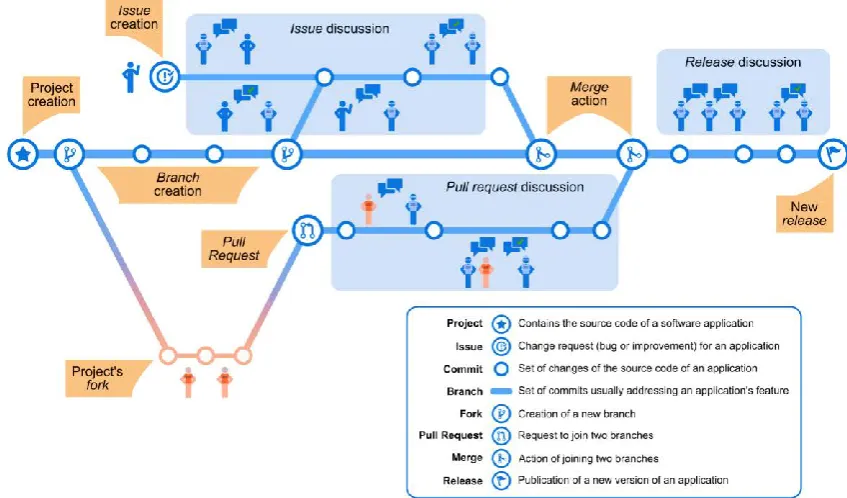
[image:36.595.119.543.305.554.2]When a developer clones a repo, this gives them a complete copy of the repo content without necessarily being an active part of that repo. Unfortunately, GitHub statistics do not track information about cloning. Figure 2-1 summarizes the various aspects of a GitHub repo.
Figure 2-1: Various aspects of a GitHub repo
(From: https://livablesoftware.com/development-process-in-github-basic-infographic/)
2.2 Understanding the GitHub Ecosystem
example, a single developer might choose to create their own repos at the same time as contributing to repos created by other developers. This is important, as it provides developers with an ability to gain technical experience through collaboration, and an ability to build meaningful professional and social relationships in a community of like-minded developers (Casalnuovo et al., 2015).
Overall, the GitHub ecosystem supports developer collaboration by providing social media that provide a range of information about repos (both descriptive and statistical) and the relationships between repos. Developers use this information to discover community-wide popular repos, as well as personally interesting repos. Moreover, this information also encourages developers to get involved in repo issue discussions and/or pull request reviews (Arora et al., 2017).
GitHub provides a freely available repository search engine tool that includes a web REST API. Many third-party web apps utilize the REST API to discover repositories on GitHub (Bello-Orgaz et al., 2016). The API generates data in terms of the information (elements) about repos (Onoue et al., 2013).
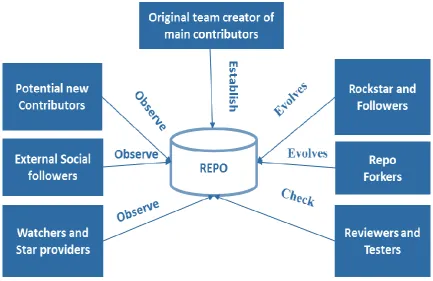
Figure 2-2: Classification of Repository developers.
Rockstars are an important repo contributor whose popularity brings into the repo additional skilled developers. These additional developers often follow the rockstar’s lead, and typically generate pull-request activity within the repo (Lee et al., 2013). The presence of Rockstar likely results in an increased repo popularity, generally along with enhanced repo outcomes (Ma et al., 2016). Developers who generate high-quality commits may become recognized as a Rockstar.
features, better implementation approaches, or even a different version of the existing repo, whilst still keeping their vision around the original repo (Ma et al., 2016).
Reviewers/testers discuss, assess, and recommend each contributor’s merging (or rejection) into the repo. When reviewers are specifically assigned, the review or testing process becomes shorter and more effective (Yu et al., 2014a).
A watcher/star-provider receives notifications of any event (commits, pull-requests, and issues) arising within the repo and on GitHub’s social media (Ma et al., 2016; Sheoran et al., 2014). It is also common to see popular repos where coding activities are seen to be successful as being ‘starred’ extensively, and experiencing higher commit frequencies (Cosentino et al., 2017). Watchers tend to contribute to popularity with their external activities on social media, and other digital community forums.
External social-followers track the actions of other coding developers of good reputation (Luo et al., 2015). Marlow et al. (2013) note GitHub’s external social-follower, and reviewer/tester, and watcher/star groups each contribute transparency into a repo (Luo et al., 2015). They also bring additional social considerations, and their social actions can contribute towards the repo’s popularity. Potential new contributors can be drawn into a GitHub repo by:
• Adding to current promotional activities;
• Adding to social media, and/or Twitter, and/or Wiki awareness campaigns;
• Following others;
• Adding a piece of personal coding; and
2.3 Previous research studies
This Section explores researchers’ efforts across three logically-interconnected areas of SECO and particularly OSSECO interest - OSS development methods used by the developer, GitHub components, and mining GitHub (and challenges).
2.3.1 OSS development methods
OSS is not used alone when designing entire software repos because it is by nature disorganised, and this presents risks. Siau & Tian. (2013) developed a theoretical OSSD model which transformed OSSD from a disorganised approach into a semi-organised relational approach. They maintained the OSSD dynamics and developed a Phase Role Skill Responsibility model. This approach deployed Grounded Theory. It is not yet implemented practically only theoretical, and it is still not risk-free. Similarly, Al-Tarawneh et al. (2013) investigate the existing commercial on the shelf (COTS) software and consider its benefits and drawbacks.
Understanding the influence of agility in OSS was investigated by Da Silva et al. (2016). The study is ongoing, and the researchers want to measure to what degree ASD applies in OSS releases. The community of developers is the key element of OSS, and its members are crucially motivated to maintain and increase the size of their community (Bahamdain, 2015).
Syeed et al., (2014) link OSS development successes to the volume of GitHub repo community users being deployed. On the other hand, agile team trends suggest the number of developers is optimally 5-9 developers (Williams, 2012). Although more community user numbers deliver more coding changes, Ye and Kishida (2003) found learning to be a key motivational driver in attracting additional software developers.
Van (2016) states there is no standardization for life-cycle shape for collaboration networks in OSS ecosystems. Also, he finds that external factors (such as public holidays) and internal factors (such as software vision) additionally influence collaboration.
The literature review above (Kalliamvakou et al., 2016, Williams, 2012,Misra & Singh, 2015; Arora, 2016; Nurdiani et al., 2016, Hebig et al. 2016; Cosentino et al. 2017) suggests OSS is an important approach to software development. OSS provides a low-cost and effective solution for software development. As the OSS development community increases, problems such as poor documentation likely decrease. Hence, by putting documentation regulation inside its developer community domain, it is possible to iteratively advance a repo.
An OSS community’s information flows can engender motivational strategies between participant members. GitHub seems to be the best solution for OSSD methods - as it facilitates the collaborative effort by providing tools and platforms for social connection and project development. I expect from the literature that GitHub developers cherry-pick development methods that incorporates ASD and traditional methods.
2.3.2 GitHub Repo Measures
Social media provides an ecosystem for OSSD. Developers use social introductions, as well as other interactions on different platforms (such as Twitter and Facebook) to engage with each other and with GitHub (Wu et al., 2014). For long-term contributions, the presence of past social bonds between developers may not be enough, thus, additional measures may be needed to encourage developer preservation (Casey, 2015). According to Blinco et al. (2016), increased numbers of project contributors will increase project popularity (such as stars and watchers).
Follower and social commentary approaches engage more potential contributors into their chosen GitHub repo. Popular contributors other than rockstars influence their followers, and so bring an additional leadership dynamic into the repo. Project leaders and core developers have a major impact on a repo. There are factors that affect a developers’ chance to become repo leaders and/or core developers such as project environment and subjective willingness (Cheng et al., 2017).
Active GitHub developers submit repo commits, which improve software quality (Li et al., 2017). Another feature that GitHub offers is that of a reviewer/tester. They are high-quality assurance assets that provide developmental evaluation – usually under some minimum response timeframe (Li et al., 2017).
the documentation, encourage greater commit activity into the repo, and small documentation improvements can deliver great benefits (Henderson, 2009).
GitHub popular repos typically engage forking, they also show clearer, more consistent documentation advice (Aggarwal et al., 2014), and useful documentation can draw in other coding contributors (Hata et al., 2015). Such documentation may also be supported by testing mechanisms (Weber & Luo, 2014), Wikis (Hata et al., 2015), Twitter (Singer et al. 2014), social media and websites (Jiang et al., 2017).
When deciding whether to contribute to a GitHub repo, OSS developers often investigate a repo’s popularity. This provides OSS developers with a calibration measure around the repo’s success. The popularity of a repo is done by interpreting GitHub statistics in different ways (Xavier et al., 2014). Popularity is gauged by (Aggarwal et al., 2014; Xavier et al., 2014; Borges et al., 2015; Borges et al., 2016; Ma et al., 2016) against number of stars, forks, pull-requests and watchers.
GitHub offers a range of components that assist in judging an OSS repo’s activity levels (Härdle & Borke, 2017). Key GitHub programming languages are either web-focused (JavaScript, Ruby, PHP, CSS) or system-oriented (C, C++, Python). JavaScript, Java, and Python are currently the top three GitHub programming languages (Cosentino et al., 2017). From the above review, this thesis therefore selects the following aspects of GitHub repos on which to focus:
Repo-type: GitHub repos range from major corporate software developments such as Adobe bracket, or Facebook that incorporate forks when overcoming issues and/or when speeding new release versions, through to small core creator / developer repos.
Repo-lifetime: Large GitHub repos tend to remain active, forked, retain interest and be long-term ongoing operations (Cosentino et al., 2017). This thesis concentrates on mature repos where they were in GitHub for more than one year and they still gain more popular.
Repo-measures: GitHub measures commits, committers, software-releases, popularity-of-repo, number-of-stars-provided, forks, watchers, followers, testers, and reviewers (Xavier et al., 2014) (Härdle & Borke, 2017). In our dataset, the most forked and stars are the main criteria for the studied repos (see Chapter 3).
Previous studies do not provide a holistic view of the constructs affecting a repo’s activity level within GitHub repo ecosystems. Although the number of issues is also a repo success indicator some active repos do not engage GitHub’s issue tracker (Cosentino & Cabot, 2015).
2.3.3 Thesis links to the literature
Table 2-1 summarizes the literature and shows the relationships between various GitHub measurable elements.
Table 2-1 Summary of previous studies regarding this thesis.
References GitHub Elements Strength of
relationship Investigate in this thesis Hu et al., 2016; Borges et al. 2016a Stars & Fork Strong ✓ Borges et al. 2016a Stars & Commits Moderate ✓ Borges, et al., 2016b Star & Contributors Moderate ✓ Borges et al., 2016b Release & Stars Strong ✓ Kalliamvakou et al., 2016 Pull & Contributors Strong ✓ Jiang et al. 2017; Vasilescu et al.,
2015 Fork & Contributions Strong ✓
Kalliamvakou et al., 2014 Commits & Pulls Strong ✓
Peterson, 2013 Watchers & Fork Strong ✓
Sheoran et al., 2014 Watchers & Commits Negligible ✓
Forks, stars and contributors appear to be drives of existing literature, commits, pulls and watchers are relevant research foci. This thesis focuses on all of them and attempts to more deeply understand the relationships between them.
2.3.4 Mining GitHub and Challenges
supports rapid software development, and has collaborative repo features including bug-tracking, feature-requests, task-management and Wikis (Marlow et al., 2013; Zakiah & Fauzan, 2016). The interpretation of repository statistics is the subject of ongoing research (Borges et al., 2016; Cosentino & Cabot, 2016). The ability to understand GitHub repository statistics would allow developers easier access to repositories appropriate for consumption and allow developers to find repositories to which they would make suitable contributors. Kalliamvakou et al. (2016) suggest data sourced through mining GitHub is useful in evaluating aspects of software engineering provided those researchers datamining GitHub remain aware of what information they are pursuing.
Many studies have datamined GitHub to find user profiles, interpret customer behaviour and find repository preferences, such as programming language, popularity and usage (Ye & Kishida, 2003; Williams, 2012; Marlow et al., 2013; Gousios et al., 2014; Wu et al., 2014; Kalliamvakou et al., 2014; Blincoe et al., 2016). Cosentino et al. (2016) suggest that extracting knowledge by mining GitHub can be optimized for committers and/or repo collaborators.
Although there are benefits to mining GitHub, many shortcomings remain (Gandomani et al., 2013). Studies to date lack: (1) longitudinal research, (2) predefined sampling techniques (for data extraction and analysis), (3) assessment using large data sets, (4) long data collection times needed to extract, collate, and deploy large data sets (Blincoe et al., 2016; Borges et al., 2016; Xavier et al., 2014), (5) software engineering team diversity and (6) software productivity consistency (Squire, 2017). Hence, long-term studies with clear datamining techniques that capture large datasets remain a knowledge gap in GitHub repo studies (Borges et al., 2016).
To improve pull request acceptance, Yu et al. (2016) applied a classifier evaluation matrix utilizing precision, recall and an F-measures. There are many aspects about GitHub repo research that represent threats to analysis and validity (Ray et al., 2014; Borges et al., 2016). Cosentino et al. (2017) suggest that a systematic study is needed, and study replication is lacking. Moreover, researchers indicate that GitHub API restrictions are a considerable challenge when trying to extract useful data about GitHub repos (Hebig et al., 2016).
problem faced was the occurrence of duplicate repositories. There is a lack of studies about GitHub ecosystem (Xavier et al., 2014; Blincoe et al., 2016; Borges et al., 2016; Ma et al., 2017).
In conclusion, GitHub appears to be “the engine” of open source software development. GitHub’s growing community of developers contribute from anywhere around the world at any time. To understand GitHub, researchers must be prepared to more deeply explore its nature. I believe that GitHub is an ideal place to explore OSS Ecosystem.
CHAPTER 3
3 RESEARCH METHODOLOGY
3.1 Introduction
This Chapter describes the methodology, study design, sample data used, procedure and criteria used for data collection along with the mathematical tools used. Finally, the detail of the methods and techniques used for data analysis are covered.
3.2 Thesis Dataset
Data about GitHub repos are collected by using GitHub search tools. GitHub Querying is applied to collect an initial dataset. GitHub is currently the ‘absolute dominant’ data source for open source software (OSS) data mining research (Kalliamvakou et al., 2014; Hata et al., 2015; Dias et al., 2016; Cosentino et al., 2017).
GitHub’s search engine allows searching of its repos against ‘stars’ or ‘forks’ counts (Jarczyk et al., 2014; Robinson & Deng, 2015; Borges et al., 2016b). The thesis considers the forks number as the main criteria to query GitHub for two reasons. Firstly, for a repo the presence of forks, means that this repo is active, and the open source software being developed is likely still under development. In contrast, the presence of stars just means that individuals express a likeness for the repo, and they’ve rated the repo with stars (Baudry & Monperrus, 2012; Weber & Luo, 2014).
repo’s net contributors number (Kalliamvakou et al., 2016). Secondly, most repos which acquire a high number of forks, also likely have a high number of stars (Borges et al., 2016a). Hence, this pilot study focusses on both GitHub search criteria.
Top three GitHub programming languages are JavaScript, Python and Java (Christopher et al., 2015; Cosentino et al., 2017a; Hu et al., 2016; Ray et al., 2015). These programming languages are used in both phases.
An API GitHub query collects eight datasets for case study two. It consists of the top eight programming languages JavaScript, Python, Java, C#, CSS, C++, Ruby and PHP (Badashian & Stroulia, 2016; Borges et al.,2016a; Kumar & Dahiya, 2017; Härdle & Borke, 2017; Noone & Mooney, 2017). Data set used in phase 1 are time series data representing 30 repos collected over six different time frames, two weeks between each time frame.
Each dataset in case study two captures eight GitHub key element which are: Stars, Forks, Watchers, Contributors, Releases, Issues (open or closed), Pulls (open or closed) and Commits. 1600 GitHub repos are downloaded, and prepared for analysis, each programming language data set consisting of its top 200 repos.
the studies that draw on the data itself (Gousios & Spinellis, 2017). Borges et al. suggest extracting good sample data requires some degree of human interactions and the following of procedural guideline (Borges et al., 2016b; Cheng et al.,2018). In GitHub the majority of its repos are either inactive, or are personal (Kalliamvakou et al., 2014). In this thesis the analysis of GitHub’s repos follows two main querying considerations: (1) the programming language and (2) the forks count.
The forks is an important measure of repo activity (Biazzini & Baudry, 2014; Chen et al., 2014 ; Jiang et al., 2017). The limitation conditions (or filters) applied for the repo’s extraction applied to case study one is:
• Repos with more than one year old
• Illegal repos considered invalid and excluded from the dataset, this could be confirmed by visiting repos webpage.
These two limitation conditions applied to all this thesis’s case studies. They ensured the consistency of the sample datasets, and upon look-up check all are dataset believed to represent good quality repos.
3.3 MATLAB program - developed for Querying GitHub
the condition of repos. For example, MATLAB can compare the number of commits - considering the number of committers to a repo and eliminate questionable ones. In another word MATLAB tests if the GitHub repo’s unique contribution condition for a commit is satisfied before extracting the commit element from the repo. Then MATLAB program extracts the commits from each repo, and directly adds the results into excel applications.
This process is used for all dataset collections and collations. The input into the MATLAB program is a useful CSV file. It is pair-labelled as Owner’, ‘Repo-Name’. This information is used to check and invoke repo attributes.
3.4 Study Design
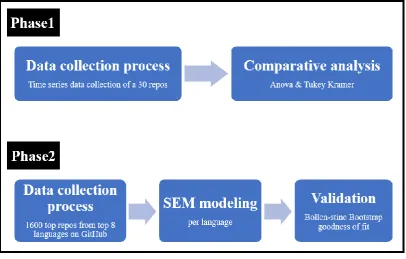
This thesis addresses the research questions (pp. 10 Chapter one), and the supporting hypotheses regarding the GitHub ecosystem and its relationship with its key elements. These key elements exert an influence on an individual GitHub repo’s success. Stepwise phases across these studies are illustrated in Figure 3-1. The methodology involves two overarching phases:
Figure 3-1: The two-phase methodology.
Phase two extract GitHub data for a large-scale modelling study involving 1600 of the most popular GitHub repos. In this thesis structural contribution models are delivered. Each model is bootstrap validated (200 times). An excellent bootstrapped model fit is validated when the Bollen-Stine p-value exceeds 0.05 (Hair et al.,1998).
3.5 Phase one- case study one
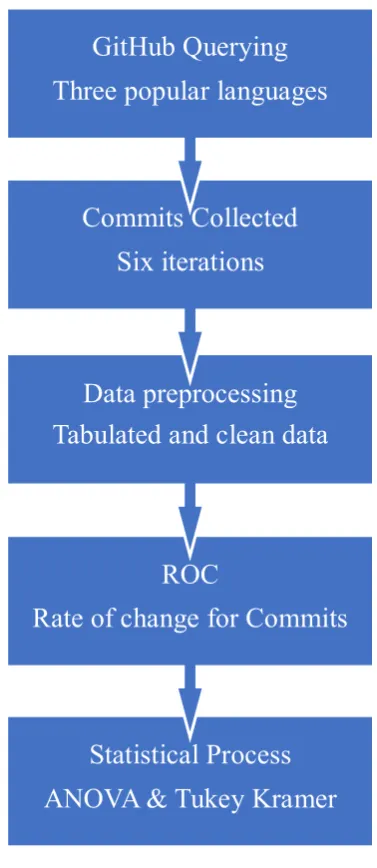
[image:54.595.116.523.74.333.2]Figure 3-2: Phase 1 case study one processes.
3.5.1 Phase one- GitHub data collection and process
Querying GitHub using a ‘general search’ tool is the first step in data processing. The first filter is a programming language. Inside the programming language repos, only ‘forked’ repos are selected. The MATLAB program (now termed MATLAB) is used to access the repo’s commit information. In case of study one (pilot study), three programming languages are used to search for language correlations. Each language
Statistical Process
ANOVA & Tukey Kramer
ROC
Rate of change for Commits
Data preprocessing
Tabulated and clean data
data captures only captures its own repos, and only uses the ten repos with the largest number of forks. These repos are collected firstly in ‘pair-labelled’ groupings – with the format: repo (owner, name) MATLAB uses to generate CSV files. Following a two weeks lag-time, the prior process is again repeated for same repos.
Case study one (the pilot Study), commits are considered, as according to the literature (Kalliamvakou et al., 2014) the activity in GitHub is mostly reflected by the level of commits. Commit is one of GitHub key elements. Metadata extractions for this pilot study occurred six times, two weeks apart, over a three months period. These evenly-spaced time intervals provided snapshots of the repositories elements measures per language.
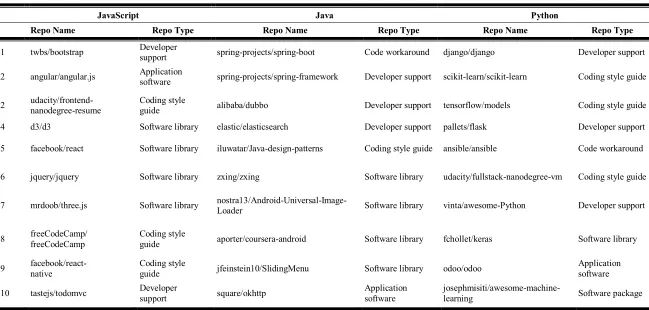
Metadata for case study one is illustrated in Table 3-1. Which shows the repo name/owner as paired title and type- of- repos- representing the category of it used for. Each language specific data collection is allocated to a dedicated computer, and each involves the ten most popular repos per language.
Also, each selected repo must have been active for over three years – as this indicates the repo likely represents a substantive OSS program being developed (Vasilescu et al., 2016). Data extraction is performed using a custom tool1 based on Version 3 of the
GitHub API2. Data collection is then organized using the GitHub API group terms
(Chatziasimidis & Stamelos, 2015). This data is then tabulated, data cleaned, and checked for outliers (e.g. GitHub questionable repos3) which are removed.
This two week repetitive approach follows agile software development methodology (Gunal, 2012), and rapidly assesses the repositories development. This approach allows for changes or updates to each repo’s information. Accordingly, repos that follow agile development methodology do show different activity levels at each collection point on the time-scale.
The resultant datasets total 180 (60 sets of data for each language) tabulated for comparative analysis. Initial findings indicated differences in repo activity levels between each language. Case study one investigates whether observed differences in GitHub repo occurred over time across these three programming languages.
Table 3-1: The top ten GitHub repos for JavaScript, Java, and Python
JavaScript Java Python
Repo Name Repo Type Repo Name Repo Type Repo Name Repo Type
1 twbs/bootstrap Developer support spring-projects/spring-boot Code workaround django/django Developer support
2 angular/angular.js Application software spring-projects/spring-framework Developer support scikit-learn/scikit-learn Coding style guide
2 udacity/frontend- nanodegree-resume Coding style guide alibaba/dubbo Developer support tensorflow/models Coding style guide
4 d3/d3 Software library elastic/elasticsearch Developer support pallets/flask Developer support
5 facebook/react Software library iluwatar/Java-design-patterns Coding style guide ansible/ansible Code workaround
6 jquery/jquery Software library zxing/zxing Software library udacity/fullstack-nanodegree-vm Coding style guide
7 mrdoob/three.js Software library nostra13/Android-Universal-Image-Loader Software library vinta/awesome-Python Developer support
8 freeCodeCamp/ freeCodeCamp Coding style guide aporter/coursera-android Software library fchollet/keras Software library
9 facebook/react- native Coding style guide jfeinstein10/SlidingMenu Software library odoo/odoo Application software
Repo collection procedure was re-executed every two weeks for each programming language, and for the same repos. Thirty repo commits are collected in timeframe 1, another 30 commits for the next timeframe till timeframe 6. Total number of repos where 180 repos (3 languages x 10 repos x 6 samples). Collecting six consecutive timeframes allows for a suitable trend analysis to be established. Moreover, agile software development practices suggest that a major coding milestone typically takes at least 6 iterations to produce a stable release of the software where each iteration typically takes two weeks.
3.5.1.1 Phase one- Rate of Change
Analysis of the data collected in case study one applies Rate of Change (ROC) as a normalization process (Campos & Scherson, 2000) as shown in Figure 3-2. This process makes the data easier to deal with. Let ROC be defined as a normalized value that measures how a quantity changes over a fixed time interval.
𝑅𝑂𝐶 = 100 [( 𝑐𝑢𝑟𝑟𝑒𝑛𝑡 𝑞𝑢𝑎𝑛𝑡𝑖𝑡𝑦
𝑝𝑟𝑒𝑣𝑖𝑜𝑢𝑠 𝑞𝑢𝑎𝑛𝑡𝑖𝑡𝑦 𝑛 𝑡𝑖𝑚𝑒 𝑝𝑒𝑟𝑖𝑜𝑑𝑠 𝑎𝑔𝑜) − 1]
3.5.1.2 Phase one- Comparative analysis
3.5.1.3 Statistical tools
To compare the three most popular GitHub programming languages a standard one-way ANOVA (analysis of variances) and Tukey-Kramer (post hoc) is deployed to confirm the validity of sample data used in the pilot study (King, 1986), and to discover if any significant differences between programming languages arise over time (Hair, et al. 1998).
One-way analysis of variance (ANOVA) tests the equality of three or more means at one time by using variances (Melosan, 2014). ANOVA determines whether any such variation is the result of some factor, or is simply the result of randomness, and ANOVA assumes:
• each comparison population is normally distributed;
• the observations are independent of one another; and
• each of the comparison populations displays an equivalent variance.
The Tukey-Kramer method (TK) is widely deployed in multiple comparison procedures (Benjamini & Braun, 2002) (Driscoll, 1996). TK considers possible pairwise differences of means at the same time and identifies pairs of means showing significant differences. In this thesis TK locates the differences within each programming languages (the difference between repos of the same programming languages- “difference within”) and the differences among different programming languages “difference between” TK assumes:
• homogeneity of variance.
Results using these tools are discussed in Chapter four.
3.6 Phase Two -Case study two
Top good GitHub repos are collected, with each repo having more than two contributors (Borges et al., 2016b; Kalliamvakou et al., 2014). According to Kalliamvakou et. al. (2014) good repos also show a balance between pull request and commits. Figure 3-3 illustrates the data extraction steps used in case study two.
Case study two deploys eight top programming languages : JavaScript, Python, Java, C#, CSS, C++, Ruby and PHP (Onoue et al., 2013; Borges et al., 2016a; Badashian & Stroulia, 2016; Kumar & Dahiya, 2017; Härdle & Borke, 2017 ; Noone & Mooney, 2017). It uses larger data about 1600 repos (200 repos for each language).
Figure 3-3: General Steps in Data Collection Process.
3.6.1 Case study two-Data collection
• Repos with an unbalanced number of commits and committers are excluded from the sample(Barnett et al., 2016; Goyal et al., 2018);
• Repos engaged each possessed more than two contributors to be considered valid; and
• Education repos are excluded from the sample (such repos have much forks number but commits number not changing).
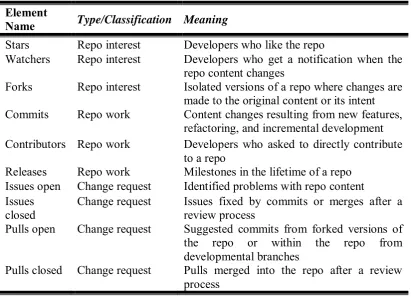
Table 3-2: GitHub repository data attributes and associated meanings.
Element
Name Type/Classification Meaning
Stars Repo interest Developers who like the repo
Watchers Repo interest Developers who get a notification when the repo content changes
Forks Repo interest Isolated versions of a repo where changes are made to the original content or its intent Commits Repo work Content changes resulting from new features,
refactoring, and incremental development Contributors Repo work Developers who asked to directly contribute
to a repo
Releases Repo work Milestones in the lifetime of a repo Issues open Change request Identified problems with repo content Issues
closed Change request Issues fixed by commits or merges after a review process Pulls open Change request Suggested commits from forked versions of the repo or within the repo from developmental branches
Pulls closed Change request Pulls merged into the repo after a review process
Both stars and forks ratings are used for rank GitHub Repos, and both display a strong correlation (Vasilescu et al., 2015; Hu et al., 2016; Borges et al., 2016). Watchers are a good measure of how good repo is, and they too have a similar rating influence to stars (Badashian & Stroulia, 2016; Borges et al., 2016b).
The forks is a first step in making contributions (Jiang et al., 2017). The forks of a repo mean making a local copy of that repo, developer may or may not choose to make update after looking at their own local copy. If developer make an update, then a pull request may be sent to either fix a bug or add a new feature or make a modification.
for engagement - allowing more developers into the repos’ community (Kalliamvakou et al., 2016). Whenever a pull request is sent to the repo community’s, it marked as open pull request.
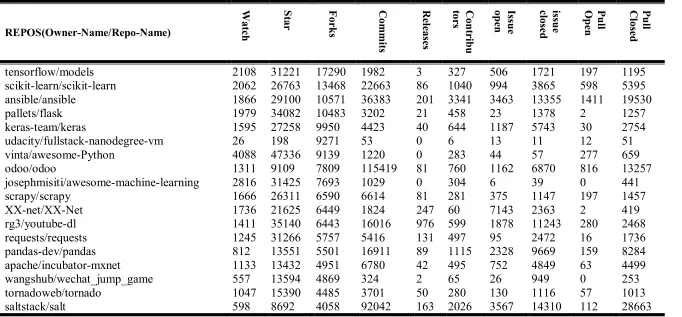
Table 3-3: The data sample of case study two: Top 20 Repos of Python language REPOS(Owner-Name/Repo-Name) Wat ch Star For ks C om m its R ele ase s C on trib u tor
s open sue Is closed ueiss Open Pull Close Pull
d
tensorflow/models 2108 31221 17290 1982 3 327 506 1721 197 1195
scikit-learn/scikit-learn 2062 26763 13468 22663 86 1040 994 3865 598 5395
ansible/ansible 1866 29100 10571 36383 201 3341 3463 13355 1411 19530
pallets/flask 1979 34082 10483 3202 21 458 23 1378 2 1257
keras-team/keras 1595 27258 9950 4423 40 644 1187 5743 30 2754
udacity/fullstack-nanodegree-vm 26 198 9271 53 0 6 13 11 12 51
vinta/awesome-Python 4088 47336 9139 1220 0 283 44 57 277 659
odoo/odoo 1311 9109 7809 115419 81 760 1162 6870 816 13257
josephmisiti/awesome-machine-learning 2816 31425 7693 1029 0 304 6 39 0 441
scrapy/scrapy 1666 26311 6590 6614 81 281 375 1147 197 1457
XX-net/XX-Net 1736 21625 6449 1824 247 60 7143 2363 2 419
rg3/youtube-dl 1411 35140 6443 16016 976 599 1878 11243 280 2468
requests/requests 1245 31266 5757 5416 131 497 95 2472 16 1736
pandas-dev/pandas 812 13551 5501 16911 89 1115 2328 9669 159 8284
apache/incubator-mxnet 1133 13432 4951 6780 42 495 752 4849 63 4499
wangshub/wechat_jump_game 557 13594 4869 324 2 65 26 949 0 253
tornadoweb/tornado 1047 15390 4485 3701 50 280 130 1116 57 1013