This is a repository copy of Automatic extraction of tagset mappings from parallel
annotated corpora.
White Rose Research Online URL for this paper:
http://eprints.whiterose.ac.uk/82967/
Proceedings Paper:
Hughes, J, Souter, DC and Atwell, ES (1995) Automatic extraction of tagset mappings from
parallel annotated corpora. In: Tzoukermann, E and Armstrong, S, (eds.) Proceedings of
the ACL-SIGDAT Workshop From Text to Tags: Issues in Multilingual Language Analysis.
ACL-SIGDAT Workshop From Text to Tags: Issues in Multilingual Language Analysis, 27
March 1995, Dublin, Ireland. Association for Computational Linguistics , 10 - 17.
[email protected] https://eprints.whiterose.ac.uk/
Reuse
Unless indicated otherwise, fulltext items are protected by copyright with all rights reserved. The copyright exception in section 29 of the Copyright, Designs and Patents Act 1988 allows the making of a single copy solely for the purpose of non-commercial research or private study within the limits of fair dealing. The publisher or other rights-holder may allow further reproduction and re-use of this version - refer to the White Rose Research Online record for this item. Where records identify the publisher as the copyright holder, users can verify any specific terms of use on the publisher’s website.
Takedown
If you consider content in White Rose Research Online to be in breach of UK law, please notify us by
arXiv:cmp-lg/9506006v1 8 Jun 1995
Automatic Extraction of Tagset Mappings from
Parallel-Annotated Corpora
John Hughes, Clive Souter
and
Eric Atwell
Centre for the Computer Analysis of Language And Speech
School of Computer Studies, Leeds University, Leeds LS2 9JT, UK
[email protected], [email protected], [email protected]
Abstract
Several research projects around the world are building grammatically analysed cor-pora; that is, collections of text annotated with part-of-speech wordtags and syntax trees. However, projects have used quite different wordtagging and parsing schemes. Developers of corpora adhere to a variety of competing models or theories of gram-mar and parsing, with the effect of restrict-ing the accessibility of their respective cor-pora, and the potential for collation into a single fully parsed corpus. In view of this heterogeneity, we have begun to investi-gate and develop methods of automatically mapping between the annotation schemes of the most widely known corpora, thus assessing their differences and improving their reusability. Annotating a single cor-pus with the different schemes allows for comparisons and will provide a rich test-bed for automatic parsers. Collation of all the included corpora into a single large an-notated corpus will provide a more detailed language model to be developed for tasks such as speech and handwriting recogni-tion. This paper focuses on methods of developing mappings between tagsets and, in particular, the method of automatic ex-traction of mappings from corpora tagged with more than one annotation scheme.
1
Introduction
Many, diverse tagged and parsed corpora have been developed. Amongst the applications of annotated corpora are as training sets for the extraction of models used in speech and handwriting recognition. Such training sets need to be as large as possible and
there is anecdotal evidence that even the largest on its own is too small for a general statistical model of higher-level syntactic structure. As annotating corpora using hand-crafted markup or some semi-automated process followed by correction by linguis-tic experts is slow and expensive (Barkema 93; Leech and Garside 91) it would be preferable if some other method of building a large annotated corpus could be found. Existing corpora were not designed to a specific framework of annotations so corpora can not easily be collated into a single large training set. The AMALGAM (automatic mapping among lexico-grammatical annotation models) project was set up to research ways of mapping between anno-tation schemes in order to increase the size of cor-pus tagged with the schemes included in the project (Atwell et al 94a; Atwell et al 94b).
We are developing a multi-tagged corpus and a multi-treebank, a single text-set annotated with all the tagging and parsing schemes we include in the mappings. The text-set is the Spoken English Cor-pus (SEC); which is already annotated with two syntax schemes. However, the main deliverable to the computational linguistics research community is not the SEC-based multi-treebank, but its associ-ated suite of mappings - this can be used to combine currently-incompatible syntactic training sets into a large unified corpus. Our development of the map-ping algorithms aims to distinguish notational from substantive differences in the annotation schemes, and we will be able to evaluate tagging schemes in terms of how well they fit standard statistical lan-guage models such as n-pos (Markov) models.
mu-tually cover all features. For instance, the British component of the International Corpus of English (Greenbaum 93) has a tagging scheme that accounts for transitivity of verbs whereas the Lancaster/Oslo Bergen corpus (Johansson et al 86) does not (nor do the EAGLES proposals - see below). We believe that our methods are scalable to mappings between multilingual tagsets.
2
Related Research
Corpus-trained statistical language learning tech-niques have been successfully applied to a range of problems in computational linguistics, including part-of-speech wordtagging (Leech et al 83; Atwell 83; Atwell 87a), word sense disambiguation and tag-ging (Demetriou and Atwell 93; Gale et al 92), learn-ing word classes (Atwell 87b; Atwell and Drakos 87; Hughes and Atwell 93; Hughes and Atwell 94), gram-mar modelling and induction (Atwell 88b; Lari and Young 90; Carroll and Charniak 92; Atwell 92; Brill et al 92; Atwell 93; Jost and Atwell 94), grammatical error detection (Atwell 88a; Atwell 90), probabilistic parsing (Sampson et al 89; Souter and O’Donoghue 91; Magerman and Marcus 91; Souter and Atwell 92; Atwell et al 91; Briscoe and Waegner 92; Black et al 93). Particularly relevant to AMALGAM is the recent research interest in Machine Translation using statistical learning techniques for mapping-extraction from parallel corpora (Brown et al 90; Brown et al 92; Chen et al 91; Wu and Xia 94).
3
Obtaining Resources
As a development and testing resource, we are using the text of the Lancaster-IBM Spoken English Cor-pus (SEC) (Taylor and Knowles 88). The SEC is a collection of recordings of radio broadcasts with ac-companying annotated transcriptions, collected by Lancaster University and IBM UK as a general re-search resource. The SEC is available from the In-ternational Computer Archive of Modern English (ICAME) based at the Norwegian Computing Cen-tre for the Humanities (in Bergen, Norway). The corpus exists in several forms and annotations: the digitised acoustic waveform; the graphemic tran-scription annotated with prosodic markings; and a part-of-speech analysis that was annotated semi-automatically with the aid of CLAWS (Atwell 83; Leech et al 83) as used for the LOB corpus. Skele-tal parsing has been added to create the SEC Tree-bank, and this forms a subset of the Lancaster-IBM Treebank. Gerry Knowles (Lancaster) and Peter Roach (Reading, formerly of Leeds) collaborated in an ESRC-funded project, MARSEC, to set up a
time-aligned database of recorded speech, accom-panied by phonetic and graphemic transcriptions (Knowles 93). Our proposal will produce, as a side-effect, several alternative tagged and parsed versions of the SEC which will be made available to the SEC database project collaborators. It will also be able to act as a test-bed for the comparison and evaluation of parsing schemes.
Obtaining resources proved to be a stumbling block. Whilst most of the people in charge of cor-pus annotation and distribution are helpful they are also usually very busy! Sometimes there are reserva-tions about distribution of resources. For example, the corpus could have copyright restrictions or could be collected for dictionary compilation. However, we have obtained the following corpora in tagged or parsed form along with manuals defining the syntac-tic annotation schemes: Brown (Francis and Kuˇcera 79), LOB (Atwell 82; Atwell et al 84; Johansson et al 86), London-Lund (Svartvik 90), Polytechnic of Wales (Souter 89; Fawcett and Perkins 80) and will apply for the British National Corpus as soon as it becomes available. We also have the software used for annotating the University of Pennsylvania corpus (Brill and Marcus 92; Marcus and Santorini 92) and the International Corpus of English (Greenbaum 93; Barkema 93).
The following table summarises the resources we have for the six main corpora we have included in the project so far. The first column reveals if we have the corpus itself: we have all but the International Cor-pus of English. The next column indicates if we have the software that was used in the automated part of annotating of the corpus. The next column shows for which corpora we have documentation giving formal descriptions of the annotation guidelines. The last column marks the London-Lund and Brown corpus with a ‘1’ to indicate that we have a small sample of corpus annotated using both these schemes. The ‘2’ marker in this column indicates the Parallel An-notated Corpus that we are building at the moment by adding the International Ccorpus English (GB) annotation to the Spoken English Corpus.
Table 1: Summary of Resources Do we have:
Corpora corp soft doc PAC
Brown • •1
ICE • • •2
LOB • • •
London-Lund • •1
POW •
4
Deriving Tagset Mappings
When we began the AMALGAM project we antici-pated that the following process would be the normal way that an annotation scheme was included in our ‘mapping suite’:
1. Develop the most accurate mapping between the new scheme and one of the schemes already in the mapping suite. Only one pair need to be mapped explicitly as the other mappings can be generated from intermediaries via an ‘interlin-gua’ approach (Atwell et al 94b).
2. Annotate the Spoken English Corpus using the mapping.
3. Correct the mapped annotation, preferably us-ing advice from the people responsible for the annotation scheme.
The uneven spread of resources means that alter-native mapping strategies must be adopted when in-cluding each annotation scheme (see table 1). As we have the software used to tag and parse the Inter-national Corpus of English we can incorporate that into the mapping. Good formal descriptions of the annotation scheme (such as for LOB) can be used to craft some rules by hand. Where the documenta-tion is sparse rules can be extracted from the corpus itself.
We require a method to evaluate the alternative mapping strategies: A simple evaluation can be ac-complished by tagging the untagged SEC using one annotation scheme (the evaluation scheme) by the tried and tested method of automatic annotation fol-lowed by hand correction. To test a mapping strat-egy one would apply the mapping from the eval-uation scheme tags to produce those of the SEC. The success of the mapping would be determined by measuring the difference between this annotation and the original SEC (CLAWS tagged) annotation produced by Lancaster.
The Parallel Annotated Corpus (PAC) created when a (non-CLAWS) evaluation scheme is used to tag the Spoken English Corpus in this way it-self provides further possibilities for developing map-ping strategies. The PAC may intrinsically encode mapping information that would not be uncovered from other mapping strategies. Extracting a map-ping from a PAC is computationally trivial; the dif-ficulty is annotating an existing corpus with a new scheme. However, PACs already exist for pairs of annotation scheme and this provides an easy way to extract mapping information. This is particularly
true when the annotation scheme of one corpus is re-placed by another. Initially this would be done using the automatic annotator of the new scheme followed by hand-correction by linguistic experts. However, the addition of the new scheme to part of the cor-pus creates a PAC from which a mapping can be de-rived. The mapping could be used to update the per-formance of the automatic annotator. A process of refinement of the automatic annotator by feedback derived from the mapping would be established.
This paper focuses on deriving tagset mappings from PACs as we are currently in the phase of our project where we are concentrating on parts-of-speech annotation. However, we anticipate that the method will be even more useful when dealing with mapping between parse trees.
5
Extraction of Correspondences
from Parallel Annotated Corpora
Although a few PACs already exist only a few tagset pairings are covered. Often a corpus is annotated with a scheme that the designers feel can be im-proved so they annotate the same texts with the up-dated scheme. This automatically results in a PAC being formed. An example PAC comprises a few sec-tions of the Brown corpus that were annotated by additional London-Lund markup (Eeg-Olofsson 91). A further example is the Nijmegen Corpus which was originally annotated with CCPP annotation (Keulen 86) but later replaced with the scheme used to an-notate the British component of the International Corpus of English (Greenbaum 93). Although the Nijmegen TOSCA team now view the CCPP scheme as largely obsolete it is still a useful resource for mapping extraction as the PAC is 130,000 words in length. This provides a large sample from which to evaluate alternative mapping strategies.
To use the method of deriving mappings from PACs it is inevitable that some traditional tagging is required to build the parallel corpus. As an exam-ple of the process of extracting correspondences from PACs we shall use the example of the SEC-ICE cor-pus. As a PAC does not exist for this pair of tagsets we had to build our own. As we aimed to produce the multitagged corpus out of the texts of the Spo-ken English Corpus it made sense to annotate the Spoken English Corpus with ICE tags.
de-riving mappings between tagged annotation but it was felt more cost effective to parse and tag the Spo-ken English Corpus now as our project will eventu-ally include parse mappings.
The output from the Nijmegen parser (Barkema 93) needs to be aligned with the markup in the Spo-ken English Corpus. Problems are caused by the taggers segmenting text by different methods. Some taggers convert words not normally capitalised into lowercase, but not all do. This causes problems try-ing to match the words again once annotation has taken place. The Spoken English Corpus has sen-tence boundaries after full stops, exclamation marks and question marks whereas the Nijmegen parser additionally delimits text separated by colons and semicolons. The Nijmegen parser and The Spoken English Corpus tagging scheme deal with enclitics in a similar manner; a word likewho’sbeing split into the separate itemswho and’s. Other schemes may leave such words as they are. To be aligned with the Spoken English Corpus would require the word and its corresponding tag to to be split. On the other hand, a proper noun such as New York may be assigned a single tag and treated as a single item rather than having the two words treated individu-ally as in the Spoken English Corpus. The Nijmegen parser does this when producing parsed output but not when producing tagged output. Some parsers alter the text they annotate; again making the align-ment process more difficult. A common practice is the removal of capital letters from words that would not normally have them were they not starting a sentence. Worse, the item may be transformed al-together. A semicolon found in the input to the Ni-jmegen parser is transformed into the string; as the semicolon on its own would be mistaken for an SGML marker (Burnard 91). Such issues make alignment a non-trivial task.
( (
In IN
Perspective NP
) )
( (
Rosemary NP
Hill NP
( )
---
---good JJ FRM:1/2
morning NN FRM:2/2
. . PUNC(per)
--- ---
---more AP PRON(quant)
news NN N(com,sing)
about IN PREP(ge)
the ATI ART(def)
Reverend NPT N(prop,sing):1/4
Sun NP N(prop,sing):2/4
Myung NP N(prop,sing):3/4
Moon NP N(prop,sing):4/4
, , *PUNC(com)
founder NN N(com,sing)
of IN PREP(ge)
the ATI ART(def)
Unification NNP N(prop,sing):1/2
church NN N(prop,sing):2/2
, , *PUNC(com)
who WP PRON(rel)
’s BEZ V(cop,pres,encl)
currently RB ADV(ge)
in IN PREP(ge)
jail NN N(com,sing)
for IN PREP(ge)
tax NN N(com,sing):1/2
[image:5.612.81.248.541.720.2]evasion NN N(com,sing):2/2
Figure 1: Alignment of SEC and ICE
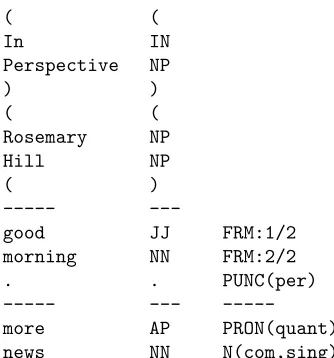
To align texts annotated by two schemes we used a method we termisland driven alignment. The ‘is-lands’ are the singletons found to be present in the output of both schemes. The position of these items can easily be aligned. The words next to the islands can be examined in turn. Often they will match and so can be aligned immediately, but occasionally the next pair of items will not match. Attempting to split enclitics, recombine split compounds or al-tering initial letter case may match some pairs but others such as the semicolon problem mentioned ear-lier will require pattern matching of the surrounding text. Occasionally an item in one of the annotations will match with no item in the other; the extra end of sentence markers in ICE texts being a good example. When this happens it can only be discovered after aligning the items on either side of it with neighbour-ing items in the other annotated output. The first few lines of the Spoken English Corpus when aligned with the ICE tags of the same text are shown figure 1, above. The first two columns are the words and CLAWS tags from the tagged SEC and the remain-ing column contains the correspondremain-ing ICE tags.
The Spoken English Corpus contains the short header: (In Perspective)(Rosemary Hill). The pro-cess by which ICE was annotated excluded headers such as this (they will be tagged by hand). As the header is not included in the ICE annotation of the text there is nothing to align it to.
list of correspondences made for each individual tag to show the probabilities of each pair. For instance the London-Lund/Brown PAC produced the list of London-Lund correspondences for the interrogative wh-determiner tag,WDT, in Brown shown in figure 2.
B2deg 2.13%
BHitr 25.53% WDT x ---> BRwha 4.26% GAwhi 53.19% GCwha 14.89%
Figure 2: Correspondences for WDT
The Brown tagWDTpairs with the London-Lund tag GAwhi, relative pronoun: which, just over half the time in the PAC. The easiest way to convert these correspondences into a mapping is to map the tag in one scheme always onto the most common pairing found in the PAC. Many tags will have a 1:1 mapping or will pair with one particular tag in the other scheme almost all the time. However, the above example correspondence list illustrates where mapping the most common pairing will work badly. We are currently investigating methods of incorpo-rating the lexicon (which could be extracted from the corpus samples we have, or from the PACs we have built ourselves) or using the contextual infor-mation supplied by the neighbouring words and tags. We also hope to explore methods developed by Brill in which texts were first tagged by always select-ing the most common tag for a word, and then the tag selection refined with a set of automatically ex-tracted rewrite rules, orpatches(Brill 91).
6
Lessons for the EAGLES Initiative
Until recently, very little effort has been expended on the development of standards in tagging and pars-ing natural language corpora. Individual taggpars-ing and parsing schemes have been invented more or less independently, and differ not only in the linguistic description, but also in the formalism used to la-bel words or represent tree structures. (Souter 93) surveys some of the substantive differences between such formalisms for contemporary parsed corpora of English, and illustrates how standards are needed to facilitate the reusability of corpus resources (through enterprises such as the Text Encoding Initiative), and to improve the general applicability of corpus-processing software, such as the Nijmegen Linguistic DataBase (van Halteren and van den Heuvel 90).
As many participants at the workshop will know,
EAGLES is a European initiative to devise a set of common standards for Natural Language Process-ing technology across the range of European Union working languages. Of particular relevance to our research are the standards proposals for morphosyn-tactic wordclasses; a lengthy draft proposal (over 200 pages) has recently been made available to EL-SNET nodes and a number of other centres of ex-pertise for comment. The proposals aim to stan-dardise a set of wordclasses to be applied to Dan-ish, Dutch, EnglDan-ish, French, German, Greek, Italian, Portuguese, and Spanish; once (or if) agreed, the standards may later be extended to cover other lan-guages (e.g. Swedish, Finnish, Norwegian, Gaelic, Welsh, Basque, . . . ) Even among the current EU main languages, there is considerable diversity in morphosyntax, so the EAGLES group are to be con-gratulated for achieving a compromise which on the face of it is largely uncontentious. EAGLES rec-ommends several levels of refinement or delicacy in wordclasses, so that specific applications and/or lan-guage models are free to select an appropriate level of tagset granularity. For example,NOUNis a broad (level 1) category, a general class which all language models must recognise; within this, there is a level 2 subdivision into proper nouns and common nouns, which will apply to many but not all applications etc. Many other possible wordclass distinctions are captured by features, e.g. number, gender; some of these do not apply to certain languages (eg gender of English nouns).
in progress statements’ not worth publishing - with the notable exception of (Johansson et al 86).
Our earlier example of parallel CLAWS/ICE tag-ging of the Spoken English Corpus illustrates the fuzziness in the distinction between proper noun and common noun. In general, a singular proper noun is NP in LOB and CLAWS, but N(prop,sing) in ICE. However, notice that Perspective, the second word in the corpus, is tagged NP. This may have been because the word begins with a capital, and the tag-ging system uses this as a deciding criterion (how-ever, note that the previous word, In, escapes this default NP tagging because English text requires the first word of every sentence to start with a capital, so the tagging system by default converts this to lower case and tags according to dictionary-lookup). To a linguist, this analysis ofPerspectivemay intuitively be an ‘error; however there are no definitions within the EAGLES guidelines which rule out such counter-intuitive computationally-motivated criteria.
A second example of disagreement over the proper and common noun boundary is the analysis of Rev-erend Sun Myung Moon - in ICE this is tagged as a proper-noun sequence (or rather, a com-pound proper-noun single lexical item), but in LOB/CLAWS, one fuzzy boundary between com-mon and proper nouns is recognised - the area of titular nouns tagged NPT (for example, Reverend can start with upper or lower case in much the same context, so NPT avoids conflicting taggings depend-ing on the case of the initial letter). Further ex-amples abound in the parallel corpus; generally the problem arises from differences in the handling of upper-case initial letter.
Our conclusion for the EAGLES Initiative is that the morphosyntactic category proposals must be fol-lowed up with detailed definitions, preferably includ-ing computable criteria. In the specific example of nouns, there must be clear standards on handling of word-initial case. (This is relevant not only to En-glish). Otherwise the ‘standards’ will be interpreted differently (and incompatibly) in different tagged corpora. We had hoped that the EAGLES tagset might constitute an ‘interlingua’ for translating be-tween existing tagsets. However, we have already had to conclude that our task of automatic tagset-mapping extraction can never achieve perfect accu-racy, as both source and target training data are noisy; using a fuzzy-edged tagset as an interlingua could only worsen matters.
References
[Atwell 82] Eric Atwell. 1982. LOB corpus tagging project: Manual post-edit handbook. Departments of Computer Studies and Linguistics, Lancaster University.
[Atwell 83] Eric Atwell. 1983. Constituent likelihood grammar. ICAME Journal,7. 34–67.
[Atwell 87a] Eric Atwell. 1987a. Constituent likeli-hood grammar. In Roger Garside, Geoffrey Samp-son and Geoffrey Leech (eds.),The computational analysis of English: A corpus-based approach. 57– 65.
[Atwell 87b] Eric Atwell. 1987b. A parsing expert system which learns from corpus analysis. In Willem Meijs (ed.), Corpus Linguistics and Be-yond: Proceedings of the ICAME 7th
Interna-tional Conference. Amsterdam: Rodopi. 227–235.
[Atwell 88a] Eric Atwell. 1988a. Grammatical analy-sis of English by statistical pattern recognition. In Josef Kittler (ed.), Pattern recognition: Proceed-ings of the 4th
International Conference, Cam-bridge. Berlin: Springer-Verlag. 626–635.
[Atwell 88b] Eric Atwell. 1988b. Transforming a parsed corpus into a corpus parser. In Merja Kyto, Ossi Ihalainen, and Matti Risanen (eds.), Corpus Linguistics, hard and soft: Proceedings of the ICAME 8th International Conference. Ams-terdam: Rodopi. 61–70.
[Atwell 90] Eric Atwell. 1990. Measuring gram-maticality of machine-readable text. In Werner Bahner, Joachim Schildt, and Dieter Viehweger (eds.),Proceedings of the Fourteenth International Congress of Linguists, III. Berlin: Akademie-Verlag. 2275–2277.
[Atwell 92] Eric Atwell. 1992. Overview of grammar acquisition research. In Henry Thompson (ed.), Workshop on sublanguage grammar and lexicon acquisition for speech and language: Proceedings. 65–70.
[Atwell 93] Eric Atwell. 1993. Corpus-based statisti-cal modelling of English grammar. In Souter and Atwell (eds.),Corpus-based computational linguis-tics. Amsterdam: Rodopi. 195–215.
[Atwell et al 84] Eric Atwell, Geoffrey Leech, and Roger Garside. 1984. Analysis of the LOB cor-pus: Progress and prospects. In Jan Aarts and Willem Meijs (eds.), Corpus linguistics: Proceed-ings of the ICAME 4th
[Atwell and Drakos 87] Eric Atwell and Nikos Drakos. 1987. Pattern recognition applied to the acquisition of a grammatical classification system from unrestricted English text. In Bente Maegaard (ed.),Proceedings of the Third Confer-ence of the European Chapter of the Association for Computational Linguistics. New Jersey, USA. 56–63
[Atwell et al 91] Eric Atwell, Clive Souter and, Tim O’Donoghue. 1991. Training Parsers with Parsed Corpora: Report 91.2. School of Computer Stud-ies, University of Leeds, UK.
[Atwell et al 94a] Eric Atwell, John Hughes, and Clive Souter. 1994a. A unified multicorpus for training syntactic constraint models. In Lind-say Evett and Tony Rose (eds.), Proceedings of AISB Workshop on Computational Linguistics for Speech and Handwriting Recognition. Leeds Uni-versity, UK.
[Atwell et al 94b] Eric Atwell, John Hughes, and Clive Souter. 1994b. AMALGAM: Automatic mapping among lexico-grammatical annotation models. In Judith Klavans and Philip Resnik (eds.), Proceedings of the balancing act - com-bining symbolic and statistical approaches to lan-guage, Workshop in Conjunction with the 32nd Annual Meeting of the Association for Computa-tional Linguistics. New Mexico State University, Las Cruces, New Mexico, USA.
[Barkema 93] Henk Barkema. 1993. The TOSCA Analysis Environment for ICE. TOSCA, Univer-sity of Nijmegen, The Netherlands.
[Black et al 93] Ezra Black, Roger Garside, and Ge-offrey Leech (eds.). 1991.Statistically driven com-puter grammars of English: The IBM-Lancaster approach. Rodopi.
[Brill 91] Eric Brill. 1991. A simple rule-based part of speech tagger. Technical report: Department of Computer Science, University of Pennsylvania.
[Brill et al 92] Eric Brill, David Magerman, Mitchell Marcus, and Beatrice Santorini. 1992. Deducing linguistic structure from the statistics of large cor-pora. In Proceedings of the AAAI-92 Workshop on Statistically-Based NLP Techniques. San Jose, California, USA.
[Brill and Marcus 92] Eric Brill and Mitchel Mar-cus. 1992. Tagging an unfamiliar text with min-imal human supervision. In Robert Goldman (ed.),Working Notes of the AAAI Fall Symposium on Probabilistic Approaches to Natural Language, AAAI Press.
[Briscoe and Waegner 92] Ted Briscoe and Nick Waegner. 1992. Robust stochastic parsing us-ing the Inside-Outside Algorithm. InProceedings of the AAAI-92 Workshop on Statistically-Based NLP Techniques. San Jose, California, USA.
[Brown et al 90] Peter Brown, John Cocke, Stephen DellaPietra, Vincent DellaPietra, Frederik Je-linek, John Laffety, Robert Mercer, Paul Roosin. 1990. A statistical approach to machine transla-tion. Computational Linguistics,16. 29–85. [Brown et al 92] Peter Brown, Stephen DellaPietra,
Vincent DellaPietra, John Laffety, Robert Mercer. 1992. Analysis, statistical transfer, and synthesis in machine translation. in Fourth International Conference on Theoretical and Methodological Is-sues in Machine Translation. Montreal. 83–100.
[Burnard 91] Lou Burnard. 1991. What is the TEI? In D. Greenstein (ed.), Modelling historical data. Goettingen: St. Katharinen.
[Carroll and Charniak 92] Glenn Carroll and Eugene Charniak. 1992. Two experiments on learn-ing probabilistic dependency grammars from cor-pora. In Proceedings of the AAAI-92 Workshop on Statistically-Based NLP Techniques. San Jose, California, USA. 1–13.
[Chen et al 91] S.-C. Chen, J.-S. Chang, J.-N. Wang, and K.-Y. Su. 1991. ArchTran: A corpus-based statistics-oriented English-Chinese machine trans-lation system. In Proceedings of Machine Trans-lation Summit III. Washington, D.C. 33–40.
[Demetriou and Atwell 93] George Demetriou and Eric Atwell. 1993. Machine-learnable, non-compositional semantics for domain independent speech or text recognition. In Proceedings of 2nd
Hellenic-European Conference on Mathemat-ics and InformatMathemat-ics (HERMIS). Athens Univer-sity of Economics and Business, Greece.
[Eeg-Olofsson 91] Mats
Eeg-Olofsson. 1991. Word-class tagging - some computational tools. G¨oteborgs Universitet Insti-tutionen f¨or Spr˚akvetenskaplig Databehandling.
[Fawcett and Perkins 80] Robin Fawcett and Michael Perkins. 1980. Child language transcripts 6-12. (With a preface, in 4 volumes). Department of Behavioural and Communication Studies, Poly-technic of Wales.
[Gale et al 92] William Gale, Kennethe Church, and David Yarowsky. 1992. Using bilingual materials to develop word sense disambiguation methods. In Fourth International Conference on Theoreti-cal and MethodologiTheoreti-cal Issues in Machine Trans-lation. Montreal. 101–112.
[Greenbaum 93] Sidney Greenbaum. 1993. The tagset for the International Corpus of English. In Clive Souter and Eric Atwell (eds.),Corpus-based Computational Linguistics. Amsterdam: Rodopi.
[van Halteren and van den Heuvel 90] Hans van Hal-teren and Theo van den Heuvel. 1990. Linguistic Exploitation of Syntactic Databases. Amsterdam: Rodopi.
[Hughes and Atwell 93] John Hughes and Eric Atwell. 1993. Acquiring and evaluating a classification of words. In Simon Lucas (ed.),IEE Grammatical Inference Colloquium. University of Essex, Colchester, UK.
[Hughes and Atwell 94] John Hughes and Eric Atwell. 1994 The automated evaluation of inferred word classifications. In Tony Cohn (ed.), The 11th
European Conference on Artificial Intel-ligence. RAI Congress Centre, Amsterdam, The Netherlands.
[Johansson et al 86] Stig Johansson, Eric Atwell, Roger Garside, and Geoffrey Leech. 1986. The tagged LOB corpus: Users’ manual. The Norwe-gian Centre for the Humanities, Bergen.
[Jost and Atwell 94] Uwe Jost and Eric Atwell. 1994. Capturing long-distance syntactic constraints in a bigram model. In Lindsay Evett and Tony Rose (eds.), Proceedings of AISB Workshop on Com-putational Linguistics for Speech and Handwriting Recognition. Leeds University, UK.
[Keulen 86] Fran¸coise Keulen. 1986. The Dutch Computer Corpus Pilot Project. In Jan Aarts and Willem Meijs (eds.), Corpus Linguistics II, Ams-terdam: Rodopi. 127–163.
[Knowles 93] Gerry Knowles. 1993. From text to waveform: Converting the Lancaster/IBM Spo-ken English Corpus into a speech database. In Clive Souter and Eric Atwell (eds.),Corpus-Based Computational Linguistics. Amsterdam: Rodopi. 47–58.
[Lari and Young 90] K. Lari and S. J. Young. 1990. The estimation of stochastic context-free gram-mars using the Inside-Outside Algorithm. Com-puter Speech and Language, 4. 35–56.
[Leech et al 83] Geoffrey Leech, Roger Garside, and Eric Atwell. 1983. The automatic grammatical tagging of the LOB Corpus. ICAME Journal, 7:13–33.
[Leech and Garside 91] Geoffrey Leech and Roger Garside. 1991. Running a grammar factory: The production of syntactically-annotated cor-pora or ‘treebanks’. In Stig Johannsson and Anna-Brita Strenstr¨om (eds.), English Computer Corpora. Berlin: Mouton de Gruyter. 15–32.
[Magerman and Marcus 91]
D. Magerman and M. Marcus. 1991. Pearl: A probabilistic chart parser. In Proceedings of the 2nd
International Workshop on Parsing Technolo-gies. Cancun, Mexico. 193–199.
[Marcus and Santorini 92] Mitchel Marcus and B. Santorini. 1992. Building very large natural lan-guage corpora: The Penn treebank. In N. Ostler (ed.),Proceedings of the 1992 Pisa Symposium on European Textual Corpora.
[Sampson et al 89] Geoffrey Sampson, Robin Haigh, and Eric Atwell. 1989. Natural language analysis by stochastic optimisation: A progress report on project April. Journal of Experimental and The-oretical Artificial Intelligence, 1. 271–287. [Souter 89] Clive Souter. 1989. A short handbook to
the Polytechnic of Wales corpus. Bergen: Nor-wegian Computing Centre for the Humanities, Bergen University.
[Souter 93] Clive Souter. 1993. Towards a standard format for parsed corpora. In J. Aarts, P. de Haan and N. Oostdijk (eds.), English Language Corpora: Design, Analysis and Exploitation. Am-sterdam: Rodopi. 197–214.
[Souter and O’Donoghue 91] Clive Souter and Tim O’Donoghue. 1991. Probabilistic parsing in the communal project. In Stig Johansson and Anna-Brita Stenstrom (eds.), English Computer Cor-pora, Selected Papers and Research Guide. Berlin: Mouton de Gruyter. 33–48.
[Souter and Atwell 92] Clive Souter and Eric Atwell. 1992. A richly annotated corpus for probabilistic parsing. In In Proceeding of the AAAI-92 Work-shop on Statistically-Based NLP Techniques. San Jose, California, USA.
[Svartvik 90] Jan Svartvik (ed.). 1990. The London-Lund corpus of spoken English: Description and Research. Lund University Press, Lund, Sweden.
[Taylor and Knowles 88]
L.J. Taylor and G. Knowles. 1988. Manual of information to accompany the SEC corpus. Tech-nical report, Unit for Computer Research on the English Language, University of Lancaster, UK.