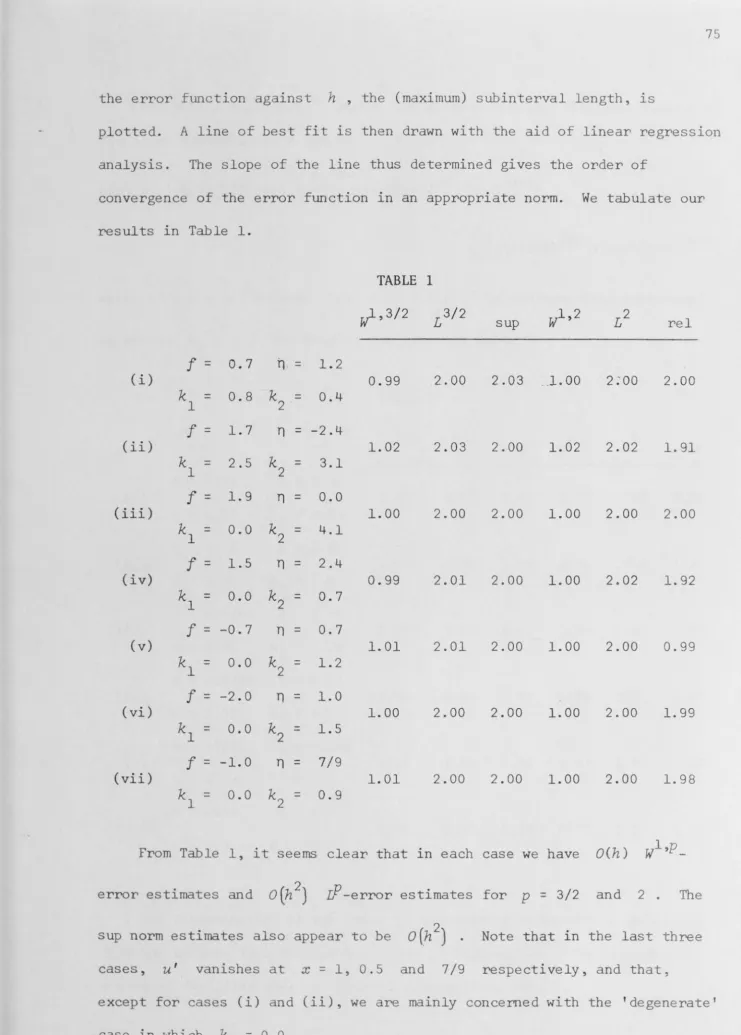
OF MONOTONE TYPE
by
-S.-S. CHOW
A thesis submitted to the
Australian National University
STATEMENT
The proof of Lemma 3
.
1 was suggested by Frank de Hoog.
Elsewhere
1nthis thesis, unless otherwise indicated, the work is my own
.
~ / / ( _
-ACKNOWLEDGEMENTS
The work for this thesis was undertaken in the Department of Mathematics in the Faculty of Science of the Australian National
University. I would like to thank the heads of the department, Dr N.F. Smythe, Professor N.S. Trundinger and Dr P.J. Cossey, for their general support and acknowledge the financial assistance provided by the
Australian National University.
I am greatly indebted to my supervisors Bob Anderssen and Frank de Hoag for their constant encouragement and helpful advice. Their interest and concern with my work has been most invaluable. I thank them deeply for their effort in providing me with the best possible supervision and for their many constructive criticisms of this thesis. I also wish to thank Bob Anderssen for catching numerous grammatical errors that appeared in the draft.
Without the support and sacrifice of my family, i t would not be possible for me to complete this study. I am most grateful to them for their support and perseverance with the many hardships. I would especially like to thank my mother for encouraging me to study abroad so that I may have the opportunity to develope a greater appreciation and understanding of the land and people in this country.
During the past three years, I have benefited greatly from discussions with staff and fellow students. The many discussions I had with others while attending conferences and seminars are also valuable.
ABSTRACT
In this thesis, we examine the order of convergence of finite element approximations to some nonlinear elliptic problems of monotone type. This is determined by establishing error estimates in the 'energy' norm for the approximations. The nonlinear problems we are interested in arise in many practical situations. Examples from blast furnace gas flow, magnetostatic
distribution and nonlinear seepage flow are discussed in some details. In Chapter 2 we show that a class of second order boundary value problems of divergence form with gradient nonlinearity may be formulated variationally, and, in an abstract setting, as an operator equation, if the nonlinear coefficients of the equation satisfy certain conditions. Under
these conditions the operator turns out to be monotone. In Chapter 3 we introduce the concept of strong monotonicity and T-continuity and
demonstrate the relation between strong monotonicity and convexity. We then prove the strong monotonicity and Holder continuity of the operator
introduced in Chapter 2. The well-posedness of the boundary value problem is then shown by establishing the unique solvability and stability of the problem.
In Chapter 4, after showing how error estimates for finite element approximations maybe obtained in an abstract setting if the associated
operator is strongly monotone and T-continuous, we proceed to derive error estimates for the class of nonlinear problems discribed earlier and examine the order of convergence of the finite element approximations under the assumption that the (weak) solution satisfies only a weak regularity
condition.
Hilbert space, it is of interest to consider the optimality of the order of convergence in other cases. In Chapter 5 we establish the conditions under which a class of nondegenerate equations, including Ergun's equation and nonlinear seepage flow equations, can be shown to have the optimal order of convergence. We also examine the problems of error estimation in
W1' 2-norm and for a class of problem solvable in the W1'P-Sobolev space with p > 2 .
In Chapter 6, we use the method developed earlier to establish a
variational formulation for a class of nonlinear vectorial boundary value problems and to derive error estimates for the finite element approximations.
In the last chapter we discuss a direct method for solving a class of one dimensional problem and present some results from numerical
STATEMENT .. ACKNOWLEDGEMENTS ABSTRACT
TABLE OF CONTENTS
CHAPTER 1: NONLINEAR PROBLEMS 1.1 Introduction
1.2 Formulation of Ergun's equation 1.3 Nonlinear seepage flow
1.4 Magnetic field analysis
(i)
(ii)
(iii) l l 8 11 14CHAPTER 2: VARIATIONAL FORMULATION AND FINITE ELEMENT APPROXIMATIONS 18
CHAPTER 3:
CHAPTER 4:
2.1 Function analytic preliminaries ..
2.2 Properties of associated functions 2.3 Variational formulation ..
2.4 Finite element approximations ESSENTIAL INEQUALITIES
3.1 Introduction
3.2 Monotonicity and convexity
3.3 Holder continuity and strong monotonicity 3.4 Well-posedness
ERROR ESTIMATION I
4.1 Abstract error estimates 4.2
w
1'P-error estimates4.3 Equations with implicitly defined coefficients 4.4 Weaker regularity assumptions
CHAPTER 5: ERROR ESTIMATION II 5.1 Introduction
5.2 Optimal estimates for nondegenerate equations 5 . 3 Wl,2 -estimates or linear triangular . f . . e l ements 5.4 Equations in W1'P(~) with p
~
2CHAPTER 6: THREE DIMENSIONAL MAGNETOSTATIC DISTRIBUTIONS 6.1 Variational formulation
6.2 Error estimations
CHAPTER 7: NUMERICAL SOLUTION OF NONLINEAR PROBLEMS ..
REFERENCES
7.1 7.2 7. 3
Direct method for one dimensional problem Numerical results
Concluding remarks
CHAPTER
1
NONLINEAR PROBLEMS
1.1
Introduction
Whenever an approximating process is utilised to obtain an approximate
solution, it is appropriate to provide an error estimate (that is, a measure of the proximity of the approximation to the actual solution). This error estimation is especially important in numerical schemes because, in addition
to generating relevant technical information, it may also be used as an
indicator of the efficiency of the algorithm used and to provide valuable insight whenever one needs to modify the approximation procedures. For
example, error estimates play a key role in the analysis of grid refinement techniques. In this thesis, we construct error estimates for finite element approximations of certain nonlinear boundary value problems that can be
analysed using monotone operator theory.
Throughout this thesis, let be a bounded open domain in
n
> l , with Lipschitz boundary 3S1 = r0 u f , where r0 and f are disjoint and meas(r
0) is strictly positive. Let
n
be the unit outward normal vector on r . The class of problems that we are mainly concerned with takes the form-V •
(k
(x,I
Vu(x) I Vu(x)) --
~g(u(x)) + f(x) in St ' (la)u(x) -- (j)(X) on ro (lb)
'
-k(.x, IVu(x)l)vu(x) • n = n(x) on r
'
( le)where f g
' ' (j) and
n
are functions with various properties, which will be discussed later. The function k E C(St x IR+) is assumed to be positive and for almost every x E St ,k(t)t
is a strictly monotone increasingvalue problem (la-le) must be elliptic, while the latter is needed to ensure
the applicability of the method of monotone operators.
Such types of boundary value problems arise naturally in many real life situations. Examples which arise in areas of blast furnace operation, non-linear seepage flow and turbogenerator design, are discussed in the
remaining sections of this chapter, along with the formulation of the
associated boundary value problems .
Even for the simplest linear cases, it is virtually impossible to obtain solutions in closed form when
n
is not one dimensional.Consequently, some form of approximation must be used to determine the behaviour of the solutions. One possibility is the
finite element method.
Its appeal over other numerical methods is connected directly with the
divergence structure of (la), the existence of variational form for (la-le)
and the flexibility of the finite element method in dealing with complex
geometric domains.
If the finite element method is used to construct approximations to the
solutions of (la-le), then it is necessary to examine the quality of such
approximations. For linear equations , it is well known that the finite
element approximations yield the best approximations to the (weak) solution
of the problem in the energy space ([8], [28], [43]). The situation is not
so clear cut when nonlinearity is introduced. Even for one dimensional problems, it is not in general possible to characterize the approximations
along the lines used for linear problems.
Nevertheless, there exist many problems for which one can use the best approximation characterization for finite element approximations . In almost all cases, an error inequality is established which yields an upper bound
of linearity in linear problems. For nonlinear problems , an important tool in establishing the error estimate is the method of monotone operators.
Once such inequality is derived, it only requires one to draw on results from approximation theory to obtain specific properties of the error.
In [9], Ciarlet, Schultz and Varga studied the semi-linear two point boundary value problem
.I (
-1) j + 1z:P
'P
. (
x)zl
u ( x0 -
f ( x , u ( x)) , O < x < l , n > l ,J=O ~J
j
with boundary conditions
D - d
dx ' O < k < n-1 .
A
By considering the finite dimensional approximation
WM
as a projection ofthe classical solution ~ on the finite dimensional subspace
SM
withrespect to a subspace dependent inner product, they obtained proofs of
convergence of polynomial, piecewise polynomial and spline approximations. 00
These results are derived from the L -norm estimates they constructed for the approximation and its derivatives. They proved that
llw-~
11y (2)
where
K
andC
are constants which can be explicitly determined a pri,or~ , y is a lower bound for f (x,u)
u and the norm
II
·
lly
i s defined by2
Il
(
n ( · 2J
21
·
llw
II
=.I
p . ( x) (lf
w
(
x)) +yw (
x) dx .y O J=O J
By letting
SM
be the polynomial, piecewise polynomial and spline subspacein turn, and utilising results from approximation theory for these subspaces when the norm is
11
•
lly
,
the required L 00 -error estimates follow from (2) .Note that, for higher dimensional problems , the first inequality in (2) is
continuously embedded in L00
(n)
whenn
c IRn with n~
2 .In a later paper [10], Ciarlet
et al
obtained abstract error estimatesfor some nonlinear boundary value problems associated with a finitely
continuous , bounded and strongly monotone operator defined on a reflexive
Banach space. However, the operators associated with many important
problems do not possess these assumed properties. More specifically as we
shall see later, many interesting operators are unbounded in the Banach
spaces on which they are defined.
Noor and Whiteman [34] also derived abstract error bounds for a class
of semilinear elliptic boundary value problem with the associated nonlinear
operator being antimonoton2 and Lipschitz continuous in the corresponding
Hilbert space. In the same paper they demonstrated the relation between the
antimonotone operator and a convex nonlinear functional. This connection is
conceptually important in much of the study of boundary value problems
involving the application of monotone operators.
Glowinski and Marrocco [17] studied (la-le) with
(3)
where s > 0 ,
S
> l > a are known constants, in a Hilbert space setting.Using the fact that
k(t)
is a strictly increasing continuous function oft ,
they proved the convergence of the finite element solutions but did notderive any error estimate. Xie [48] also studied (la-le) in a Hilbert space
setting for a general
k(t)
and derived results which correspond to thoseof oor and Whiteman. Xie noted that the strictly increasing property and Lipschitz continuity of
k(t)t
may be exploited to prove the strictmonotonicity and Lipschitz continuity of the operator associated with the problem and to obtain an error estimate for the finite element approximation. For
k(t)
in (3) it is not difficult to see that(k(t)t)'
is boundedFrom the discussion above it is clear that the method of monotone operators is of considerable importance in establishing the desired error bounds. We recall that monotonicity is intimately related to convexity, and it is natural to expect that the variational functional associated with
(la-le) is convex in some appropriate function space if the operator
corresponding to (la-le) is monotone. In Chapter 2, we examine a variational formulation for (la-le) and introduce the notions of weak solutions and
finite element solutions. We then study in the first part of Chapter 3 the concept of strong monotonicity and its relation to coercivity and the
increasing property of a Gateaux differentiable functional.
Glowinski and Marrocco [18] studied in some detail the finite element solution of the degenerate boundary value problem
u
-
0 on 3~ ,and proved that the corresponding abstract operator A is strongly
( 4-a)
( 4-b)
monotone. They also showed that for l < p < 2 , A is H 0
older continuous
with exponent p - l , and, for oo > p ~ 2 , A satisfies an inequality of the form
II
A
u-
Av
II*
<yll
u-vll
c
II
ull
+II
vii
)p-2when y is a positive constant and
11
•
11
,
II·
II*
are norms on appropriate spaces . These results concerning the boundary value problem (4-a-4-b) are important in that when p # 2 , the operator equation cannot be studied conveniently in a Hilbert space setting and that when p E ]l, 2[ , theoperator A is unbounded in its natural space of definition. Consequently, none of the results in the works mentioned earlier on may be used to
establish error estimates for approximate solutions of (4-a-4-b) .
other problems we must employ other properties of
ta
to complete theproofs.
In §3. 3 we replace this homogeneity property with the condition that
k(t)t
be strictly increasing and Holder continuous with exponent p - 1 ,1 < p S 2 . Thus, by extending the ideas of Xie and utilising some of the techniques of Glowinski and Marrocco, we obtain inequalities similar to those mentioned earlier. With the aid of these inequalities, the well posedness of (la-le) and the unique solvability of the finite element solution is established.
In Chapters 4 and 5, we are mainly concerned with deriving error estimates for finite element approximations of (la-le). After describing the general procedure of obtaining error estimates in an abstract setting, we utilize the various inequalities derived in Chapter 3 to obtain
w
1'P-error estimates for the finite element approximations of (la-le). Aswe shall show below, there exist· situations where the function
k(t)
is not known explicitly and we only have at our disposal a functionl(s)
such thatt
=
l(s)s
if and only ifs
=
k(t)t
.
We shall examine how error estimates may be obtained in such a case. It is also of interest to study the behaviour of the error under weak regularity assumption and this is done in the last section of Chapter 4.When p < 2 , the result obtained in Chapter 4 is not optimal in the sense that the derived order of convergence of the finite element
approximations is less than those in the case of linear equations. By
d · h d d b ·
w
1' 2 · f h · · fa apting a met o use too tain -estimates or t e minimal sur ace equation [20], we prove that one obtains the optimal W1'P-estimate for
k(t)
bounded above by some constant , in addition to certain regularityassumptions. We also show, how one may, in an analogous way to [20], obtain
and regularity assumptions, for two dimensional problem using linear
elements . The case when the solution space of the boundary value problem
(la-le), is in
W
1'P(~)
with p > 2 is then considered.In Chapter 6 we use the techniques developed in Chapters 2, 3, 4 to
study a class of nonlinear vectorial boundary value problems of the form
curl(~Clcurl ul) curl u) -
j
inA,
div U - 0 in
A,
and
curl U •
n
-
O on8A,
where A is a bounded open simply connected domain in IR 3 , and
n
is theoutward normal on the boundary
8A.
An example of this type of problemarises in the analysis of a three dimensional magnetostatic field
distribution in a turbogenerator (see §1.4). After introducing the
appropriate function spaces which enable us to construct a variational (or
weak) formulation of the problem, we derive error estimates for the finite
element approximations and show the well posedness of the boundary value
problem.
In the final chapter we examine a direct method for solving (la-le) in
one dimension with minimal assumption on
k(t)
and present the result ofsome numerical experiments for Ergun's equation in one and two dimension.
In the remaining sections of this chapter, we consider some actual
problems which can be formulated in the form of (la-le). Besides providing
motivation, such examples also serve two purposes - the form of the
functions
k(t)
derived enables us to extract information to further ourmathematical intuition and the physical aspect enables us to develop further
insight by drawing on experimental data when necessary. We begin our
1.2
Formulation of Ergun's equation
BLAST FURNACE PROCESS
The production of pig iron from ferrous ore by blast furnaces has a relatively long history compared with other metal smelting processes currently in use. The first blast furnaces, having sufficiently high
temperatures to melt iron, came into existence in Germany and Belgium in the fourteenth centruy. Since the introduction of preheated blast at the
beginning of the nineteenth century, various modifications and adjustments in scale, design and operation practice have been under investigation up to the present day. However, the basic structure of the blast furnace has
changed very little in the course of time. This is a direct consequence of the fact that there is still very limited information about the extremely complex chemical and physical processes occurring within the furnace.
General details about blast furnace processes may be found in [4].
The blast furnace is a packed bed reactor. In order to optimise the design of the reactor and to improve the operator's procedures so ·as to achieve a better performance in terms of cost and productivity, it is necessary to have a good understanding of the flow distribution in packed beds having spati ·ally non-uniform resistance. The experimental approach has two major disadvantages. Firstly, a small scale model does not provide a satisfactory representation of the furnace. For example, it is very
difficult to achieve the high termperature associated with the operation. Secondly, the cost of obtaining realistic information from commercial
furnaces is extremely high. This is especially true, when the investigation involves the dissection of a quenched blast furnace ([21], [22]).
By comparison, the mathematical modelling approach does not suffer from such disadvantages. As long as a good model is available, it is possible to obtain valuable information at a reasonable cost. In 1952, Ergun [14]
his observation that losses in pressure are caused by simultaneous losses in
viscous and kinetic energy. While Ergun's law is of great value, it
represents, due to certain underlying assumptions, an over simplification as
it does not allow for non-uniform flow. In most practical applications , the
non-uniform packing of the reactant particles leads to the so called wall
effect which in turn causes non-uniform flow . In order to overcome this
difficulty, Stanek and Szekely [42] proposed a vectorial differential form
of Ergun' s law.
ERGUN 'S LAW
Stanek and Szekily proposed that Ergun's law for incompressible fluid
flow, with its validity confined to the direction of flow and to an
infinitesimal length of the bed, be given by
(5)
while for compressible flow , without any restriction on its validity, by
(6)
where p is the pressure,
V
the superficial velocity andG
the massvelocity. The parameters of resistance and are given by
and
where µ denotes dynamic visocity,
s
porosity, d particle diameter andp density.
We assume that the temperature profile within the reactor is known, and
that the compressible fluid passing through the packed bed satisfies an
equation of state of the form p/p =
F(T)
,
for some known functionF
ofthe temperature T (for example, the perfect gas law) . Thus we may regard
variables in the region of interest.
We now show that Ergun's law, when coupled with the continuity equation,
is equivalent to a second order elliptic partial differential equation in divergence form. The continuity equations for incompressible and
compressible fluid flow in packed bed reactors are
and
respectively, where
V·V = f(x) - g(x, p)
2
V • G = f(x) - g (x, p )
f : S1 -+ IR and g :
n
X IR ( or(7)
(8)
+
n
x IR ) -+ IR are known functions and represent (possibly pressure dependent) source and sink terms within the packed bed.Consider the case when the fluid is incompressible. Taking the modulus of (5) and recognizing that both
f
1 and f :2 are positive, we have, after
solving a quadratic equation and taking only the positive root.
( 9)
Using (5), (7) and (9) we get
(10)
A similar algebraic manipulation with (6) and (8) yields an equation of the same form as (10) with
respectively.
and p 2 replacing and p '
To complete the formulation of the problem, we examine the boundary
conditions . Let us assume that, along
r
0 , the pressure is prescribed by a
continuously differentiable function ~ and that, along the remaining
portion of the boundary, the normal component of the superficial velocity (of the mass velocity in the case of compressible fluid) is given by a known
the Neumann boundary condition is transformed to
(11)
Letting
u
= p - ~ , it is clear that equations (10) and (11) retainessentially the same form while the inhomogeneous Dirichlet boundary
condition on p becomes a homogeneous one on
u
alongr
0 It is clear
that, for the compressible fluid case, the boundary conditions may be dealt
with in a similar manner and analogous expressions are yielded if the
substitution u = p 2 - ~ 2 is used.
Letting k
1, k2 ,
u
and ~ stand forf
1/2,f
2, p and ~ respectivelyif the fluid is incompressible or for and ~ 2 if the fluid
is compressible, we see that a mathematical formulation of the steady s·~ate
gas flow within a blast furnace is given by
where
Clearly k
-V• (k(
I
Vul )Vu) - f(x)u(x) - ~(x)
-k(IVul )Vusn -
n(x)g(x, u) in St ,
on
ro '
on
r
k(t) =
~l
+
v
ki+k2tTl .
is a positive continuous function on St x IR+ and
(12a)
( 12b)
(12c)
(13)
(14)
is a strictly increasing function of
t
.
Therefore (12a-12c) is of thetype (la-le).
1.3 Nonlinear
seepageflow
We now reexamine Ergun 's law for seepage flow. Such a consideration is
porous medium. Darcy's law is commonly adopted for describing pre-limina or
creeping flow in which inertia effects are negligible [3]. If viscous
dissipation dominates and the Reynolds number is small (for example ,
Re~ 1.5), then we may set and to zero in (5) and (6) respectively.
Ergun's law may then be regarded as a variant of Darcy's law and (12a-12c)
-1 ( -1 -1)
reduces to a familiar linear problem with
k(x, t)
.
=
2k1 .=
f
1 or g1 .On the other hand, if the flow is dominated by turbulence dissipation and
large Reynolds number (for example , Re~ 150), we may drop the viscous term
in Ergun's equation. Assuming that
g(x, u)
=
0 , we may write (12a) as( 15)
Clearly, when k
2
(x)
-
constant , (15) is a special case of (4a) withp - 3/2 .
Equations of the type (15) or (4a) also arise naturally in modelling
the flow of a liquid or gas through a porous medium satisfying Missbach's
law [47] which provides a relationship between velocity and hydraulic
gradients :
( 16)
where is the velocity in the direction s ' h is the hydraulic head
and c , n are constants .
There exists another seepage law which describes the nonlinear behaviour
of laminar and turbulent flow. Forchheimer's law [47] is given by
ah
2as - aq s + bq s '
and resembles the vectorial differential forms of Ergun's law for
incompressible fluid first proposed by Stanek and Szekely [41] :
~
-dX
~
-d
(17)
(18a)
Subsequently , it was pointed out that (18a-18b) are not invariant to
coordinate transformation and hence formally incorrect [38]. Thus one may
modify (17) to a form similar to (5) when the fluid flow under consideration
is isotropic. (The above comment is also applicable to the Missbach law.)
An example of such a modification appears in the study of glaciology by
Pelissier [37], which gives rise to (4a) .
Since the continuity equation may be written as
V
•
q =f(x)
-
g
(x,
h) in Q (19)with source or sink term
f(x)
-
g(x
,
h)
and velocity q , it is clear that the equation of divergence form in h resulted by coupling the modifiedequation ·of (17) and (19) is of the same form as (12a).
More generally, one may consider the nonlinear seepage law [35]
(20)
where n ~ 0 is a constant and a , b are positive continuous functions of
the spatial variables in the region of interest. In order to derive an
equation of the form (la) we first note that the function
Z(s)s
=(a+bs1'2)
s
mapping to is strictly increasing in S , and hence possesses a
strictly increasing inverse function
k(t)t
, that is,.
t
=Z(s)s
if and only if s =k(t)t
.
Thus we may write (20) asq =
k(!Vhl)Vh
.
(21)For n
t
O or l , it is very difficult , if not impossible, to derivek(t)
explicitly. Nevertheless, a numerical evaluation scheme may be usedto determine
k(t)t
economically in the course of computing a solution tothe boundary value problem modelling the flow . The boundary value problem is obtained by combining (19) and (20) as well as appropriate boundary
l
.
4 Magnetic
field analysis
One advantage of mathematical modelling over others is that very often the same model may be used to describe vastly different physical phenomena.
One such example is the wave equation. In this section we provide yet another illustration of the above statement by showing how (la-le) can be used as a model for the magnetostatic field distribution in turbogenerator or electromagnet design problems . In the process of modelling such problems another type of boundary value problem arises, which will be studied in more
detail in Chapter 6.
In order to optimise design and to ensure reliability of electrical
machinery and devices an accurate prediction of the magnetic field
distribution in their active region is required. The presence of complex geometries and material discontinuities invariably exclude the possibility of obtaining an analytical solution. The finite element method is well
suited to dealing with such complications.
Let A be a simply-connected bounded open domain in IRn , n
~
2 ,with smooth boundary 8A and let n be the outward unit normal to aA . By assuming that the permeability µ is a single-valued scalar function
(that is, istropic material and ignoring hysteresis effect) and the source function is represented by a volumetric current density distribution in
ideal conductors carrying current, the stationary magnetic field distribution in A lS given by the Maxwell's magnetostatics equations
curl H -- J (21a)
'
B
--
µ.H
( 21b)'
div
B
-- 0 (21c)'
where H is the magnetic field intensity, J the current density vector, and B the magnetic induction (all in appropriate units) .
The solenoidal vector
B
may be represented by a potential vectorA
B
= curlA.
(22) Letting V be the magnetic reluctivity (inverse permeability), i t is clear that (2la-2lb) and (22) yieldcurl(V curl
A) -
J inA.
(23a)The reluctivity is a function of
IBI
and for ferrous material ishighly nonlinear. It is usually available for interpolation of experimental cata as the
B
-
H
curve. Some typical forms ofv
are(i) with a - 4.5 X 10⁻⁴ ,
+4
S
=
2.2 x 10 and s=
8 for the rotor in a turbo-alternator, and
s -
5.16 x 10⁻⁴ ,C
=
0.176 ,T
=
8.76 x 10³ anda -
5. 42 as a typical set of values.In both cases µ
0 = 4TI x l0-7
MKSA.
Clearly, if A is a vector function satisfying (23a), then, for any continuously differentiable function
X,
A
+
gradX
is also a solution of (23a) . Thus, to ensure uniqueness , we impose the normalising condition onA :
div
A
=
0 inA.
(23b)If we assume the magnetic field outside the machine or device is negligible,
we obtain the boundary condition
curl A• n = 0 on 3A . (23c)
Equations (23a-23c) may be regarded as a boundary value problem. This
problem is considered in detail in Chapter 6 .
We now consider the case when the magnetic vector potential and the
current density vector have only a component in the 2-direction, that is,
and
J = (0, 0, g)
with
u
=
u(x,
y)
andg
=
g(x, y)
.
Clearly (23b) is satisfied identicallyand, noting that !Bl - !curl
Al
=I
gradul
,
(23a) gives-V
•
(vC!Vul)Vu)
= g in AThe boundary condition (23c) is satisfied if
u -
o
onaA
.
Note that we use the same symbols
A
andaA
for the two dimensionalanalogue of the original region and boundary respectively. Obviously
(24a)
(24b)
(24a-24b) is a special case of (la-le) since v(t)t is an increasing
.
.
function of
t
E IR + , as can be seen from theB
-
H
curve : [image:23.772.8.754.19.1073.2]B
FIGURE 1
Returning to the fully three dimensional case, the solution of the
magnetic vector potential A requires computation for the three components
of
A,
and is thus rather costly in terms of execution time and memoryrequirement . It is natural then to seek an alternative approach whi ch is
more economical, computationally speaking. The method of scalar magnetic
potential provides a competitive approach to the solution of (2la-2lc) . From Maxwell' s theory we know that the current density vector is
solenoidal, so by letting
J = curl H
0 for some vector H
0 , with no restriction on its divergence , we may represent H by the sum of its irrotational and rotational parts:
H
= - grad¢+H
0where ¢ is termed a reduced scalar potential.
(25 )
Suppose now that a suitable H
0 satisfying (25) is chosen. This may
be obtained by evaluating the integral
1
J
jC
r'
) C
r- r'
)
dv
,
H0Cr ) = -4n
v
'
I
r-r'I
3 (27)or by the method described in [29]. Noting that the representation (26) is
still not unique , we impose the normalising condi t-ion
{
¢(x)dx
= J St0 .
Substituting (26 ) in (21b) and (21c) we see that
div(µ(I H
0 + grad ¢I )
(H
0 +grad¢)) - O inA
.
(28a)
( 28b)
From the
B
-
H
diagram it is clear that µ(t)t is a strictlyincreasing function of
t
~ 0 , so (28a-28b) is strongly related to(la-le) . The problem (28a-28b) is however a purely Neumann problem, with
boundary condition
B •
n
-
(
H
0 +grad¢) •
n -
b(x)
on8A,
(28c)for some given function
b
(
x
) .
We will see later that the results obtained for (la-le) also hold for
(28a)-(28c) with minor modification. Moreover, the computational cost for
solving (28a)-(28c) is much less than that for solving (23a-23c) . However,
we must point out that the computational cost for obtaining H
0 is q ite
substantial and so this scalar potential approach is not always superior to
the vector potential approach. In fact , numerical investigation using the
latter approach is becoming quite popular among the engineering community
CHAPTER 2
VARIATIONAL FORMULATION AND FINITE ELEMENT APPROXIMATIONS
2.1
Function analytic preliminaries
The practical problems discussed in the previous chapter show that it is important to obtain solutions , or at least approximations to solutions, of (l.la-1.lc). To do this we shall consider (l~la-1.lc) in a variational setting and formulate the problem as one in functional minimization . This
enables us to introduce the notions of weak solutions and finite element approximations in a natural manner. We begin by stating some relevant
definitions , notations and results to be used later.
IR+
We use to denote the set of all nonnegative real numbers. For any
p
t
O , andinequality:
n .
x, y E IR , n > 1 , we have the p-triangle
where
f1 if 0 < p < - l
'
C-tp-1
-p
if 1Sp< 00 •
Clearly, for O < p S 1 , we also have the inverse p-triangle inequality
Let
m
be a nonnegative integer and p E [l, co] . IfO
is an openset in IRn , we the norm
II
·
llm
,pdenote by given by
llulip
m,pthe usual Sobolev space equipped with
on 0 For
n
C IRn (see §1.1), we define Vto be the closure of D(rt u r) for the ll • 11
1 ,p norm. For each p > l , one can find r E IR and a unique trace map R
the trace embedding
R(W
1
'P(rt))~
Lr(r0
)
holds[23].
Thus, a characterization of V isV
=
{u
Ew
1,Pcni[Ru=
0a
.
e
.
on
ro}
,
Using the Poincare inequality it is clear that the seminorm
(1)
is in fact a norm on V and is equivalent to the
II
·
II
l,p norm .In some situations , our assumptions on
n
do not hold. When meas(r0)
is zero, we set
v
=
{
u Ew
1 ,pCn l [
In
udx=
o}
.
In this case, the seminorm
II·
II
is again a norm on V .The space V equipped with the norm (1) is a reflexive, separable and uniformly convex Banach space for p
E
]l, oo[[23].
We shall denote the dual space of ( V,II
·
II)
by ( V* ,II
·
II*)
and the pairing ( • , • > : V* x V -+ IR by< f, u
> -
In
fudxfor every f E
V*
and u EV
.
Also, for p > 1 and pq
=
p + q'
letII
•
II
r
*
denotes the norm on thedual space
Z*
ofz
=
w
1 /q,Pcr) and (.
'
.
)r
'
thewith its dual. For each
u
EZ
andv
EZ*
,
we set< V' u
>r - Ir
uvdY .From now on, unless otherwise indicated, we always assume p E ]l, 2] .
We shall also use C to denote a generic constant which is not necessarily the same in each of its appearances .
2.2 Properties of associated functions
We now define the properties which the functions k , g,
f,
q> andn
will be assumed to satisfy. As stated in §1.1,k(•,
•)
is assumed to be a positive continuous function on S1 x IR+ and, for a.e .x
E S1 ,k(x,
•) •
is a strictly increasing function on IR+ • We follow the convention that wheneverk(•)
i s used it is meant to represent the functionk(x,
•)
for a .e . x E S1. In general, we do not assume thatk(t)
is bounded above. However, the functionk(t)t
is assumed to vanish at the origin andsatisfies the following conditions for some p E ]l, 2]
(i) for all
t
ER+,where a
1 > 0 , a2 ~ 0 are constants independent of
t
,
(ii)k(t)t
is Holder continuous with exponent p - 1 , that is,there exists a constant
y
> 0 , independent oft
and s , such thatlk( t)t- k(s)sl < Yl t-slp-l for all
t
,
s E IR + ;(iii)
k(t)t
is continuously differentiable for allt
> 0 and one can find constantsthat
K > 0
l - ' K 2 > O and C 1 > 0
As a consequence of (3), and the simple inequality
for all
t
> 0'
such
(2)
( 3)
(4)
( 5)
it is easy to show that
k(t)t
-
c1
(x
1+K2t
2
-P)t
nonnegative function for all t > 0 . Then we have
(6)
Obviously, the monotonicity of
k(t)t
does not imply monotonicity fork(t)
.
However, the converse implication holds . Whenk(t)
is monotone, it is not unreasonable to expect that those results, established byexploiting the various properties of
k(t)
described above, will remain valid under a sli ghtly weaker condition on k . This is indeed the case .As we shall see later, if
k(t)
is monotone increasing, we may i gnore (iii) above and only requirek(t)
to satisfy (6).As an illustration , consider Ergun's problem (l.12a-l.12c). In this case ,
k(t)
-
-(
kl
+J
k~+k2trl
andk(t)t
--[
j
k~
+
kl
-k
1)
/k2
.
It is easy to check that
k(t)t -
- 0 att
-- 0 and conditions (i)-(iii) areA A
satisfied with p - 3/2 al - y
=
k2
a.2 - 0Kl -
k
K2
=
k
and-'
-'
-'
- 1'
2A
~k
k
.
C -- where
k.
> 0 and > 0 are respectively the upper and lower'
-1 2 1,, 1,,
bounds of k . ,
1,,
.
i, - 1, 2 .
For the sake of simplicity, we assume that g(t) is an increasing
.
.
function on IR and is Holder continuous with the same exponent as that fork(t)t
.
It is also convenient to setg(O)
= 0 . An example of such afunction is
g(u)
=lulp-
2u
.
As will be seen later, these properties of g( • ) and those of k( • ) enable us to study the boundary value problem(l.la-1.lc) in a variational setting. In fact (l.la-1.lc) may be recast as a functional minimization problem over the subspace V of
w
1'P(n)
described in 2.1, with p chosen according to (2)-(4) .
We also suppose that
n
is in the dual space of L r(f) ,
where r = 1 forn
s
p
andr
=(np-p)/(n-p)
forn
>p
.
We do this becausew
1'
P(n)
isembedded in
Lr(f)
[23]. Finally, we stipulate that~
Ew
1'P(n)
.
This enables us to make a substitution in (l.la-1.lc) to obtain the
following boundary value problem which has a homogeneous Dirichlet boundary
condition :
-V • [k (IV(u+<p) l)V(u+~)] + g(u+~) - f in
n
,
u - 0 onro
,
-k
(
I
V
(
u+~)I)
V (
u+<p) • n -n
onr
.
2.3
Variational formulation
(7a)
( 7b)
The divergence structure of (7a) clearly indicates that it is the
Euler-Lagrange equation of some associated variational principle. We now
establish the equivalence of (7a-7c) and the following minimization problem.
Find
u E V J (u ) - min J (v) , v E V , (8)
where
(
f
I
V ( v+~ )I
(
{v t~J(v) -
k(t)tdtdx
+g(t)dtdx
J
n o
J
n Jo
Using the properties of k ,
g,
f,
~ andn
discussed in the previoussection, it is easy to show that J is well defined on V and has its
range in IR . To show that J is Gateaux differentiable we follow the
method in [5]. Let 8 E IR and
v
,
h E V be given. LetVt=
(v+~) +8th
,
for eacht
E [O, l] , and definew
1,
w
2 [ O, l ] -+ IRl'vvtl
w1
< t) -J
0
Vt
k(s)sds
+f
Og(s)ds
- fvt ,
Clearly
W1, W2 E
c1co,
l] and so, on applying the mean value theorem, weobtain
- ( 1
w
'
<t)dt
JO lAlso
W2(1) - w2(0)
=n(Sh)
.
ThereforeOne may utilise the properties possessed by k and g as well as the
Holder inequality to show that the function
lS ln and hence by Fubini 1 s theorem one may change the order of integration to
J(v+Sh)-J(v)
8
Now for each
t
E [O, l] , the continuity implies thatk(l'vvtl)
~k(l'vvj)
and
g(vt
)
~g(v)
uniformly as 8 ~ 0 (henceSt~
0 ). Also, for 0 < 8s
l , there exists C > 0 such thatand the right hand side is integrable by Holder inequali ty. Therefore by
the dominated convergence theorem we conclude that the Gateaux derivative
( J I ( U ) , V ) - (
Au ,
V ) + ( Gu , V ) - ( f, V ) + (n
,
V ) f , (10)where the operator
A, G
V
~V* ,
which hold for allu,
VEV,
are givenby
( Au, v) -
Ink(
IVul
)\lu • \lvdx ,and
< Gu, v > - ( g( u )vdx .
Jn
It follows that the minimization problem is equivalent to the weak
formulation of (6a-6c). Find
u E V
(
Au'
V > + <Gu'
V > = <f'
V > - <n'
V >r for all V E V(11)
(12)
(13)
Now, if u is a solution of the variational problem (13), and if u is sufficiently smooth, we may, after performing an integration by parts, deduce that u is a solution of (7a-7c). Conversely, if u is a solution
of (7a-7c) it is obvious that it satisfies (13). Thus the minimization
problem (8) is equivalent to (7a-7c) provided that the minimizer of (7) is sufficiently smooth. We shall call any u
EV
satisfying(
8
),
or,equivalently, (13), a weak solution of (7a-7c).
If
k(t)t
~ oo ast
~ 00 , then the function ¢ IR+~ IR+ given y b~(s) =
J:
k(t)tdt
is a Young's function and ¢ is continuous, strictly increasing and convex
on [2 3]. In this case the variational principle J i s not only convex
but also admits a complementary or dual formulation. In this case useful
results can be obtained if one considers the minimization of
J(
•
)
given by2.4 Finite element approximations
We now examine more closely the approximation process that gives rise
to finite element approximations uh for the weak solution u . The notation we employ here is essentially that used by Ciarlet [8].
Firstly, the polygonal nature of Q enables us to establish a family
of triangulations Th on Q parametrized by h
E
]O,
l[ and satisfies aninverse assumption. We may therefore define a family of finite element
spaces
fl
c V with triangulation Th The inclusion offl
in Vimplies that we are only concerned with conforming finite element methods.
for the case of linear elements we have
o -
I
E
c
(Q); vhr
0
where P
1(K) is of course the space of all linear polynomials on K .
Secondly , we assume that each member of the regular family of finite
elements
(
K, PK'
TIK) is affine equivalent to some reference element" " "
(K, P, TI) and that the inclusion p
(K)
Cp
Cw
1'P(K)
l holds. In this
setting it is now possible to introduce the finite element approximations
and to study their convergence properties.
If one can find a uh E
Ji
such that(14)
then is called a finite element solution of (7a-7c). Equivalently,
is a finite element solution if and only if uh solves the problem: find
From now on, unless otherwise stated, we reserve the symbols u and
represent the weak solution and the finite element solution of (7a-7c)
respectively. On closer examination of (8), (13), (14) and (15) several
questions arise naturally. For example, one is interested in seeking out
whether
u
and exist or not , and if they do, whether there are amultiplicity of such solutions . Other crucial questions concern the
convergence of uh to u as h tends to 0 and the size of the global
to
error
llu-~11
.
To answer these questions i t is necessary to examine theoperator A more closely. As it t urns out , the answer to most of these
questions lies in the continuity and monotonicity properties of A . These
CHAPTER 3
ESSENTIAL INEQUALITIES
3 .
1 I n trod u ct i on
With the boundary value problem (l.la-1.lc) formulated in a variational
setting, we are now in a position to derive some key intermediate results
that are crucial to the establishment of error estimates for finite element
approximations. These results are expressed in inequality forms.
Using standard methods it is relatively easy to show the convergence of
finite element approximations to the unique weak solution if the functional
involved is strictly convex, increasing and lower semicontinuous over a
reflexive Banach space ([26], [27]). However, it is necessary to impose
further conditions if error estimation is desired.
In this chapter we introduce the concepts of strong monotonicity and
T-continuity and prove that the Gateuax derivative
J'
(2.10) of thefunctional J defined in (2.9) possesses these properties. We then examine
the well-posedness of the variational problems (2.13) and (2.15). This
leads to the result that both the weak solution and the finite element
approximation of (2.8) are bounded by some constant in V and
r/2
respectively3.2 Monotonicity and convexity
In this section let (\V, 11 • II) be a Banach space with dual space
(\V*, 11 • 11 *) and pairing ( • , •) : \V* x \V -+ IR • We start by recalling the
standard definitions of monotone operators and convex functionals.
DEFINITION.
An operator A : W-+ \V* is said to be monotone if for anyu' V E \V '
M is
strictly
monotone
,
if equality holds only whenu
=v
.
DEFIN
I
TION
.
A functional JI :\V
-+ IR is calledconv
e
x
if, for anyu,
v
EW
,
the inequality8Jl(u) + (l-8)Jl(v) - J1(8u+(l-8)v) ~
o
holds for all 8 E [O , l] . JI is
strictly convex
if we have equality only whenu
=v
.
In order to achieve a more quantitative description of monotonicity, we
introduce the following modification of the above definition which will be
useful later on. Let
T
be the space of all function pairs(
X
,
TI) such that X ·. IR+ -+ IR+ is a strictly increasing continuous function with . . . .xC
o)
=o
and x(t)-+ OO as t-+ 00 , and that+ +
TI : IR -+ IR is a continuous
function with TI(t )
=
O only if t=
0 and x(t)/TI(t) is an unbounded, strictly increasing continuous funct ion for all t > 0 •D
E
FINITION.
An operator ~ : W-+W
*
isstrongly monotone
if there exists a function pair(X,
TI) inT
such that for any u , vE
W
,
TI(llull+llvll)<!Au-/Av, u-v > ~ xCllu-vll)Jju-vll .
Note that when TI= 1 , the above definition coincides with the more
usual definition of strong monotonicity . Clearly, every strongly monotone
operator is strictly monotone . Recalling that the Gateaux derivative of a functional is strictly monotone if and only if the functional is strictly
convex, we see that if the Gateaux derivative of a functional is strongly
monotone then the functional is strictly convex.
If /A :
W
-+W*
is a strongly monotone operator withIIAo II*
S M for some M ~ 0 , then for any u # 0 inW ,
we can find X and TI such that< !Au ,u) > x(llull) </Ao, u >
II
uII
- TI (!lull) + llull>
xc
llull) - IIAo II*
-TI (!lull)
> X( llull) M
.
-n(llull) -
'
thus, as llull + 00
'
< IAu, u> !llull + 00 This shows that ~ is coercive.Suppose JI : \V + IR takes finite value at u = 0 and its Gateaux
derivative JI' is strongly monotone with II JI' 0
II*
bounded above by someconstant M. For any fi xed u, v E
\v
,
let g(a ) = Jl(au+(l-a)v} ,Os a S l . Then
g'(a) = lim g(a+t;-g(a)
~o
_ lim Jl(v+(a+t)(u-v))-Jl(v+a(u-v))
t+O t
- <JI' (au+(l-a)v), u-v>
Applying the mean value theorem to
g
,
we haveg(l) - g(O) = g'(a) for some a E Jo , l[ .
So Jl(u) - Jl(v) = < Jl'(au+(l-a)v), u-v> and thus
Jl(u ) = JI( 0) + < JI' Cau),
u
>> JI( o) +
(x(
liauJI) -M]
!lull . n( llaull)As llull + oo , the right hand side of the inequality tends to infinity
and hence Jl(u) + oo • Therefore JI is
.
increasing..
.
To conclude this section we introduce a special form of continuity that
will be of use in the derivation of an abstract error estimate in Chapter 4.
DEFINITION.
An operator ~ :W
+W*
is said to be T-continuous ifthere exists Cs, T) ET such that
11/Au-lAvll* < sCllu-vll)TCllull+llvll) for all u , v E \V •
Note that when T
=
l and sCt) = ytP , where y > 0 is a constant,the above definition reduces to that of Holder continuity of A with exponent
3.3 Holder continuity and strong
monotonicity
IICLDER CONTINUITY
In [18], Glowinski and Marrocco studied the boundary value problem
(l.4a-l.4b) and proved that the corresponding operator is Holder continuous
for l < p < 2 . One crucial step in the proof is to show that the vector
identity
n
for all z , y E IR ,
(l)
holds for some positive constant
y
independent of y and z . Thederivation of (1), and in fact all of the vector inequalities in [18], relies
on the homogeneity of the function
a
>o
.
If we are toestablish a vector inequality similar to (1) for (2.7a-2.7c) involving a
general
k(t)
,
then clearly a different route has to be taken.On the other hand, Xie [48] utilised the assumed Lipschitz continuity
of the function
k(t)t
to prove the Lipschitz continuity of the operatorassociated with the problem (2.7a-2.7c) for p - 2 Eventhough it is not
possible to generalise his proof to the case of l < p < 2 , it is clear
that the Holder continuity of
k(t)t
plays an important role in determiningwhether the operator
A
is Holder continuous. We now show how one may usethis continuity property to establish the desired vector inequality.
LEMMA 3.1.
If k(t)t is Holder continuous with
exponent
p - l ~l < p s 2 ~
and
with Holder constant
Q ~
then there
e
xists
a
constant
0
such that
for all
n
y > y '
z
E IR ~n
> - l ~lk( lzl
)z-
k(
!
Y
I
)y l S Ylz-ylp-l .Proof. If y -- 0 then clearly
I
k
<I
z
I
)zI
= k(l 2 !)jzl < Qjzlp-1 .y ' z i= 0 '
(2)

![FIGURE B Following [31], we now consider 2 how the problem may be formulated](https://thumb-us.123doks.com/thumbv2/123dok_us/8047128.222541/74.776.11.762.19.1075/figure-b-following-consider-problem-formulated.webp)