Abstract: Observed varying interference in radar signal processing limits the accuracy of target detection. Signal processing approaches using spectral coding are used in computing the Doppler. The spectral processing are however computationally slower due to large processing coefficients. In this paper, a new selective process for spectral bands is proposed using recurrent band mapping to derive a scale level selection in radar processing. A stopping criterion developed, limits the additional computation overhead in radar signal processing, and reduces the delay in computation of decision making. The simulation of the proposed approach validates the Doppler profile and delay parameter under different data rate and fractional order of receiving signal.
Index term: Multi spectral coding, radar signal processing, spectral mapping, recurrent coding
I. INTRODUCTION
Very high frequency radar interface are used for target detection for long altitude objects. The radar interface is used for a uplink and reception of reflected signals at ground station for detection of target and its associated parameters. The estimation unit, measures the target location and velocity metric by processing the signal characteristic and the time delay factor. in the propagation of the signal, multiple interferences are affected on the communicating signals. The surface of the hitting target and the medium of communication scatter the signals in multipath, which degrades the signal strength and induces multiple different levels of interferences in the communicating signal. In the process of signal processing using spectral coding, in [1] a radar signal processing using wavelet based coding [2] for denoising of radar signal is presented. A denoising approach based on sub band decomposition and a denoising criterion following threshold approach is proposed. This method used a spectral decomposition using “atmoslets”[3] transformation with atm1-atm6 transformation techniques for spectral decomposition in wind profile detection. In mitigation of interference in radar signal a bi-spectral estimation approach was presented in [4]. The approach performs a noise computation at a cost of higher computational complexity. In [5] a multi tapper approach for radar signal processing is presented.
Revised Manuscript Received on August 05, 2019
K. Satish Babu, Research Scholar, Dept.of ECE, Jawaharlal Nehru Technical University, Hyderabad, India.
P. S. Sarma, Retd. Professor, Aurora's technological and Research Institute, Hyderabad, India.
This approach minimizes the spectral variance by widening the spectral peak monitoring. In [6] a Fourier based estimation is presented for detecting the moment of radar coefficient in radar signals processing. This approach defined a new adaptive estimation approach for detection of dominant spectral peaks and selects the highest peak level in estimation process. The process has a limitation of detection under interference variance conditions. In the signal propagation multiple signals are observed at the reception terminal due to refractive pattern and the medium scattering for a communication signal. A fraction Fourier based signal generation for radar signal processing is outlined in [7]. The suggest approach defined a library generation of communicating signal to generate rotatable waveform of franker and barker coded waveforms. A suitability of signal selection by delay profile in the side lobe is presented. In [8] fraction Fourier transform (FrFT) is used in defining communicating signal in an OFDM based communication signal. The approach is proved to have better tolerance to interference between sub carriers improving the SNR factor and minimizing the BER of the system. [9] Defined a signaler approach of signal generation over rectangular pulse waveform. A phase coded signal for defining rotatable waveform library is defined in [10], where the signal performance wrt. side lobe delay and side lobe level are measured. In [11], a signal processing approach of waveform generation using FrFT for barker and frank code is presented. The analysis under ambiguity function reflects the significance of the FrFT selection in radar signal generation. The selection of signal for low interference using a waveform library following FrFT and its spectral coding for noise minimization effectively improves the Doppler profile detection. However, the complexity of spectral coding on the radar signaling is high. This affects the performance of radar processing in target detection and its processing accuracy. To improve the detection accuracy in this paper, a new spectral recurrent mapping approach is proposed. This approach defines a mapping approach on successive decomposed band and limits the decomposition process by defining the stopping criterion to reduce computation overhead to the system. To present the stated objective, this paper is outlined in 6 sections. The signaling approach and the existing approach of spectral coding is presented in section 2. Section 3 defines the proposed approach of recurrent spectral mapping. Section 4 presents the simulation result for the developed system, with conclusion outlined in section 5.
Multi Spectral Coding in RADAR Signal
Conditioning using Recurrent Spectral Mapping
II. SIGNALCODINGANDSPECTRAL REPRESENTATION
In the radar signal propagation, each of the transmitting antenna uplink a signal with energy ‘E’ into space, which get reflected and scattered into multiple rating signal back to the receiving antenna. The receiving antenna receives a multiple copies of the reflected signal at different interference level and delay. These collected signals consist of the target information which is processed at the ground station to predict the target parameters such as location, velocity, density etc. In the developing of radar signaling process, a waveform generation based on multiple refractive energy derived by Fourier transform is presented in [7]. A fractional Fourier transform is used as a signal processing approach for representation of a signal in time-frequency domain. A signal represented in fractional Fourier transform is given by,
(1)
Where, the angle of a signal rotation is given by and the kernel defining the FrFT is defined by,
(2)
Here is defined as , where is the fractional transformation order of the FrFT. When = -1 it defines the inverse Fourier operation. = 1 gives a regular Fourier transform. In constructing a signal for code pattern (ξ) in Barker or Frank at a sampling rate of r, the generated signal is derived for a length of . The signal is defined as,
(3)
The FrFT of the original signal is defined by,
(4)
(5)
For different value of the generated signal are of different spectral values. the receiver observe the signal as a group of variation waveform of the original signal. These signals are observed at radar receiver unit and processed for target detection. During the propagation, the signals are affected with different noise interference. An ambiguity function defines the variation component of the defining signal given by,
(6)
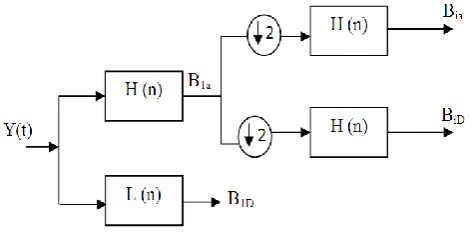
[image:2.595.311.547.308.426.2]Where and are the observed Doppler effect and delay profile in signal propagation. This received signal is processed for the removal on noise frequency component using spectral coding. An approach of denoising in radar signal was outlined in [1]. This approach present the usage of wavelet transformation for signal denoising using a threshold based median filtration over decomposed frequency bands. The method used a transform called ‘atmoslet’ [10] for the decomposition of received signal into finer subband coefficient. Wavelet transformation defined the signal in both time-frequency domain, and decompose the original signal to finer resolution using successive filter banks of high and low pass filter banks. For a noise effected signal, x(t) = s(t) + (t), where s(t) is the signal value and (t) is the white Gaussian noise. Each of the band decomposed gives a finer detail resolution of the decomposed band and the residual coefficients are taken as approximates which are further decomposed to derive finer details in other frequency band regions. The signals are decomposed in a successive level as illustrated in Fig 1 below
Fig 1. Successive resolution decomposed of a signal
Each of the decomposed bands is threshold with a limiting value to filter the noise contamination. Threshold based filtration are developed in past literature [12, 13]. A threshold computation for the decomposed band for denoising here is defined by,
(7)
Where,
(8)
Which reflect the updation of the signal as,
(9)
Where,
(10)
is defined as the noise level derived as the absolute median deviation. Dm is the band decomposed coefficient. The process of denoising here is processed for all level of decomposition and at each
updated signal is buffered which is then inverse transformed to regenerated the denoising signal back. Here, the observatory parameter is that each of the decomposed signals is processed for denoising irrelevant of its information content. In decomposition of signal in multiple frequency bands, there are possibilities of no information in some bands or bands with similar spectral density a repetitive processing over such bands would reflect the same result with increase in processing overhead. In addition, further decomposition of signal to higher scale level would lead to saturated signal which would reflect similar energy content as the lower bands; this also introduces delay in the decision. It is hence required to develop optimal decision logic for frequency decomposition based on the information details of the bands. A filtration process is proposed in this paper to overcome this limitation.
III. RECURRENTSPECTRALMAPPING
In the process of signal denoising, each of the decomposed bands is threshold for denoising. In most of the signal processing application, the signals are processed over multiple decomposed bands to develop a decision. The process of decomposition, are however highly dynamic, as the selection of frequency band, scale level and selection approaches defines the accuracy and efficiency of the coding approach. in the process of frequency decomposed process the decision of level of decomposition play a crucial role. As a false termination may lead to information loss, an over biased scaling would lead to over computation of the signal with minimal or no improvements.
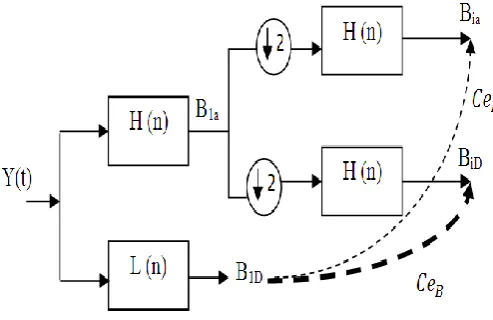
[image:3.595.50.297.504.664.2]An optimal termination for band decomposition improves the performance of the estimating approach. For the decision of termination a recurrent mapping of successive band energy is made as illustrated in Fig 2 below.
Fig 2. Proposed Recurrent Successive Band Correlation Approach
This approach computes the spectral deviation between two successive decomposed bands and use a LMS-adaptive filter to make decision of band scale termination. For a decomposed band , given by,
Where is the band information and is the distortion value, a normalizing factor is applied to minimize the biasing effect due to filtration. For each of the decomposed band a correlative error is computed in spectral domain given by,
(12)
Where decomposed band is correlated with it successive normalized band. Here the band normalization factor is updated as a value of past normalization and the current error value. The updation factor is given by,
(13)
Here µ is the fractional updation factor.
At each scale level the error computed is then compared to the tolerance limit δ and a selection of the decomposed scale level is taken. The process of decision for spectral band is given as,
(14)
A recurrent correlation of the two decomposition with approximate coefficient and detail coefficient is then made to define the termination. The process of termination is given as,
(15)
The correlation function is defined as the match value of past band spectral value with the current approximate spectral value. The correlation threshold of is set as a user defined resolution limit. The correlation function is given as,
(16)
To validate the proposed approach a simulation of the developed approach is made as presented in following section.
IV. SIMULATIONRESULT
The analysis of the developed approach is validated over ambiguity function for the generated signal using FrFT and evaluated for delay profile, error validation and Doppler resolution under different coding rates. The fractional order for the FrFT coding defines the isolation of signal in spectral domain using FFT. Ambiguity analysis is used to observe the performance of waveform generation in radar signaling. A rotating waveform using barker13 and frank16 is used for the generation of signals in radar analysis.
The delay resolution of the proposed approach is defined by,
And the Doppler resolution is defined as,
(18)
The phase shift parameter for the barker and frank scale is taken as,
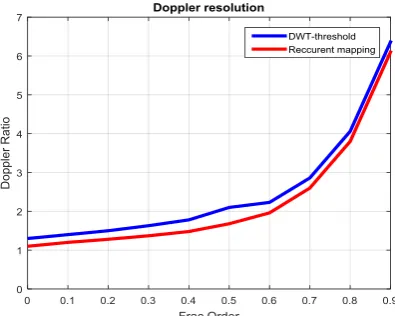
[image:4.595.318.526.55.416.2]The resolution observation for the developed system at different data rate is as shown below.
Fig 3. Delay resolution for varying fractional order at different data rate
Fig 4. Doppler resolution for the developed approach
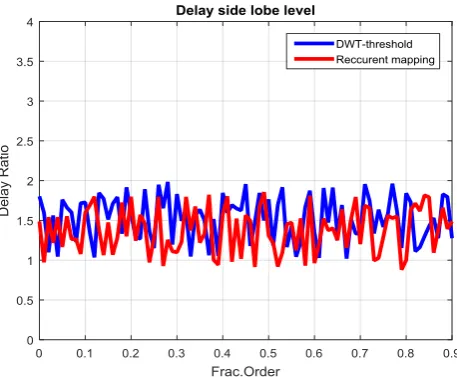
The delay profile and the Doppler resolution for the developed approach computation is more accurate in estimation. The spectral resolution mapping and selection of bands and the termination process result in faster decision and Doppler frequency resolution rate evaluation is more accurate.
[image:4.595.63.268.199.355.2]Fig 5. Side lobe delay resolution
Fig 6. Doppler ratio for the two method for side lobe
[image:4.595.68.266.405.563.2]A reuse of the signal defines the orthogonally correlation of two side lobes. For different value of fractional order the reuse observation is obtained as shown in Fig 7.
Fig 7: Reuse interval for developed approach
[image:4.595.326.545.500.662.2]Fig 8. Delay profile for the two method by frFrank
Fig 9. Doppler profile for the developed approach by frFrank
Fig 10. Delay profile for side lobe in frFrank
[image:5.595.319.543.243.435.2]Fig 11. Doppler profile for side lobe under frFrank
Fig 12. Reuse interval under frFrank
V. CONCLUSION
[image:5.595.50.279.496.684.2]REFERENCES
1. Sreenivasulu Reddy Thatiparthi, Ramachandra Reddy Gudheti, and Varadarajan Sourirajan, “MST Radar Signal Processing Using Wavelet-Based Denoising’, IEEE Geoscience and Remote Sensing letters, Vol. 6, No. 4, October 2009.
2. K. P. Soman and K. I. Ramachandran, “Insight Into Wavelets From Theory to Practice”, New Delhi, India: Prentice-Hall India, 2004. 3. S. Varadarajan, K. Jithendra Reddy, and G. Ramachandra Reddy, “Wind
profile detection of atmospheric radar signals using wavelets and harmonic decomposition techniques,” Atmos. Sci. Lett., vol. 5, no. 7, pp. 152– 161, Dec. 2004.
4. K.ANANDAN,G.RAMACHANDRA REDDY, AND P.B.RAO,“SPECTRAL ANALYSIS OF ATMOSPHERIC SIGNAL USING HIGHER ORDERS SPECTRAL ESTIMATION TECHNIQUE,”IEEETRANS.GEOSCI.REMOTE SENS., VOL.
39, NO.9, PP.1890–1895,SEP.2001.
5. V. K. Anandan, C. J. Pan, T. Rajalakshmi, and G. Ramchandra Reddy, “Multitaper spectral analysis of atmospheric radar signal,” Ann. Geophys., vol. 22, no. 11, pp. 3995–4003, Nov. 2004.
6. V. K. Anandan, P. Balamuralidhar, P. B. Rao, and A. R. Jain, “A method for adaptive moments estimation technique applied to MST radar echoes,” in Proc. Prog. Electromagn. Res. Symp., 1996, pp. 360–365. 7. Guo Yongqiang, Wu yumin, Liu Hui , “Construction of Waveform
Library In Cognitive Radar”, Polish Maritime Research, Special Issue, Vol. 24, pp. 22-29, 2017.
8. A.A.A. Solyman, S. Weiss, J.J. Soraghan.: Low-Complexity LSMR Equalisation of FrFT-Based Multicarrier Systems in Doubly Dispersive Channels. IEEE International Symposium on Signal Processing and Information Technology, ISSPIT 2011, p. 461-465, 2011
9. B. Jin.: Research on Target Tracking Methods in Cognitive Radar [D]. Xian, Xian Electronics Science and Technology University, 2014. 10.C.V. Ilioudis, C. Clemente, I. Proudler, J.J. Soraghan.: Performance
Analysis of Fractional Waveform Libraries in MIMO Radar Scenario. IEEE National Radar Conference - Proceedings, v 2015-June, June, p. 1119-1124