International Journal of Innovative Technology and Exploring Engineering (IJITEE) ISSN: 2278-3075, Volume-8 Issue-12, October 2019
Abstract: The fingerprint identification system is nowadays the biometric sector that is most exploited. Segmentation of the fingerprint image is considered as one of its first stage of processing.This stage thus typically affects the extraction and matching process of the feature, resulting in a high accuracy fingerprint recognition system.Three important steps are proposed in this paper. First, to improve the quality of the fingerprint images, Soble and TopHat filtering method were used.K-means clustering for combining 5-dimensional vector characteristics (variance, mean difference, gradient coherence, ridge direction, and energy spectrum) then accurately separates the foreground and background region for each local block in a fingerprint image.Also, local variance thresholding is used in our approach to reducing computing time for segmentation. Finally, we are combined with our DBSCAN clustering system that was performed to overcome the disadvantages of classifying K-means in the segmentation of fingerprint images.In four different databases, the proposed algorithm is tested. Experimental results show that our approach is significantly effective in the separation between the ridge and non-ridge region against some recently published techniques.
Keywords: Fingerprint image segmentation, Classification, Clustering, DBSCAN, K-means, Machine learning, Thresholding.
I. INTRODUCTION
In the present world, because of its uniqueness and invariance to every person, fingerprints have become an important biometric technology.Besides, with the popularity of fingerprinting technology, particularly in mobile phones, the technology that was earlier used in the criminal investigation sector is now being commercialized.This biometric feature is more widely used and acceptable by users as the capture device is relatively small and the accuracy of identification is comparatively very high to other biometric recognition techniques such as the retina, iris, hand geometry, etc.[1-2].
In the field of computer vision and image processing, image segmentation is one of the main problems.Thus, the segmentation of fingerprints is typically the first and foremost step in the process of fingerprint-based biometric recognition systems. Additionally, this step's effect directly affects system performance. The fingerprint recognition system's overall structure consists of four major steps. The acquisition of a fingerprint image in the first is the process of obtaining a person's digitized image by using the specific sensors.
Revised Manuscript Received on October 05, 2019.
Mr. S. Ramakrishnan, Assistant professor, Jeppiaar SRR Engineering college, Chennai.
Ms. Pa. Dhakshayeni, Assistant professor, Jeppiaar SRR Engineering college, Chennai.
These images can be acquired in two ways: acquisition of offline and live-scan [3-4]. The pre-processing is enabled to improve the overall quality of the captured image in the second step.Due to the presence of large amounts of noisy areas in the image [5-6], it is often difficult to realize this process. After that, the segmentation is applied.It is the process of image separation into two regions: the region of the fingerprint image containing all the important data required for recognition is called the foreground region, whereas the regions that were the blurred or noisy area are called the background region.The feature points are extracted from a pre-processed fingerprint image such as ridge ending and bifurcation consistently called minutiae in the next step. Usually, in the last step, matching the extracted feature points to perform the person's identification.
Over the past decade, automatic segmentation has drawn significant interest in reach. Hence, the enhanced technique of segmentation of fingerprints using two machine learning models is described in this article. We used specific filtering methods in our algorithm to assess the quality of the obtained image.The fingerprint image is then partitioned into non-overlapping blocks of a specific size. Also, the feature vector for each block is represented by its variance, mean difference, gradient consistency, ridge orientation, and energy spectrum.Also, local variance thresholding is used to distinguish between the characteristics to be calculated or deemed null. The first machine learning classifier, K-means, is taught to divide each extracted feature into two groups (front and background region).Finally, due to the K-means classification, the second one (DBSCAN clustering) is used to remove some misclassified blocks. The contour smoothing is therefore conducted to improve the fingerprint segmented images.
II. RELATED WORKS
The segmentation of the fingerprint image is one of the main stages of automated fingerprint recognition. This pre-processing stage allows the region of the fingerprint to be separated from an image captured with two areas: foreground and background[7].Most of the existing segmentation methods are based on the pixel intensity function in a block as it is computationally quicker than others based on pixel intensity only[8-10].
There are so many different techniques suggested in the state-of-the-artist for fingerprint segmentation. Here we review these techniques. By calculating the gray contract and Fourier spectrum energy ratio for each block in the fingerprint image, Li, et al.[11] proposed a segmentation technique and then classified
An Increasing Performance of Fingerprint Image
Segmentation Based on Clustering and Algorithms
those blocks by linear vector machine support approach.Finally, to enhance the segmented picture, morphological operations are used.
Akram, et al. provided a segmentation technique by calculating each block's fingerprint picture mean, variance, and gradient deviation data.The fingerprint segmentation image is obtained with the linear classifier [12]. Li, et al.[13] suggested a fingerprint segmentation method using a new K-Means approach. The fingerprint image is divided into blocks that are not overlapping.Also, the variance, direction, and energy spectrum are extracted for each block to construct feature vectors and then classified by the K-means clustering algorithm these characteristics.Finally, after processing, the remaining isolated blocks in the foreground or background region were removed. In Yang, et al.[14-15] a novel algorithm of segmentation of fingerprint images was subjected using an unsupervised method of learning based on K-means classification.Thus, average and consistency data are calculated for each block to divide the image into two regions using the clustering approach of K-means. The segmentation of the correlation-based fingerprint image is used in [16].Fahmy, et al.[17] suggested a technique using morphological processing to remove the foreground from the fingerprint image. After dividing the image into non-overlapping blocks, this technique used the feature vector for each block to perform segmentation of fingerprints.The adaptive thresholding is then used to transform the image of the fingerprint to binary. Next, the image is segmented by some morphological activities (closing and opening). Finally, the complicated expansion of the Fourier series is carried out to smooth the segmented contour.The image is separated into blocks and sub-blocks in this algorithm. Subsequently, the threshold level was applied for segmentation. Das, et al.[18] achieved segmentation of fingerprints through computer-based statistics and morphological operations.Abboud, et al.[19] provided a fresh statistical computing segmentation technique: mean, variance and consistency characteristics of each block in the fingerprint image based on automatic threshold values and Otsu's method.Finally, by using specific sets of rules based on neighboring regions, the filing of the gaps is applied to remove the noise in certain regions in the foreground or background.
III. PROPOSED APPROACH
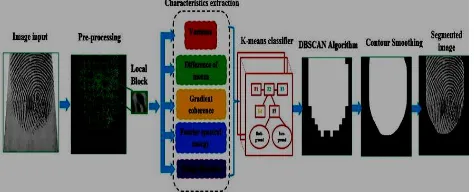
[image:2.595.52.289.660.756.2]The fingerprint segmentation based on K-Means and DBSCAN clustering are enhanced by our proposed method. For a fingerprint recognition system, a robust and effective fingerprint image segmentation algorithm is an important phase.In this section, we provide details of the proposed technique shown in Figure 1. The details of each phase are described below.
Fig. 1 Proposed algorithm for fingerprint image segmentation
Pre-Processing
Sobel and TopHat filter methods were used in this phase to improve the image quality of the fingerprint. Sobel structuring operators are shown in (1) for Sobelx and Sobely for an image.
(1) The gradient Gxand gradient Gy of pixels are defined from
image Img by (2).
(2)
To find the absolute magnitude (the output edge) the gradient result is combined. This result is described as follows:
(3)
After normalization and the Sobel technique, the fingerprint image is improved. However, by using the TopHat technique, the fingerprint image is better. This filter is a process by which details and small elements are extracted from the image.The filtering of TopHat is based on the method of dilation, erosion, opening, and closing. Picture morphological dilation and erosion operation Img of
size x X y with structuring element Se is defined by (4) and (5) respectively:
(4)
(5) The process of opening and closing image Img with
structuring element Se is described by combining the erosion and dilation operation of (6) and (7) respectively:
(6) (7)
The TopHatop opening and TopHatcl closing operations for
image Img with structuring element Se are represented respectively by (8) and (9):
(8) (9) Segmentation
The fingerprint image is divided into non-overlapping local size w x w blocks after the preprocessing phase. The characteristic vector is further classified into two classes for each block: foreground and background region using the classification of K-means.
Characteristics extraction
International Journal of Innovative Technology and Exploring Engineering (IJITEE) ISSN: 2278-3075, Volume-8 Issue-12, October 2019
Image intensity-based characteristics
In the fingerprint image, the change in intensity values is usually specific along the ridges and no-ridges compared to the background areas.General image intensity-based characteristics can be used to define the most intensity, such as the mean difference, which is the difference between the mean of the local intensity and the mean of the global intensity, and the blocks of variance in the given Img of size x X y.These proprieties are computed by (11) and (12) respectively.
(10)
(11) Where ImgMeanL is the local image block's mean intensity, and
ImgMeanG is the global image's mean intensity.
(12) Gradient-based characteristics
The gradient is used to obtain the directional variation of the intensity value along with an image Img direction of size x
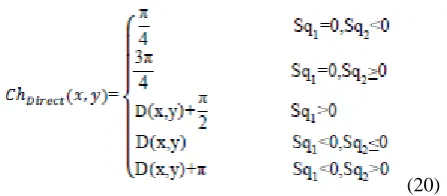
Xy. Characteristics like gradient coherence and direction of the ridge can be classified into characteristics based on gradient.The coherence of the gradient and the direction of the ridge are calculated respectively by (16) and (20).
(13) Where
(14)
(15)
(16) The gradient Gx and gradient Gy are defined by (3).
(17)
(18)
(19)
(20) Gradient-based characteristics
Features such as ridge frequency (energy spectrum) which is calculated by using Fourier transform for each local image block Img size xXy can be grouped as ridge-based features.
This feature is calculated by (22).
(21)
(22)
wherek,l ϵ {1,…..w} and < (x, y)(k, l) >= xk + yl. Local variance thresholding
The variance local thresholding decides whether or not to compute another characteristic for segmentation in the region in the fingerprint image. In the given image Img of
[image:3.595.317.541.49.147.2]size xXy by (12), the local variance is calculated.If local intensity variance in an image block is greater than 0, otherwise the other characteristic of the block will be calculated as null.From Table 1, it is therefore observed in DB1 that for a fingerprint image obtained, the difference in the processing time of our proposed segmentation is achieved nearly 10 seconds.Besides, it is shown that the average segmentation time in 4 databases is less than the other K-means segmentation technique, which is represented by a 3-dimensional characteristic vector-only [13].
Table. 1 Comparison of segmentation time in second for each database in FVC2004
K- Means Clustering
On the other hand, it is simplified to implement, easier to interpret, faster and adapted to sparse data. K-means classification is represented as follows.First, this approach randomly selects the number of clusters and assigns the cluster with the closest centroids; then it determines each data point to the nearest centroids and for each cluster, the new centroids are recalculated and this process is repeated until some condition is verified [22].
(23) DBSCAN algorithm
DBSCAN, Density-based Spatial Clustering of
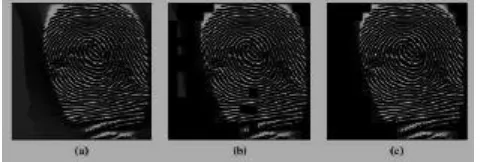
Applications with Noise, is another model proposed by Martin Ester et al.[23] for machine learning and clustering analysis algorithms. DBSCAN is one of the most commonly used algorithms for the analysis of clusters.This algorithm is density-based: given a set of points in a dataset, the algorithm can group nearby points (points with many adjacent points) and mark outliers in the low-density area.The general DBSCAN Clustering algorithm is shown in algorithm 2. The reason for using DBSCAN over other clustering algorithms is because it does not require a fixed number of groups in the dataset.It also recognizes outliers as noise that simply introduces them to the cluster even if the data points are very different. Furthermore, finding groups of any size and shape is a good place.DBSCAN Clustering is used in our proposed algorithm to achieve more compact blocks to reduce the region of misclassification due to the K-means algorithm. Figure 2 presents the result using the DBSCAN algorithm.Finally, the contour smoothing (filtering in a complex Fourier transform domain [24]) as a post-processing technique to smooth the mask edges [17]
[image:4.595.308.548.58.139.2]Algorithm 1 DBSCAN Clustering
Fig. 2 Removing the misclassification region by DBSCAN algorithm: (a) Original image; (b) Our K-means classification; (c) Our K-K-means and DBSCAN
classification
IV. RESULTS AND DISCUSSION
This study describes the experimental operating platform as follows: host configuration: CPU Intel Core2 Duo at 2.00 GHz, RAM 3.00 GB, runtime environment: Microsoft Visual Studio C++ 2013 with OpenCV library.To better verify our algorithm, the following segmentation methods are used in the experiment: SVM [9], 3-dimensional K-means [13], MP[17], ACT [19].These algorithms of segmentation were compared with each other.The results have been tested on the public Fingerprint Verification Competition 2004 dataset[25] which contains 4 databases, namely DBl, DB2, DB3, and DB4, to validate the proposed algorithm. The performance measure uses the number of misclassification as defined by (25).
(24)
(25)
Where Nbrbe is the number of classified background
errors, Nbrb is the total number of true background regions
in the fingerprint image and Prob1 is the probability that the
foreground region is classified as background.Nbrfe is the
number of foreground classified errors, Nbrf is the total
number of true foreground regions in the fingerprint image and Prob2 is the probability of a background region being classified as foreground. ProbErrprobability of error is the
average of Prob1 and Prob2.
International Journal of Innovative Technology and Exploring Engineering (IJITEE) ISSN: 2278-3075, Volume-8 Issue-12, October 2019
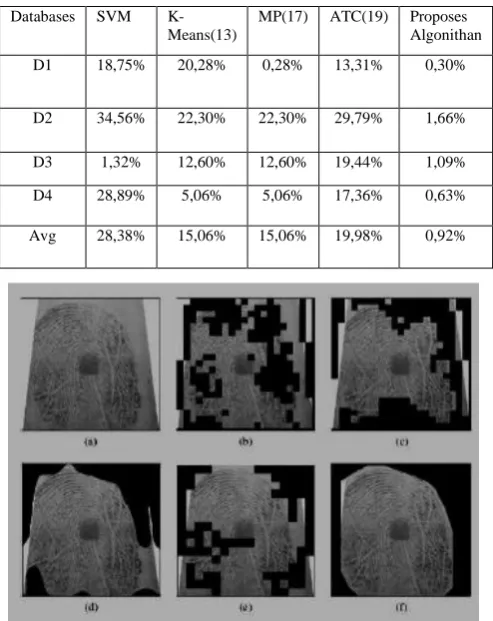
[image:5.595.47.294.436.747.2]In the second database, if SVM[11 ], K-Means with a 3-dimensional feature[13], MP[17] and ATC[19] offer 34.56 percent, 22.30 percent, 292 percent, 29.79 percent respectively in the segmentation rate, but our suggested technique requires a minimum error rate of 1.66 percent.Likewise, the misclassification rate (1.09%) in the last database is less for the proposed algorithm compared to other techniques in the third database. In the fourth database, SVM[11 ] failed to better classify them forwound and background regions (an error rate of 28.89%). Our system has thus succeeded in reducing the segmentation error by 0.63 percent compared to K-Means with 3-dimensional features[13], MP[17] and ATC[19] which give 5.06 percent, 1.31 percent and 17.36 percent respectively.The proposed algorithm results show better performance compared to other algorithms with an average misclassification rate of 0.67 percent at different fingerprint image databases. The means of these results show that our algorithm improves the person's accurate recognition rate.From these existing works, it is worth saying that the results of the proposed method are higher in the rate of error in terms of segmentation. Figure 3 shows the visual results of the proposed algorithm and other techniques. When we compared this figure with the existing works.We can say that our proposed segmentation error rate is efficient and reduced. The visual quality results of the segmented image indicate that the proposed algorithm adapts and gives better results in terms of segmentation in different environments than comparative techniques for segmentation of accuracy.
Table 2. Comparison of segmentation misclassification using different algorithms in FVC2004 Databases SVM K-
Means(13)
MP(17) ATC(19) Proposes Algonithan
D1 18,75% 20,28% 0,28% 13,31% 0,30%
D2 34,56% 22,30% 22,30% 29,79% 1,66%
D3 1,32% 12,60% 12,60% 19,44% 1,09%
D4 28,89% 5,06% 5,06% 17,36% 0,63%
Avg 28,38% 15,06% 15,06% 19,98% 0,92%
Fig. 3 Segmentation results using different methods in DB2: (a) Original image, (b) SVM [11], (c) K-means [13],
(d) MP [17], (e) ATC [19], (f) Proposed method
V. CONCLUSION
This article suggested an enhanced fingerprint segmentation technique based on K-Means classification and DBSCAN clustering. Our suggested scheme will be submitted in three steps. In the first phase, the quality of fingerprint images is improved using the filtering technique Soble and TopHat.In the second step, the K-means method is implemented to classify the picture into the foreground and background region using a five-dimensional characteristic vector extraction for each local block.Also, the segmentation processing time is quicker than another algorithm based on characteristics of just 3 dimensions owing to the local variance threshold. In the final step, the DBSCAN algorithm is used to remove some misclassified blocks owing to the clustering of K-means and contour smoothing is obtained to enhance the segmented image.Results of simulation show significantly that the proposed method is the effectiveness of some recent existing techniques in the average rate of error in segmentation. Hence, having a higher accurate recognition rate of the person affects the performance of the system.
REFERENCES
1. E.M Cherrat, R. Alaoui, H. Bouzahir, W. Jenkal, "High-density salt-and-pepper noise suppression using adaptive dual threshold decision-based algorithm in fingerprint images," IEEE Intelligent Systems &Computer Vision, pp. 1-4, 2017.
2. S.R. Borra, G.J Reddy, E. S. Reddy, "An Efficient Fingerprint Identification using Neural Network and BAT Algorithm," International Journal of Electrical and Computer Engineering (IJECE), vol. 8, no. 2, pp. 1194-1213, 2018.
3. P. Wang, "Pattern recognition, machine intelligence and biometrics," Springer Berlin Heidelberg, 2011.
4. A. Ross and J. Anil, "Biometric sensor interoperability: A case study in fingerprints," In ECCV Workshop BioAW, pp. 134-145, 2004. 5. M. N. Abdulwahed and A. Kamil Ahmed, "Underwater Image
de-nosing using discrete wavelet transform and pre-whitening filter," TELKOMNIKA Telecommunication Computing Electronics and Control, vol. 16, no. 6, 2018.
6. R.M. Zayed, "Optimum Image Filters for Various Types of Noise," TELKOMNIKA Telecommunication Computing Electronics and Control, vol. 16, no. 5, 2018.
7. B. Stojanovic, O. Marques, and A. Nekovi, "Latent overlapped fingerprint separation: a review," Multimedia Tools and Applications, 76(15), pp.16263-16290, 2017.
8. C. Wu, S. Tulyakov, V. Govindaraju, "Robust point-based feature fingerprint segmentation algorithm," Advances in Biometrics, pp.1095-1103, 2007.
9. E. Zhu, J. Yin, C. Hu, G. Zhang, "A systematic method for fingerprint ridge orientation estimation and image segmentation,". Pattern Recognition, 39(8), pp.1452-1472, 2006.
10. N.V. Boulgouris, K.N. Plataniotis, E. Micheli-Tzanakou, "Biometrics: theory, methods, and applications," John Wiley & Sons, (Vol. 9), 2009. 11. Y. X. Li, X.Q. Peng and S. Li, "Fingerprint image segmentation method based on the linear support vector machine," Application Research of Computers, 25(12), pp. 3669-3670, 2008.
12. M. U. Akram, A. Ayaz, and J. Imtiaz, "Morphological and gradient-based fingerprint image segmentation", International Conference on Information and Communication Technologies (ICICT), pp. 14, 2011. 13. H. Li and Y. Ping, "A novel approach of K-means based fingerprint
segmentation algorithm", In Instrumentation & Measurement, Sensor Network and Automation, IEEE International Symposium on, Vol. 1, pp. 218-221, 2012.
15. G. Yang, Y. Li, Y. Yin, and Y.-S. Li, "Two-Level Evaluation on Sensor Interoperability of Features in Fingerprint Image Segmentation," Sensors, vol. 12, no. 12, pp. 31863199, 2012. 16. S. R.Suralkar and P. M. Patil, "Correlation-based Fingerprint Image
Segmentation," Int. J. Comput. Appl., vol. 68, no. 7, pp. 13, 2013. 17. M. F. Fahmy and M. A. Thabet, "A fingerprint segmentation technique
based on morphological processing," In Signal Processing and Information Technology (ISSPIT), IEEE International Symposium on, pp. 000215-000220, 2013.
18. D. Das and S. Mukhopadhyay, "Fingerprint Image Segmentation Using Block-Based Statistics and Morphological Filtering," Arab. J. Sci. Eng., vol. 40, no. 11, pp. 31613171, 2015.
19. A.A, Abood,S. Ghazali, A.R, AtheerAkram and U.P. Sabine, "Segmentation and enhancement of fingerprint images based on automatic threshold calculations," In International Conference of Reliable Information and Communication Technology Springer, pp.400-411, 2017.
20. V. Mhaske-Dhamdhere and S. Vanjale, "A novel approach for phishing emails real time classification using k-means algorithm," International Journal of Engineering and Technology, 7, no. 1.2 , 96-100, 2018. 21. G. Gan and M.K.P. Ng, "k-means clustering with outlier removal,"
Pattern Recognition Letters, 90, pp.8-14, 2017.
22. J. Qin, W. Fu, H. Gao and W.X. Zheng, "Distributed K-Means Algorithm and Fuzzy C-Means Algorithm for Sensor Networks Based on Multiagent Consensus Theory," IEEE transactions on cybernetics, 47(3), pp.772-783, 2017.
23. Ester, Martin, H.P Kriegel, J. Sander, X. Xu, "A density-based algorithm for discovering clusters in large spatial databases with noise," In Kdd, vol. 96, no. 34, pp. 226-231, 1996.
24. R. C. Gonzalez and R. E. Woods, "Digial Image Processing," Prentice Hall, 2003.