
The discursive construction of literacy in a disadvantaged school
32
0
0
Full text
(2) Chapter 3 Research as discursive practice: Whose stories to tell?. When is a gap in knowledge perceived. and by whom? Where do 'problems' come from? (Clifford 1986, p.18) One studies stories not because they are true or even bccause they are false, but for the same reason 1hat people tell and listen to them. in order to learn about the terms on which others make sense of their lives: what they take into account and what they do not; what they consider wonh cOnlcmplating and what they do not; what they are and are nO! willing 10 raise and discuss as problematic and unresolved in life. (BrOOkey 1987, p.47). 3.1 Introduction Educational researc h. as is the case with pedagogy, is constructed through di scursive and institutional practices. As I have discussed in Chapter Two. poststructuralist theorists, including Foucault, have shaken illusions researchers might have had about producing the truth. Within the academy succeeding paradigms - quantitative, qualitative. critical, emancipatory - have been critiqued in tenns of the claims they make for truth (Ellsworth 1992; Guba & Lincoln 1994; Lather 199 1). Recognising that research accounts remain constructed and pru1ial, ethnographies have sometimes been described as fictions (Atkinson 1990, Clifford 1986). The researcher mediates what is seen and heard and what it is important to retell and in what ways. In short the researcher decides whose stories to lell (Polakow 1985). Taking on board these critiques of the neutrality or objectivity of any research method, I explain how I constructed this research project. I outline the decisions I made and anticipate the effects of my research practice. In beginning this work I was aware of ongoing debates about what educational research is for, what it might achieve, who can speak about what and for whom (Comber 1988b). I was aware too of the difficu lty of establishing a way of working in these times of 'plodding research and galloping theory' • where the thesis appears anachronistic by the time it is completed (McWilliam 1993). In Ihis chapter [locate Ihe study withi n the CUtTent contested field of educational research. My atm is to make my research practices visib le. The chapter proceeds in four main sections. I begin by picking up the tlu·eads of the story of how I came to lhis research problem. I follow this with an account of the ways in which I have drawn on qualitative. pos{stnlcturalist, feminist, critical approaches. Page 49.
(3) Chapter 2 Literacy, pedagogy and disadvantage. public schools, considerable media and pol itical attention to claims for low educational standards and levels of literacy in particular, criticisms of teachers resulting from these claims of low standards, (someti mes fuelled by conservative academics) known in Austral ia as 'teacher bashing'. For example, witness the current national moves to improve teachers' judgements about students' academic achievemenrs. Teacher and student competencies were questioned. At the same time the media produced images of del inquent youth, homeless children, abused children, and illiterate children. Given these discourses how do teachers construct their work and their professional identity? What local rationalities are produced? What possibilities or spaces are created by teachers for making themselves different kinds of subjects, for constructing alternative. discourses about their work? The present study examines how educational discourses produce the literacy teacher and the disadvantaged school child both as objects of knowledge and subjects of power. My interest is the ways in which educational discourses produce [he child and teacher subject. How does it limit what can be said at this time about children, about literacy, about teaching and about what action teachers and students might take in the literacy classroom? More recently, in response to moral and social pressures we have seen the emergence of the hyperactive child and we may be about to witness the arrival of the unemployable child and the 'at-risk' child .... What is required then is a general question about the nature of modern power in the contemporary school. This should be an account that shows the general possibility of the developing child and the at-risk child, as well as other forms of subjectivity. (Marshall 1990, p.24). The child to be educated is specified across grids, such as disadvantage and literacy; the production of knowledge about the literate child usually is usually done in the school site. The school also uses information produced elsewhere about the child, such as the socioeconomic circumstances. health and language background. Professionals associated with specific institutions become the authorities who have the right to speak, to interpret, to judge. Here I examine the possibilities which are constructed for the literate child and the literacy teacher in this school site at this time in history. Through part-time incarceration at school, teachers and children are engaged in the construction or reconstruction of subjectivities. Teachers must produce the literate, well behaved child and themselves as dedicated, up-to-date, self-sacrificing professionals. My use of Foucault in this study allows what are for me new readings of 'disadvantaged school' literacies at work. I question universal theories and pedagogies which promise to make all students literate and empower them in the process. Instead I examine the ways in whic h discursive practices construct the literate student In one disadvantaged schooL I consider literacy pedagogy as discursive work carried out in particular sites and usually. Page 47.
(4) Chapter 3 Research as discursive practice. in constructing a pri ncipled practice. Next I outline the decisions I made and describe how I went about the study. In so doing I foreground doubts and dilemmas.. 3.2 The research problem - Continued? As I have explained in Chapter One, my concern with how literacy was taught at this time in a disadvantaged school, arose in part out of my family and educational hislOry. Here I explai n how these autobiographical circumstances intersected with my current professional position. {Q. produce this study. My concern that my work in literacy. education had unwittingly produced pedagogical approaches that failed disadvantaged students and their teachers led me to conduct a number of investigations, both formal and informaL In 1990, with my colleagues. I conducted a statewide survey of professional development in language and literacy in disadvantaged schools. Teac hers told us that mainstream programs were irrelevant or unworkable in their contexts (Comber et al.. 1991). Inexperienced teachers made comments like, 'I haven't got time for literacy, I'm too busy with behaviour management'. The survey indicated that mainstream literacy programs had low credibility with teachers in disadvantaged schools. Teachers' statements emphasised behaviour management as a priority and the need to mod ify literacy pedagogies and curriculum accordingly. Teacher responses signalled a grow ing negative culture in some disadvantaged sc hools about what cou ldn't be done with 'these kids'. In the following year I was involved in a national survey of early years teachers in disadvantaged schools and simi lar trends emerged. The major concern which arose from the two surveys was the production of discourses of disadvantage - deficit discourses whereby teachers blamed children's failures on perceived problems or lacks in the fa mi ly (Badger et al. 1993). While the surveys were illuminating in worrying ways, they couldn't reveal the complexity of teachers' work in disadvantaged schools, nor how deficit discourses were produced, nor the ways in which such discursive practices might impact on the construction of schoolliteracies. At the same time as my colleagues and I mulled over the results of the surveys, an education department state-wide aud it of literacy performance in South Australian schools confirmed that students who were disadvantaged by poverty were more likely lO have lower levels of literacy achievement on mainstream measures of assessment (Education Department of Sou th Australia 1992). In this way, a number of related problems and questions were fermenting in relation to the ways in which schoolliteracies were implicated in the production of failure for disadvantaged students.. Page 50.
(5) Chapter 3 Research as discursive practice. In fo rmally, I continued to talk with friends who taught in disadvantaged schools about the natu re of their work. Most were fiercely determined that their students should get access to the best possible teaching and curriculu m offerings, but that their work was hard. Student absences, illness and poverty, high levels of violence and stress in their communities meant that the students and their teachers had to work twice as hard for hi gh academic results (Connell et aL 1991; McRae 1990; Thomson 1992). As I listened to teachers they claimed that some practices which had been effective and e nj oyed by students in other schools simply didn't work in disadvantaged school contexts. For example, one teacher explained that a counter-sexist collection of fairy tales she had used successfully as part of her approach to critical literacy in another sc hool was not useful in her c tllTent workplace because the students were not familiar with the plots and characters of tradit ional fairy tales. The exploi ts of Anglo and European princesses and princes, even feminis t versions, were of no interest to her five, six and seven year olds from Aboriginal, Vietnamese, Laotian, Chilean, Cambodian and poor white working class communities. The humour and the counter-hegemonic work were lost because they had not been inducted in to the traditional canon of Anglo-European early childhood literary works. She wondered whether she shou ld take them into this world. What kinds of literature could and should she use? Would they be disadvantaged without access to the traditional literacy canon and ways of resisting it? Questions about the production of li terate cultures in the contexts of disadvantaged schools became the driving fo rce behind this investigation. It was clear to me that survey research, one-off interviews, reviews of literature and my own experience yielded limited insights into the problem and se rved to raise further questions. I decided therefore to locate myself in one disadvantaged school over a period of time. My objective was to learn about how literacy was taught in this context at that time. Given that I understood literacy as a social construct and pedagogy as institutionally located discursive practice, my intention was not to read the informants' perspectives as tnuh . Rather my intention was a detailed analysis of the discursive practices of a professional community at a particular time and place. I was particularly interested in ascertaining what ki nds of literate practices teachers made high priorities and what kinds of pedagogies were constructed to this end. I was interested in how literacy was constructed in a disadvantaged school setting and the material, institutional and discursive limits on who these teachers and students could be. Therefore a case study approach was suited to the prob lem at hand.. Page 51.
(6) Chapter 3 Research as discursive practice. I did not set myself up as bei ng in a position to fix or improve school practices. My problem was to understand teachers' work in a disadvantaged school particularly in regard to their pedagogical decisions and discursive practices about literacy. Initially this problem grew out of critical feedback to my teaching, writing and curri culum development and mounting evidence of the failure of educat.ional institutions to deliver curricu lum that worked for disadvantaged groups. I incl ude teacher train ing insti tution s as well as schools here, as I believe that we have not implicated ourselves - as uni versity educators - in the production of school practices. Rather, problems have been placed with school practitioners, administrators and educational bureaucracies, in ways not unlike how teachers di rect the problem of school fa ilure to parents. I did not see my role as helping teachers to see themselves more clearly, so that they could better transform what they offered their students. Rather I sought the hel p of collaborating school-based educators in understanding how different pedagogical practices were taken up and delivered in a specific site. I was conunitted to learning about how these teac hers operated in this school at this time and to apprec iating the local rationality of their practices. ] was interested in re-educating myself about what it meant to teach literacy in a disadvantaged school and what the implications might be for me as a university teacher educator. In the long term my commitment is to improving disadvantaged schools as workplaces for students and their teachers. To do this I believed 1 needed fi rst to listen and experience the everyday li ves of these teachers and their students. The problem that I decided to research had involved me personally and professionally for some time and it was also increas ingly seen as urgent by academics and policy makers. The teaching of literacy in schools serving socio-economically disadvantaged communities was under-researched in the Australian context (Freebody & Welch 1993). This lack of research may have been part of a silence in Australian educational research, a missing 'equity discourse, concerned with how educational research deals with social justice' (Blackmore el al. 1994, p.ii). How gaps in know ledge or prob lems for research are identified and by whom is itself a matter fo r debate (Clifford 1986). From my viewpoint this research was concerned with addressing an immediate and far-reaching educational problem co ncerned with who gets what from schoo ling. The five year period since I began this research has seen an increasi ng body of work in the area of literacy achievement of socio-economicaHy disadvantaged and diverse student communities, much of it funded by the Commonwealth Department of Employment, Education and Training (Breen et al. 1994; Freebody et a1.l995; Luke et al. 1994a). Many of these studies involved teams of researchers working in multiple contexts and involvi ng comparative cases.. Page 52.
(7) Chapter 3 Research as discursive practice. My project is limited to one si te and myself as researcher. My particular focus was the way in which literacy was discursively constructed in the everyday practices of teachers in a disadvantaged school. In developing the project I turned to a range of approaches which have proved useful in studying similar problems - qualitative case study, poststmcturalist, critical and feminist research. Next I briefly outline how insights from each of these areas informed the present study.. 3.3 Constructing principled research practices: A poststructuralist study in a local site My previous research had indicated how illuminating and useful classroom observations over a period of time could be. Yet I was also conscious of how easy it is to leave such investigations rich in anecdote and low in theory. In my earlier work I had been unsure how I might approac h questions of power in classroom interactions. For instance in an investigation of children's questions and requests for help in literacy lessons my analysis was limited when it came to the problem of differential pedagogical resources for differen t groups of children (Comber 1988a). Hence in this case study I turn to cri tical, feminist and poststructuralist theorising in order to explore power relations and to deal with the methodological and ethical dilemmas which arise from researching other people's teaching.. 3.3.1 Qualitative case stUdy Case studies have made significant contributions to theories of social inequality and the differential effects of education by introducing cultural elements, injecting human agency and the reflexive relations between institutional practices and students' careers (Mehan 1992). Research about literacy includes a rich history of qualitative case studies, particularly in the United States where 'kidwatching', ethnographic and sociolinguistic studies of classrooms have become prolifiC over the past two decades (Evenson & Green 1986; Heath 1983; Edelsky et a!. 1983; Dyson 1993). Classroom observation allows researchers to explore literacy events as they are constnlcted by participants. Through recording classroom talk, collecti ng artefacts and talking with teachers and students, the case study researcher can make a close analysis of everyday school and classroom practices. This study draws on this tradition of inquiry. Case studies are useful because their flex ib le responsive methods of inquiry adapt to the 'evolving contexts' education presents (Anderson 1990). The researcher has access to everyday routines and unanticipated dilemmas as well as to multiple and comprehensive sources of data. Case studies investigate contemporary phenomena in actual contexts.. Page 53.
(8) Chapter 3 Research as discursive practice. Case study researchers aim to 'make the familiar strange'. Everyday acti vities and language are explored in depth to scrutinise what are often taken-far-granted assumptions and practices. In the present study, examining teachers' talk about ' these children' is one instance of making the familiar strange . Investigating ' what counts as literacy?' in enacted classroom events and in teacher assessments is another (Baker & Freebody 1993). The combination of intensive data collection, including classroom discourse and artifacts combined with a discourse analytic approach allowed me to re-read the ord inary and mundane aspects of classroom literacy lessons which are often ignored or edited out, such as interruptions, routine announcements and behaviour management. I deliberately foreground aspects of classroom life that some researchers may see as technical or trivial. Followi ng Foucault and fentinist researchers, I am interested in specific everyday institutional and discursive practices. As again st the goals of much educat ional research, my interest is not in whether such rout ine prac tices 'work', but what work they do and what they work to do. In the present study I employed case study methods in design, scope and data collection. 1 observed in literacy lessons two to three mornings per week over an eighteen month period. During this time I was a participant observer in each of four cl asses for the minimum of a school tenn, and attended staff meetings, school celebrations, library lessons. liturgical ceremonies and major sc hool events. I also talked wi th each of the staff, both in recorded interview situations and informally at school, at my home, in their homes and cafes. This investigation benefited from the potential of case study research for building a comprehensive, contextually rich and detailed corpus of data. I explored how teachers and administrative staff talked about literacy, pedagogy and disadvantage and how they constructed their literacy programs. However I do not present a case study to demonstrate the uniqueness of one environment. Rather my interests are in the ways in which discourses linking literacy, pedagogy and disadvantage are constructed in a local si te within the contexts of larger regional, state and national debates. Insofar as all descripti on is epistemological activity, qualitative research projects require an engagement with theoretical analysis (Weiler J988). In this investigation the data generated through the case study methods have been treated as text and discourse analytic approaches infonned by the theoretical work of Foucault have been employed. Thus the outcome is not a case study in the sense of rich portrayals of indi viduals or events. but rather an analysis of discursive practices in one educational site. This project allowed me give an account of the ways in which educational discourses compete to construct the literacy teacher and the literate student in thi s community. My aim is to consider how people in schools are constituted by contemporary theories and practices of literacy education and what kinds of agency and spaces are avai lable to educators working for. Page 54.
(9) Chapter 3 Research as discursive practice. social j ustice. Foucault describes the need to examine material and concrete operations of power in local sites. Here Lanalyse how professional know ledges about literacy, pedagogy and disadvantage, produced through a proli feral'ion of competing discourses, are recontextualised in one site and affect the day-to-day conslruction of literacy lessons.. 3.3.2 Poststructuralist challenges to ethnographic reality I have already touched on some criticisms of qualitative research met hods and claims. These include the problems with ethnographic claims to tru th and the ways in which researchers represent 'olhers'. The limits of the ethnographer in being able 10 re-construct people's lives in text have been acknowledged (Atkinson 1990; Brodkey 1987; Cli ffo rd & Marcus 1986). The extent to which research in process and product involves the researcher's textual practices has been foregrounded. The ' textual tum' in educational research has implications not only for the objects which educational researchers study, but also for the ir own practices as data producers and writers. Poststructura!ism recognises that data is shaped, selected and produced, rather than naturally occurring, complete and objective. Fieldwork 'is synonymous with the activity of inscribing diverse contexts of oral discourse through fieldnotes and recordings' (Marcus 1986, p.264). Fieldnotes and final reports are both consciously and unco nsciously constructed by researchers in ways intended to produce versions of reali ty that readers will fi nd both credible and insightful. The writer's constructive craft is therefore central to the research text. Experience cannot be reproduced in speech or writ ing, it must be narrated (Brodkey 1987, p.26). Rather than a tlu thful, objective eyewitness observer the identi ty and cultural location of the researcher/ nalTator is considered as part of the research process and therefore needs to be theorised and visible in the 'final text'. The focus of postslfUcturalist research then, is on 'the productivity of language in the construction of the objects of investigation' which requires a reflexive rather than 'realist ethnographic tale-tell ing' (Lather 199 1, pp. 13- 15). Thus 'writi ng up' case study research is not a neutral act ivity. What is req ui red the refore is that the researcher simultaneously denatu ralises the representations they have constructed, self-consciously contextualising the claims. desc ription, in terpretations, explanations of what is selected and why and what is missing and why (Clifford 1986). There is 'a general trend toward a specification of discourses in ethnography: who speaks? who writes? when and where? with or to whom? under what historical and institutional constrai nts?'(Clifford 1986, p.13), Some poststructu ralist theorists argue that researc hers should use textual tec hniques that allow them to interrupt the text so as to alert readers to their position. One approach is to insert a meta-text or mera-commentary. Page 55.
(10) Chapter 3 Research as discursive practice. that questions the ethnographic narrative presented. Anorher approach is to make explicit layout and typeface decisions in order to signal who is speaking or whose words are to be foregrounded (Lather 1994). Despi te thi s ever-i ncreasing sophistication of textual strategies, no matter how muhi-Iayered or multi-vocal, research accounts remain nevertheless partial and intentional. The writer directs readers to incomplete representatio ns which have been selected ahead of others. My intention in this document is to give space to multiple and contrastive examples of extended texts in order for readers to have access to the con tradictory and exceptional along with what I have analysed as usual. I acknowledge my role in the construction of this 'story' and try to avoid 'the thirdperson voice of analysis' (Brodkey 1987, p.39). Deciding which texts to include and what kinds of ethical positions has been one of the most difficult parts of the research. For instance, it was difficult to decide abom the inclusion of teachers' statements which portrayed children and their families as 'deviant'. Yet these statements were elicited in interviews with me. How did my questioning contribute to the kind of talk that was produced? 1 cannot pretend that my being there and that my own discursive practices were unrelated to teachers' responses. Asking teac hers to tell me abollt their children constructed a space in which things could be said which were unacceptable in official sc hool talk. I had nor anticipated how (or why) teachers mi ght use the interview to vent negative representations of the sc hool commun ity. If a subject can talk about feelings and thoughts in an interview that they feel are not 'al lowed ' expression within the normat ive realms observed by the researcher, then the researcher has learned something important about the norms operat ing in the routine con texts. (Carspccken & Apple 1992, p.532). Indeed the interviews did reveal a great deal about what teachers thought could and couldn ' t be said about chi ldren and their families in the context of their professional school day. Yet I was uncel1ain about how to deal with deficit representat ions of children and their fam.ilies in thi s written account and the effects my writing might have on my relationships with the teachers. Because the emphasis in talk and writing generally is frequently negati ve and because Foucauldian discourse analysis deals with what is produced (rather than what isn't) it may be that a cycle of negativity results. I was concerned not to betray my informants - 'by revealing too much that is identifying. by reaping the benefits of good data from someone else's life crisis' (Edelsky & Boyd, 1993, p.l?). Nevertheless, as a teacher-educator I cou ld no longer ignore the questions that drove this research, questions about how schools work for, on and against children from disadvantaged communities. In writing this thesis I continue to confront the ethical tensions and dilenunas that arise from researching other people's lives.. Page 56.
(11) Chapter 3 Research as discursive practice. 1 provide readers not with a neat account, but a text which foregrounds comp lexity, contradictions and discontinuities whilst at the same time identifying patterns. J de liberately include selections of texts which illustrate the multiplicities of positions each teacher holds simultaneously. I have avoided case studies of individual teachers which position them as certai n kinds of people, or types of teachers, or as uni-dimensional consistent subjects. As I have discussed in Chapter Two studies of classroom literacy which draw on poststructuralist theorising have produced new questions concerning the ways in which pedagogical discourses position students and teachers and the differential effects on diffe rent groups of students (Baker 1995; Donald 1993; Gilbert 1990; Lee 1992; Luke 1993c; Luke et at. 1993). The present study is informed by this work in terms of the questions asked, the data gathered and the analysis that was undertaken. Firstly, I am interested in the discursive construction of literacy and the al1ied production of subjectivities for teachers and students. I have treated the data as constructed text, which can therefore be deconstructed. I have assembled a range of analyticallOols in 'reading' the data. The purpose of the research remains firmly anchored to broader questions of education and social justice. 3.3.3 Research and social justice This research is informed by principles of research which is 'openly ideological' (Lather 1986), insofar as it begins from stated critical and feminist orientations, I was concerned with questions concerning the 'role of schools in the context of an unequal society' (Carspecken & Apple 1992. p.510). Critical researchers exami ne the 'connec tions between what goes on in institutions such as schools and the assemblage of differential power relations - and how they are continually produced, mediated, andlor transfonned in our daily lives' (Carspecken & Apple 1992. p.549). In working over an extended period in everyday lessons and meetings, I was interested how and why literacy came to be seen as urgent for 'these children' and in the literacy lessons teachers produced at this time, in this location. Literacy was seen as a right and as a priority in a sc hool community commiued to social justice, to use the principal's words, as 'a liberating force', but what did this mean for teachers and students work in literacy lessons? Critical and feminist researchers fOCllS on the ways in which unequal power relations and distribution of resources are produced or changed through local action. Feminist researchers 'begin their investigation .. .from a grounded position in their own subjective oppression'; emphasise 'lived experience and everyday life'; and state that their research is 'politically committed' to changing the position of women and therefore. Page 57.
(12) Chapter 3 Research as discursive practice. soc iety (Weiler 1988, p.S8). Feminist theory denies the possib ility of value· free research and requires instead that the conscious subjectivity of the researc her be articulated throughout the project. Feminist research is se lf-reflective and is concemed with socially relevant issues in spec ific contexts. Rather than aiming for invisibility or objectivity the researcher explicitly names her involvement and position. The research is overtly political in that it attempts to replace patriarchal models with feminist ways of reading, understanding and writing. Feminist 'textual practices seek to map diffracted subjectivi ties and subject constructions and to write margin ali sed and localized knowledges and subjects' (Luke & Luke 1995, p.361). It is research which is both about and for women (Nielsen 1990; Jones 1992). Consideri ng the feminised nature of the teacher work force, particularly in primary education, I took the opportunity to work in an all-female si te, where teaching and administrative staff were all women. I was also aware that approaches to literacy pedagogy have largely been generated without teachers or at best involve teachers at the point of testing out the theory. Teachers are often the obj ect of criticism in renns of the authority they hold in the classroom, yet they are often excluded when it comes to the construction of curriculum theorising. In this study I consc iollsly sought to get the perspective of women teachers working in a di sadvantaged sc hool in order that I might see things differently. In the present study the research problem was explicitly stated at the outset and became the foclls of ongoing conversations between the sc hool staff and myself. Formal interviews quickly gave way to audiotaped conversations where the school staff initiated topics and questions. Transcripts of initial interviews indicate that before the end of our first one-to-one conversations staff members were asking questions of me about their classroom or professional concerns. Thus as well as introducing my agenda I took a responsive role in all conversations. Ultimately li stening to their questions and responding to their issues meant that I was able to find Ollt what preoccupied them about their work. I have taken up the calls from fenlinist researchers for more reflexive texts which foregrounds the position of the writer (Brodkey 1987; Bannerji et al. 1991; Jones 1992, Lather 1994). Throughout the document I have attempted to implicate myself as a literacy educator as a part of the research not as a separate all-see ing spectator. In many respects I have used my time with this sc hool community as a way of re-reading my practice as a tertiary literacy educator. The investigation then has dual effects; on the one hand I consider the ways in which contemporary discourses construct the work of the literacy teacher and student in disadvantaged schools and I use my analysis of these effects to re-. Page 58.
(13) Chapter 3 Research as discursive practice. read the discourses 1 produce as a teacher educator. While there is an increasing awareness of the importance of the 'researcher as instrument' in qualitati ve research, there is a need for: asking new questions out of renexive encounters and re-encounters with our practice via a move from the dominant confessional, psychologizing approach to self-reflexivity to the micropolitical practices of representation of self and others in situated inquiries. (Lather 1994, p.42). Here I try to avoid a confessional approach to self-reflex ivity. Rather I examine my practices in representing myself and the people in this school conununity. As Lather goes on to point out, research in the human sciences has been intrusive and exploitative (Lather 1994). I wanted to see and hear the everyday world of work of these women teachers in order to cri tically re-evaluate my own work as a teacher-educator, not to make teachers the targets of blame. Feminist research shows the value of focussing on everyday life worlds as opposed to the public domai n. Schools are both public and private territory. While schools are pub lic institutions, classrooms are semi-private spaces where one teacher and about thirty children become invisible for who le days. One paradox of classroom teaching is that teachers are publicly 'on show' to children but cut off from their adu lt peers. Hence pedagogy is simultaneously public work, within a defined, partially isolated and secluded space. As a participant-researcher I was aware that fo r some teachers I was, at least initially, an inttuder into that semi-private environment. Unlike some critical and feminist researchers, I do not make claims for social transformation as an outcome of this work. The project provided an opportunity for women teachers to speak about thei r work which I hope was useful to them at the time. In the thesis I discuss teachers' 'valuable and committed work' (Weiler 1988, p.70) and attempt a socially critical approach to the study of literacy pedagogy which foregrounds the comp lexity of teache rs' work in disadvantaged schools. In feminist and poststructuralist work, questions of class and consciousness, central to all sociological theory and research, are reconceptualised in temlS of locality and identity. What this enables is a much more acute empirical description and theorization of the various intersections and conjoint knowledge effects of 'gender', 'class', and 'cthnicity/race' than the previous detenninist sociologies enabled. (Luke & Luke 1995, pp.375). It is this potential of feminist and poststructuralist work to take into account issues of locality and identity which I seek to highlight in this project. I try to avoid a detenru nist analySis, that constructs teachers as unitary subjects who passively reproduce inequities. What [ aim to do is to show how teachers in one school mediate competing and contradictory discourses in assembling a pedagogy in a local community.. Page 59.
(14) Chapter 3 Research as discursive practice. 3.4 Research in practice As I have explained I conscious ly tried to construct a principled practice for this project. Research also involves negotiation and compromise as it evolves in the site. In this section I explain how and why I constructed (he study in the ways I did, outlining key decisions and consequences. 1 begin by explaining why I chose the school site; next I briefly discuss my relationships with the school community; and finally, I describe the scope and design of this research.. 3.4.1 Choosing the site: 'Holy Mother', Banfield There was a number of reasons why { decided to work with this school community. ~. 'Holy Mother', Banfield. These related directly to the nature of the Banfield community, its size, location and the openness with which I was welcomed into the school. The school was a classified disadvantaged school with sevenry percent of students' families receiving financial assistance from the government at that time. As one of the poorest communities in the state it was an ideal place for studying the ways literacy was constructed in a disadvantaged school. In addition the school population was extremely diverse in tenns of race, ethnicity, language and religion. The principal had a repu tation amongst teachers and administrators in Catholic Education fo r her commitment to social justice and was actively involved in a number of committees associated with the Disadvanraged Schools Program. This was her first appointme nt as a principal. She was doing fut1her university study with a research component and was supportive of local action research. Her studies emphasised emancipatory approaches to religious education and she involved her staff in opportunities for professional development which took a socially critical stand concerning the role of Catholic education. In addition to the support I anticipated from the principal, prior to this project I already knew two Banfield teachers from their attendance at professional development courses in language and literacy. One teacher had invited me into her classroom the previous year and was willing to continue working with me. Another asked me to be her 'critical friend'. I asked the principal whether other members of sraff and the parent community would be comfortable with me conducting research in their school. After checking with the school community, she reported that they had agreed to support the study. From the start I was welcomed as a friend and colleague by staff, parenrs and students. A further bonus was that Banfield was an inner suburban school only a ten minute walk from my horne and a ten minute drive from my workplace. Its location meant that I was able to spend time there on a regular basis. Another feature of the school which attracted me was its size. In 1991 the school had an enrolment fluctuating between ninety and one hundred students and only fou r fulltime class teachers. This meant that I was able to. Page 60.
(15) Chapter 3 Research as discursive practice. work with each of the teachers for at least one school term. As I discuss in Chapters Five and Six, during this period Banfield staff saw the literacy performance of their students as an issue requiring attention so they were sympathetic to the focus of my work. As I was interested in the ways in which literacy was constructed across a sc hool community, Banfield was ideal.. Each teacher was a committed educator with lengthy experience in disadvantaged schools. All teachers had been teaching for at least eight years and were recognised as effective practitioners. Two of the teachers were regarded as having particular expertise in literacy. One had trained as an Early Literacy Inservice Course tutor and one as a Literacy and Leaming in the Middle Years tutor. The Early Literacy Inservice Course (Education Depal1ment of South Australia 1984) was an official inservice program for grade one, two and three teachers which was developed in South Australia. Teachers whose own classroom practice in language arts was judged to exemplary were trained over a school term to be tutors of other teachers. Theoretically the program was largely based on the work of Marie Clay, Donald Graves and Don Holdaway and took the standpoint that teachers could learn best from having access to current research and theory and the opp0i1unities to reflect on their practices with their colleagues and by watching children read and write. The Literacy and Learning in the Middle Years Project (Campagna et al. 1989) was similar ex.cept that it targetted middle years teachers and was more concerned with the teacher'S role than with child development. In addition, in thi s project the tutor training required that the selected teachers enrol in a two year graduate diploma course at the university. Both programs were based on a reflective practitioner stance and encouraged small scale directed classroom research and collaborative professional development and programming. Each of the Banfield teachers who had been involved in these projects had participated in extended professional development and further study in language and literacy education. Other staff had been participants in these courses and all were undertaking ongoing professional development in the area of genre based pedagogy. At this time the principal ex.plicitly made literacy standards a problem for discussion. That the school was Catholic was not a major factor in my choice. I should note however, that the Catholic Education Office was supportive of research such as mine, whereas at the same time regulations and procedures in the state education department concerning 'outside research' were being tightened considerably . The Catholic Education Office was encouraging of sc hool-university collaboration and the Catholic school principal enjoyed considerable autonomy in making such decisions within the community. However the Banfield principal did, at my request, formally 'clear' my. Page 61.
(16) Chapter 3 Research as discursive practice. proposal to conduct the research with her adm..inistratof. Nego6ating access. (0. do research. in a Catholic school was not a bureaucratic hurdle but a matter of fonnin g trust with a particular school community. [ chose Banfield because it served a poor community and also because the staff welcomed my being there as researcher. Nevertheless the fact that the school was Catholic cannot be ignored as it impacts on the ways in which discourses were a!1iculated and heard (Brodkey 1992). Further discussion of the school ethos and history is provided in chapter five. In consultation with the school staff, it was decided. (Q. provide pseudonyms for the. school. The principal suggested 'Hol y Mother' as it signified elements of the schoo l ethos which she associated with the school's actual name - the spi ritual, strong, caring and nurturing aspects of 'Mary', emphasised in Catholicism. I suggested 'Banfield' as a pseudonym for the industrialised suburb where the school was located, [Q highlight physical aspects of the sc hool environment and surrounding area, characterised by an absence of parks and playing fields. The suburb name was the label more commonly used by teachers in naming {he school. For that reason , and also because it highlights the environmenta1 and material conditions of the community, I use it more frequently than 'Holy Mother' in this document. 3.4.2 Relationship with school·based educators. Collaborative research with exemplary teac hers produces useful knowledge for other educators. Collaborative research studies of good teachers have the potential to improve the educational enterprise (Edelsky & Boyd 1993, p.8). In earlier research I had worked. collaboratively with teachers to analyse successful teaching (Comber 1987; Comber 1988a; Comber & O'Brien 1993). In this project I decided to work with all the teaching. staff at Banfield. Whi le all teachers were personally welcoming some simply did not have time to devote to what they saw as 'Barbara's research'. Ultimately this meant that it was not possible to work in a co-researcher fas hion with every teacher. Deciding to work with all teachers also meant that I would be working with teachers of whose classroom expertise I was completely unaware. This meant that there were no guarantees that each of the teac hers would prove to be 'good teachers' when it came to literacy curriculum. Initial interviews indicated that there were different degrees of professional knowledge and expertise amongst the staff as far as literacy pedagogy was concerned. [n terms of the four teachers, the principal spoke of two as 'high flyers' in the area of literacy teaching. The other teachers she saw as having strengths in other areas of the curriculum. It was her hope that the two teachers with high experti se in literacy teaching would assist the other teachers. Thus while all four teachers were seen as competent and experienced, two. Page 62.
(17) Chapter 3 Research as discursive practice. were consi dered within the sc hool community as 'good teac hers' of literacy with a special interest in or flai r for language related work. Working with each of the fo ur teachers with their differem pro fessed levels of expertise and interest in li teracy meant that I could see how differem teachers took up and worked on rheorie.~ of literacy pedagogy. For example when the staff attended a conference concerned with the explicit teaching of genres or worked together at a planning session it was illuminat ing to see the impact of different theories and practices on different teachers working in the same school. 1 fou nd that [ had much to learn from each of the teachers about teachi ng literacy in their particular classroom context. I am less sure now than when I began that I know how to iden tify a 'good teac her' of literacy. Each teacher was worki ng on her theory and practice. Some al ready had extensive discursive expertise in the area of academic discourses of literacy and for others literacy was new terri tory. In practice however the differences in classroom practices were less than each of them had imagined. 1 sought to learn from these teachers, not to change their practices. What I saw then was what each of them was prepared to try with me as an observer in thei r classroom. I did not have, nor did [ try to have, the same kind of re lationship with each teacher. One teacher was a friend and former student, another I had known of for some years. The principal was st udy ing with University colleagues of nU ne; two teachers I had not met un til I began the project. This meant that I started with a differe nt relationship with each teacher, which made a difference to the kinds of conversations we had and how involved in the research the teachers became. In addition to the history of re latio nships teachers' other commi tments made a differe nce to what they could manage. Two of the staff were studyi ng part time. Two taught aerobics classes during the eveni ng. One was a single paren t. For most of the 'field work' T was teaching graduate courses in language and literacy education atlhe unive rsity fulltime. What transpired therefore in tenns of co ll aboration and working relationships was the best that we cou ld negotiate and phys ically manage. I was concerned (hat my research did not 'add an oppressive burden' to teachers' workloads (Edelsky & Boyd 1993. p.17). Mostly I took a position of pal1icipant-observer, rather than collaborator. While I rarely initiated I always responded to teachers' requests for feedback and resources. The relationshi p Tnegotiated wi th each teacher and the kinds of roles I took therefore were not fi xed. One fi nal issue is worthy of mention regardi ng my relationship with this small co mmu nity, concerni ng the ethics of reporting on the conflicts and problems of others. The researcher role can be seen as voyeuristic (Walkerdine 1994) in the sense thal one hears about and sees eve nts and circumstances that would usually remain private. For. Page 63.
(18) Chapter 3 Research as discursive practice. instance, during this project I had access to legal and personal information about staff, parents and children. Talso witnessed conflicts between staff. This group of women educators were extremely dedicated and close knit, bm they differed on a number of values, beliefs and practices. At the time of my entry to the school they were negotiatin g friendships and professional relationships. I made the decision that I would not use any information which was likely to create at that time (or as far as I could predict in the future) discord amongst the community or personaJ infonnation about any of the staff or students which may unwittingly affect fu ture relationships. This relates to Edelsky and Boyd's warning. mentioned earlier. about the dangers of researchers benefitting from 'someone else's life cri sis'. In this document I use only data which are relevant to discussions of literacy, disadvantage and pedagogy.. 3.4.3. Scope and design of the project Over a two year period I collected a corpus of texts concerned with literacy, pedagogy and disadvantage. Having put together a corpus of contemporary texts which related to the teaching of literacy in a disadvantaged school community at th is paIticuiar time my objective was then to analyse both public and local discursive practices using poststructuralist discourse analysis. The corpus compri sed three sets of data: 1. Set one: A collection of publicly available texts, including newspaper articles, policy documents and academic texts. 2. Set two: A collection of written documents produced at Banfield, including official documents, policies, teacher programs. parent information pack, school advertising, newsletters, day books, roll books, submissions for funding, school census data, and student report cards 3. Set three: A collection of fieldnotes and transcripts of interviews, staff meetings and classroom literacy lessons (and related teacher and child products). Across the corpus of texts I consider the discursive practices of those who make authoritative statements about the role of literacy in the lives of disadvantaged students and the discursive practices of those who are authorised to make these students literate. Published official texts are thu s read with and against the everyday texts produced in the course of teachers and students' work in one disadvantaged school. By reading these data sets with and against each other I explore the contradictory nature of teachers' work and the multiplicities of teacher and student identities produced in schools. Similar statements, constructions, images and metaphors may appear and reappear in written and spoken texts like the policy document, the syllabus, principals' memos, the staffroom conversation, the teachers' guidebook, and, of course, the textbook. (Luke & Luke 1995, p.371 ). Page 64.
(19) Chapter 3 Research as discursive practice. The present study explores how professional discourses in different sites produce versions of the literate student. Academic, policy and media documents are examined alongside schoo l based texts produced by educators and students. The first data set, the publ icly available texts, is considered in terms of the commonsense views of literacy, pedagogy and d isadvantage which are produced. What is taken-for-granted by the public impacts on teachers and schools through media accounts and policy action and fu ndi ng. My questions are related to the construction of literacy, the disadvantaged student and the transfOlmative role of the teacher. T hese discourses are produced outside of the school by professionals in media, academia and policy but have specific effects in schools. T he second data set consisted of materials produced by the school, about the sc hool, its programs and its community, including staff, parents and children. In analysing these texts my objective was. lO. consider which discourses were taken up and in what ways at. this time in this site. In panicular, I was interested in the competi ng discourses which were employed in constfLlcti ng literacy and the literate student. These analyses are reported in Chapters Five and Nine. In Chapter Five r construct the school site in terms of school population, material conditions, ethos and contested discourses at this point in its history. In Chapter Ni ne I analyse the ideal literate student as constituted by teachers' written reports and students' written self evaluations. T he third data set comprised the field notes and transcripts which I produced through interviews and participant observations of classrooms and staff meetings. During an eighteen month period I observed in each of the four classrooms two to three mornings per week. I have not presented this as four ind ividual case studies, but rather organised the analys is around themes and discourses that were produced across the group of teachers, in order to protect the anonymity of the teachers and because [he si milarities between the teachers' discu rsive practices were considerable (Wei ler 1988). During this period and for the remainder of 1993 I continued to vis it the sc hool and talk with teachers and to collect school and classroom artifacts. Over the eighteen month period I also scheduled interviews and observed staff meetings and collaborative planning days. In the observation of everyday school life my aim was to document and analyse teachers discursive and insti tutional practices about literacy, disadvantage and pedagogy and teachers' and students' constructions of literacy in lessons. The oral data derived from ethnograph ic fie ldnotes has been treated as 'text' and poststructu ralist discourse analytic methods have been applied (Luke 1995; BUlman & Parker 1993; Waitzkin 1991). This is reported in Chapters Six, Seven and Eight. Some of the interview data is also used in Chapter Fi ve.. Page 65.
(20) Chapter 3 Research as discursive practice. 3.4.4 Data collection and selection As may be clear from the outline above the project involved the collection and production of a rich and considerable corpus of data from a range of sources outside of and within the school. In this section I explain briefly how each of the three data sets was collected, organ ised and selected . During the period surrounding the study I collected and read newspaper at1icies, policy documents (and associated press re leases) and academic materials which made statements about literacy (incl uding reading, writing, spelli ng), disadvantage (incl uding poverty, unemployment, underclass), and pedagogy (including teachers, schooling, students). I began this collection from the mid to late eighties, realising that the effects of such discursive practices may prevail for some time, Where necessary I reviewed earlier documents which continued to have impact such as policies to do with the Disadvantaged Schools Program, initiated in the mid seventies. I also drew on secondary sources· larger comprehens ive historical document analyses· which were relevant to the project. For example, the Australian Literacy Federation had funded a docu mentary history to track literacy in the public media (Green et al. 1994). Judith Bessant (1995b) had completed a comprehensive study of the ways in which youth were represented in policy and the media, particu larly 'poor youth'. Each of these studies made my task considerably easier. For my own part, I was particularly interested in the ways in which pubJ.icly available texts constructed commonsense myths about literacy, schooling and the needs of economically disadvantaged youth. In selecting texts for delailed attention articles and documen ts which made claims about the economic and civilising effects of literacy were of particular interest as were those which positioned teachers as agents or problems in these processes. The second data set I collected during the period I observed at Banfield and in the following year. This consisted of written documents produced al Banfield, including officia l submissions, policies, teacher programs, parent infonnation pack, school advertising, newslelters, day books, roll books, submissions for funding , school census data, and student report cards. In collecting and selecting this material I was interested in texts which represented the school community and its programs, literacy and the literate student. My foclls was on what could be learnt about the school ecology. the material conditions and the competing and c hanging discourses which affected teachers' work as literacy teachers. I realised that the corpus of schoo l report cards may be a useful way of considering the question of what counted as literacy in this environment and how thal may have changed over time. Hence I collected the entire corpus of reports that were available for senior studen ts in the school and the entire collection of repons written for. Page 66.
(21) Chapter 3 Research as discursiv8 practice. the 1992 school year. Other key documents were the principal's application for reappointment where she rev iewed recent school history, an advertisement and an article promoting Banfield in the local newspaper. Thus the texts which I selected for close attention were those which represented the school and its students publicly and those which made particular reference to literacy. The third data set comprised the fie ldnotes and transcripts I produced. (Q. record the. interviews and observations I made of staff meetings and classroom literacy lessons. In the course of the study eighteen fonnal interviews were fully transcribed from the audiotapes. These included interviews with the four teachers, the principal, the English as a Second Language teacher, the religious educat ion coordinator and the schoo l secretary. 1 start by explaining how the interviews evolved, illustrating from my initial interviews with the teachers. Firstly, interviews are constructed events involving power relations between researcher and infonnants and a complex negotiation of what can and should be said. The development of useful theory requires the deconslJUction of researchers' discursive practices as prot of the analysis (Anyon 1994). Aware of these issues I attempted to be explicit with teachers about my agenda and to build the interviews around things they may have already said to me. In the case of the initial interview in the first month of the school year, I wrote to each teacher before hand, explaining what I was hoping to talk about. (See Figure 3.4.4) Figure 3.4.4 Letter to teachers Dear [Teacher's name], 1was wondering if I could make a time to interview you over the next two weeks. What I'm interested in is your language arts program, in particular, what you plan to do with this year's group and how you intend to go about it, your perceptions of the difficulties etc. I'm also interested in your understanding of literacy, what you think is important for the children you work with and how you think you can best teach it. I'm interested in the activities you do daily and those you do weekly etc. I'm keen to know the kinds of books you read to them, what they read to you, what they take home etc. I'm also curious about what they write,. how they approach spelling .... Anything at all that helps me to understand the approach you take to language arts; maybe we could also look at kids' work? I'd like to ask you about any other teaching experience you might have had, what you see as unique or important about this school or the students. I don't want to overwhelm you with questions. I just want to give you an idea of what I'm interested in. We can add or delete things from here depending on what you think. [Teacher's name], ignore the formality of this letter. I just wanted you to know the kind of information that I'm asking for from you and your colleagues as well. It's a bit easier to talk with you, because you know me and you're used to having me around and talking about this kind of stuff, but I think it is important to let people know before hand the focus and purpose of an interview. Really I'm trying to get a picture of the ways in which the teachers translate their understandings of literacy into classroom practice in this particular context. Thanks so much for agreeing to become a part of this project. I really appreciate it. Regards,. Barbara. Page 67.
(22) Chapter 3 Research as discursive practice. Each of the teachers received a letter simi lar to this one. My aim was to let them know my agenda before we talked. In reviewing the letter above 1 am conscious of my invitation Lo describe 'difficulties' and refer to this in making the point that interviews are constructed texts, where the researcher's own textual practices produce what may be unanticipated as we ll as hoped for effects. The schedule outlining the initial interview I had with each of the teachers is induded below. At the beginning of each interview I explained to each teacher that my purpose was 'to explore the ways in which you think about literacy and also about teach ing in a disadvantaged school. I'm interested in what you see as your priorities, what you think children need to know and how you go about teac hing: The quest ions I prepared grew ou l of comments which the principal and teachers had made to me in my first few weeks in the school. Although I had a lengthy set of questions and prompts, no two interviews went in the same direction and in no case did we complete the sc hedule in the first interview. In all cases I followed up the initi al interview with further taped infonnal conversations.. • How long have you been teaching at B.P.S ? • How long have you been teaching ahogether? • Where else have you taught? • How would you describe what it is like for you to teach at B.P.S.? •. How does teac hin g at B.P.S. compare with other schools you have taught at?. • •. What do you see as the greatest challenges in teaChing in a disadvantaged school?. • •. Whar do you see as your main priorities at the beginning of the school year, in the first weeks of school? What difficulties have YOll confronted so far? Have you had a chance to assess what the children are able to do in literacy and language arts?. •. What are you pleased with/w hat are you worried about?. • • •. What is your understanding of what it means to be literate? Can you remember how you were taught to read and write?. •. How do you set up your literacy/language program?. What do you think of that approach?. • What do you expect the children to be able to do at the beginning of the year?. •. What do you expect them to be able to do at the end of the year ?. •. If I asked your students from last year about what they did in language time what do you think they would say?. • •. What kinds of texts do you use in the classroom? What have you used so far? In what kinds of ways do you use these books?. •. Are there texts you have rejected that you expected to work?. •. What kinds of writing have the children done so far?. Page 68.
(23) Chapter 3 Research as discursive practice. • What are you working on for their writing? • What are your main aims for their writi ng at this stage? •. Do you have any concerns?. • •. What are the activities that you do most often in language time?. •. How do you find out what the children can do at the beginning of the year?. • •. How do you monitor the children's literacy and language progress?. What are you hoping to achieve through this?. Are there any other things you would like to discussl comment on about teaching, literacy, working in a disadvantaged school ?. While I started with a set of questions, when teachers were clearl y uncomfortable about a particular issue I did not insist in any way. Some teachers quickly moved from my agenda and introduced their own. One teacher began to seek my advice; another used it as an opportunity to express her uncertainties about her literacy program. As I was committed to the research being an opportunity for the teachers to debrief about the nature of their work and also that the investigation would add as little stress as possible to an already difficult job, I did not press for answers to my questions. rather I listened to their questions and doubts about their teaching and encouraged them to talk through possibilities. This approach has been described as 'dialogical data generation' where 'subjects of study are asked to reflect on their li ves in ways that may be new to them and to share in the production of a theory relevant to their lives' (Carspecken & Apple 1992, p.5 13). As J was interested in the statements teachers made about their literacy teaching rather than answers to pal1icular sets of ques tions, when they regu lated how the interview went I did not challenge this. When they did not answer this in itself was dma. Throughout the interviews I found that my initiating prompts or questions were more likely to match the discourses of some teachers than others. With one teacher my prompts acted as catalysts for some lengthy and largely self-sustaining monologues whereas with. other teachers, the same question might produce a response such as, '[ don't know really'. Teachers varied in their approach to interviews. Some actively sought me out for extended discussions and others were brief and efficient. In these ways, teachers used the interview situation differently, with some simply helping me out and others using the interview as a chance to talk through decisions about their work and approach to literacy teaching. Some teachers had more to say about teaching literacy in a disadvantaged school than others. Teachers who were new to the school and cri tical of what they found and those who had done further study in literacy education were more eager to talk with me. They talked more, dealing with my agenda and addi ng their ow n. Teachers who were old hands at the school were less verbal in the initial interviews. When they talked about literacy they talked about their uncertainties and doubts about pedagogy and were. Page 69.
(24) Chapter 3 Research as discursive practice. keen to get feedback from me about their ideas. As this was their thinking about literacy at the time l chose to follow their lead. Partly then this was a decision that is defendable in terms of my interest in the statements teachers produce. But also it was based on my commitment that the research should be supporti ve of the women with whom I worked. I am aware that teachers' practical knowledge and the truth claims need to be deconstructed along with grand meta-narratives (Luke 1992). The interview therefore needs to be treated in the context of its production. It remains text produced for, wi th and partially by the researcher. Hence I read the interviews as what the teachers were prepared to say to me in the context of the research. Baker explains how interviews are constrained and situated events. These accounts are moral accounts in that they describe what they take to be the nonnative order by which they and others should live. These interview responses and other speeches are not direct 'representat ions' of what they do or think, but culturally plausible accounts of what they do and think. (Baker 1995. p.14). \Vhen the interview texts are read together with and against the discourses produced in the classroom and in writing reports they indicate the rationalities and theories teachers employed in the course of explaining their teaching of literacy with these kids in this school. Interviews can also be seen as confessionaL It is a site in which teachers can explain failures, fears, conflicts and successes. In the privacy of the interview teachers speak about their feelings about teaching in this school in a way thal is quite different from the classroom, yard and staffroom. As femin ist researchers point out research is itself a form of policing and surveillance (McWilliam 1993; Walkerdine 1994). This may have unanticipated consequences such as the production of teacher gu ilt and changing emphases in classroom work, (for instance concern with discipline). The most intensive data collection work in thi s project was the observation of classroom literacy lessons. Over an eighteen month period I spent one, two or three mornings per week in a classroom at the two-hour time slot for Language Arts. I often arrived in time to have a coffee and a chat before school in the staffroom. Usually, I was in the schoo l fro m 8.30 11.30 and sometimes I stayed longer to foll ow up specific ongoing events in classrooms or to talk with the principal. There were four classrooms: a reception/one composite class; a reception/one/two composite class; a three/four class; and a fi ve/six/seven composite class, each with their own class teacher. Reception is the fi rst year of fonnal schooling in South Au stralia. Children begin school at five years of age. Composite classes are very common in small schools and necessary to balance the number of children across the classes. Page 70.
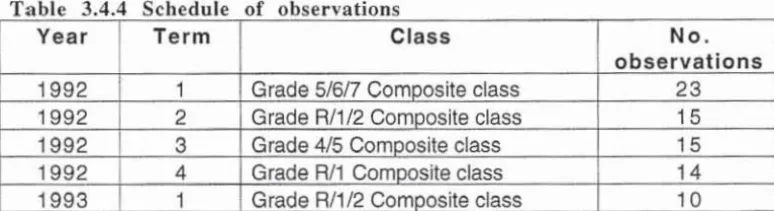
(25) Chapter 3 Research. as discursive practice. I spent at least one school term (ten to twelve weeks) with each of the four class teachers and in one case I continued my visits the fo llow ing year. Thus I observed in each classroom between fiftee n to twenty-five occasions for a period of two hours. I usually spem time talking with the teacher infomlally either before and after the lesson. (See sc hed ule of observations in Table 3.4.4.) Tab le 344 . Schedu le of obse r vatio ns Year T er m Cl ass. 1992 1992 1992 1992 1993. 1 2 3 4 1. Grade 5/6f7 Composite class Grade R/1/2 Composite class Grade 4/5 Composite class Grade Rl1 Composite class Grade R/1/2 Composite class. N o. ob servatio ns. 23 15 15 14 10. Duri ng the two hour language and literacy time slot [ wrote fieldnotes and audiotaped classroom talk. When the teacher talked to the class as a whole group I sat with the children if there was space, or to the side whe n there wasn't. Thus I listened to and observed the teacher from the same place as the students. When the children were doing tasks at their tables or on the floor I sat wi th and recorded the talk and action in one small group, where there was space for me to sit (often where a child was absent). I collected handouts and copied notes on the blackboard. The combination of the fieldnotes and the audiotapes was used to complete transcripts of the literacy lessons. A research assistant and a typist helped wi th some of the transcription which 1 then checked against my original handwritten field notes and the audiotapes. On some occasions the timetab le was changed to celebrate a special event or a religious festival. I participated in these events and recorded a summary afterwards. In addition to the classroom lessons I observed the pri ncipal take classes for thei r library period. In total I completed transcripts of seventy five literacy lessons over the eighteen month period. Thus the corpus of data concerning literacy practices in the school community was extensive and detailed. [n addition to the informal staff room conversations Tattended several staff meetings where curricu lum issues and col laborative planning were on the agenda. I recorded these in fieldnotes and on audiompe. This was an illuminating source of data as the professional relationships were negotiated here and what was to count as appropriate curriculum and pedagogy was discussed. How official discourses and practices are contested in everyday professional interactions was visib le on these occasions. This is discussed further in Chapter Six.. Page 71.
(26) Chapter 3 Research as discursive practice. A key moment for researchers and the subjects of research is the selection of data for reponing. Data do not merely get collected; they are produced and selected. In ethnographic research the investigator is faced with an embarrassment of texts from which they select to construct their narratives and arguments. There are ethical questions associated with data selection. Educational researchers are powerfully positioned with respect to their teacher subjects. In literacy education research teachers are frequently constructed as the objects of criticism. Recent research about literacy has fore grounded how students are positioned in the classroom (Baker & Freebody 1993; Dyso n 1993; Freebody et a1. 1995; Luke 1993c), indicating the work students have to do to make sense of classroom life in literacy lessons. In this work I attempt to take a similar position in regard to teachers, to take seriously the complexity of the literacy teachers' work in contemporary and diverse communities. From a large corpus of data I discuss texts which are typical, in the sense that similar events occur frequently or that the discourse is repeated on numerous occasions, but at the same time I include the unusual, the occasions where contrastive discourses and practices are employed. Thus in selecting the texts for discussion I have included instances that illustrate teachers' contradi ctory practices and positions as well as the common patterns of discursive and pedagogical practices. I selected texts for detailed analysis which challenge total ising theories of literacy pedagogy. In order to explode the myths that teachers can be identified unproblematically as 'whole language' or 'genre' or 'critical' or that any of these is intrinSically empowering, I deliberately show contrastive discursive practices from the same teachers. I argue that in classrooms there are no pure theories or practices and that teachers by the nature of their work often produce conflicting discourses and practices. [n add ition to selecting contrastive texts I try to avoid reducing data to neat 'literacy events'. Rather through extended transcripts of classroom literacy lessons I recontexlualise how literacy lessons happen within the broader times and spaces of the school day. I apologise to readers for the extra length of my text which results from these decisions. However I believe that these are key decisions in my work. In order to recontextuaJise school literacy pedagogy as institutional practice and to theorise literacy pedagogy as teachers' work, there is a need to read extended texts where the construction of school literacy can be viewed in its intricate intersections with the lifeworlds of teachers and students. Despite these attempts to include extended passages of school texts, J remain aware that these too are fleeting reductions of an ensemble of practices that one can never hold quite still. There are no comp lete or finished stories in educational research.. Page 72.
(27) Chapter 3 Research as discursive practice. 3.5 Discourse analysis In this project I conSU·uct an approach to discourse analysis following the interpreti ve analytics of Foucault. Foucault's work on the constitutive nmure of discourse is particularly germane to the present study. As I discussed in Chapter Two, poststruc turalist theorists have demonstrated how human subj ects are construc ted through discurs ive practices, for example 'the di sadvantaged chi ld', 'the ill iterate', 'the une mployed'. This classifying, naming and managi ng of the population happens in local sites, such as schools and families, as well as more broadly through government policies and systems, media and so on. In these ways the modern individual is produced. Different professional know ledges (including legal, economic, medical, educational, psychological) are dep loyed in deciding what counts as 'normal' wi thin a society at a particular time. In the present study I am interested in how primary school teache rs induct the disadvantaged child into school literacy and the limits and possibilities this creates. The corpus consists of a range of texts: staff meetings, e veryday conversations, the talk and artifacts of literacy lessons, written applications and newsletters, report cards and student s' writing. How to apply poststructuralist theory of discourse, powerl knowledge and subjectivity to such a corpus is not a given. A method must be built which deals with problem at hand. My analys is was informed by educators and researchers who have constructed approaches, generated from a Foucauldian perspective, for dealing with contemporary oral and wri Hen texts (Burman & Parker 1993; Fai rclough 1992b; Gore 1994; Luke 1995; Wai tzkin 199 1; Wa1kerdine 1984). The order of discourse of some social domain is the totality of its discursi ve practices. and the relationships (of complementarity, inclusion/exclusion, opposition) between them - for instance in schools. the discursive practices of the classroom, of assessed work, of the playground, of the staff-room. (Fairclough 1993, p.l3S). Taking up Fairclough's point about the 'order of discourse' in a social domain, my aim was to consider the di scourses at work in a school site, wh ich had effects on the ways in which literacy was taught at this time. In reading across the corpus of tex ts my first approach was. {Q. consider the recurring topics. These included for example 'work',. 'quality ', 'behaviour', 'standard s'. In other words, across the interviews, staffroom and classroom observations, official school documents and teachers' and students' assessme nts these topics reappeared. In addition I looked wi th in particular data sets and subsets for panems in the ways the texts were produced and delivered. Because I was interested in teac hers' discursive practices across enti re lite racy lessons I needed some ways of dealing wi th extended passages of text which accounted fo r what I was seeing. In analys ing transcripts of classroom discourse I developed some analytic. Page 73.
Figure
Related documents
The main difference between the notion of identity from classical email systems and identity in the context-aware extensions relates to the issue of when it is decided that a
The human observer study revealed lower detection limits in PET/CT images (5 mm) compared to PET/MRI images (6 mm) for the 8:1 activity concentration for acquisitions with
To investigate the association between STYK1 protein levels and the clinicopathological features of GC, we analyzed the correlation between STYK1 protein expression and the
Taken together, these results suggest that latent SIV can be recovered from resting CD4 ⫹ T cells from various lymphoid tissues of viremic animals, including spleen, lymph nodes,
7.13 Correct classification rates CCR and quadratic probability measures QPM for thp "Wavelet based Inethods applied to the sea- grass s, mineral em, paraxylene p and butanol b
The multivariate methods which were applied for the regression of spectral data include: • SMLR: stepwise multiple linear regression til SPCR: stepwise principal component regression
5.4.6 Conclusion The results of the present study clearly demonstrate that dietary protein and energy regulate the growth, proximate composition and level of circulating IGF-I
CFPDI: Craniofacial Pain and Disability Inventory; CFPDI-I: Craniofacial Pain and Disability Inventory, Italian version; ICC: Intraclass Correlation Coefficient; IOHIP-14: Oral
