International Journal of Innovative Technology and Exploring Engineering (IJITEE) ISSN: 2278-3075, Volume-9 Issue-2, December 2019
Abstract: Since the number of mobile users has been increased, there comes a number of new mobile operators. This accounts for the increased installation of towers. A critical mobile network consume 40-50MW (approx.) and a diesel generator consume 1MG (approx.) of diesel per day. Also a base station requires greater amount of power employed for its working in which some of its internal applications like light, coolant systems say air conditioning, fans etc., uses the major part of the power utilized. This intensifies the burning of coal which emits carbon dioxide into the atmosphere. At times the number of users for a base station may be very less especially during night time, consuming the power unnecessarily. Our approach is to reduce the intake of power by the base stations during unwanted time. This can be done by establishing communication between the adjacent towers to intimate the unused tower to remain idle or active based on the requirement. Also this approach conveys the measures taken to reduce the power consumed by the internal applications of the base station. The entire setup is under the surveillance of personal computer thereby creating an energy efficient mobile infrastructure with power saving, reduction of CO2 emission which in turn reduces global warming and successful operation of large scale mobile communication services.
Keywords : Wireless sensor networks, base station, data acquisition, data manipulation
I. INTRODUCTION
These days migration to an energy-efficient mobile infrastructure is of high importance to the mobile communications industry as it a part of international efforts for energy conservation. Due to the emerging traffic demand, mobile operators are under pressure to enhance their infrastructure in a competitive time frame. The mobile towers accounts for most of the energy consumption by mobile operators, improving the energy efficiency of its key components, such as power amplifiers and air conditioners, is of great importance. By deploying energy-efficient base stations, we can reduce the carbon dioxide emission from their network. In the view of base station, it can be perceived that the control room incorporated power amplifier, light, air conditioning and other comfort zone instruments in it. Around 87% of the total power is consumed by the internal applications of the base station and only the remaining 13%
Revised Manuscript Received on December 05, 2019.
* Correspondence Author
Nami Susan Kurian, Assistant Professor, Department of Electronics and Communication Engineering, Rajalakshmi Institute of Technology, Chennai, India
Email: [email protected]
V.Nagaraju, Professor, Department of Electronics and Communication Engineering, Rajalakshmi Institute of Technology, Chennai, India
Email: [email protected]
L.Saravanan, Assistant Professor, Department of Electronics and Communication Engineering, Rajalakshmi Institute of Technology, Chennai, India. Email: [email protected]
Subashini V, Assistant Professor, Department of Electronics and Communication Engineering, Rajalakshmi Institute of Technology, Chennai, India. Email: [email protected]
power is employed for communication. At night times and in remote areas, the users will be comparatively less. Irrespective of the users all the towers will be working consistently. Thus a large amount of power is employed in base stations during unessential times. So in our approach we propose a system to reduce the power consumption by switching off the tower under unwanted circumstances. In addition to this the power consumed by the internal applications of the base station are cut off under unnecessary situations with the help of sensors. Also the power for these applications can be self-generated using the conventional resources such as wind and solar energy.
II. RELATEDWORKS
B. Badic, T. O’Farrell, P. Loskot, J. He [1], investigated new architectural approach that improve the energy efficiency of a cellular radio access network (RAN). The aim of this paper is to characterize both the energy consumption ratio (ECR) and the energy consumption gain (ECG) of a cellular RAN when the cell size is reduced for a given user density and service area.. In order to trade the increase in capacity density with RAN energy consumption, without degrading the cell capacity provision, a sleep mode is introduced.
Congzheng Han, Tim Harrold, Simon Armour [2] ,discusses the technical background of Mobile Virtual Centre of Excellence Green Radio project established in 2009 and also discusses models of energy consumption at present in their article. Also, they analysed clearly that base stations have a much higher operational cost than mobile terminals. They target to reduce it by enabling operation from locally generated energy from solar and wind. They plan to place power amplifiers next to antennas to minimize the power loss in feeder cables thereby reducing the need for cooling equipment room. They also discussed current research in resource allocation, interference suppression and multi-hop
routing
.
In the paper titled Green Radio approach towards energy efficient Radio Access Networks [3], its major objective is to establish energy-efficient operation. NEC has employed fan-less outdoor LTE base station where heat is being radiated through heat sink. NEC has also worked on intra-base station energy saving by switching off the power amplifier when there is no data to be transferred. Inter-base station energy saving is achieved by maintaining co-ordination among the base stations such that load and capacity details are being shared and thereby activating or inactivating base station is carried out.
III. EXISTINGSYSTEM
Currently, the base stations are provided with power amplifiers, air conditioners, lighting, cooling fan and other Control Zone Instruments
(CZI). Some researchers have come up with the novel concept
Green Base Station using WSN
of fan-less base stations by alternatively ending up with heat sink. All the mobile towers[4] are kept ON in a particular location regardless of the number of users. A mobile tower consumes more power than the power used by the handsets. Beyond this, the increasing necessity of high power requirement leads to the carbon footprint caused by the burning of coal for the generation of power. Some others have established communication among base stations concerning their load and capacity which allows demand based limited positioning of base stations. The above methods are recommended as a result of research on the energy conservation. But the existing system [5] entangles the usage of power in the control room’s equipment with the major restriction of the network operators on balancing the quality of service and the cost.
IV. PROPOSEDSYSTEM
A. Hardware Requirement
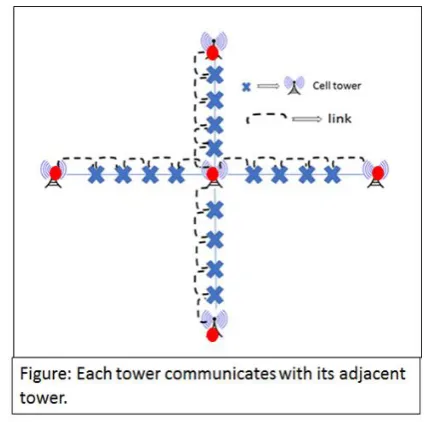
[image:2.595.320.532.97.230.2]In our proposed system, the activity of the tower using 87% of the unwanted internal power application can be minimized when it is not required. For this, the autonomous communication among adjacent towers should be enabled[Fig 1].
Fig. 1. Communication between the towers
In this we are mainly focusing on making a tower active or inactive based on the necessity of the details which are received through the wireless sensor technology. By using this technology, each tower can be assigned a Unique Identification Code and for interaction with adjacent towers, hese towers shouldn’t use business frequencies like GSM and GPRS. Instead of non-business frequencies like Radio Frequencies can be availed for communication. A particular tower accessed by a total number of users is estimated and a threshold of frequency usage is set up for 80 percent. Remaining 20 percent frequency is reserved for Bulk users. This is known as Dynamic Reduction of tower usage. The number of users in a single tower is given by,
Number of users = x/3….. (1) Let x = Total power of Tower – 87%
Where “x” is an amount of power consumed only for communication. Since each user is delivered with 3Kw, in the above equation, “x” is being divided by 3.
During daytime, lights used in base station can be kept OFF and when environmental temperature and humidity favours,
[image:2.595.61.277.333.544.2]there is no need of air conditioners. This is done by using LDR (Light Dependent Resistor) and thermistors. This is termed as Energy Auditing Method and it provides power conservation.
Fig. 2. Block Diagram
Our next aim is to generate the energy needed for the tower operation to be generated by itself with the aid of photovoltaic cell and micro-wind turbine. This comes under Energy Generation thus ensuring the power production even when the tower is OFF.
WSN (Wireless Sensor Network) input responder frequency (Input 1) is the non-business frequency used for activating a tower. This block also acts as Wireless receiver at the next tower. Sensor (Input 2and 3) senses the available number of users in its coverage area with the help of equation (1) which can be converted into voltage and current and given as an input to the microcontroller. It also senses the Temperature and Relative humidity [6] of the environment which is used as an input to the relay. Relay switches ON or OFF the air-conditioner based on the sensor output.
RS232 enables serial communication by a mutual transmission and reception of collective data such as number of users and amount of energy generated from wind turbine and photovoltaic cell from/to both personal computer(PC) and embedded microcontroller. PC receives all data from RS232 and displays it with the help of software called Visual Basics. In order to make this data available everywhere, we are engulfing the latest technology IOT (Internet of Things) as a further extension of our proposed system. Wireless Transmitter will send the encoded unique ID to make the adjacent tower either ON or OFF. Wireless Receiver decodes those received ID from the transmitter and it is known as the WSN input responder frequency of adjacent tower.
B. Modules
Our green radio concept is pitched into various modules. They are:
1. Data Acquisition system 2. Data Processing system 3. Data Conversion system 4. Data Manipulation system 5. Data communication system
a) Data acquisition system:
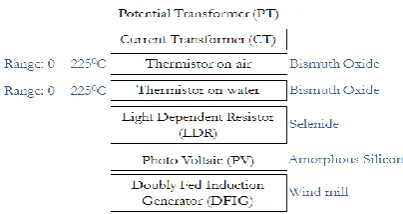
Potential transformer and Current transformer are the isolation transformers used for sensing the incoming voltage from the power grids and huge current flowing from the power supply. Potential transformer also avoids the backflow of voltage. Thermistor on air is used to sense the temperature of air. Thermistor is essentially
International Journal of Innovative Technology and Exploring Engineering (IJITEE) ISSN: 2278-3075, Volume-9 Issue-2, December 2019
resistance increases with decrease in temperature. Thermistor on water will sense the temperature of water with respect to air and otherwise it is same as the former one.
Fig. 3. Block Diagram of Data Acquisition System
Light Dependent Resistor is used for sensing the environmental light intensity. It is a simple resistor and the resistance that decreases with increase in light intensity. Photovoltaic cell is primarily a solar cell, which senses the photons and converts the light energy into electrical energy [7]. A number of solar cells constitute solar panel. Doubly fed induction generator acts as micro-wind turbine used for sensing the wind energy and converting it into electrical energy. Thus, the first module contains all these sensed inputs into the embedded microcontroller
b) Data Processing System
i. Responder frequency processing:
All types of input such as square, rectangular, saw-tooth and sinusoidal, are given to a transistor for signal conditioning. Whatever the input is given, a Transistor coupler converts it to a corresponding constant amplitude wave. Magnitude, type and duty cycle of a responder frequency is not known. Normally, an electromagnetic frequency(RF) [8] is AC in nature. Schmitt trigger is a regenerative comparator which has 2thresholds for single input frequency and it will practically convert any signal to a square wave. If all threshold such as V threshold, gain and duty cycle are satisfied, then the frequency will be converted into voltage. Either we can use CMOS or TTL as frequency to voltage converter.
Fig.4. Block Diagram of Responder Frequency Processing
[image:3.595.67.269.102.209.2]ii. PT and CT conversion:
Fig. 5. Block Diagram of PT and CT Conversion
Potential Transformer(PT) steps down thousands of voltage (11000V) in to single phase (0-250V) AC voltage. Current Transformer(CT) produces a current in the secondary proportional to the current in the primary. So, it is a transformer which is used for AC current measurement. AC current can be converted into AC voltage by using shunt FWPR (Full Wave Precision Rectifier) is used to convert from AC to DC voltage. For converting from AC to DC, we should not use Bridge rectifier [9] since at a time,2 diodes are kept ON for rectification. Each diode requires 0.7V for its operation. As a whole, 1.4V (0.7V * 2) is needed. It will become a drawback as our aim is to reduce the energy consumption. So, we use OP-AMP as FWPR which has high input impedance and output impedance is zero which ensures that there is no utilization of voltage.
[image:3.595.323.534.249.315.2]iii. Temperature and humidity processing:
Fig.6. Block Diagram of Temperature and Humidity Processing
Conversion of resistance into voltage can be made by three Modules: Potential divider, Wheatstone bridge and Kelvin’s double bridge. Since we need only 0 to 5V output, Potential divider (having 1kΩ resistor) is more than enough to provide the above voltage. This constitutes the temperature to voltage conversion. The same methodology is used for Humidity to voltage conversion. Here in addition, temperature is converted into humidity and then voltage conversion occurs.
[image:3.595.325.532.456.547.2]iv. Solar and wind energy processing:
Fig. 7. Block Diagram of Solar and Wind Energy Processing
Approximately there will be good voltage production for photo voltaic cells at forenoon and will be minimum at 12 noon and again it attains greater values till dusk. According to Bitz law, whatever may be the wind pressure and velocity, only 57-63% of energy is generated by low power wind turbine. So practically, 100% efficiency cannot be attained. Polarity controller allows only forward flow of voltage, thus avoiding [10] dual polarity. In a Step-down transformer, the primary voltage is stepped down at the secondary. Solar energy is naturally DC whereas wind energy is AC in nature. So with the help of precision rectifier, wind energy is converted into DC. The energy generated from both photovoltaic cell and wind turbines are combined at the hybrid section with the help of diode. At a time, only one diode is switched [11] ON enabling either the energy from solar cell or wind turbine. Pulse
hybrid section. Output from the hybrid section is used to operate our entire system without the help of Electricity board.
c) Data conversion system:
The responder frequency is the direct external input. Most probably, embedded system expects analog input except some input ports. The processed data are being sent through USART to ADC (Analog to Digital Converter). Here the analog inputs are converted into necessary digital form. We use PIC microcontroller which has in-built ADC in it. RS232 is used for serial communication between microcontroller [12] and personal computer. It acts as a Quarter puller as it performs voltage amplification at transmitter side and voltage attenuation at the receiver side. The various conversions taking place in this module are converting the stepped down output of potential and current transformer into original AC values using division and multiplication factor respectively. Power can be obtained from these voltage and current values.
d) Data manipulation system:
Data manipulation is a software role between ADC and the actual value. It is used for retrieving and manipulating data in a relational database. It also used for manipulating the data of wind, light and solar energy. The temperature [13] to voltage manipulation is as follows,
0C =ADC value/4.55=** V,
where Celsius is converted to voltage, “*” is the resultant value, “4.55” is the division factor. The
manipulation of Relative Humidity (RH) is as follows,
RH = Temperature in water /Temperature on air*100% Similarly, light, wind and solar energy manipulations are made.
e) Data Communication System:
The major component is Remote transmitter. It has four channels: Bottom channel, Top channel , Right channel and Left channel. We used the carrier frequency of 433.92 MHz and modulating frequency of 36,37,38 and 39 KHz. We are using 4th order accuracy to prevent interference of other users frequency with our frequency. Our channel is in between a Bandwidth of 1 KHz. This signal is received by wireless receiver which turns ON the next tower to handle excess amount of users[14].
V. SOFTWAREREQUIREMENT
Visual Basic is a third-generation event driven programming language and integrated development It was derived from BASIC and it is a user-friendly programming language designed especially for the beginners. It makes us to attain rapid application development of Graphical User Interface (GUI) applications and also access to databases. It provides graphics-rich environment for videogames and user-friendly GUI allowing users to easily access to its platform. A programmer can easily create an application by availing the components provided by the Visual Basic program itself. We have used Visual Basic software tool to represent the switch over of responder frequency from one tower to its nearby tower. In addition, it also shows the amount of supply being generated from the solar cells and wind sources. The initial direct external input from the former tower has been sent to our proposed tower, when this tower reaches its limit, the control will be switched over to the next adjacent tower. As soon as the first and foremost tower
handed [15] over the responder frequency, the power amplifier (PA)of the proposed tower will be switched ON immediately.
VI. RESULT
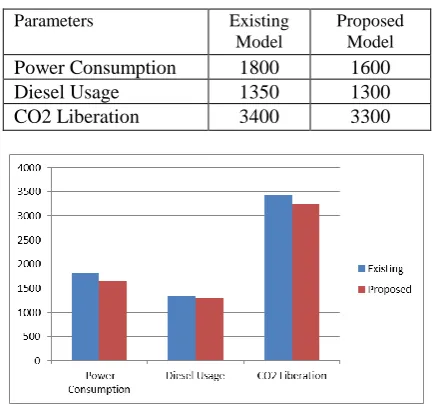
Our proposed system emphasizes the primary goal of maximum throughput and coverage as the output. The accomplishment of our proposed system has been visually presented in the graphs is shown in Fig.8. It is widely accepted that the energy consumption reduction in mobile networks will bring both the profit to the network operators and the environmental benefits to the society. Initially when none of the tower is in operation, the power amplifier will be kept OFF state, ensuring no signal transmission to the remote tower and OFF state of the lighting and cooling unit.
[image:4.595.318.536.344.548.2]When the capacity exceeds demand, the architecture is unnecessarily consuming energy by keeping unused base station switched ON. Thus sleep mode is introduced when the users are not up to the threshold level. When the tower reaches the threshold, its Remote Transmitter gets switched ON enabling the light and cooling system to switch ON or OFF based on the environmental conditions.
Table 1: Parameter Evaluation
Parameters Existing Model
Proposed Model
Power Consumption 1800 1600
Diesel Usage 1350 1300
CO2 Liberation 3400 3300
Fig.8.Graph showing difference that happens in base station power utilization after encapsulating power conservation technologies As soon as the photovoltaic cells and micro-wind turbine generates voltage, it is displayed in the visual basics software outcome. The larger the fixed proportion of energy consumption of base stations is, the larger amount of saving can be possibly attained.
International Journal of Innovative Technology and Exploring Engineering (IJITEE) ISSN: 2278-3075, Volume-9 Issue-2, December 2019
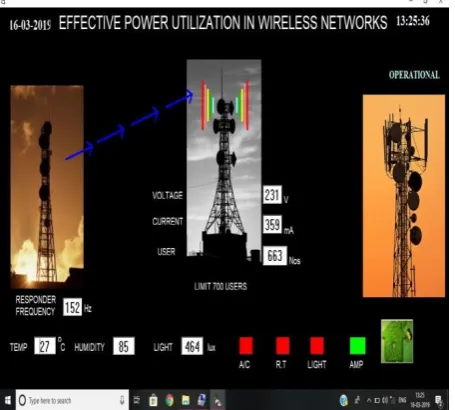
Figure 9: Software Outcome Showing the Responder Frequency
[image:5.595.310.543.52.240.2]When capacity density exceeds demand, the architecture is unnecessarily consuming energy by keeping unused base station switched on. Thus a sleep mode has been introduced where the cells that are not populated with users are turned off. The responder frequency, i.e., the initial direct external input from the former tower has been sent to our proposed tower is shown in figure 9.
Figure 410: Software Outcome Showing that the Second Tower Started Managing its Users within its Threshold
Level
[image:5.595.56.284.351.556.2]Figure 10 shows that the second tower started managing its users within its threshold level. When this tower attains its limit (as shown in Figure 10), the control will be switched over to the next adjacent tower as shown in figure 11. As soon as the first and foremost tower hand over the responder frequency, the power amplifier (PA) of the proposed tower gets switched ON. The fact that BSs have been designed to serve peak traffic leads to wastage of energy during low traffic hours. Sleep mode operations exploit the opportunity by turning lightly loaded BSs to sleep and to save fixed part of energy consumption, e.g., air conditioning.
Figure 11: Software Outcome showing that the Second Tower has reached its Threshold Level and has Given the
Responder Frequency to its Adjacent Tower When this tower reaches its threshold, its remote transmitter (RT) gets switched ON. While the lighting and temperature in the external environment doesn’t favour well, the AC and Light gets switched ON. As soon as the photovoltaic cell and micro-wind turbine generates voltage, it is being shown in the Visual Basic software outcome. For BS sleep mode techniques, the main saving comes from the fixed part of energy consumption in under-utilized BSs. The potential for energy saving is large in areas where the traffic is highly variant and relative low as compared with full capacity of BS, and where BSs are densely deployed. Also, the larger the fixed proportion of energy consumption in BSs is (the case in macro BSs), the larger amount of saving can be possibly attained.
VII. CONCLUSION
REFERENCES
1. B. Badic, T. O’Farrell, P. Loskot, “Energy Efficient Radio Access Architectures for Green Radio: Large versus Small Cell Size Deployment”,2009.
2. Congzheng Han, Tim Harrold, and Simon Armour “Green Radio: Radio Techniques to Enable Energy-Efficient Wireless Networks”,2011.
3. NEC, White Paper: Green Radio “NEC‟s Approach towards Energy-efficient Radio Access Networks”, February 2010, NEC Corporation.
4. NasirFaruk, Mujahid Y. Muhammad, “Energy Conservation through Site Optimization for Mobile Cellular Systems (Base Transceivers Station Optimization)”, Epistemics in Science, Engineering and Technology, 2012
5. Chethana R. Murthy and Dr. C. Kavitha, “A survey of Green Base Stations in Cellular Networks”, IRACST-International Journal of Computer Networks and Wireless Communications, ISSN: 2250-3501, Vol. 2, No. 2, April 2012
6. HamidrezaBoostanimehr, Vijay K. Bhargava and ZiaulHasan, “Green Cellular Networks: A Survey Some Research issues and Challenges”, Communication Surveys & Tutorials, IEEE, 2011.
7. Honggang ZHANG, “Cognitive Radio for Green Communications and Green Spectrum”, COMNETS 08 Co-located with CHINACOM 08, August 25-17, 2008, Hangzhou, China.
8. A. Ambrosy, D. Ferling, S. Petersin et al., “Final report on green radio technologies,” EARTH Project Report, Deliverable D4.2, pp. 1-89, 2012.
9. Moshe Zukerman, Jingjin Wu and Yujing Zhang, “Energy-Efficient Base-StationsSleep-mode techniques in Green Cellular Networks: A Survey”, IEEE Communication Surveys & Tutorials, Vol. 17, No. 2, Second quarter, 1553-877X, 2015.
10. Amr Mohamed, ContantinosPsomas, Imran Ahmed et al., “Survey on energy harvesting wireless communications: Challenges and opportunities for radio allocation”, Elsevier, 1389-1286, 2015. [available online] http://dx.doi.org/10.1016/j.comnet.2015.06.00 9 . 11. S.-E. Chahed, L. Elayoubi, Saker, “Minimizing Energy Consumption
via Sleep Mode in Green Base Station”, Wireless Communications and Networking Conference(WCNC), IEEE, 2010.
12. Dr. V. Saravanan and J. Soniya, “Green Energy based Mobile communication system”, International Journal of Advanced Research Trends in Engineering and Technology, Vol. 4, Issue 6, ISSN 2394-3785, June 2017.
13. Albert Ayang, Paul-Salomon Ngohe-Ekam, BossouVideme, and Jean Temga, “Power Consumption: Base Stations of Telecommunication in Sahel Zone of Cameroon: Typology Based on the Power Consumption—Model and Energy Savings”, Journal of Energy, Volume 2016
14. C. Lubritto and A. Petragliaa, “Energy and environmental aspects of mobile communication systems‟ Energy”, Volume 36, Issue 2, pp 1109-1114, En résumé, les technologies du mode sommeil ainsi que l'ensemble du réseau cellulaire vert sont des domaines de recherche prometteurs.2011.
15. Jacques Palicot, “Cognitive Radio: An enabling Technology for the green radio communications concept”, IWCMC’09, Leipzig, Germany, ACM 978-1-60558-5697/09/06, June 21-24,2009.
AUTHORSPROFILE
Nami Susan Kurian completed her B.E in Electronics and Communication Engineering, RGCE, Anna University, Chennai, India. She completed her M.E in Communication Systems, REC, Anna University, Chennai. She is a rank holder in her master’s degree. She has published papers in international journals and presented papers in international and national conferences. She is currently working as an Assistant Professor in Rajalakshmi Institute of Technology, Chennai. Her primary area of research is in WSN and MANET. She is currently working in Optimization of Bio-inspired algoritms for wireless sensor networks. She is dedicated towards research and she planned to do PhD in wireless sensor networks..
Dr.V.Nagaraju received his B.E Degree in ECE from Gulbarga University. He completed his M.E in Applied Electronics from Madras University in 2002. He completed his PhD in St.Peter’s University in 2017. His major areas of interest are in WSN, Cognitive Radio and Antenna. He is currently working as Professor in Rajalakshmi Institute of Technology, Chennai. He is having 18 years of experiencein teaching field. He has published papers in international journals and presented papers in international and national conferences. She is currently working in projects related to VANETS with the incorporation of IOT. He is fond of doing innovative projects.
L Saravanan has received the B.E. degree in Electronics and Communication Engineering from the University of Madras, Tamilnadu, India, in 2004 and the M.E. degree in Optical Communication from Anna University, Tamilnadu, India in 2008. He is currently working with Automatic Human Brain Tumor Detection in MRI Image. His research interests include medical image processing and IoT in health care applications and energy management systems. . He has published papers in international journals and presented papers in international and national conferences. His primary area of interest includes Wireless sensor networks, Internrt of things, Signal processing and Embedded systems. He is fond of doing innovative projects.