
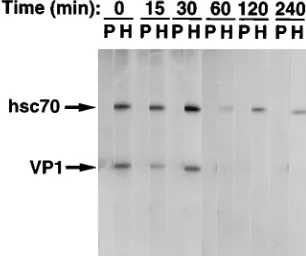
In vivo and in vitro association of hsc70 with polyomavirus capsid proteins.
Full text
Figure



Related documents
Sedimentation profiles of RNA labeled with 3H-uridine and isolated from partially purified A particles derived from N-18 neuroblastoma cells and MOPC-104E plasma cell tumors
Comprehensive comparison of this sequence with hexon protein sequences from human subgenera A, B, C, D, F, bovine AV3, and mouse AV1 revealed seven discrete hypervariable regions
One approach to gene therapy for AIDS is to block the replication of human immunodeficiency virus type 1 (HIV-1) by inhibiting the tat gene, whose product activates the expression
Here we report a methodology that employs random systematic mutagenesis to produce libraries of chimeric HRV14 viruses in which the transplanted HIV-1 sequences are joined to
Since all the viruses and reassor- tants examined here replicate well and synthesize substantial amounts of antigen in the permissive MA104 cell line stan- dardly used for
Continuous variables analysed as possible risk factors influencing pit latrine contamination of boreholes were: distance to closest pit latrine, radial pit latrine
Since 2005 he has been with HVPD whilst studying for a PhD degree at The University of Manchester School of Electrical and Electronic Engineering which was awarded in 2010
To systematically review the evidence investigating the impact of financial incentives for implementation of supported self-management on quality of care including:
