0022-538X/89/062497-07$02.00/0
Copyright © 1989, American
Society
for MicrobiologyDNA
Binding by the
Herpes
Simplex
Virus
Type
1ICP4 Protein
Is
Necessary for Efficient
Down
Regulation of
the ICPO
Promoter
JAMES RESNICK,* BRANIN A. BOYD, AND MARY L. HAFFEY
Department ofVirology, SquibbInstitutefor MedicalResearch, E. R. Squibb and Sons,P.O. Box 4000, Princeton, NewJersey 08540
Received 28 November 1988/Accepted 14 February 1989
The herpes simplexvirustype1ICP4 and ICPO polypeptidesareimmediate-early proteinsthat positively and
negativelyregulate expression of other viralgenesintrans.ICP4 has recently beenshowntobindDNA bearing
theconsensus sequence5'-ATCGTCNNNN(T/C)CG(A/G)C-3', present upstreamofanumber of viralgenes.
Totestthe hypothesisthat this DNA-binding activity is involved in ICP4-mediatedgeneregulation, site-specific
mutagenesis was employed to mutate the version of this sequence in the promoter of the ICPO gene. The
mutation eliminated detectable binding of ICP4tothe promoterasmeasuredin vitro byagel electrophoresis
band shiftassay. The ability ofthe mutated ICPO promotertodirect synthesis ofa reporter gene was also
investigated ina transient transfection assay. Whereas ICP4was found totransactivate the wild-type ICPO promotertwo- tothreefold, the mutatedpromoterwastransactivatedseven-toninefold. Inassayscontaining the ICPO transactivator gene, ICP4 down regulated the wild-type promoter far more efficiently than the
mutatedpromoter. Finally, boththe wild-typeand mutated ICPO promotersexhibiteda similar responseto ICP4 in transfections that included a vector expressing the viral transactivator protein VP16. These experimentssuggestthat thesequence-specific DNA-binding activity of ICP4isanessential element of itsrole as anegative regulator ofgeneexpression.
Studiesonthereplication cycle of herpes simplex viruses
have revealed a temporally regulated cascade of viralgene
expression (6, 20). Of the many proteins produced during
infection, four have been showntodirectly effect viral gene
expression. Threeoftheseproteins, ICP4,ICPO,andICP27,
are members of the immediate-early class, whereas VP16 is a late viral gene product. The VP16 polypeptide (ac-TIF,
Vmw65), contained in the virion, is carried into the newly infected cell, associates with host proteins, and mediates transactivation of the viral immediate-early genes (1, 5, 32,
44). ICP4(Vmwl75)is essential forproductiveinfection and
appears tobe the major viral regulatory protein (8, 10, 42, 57).ICPO(VmwllO)isapotenttransactivator ofgenesfrom
awidevariety ofsources (13, 15, 37, 38, 45, 49, 55). ICP27
(Vmw63) has been showntobe involvedinboth positive and negativegeneregulation of viral early andlategenes(3, 12,
31, 46, 48, 51).
Mutational analysis oftheICP4genehasdemonstrated the central role of this polypeptide in the viral growth cycle. Temperature-sensitive anddeletionmutantsinICP4usually fail to adequately express early and late functions while overexpressing immediately earlyfunctions(7-9, 42, 50, 57). Results from a number of laboratories have demonstrated
thatICP4iscapable of both positiveandnegative transcrip-tional regulation in transientexpression assays, dependent
on both the nature of the target promoter and the dose of ICP4 effectorgeneused(11, 15, 38, 45). Althoughtheexact mechanisms underlying ICP4-mediated gene regulation are not yet understood, ICP4 protein can bind to a conserved
sequence presentin the 5' flank ofa numberof viralgenes,
includingthe ICPOpromoter (2, 14, 23, 24, 35, 36).
To better define the biological role of the ICP4 DNA-binding activity, wecreated a mutation in the ICP4
recog-nizedsequence,the "ICP4box," inthe ICPOpromoter. This mutation abolished detectable DNA binding in vitro. We
* Correspondingauthor.
foundthat, relativeto the wildtype, the mutatedpromoter
was more strongly transactivated by ICP4 in transient
as-says. Furthermore, the negative regulatory effect of ICP4
DNArecognitionwasepistatictothepositive effect of ICPO
on the ICPO promoter.
MATERIALS ANDMETHODS
Mutagenesis.Allplasmids bearinga"68"designationbear twopointmutations in the ICPOpromotercreated by oligo-nucleotide-directed mutagenesis (25) with the synthetic
20-mer 5'-GCGGCAGTGAAGCTTCCCCC-3' complimentary
tothesensestrand ofICPODNApositions 1639 through1658
(numbering system of Perry et al. [41]). The two bases specifying mutations are underlined. Mutagenesis was
per-formed on a fragment of the herpes simplex virus type 1 KOS strain ICPOgenespanning positions905to2508 cloned into M13mpl8 between the SstI and BamHI sites. After mutagenesis,progenyphage werescreened for thepresence
ofanovel HindlIl site, and the mutation wasconfirmed by
direct DNAsequencing.
Plasmids. (i) pOWTCATandpO68CAT.Achloramphenicol acetyl transferase (CAT) expression cassettewas prepared
by digestion ofpSV2CAT (18) with Hindlll and BamHI, repair of the staggered ends with T4 DNA polymerase, ligation of synthetic PstI linkers, and cloning ofthe CAT
gene fragment into the PstI site of the pTZ19R polylinker (33). The SstI (nucleotide 905)-to-NcoI (nucleotide 1862) fragmentfrom either thewild-type promoterorthe mutated ICPO promoter was then cloned into this plasmid to yield pOWTCATorpO68CAT, respectively (Fig. 1B). Duringthis
cloning operation the ICPO NcoI sites were converted to XbaI sites by the addition of synthetic linkers, and the
fragments were cloned into the polylinker SstI and XbaI sites upstream ofthe CAT gene. To ensure that the CAT
genetranslational startcodonwasthe first encountered,the
ICPO NcoI siteswerefirstrendered blunt endedby digestion with mungbean nuclease and repaired with T4 DNA
poly-2497
on November 10, 2019 by guest
http://jvi.asm.org/
-67 -65 G T
I Nco I
AvaIATCGTC Ava I ATG
+
+1 +100
B
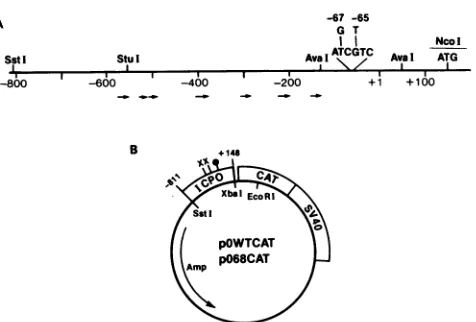
FIG. 1. (A) Physical map of the ICPO upstream region. The numbersbelow the lineindicate nucleotidepositions relativetothe
5' cap siteof ICPOmRNA atposition +1. Thelocations of various restrictionendonucleaserecognitionsites referredtointhetextare
indicated above the line, as is the position of the ICP4 box and
mutation created in this promoter. The arrows below the line
indicatethe locations and directions of the TAATGARAT homolo-giesimplicatedinresponsetotheviral transactivatorproteinVP16 (22, 26, 43, 59). (B) Representation of theplasmids pOWTCATand pO68CAT. Theseplasmids contain ICPOpromoter sequencesfrom
theSstIsiteatposition-805totheNcoIsiteat +148 linkedtothe
bacterial CAT gene and SV40-derived splice and polyadenylation signals. The relevant restriction endonuclease recognition sites,
locationofthe mutationdescribed here(X), andposition of the5'
end ofICPO mRNA(0)areshown.
merase before attachment of the XbaI linkers. The NcoI-XbaIjunctions were sequenced by the method ofMaxam and Gilbert (30) from the nearby EcoO109 site at position
1824. BothpOWTCAT andpO68CATretained the first C of theNcoloverhangbuthad lost the ATG.
(ii) p68aO. The wild-type 6.2-kilobase genomic SstI-PstI fragment encodingtheKOS ICPOgenewascloned fromviral DNA into the pUC18 SstI and PstI sites. The 1.6-kilobase SstI-BamHI fragment containing the ICPO gene upstream regionwasthenexcised andreplacedwith thecorresponding fragmentfrom theM13phage bearingthetwo-base mutation
intheICPO promoter.
(iii)pMEX4.pGX58(54)wasdigestedwithPstI andDraI, Hindlll linkers were added to the DraI site, and the 7.2-kilobase fragment encoding ICP4 was cloned into the PstI andHindlIl sitesofpUC18.Thisplasmidencodes theherpes simplex virus type 1 strain 17ICP4gene.
(iv)
pMSVP163'8058N.
pMSVP163'8,B58N expresses the KOS VP16 gene under the regulatory sequences of the murine sarcoma virus long terminal repeat. This construct was the generous gift of S. Triezenberg and S. McKnight (Carnegie Institution).Cells, transfections, and CAT assays. Vero cells were
routinelygrowninDulbeccomodifiedEagle medium supple-mented with 5% fetal calf serum. Freshly confluent cells were split 1 to 4 the day before transfection. For CAT
assays,transfectionswereperformedon60-mmNunc plates
bythecalciumphosphate procedure (19)withoutanosmotic "boost." Transfection mixtures contained 0.25 ,ug of CAT plasmid DNA and additional plasmids as indicated. All transfectionmixtureswere broughttoaconstant amountof plasmid DNA per experiment by the addition of pUC18.
Cells were harvested 44 or 48 h after transfection. CAT
activity was determined by thin-layer chromatography as describedpreviously (18)andwasnormalizedtotheprotein
content ofeach extract (4). Percent
acetylation
was deter-mined by excision of the monoacetylated spot from the chromatograph and subsequent scintillation counting. In general, acetylation reactions were run for 30 min and alwaysresulted in modification of less than 20% of theinput
['4CJchloramphenicol.
Each point representsthe average of twoindependent determinations.Band mobility shift assays. An extract enriched for
ICP4,
termedfraction VI, was prepared from 14-h herpes
simplex
virus type 1strain KOS(obtainedfrom Y.C. Cheng,Chapel Hill, N.C.)-infected Vero cells (multiplicity ofinfection,
5)
exactly as described by Metzler and Wilcox
(34).
Pro&e
DNA was prepared by excision of a 180-base-pair AvaI fragment bearing ICPO promoter sequences from
plasmid
pOWTCAT or pO68CAT. The DNA probe was end labeled with polynucleotide kinase and
[y-32P]ATP.
Binding reac-tions(20RI)
contained 1.5 ngofprobe DNA(approximately 10,000 cpmforeachprobe)and39ngofproteinextractin the buffer described by Kristie and Roizman (23). Reactions were analyzed on 6% polyacrylamide-0.2% bisacrylamide gels equilibrated in TBE buffer (28)and electrophoresed at room temperature.RESULTS
Constructionofadualpoint mutationintheICP4 box of the ICPO promoter. Faber and Wilcox (14) have shown that DNA bearing a version of the consensus sequence ATCGTCNNNN(T/C)CG(A/G)C canform stablecomplexes with ICP4 in vitro(also seereference 35). Figure 1A presents landmarks in the ICPO regulatoryregion and illustrates that an ICP4 box is located at position -68 (+1 taken as nucleotide 1716 inthenumbering systemofPerry etal.[41]). To create a mutation in this promoter which would abolish the DNA-binding activity of ICP4, two bases in the ATCGTC core recognition region were mutated by oligonu-cleotide-directed mutagenesis, converting this sequence to AGCTTC (see Materials and Methods). This region of the coresequence was chosen to avoid disruptionof aputative SPl-binding site (21), which overlaps the downstream por-tion of the ICP4 box in this promoter. After mutagenesis, the promoter was sequenced from positions -310 to +150 to both confirm the mutation and ensure the absence of untar-geted mutations. Although no untaruntar-geted mutations were detected, the KOS strain ICPO promoter did exhibit a single nucleotide polymorphism with the published strain F se-quence (27), aG/C-to-A/T transition at position + 122.
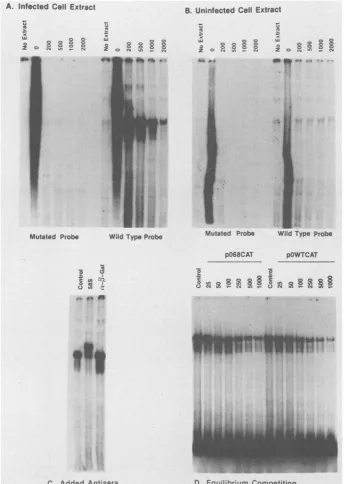
ICP4does not form a stable complex with the mutated ICPO promoterin vitro.ICP4 bindingto DNA was testedinaband mobility shift assay. Anuclearextract of 14-hinfected Vero cells was incubated with a 32P-end-labeled 180-base-pair AvaI restriction fragment (Fig. 2A) bearing the ICP4 recog-nized sequencefrom the ICPO promoter (positions -128 to +54). Asincreasing amounts of unlabeledpoly(dI)-poly(dC) competitorDNA wereaddedtoreactionmixturescontaining the wild-type probe, a single stable complex was detected (Fig. 2A). No complexes were detectedwhen the analogous fragment from the mutated ICPO promoterwas substituted in the assay. Evidence supporting the contention that ICP4 participates in the complex formed with thewild-type DNA probe is twofold. First, asimilar extract of uninfected cells failed to produce this band with either the wild type or mutant probe (Fig. 2B). Second, the addition of the ICP4-specific 58S monoclonal antibody (53) to a bindingreaction led to afurther reduction in the electrophoretic migrationof the complex. No change in complex migrationwas detected
A
satI -800
Stu I
-600 -400- -20C
_O _ --I -4
on November 10, 2019 by guest
http://jvi.asm.org/
[image:2.612.68.306.73.234.2]A. Infected Cell Extract
_ z
0 0 LUS
0 00 0 00 0
0 0 0 0 0 0 0
z 0 N o o N z O
*I
a*
#4 o4* z%'B. Uninfected Cell Extract
C-0 z
S
00 IL 0 CD
0o000 0 0000
Mutated Mutated Probe Probe
pO68CAT
o o
C,
u ,> Al
Ce* i
-I- .._
V _
....0. w
it
K'
oE o
0 tn 8 's § § a U) i s
IjppIiV-lhJjiP
i
C. Added Antisera 0. Equilibrium Competition
FIG. 2. Characterization of DNA-binding activitiesrecognizingpositions -128to+54of theICPOpromoterbyDNAband mobilityshift
assay.(A) Binding reactionscontained 32P-labeled DNA derived from either the wild-typeormutatedpromoter,infected-cellextract,andthe
indicated weight excess of poly(dI)-poly(dC) competitor DNA. (B) The experiment is identical to that in A, but with substitution of mock-infected cell extract. (C) Band shift assays contained infected cell extract, wild-type probe DNA, a 1,000-fold weight excess of
poly(dI)-poly(dC),and7ngofpurified immunoglobulin Gmonoclonalantibody58Soranti-p-galactosidase(PromegaBiotecCo.)asindicated.
(D) Reactions contained wild-type probe DNA,a1,000-fold weightexcessofpoly(dI)-poly(dC), and theindicatedamounts(nanograms) of SstI-linearizedplasmid pOWTCATorpO68CAT.The infected-cellextractwasadded last.
by inclusion of an irrelevant antibody (Fig. 2C). These
results suggest that the double mutation in the ICPO pro-moter strongly diminishes interaction of ICP4 with this
sequence.
The mutatedpromoterexhibitsincreased transactivationby ICP4.To investigate thebiological role of ICP4 recognition of the ICPO promoter, wild-type and mutated promoter fragments were cloned adjacent to a reporter CAT gene
cassette,creatingvectorspOWTCAT and pO68CAT,
respec-tively (Fig. 1B). These constructs were then transiently
introduced into Vero cells along with a plasmid that
ex-pressesICP4protein, and subsequent CATgeneactivitywas
measured (Fig. 3). In the absence of additional factors, the wild-type and mutatedICPOpromotersdirected synthesis of equivalent levels of CAT activity. As thegenedose ofICP4
was increased, the wild-type promoterexhibited a two- to threefoldincrease inactivity, whereas the mutatedpromoter
was elevatedseven- toninefold.
1Wp, WildTypeProbe
pOWTCAT
-p4
t
on November 10, 2019 by guest
http://jvi.asm.org/
[image:3.574.103.447.61.545.2]A
40*
-x :& 30
-lo
0~*
0 1 2 3
Gene DoseICP4:CAT Vector
FIG. 3. Response of ICPO promoter CAT vectors to ICP4. pOWTCAT (0)orpO68CAT(0)plasmidswerecotransfected with theindicatedamounts oftheICP4expressionvectorpMEX4, and the subsequent CATactivityof cell extracts wasdetermined.
Based onpublishedsequences,theCAT reporter cassette, ICPO promoter fragment, and pTZ19R bacterial cloning vector are all free of other ICP4 consensus sites. It is thereforeunlikely that theseexperimentsarecomplicatedby the presence of sequences in the testplasmids which ICP4 recognizes with affinity equal to that of the established recognition site. Although sequences near the plasmid rep-lication origin do contain the ATCGTC core, Faber and Wilcox (14) did not detect stable ICP4 complexes with a restriction fragment bearing this sequence. To more thor-oughly investigate whether there might be strong ICP4-binding sites in the reporter plasmids, we performed equi-libriumcompetitionassaysinwhichunlabeledpOWTCATor pO68CAT plasmid DNA was added to binding reactions containingthe32P-labeledwild-type ICPOpromoterfragment probe. Although both plasmids were able to compete in complex formation, the plasmid bearing wild-type ICPO sequenceswasthe moreeffective competitor (Fig.2D). This suggests that the mutant plasmid does not have a site of affinity equal to that of the ICPO regulatory region. We conclude that ICP4doesnotstronglyrecognizethe mutated CAT expression vector, and that the absence of this inter-action results in increased ICPO promoteractivity.
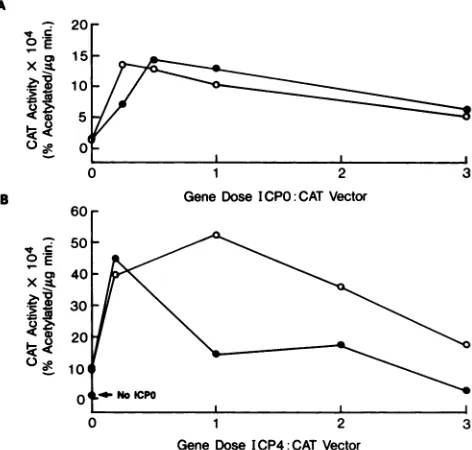
ICP4 DNA recognition resultsinnegative regulation ofthe ICPO promoter in the presence of ICPO.TheICPOpromoteris responsive to a number of virus-encoded regulatory pro-teins, including ICPO itself(16). It was therefore ofinterest toexploretheroleofICP4 DNArecognitionin the presence ofICPO. First, itwas necessary todetermine that both the wild-type and mutated ICPO promoters responded compara-blyto ICPO. The wild-type and mutant ICPO promoter CAT vectorswereeachcotransfected with a vector that expresses ICPO, p68a0. At low levels of the ICPO effector gene, both the wild-type and mutant ICPO promoters were strongly transactivated, whereasat higherICPOdoses, aslight dimi-nution of activity was detected (Fig. 4A). The relevant observations, however, are that both the wild-type and mutantpromoters respondpositively to ICPO and are indis-tinguishable in this response.
Next, transfection mixtures were prepared with either the wild-type or mutant ICPO promoter CAT vector, 0.25 gene equivalent of the ICPO expression vector, and various con-centrations of ICP4 expression vector. The
p68o0
expres-sion vector directs ICPO synthesis from the promoter bearing the two-base mutation in the ICP4 box. This vector was chosen toavoid potential repression of ICPO expression by ICP4. The addition of 0.25 gene equivalent of ICP4 expres-sion vector resulted in a 4- to 5-fold increase in the CAT activity overthe 6- to 8-fold increase mediated by the ICPO0E9
x-.
0*
B
o
X c
:= X
0 1 2 3
Gene DoseICPO: CAT Vector
0 1 2 3
Gene Dose ICP4:CAT Vector
FIG. 4. Response of ICPOpromoterCAT vectors to ICPOand ICP4. (A) pOWTCAT(0)orpO68CAT (0)plasmidswere cotrans-fected with the indicatedamountsofICPOexpressionvectorp68cO, and CATactivity of the cell extractwas measured. (B)Thesame
CATexpression plasmidswerecotransfected with0.25 gene equiv-alent ofICPOexpressionvectorp68cxOand variousamounts ofthe lCP4expression vectorpMEX4. The two isolated points onthe y axisindicatetheactivity derived from the CAT expressionplasmids in the absence ofICP4orICPO.
vectoralone, resulting in an overall 30- to 50-fold transacti-vation of bothtemplates(Fig. 4B). Workers in a number of laboratories have previously documented synergy between ICPO andICP4in transactivation of other promoters (11, 13, 15, 29, 38,45, 51,52). As the concentration of ICP4 genewas increased, however,the wild-type ICPOpromoterwasdown regulated while the mutant maintained high levels of CAT geneexpression. These results suggest that in the presence of ICPO,increasingamountsof ICP4 leadtodownregulation of the ICPO promoter. Moreover, this down regulation is mediatedbythe ICP4 box in the ICPO promoter.
ICP4 DNA recognition does not influence VP16-mediated transactivation of the ICPO promoter. The ICPO promoter responds positively to the virion transactivator protein VP16.ToinvestigatewhetherICP4sequence-specific DNA-binding activity influences the activity of VP16, we first determined that both the wild-type and mutant ICPO pro-moters responded similarly to VP16. The wild-type and mutant ICPO promoter CAT plasmid were each cotrans-fected with various amountsof the VP16 expression vector
pMSVP163'8558N.
Bothtemplatesexhibited anequal posi-tive responsetoVP16(Fig.SA).Transfection mixtureswere thenprogrammed with either the wild-type or mutantICPO promoterCAT vector, 0.4gene equivalent of VP16 expres-sion vector, and various levelsof ICP4expressionvector. In contrasttocotransfection withtheICPOexpression plasmid, in the presence of VP16 both templates exhibited the same responsetoICP4:aslight diminution of activityathighICP4 geneconcentrations (Fig. 5B). These dataindicate that the ICP4 DNA-binding activity has little influence on VP16-mediated transactivation of the ICPO promoter.201
15 10 5
on November 10, 2019 by guest
http://jvi.asm.org/
[image:4.612.81.298.73.183.2] [image:4.612.330.566.77.302.2]A
K
t
v-B
I-x :,:
! -y
L)
Gene DoseVP16:CATVector
1 2
GeneDoseICP4:CATVector
FIG. 5. Response of ICPO promoterCAT vectorsto VP16and ICP4. (A) pOWTCAT(0)or pO68CAT(0)plasmids were cotrans-fected with variousamountsof plasmidpMSVP163'8b58N,avector
which expresses the virion transactivator protein VP16, and the
CAT activity of cell extracts was determined. (B) Cells were
cotransfected with the same CAT expression vectors, 0.4 gene
equivalentof.pMSVP163'8b58N, and the indicated amounts ofthe ICP4expressionvector pMEX4. The twoisolated points onthe y
axis indicatethe CAT activity in extracts of cells transfectedwith
theICPOpromoterCAT plasmids without VP16orICP4expression
vectors.
DISCUSSION
Recent research suggests that the domains of ICP4 in-volved in DNAbindihgarealsoimportantfortranscriptional
regulation. Inatransientassayformat,PatersonandEverett
(40) found that small insertions into domains of ICP4 in-volvedin DNA binding also disrupt the regulatoryfunctions of the protein. DeLuca and Schaffer (9) reported that C-terminal truncationsof ICP4 that eliminate sequence-specific DNA binding correlate with the ability to properly regulate ICPOtranscription. Totestthe premise thatICP4 bindingto the ICPO promoter is involved in regulation, we used
site-specific mutagenesistoaltertwobasesintheICP4boxof the
ICPO promoter. This mutation was sufficient to eliminate
detectable DNA binding by ICP4 in vitro. In a transient
assay system, both wild-type and mutated promoter
se-quences directed equivalent levels of transcription in the
absence of additional factors. In the presence of an ICP4
expression vector, both promoters were transactivated, but
the mutated promoter exhibited a two- to fivefold greater
response (Fig. 3). Both promoters were stimulated by ICPO
alone. InthepresenceofICPO,ICP4DNAbindingappeared
necessaryfor efficient downregulationoftheICPOpromoter (Fig. 4), suggesting that the negative effect of ICP4 DNA
bindingisepistatictothe positiveeffectofICPO. All of these effectsare reflected in steady-state levels ofcorrectly
initi-ated transcripts (data not shown). Taken together, these experiments suggest that the DNA-binding activity ofICP4
is an essential element of its ability to down regulate
tran-scription.
Overthefirst3to4hofinfection, thetranscriptionrateof the ICPO promoter increases continuously, whereas the ICP4 promoterdeclines in activity (17, 58). This decline in ICP4 transcription rate is dependent on protein synthesis
(58). The observations that, in the presence of the VP16, ICP4 effects only about a twofold reduction of ICPO
pro-moteractivity(Fig. 5) and that DNA bindingdoesnotappear toinfluence this effectmayrelatetothe dissimilarpatternsof regulation ofthe ICPO and ICP4promoters. This difference in regulation could be explained if the ability of ICP4 to
interfere withtransactivationof the ICP4promoter(39)were stronger than that observed here for the ICPO promoter.
Such a model may prove too simplistic, however, because other factors such as ICP27 may also influence immediate
early gene regulation (3, 31, 46, 48, 51).
After completionof thepresentstudies, Robertsetal. (47) reported that deletion oftwo bases in the ICP4 box of the ICP4 promoter reduced the ability of ICP4 to autoregulate this promoter, whereas Teddor and Pizer (56) found that deletion ofanICP4 consensus sequence fromthe
glycopro-tein D promoter reduced ICP4-mediated transactivation of this promoter by twofold. We have found a third pattern: ICP4 bindingto its cognate sequence prevents full
transac-tivation of the ICPO promoter. Perhaps the altemative
re-sponses ofthese three promoters to DNA binding by ICP4
result from the different position of the ICP4 responsive
sequences in these promoters, affinity of ICP4 for these
versions of the consensus binding sequence, or promoter-specific interactions withothertranscription factors.
ACKNOWLEDGMENTS
We are indebted to A. Kirk Field and Steve Weinheimer for
encouragementandhelpfuladvice. We also thankJean Lynchand Ki Mazinaforexpert technical assistance.
LITERATURE CITED
1. Batterson, W., and B. Roizman. 1983. Characterization of the herpes simplex virus-associated factor responsible for the in-ductionofagenes. J. Virol.46:371-377.
2. Beard, P. S., S. Faber, K. W. Wilcox, and L. I. Pizer. 1986.
HSV1 infected-cell polypeptide4 binds toDNA andpromotes transcription. Proc. Natl. Acad. Sci. USA 83:4016-4020. 3. Block, T., and R. Jordan. 1988. Herpes simplex virus type 1
alphagenecontaining plasmidscaninhibitexpression regulated
fromanalphapromoterin CV-1 butnotHeLacells. Virus Res. 11:269-279.
4. Bradford, M. M. 1976. A rapid and sensitive method for the quantitation of microgram quantities of protein utilizing the principleof protein-dye binding. Anal. Biochem. 72:248-254.
5. Campbell, M. E. M., J. W. Paifreyman, and C. M. Preston. 1984. Identification of herpes simplex virus DNA sequences which encode atrans-actingpolypeptideresponsible for
stimu-lationof immediate earlytranscription.J. Mol. Biol. 180:1-19. 6. Clements, J. B., R.J. Watson,and N.M. Wilkie. 1977.Temporal
regulationof herpessimplexvirustype1transcription: localiza-tionof transcripts onthe viralgenome. Cell 12:275-285. 7. DeLuca, N. A., M. A. Courtney, and P. A. Schaffer. 1984.
Temperature-sensitive mutants in herpes simplex virus type 1 ICP4permissiveforearlygeneexpression. J. Virol. 52:767-776.
8. DeLuca,N.A., A.McCarthy, and P. A.Schaffer. 1985. Isolation andcharacterizationofdeletionmutantsofherpes simplexvirus type 1in thegeneencodingimmediate-early regulatory protein
ICP4. J. Virol. 56:558-570.
9. DeLuca, N.A.,andP. A. Schaffer. 1988.Physicalandfunctional domains of the herpes simplexvirus transcriptional regulatory
proteinICP4. J. Virol. 62:732-743.
10. Dixon, R. A. F., and P. A. Schaffer. 1980. Fine-structure
on November 10, 2019 by guest
http://jvi.asm.org/
[image:5.612.52.291.66.338.2]mapping and functional analysis oftemperature-sensitive mu-tants in the gene encoding the herpes simplex virus type 1 immediate early protein VP175. J.Virol. 36:189-203.
11. Everett, R. D. 1984. Transactivation oftranscription by herpes virus product: requirements for two HSV-1 immediate-early polypeptides for maximumactivity. EMBOJ. 3:3135-3141. 12. Everett,R.D. 1986. The productsofherpes simplex virus type
1 (HSV-1) immediate early genes 1, 2 and 3 can activategene expression intrans. J. Gen. Virol. 67:2507-2513.
13. Everett,R. D.1987. AdetailedmutationalanalysisofVmwllO,
a trans-actingtranscriptional activator encoded by herpes sim-plex virustype 1. EMBO J. 6:2069-2076.
14. Faber,S.W.,and K.W. Wilcox. 1986.Association of the HSV1 regulatory protein ICP4 with specific nucleotide sequences in DNA. Nucleic Acids Res. 14:6067-6082.
15. Gelman, I. H., and S. Silverstein. 1985. Identification of imme-diateearly genes from herpes simplex virus thattransactivate the virus thymidine kinase gene. Proc. Natl. Acad. Sci. USA 82:5265-5269.
16. Gelman, I.H., and S. Silverstein. 1986.Co-ordinateregulation of herpes simplex virusgeneexpression is mediated by the func-tionalinteraction oftwoimmediate earlygeneproducts.J. Mol. Biol. 191:395-409.
17. Godowski,P.J., and D. M.Knipe. 1986.Transcriptional control ofherpes virus gene expression: gene functions required for positive and negative regulation. Proc. Natl. Acad. Sci. USA 83:256-260.
18. Gorman, C. M., L. F. Moffatt, and B. H. Howard. 1982. Recombinant genomes which express chloramphenicol acetyl-transferase in mammaliancells. Mol. Cell. Biol.2:1044-1051. 19. Graham,F.L.,and A.J.Van der Eb.1973. Anewtechnique for
the assayofinfectivity ofhumanadenovirus5 DNA. Virology 52:456-467.
20. Honess,R.W.,and B. Roizman. 1974.Regulation of herpesvirus macromolecularsynthesis. I. Cascade regulation of the synthe-sis of threegroups of viralproteins. J. Virol. 14:8-19. 21. Jones, K. A., and R. Tjian. 1985. Spl binds to promoter
sequencesand activates herpes simplex virus immediate-early genetranscriptionin vitro. Nature(London)317:179-182. 22. Kristie,T.M.,and B. Roizman. 1984. Separation ofsequences
definingbasalexpression from those conferringagene recogni-tion withintheregulatory domains of herpes simplex virus 1a genes. Proc. Natl. Acad. Sci. USA81:4065-4069.
23. Kristie,T.M.,and B.Roizman. 1986. cx4, themajor regulatory proteinofherpes simplexvirus type 1 is stably and specifically associated withthepromoter-regulatory domains ofagenesand of selected other viral genes. Proc. Natl. Acad. Sci. USA 83:3218-3222.
24. Kristie, T. M., and B. Roizman. 1986. DNA-binding site of majorregulatory proteina4specifically associatedwith promot-er-regulatory domains ofa genesof herpessimplex virus type 1. Proc.Natl. Acad. Sci. USA83:4700-4704.
25. Kunkel,T. A.1985.Rapid and efficientsite-specific mutagenesis without phenotypic selection. Proc. Natl. Acad. Sci. USA 82:488-492.
26. Lang, J. C., D. A. Spandidos, and N. M. Wilkie. 1984. Tran-scriptionalregulation ofaherpes simplex virusimmediateearly geneismediatedthroughanenhancer-typesequence. EMBO J. 3:389-395.
27. Makem, S., and B. Roizman. 1982. Structural features of the herpes simplex virus ao gene 4, 0, and 27 promoter regulatory sequence which confer a regulation on chimeric thymidine kinase genes. J. Virol. 44:939-949.
28. Maniatis,T., E. F. Fritsch, and J. Sambrook. 1982. Molecular cloning: alaboratorymanual. Cold Spring Harbor Laboratory, Cold Spring Harbor,N.Y.
29. Mavromara-Nazos, P., S. Silver, J. Hubenthal-Voss, J. C. Mc-Knight, and B. Roizman. 1986. Regulation of herpes simplex virus 1 genes: a gene sequence requirements for transient induction of indicatorgenes regulated byPor late(Y2) promot-ers. Virology 149:152-164.
30. Maxam, A.,and W.Gilbert.1980. Sequencing end-labeled DNA with base-specificchemical cleavages. Methods Enzymol. 65:
499-560.
31. McCarthy, A.M., L.McMahan, and P. Schaffer. 1989. Herpes simplex virus type 1 ICP27 deletion mutants exhibit altered patterns of transcription and are DNA deficient. J. Virol. 63:18-27.
32. McKnight, J. L. C., T. M. Kristie, and B. Roizman. 1987. Binding of the virion protein mediating a gene induction in herpes simplex virus 1-infected cells to its cis site requires cellular proteins. Proc. Natl. Acad. Sci. USA84:7061-7065. 33. Mead, D. A., E. Szczesna-Skorupa, and B. Kemper. 1986.
Single-stranded DNA'blue' T7 promoter plasmids: aversatile tandem promoter system for cloning and protein engineering. Protein Eng. 1:67-74.
34. Metzler,D.W.,and K. W. Wilcox. 1985.Isolation of theherpes simplex virus regulatory protein ICP4as ahomodimeric com-plex. J. Virol. 55:329-337.
35. Michael, N., D. Spector, P. Mavromara-Nazos, T. M. Kristie, and B. Roizman. 1988. TheDNA-bindingproperties of themajor regulatory proteins a4 of herpes simplex virus. Science 239: 1531-1534.
36. Muller,M. T. 1987. Binding of theherpes simplex virus type 1 gene product ICP4 to its owntranscription startsite.J. Virol. 61:858-865.
37. Nabel, G. J., S. A. Rice, D. M. Knipe, and D. Baltimore. 1988. Alternative mechanism for activation of human immunodefi-ciency virus enhancer inTcells. Science 239:1299-1302. 38. O'Hare, P., and G. S. Hayward. 1985. Evidence for direct role
of boththe175Kand 110K immediate-early proteinsof herpes simplex virus inthetransactivationof delayed-early promoters. J. Virol. 53:751-760.
39. O'Hare, P., and G. S. Hayward. 1985. Three trans-acting regulatory proteins ofherpes simplex virus modulate immedi-ate-early geneexpression in apathway involvingpositive and negative feedback regulation. J.Virol. 56:723-733.
40. Paterson, T., and R. D.Everett. 1988. The regions of the herpes simplex virus type 1 immediate early protein Vmwl75required for site specific DNA binding closely correspond to those involved in transcriptional regulation. Nucleic Acids Res. 16: 11005-11025.
41. Perry, L. J., F. J. Rixon, R. D. Everett, M. C. Frame, and D. J. McGeoch. 1986. Characterization of the IE110 genes of herpes simplexvirus type 1. J. Gen. Virol. 67:2365-2380.
42. Preston, C. M. 1979. Control of herpes simplex virus type 1 mRNA synthesis in cells infected with wild-type virus or the temperature-sensitive mutanttsK. J. Virol. 29:275-284. 43. Preston, C. M., M. G. Cordingley, and N. D. Stow. 1984.
Analysisof DNA sequences which regulate the transcriptionof a herpes simplex virus immediate-early gene. J. Virol. 50: 708-716.
44. Preston, C. M., M. C. Frame, and M. E. M. Campbell. 1988. A complex formed betweencell components and an HSV struc-tural polypeptide binds to a viral immediate early gene regula-tory DNA sequence. Cell 52:425-434.
45. Quinlan, M.,and D. Knipe. 1985. Stimulation of expression of a herpes simplex virus DNA-binding protein by two viral func-tions. Mol. Cell. Biol. 5:957-963.
46. Rice, S. A. and D. M.Knlpe. 1988. Gene specific transactivation by herpes simplex virus type 1 alpha protein ICP27. J. Virol. 62:3814-3823.
47. Roberts, M. S., A. Boundy, P. O'Hare, M. C. Pizzorno, D. M. Ciufo, and G.S. Hayward. 1988. Direct correlation between a negative autoregulatory response element at the cap site of herpes simplex virus type 1 1E175 (a4)promoter and aspecific binding site for the 1E175(ICP4) protein. J. Virol. 62:4307-4320. 48. Sacks, W. R., C. C. Greene, D. P. Aschman, and P. A. Schaffer. 1985.Herpessimplex virus type 1ICP27 is an essential regula-tory protein. J. Virol. 55:796-805.
49. Sacks, W. R., and P. A.Schaffer. 1987. Deletion mutants in the gene encoding the herpes simplex virus type 1 immediate-early protein ICPOexhibit impaired growth in cell culture. J. Virol. 61:829-839.
50. Schroder, C. H., J. DeZazzo, K. W. Knopf, H. C. Kaerner, M. Levine, and J. Glorioso. 1985. A herpes simplex virus type 1
on November 10, 2019 by guest
http://jvi.asm.org/
mutantwithadeletion in the polypeptide-coding sequencesof
the ICP4gene.J. Gen. Virol.66:1589-1593.
51. Sekulvich, R. E., K. Leary, and R. M. Sandri-Goldin. 1988. The herpes simplex virus type 1 a protein ICP27 can act as a
trans-repressor or a trans-activator in combination withICP4
andICPO.J. Virol. 62:45104522.
52. Shapira, M., F. L. Homa, J. Glorioso, and M. Levine. 1987. Regulation of the herpes simplex virustype1late(Y2) glycopro-tein c gene: sequences between base pairs 34to +29 control transient expression andresponsiveness to transactivation by theproducts of the immediate early (a)4 and0genes. Nucleic
AcidsRes. 7:3097-3111.
53. Showalter, L. D., M. Zweig, and B. Hampar.1981. Monoclonal antibodies to herpes simplex type 1 proteins including the immediate-earlyprotein ICP4. Infect.Immun. 34:684-692. 54. Stow,N.D., and C. McMonagle. 1983. Characterization of the
TRS/IRsoriginofDNAreplication of herpes simplex virustype
1. Virology 130:427-438.
55. Stow,N.D.,and E.C. Stow. 1986. Isolation and characteriza-tion of a herpes simplex virus type 1 mutant containing a
deletion within thegeneencodingtheimmediate early
polypep-tide VmwllO. J. Gen. Virol. 67:2571-2585.
56. Teddor, D. G., and L. I. Pizer. 1988. Role for DNA-protein
interaction in activationof the herpes simplexvirus glycopro-tein Dgene.J.Virol. 62:4661-4672.
57. Watson, R. J., and J. B. Clements.1980.Aherpes simplex virus
type 1 function continuously required for early and late virus RNAsynthesis. Nature (London) 285:329-330.
58. Weinheimer, S. P., and S. L.McKnight. 1987. Transcriptional andposttranscriptionalcontrols establish the cascade ofherpes simplexvirusprotein synthesis.J. Mol. Biol. 195:819-833. 59. Whitton, J. L., F. J. Rixon, A. E. Easton, and J. B. Clements.
1983.Immediate-earlymRNA-2 ofherpes simplexvirustypes1 and 2 is unspliced: conserved sequences around the 5' and 3' termini correspondtotranscription regulatory signals. Nucleic Acids Res. 11:6271-6287.