Comparative Analysis of Swarm Intelligence Optimization
Techniques for Cloud Scheduling
S.J.Mohana1, Dr.M.Saroja2, Dr.M.Venkatachalam3
1
Dept. of Computer Applications, 2,3Dept. of Electronics 1,2,3 Erode Arts and Science college, Erode, India.
Abstract
Swarm Intelligence is the property that deals with collective behaviour of decentralized and self-organized systems. For algorithm with complex problems, Swarm Intelligence is one among the successful paradigms. The main objective of this paper is to analyse and compare most successful optimization techniques inspired by Swarm Intelligence: Ant Colony Optimization and Particle Swarm Optimization. In cloud computing, Scheduling can be more effective by achieving lower makespan time. An elaborative comparison is carried out to investigate the performance of Ant Colony Optimization and Particle Swarm Optimization techniques.
Keywords : Swarm Intelligence, Cloud Scheduling, Ant Colony Optimization, Particle Swarm Optimization
1. Introduction
Swarm Intelligence, an artificial intelligence discipline has become an interesting and exciting development in computer industry. Inspired by the collective behaviours of social insects and animal societies, swarm intelligent techniques are used to solve complex real-world optimization problems. Colonies mechanism of social insects have is fascinating and it remains unknown for a long time. Complex tasks can be achieved by cooperation. Each clusters are similar among themselves and dissimilar to objects of other groups. Homogeneity, locality, collision avoidance, velocity matching and flock centering are some of the main properties of collective behaviour. It has a decentralized way of working. That is, the flock moves without any leader. The movement of each bird is influenced by the nearest block mates.
For flock organization, vision is an important sense. Collision should be avoided with the nearest flock mates and also speed should match with them. They should stay close to each other without collision. There is limited communication and has no explicit model of the environment. They have
perception of environment ( ie sensing) and has the ability to react to environment changes. Social interactions, that is locally shared knowledge
provides the basis for unguided problem
solving.Computer systems are getting complicated and it is getting hard to have a master control. Swarm intelligence are robust and relatively simple. This paper analyze the two most successful methods of optimization techniques inspired by Swarm Intelligence (SI) : Ant Colony Optimization (ACO) and Particle Swarm Optimization (PSO).
2. Cloud Scheduling
Cloud computing is the development and commercial implementation of distributed computing. Workflow scheduling, which is an NP-hard optimization problem, is one of the crucial task in cloud environment. Many meta-heuristic algorithms have been proposed to schedule workflows in cloud. A good workflow scheduling strategy should adapt to the dynamic environment. Cloud computing focuses on user applications rather than academic and hence it is promoted by the business industry. Virtualized and elastic resources are offered to the end users. It has the potential to support full realization of ‘computing as a utility’ in the near future[1]. With the support of virtualization technology[2, 3], cloud platforms enable enterprises to lease computing power in the form of virtual machines to users. Because these users may use hundreds of thousands of virtual machines (VMs)[4], it is difficult to manually assign tasks to computing resources in clouds[5,6]. So, an efficient algorithm is needed for scheduling workflows in the cloud environment. Therefore, a dynamic task scheduling algorithm, such as Ant Colony Optimization (ACO)[8, 9], is appropriate for clouds.
3. Ant Colony Optimization
Ant Colony Optimization, developed by Marco Dorigo (Milan, Italy), and others in early 1990s is a probabilistic technique and is one among the swarm intelligence methods. Ant Colony Optimization algorithm is inspired by the foraging behaviour of ants. Ants find the shortest path to food from source through pheromone deposit. This kind of indirect communication via local environment is called stigmergy. This strategy has adaptability, robustness and redundancy. Ant colony optimization is a meta-heuristic combinatorial optimization algorithm and can be used to solve complex problems by adding problem-dependent heuristics.
Algorithm 1 : The Ant Colony Optimization Meta-heuristic
Step 1: Set parameters, initialize pheromone trails Step 2: While termination condition not met do Step 3: Construct Ant solutions
Step 4: Apply local search (optional) Step 5: Update pheromones
Step 6: End while
The ACO differs from the classical ant system in the sense that here the pheromone trails are updated in two ways. Firstly, when ants construct a tour they locally change the amount of pheromone on the visited edges by a local updating role. Secondly, after all the ants have built their individual tours, a global updating rule is applied to modify the pheromone level on the edges that belong to the best ant tour found so far.
Some common applications of ACO includes dynamic routing problems in networks, scheduling problems and quadratic assignment problems. Benefits of the Ant Colony Optimization include positive feedback accounts for discovery of optimum solution, inherent parallelism, efficient for TSP and similar problems. It can also be used in dynamic environments. Difficulty in theoretical analysis, dependencies, and theoretical research are some of the drawbacks of Ant Colony Optimization. Even though convergence is certain, time taken to convergence is uncertain.
4. Particle Swarm Optimization
The PSO is a stochastic, population-based computer algorithm modelled on swarm intelligence. Particle swarm optimization (PSO) is a population based optimization technique developed by Dr. Eberhart and Dr. Kennedy in 1995, inspired by social behaviour of bird flocking or fish schooling. PSO can be applied into both scientific research and engineering use. It has no overlapping and mutation calculation. The search can be carried out by the speed of the particle. During the development of several generations, only the most optimist particle can transmit information onto the other particles, and the speed of the researching is very fast. PSO is initialized with a group of random particles or solutions and then searches for optima by updating generations.
The particles change its condition according to the following three principles:
(1) To keep its inertia
(2) To change the condition according to its most optimist position
(3) To change the condition according to the swarm’s most optimist position.
In PSO, each single solution is a "bird" in the search space and it is called as "particle". All of particles have fitness values which are evaluated by the fitness function to be optimized, and have velocities which direct the flying of the particles. The particles fly through the problem space by following the current optimum particles.In each iteration, every particle is updated by following two "best" values. The first one is the best solution (fitness) which has achieved so far. The fitness value is also stored. This value is called pbest. Another "best" value that is tracked by the particle swarm optimizer is the best value, obtained so far by any particle in the population. This best value is a global best and called gbest. When a particle takes part of the population as its topological neighbours, the best value is a local best and is called lbest. After finding the two best values, the particle updates its velocity and positions. PSO can be combined with the other intelligent optimization methods to design several compound optimization methods; PSO can be also led into scattering system, compound optimist system, non-coordinate system to develop PSO’s application ranges. The first practical application of PSO was in the field of neural network training
5. Comparative Analysis of ACO and PSO
In ACO convergence to optimal solutions has been proved. It provides heuristics to solve difficult problems. It has been applied to a wide variety of applications and can be used in dynamic applications. We cannot predict how quickly optimal results will be found .It suffers from stagnation and selection bias. In ACO, coding is somewhat complicated and not straightforward. Even though PSO cannot work out the problems of non-coordinate system, calculation in PSO is very simple. The method easily suffers from the partial optimism, which causes the less exact at the regulation of its speed and the direction.
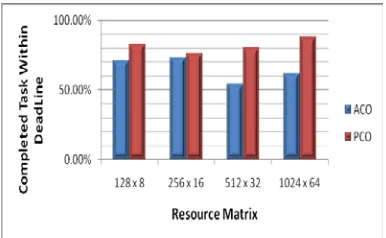
Figure 2: Deadline comparison
Figure 3: Cost comparison
The most optimist solution can be worked out in Particle Swarm Optimization algorithm by the cooperation of each individual. The particle without quality and volume serves as each individual, and the simple behavioral pattern is regulated for each particle to show the complexity of the whole particle swarm.This algorithm can be used to work out the complex optimist problems. Due to its many advantages including its simplicity and easy implementation, the algorithm can be used widely in the fields such as function optimization, the model classification, machine study, neutral network training, the signal procession, vague system control and automatic adaptation control.
Figure 1: makespan comparison
6. Conclusion
High quality solutions are needed in NP-hard problems. In dynamic scheduling, like cloud, focus is on effective evaluation of alternative paths. Compared with the other developing calculations,
Sch. Algo
Resour ce Matrix
Makespan Cost (Rs) Dead Line
ACO
128 x 8 1013432.65 1723418.78
71.12 %
PSO 977234.37 1273176.98 82.5%
ACO
256 x 16
1056734.24 1782254.34 73%
PSO 1025281.76 1735469.87 76.23
% ACO
512 x 32
1030043.37 1795321.43 53.9%
PSO 1000582.33 1686234.72 80.25
%
ACO
1024 x 64
1068347.69 1765692.83 61.47
%
PSO 1041251.74 1732785.83 87.89
%
PSO occupies the bigger optimization ability and it can be completed easily. PSO adopts the real number code, and it is decided directly by the solution. PSO can be easily implemented and has proven both very effective and quick when applied to a diverse set of optimization problems in cloud scheduling. PSO has no overlapping or mutation calculation and the speed of the researching is very fast. PSO is a clustering algorithm in the areas of multi-objective, dynamic optimization and constraint handling which is best suitable for cloud environments. PSO is applicable for problems that are fuzzy in nature. From the above analysis, PSO algorithm outperforms ACO in terms of makespan, deadline and cost. So, PSO algorithm in cloud scheduling is a better option when compared to ACO.
References
[1] I. Foster and C. Kesselman. The Grid: Blueprint for a New Computing Infrastructure. Morgan Kaufmann Publishers, 1998.
[2] K. Q. Yan, S. C. Wang, C. P. Chang, and J. S. Lin. A hybrid load balancing policy un-derlying grid computing environment.
Computer Standards and Interfaces, 29(2):161173, 2007.
[3] I. Foster and C. Kesselman. The Grid: Blueprint for a New Computing Infrastructure. Morgan Kaufmann Publishers, 1998.
[4] R. Schoonderwoerd,O.E. Holland, J. L. Bruten, and L. J. M. Rothkrantz. Ant-based load balancing in telecommunications networks. Adaptive Behavior, (2):169{207, 1996.
[5] C. Grosan, A. Abraham, and B. Helvik. Multiobjective evolutionary algorithms for scheduling jobs on computational grids. ADIS International Conference, Applied Com- puting, Salamanca, Spain, Nuno Guimares and Pedro Isaias 2007.
[6] M. Dorigo, V. Maniezzo, et A. Colorni, Ant system: optimization by a colony of cooperating agents, IEEETransactions on Systems, Man, and Cybernetics--Part B , volume 26, numéro 1, pages 29-41, 1996.
[7] E. Ridge, D. Kudenko, D. Kazakov, and E. Curry,“Moving Nature-Inspired Algorithms to Parallel, Asynchronous and Decentralised Environments,” in Self-Organization and
Autonomic Informatics (I), 2005, vol.135, pp. 35-49.
[8] Shah-Hosseini, Hames (2009). “The intelligent water drops algorithm: a nature-inspired swarm-based optimization algorithm”. International Journal of Bio-Inspired Computation 1 (1/2) : 71-79.
[9] Karaboga, Dervis (2010)Artificial bee colony algorithmScholarpedia, 5(3): 6915.
[10] M. Livny and M. Melman. Load balancing in homogeneous broadcast distributed systems. SIGMETRICS Performance Evaluation Review, 11(1):47{55, 1981.
[11] Y. Li and Z. Lan. A Survey of Load Balancing in Grid Computing. Springer Berlin / Heidelberg, 2005.
[12] K. Kousalya and P. Balasubramanie,” Task Severance and Task Parceling Based Ant Algorithm for Grid Scheduling”, International journal of computational cognition (http://www.ijcc.us), vol. 7, no. 4, december 2009. [13] D. Merkle, M. Middendorf, and H. Schmeck, “Ant colony optimization for resource-constrained project scheduling,” IEEE Trans. Evol. Comput.,vol. 6, no. 4, Aug. 2002.
[14] Yarkhan .A, J. Dongarra, “Experiments with scheduling using simulated annealing in a grid environment”, in: 3rd International Workshop on Grid Computing, 2002.
[15] Abraham, R. Buyya, and B. Nath.” Nature’s heuristics for scheduling jobs on computational Grids”. In The 8th IEEE International Conference on Advanced Computing and Communications (ADCOM 2000), India, 2000.
[16] V. Di Martino, M. Mililotti, “Sub optimal scheduling in a grid using genetic algorithms”, Parallel Computing 30 (2004) 553–565.
[17] Lei Zhang, Yuehui Chen, Bo Yang “Task scheduling Based on PSO Algorithm in Computational Grid”, 2006 Proceedings of the 6th International Conference on Intelligent Systems Design and Applications, vol-2, 16-18 Oct, 2006, Jinan, China.
[18] Xiaohong Kong, Jun Sun and Wenbo Xu “Particle Swarm Algorithm for Tasks Scheduling in Distributed Heterogeneous System”, 2006 Proceedings of the Sixth International Conference on Intelligent Systems Design and Applications. [19] Shih-Tang Lo, Ruey-Maw Chen, Der-Fang Shiau and Chung-Lun Wu “Using Particle Swarm Optimization to Solve Resource-constrained
Scheduling Problems” IEEE Conference on Soft Computing in Industrial Applications, 25-27 June, 2008, Muroran.
1. S.J.MOHANA
She has completed her Post Graduate with M.Phil from Bharathiar University, Coimbatore. Now, she is working as an Assistant Professor in Erode Arts and Science college, Erode. She presented 1 International Conference and 1 International workshop .Many national and international journals are also published. She is intersted in Grid computing, cloud computing, advanced networking. Now she is doing research papers in cloud computing.
2. Dr. M.SAROJA
She had completed her Ph.D., in Bharathiar university, Coimbatore. She is working as an Associate Professor in Erode Arts and Science College, Erode. She has published many national and international journals. She has presented many papers in international and national conferences. Her area of interest includes mobile computing, cloud computing and thin films.
3. Dr. M.VENKATACHALAM
He had completed his Ph.D., in Bharathiar university, Coimbatore. He is working as an Associate Professor & Head, in Erode Arts and Science College, Erode. He has published numerous papers in national and international journals.He has presented many papers in international and national conferences. His area of interest includes thin films, grid computing and cloud computing.