ISSN(Online): 2319 - 8753
ISSN (Print): 2347 - 6710
I
nternational
J
ournal of
I
nnovative
R
esearch in
S
cience,
E
ngineering and
T
echnology
(An ISO 3297: 2007 Certified Organization)
Vol. 4, Issue 3, March 2015
Strength Properties of Concrete Using
Crumb Rubber with Partial Replacement of
Fine Aggregate
S.Selvakumar1, R.Venkatakrishnaiah2
P.G. Student, Department of Civil Engineering, Adhiparasakthi Engineering College, Melmaravathur, India1 Associate Professor, Department of Civil Engineering, Adhiparasakthi Engineering College, Melmaravathur, India2
ABSTRACT: Concrete is most widely used building material in the world, as well as the largest user of natural
resources with annual consumption of 12.6 billion tons. Basically it consists of aggregates which are bonded together by cement and water. The major part of concrete besides the cement is the aggregate. Aggregate include sand and crushed stone / Gravel. Use of these conventional materials in concrete is likely to deplete the resources unless there is a suitable substitute. Rubber which is generated in large quantities as waste does not have useful disposal till now. But rubber is found to possess properties that are required for viable replacement of fine aggregate in concrete. Hence we in this project have aimed to study the effectiveness of rubber as substitute for fine aggregate and utilize the crumb rubber tyres in concrete, to minimize global warming. Aggregate properties viz., specific gravity, water absorption, acid resistance were to be conducted to ascertain the properties concrete specimens were to be casted and tested for concrete mix with various percentage of replacement (5%,10%,15% &20%) and its viability for replacement are discussed in this project.
KEYWORDS: Crumb rubber, Compressive strength, Splitting tensile strength, Flexural Strength, Fine aggregate.
I.INTRODUCTION
The use of rubber product is increasing every year in worldwide. India is also one the largest country in population exceeds 100cr. So the use of vehicles also increased, according to that the tyres for the vehicles also very much used and the amount of waste of tyre rubber is increasing. This creates a major problem for the earth and their livings. For this issue, the easiest and cheapest way of decomposing of the rubber is by burning it. This creates smoke pollution and other toxic emission and it create global warming. Currently 75-80% of scrap tyres are buried in landfills. Only 25% or fewer are utilized as a fuel substitute or as raw material for the manufacture of a number of miscellaneous rubber goods. Burying scrap tyres in landfills is not only wasteful, but also costly. Disposal of whole tyre has been banned in the majority of landfill operations because of the bulkiness of the fires and their tendency to float to the surface with time. Thus, tyres must be shredded before they are accepted in most landfills.So many recycling methods for the rubber tyre are carried according to the need. From this one of the processes is to making the tyre rubber in to crumb rubber. It is used in many works such as Road construction, Mould making etc
Ilker Bekir Topcu et al(1995) proposed the concrete was modified by mixing with crumb rubber in coarse aggregate in the ratio of 15%, 30% and 45%. In this study the changes of the properties of rubberized concrete were investigated according to the terms of both size and amount of rubber chips added. In this the physical and mechanical properties were determined according to that the stress strain diagram were developed from that the toughness value and the plastic and elastic energy capacities were determined.
ISSN(Online): 2319 - 8753
ISSN (Print): 2347 - 6710
I
nternational
J
ournal of
I
nnovative
R
esearch in
S
cience,
E
ngineering and
T
echnology
(An ISO 3297: 2007 Certified Organization)
Vol. 4, Issue 3, March 2015
addition of rubber. (Rubber type had only marginal effect.) Density varied between about 1300 and 2300 kg/m3. Compressive strength reduced by 70% when the proportion of rubber to total solid content by mass of concrete reached about 13%.
Piti Sukontasukkul et al(2004) proposed the paper on crumb rubber concrete. In their study they decided to replace the course and fine aggregate in concrete for moulding pedestrian blocks. They believe that the concrete acting as a binder mixed with crumb rubber can make the concrete blocks more flexible and it provide softness to the surface. In this study they saw that the pedestrian blocks with crumb rubber performed quite well in skid and abrasion resistance. In this study the process of making the concrete is economical due to the simplicity of the manufacturing process.
II.EXPERIMENTAL INVESTIGATION
Materials Cement
Ordinary Portland cement of Ultratech brand of 53 grade confirming to IS 12269-1987(9) was used in the present study. The properties of cement are shown in Table 1.
Table 1 Properties of Cement
Sl.No Property Result
1 Initial Setting time 35min
2 Specific Gravity 3.148 3 Fineness Modulus 1.5%
Fine Aggregate
Natural sand as per IS: 383-1987 was used. Locally available river sand having bulk density 1860kg/m3 was used. The properties of the fine aggregate are shown in Table 2.
Table 2 Properties of Fine Aggregate
Sl.No Property Result
1 Specific Gravity 2.55 2 Fineness Modulus 2.36% 3 Water Absorption 0.50%
Coarse Aggregate
Crushed aggregate confirming to IS: 383-1987 was used. Aggregate of size 12mm of specific gravity 2.63 and fineness modulus are shown in Table 3.
Table 3 Properties of Coarse Aggregate
Sl.No Property Result
1 Specific Gravity 2.63 2 Fineness Modulus 6.75% 3 Water Absorption 2.4%
Crumb Rubber
The properties of crumb rubber are shown in Table 4.
Table 4 Properties of Crumb Rubber
Sl.No Property Result
1 Specific Gravity 1.72 2 Fineness Modulus 4.48% 3 Water Absorption 2%
ISSN(Online): 2319 - 8753
ISSN (Print): 2347 - 6710
I
nternational
J
ournal of
I
nnovative
R
esearch in
S
cience,
E
ngineering and
T
echnology
(An ISO 3297: 2007 Certified Organization)
Vol. 4, Issue 3, March 2015
Mix Proportioning
Concrete mix design in this experiment was designed as per the guidelines in IS 10262-2009. All the samples were prepared using design mix. M30 grade of concrete was used for the present investigation. Mix design was done based on I.S 10262-2009. The table 5 shows mix proportion of concrete (Kg/m3)
Table 5 Mix proportioning
Water Cement Fine Aggregate Coarse Aggregate
160litres 380.95 Kg/m3 696.71 Kg/m3 1169.72 Kg/m3 0.42 1 1.82 3.07
III.EXPERIMENTAL PROCEDURE
The specimen of standard cube of (150mmx150mmx150mm) and standard cylinders of (200mmx100mm) and prisms of (100mmx100mmx500mm) were used to determine the compressive strength, split tensile strength and flexural strength of concrete. Three specimens were tested for 7&28 days with proportion of crumb rubber replacement. Totally 30 cubes, 30 cylinders and 30 prisms were cast the strength parameters and 15 cubes for acid attack test. The constituents were weighed and the materials were mixed by hand mixing. The water cement ratio was 0.42.
Experiments Conducted
The following experiments are conducted on the specimen cast.
Compression test
Splitting tensile test
Flexural test
Specimen Details
From the study of the past literatures, the conventional concrete grade was chosen as M30 for replace the crumb rubber in the fine aggregate. Tests for physical properties of the materials have done and the mix ratio for the concrete was calculated by the materials properties as 1:1.82:3.07 and the water to cement ratio of 0.42% had been chosen.
Results and Discussion
The normal and crumb rubber concrete are tested for their performance by determining their compressive strength, splitting tensile strength and flexure strength development at different ages of 7th and 28th days. The results obtained are discussed in detail in the following sections.
Compressive Strength
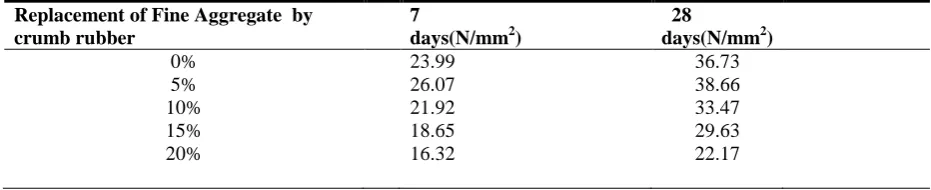
The limit of compressive strength of the cement concrete depends on both, the strength of the matrix and the particle tensile strength of the aggregate. The strength of the concrete is usually related to the cement content and water to cement ratio. However, in this study the crumb rubber is partially replaced with fine aggregate and test the strength under compression. The compression strength of the concrete at 7th and 28th day were conducted is given in Table 6.
Table 6 Compressive strength of normal and crumb rubber concrete.
Replacement of Fine Aggregate by crumb rubber
7
days(N/mm2)
28
days(N/mm2)
0% 5% 10% 15%
23.99 26.07 21.92 18.65
ISSN(Online): 2319 - 8753
ISSN (Print): 2347 - 6710
I
nternational
J
ournal of
I
nnovative
R
esearch in
S
cience,
E
ngineering and
T
echnology
(An ISO 3297: 2007 Certified Organization)
Vol. 4, Issue 3, March 2015
Splitting tensile strength
The splitting tensile strength of the crumb rubber concrete with the different percentage replacement of crumb rubber by fine aggregate in normal concrete at the 7th and 28th day results were to be tabulated in Table 7.
Table 7 Splitting tensile strength of normal and crumb rubber concrete.
Flexural Strength
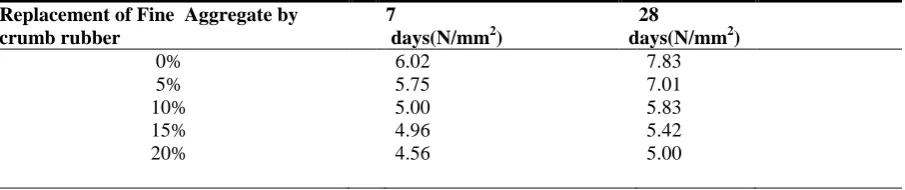
The flexural strength of the normal and crumb rubber concrete for the different proportions of crumb rubber in fine aggregate at 7th and 28th day results were given in the Table 8.
Table 8 Flexural strength of normal and crumb rubber concrete.
IV.CONCLUSION
From this study the effective utilization of rubber tyre waste as been developed and it made to used in the concrete mixture as fine aggregate. At present the crumb rubber production in the south India is very less than north. So the material availability was less, because of less knowledge about that. Based on the test results the following conclusions were made. These can also include non primary structural applications of medium to low strength requirements, benefiting from other features of this type of concrete.
Even if rubber tyre aggregate was used at relatively low percentages in concrete, the amount of waste tyre rubber could be greatly reduced due to the very large market for concrete products worldwide. Therefore the use of discarded tyre rubber aggregates in concrete shows promise for developing an additional route for used tyres.
The compressive strength of crumb rubber concrete with 5% replacement is 38.66 N/mm2; it is higher than the strength of normal concrete (36.73N/mm2) on 28th day.
The compressive strength of crumb rubber concrete with 10% replacement, it gives acceptable strength of 33.47 N/mm2
In splitting tensile strength the strength of crumb rubber concrete is lower than the strength of normal concrete.
In the flexural strength test conducted on crumb rubber concrete it shows a decrease in strength when compared to the strength of normal concrete.
From the test results, it is found that the crumb rubber posses less bonding ability which has affected on the strength of the concrete.
Replacement of Fine Aggregate by crumb rubber
7
days(N/mm2)
28
days(N/mm2)
0% 5% 10% 15% 20%
2.22 2.86 2.22 2.01 1.87
4.08 3.50 2.96 2.59 2.17
Replacement of Fine Aggregate by crumb rubber
7
days(N/mm2)
28
days(N/mm2)
0% 5% 10% 15% 20%
6.02 5.75 5.00 4.96 4.56
ISSN(Online): 2319 - 8753
ISSN (Print): 2347 - 6710
I
nternational
J
ournal of
I
nnovative
R
esearch in
S
cience,
E
ngineering and
T
echnology
(An ISO 3297: 2007 Certified Organization)
Vol. 4, Issue 3, March 2015
REFERENCES
[1] Ilker Bekir Topcu (1995) “The properties of rubberized concrete”, Cement and Concrete Research, Vol. 25, No.2, pp. 304-310, 1995.
[2] N. I. Fattuhi and L. A. Clark (1996) “Cement-based materials containing shredded scrap tyre rubber” Construction and Building Materials, Vol. 10, No. 4, pp. 229-236, 1996.
[3] Piti Sukontasukkul and Chalermphol Chaikaew (2004) “Properties of concrete pedestrian block mixed with crumb rubber”. Construction and Building 20 (2004) 450- 457.
[4] Piti Sukontasukkul (2008) “Use of crumb rubber to improve thermal and sound properties of pre-cast concrete panel”, Construction and Building Materials 23 (2008) 1084–1092.
[5] P. C. Varghese fourth edition “Building materials” text book may 2009.
[6] IS: 2386 (part 2) Method of testing of sand. Determination of Specific gravity of sand.
[7] IS: 2386 (part 3 & 4) Method of testing of coarse aggregate. Determination of Specific gravity and Crushing value. [8] IS: 2720 (part 3) Method of testing of soil. Determination of Specific gravity.
[9] IS: 8112-1989 Method of testing of cement. Determination of Initial and Final setting time. [10] IS: 516 – 1959 Methods of tests for Strength of concrete.