R E S E A R C H
Open Access
An interplay model for official information
and rumor spreading with impulsive effects
Liang’an Huo
1*and Xiao Li
1*Correspondence: [email protected] 1Business School, University of
Shanghai for Science and Technology, Shanghai, China
Abstract
When an emergency event occurs, it inevitably causes some rumors, and the government always issues some official information to control rumors; then the rumors and official information can interact with each other. In this paper, an interplay model between official information and rumor spreading with impulsive effects is proposed to simulate the government strategies in emergency management. By using Floquet theory and comparing methods involving multiple Lyapunov
functions, the thresholds for rumor eradication and system permanence are obtained. The influence of the analytical threshold on the stability of a system is verified in a numerical simulation. Finally, some suggestions are provided for the government to eliminate losses causing rumor effect in emergencies.
Keywords: Interplay model; Impulsive effects; Official information; Rumors spreading
1 Introduction
There will always be arising rumors when a social emergency occurs. Rumors can shape public opinion and affect beliefs, thereby changing individuals’ attitude toward social, eco-nomic, and political aspects; improper control can easily cause social confusion and losses [1]. Meanwhile the proliferation of rumors will lead to new emergencies and cause cas-cade reactions. In this sense, the study of spreading of rumors is necessary and of great significance.
Recently, rumor spreading theory has been widely addressed by scholars. Daley and Kendal [2,3] introduced a standard model of rumor spreading, in 1965. In the research field of complex systems, complex network knowledge has been widely used [4]. Zanette used complex network theory to study rumor spreading, and established a rumor spread-ing model based on a small world network [5]. As the model of rumor spreading has been fully studied and analyzed, scholars also have begun to discuss the various factors affecting rumors [6–8]. The internal and external factors of a social network have a comprehensive effect on rumor spreading, such as node vitality and heterogeneous network spreading environment [9]. In recent years, the study of rumor spreading has undergone various ex-plorations. Aiming at the spreading of rumors online, Zhang et al. proposed an anomaly detection method based on an automatic encoder to detection rumors [10]. Multiple ru-mors cascading form a network of intensive collaboration, for such networks, the ways to prevent rumors from spreading effectively can borrow groups formed by repetitive
mor spreaders [11]. Based on the dynamic rule of rumor spreading, Han et al. proposed a new SIDR rumor spreading model, considering the psychological factors of “suspicion” and using a full coverage monitoring scheme to prevent and control rumors [12].
The emergency often is accompanied by rumor spreading, which causes social chaos and new derivative accidents. In China, the government always plays the manager role in emergency, and always tends to use official information to dispel the rumors; it will reduce this dampening effect brought about by rumors. Official information is a good factor to guide rumor spreading. Enhancing the enthusiasm of positive news communicators can smoothly guide and restrain rumor spreading, to eliminate a cascade reaction of rumors in emergency events [13–15]. Zhang et al. presented a model describing turnout spreading and emergency development, indicating that rumors propagate at a certain speed [16]. The interaction mechanism between government media can effectively prevent the deteriora-tion of emergency and make rumors play a positive role in the evoludeteriora-tion of an emergency [17]. The coupling of official government communication and rumor spreading provides a rational way for limiting the spread of rumors after emergency [18]. The government will adjust the emergency strategies in real time according to the actual situation, issuing pub-lic official information about emergency events or refute specific rumors. The government emergency strategies have pulse characteristics with periodical performance [19,20]. Dis-crete impulse theory is widely used in exponential synchronization of complex networks with random disturbances strategies [21–23], and this paper add discrete impulse to the differential equation system.
The existing literature lacks interaction research between official information and ru-mors, in this paper, we consider the characteristics of government emergency strategies and establish an interplay model to simulate the interaction between official information and rumor spreading. Taking government emergency strategies as a pulse adding system, we verified the dynamic behavior of the model by analytical methods and a numerical simulation, and we obtain the thresholds for rumor eradication and system permanence. Finally, we provide some suggestions for the government to eliminate losses caused by rumors in an emergency.
The rest of this paper organized as follows: In Sect.2, we introduce the proposed model and variables meaning. In Sect.3, we make preparations by presenting some definitions and three lemmas for the following proofs. In Sect.4, we study the condition for rumor eradication and system permanence, respectively. In Sect.5, by numerical simulations we confirm our theoretical results. Finally, a conclusion is given in Sect.6.
2 An interplay model for official information and rumor spreading with impulsive effects
We will reference a functional response function to describe the functional response of official information to relevant rumors [24]. It describes the influence of rumor spreaders to official information disseminators at different stages. With the increase of the number of rumor spreaders, the intensity of rumor spreading first rises and then decreases. Simi-larly, when rumor spreaders are confronted with government information disseminators (similar to the ignorant who is not familiar with rumors in [24]), the influence of rumors on government information disseminators first increases and then decreases. We have
wx(t),y(t)= βx(t)y(t)
wherex(t) represents the number of spreader who hear, believe and spread rumors,y(t) represents the number of disseminators who know and disseminate official information.
β represents the informed probability of the official information, αrepresents the psy-chological effect of the behavioral change of the official information disseminator when the numbers of rumor spreaders change. In fact, the functional response function is the marginal utility of rumors to official information in the interplay process. When the rumor spreader meets the official information disseminator, the former will with a certain proba-bility then transform into the person who disseminates the official information. Owing the inhibition effect or weary effect from the increased rumor spreaders, the transform prob-ability is reduced, influencing the final scope of rumor spread. Therefore, the instant inter-play between official information and rumors will reduce the number of rumor spreaders and increase the number of official information disseminators. With fixed y(t), the re-sponse function will gradually be increasing when rumor spreaderx(t) on a small level, and with the increase of rumor spreadersx(t),w(x,y) will reach the peak value, after that it will be decreasing. This is because of reasons such as the interest of the rumor spread-ers and so on, the influence of rumors on government information disseminators first increases and then decreases. If the number of people spreading rumors tends to infinite, the influence of rumors on government information tends to zero.
We assume rumor spreadersx(t) always obeys logistic growth,ris the intrinsic growth coefficient ofx(t), and the greatest bearing capacity of society on rumor spreaders isk. The functional response function is in Eq. (1), which describes the interplay between official information and rumor spreading,γ is the conversion coefficient telling us official infor-mation disseminators assimilating the number of the rumor spreaders in unit time. The official information disseminators will lose interest for the already known official informa-tion with a rated. We established an impulsive differential system, the function of official information disseminator and rumor spreader, to model the dynamic interplay process of official information and rumors in emergency. The government always tends to use official information to clear up the rumors, it will reduce the negative effects of rumor spreading. We take government strategies of official information as a pulse added to the interplay system in the emergency response process. We divide those strategies into two types: one is refuting specific rumors according to the influence range of rumors,qrepresents the strength of this strategy (0≤q< 1). The other is the periodic public official information about emergency events, for which is always assumed that the public official information will release through official channels periodically,prepresents the number of new dissem-inators for each time public official information release (p≥0). Then we have an interplay model for official information and rumor spreading with impulsive effects as follows:
⎧
3 Preliminaries
In this section, we reference the definitions in [25], giving the following notations and three lemmas that will be used for the later sections.
LetR+= [0,∞),R2+={x∈R2:x≥0}Ω=intR2+,Nbe the set of all non-negative integers. (2) Vis locally Lipschitzian inx.
Definition 3.1 V∈V0, then, for (t,x)∈(nT, (n+ 1)T]×R2+, the upper right derivative of
Definition 3.2 System (2) said to be persistent if there exist positive constantsm> 0,
M> 0 (independent of initial value) and a finite timeT0, such that for each positive solution (x(t),y(t)) of system (2) is satisfiedm≤x(t)≤M,m≤y(t)≤M, for allt>T0.
The solution of system (2) is a piecewise continuous function x(t) :R+→R2+, x(t) is continuous on (nT, (n+ 1)T], andx(nT+) =lim
t→nT+x(t) exists. Obviously the smoothness
properties off guarantee the global existence and uniqueness of solutions of system (2) (see [26,27] for details on the fundamental properties of impulsive systems).
It is easy to prove the following lemma.
Lemma 3.1 Let x(t)is a solution of system(2)with x(0+)≥0,then x(t)≥0for all t≥0
and further x(t) > 0,t≥0if x(0+) > 0.
We will use the following comparison theorem for later proofs [26].
Lemma 3.2 Suppose V∈V0,and assume that
maximal solution of the scalar impulsive differential equation,
Considering the application of comparison theorem in differential equations, we give some basic properties of the following subsystem of system (2):
⎧
the positive periodic solution of system (3):
y(t) =
complete expression for the rumor-eradication periodic solution of system(2),
4 Rumor eradication and system permanence
In this section, we will study the condition for rumor eradication and system permanence, respectively. Firstly, we show that all solutions of system (2) ultimately are bounded from Theorem4.1. By using Floquet theory and the small amplitude perturbation method [28], we obtain the conditions for the local stability of a rumor eradication periodic solution (0,y∗(t)) from Theorem4.2. We named it the rumor eradication theorem. Based on Defi-nition3.2, we will show the conditions for the permanence of system (2) from Theorem4.3. We named it the system permanence theorem.
Theorem 4.1 There exists a constant M> 0such that x(t)≤M,y(t)≤M for each solution
(x(t),y(t))of system(2)with all t large enough.
Proof Suppose (x(t),y(t)) is any solution of system (2). Define
ThenV∈V0,
ThereforeV(t) is ultimately bounded by a constant and there exists a constantM> 0, such thatx(t)≤M,y(t)≤Mfor each solution (x(t),y(t)) of system (2) with alltlarge enough.
The proof is completed.
Theorem 4.2 Let (x(t),y(t)) be any solution of system (2), if p> dβ[rT –ln(1–1q)] then
(0,y∗(t))is said to be locally asymptotically stable.
Proof The locally asymptotical stability of the periodic solution (0,y∗(t)) may be deter-mined by considering the behavior of a small amplitude perturbation of the solution. De-finex(t) =u(t),y(t) =y∗(t) +v(t). Herev(t) is a small perturbation from system (2), and we
The matrix solution matrixΦ(t) satisfies
Φ(t) =
After adding impulses, system (2) becomes
By the Floquet theory of impulsive differential equations [28], (0,y∗(t)) is locally asymp-totically stable if|p1|=exp(–d×T) and|p2|= (1 –q)exp
T
0 (r–βy∗)dtthe absolute values of both eigenvalues are less than one, thus we obtain the conditionsp>βd[rT–ln(1–1q)] for
the local stability of the rumor eradication periodic solution.
Theorem 4.3 If p<βd[rT–ln(1–1q)]then system(2)is persistent.
Proof Suppose that (x(t),y(t)) is any solution of system (2) withx(0) > 0. By Theorem4.1, we have proved that there exists a constantM> 0, such thatx(t)≤M,y(t)≤MandM>k, fortlarge enough. Then we will prove that the solution of system (2) has lower bounds to complete the proof of system permanence.
moreover, we can obtain the following result: rem4.1. Therefore, the first assumption is not true. Hence there exists at1> 0 such that
the first equation of system (2) gives
which is a contradiction to assumption three. Therefore, assumption three is not true. Thus fort∈(n1T, (n1+ 1)T+T] we getx(t)≥m3. And assumption two is really true,t∗is
From Theorem4.2and Theorem4.3, we know that the impulsive differential system de-scribes the interplay between official information and rumor spreading in emergency, and there exist two states: rumor eradication and system permanence. We see that the ru-mor eradication periodic solution (0,y∗(t)) is locally asymptotically stable if the condition
p>pthr=dβ[rT–ln
1
(1–q)], is satisfied and system (2) is persistent ifp<pthr. Moreover, we also get an inference about the rumor eradication and system permanence as follows.
Inference 5.1 Let (x(t),y(t)) be any solution of system (2), if the conditionq>qthr= 1 –
exp(pdβ –rT) is satisfied, then (0,y∗(t)) is said to be locally asymptotically stable. Ifq<
qthr,then system (2) is persistent.
The two government strategies we mentioned above are: firstly, timely release of pub-lic official information on emergency events, through government bulletins, government websites, press conferences, newspapers, radio, television and other news media to make the masses aware of the event and avoid panic. Secondly, according to the influence range of various rumors, refuting the specific rumors through government information channels in a timely manner. As is well known, the corresponding continuous system (2) cannot be solved explicitly and is not an infinite system. So we have to study the numerical simula-tions of system (2), and consider the following set of parameters to our analysis:
r= 0.95, β= 0.04, γ = 0.5, d= 0.2,
Figure 1Time-series of the spreaderxfor eradication and the disseminatoryfor oscillation
According to Theorems4.2–4.3and Inference5.1, we get the threshold value of the pub-lic official information pulsepand the threshold values for the pulse strengthqof refuting specific rumors. Ifp>pthrorq>qthr, the periodic solution (0,y∗(t)) is locally asymptoti-cally stable. A typical rumor eradication periodic solution is obtained through simulation, and we find that the variabley(t) oscillates in a stable cycle, whereas the number of ru-mor spreaders x(t) drops rapidly to zero (Fig.1). The state of rumor eradication is that over time, the validity of the official information is oscillating in a stable limit cycle, and the negative social impact of rumors tends to disappear. Ifp<pthrorq<qthrthe system is persistent, that is, rumors can be spread among all people, and the official information disseminator is far lower than the rumor spreaders (Fig.2). The phase portrait (T-periodic solution) ofx(t),y(t) showsxandycan coexist on a positive periodic solution, an early shock eventually forms a limit cycle (Fig.3). We say the system persistent if we have valid-ity of official information and a negative influence of rumors, oscillation tends to a stable limit cycle, continuing by oscillation in a quasi-periodic or periodic period.
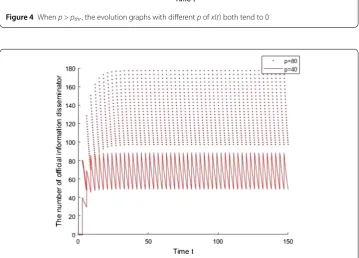
In addition, we study the effects of two kinds of pulses to the system, in the manner of control variate. Firstly fixing the parameterq= 0.5, we get the threshold ofpby calculating the system parameters:pthr= 39. Moreover, setting differentpvalues, we found that, if
p>pthris satisfied, and the rumor spreadersx(t) will tend to zero. The larger the value of
pis, the fasterx(t) tends to zero, the smaller the influence range of rumor spreading (Fig.4). At the same time, the official information disseminatory(t) is directly proportional to the public official information pulse about the emergency. The larger the value ofpis, the more people on the impulse period node who get official information (Fig.5). This is because the government has intensified its propaganda of official information, and more and more people have been informed of official information, thus affecting the spread of rumors. As long as the intensity is greater than a certain threshold, the rumors will disappear in the end.
Figure 2Time-series of the spreaderxand the disseminatoryfor permanence
Figure 3Phase portrait (T-periodic solution) of the spreader and the disseminator population of system (2)
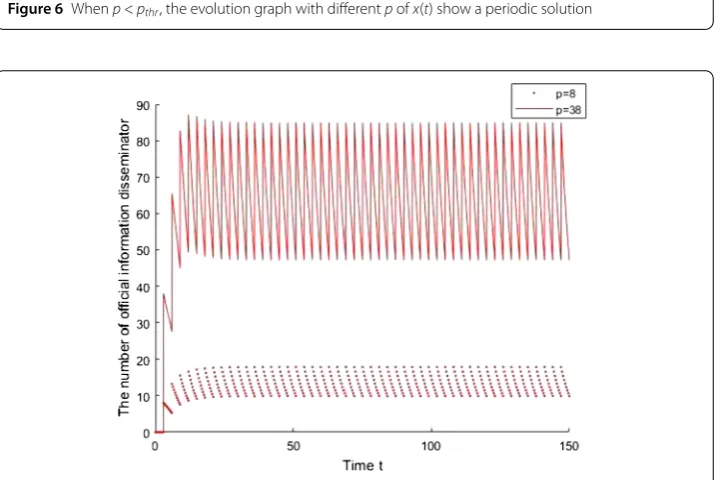
contrary,pvalue has a significant effect on official information disseminator. The larger the value ofp, the more the official information disseminator is on the impulse period node. The smaller the value ofp, the fewer official information disseminators on the impulse period node, which disseminator will oscillate between smaller values, but will not tend to zero (Fig.7).
Figure 4Whenp>pthr, the evolution graphs with differentpofx(t) both tend to 0
Figure 5Whenp>pthr, the evolution graph with differentpofy(t) are in oscillation
spreading will not worsen further. Our conclusion is: strengthen the official emergency response, pay attention to the real-time dynamics of emergency, do a timely release of public official information on events, and bring the emergency into the field of emergency development.
Figure 6Whenp<pthr, the evolution graph with differentpofx(t) show a periodic solution
Figure 7Whenp<pthr, the evolution graph with differentpofy(t) show a periodic solution
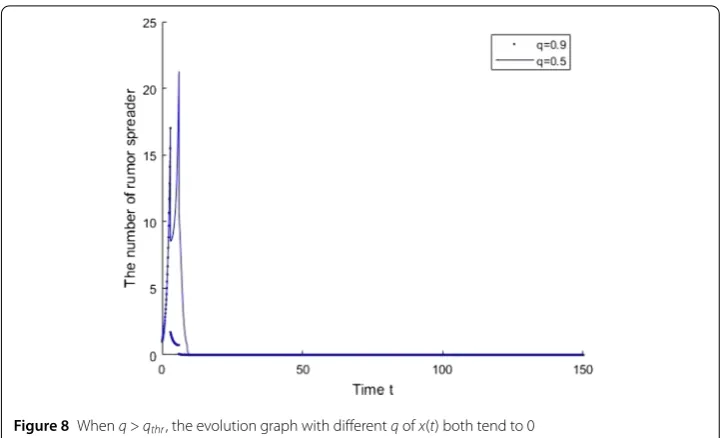
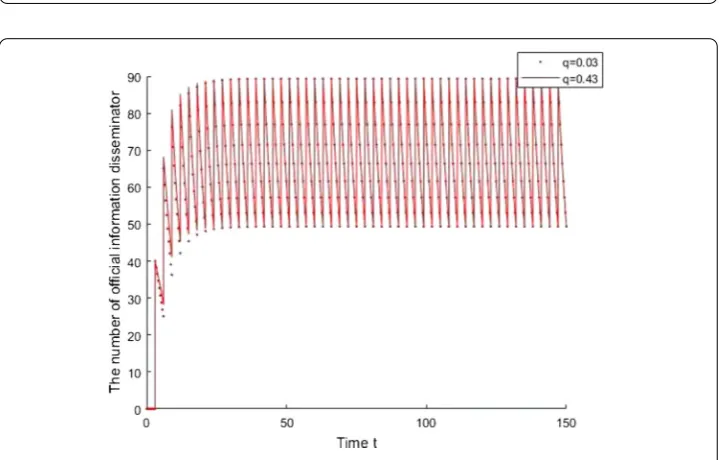
spreading, the faster the rumor spreaders tend to zero (Fig.8). Compared with the differ-ent values ofq, all the official information disseminatorsy(t) oscillate on the same level of positive periodic solution (Fig.9).
Whenq<qthr, the smaller value ofqwill make the rumor spreaders approach a constant value which means rumors break out and everyone knows rumors. The smaller the value ofq, the more rumor spreaders on the impulse period node, we say that the rumor spreader is inversely proportional to the refuting specific rumors strength pulseq(Fig.10). With differentqvalues, the official information disseminatory(t) oscillates on the same level of positive periodic solution (Fig.11).
Figure 8Whenq>qthr, the evolution graph with differentqofx(t) both tend to 0
Figure 9Whenq>qthr, the evolution graph with differentqofy(t) are in oscillation
regard to the serious negative impact on society by the rumor spreading, the government should consider to stop to report the public official information temporary (i.e. pulsep
can be zero), make every effort to suppress all kinds of rumors, strengthen theq pulse strength of refuting specific rumors, and make the rumor spreaders tend to zero quickly in the system.
6 Conclusions
Figure 10 Whenq<qthr, the evolution graph with differentqofx(t) are in a periodic solution
Figure 11 Whenq<qthr, the evolution graph with differentqofy(t) are in a periodic solution
flood and the system is a persistent system, which may generate cascade reactions and trigger new emergencies. The numerical simulation confirmed our conclusion, that is to say, to eliminate social losses caused by rumors and calm down emergency effectively, the government can increasingly issue public official information of events, or increase the strength of refuting specific rumors according to the influence range of rumors timely.
Acknowledgements
The authors are very grateful to the anonymous referees for their valuable comments and suggestions, helping them to improve the quality of this paper.
Funding
Competing interests
The authors declare that they have no competing interests.
Authors’ contributions
LAH conceived of the study, proposed the project, helped to draft the manuscript. XL carried out the computations in the proof, and drafted the manuscript. All authors read and approved the final manuscript.
Publisher’s Note
Springer Nature remains neutral with regard to jurisdictional claims in published maps and institutional affiliations.
Received: 17 January 2019 Accepted: 14 April 2019
References
1. Ndii, M.Z., Carnia, E., Supriatna, A.K.: Mathematical models for the spread of rumors: a review. In: Issues and Trends in Interdisciplinary Behavior and Social Science, pp. 65–73. CRC Press, Boca Raton (2018)
2. Daley, D.J., Kendall, D.G.: Stochastic rumours. IMA J. Appl. Math.1(1), 42–55 (1965)
3. Daley, D.J., Gani, J.: Epidemic Modelling: An Introduction. Cambridge University Press, Cambridge (2001) 4. Nekovee, M., Moreno, Y., Bianconi, G., et al.: Theory of rumor spreading in complex social networks. Phys. A, Stat.
Mech. Appl.374(1), 457–470 (2007)
5. Zanette, D.H.: Criticality of rumor propagation on small world networks. arXiv preprint (2001).
arXiv:cond-mat/0109049,https://doi.org/10.1103/physreve.65.041908
6. Hu, Y., Pan, Q., Hou, W., et al.: Rumor spreading model with the different attitudes towards rumors. Phys. A, Stat. Mech. Appl.502, 331–344 (2018)
7. Liu, W., Wu, X., Yang, W., et al.: Modeling cyber rumor spreading over mobile social networks: a compartment approach. Appl. Math. Comput.343, 214–229 (2019)
8. Dong, S., Fan, F.H., Huang, Y.C.: Studies on the population dynamics of a rumor-spreading model in online social networks. Phys. A, Stat. Mech. Appl.492, 10–20 (2018)
9. Huo, L., Cheng, Y., Liu, C., et al.: Dynamic analysis of rumor spreading model for considering active network nodes and nonlinear spreading rate. Phys. A, Stat. Mech. Appl.506, 24–35 (2018)
10. Zhang, Y., Chen, W., Yeo, C.K., et al.: Detecting rumors on online social networks using multi-layer autoencoder. In: Technology & Engineering Management Conference (TEMSCON), pp. 437–441. IEEE, New York (2017)
11. Li, D., Gao, J., Zhao, J., et al.: Repetitive users network emerges from multiple rumor cascades. arXiv preprint (2018).
arXiv:1804.05711
12. Han, Q., Miao, F., Fan, W.: Rumor spreading and monitoring deployment in online social networks. In: Communication Technology (ICCT), 2017 IEEE 17th International Conference on, pp. 1347–1351. IEEE, New York (2017)
13. Huo, L., Huang, P., Fang, X.: An interplay model for authorities’ actions and rumor spreading in emergency event. Phys. A, Stat. Mech. Appl.390(20), 3267–3274 (2011)
14. Luo, Y., Ma, J.: The influence of positive news on rumor spreading in social networks with scale-free characteristics. Int. J. Mod. Phys. C29(9), 1850078 (2018)
15. Hughes, A.L., Palen, L.: The evolving role of the public information officer: an examination of social media in emergency management. J. Homel. Secur. Emerg. Manag.9(1) (2012).https://doi.org/10.1515/1547-7355.1976
16. Zhang, Z., Zhang, Z.: An interplay model for rumor spreading and emergency development. Phys. A, Stat. Mech. Appl. 388(19), 4159–4166 (2009)
17. Zhao, L., Wang, Q., Cheng, J., et al.: The impact of authorities’ media and rumor dissemination on the evolution of emergency. Phys. A, Stat. Mech. Appl.391(15), 3978–3987 (2012)
18. Xu, J., Zhang, M., Ni, J.: A coupled model for government communication and rumor spreading in emergencies. Adv. Differ. Equ.2016(1), 208 (2016)
19. Milman, V.D., Myshkis, A.D.: On the stability of motion in the presence of impulses. Sib. Math. J.1(2), 233–237 (1960) 20. Myshkis, A.D., Samoilenko, A.M.: Systems with impulses in prescribed moments of the time. Mat. Sb.74(2), 202–208
(1967)
21. Agur, Z., Cojocaru, L., Mazor, G., et al.: Pulse mass measles vaccination across age cohorts. Proc. Natl. Acad. Sci. USA 90(24), 11698–11702 (1993)
22. Zhang, Q., Chen, G., Wan, L.: Exponential synchronization of discrete-time impulsive dynamical networks with time-varying delays and stochastic disturbances. Neurocomputing309, 62–69 (2018)
23. Zhao, Y., Zhang, L., Tang, M., et al.: Bounded confidence opinion dynamics with opinion leaders and environmental noises. Comput. Oper. Res.74, 205–213 (2016)
24. Huo, L., Lin, T., Huang, P.: Dynamical behavior of a rumor transmission model with psychological effect in emergency event. Abstr. Appl. Anal.2013, Article ID 282394 (2013)
25. Liu, Z., Tan, R.: Impulsive harvesting and stocking in a Monod–Haldane functional response predator–prey system. Chaos Solitons Fractals34(2), 454–464 (2007)
26. Lakshmikantham, V., Simeonov, P.S.: Theory of Impulsive Differential Equations. World Scientific, Singapore (1989) 27. Simeonov, P.S.: Impulsive Differential Equations: Asymptotic Properties of the Solutions. World Scientific, Singapore
(1995)