A Discourse Commitment-Based Framework for Recognizing Textual
Entailment
Andrew Hickl and Jeremy Bensley
Language Computer Corporation 1701 North Collins Boulevard Richardson, Texas 75080 USA
{andy,jeremy}@languagecomputer.com
Abstract
In this paper, we introduce a new framework for recognizing textual entailment which de-pends on extraction of the set of publicly-held beliefs – known as discourse
commit-ments– that can be ascribed to the author of
a text or a hypothesis. Once a set of commit-ments have been extracted from a t-h pair, the task of recognizing textual entailment is reduced to the identification of the commit-ments from a t which support the inference of the h. Promising results were achieved: our system correctly identified more than 80% of examples from the RTE-3 Test Set correctly, without the need for additional sources of training data or other web-based resources.
1 Introduction
Systems participating in the previous two PAS-CAL Recognizing Textual Entailment (RTE) Chal-lenges (Bar-Haim et al., 2006) have successfully em-ployed a variety of “shallow” techniques in order to recognize instances of textual entailment, including methods based on: (1) sets of heuristics (Vander-wende et al., 2006), (2) measures of term overlap (Jijkoun and de Rijke, 2005), (3) the alignment of graphs created from syntactic or semantic dependen-cies (Haghighi et al., 2005), or (4) statistical classi-fiers which leverage a wide range of features, includ-ing the output of paraphrase generation (Hickl et al., 2006) or model building systems (Bos and Markert, 2006).
While relatively “shallow” approaches have shown much promise in RTE for entailment pairs where the text and hypothesis remain short, we ex-pect that performance of these types of systems will ultimately degrade as longer and more syntactically complex entailment pairs are considered. In order to remain effective as texts get longer, we believe that RTE systems will need to employ techniques that will enable them to enumerate the set of propo-sitions which are inferable – whether asserted, pre-supposed, or conventionally or conversationally im-plicated – from a text-hypothesis pair.
In this paper, we introduce a new framework for recognizing textual entailment which depends on ex-traction of the set of publicly-held beliefs – or
dis-course commitments – that can be ascribed to the
author of a text or a hypothesis. We show that once a set of discourse commitments have been extracted from a text-hypothesis pair, the task of recognizing textual entailment can be reduced to the identifica-tion of the one (or more) commitments from the text which are most likely to support the inference of each commitment extracted from the hypothesis. More formally, we assume that given a commitment set {ct} consisting of the set of discourse
commit-ments inferable from a texttand a hypothesish, we define the task of RTE as a search for the commit-mentc ∈ {ct}which maximizes the likelihood that
ctextually entailsh.
The rest of this paper is organized in the fol-lowing way. Section 2 provides a sketch of the system we used in the PASCAL RTE-3 Challenge. Sections 3, 4, and 5 describe details of our sys-tems for Commitment Extraction, Commitment
Entailed Knowledge Entailment Classification Commitment
Selection Commitment
Extraction
0 0 0
1 1 1
0 0 0
1 1 1
0 0 0
1 1
1 Lexical
Alignment
Extracted Knowledge
Preprocessing
YES
NO Text
Hyp
Text Commitments
Hyp Commitments
Extracted Commitments from Text and Hypothesis
NO
YES
+ Contradiction
Contradiction
− Contradiction
[image:2.612.88.526.54.136.2]Detection
Figure 1: System Architecture.
lection, and Entailment Classification, respectively. Finally, Section 6 discusses results from this year’s evaluation, and Section 7 provides our conclusions.
2 System Overview
The architecture of our system for recognizing tex-tual entailment (RTE) is presented in Figure 1.
In our system, text-hypothesis (t-h) pairs are ini-tially submitted to a Preprocessing module which (1) syntactic parses each passage (using an imple-mentation of the (Collins, 1999) parser), (2) iden-tifies semantic dependencies (using a semantic de-pendency parser trained on PropBank (Palmer et al., 2005) and NomBank (Meyers et al., 2004)), (3) annotates named entities (using LCC’s Cicero-Lite named entity recognition system), (4) resolves instances of pronominal and nominal coreference (using a system based on (Luo et al., 2004)), and (5) normalizes temporal and spatial expressions to fully-resolved instances (using a technique first in-troduced in (Aarseth et al., 2006)).
Annotated passages are then sent to a
Commit-ment Extraction module, which uses a series of
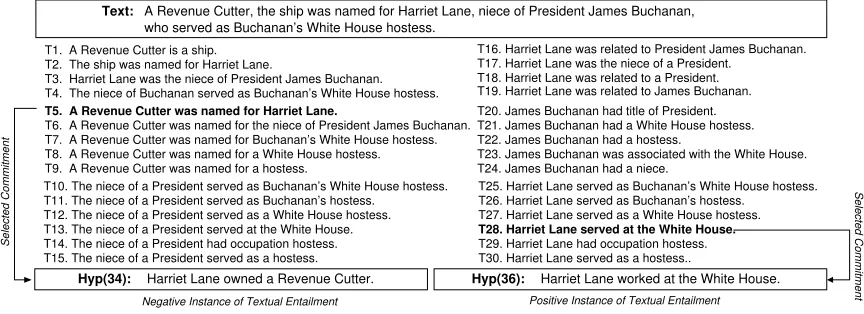
ex-traction heuristics in order to enumerate a subset of the discourse commitments that are inferable from either the text or hypothesis. Following (Gunlog-son, 2001; Stalnaker, 1979), we assume that a dis-course commitment (c) represents the any of the set of propositions that can necessarily be inferred to be true, given a conventional reading of a text passage. The complete list of commitments that our system is able to extract from from the t used in examples 34 and 36 from the RTE-3 Test Set is presented in Figure 2. (Details of our commitment extraction ap-proach are presented in Section 3.)
Commitments are then sent to a Commitment
Se-lection module, which uses a weighted bipartite
matching algorithm first described in (Taskar et al., 2005b) in order to identify the commitment from the
twhich features the best alignment for each commit-ment extracted from the h. The commitcommit-ment pairs identified for the hypotheses from 34 and 36 are highlighted in Figure 2. (Details of our method for selecting and aligning commitments are provided in Section 4.)
Each pair of commitments are then considered in turn by an Entailment Classification module, which follows (Bos and Markert, 2006; Hickl et al., 2006) in using a decision tree classifier in order to compute the likelihood that a commitment extracted from a t textually entails a commitment extracted from an h.
If a commitment pair is judged to be a pos-itive instance of TE, it is sent to an Entailment
Validation module, which uses a system for
rec-ognizing instances of textual contradiction (RTC) based on (Harabagiu et al., 2006) in order to de-termine whether the (presumably) entailed hypothe-sis is contradicted by any of other commitments ex-tracted from the t during commitment extraction. If no text commitment can be identified which contra-dicts the hypothesis, it is presumed to be textually entailed, and a judgment ofYES is returned. Alter-natively, if the entailed h is textually contradicted by one (or more) of the commitments extracted from the t, the h is considered to be contradicted by the t, the entailment pair is classified as a negative in-stance of TE, and a judgment ofNOis returned.
Negative Instance of Textual Entailment
who served as Buchanan’s White House hostess.
Text:
Hyp(34): Harriet Lane owned a Revenue Cutter. Hyp(36): Harriet Lane worked at the White House. T20. James Buchanan had title of President. T21. James Buchanan had a White House hostess.
T24. James Buchanan had a niece. T22. James Buchanan had a hostess.
T23. James Buchanan was associated with the White House. T6. A Revenue Cutter was named for the niece of President James Buchanan.
T7. A Revenue Cutter was named for Buchanan’s White House hostess. T8. A Revenue Cutter was named for a White House hostess. T9. A Revenue Cutter was named for a hostess.
T10. The niece of a President served as Buchanan’s White House hostess. T11. The niece of a President served as Buchanan’s hostess.
T12. The niece of a President served as a White House hostess.
T14. The niece of a President had occupation hostess. T1. A Revenue Cutter is a ship.
T2. The ship was named for Harriet Lane.
T3. Harriet Lane was the niece of President James Buchanan.
T4. The niece of Buchanan served as Buchanan’s White House hostess. T19. Harriet Lane was related to James Buchanan. T16. Harriet Lane was related to President James Buchanan. T17. Harriet Lane was the niece of a President.
T18. Harriet Lane was related to a President.
T25. Harriet Lane served as Buchanan’s White House hostess. T26. Harriet Lane served as Buchanan’s hostess.
T27. Harriet Lane served as a White House hostess.
T29. Harriet Lane had occupation hostess.
T5. A Revenue Cutter was named for Harriet Lane.
T30. Harriet Lane served as a hostess.. T13. The niece of a President served at the White House.
T15. The niece of a President served as a hostess.
T28. Harriet Lane served at the White House.
Selected Commitment
Selected Commitment
Positive Instance of Textual Entailment
[image:3.612.90.522.56.213.2]A Revenue Cutter, the ship was named for Harriet Lane, niece of President James Buchanan,
Figure 2: Text Commitments Extracted from Examples 34 and 36.
3 Extracting Discourse Commitments
Following Preprocessing, our system for RTE lever-ages a series of heuristics in order to extract a subset of the discourse commitments available from a text-hypothesis pair. In this section, we outline the five classes of heuristics we used to extract commitments for the RTE-3 Challenge.
Sentence Segmentation: We use a sentence seg-menter to break text passages into sets of individ-ual sentences; commitments are then extracted from each sentence independently.
Syntactic Decomposition: We use heuristics to syntactically decompose sentences featuring coordi-nation and lists into well-formed sentences that only include a single conjunct or list element.
Supplemental Expressions: Recent work
by (Potts, 2005; Huddleston and Pullum, 2002) has demonstrated that the class of supplemental expressions – including appositives, as-clauses, parentheticals, parenthetical adverbs, non-restrictive relative clauses, and epithets – trigger conventional implicatures (CI) whose truth is necessarily pre-supposed, even if the truth conditions of a sentence are not satisfied. In our current system, heuristics were used to extract supplemental expressions from each sentence under consideration and to create new sentences which specify the CI conveyed by the expression.
Relation Extraction: We used an in-house rela-tion extracrela-tion system to recognize six types of se-mantic relations between named entities, including: (1) artifact (e.g. OWNER-OF), (2) general affilia-tion (e.g. LOCATION-OF), (3) organization
affilia-tion(e.g.EMPLOYEE-OF), (4) part-whole, (5) social
affiliation(e.g. RELATED-TO), and (6) physical
lo-cation(e.g. LOCATED-NEAR) relations. Again, as
with supplemental expressions, heuristics were used to generate new commitments which expressed the semantics conveyed by these nominal relations.
Coreference Resolution: We used systems for re-solving pronominal and nominal coreference in or-der to expand the number of commitments avail-able to the system. After a set of co-referential entity mentions were detected (e.g. Harriet Lane, the niece, Buchanan’s White House hostess), new commitments were generated from the existing set of commitments which incorporated each co-referential mention.
4 Commitment Selection
Following Commitment Extraction, we used an word alignment technique first introduced in (Taskar et al., 2005b) in order to select the commitment extracted from t (henceforth, ct) which represents
the best alignment for each of the commitments ex-tracted from h (henceforth,ch).
We assume that the alignment of two discourse commitments can be cast as a maximum weighted matching problem in which each pair of words (ti,hj) in an commitment pair (ct,ch) is assigned a
score sij(t, h) corresponding to the likelihood that
ti is aligned tohj.1 As with (Taskar et al., 2005b),
we use the large-margin structured prediction model
1
introduced in (Taskar et al., 2005a) in order to com-pute a set of parametersw(computed with respect to a set of featuresf) which maximize the number of correct alignment predictions (¯yi) made given a set
of training examples (xi), as in Equation (1).
yi = arg max
¯
yi∈Y
w⊤f(xi,y¯i),∀i (1)
We used three sets of features in our model: (1) string features (including Levenshtein edit distance, string equality, and stemmed string equality), (2) lexico-semantic features (including WordNet Simi-larity (Pedersen et al., 2004) and named entity sim-ilarity equality), and (3) word association features (computed using the Dice coefficient (Dice, 1945)2). In order to provide a training set which most closely resembled the RTE-3 Test Set, we hand-annotated token alignments for each of the 800 entailment pairs included in the Development Set.
Following alignment, we used the sum of the edge scores (Pni,j=1sij(ti, hj)) computed for each of the
possible (ct, ch) pairs in order to search for the ct
which represented the reciprocal best hit (Mushe-gian and Koonin, 2005) of each ch extracted from
the hypothesis. This was performed by selecting a commitment pair (ct, ch) where ct was the
top-scoring alignment candidate for ch and ch was the
top-scoring alignment candidate forct. If no
recip-rocal best-hit could be found for any of the commit-ments extracted from the h, the system automatically returned a TE judgment ofNO.
We compared the performance of our word align-ment and commitalign-ment selection algorithms against an implementation of the lexical alignment classi-fier described in (Hickl et al., 2006) on commitments extracted from the entailment pairs from the RTE-2 Test Set. Table 1 presents results from evaluations of these two models on the token alignment and com-mitment selection tasks. (Gold standard annotations for each task were created by hand by a team of 3 annotators following the RTE-3 evaluations.)
2
The Dice coefficient was computed as Dice(i) =
2Cth(i)
Ct(i)Ch(i), whereCthis equal to the number of times a word
iwas found in both the t and an h of a single entailment pair,
whileCt and Ch were equal to the number of times a word
was found in any t or h, respectively. A hand-crafted corpus of 100,000 entailment pairs was used to compute values for
Ct, Ch, andCth.
[image:4.612.318.536.54.97.2]Task Measurement Current Work Hickl et al. Token Alignment Precision 94.55% 92.22% Token Alignment MRR 0.9219 0.8797 Commitment Selection Precision 89.50% 72.50% Commitment Selection MRR 0.8853 0.7410
Table 1: Alignment and Selection Performance
5 Entailment Classification
Following work done by (Bos and Markert, 2006; Hickl et al., 2006) for the RTE-2 Challenge, we used a decision tree (C5.0 (Quinlan, 1998)) to estimate the likelihood that a commitment pair represented a valid instance of textual entailment.3 Confidence values associated with each leaf node (i.e. YES or NO) were normalized and used to rank examples for the official submission.
In a departure from previous work (such as (Hickl et al., 2006)) which leveraged large corpora of en-tailment pairs to train an enen-tailment classifier, our model was only trained on the 800 text-hypothesis pairs found in the RTE-3 Development Set (DevSet). Features were selected manually by performing ten-fold cross validation on the DevSet. Maximum per-formance of the entailment classifier on the DevSet is provided in Table 2.
IE IR QA SUM Total Accuracy 0.8450 0.8750 0.8850 0.8600 0.8663 Average Precision 0.8522 0.8953 0.9005 0.8959 0.8860
Table 2: Entailment Classifier Performance. A partial list of the features used in the Entailment Classifier used in our official submission is provided in Figure 3.
6 Experiments and Results
We submitted one ranked run in our official submis-sion for this year’s evaluation. Official results from the RTE-3 Test Set are presented in Table 3.
IE IR QA SUM Total Accuracy 0.6750 0.8000 0.9000 0.8400 0.8038 Average Precision 0.7760 0.8133 0.9308 0.8974 0.8815
Table 3: Official RTE-3 Results.
Accuracy and average precision varied signifi-cantly (p <0.05) across each of the four tasks. Per-formance (in terms of accuracy and average preci-sion) was highest on the QA set (90.0% precipreci-sion) and lowest on the IE set (67.5%).
The length of the text (either short or long) did not significantly impact performance, however; in fact,
3
ALIGNMENT FEATURES: Derived from the results of the alignment of each pair of commitments performed during Commitment Selec-tion.
⋄1⋄LONGESTCOMMONSTRING: This feature represents the longest contiguous string common to both texts.
⋄2⋄UNALIGNED CHUNK: This feature represents the number of chunks in one text that are not aligned with a chunk from the other
⋄3⋄LEXICALENTAILMENTPROBABILITY: Defined as in (Glickman and Dagan, 2005).
DEPENDENCY FEATURES: Computed from the semantic depen-dencies identified by the PropBank- and NomBank-based semantic parsers.
⋄1⋄ENTITY-ARGMATCH: This is a boolean feature which fires when aligned entities were assigned the same argument role label.
⋄2⋄ENTITY-NEAR-ARG MATCH: This feature is collapsing the ar-guments Arg1and Arg2(as well as the ArgMsubtypes) into single
categories for the purpose of counting matches.
⋄3⋄PREDICATE-ARGMATCH: This boolean feature is flagged when at least two aligned arguments have the same role.
⋄4⋄PREDICATE-NEAR-ARGMATCH: This feature is collapsing the ar-guments Arg1and Arg2(as well as the ArgMsubtypes) into single
categories for the purpose of counting matches.
SEMANTIC/PRAGMATIC FEATURES: Extracted during prepro-cessing.
⋄1⋄NAMEDENTITY CLASS: This feature has a different value for each of the 150 named entity classes.
⋄2⋄TEMPORAL NORMALIZATION: This boolean feature is flagged when the temporal expressions are normalized to the same ISO 9000 equivalents.
⋄3⋄MODALITYMARKER: This boolean feature is flagged when the two texts use the same modal verbs.
⋄4⋄SPEECH-ACT: This boolean feature is flagged when the lexicons indicate the same speech act in both texts.
⋄5⋄FACTIVITYMARKER: This boolean feature is flagged when the factivity markers indicate either TRUE or FALSE in both texts simul-taneously.
[image:5.612.313.544.54.103.2]⋄6⋄BELIEF MARKER: This boolean feature is set when the belief markers indicate either TRUE or FALSE in both texts simultaneously.
Figure 3: Features used in the Entailment Classifier
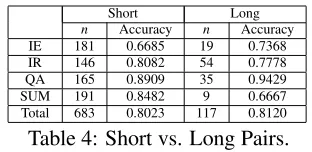
as can be seen in Table 4, total accuracy was nearly the same for examples featuring short or long texts.
[image:5.612.77.292.58.372.2]Short Long n Accuracy n Accuracy IE 181 0.6685 19 0.7368 IR 146 0.8082 54 0.7778 QA 165 0.8909 35 0.9429 SUM 191 0.8482 9 0.6667 Total 683 0.8023 117 0.8120
Table 4: Short vs. Long Pairs.
In experiments conducted following the RTE-3 submission deadline, we found that using a sys-tem for recognizing textual contradiction to vali-date judgments output by the entailment classifier had only a slight positive impact on the overall per-formance of our system. Table 5 compares per-formance of our RTE system when four different configurations of our system for recognizing textual contradiction was used.
When used with its default threshold (λ= 0.85), we discovered that using textual contradiction en-abled us to identify 17 additional examples (2.13% overall) that were not available when using our
sys-Validation? λ IE IR QA SUM Total Yes (RTE-3) 0.85 0.6750 0.8000 0.9000 0.8400 0.8038
Yes 0.75 0.6900 0.8100 0.8850 0.8650 0.8125 Yes 0.65 0.6550 0.8000 0.8850 0.8250 0.7913 No – 0.6550 0.8000 0.8650 0.8250 0.7865
Table 5: Impact of Validation.
tem for RTE alone.4 When we hand-tunedλto max-imize performance on the RTE-3 Test Set, we found that accuracy could be increased by 3.0% over the baseline (to 81.25% overall). Despite its limited ef-fectiveness on this year’s Test Set, we believe that net positive effect of using textual contradiction to validate textual entailment judgments suggests that this technique has merit and should be explored in future evaluations.
In a second post hoc experiment, we sought to quantify the impact that additional sources of train-ing data could have on the performance of our RTE system. Although our official submission was only trained on the 800 t-h pairs found in the RTE-3 De-velopment Set, we followed (Hickl et al., 2006) in using a large, hand-crafted training set of 100,000 text-hypothesis pairs in order to train our entailment classifier. Even though previous work has shown that RTE accuracy increased with the size of the training set, our experiments showed no correlation between the size of the training corpus and the over-all accuracy of the system. Table 6 summarizes the performance of our RTE system when trained on in-creasing amounts of training data. While inin-creasing the training data to approximately 10,000 training examples did positively impact performance, we dis-covered that using a training corpus of a size equal to (Hickl et al., 2006)’s had nearly no measurable impact on the observed performance of our system.
Training Corpus Accuracy Average Precision 800 pairs (RTE-3 Dev) 0.8038 0.8815
[image:5.612.106.262.449.525.2]10,000 pairs 0.8150 0.8939 25,000 pairs 0.8225 0.8834 50,000 pairs 0.8125 0.8355 100,000 pairs 0.8050 0.8003
Table 6: Impact of Training Corpus Size.
While large training corpora (like (Hickl et al., 2006)’s or the one compiled for this work) may pro-vide an important source of lexico-semantic infor-mation that can be leveraged in performing an entail-ment classification, these results suggest that our ap-proach based on commitment extraction may nullify
4
[image:5.612.335.517.524.579.2]the gains in performance seen by these approaches.
7 Conclusions
This paper introduced a new framework for recog-nizing textual entailment which depends on the ex-traction of the discourse commitments that can be inferred from a conventional interpretation of a text passage. By explicitly enumerating the set of infer-ences that can be drawn from a t or h, our approach is able to reduce the task of RTE to the identification of the set of commitments that support the inference of each corresponding commitment extracted from a hypothesis. In our current work, we show that this approach can be used to correctly classify more than 80% of examples from the RTE-3 Test Set, without the need for additional sources of training data or web-based resources.
References
Paul Aarseth, John Lehmann, Murat Deligonul, and Luke Nezda. 2006. TASER: A Temporal and Spatial Expression Recognition and Normalization System. In Proceedings of the Automatic Content Extraction (ACE) Conference.
Roy Bar-Haim, Ido Dagan, Bill Dolan, Lisa Ferro, Danilo
Gi-ampiccolo, Bernardo Magnini, and Idan Szpektor. 2006.
The Second PASCAL Recognising Textual Entailment Chal-lenge. In Proceedings of the Second PASCAL Challenges Workshop.
Johan Bos and Katya Markert. 2006. When logical
infer-ence helps in determining textual entailment (and when it doesn’t). In Proceedings of the Second PASCAL Recogniz-ing Textual Entailment Conference, Venice, Italy.
Michael Collins. 1999. Head-Driven Statistical Models for Natural Language Parsing. Ph.D. thesis, Univ. of Pennsyl-vania.
L.R. Dice. 1945. Measures of the Amount of Ecologic Asso-ciation Between Speices. In Journal of Ecology, volume 26, pages 297–302.
Oren Glickman and Ido Dagan. 2005. A Probabilistic Setting and Lexical Co-occurrence Model for Textual Entailment. In Proceedings of the ACL Workshop on Empirical Modeling of Semantic Equivalence and Entailment, Ann Arbor, USA.
Christine Gunlogson. 2001. True to Form: Rising and Falling Declaratives as Questions in English. Ph.D. thesis, Univer-sity of California, Santa Cruz.
Aria Haghighi, Andrew Ng, and Christopher Manning. 2005. Robust textual inference via graph matching. In Proceed-ings of Human Language Technology Conference and Con-ference on Empirical Methods in Natural Language Process-ing, pages 387–394.
Sanda Harabagiu, Andrew Hickl, and Finley Lacatusu. 2006. Negation, Contrast, and Contradiction in Text Processing. In Proceedings of AAAI, Boston, MA.
Andrew Hickl, John Williams, Jeremy Bensley, Kirk Roberts, Bryan Rink, and Ying Shi. 2006. Recognizing Textual En-tailment with LCC’s Groundhog System. In Proceedings of the Second PASCAL Challenges Workshop.
Rodney Huddleston and Geoffrey Pullum, editors, 2002. The Cambridge Grammar of the English Language. Cambridge-University Press.
V. Jijkoun and M. de Rijke. 2005. Recognizing Textual Entail-ment Using Lexical Similarity. In Proceedings of the First PASCAL Challenges Workshop.
X. Luo, A. Ittycheriah, H. Jing, N. Kambhatla, and S. Roukos. 2004. A mention-synchronous coreference resolution algo-rithm based on the Bell Tree. In Proceedings of the ACL-2004, Barcelona, Spain.
A. Meyers, R. Reeves, C. Macleod, R. Szekely, V. Zielinska, B. Young, and R. Grishman. 2004. The nombank project: An interim report. In A. Meyers, editor, HLT-NAACL 2004 Workshop: Frontiers in Corpus Annotation, pages 24–31, Boston, Massachusetts, USA, May 2 - May 7. Association for Computational Linguistics.
Arcady Mushegian and Eugene Koonin. 2005. A minimal gene set for cellular life derived by compraison of complete bac-terial genomes. In Proceedings of the National Academies of Science, volume 93, pages 10268–10273.
Martha Palmer, Daniel Gildea, and Paul Kingsbury. 2005. The Proposition Bank: An Annotated Corpus of Semantic Roles. Computational Linguistics, 31(1):71–106.
T. Pedersen, S. Patwardhan, and J. Michelizzi. 2004. Word-Net::Similarity - Measuring the Relatedness of Concepts. In Proceedings of the Nineteenth National Conference on Arti-ficial Intelligence (AAAI-04), San Jose, CA.
Christopher Potts, editor, 2005. The Logic of Conventional Im-plicatures. Oxford University Press.
R. Quinlan. 1998. C5.0: An Informal Tutorial. RuleQuest.
Robert Stalnaker, 1979. Assertion, volume 9, pages 315–332.
Ben Taskar, Simone Lacoste-Julien, and Michael Jordan. 2005a. Structured prediction via the extragradient method. In Proceedings of Neural Information Processing Systems, Vancouver, Canada.
Ben Taskar, Simone Lacoste-Julien, and Dan Klein. 2005b. A
discriminative matching approach to word alignment. In
Proceedings of Human Language Technology Conference and Empirical Methods in Natural Language Processing (HLT/EMNLP 2005), Vancouver, Canada.