Composable Oblivious Extended Permutations
Peeter Laud and Jan Willemson {peeter.laud|jan.willemson}@cyber.ee
Cybernetica AS
Abstract. An extended permutation is a function f : {1, . . . , m} → {1, . . . , n}, used to map an n-element vectora to anm-element vector b by bi = af(i). An oblivious extended permutation allows this map-ping to be done while preserving the privacy ofa,band f in a secure multiparty computation protocol. Oblivious extended permutations have several uses, with private function evaluation (PFE) being the theoreti-cally most prominent one.
In this paper, we propose a new technique for oblivious evaluation of extended permutations. Our construction is at least as efficient as the existing techniques, conceptually simpler, and has wider applicability. Our technique allows the party providing the description off to be ab-sent during the computation phase of the protocol. Moreover, that party does not even have to exist — we show how to compute the private rep-resentation offfrom private data that may itself be computed from the inputs of parties. In other words, our oblivious extended permutations can be freely composed with other privacy-preserving operations in a multiparty computation.
Keywords:Secure multiparty computation, Private function evaluation, Extended permutations
1
Introduction
In Secure Multiparty Computation (SMC), k parties compute (y1, . . . , yk) =
f(x1, . . . , xk), with the party Pi providing the input xi and learning no more
than the outputyi. Private Function Evaluation (PFE) is a special case of SMC,
where the function f is also private, and its description, typically in the form of a circuit, is provided as input by one of the parties. One will thus obtain a solution for PFE, if one designs an SMC system for a universal function f. In SMC systems, f is usually represented as a Boolean or arithmetic circuit. Universal circuits are large (compared to circuits they can execute), hence this approach has not been practical so far.
SMC techniques have seen significant maturation in last years, with the ap-pearance of several frameworks [1, 2, 5, 9, 14, 21, 34] that allow the private compu-tation of certain tasks with practically relevant sizes. There has been a number of successful applications of these frameworks [3, 7, 8, 26, 30]. A common tenet of all existing and in-progress applications is their client-server nature, where the participating entities are partitioned intoinput parties providing the private inputs to a SMC system,computing parties that execute the SMC protocols for computing the functionf, andoutput partiesthat receive the results of the com-putation [4]. Depending on the application, these sets of parties may intersect or even coincide, but such partitioning is nevertheless supported by the used SMC platforms. This flexibility is certainly required in practice, as the active partic-ipation of all input parties in all stages of computation is unwanted both for efficiency (if the number of inputs parties is large), as well as organizational (if the input parties do not have the ability to execute complex protocols) reasons. Mohassel’s and Sadeghian’s OEP construction does not fit into the model with input, computing and output parties. In their construction, the party pro-viding the description of the private function must participate in the computa-tion, i.e. it must be both an input and a computing party.
In this paper, we propose a multiparty OEP construction that allows the ex-tended permutation to be input to the private computation by a non-computing input party. Even more, our construction allows oblivious extended permutations to be constructed during the computation from other private values, thereby removing the need to treat them in any special manner. In fact, all our con-structions will be presented in the Arithmetic Black Box (ABB) model, mak-ing their use in larger applications straightforward, and also greatly simplifymak-ing the security proofs. Our construction is conceptually simpler than [36], and, if the number of computing parties is small, also potentially more efficient (even though a fair comparison is difficult due to different operational profiles). We have implemented our proposed construction and provide benchmarking results. Our algorithms for constructing an OEP during the execution of a private computation alternate between sorting the matrices along various columns, and computing new columns from the existing ones in parallel manner. These tech-niques may be of independent interest, as they can be used for various other tasks, including the privacy-preserving grouping and aggregate computation protocols in oblivious databases.
the OEP protocol; according to our knowledge, this is the first such implemen-tation. In Sec. 10, we discuss some further research directions opened up by our OEP construction.
2
Related Work
A number of existing OEP constructions are based on switching networks em-ploying 2×2 switches that may either pass their inputs unmodified, swap the inputs, or copy one input to both outputs. The network is commonly obtained from Waksman’s construction [38]; it is evaluated with SMC techniques. Such constructions appear in [22, 27, 36]. In [35], the construction of [36] is amended to give it security against malicious adversaries. All such constructions require one of the computing parties to know the extended permutation.
An OEP can also be constructed, using homomorphic encryption [22, Sec. 5.3.2]. This construction has better asymptotic complexity than the ones based on switching networks, but it requires many public-key operations. Again, one com-puting party has to know the extended permutation.
A very simple construction forshuffling(permuting) the elements of a vector is given by Laur et al. [31]. Hamada et al. [19, 20] have used this construction to give fast sorting algorithms. Our constructions are also based on this form of shuffling protocols.
OEPs can be used for purposes other than PFE. Guanciale et al. [18] have ap-plied them in the minimization of finite automata obtained through the product construction.
3
Preliminaries
Universal composability (UC) [10] is a standard theoretical framework for stating and proving security of cryptographic constructions. In this framework, a proto-colπis defined secure if it isas secure as some ideal functionalityF embodying the desired functional and non-functional properties ofπin an abstract manner. A functionalityF1is at least as secure asF2, if for every user of these
function-alities, and every adversary ofF1, there is an adversary ofF2, such that the user
cannot see the difference in interacting withF1orF2. UC framework derives its
usefulness from the composability of the “at least as secure as” relation.
Arithmetic black box. For SMC, the standard ideal functionality is the Arithmetic Black Box (ABB) FABB [13]. It provides an interface for users P1, . . . , Pk, up
to t of which may be corrupted, to perform computations without revealing intermediate values. Heretdepends on the protocol setπABBimplementingFABB. The functionality FABB is given in Fig. 1. Depending on the implementation
Internal state: a finite mapSfrom variable names to values (initially empty) Exposed commands:
Input data. On input (input, v, x) from somePi and (input, v) from all other parties, add{v7→x}toS.
Classify. On input (classify, v, x) from all parties, add{v7→x}toS.
Compute. On input (compute,⊗, v1, v2, v3) from all parties, look upx1 =S(v1) and x2=S(v2), and add{v37→x1⊗x2}toS.
Declassify. On input (declassify, v) from all parties, answer withS(v) to all parties..
When receiving any command exceptinput, the whole command, as well as its answer is also sent to the adversary. Forinput-commands, (input, v) is sent to the adversary. Some of the parties may be controlled by the adversary; for simplicity, the corrup-tions are static. For any command (c, . . .) listed above, FABB accepts the command
(masqi, c, . . .) from the adversary, for a corrupted partyPi. Such commands are pro-cessed as commands (c, . . .) fromPi.
Fig. 1:The ideal functionalityFABB
The interface ofFABBdoes not correspond well to the partitioning of parties into input, computing, and output parties. Still, it can be modeled by precisely defining, which parties are needed to execute different commands, and which parties receive the results.
The valuesFABB operates on are elements of some algebraic structure de-pending onπABB, typically some finite field or ring. The operations⊗supported byFABB also depend on the actual protocols that are available. Many protocol setsπABB for SMC have been proposed [12, 15–17, 24, 37, 39], several of them also providing security against malicious adversaries. All sets support at least the addition and multiplication of values stored inS. Based on them, one can imple-ment a rich set of arithmetic and relational operations [11], enjoying the same security properties. The protocols we present in this paper need to compare the values inS, and we assume that “equals” and “less than” operations are available in FABB.
For a variable namev, it is customary to denote its value, as stored inS, by
JvK. Also, in the description of algorithms executed together withFABB, notation JwK=⊗(JuK,JvK) denotes the calling of (compute,⊗, u, v, w) onFABB.
Shuffling. An oblivious shuffle, introduced by Laur et al. [31] allows to permute the elements of a private array of length maccording to a private permutation
σ∈Sm. The functionality and security of oblivious shuffle can be likewise
pre-sented through the notion of ABB. Let the variable names be partitioned into two — names for scalars, and shuffles. In Fig. 1, each variable name refers to a scalar. In Fig. 2 we list the shuffling-related commands of the ABB. Here u, v
denote scalar variables, andsdenotes shuffle variables.
Input a shuffle. On input (input, s, σ) from somePi and (input, s, m) from all other parties, ifσ∈Smthen add{s7→σ}toS.
Classify a shuffle. On input (classify, s, σ) from all parties, add{s7→σ}toS. Make a random shuffle. On input (rand shuffle, s, m) from all parties, pickσ∈RSm
and add{s7→σ}toS.
Compose private and public shuffle. On input (compose left, s1, s2, τ) from all parties, look up σ = S(s2) and add {s1 7→ τ ◦ σ} to S. On input (compose right, s1, s2, τ) do the same, but add{s17→σ◦τ}toS.
Apply a shuffle. On input (apply, u1, . . . , um;v1, . . . , vm;s) from all parties, look up σ=S(s) andxi=S(vi) for alli∈ {1, . . . , m}. Add{ui7→xσ(i)}toSfor alli. Compose shuffles in parallel. On input (compose parallel, s1, s2, s3) from all
par-ties, look up σ1 = S(s1) and σ2 = S(s2). Let σi operate on mi elements. Let m3 = m1 +m2 and define σ3 ∈ Sm3 by σ3(x) = σ1(x), if x ≤ m1, and
σ3(x) =σ2(x−m1) +m1, ifx > m1. Add{s37→σ3}toS.
Invert a shuffle On input (invert, s1, s2) from all parties, look upσ=S(s1) and add {s27→σ−1}toS.
Similarly to Fig. 1, all commands are also sent to the adversary, except forinput, where only (input, s, m) is sent. Also, (masqi, . . .) commands are accepted from the adversary.
Fig. 2:Shuffle-related operations in FABB
if A ∈ Γ. A shuffle σ ∈ Sm is represented as JσK = (JσK1, . . . ,JσKl), where JσKi ∈Sm are random permutations subject toJσK1◦ · · · ◦JσKl=σ. EachJσKi
is known by all parties in some set Ai∈Γ. The number l and the setsAi must
be chosen so, that for each ¯A⊆ {1, . . . , k}, ¯A6∈Γ, there exists somei, such that ¯
A∩Ai = ∅. In the shuffling protocol, the values x1, . . . , xm are shuffled using
JσK1, . . . ,JσKl (sequentially). Before shuffling with JσKi, the current values are
shared among the parties inAi only.
In general,l is exponential inkandt, but the protocol is very practical ifk
andt are small. For k= 3 andt= 1 (in which caseΓ ={{1,2},{1,3},{2,3}}) we have l= 3, with each party knowing two permutations.
It is straightforward to securely implement other operations in Fig. 2, based on the protocol of Laur et al. [31]. Note that inverting a shuffle also inverts the sequence of the party setsAi applying the consecutive permutations inJσK.
Laur et al. also show how to make the protocols secure against malicious ad-versaries. Alternatively, recent proposals for making passively secure protocols verifiable [23, 28] are readily applicable to described shuffling protocols.
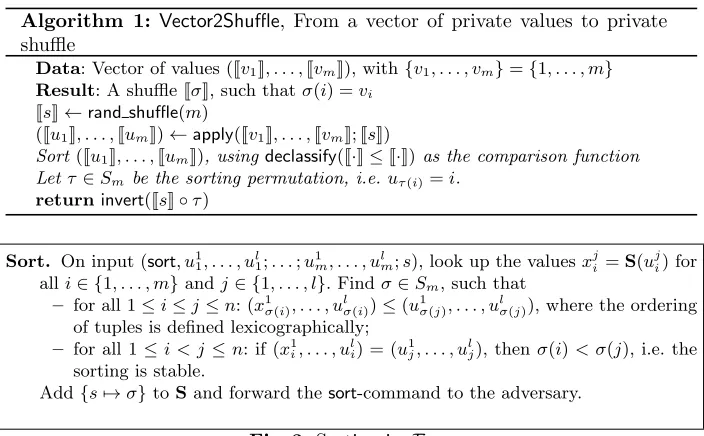
Oblivious shuffles are instrumental for fast sorting algorithms on private val-ues [20]. To sort a vectorJuK= (Ju1K, . . . ,JumK), where all values are known to
be different, one may generate a random shuffle JσKand apply it onJuK. After-wards, the elements of JuK are randomly ordered and their comparison results may be declassified. In this way expensive, data-oblivious sorting methods [25] do not have to be employed. Sorting, in turn, can be used to transform a vector of values (Jv1K, . . . ,JvmK) to a shuffle JσK, such that σ(i) = vi, provided that
Algorithm 1: Vector2Shuffle, From a vector of private values to private shuffle
Data: Vector of values (Jv1K, . . . ,JvmK), with{v1, . . . , vm}={1, . . . , m} Result: A shuffle JσK, such thatσ(i) =vi
JsK←rand shuffle(m)
(Ju1K, . . . ,JumK)←apply(Jv1K, . . . ,JvmK;JsK)
Sort(Ju1K, . . . ,JumK), usingdeclassify(J·K≤J·K) as the comparison function
Letτ ∈Sm be the sorting permutation, i.e.uτ(i)=i. returninvert(JsK◦τ)
Sort. On input (sort, u1
1, . . . , ul1;. . .;u1m, . . . , ulm;s), look up the valuesx j i =S(u
j i) for alli∈ {1, . . . , m}andj∈ {1, . . . , l}. Findσ∈Sm, such that
– for all 1≤i≤j≤n: (x1
σ(i), . . . , u l
σ(i))≤(u 1
σ(j), . . . , u l
σ(j)), where the ordering of tuples is defined lexicographically;
– for all 1≤i < j ≤n: if (x1i, . . . , u l i) = (u
1 j, . . . , u
l
j), thenσ(i)< σ(j), i.e. the sorting is stable.
Add{s7→σ}toSand forward thesort-command to the adversary.
Fig. 3:Sorting inFABB
is secure because the only values output by FABB during its execution are the results of comparisons; these may be made public by the security arguments for sorting algorithms. It is easy to verify that Alg. 1 is also correct.
As sorting turns out to be a useful operation in our protocols, we opt to make it a part of FABB. See Fig. 3 for the exact specification. For ease of use, we let our sorting functionality to not actually sort its input, but to output a private shuffle that would sort the input if applied to it. The protocol for computing such a shuffle in πABB is identical to Alg. 1, except for the omission of the last inversion.
4
Ideal functionality
The notion ofextended permutation (EP)was introduced in [36] for encoding the topology of arithmetic or Boolean circuits. Mathematically, an EPφfrom ann -element set to anm-element set is just a function from{1, . . . , m}to{1, . . . , n}. Applying φ to a sequence (x1, . . . , xn) produces a sequence (y1, . . . , ym), such
that yi = xφ(i) for each i. Similarly to shuffles, we want to apply EPs in an
oblivious manner, such that the values to whichφis applied, as well as φitself remain private.
LetFn,m denote the set of all mappings from{1, . . . , m} to{1, . . . , n}. Our
Include the stateSand commands ofFABBin Fig. 1 and Fig. 2.
Additional commands are given below.
Input an EP. On input (input, f, φ) from somePi and (input, f, n, m) from all other parties, ifφ∈Fn,m then add{f7→φ}toS.
Classify an EP. On input (classify, f, φ) from all parties, add{f7→φ}toS. Apply an EP. On input (apply, u1, . . . , um;v1, . . . , vn;f) from all parties, look upφ=
S(f) andxi=S(vi). Add{uj7→xf(j)}to Sfor allj∈ {1, . . . , m}. The mapping φmust be an element ofFn,m.
Convert a vector to an EP. On input (convert, u1, . . . , um, n, f) from all parties, look upxi=S(ui) for alli∈ {1, . . . , m}. If 1≤xi≤nholds for alli, letφ∈Fn,m be defined byφ(i) =xiand add{f7→φ}toS. Otherwise, the behaviour ofFOEP
is undefined.
The commands are sent to the adversary, and accepted from the adversary similarly to Fig. 1 and Fig. 2.
Fig. 4:The ideal functionalityFOEP
5
Real functionality
Our representation of oblivious extended permutations is based on the following simple result.
Theorem 1. For any m, n∈N there exist`n,m= (1 +o(1))mlnm and gn,m:
{1, . . . , `n,m} → {1, . . . , n}, such that for any function φ ∈ Fn,m, there exist
σ∈Sn andτ∈S`n,m, such thatφ(x) = (σ◦gn,m◦τ)(x)for allx∈ {1, . . . , m}.
Proof. Define`n,m by
`0,m= 0
`n,m=`n−1,m+bm/nc .
Then`n,m= (1 +o(1))mlnm[32]. Definegn,mby
gn,m(x) =k⇔`k−1,m< x≤`k,m .
Letφ∈Fn,mbe given. For eachy∈ {1, . . . , n}, letφ−1(y) ={x|φ(x) =y}.
Let the permutationσ∈Snbe such, that|φ−1(σ(i))| ≥ |φ−1(σ(i+ 1))|for alli.
Note that |φ−1(σ(i))| ≤ bm/ic.
LetDi={`i−1,m+ 1, . . . , `i,m}. Note that|Di|=bm/icandgn,m(Di) ={i}.
Let the permutationτ∈S`n,m be defined so, that for alli∈ {1, . . . , n}, we have τ(φ−1(σ(i))) ⊆D
i. Such permutation τ exists, because |φ−1(σ(i))| ≤ |Di| and
different setsDi are disjoint.
For eachx∈ {1, . . . , m}, we now haveτ(x)∈Dσ−1(φ(x)), implyinggn,m(τ(x)) = σ−1(φ(x)) orσ(g
n,m(τ(x))) =φ(x). ut
We see thatσsorts the elements of{1, . . . , n}according to their number of preimages with respect to φ. The mapping gn,m creates a sufficient number of
There are machines M1, . . . , Mk executing the protocols on behalf of the parties P1, . . . , Pk participating in the protocol. These machines have access to the function-alityFABB.
There is a public function f 7→ (sf, tf) mapping variable names for EPs to pairs of variable names for shuffles. We assume that these variable names for shuffles are not used outside this protocol set.
A machineMiresponds to the various commands as follows.
Commands for FABB. When receiving a command for FABB from the environment,
Miforwards it toFABBand gives back the result.
Input an EP. On input (input, f, φ), the machineMiconstructs the shufflesσandτ corresponding toφaccording to the proof of Thm. 1. It will then send commands (input, sf, σ) and (input, tf, τ) toFABB.
Input an EP. On input (input, f, n, m), the machine Mi sends commands (input, sf, n) and (input, tf, `n,m) toFABB.
Classify an EP. On input (classify, f, φ), the machine Mi constructs the shuffles σ andτ corresponding toφaccording to the proof of Thm. 1. Any indeterminacys in the proof are solved in the same, public manner by all parties. MachineMiwill then send the commands (classify, sf, σ) and (classify, tf, τ) toFABB.
Apply an EP. On input (apply, u1, . . . , um;v1, . . . , vn;f), machineMi will pick`n,m new variable namesw1, . . . , w`n,m (for scalars). After that, it will
1. send (apply, w1, . . . , wn;v1, . . . , vn;sf) toFABB;
2. copyw1, . . . , wn tow1, . . . , w`n,m according togn,m, i.e.wi after copying will be equal towgn,m(i)before copying (note that this is an operation ofFABB);
3. send (apply, u1, . . . , um, wm+1, . . . , w`n,m;w1, . . . , w`n,m;tf) toFABB.
Fig. 5:The protocol setπOEP (partially)
Theorem 1 immediately suggests the private encoding for an OEPφ. In our implementation πOEP for FOEP, we will store them as pairs of private shuffles (σ, τ), defined as in the proof of Thm. 1. Fig. 5 depicts the protocol set πOEP (except for theconvert-protocol, which is given in Sec. 6), defined in theFABB -hybrid model.
Theorem 2. The protocol setπOEP, as depicted in Fig. 5, is at least as secure asFOEP withoutconvert-commands.
Proof. We have to show a simulatorS that can translate between the messages at the adversarial interface ofFOEPand the messages at the adversarial interface ofπOEP. The simulatorS has no long-term state and works as follows:
– On an input (c, . . .) from FOEP that corresponds to a command for FABB, the simulator forwards this input to the adversary.
– On input (input, f, n, m) fromFOEP, the simulator forwards the commands (input, sf, n) and (input, tf, `n,m) to the adversary.
– On input (classify, f, φ) fromFOEP, the simulator computes the permutations
σandτ according to the proof of Theorem. 1, and forwards (classify, sf, σ)
– On input (apply, u1, . . . , um;v1, . . . , vn;f) fromFOEP, the simulator forwards the commands for applyingsf, copying the variables and applyingtf to the
adversary. The commands are the same as in Fig. 5. – On input (masqi, c, . . .) from the adversary toF
ABB, the simulatorSforwards that command toFOEP, unless the command is part of an adversarial party’s activity in the protocols ofπOEP. These are recognized through the inclusion of variable namessf andtf.
– On input (masqi,input, s
f, n) from the adversary, followed by (masqi,input, tf, `n,m):
send (masqi,input, f, n, m) toFOEP.
– On input (masqi, c, s
f, σ) from the adversary, followed by (masqi, c, tf, τ),
where c is either input or classify: the simulator constructs φ =σ◦gn,m◦
τ (where n, m are found from the descriptions of σ and τ), and sends (masqi, c, f, φ) toFOEP.
– On input (masqi,apply, w
1, . . . , wn;v1, . . . , vn;sf) from the adversary,
fol-lowed by the requests to copy the variableswj according togn,m and the
input (masqi,apply, u
1, . . . , um, wm+1, . . . , w`n,m;w1, . . . , w`n,m;tf): send
(masqi,apply, u
1, . . . , um;v1, . . . , vn;f) to the adversary.
Quite clearly, this simulator provides the necessary translation. Actually, the only non-trivial part of this simulator is the construction of φ from σ and τ
provided by the adversary. Fortunately, there exists aφfor anyσandτ(of correct types). HenceπOEP is secure even against active adversaries (if the protocol set implementingFABB is secure against such adversaries). ut The provided simulator S is valid for any attacks by the adversary. It can cope with active attacks and with dishonest majority. Hence FOEP provides the same security guarantees asFABB.
6
Converting a private vector to an OEP
Suppose we are given the numbersm, n, and a vector (Jv1K, . . . ,JvmK), such that
1≤vi≤nfor alli. We want to constructJφK, such thatφ∈Fn,mandφ(i) =vi
for all i. For this, we have to construct private shuffles JσK and JτK of correct size, such that φ=σ◦gn,m◦τ. As we show below, the functionality provided
by FABB is sufficient for this construction. However, the construction is more complex than what we have seen before.
Partially specified shuffles. The following subtask occurs in the construction of bothσandτ. Let a vector (Jv1K, . . . ,JvnK) be given, such thatvi∈ {0,1, . . . , n}
and for eachj∈ {1, . . . , n}there exists at most onei, such thatvi=j. Construct
JσK, where σ∈Sn and∀i∈ {1, . . . , n}:vi>0⇒σ(i) =vi.
We cannot directly apply Alg. 1 to obtain the shuffle, because this algorithm assumes that the input vector is a permutation of{1, . . . , n}. In particular, the correctness of Alg. 1 hinges on the sorted vector being equal to (1, . . . , n).
Will we hence first fill the zeroes in the vectorv1, . . . , vn with the missing
numbers. We use Alg. 2 for that, making the callFillBlanks(1, n;Jv1K, . . . ,JvnK).
Algorithm 2: FillBlanks, filling the blank squares of a shuffle Data: BoundsL, H∈N
Data:JvLK,JvL+1K, . . . ,JvHK, wherevi∈ {0, L, . . . , H}, and for each
j∈ {L, . . . , H}, there is at most onei, such thatvi=j
Result:JuLK,JuL+1K, . . . ,JuHK, where{uL, . . . , uH}={L, . . . , H}and
vi>0⇒ui=vi
1 if L=H then 2 returnJLK
3 M ← b(L+H)/2c
4 JξK←sort(JvLK;JvL+1K;. . .;JvHK) ; // Fig. 3 5 (JvL0K, . . . ,Jv
0
HK)←apply(JvLK, . . . ,JvHK;JξK) 6 foreachi∈ {1, . . . , H−M}do
7 JbiK←Jv 0
M+iK≤M 8 (Jv0L+i−1K,Jv
0
M+iK)←JbiK? (Jv 0
M+iK,Jv 0
L+i−1K) : (Jv 0
L+i−1K,Jv 0
M+iK) 9 (Jv0LK, . . . ,Jv0MK)←FillBlanks(L, M;Jv0LK, . . . ,Jv0MK)
10 (Jv0M+1K, . . . ,JvH0 K)←FillBlanks(M+ 1, H;JvM0 +1K, . . . ,Jv0HK) 11 foreachi∈ {1, . . . , H−M}do
12 (Jv0L+i−1K,Jv0M+iK)←JbiK? (Jv 0
M+iK,Jv 0
L+i−1K) : (Jv 0
L+i−1K,Jv 0
M+iK) 13 (JuLK, . . . ,JuHK)←apply(JvL0K, . . . ,Jv
0
HK;invert(JξK)) 14 return(JuLK, . . . ,JuHK)
In Alg. 2, we have used a few conventions that have appeared elsewhere in the specifications of privacy-preserving algorithms. In line 7, the variable JbiK will
store either 1 or 0, depending on whether the comparison returnstrue. The line 8 contains an instance of thebinary choice operatorJbK?JxK:JyK. Its result is equal toJxKifb= 1, andJyKifb= 0. It is typically computed asJbK·(JxK−JyK) +JyK. In lines 8 and 12 we are actually using pairs of values in place of JxK and JyK. Hence the effect of these lines is to swap JvL0+i−1K and JvM0 +iK if bi = 1, and
otherwise leave them as is.
A number of operations in Alg. 2 can be performed in parallelized fashion. We use the convention that foreach-statements indicate vectorized computations. In addition to that, the recursive calls in lines 9 and 10 are executed in parallel. Clearly, Alg. 2 is secure — it does not declassify any values. Also, it does not input any values from a particular party, hence there are no issues in making sure that these values are valid. Alg. 2 invokes a number of commands ofFABBin order to transform a private vector to a different private vector. The adversary’s view of Alg. 2 consists of the sequence of the names of these commands. This sequence can be derived from L, H, and the names of the variables input to Alg. 2.
Due to the need to preserve the privacy of JviK, Alg. 2 is quite non-trivial,
working in the divide-and-conquer fashion. The main case starts in line 3, and the lines 3–8 are used to rearrange the elements ofvL, . . . , vHso, thatvL, . . . , vM
only contain elements in{0, L, . . . , M}, andvM+1, . . . , vH only contain elements
this rearrangement later. Through recursive calls in lines 9 and 10, we fill in the zeroes amongv0L, . . . , vH0 with missing numbers. Finally, in lines 11–13 we undo the rearrangement we introduced at the beginning.
Assuming that the complexity of sorting isO(nlogn), the overall complexity ofFillBlanksisO(nlog2n). We could actually simplify the algorithm somewhat — in line 10, the vector that is the argument to the recursive call is already sorted, hence there is no need to sort it again in line 4. This does not reduce the asymptotic complexity, though, as theFillBlanks-call in line 9 still needs to sort its argument vector. In Sec. 7 we show that for certain implementations of the ABB, this vector (which is just a private rotation away from being sorted) can also be sorted more efficiently, bringing the overall complexity ofFillBlanks
down toO(nlogn), the same as Alg. 1.
Finding vector representations of JσK and JτK. With the help of Alg. 2, we are now ready to present the computation ofJσKandJτK, such thatφ=σ◦gn,m◦τ.
Algorithm 3 depicts this computation. In the description of this algorithm, we will heavily use the notationJvKfor vectors with private components (but note that the length of the vector is public). Alg. 3 is secure for the same reasons as Alg. 2.
The algorithm to convert the vectorJv (1)
K= (Jv (1)
1 K, . . . ,Jv (1)
mK) to the private
shufflesJσK,JτKhas the following components:
– Counting, how many times each valuex∈ {1, . . . , n}occurs amongv1, . . . , vm.
We first sort the vectorv(1), giving the vectorv(10). In this vector, the
dif-ferent valuesxoccur in continuous segments. Vector v(20) marks the start
of each segment andv(30)additionally records the positions, where different
segments start. Sorting according tov(30) (a stable sort according tov(20)
would have had the same effect) brings the start positions together and their differences, recorded inv(400) are the counts of the valuesx(the lengths of the segments).
– Computing the vector representingσ, to be used as the argument toVector2Shuffle. As we sort the vectors in non-decreasing order, the counts end up in the last
nelements ofv(400). We want to sort them in non-increasing order, hence we collect their negations in the vectoru(2). We apply the sorting permutation to the actual values, whose counts were in u(2). We collect the actual val-ues inu(1), but we must be careful, because not allnvalues are necessary
there. Fortunately, in vector v(200), there is exactly one “1” for each
possi-ble value. Thus we obtain zeroes instead of missing values and can use the
FillBlanks-algorithm to fill them out.
– Computing the vector representing τ−1. This vector must have the values `i−1,m+ 1, `i−1,m+ 2, . . . in the positions where the original vector Jv
(1) K
had the i-th most often occurring values among {1, . . . , n}. We intend to compute this vector through prefix summation; this takes place in lines 24– 25. While doing this prefix summation, we assume thatv(1) is sorted, we
undo the sorting afterwards. In lines 18–23 we set up the vector v(50) that
Algorithm 3: From a vector of private values to an OEP Data:m, n∈N
Data:Jv(1)
K= (Jv
(1) 1 K, . . . ,Jv
(1)
mK), where 1≤v
(1) i ≤n
Result:JσK,JτK, such that (σ◦gn,m◦τ)(i) =vifor alli∈ {1, . . . , m}
1 Jξ1K←sort(Jv(1)K) 2 Jv(1
0
)
K←apply(Jv
(1)
K;Jξ1K) 3 Jv(2
0
) 1 K←1
4 foreachi∈ {2, . . . , m}doJv(2
0)
i K←1−(Jv
(10) i K
? =Jvi(1−01)K) 5 foreachi∈ {1, . . . , m}doJv(3
0)
i K←i·Jv
(20) i K 6 Jξ2K←sort(Jv(3
0) K) 7
Jv
(100)
K←apply(Jv
(10)
K;Jξ2K) 8
Jv
(200)
K←apply(Jv
(20)
K;Jξ2K) 9
Jv
(300)
K←apply(Jv
(30)
K;Jξ2K) 10 foreachi∈ {1, . . . , m−1}doJv(4
00)
i K←Jv
(200) i K? (Jv
(300) i+1K−Jv
(300) i K) : 0 11 Jv(4
00)
m K←m+ 1−Jv
(300) m K 12 foreachi∈ {1, . . . , n}do
13 Ju(1)i K←m−n+i >0∧Jv(2
00)
m−n+iK?Jv
(100) m−n+iK: 0 14 Ju(2)i K←m−n+i >0 ?−Jv(4
00)
m−n+iK: 0 15
Jξ3K←sort(Ju
(2)
K) 16
Ju
(10)
K←apply(Ju
(1)
K;Jξ3K) 17
JσK←Vector2Shuffle(FillBlanks(1, n;Ju
(10)
K)) 18 foreachi∈ {1, . . . , n}doJu(3
0)
i K←`i−1,m+ 1 19 Ju(3)K←apply(Ju(3
0)
K;invert(Jξ3K)) 20 foreachi∈ {1, . . . , m}do
21 ji←i−m+n
22 Jv
(500) i K←
1, ifi≤0∨ ¬Jvi(200)K
Ju
(3)
ji K, ifJv
(200) i K∧ ¬Jv
(200) i−1K Ju
(3) ji K−Ju
(3) ji−1K+Ju
(2)
ji−1K+ 1, ifJv
(200) i−1K 23 Jv(5
0)
K←apply(Jv
(500)
K;invert(Jξ2K)) 24 Jv(6
0)
1 K←Jv
(50) 1 K
25 fori= 2tomdoJv(6
0)
i K←Jv
(60) i−1K+Jv
(50) i K 26 Jv(6)K←apply(Jv(6
0
)
K;invert(Jξ1K)) 27 foreachi∈ {m+ 1, . . . , `n,m}doJv
(6) i K←0
continuous segments ofv(10), the values inv(50)have to be “1”. At the border
fromi-th most toi0-th most occurring value, however, there should be jumps from the segment [`i−1,m+ 1, . . . , `i,m] to [`i0−1,m+ 1, . . . , `i0,m]. The length
of these jumps depends on i, i0, and on the length of the ending segment. These lengths of jumps are computed in line 22 (clearly, the expression there can be converted into a sequence of “? :”-operations). Different cases in this line correspond to the middle of continuous segments, the start of the first segment, and to the starts of following segments, respectively. The vector
u(2) contains thenegations of the lengths of the continuous segments. The running time of Alg. 3 is dominated by the call toFillBlanksin line 28. As the size of its argument is O(mlogm), the running time of the algorithm is
O(mlog3m).
Alg. 3 is used in the protocol setπOEP for converting a private vector to an OEP.
7
Specific operations with shuffles
In Sec. 5 we showed how the operations with extended permutations, defined in Sec. 4, can be implemented on top of the ABB defined in Sec. 3. The resulting implementation will have the same security guarantees as the used ABB, which can be implemented using several different protocol sets. Parts of the OEP imple-mentation, however, can be more efficient if the ABB supports more operations with shuffles. In the following, we will present these operations, as well as their implementations on top of the ABB ofSharemind[6], based on additive sharing overZN by three parties, providing security against one semi-honest party.
Unfortunately, we have to expose an implementation artifact through the interface ofFABB. Namely, we let the shuffles stored inSbelong to two different sorts (this notion is unrelated to “sorting”), which we denote with “0” and “1”. Except for inversion, the shuffles of both sorts behave identically to each other. In particular, the result of applying them is the same. The operations for inputing, classifying and making a random shuffle (Fig. 2), as well as sorting (Fig. 3) receive an extra public argument, denoting the sort of the resulting shuffle. The result of the inversion operation will have the sort different from the argument. Let “s 7→b σ” denote that the variable s is assigned to the shuffle σ of sort b. During the execution, the sorts of all shuffles stored in FABB can be deduced from public information.
The extra operations are depicted in Fig. 6. The permutationrotm
x ∈Sm is
defined by rotm
x(i) ≡i+x (modm). The operation mkrotation is another one
taking the sort of the result as an argument. The compose operation and its interplay with inversion is the reason for introducing the sorts. The existence of the composition protocol depends on the order of parties performing the shuffles in JσK= (JσK1,JσK2,JσK3).
Convert a value to a rotation. On input (mkrotationb, v, s, m) from all parties, look upx=S(v) and add{s7→b rotmx}toS.
Compose private shuffles. On input (compose, s1, s2, s3) from all parties, wheres1 ands2have the same sortb, look upσ1=S(s1) andσ2=S(s2). Add{s37→b σ1◦σ2} toS.
Fig. 6:More shuffle-related operations inFABB
Algorithm 4: Making a rotation Data: A private valueJvK
Data: A public valuemand a bitb Result: Private shuffleJrotv,mKof sortb
Jv 0
K 0←
change modulus(JvK, m) PartyPisendsJv0K0i toPi+1
PartiesP1+2b andP2 defineJσK1←rot
m
Jv0K
0
1+b
PartiesP1 andP3defineJσK2←rotm
Jv
0
K
0
3
PartiesP2 andP3−2bdefineJσK3←rot
m
Jv
0
K
0
2−b
returnJσK
v∈ZN,JvK1+JvK2+JvK3≡v (mod N) for some fixed modulusN, and partyPi
knowsJvKi. In the implementation of Sharemind, the modulusN is a power of
two, making the set of values isomorphic to (logN)-bit unsigned integers. There exist protocols to increase or decrease the bitwidth of these values [6, Sec. 7]. Essentially the same protocols can be used for arbitrary changes of the modulus
N. I.e. given N, M, and a sharing JvK over ZN, there is a protocol for the
operationJv0K0 =change modulus(JvK, M), whereJv0K0 = (Jv0K01,Jv0K02,Jv0K03), and
Jv
0
K
0
1+Jv
0
K
0
2+Jv
0
K
0
3≡v (mod M). These protocols are secure against one
semi-honest adversary. The protocols are made composable by resharing [6, Alg. 1] their outputs.
Rotation. InSharemind, a private shuffle of sortbis stored asJσK= (JσK1,JσK2,JσK3)
with JσK1◦JσK2◦JσK3 =σ. Here the partyP1+2b knows JσK1 and JσK2, party P2 knowsJσK1 andJσK3, and partyP3−2b knowsJσK2 and JσK3. A protocol for
converting a valueJvKto a private rotationJσKis given in Alg. 4. All indices of parties are givenmodulo 3.
Algorithm 4 is correct due to the equalityrotm
x ◦rotmy =rotm(x+y) modm. It is
also secure against one semi-honest party, as the shares ofJv0K0 are three random elements of Zm, subject to their sum being equal tov0. Each party learns two
of those shares; these carry no information aboutv0, even if combined with the party’s view in the modulus change protocol (due to composability).
Algorithm 5: Composing private shuffles of sort 0 Data: Private shufflesJσKandJτKof sort 0, whereσ, τ∈Sm Result: Private shuffleJξKof sort 0, such thatξ=σ◦τ
PartyP2randomly choosesρ1, ρ3∈Sm, such thatρ1◦ρ3=JσK3◦JτK1
PartiesP1 andP3agree on randomly chosenπ1, π3∈Sm PartyP2sendsρ1toP1 andρ3 toP3
PartyP1computesJξK1←JσK1◦JσK2◦ρ1◦π1 and sends it toP2 PartyP3computesJξK3←π3◦ρ3◦JτK2◦JτK3 and sends it toP2
PartiesP1 andP3computeJξK2←π−11◦π
−1 3 returnJξK
Algorithm 6: Composing private shuffles generically Data: Private shufflesJσ1K, . . . ,JσkK, whereσi∈Sm
Result: Private shuffleJξK, such thatξ=σ1◦ · · · ◦σk foreachi∈ {1, . . . , m}doJviK←classify(i)
fori= 1tokdo(Jv1K, . . . ,JvmK)←apply(Jv1K, . . . ,JvmK;JσiK)
returnVector2Shuffle(Jv1K, . . . ,JvmK)// Alg. 1
The correctness of Alg. 5 is straightforward to verify. It is also obvious that it is secure against one semi-honest party: each party only receives random elements ofSm. Indeed, partyP1 [resp.P3] receives the permutationρ1 [resp.ρ3]. Alone,
this is a random permutation, carrying no information aboutJσK3◦JτK1. Party P2receives two permutations,JφK1andJφK3. They are both masked with random
permutationsπ1 andπ3, hence being random themselves.
For completeness, we show that private shuffles can be composed also by using just the operations of FABB in Fig. 1 and Fig. 2. The resulting protocol, shown in Alg. 6, is, however, significantly slower than Alg. 5 due to the need to sort a vector of lengthm.
8
Speeding up the conversion to OEP
Using the operations in Fig. 6, and assuming the complexities of their imple-mentations to be the same as in Sharemind’s set of protocols (constant for
mkrotation, linear for composition), we can construct a version of theFillBlanks -algorithm that works in time O(mlogm) for a vector of length m. In fact, as Alg. 3 only usesFillBlanksin composition withVector2Shuffle, we will present a faster version of their composition, converting a vector representing a permuta-tion with blank spots into a private shuffle.
The algorithm is presented as Alg. 7, with subroutines in Alg. 8 and Alg. 9. We see that structurally, they are similar to Alg. 2, but as certain arrays are almost sorted, we use more efficient methods to actually sort them.
Algorithm 7: VectorWithBlanks2Shuffle, From a vector of private values (with blank cells) to private shuffle
Data:b∈ {0,1}, denoting the sort of the resulting shuffle
Data:Jv1K, . . . ,JvmK, wherevi∈ {0,1, . . . , m}, and for eachj∈ {1, . . . , m}, there is at most onei, such thatvi=j
Result: A shuffle JσK, such thatvi>0⇒σ(i) =vi
1 if m= 1then 2 returnJ{17→1}K
3 JξK←sort1−b(Jv1K;. . .;JvmK)
4 (Ju1K, . . . ,JumK)←apply(Jv1K;. . .;JvmK;JξK)
5 JτK←VectorWithBlanks2Shufflebsort(1, m;Ju1K, . . . ,JumK) 6 returnJτK◦invert(JξK)
Algorithm 8: VectorWithBlanks2Shufflesort, a subroutine of
VectorWithBlanks2Shuffle
Data:b∈ {0,1}, denoting the sort of the resulting shuffle Data: BoundsL, H∈N
Data: Sorted vectorJvLK,JvL+1K, . . . ,JvHK, wherevi∈ {0, L, . . . , H}, and for eachj∈ {L, . . . , H}, there is at most onei, such thatvi=j
Result: A shuffleJσK, whereσ∈SH−L+1andvi>0⇒σ(i−L+ 1) =vi−L+ 1
1 if L=H then 2 returnJ{17→1}K
3 M← b(L+H)/2c
4 foreachi∈ {1, . . . , H−M}do 5
JbiK←JvM+iK≤M
6 JχiK←mkrotation1−b(JbiK,2)
7 χH−M+1←H−Lis even ?{17→1}:{}
8 JτK←µH−L+1◦(Jχ1Kk · · · kJχH−MKkχH−M+1)◦µ −1 H−L+1
9 (JvL0K, . . . ,JvH0 K)←apply(JvLK, . . . ,JvHK;JτK) 10
Jσ1K←VectorWithBlanks2Shuffle
b
rotate(L, M;Jv 0
LK, . . . ,Jv 0
MK) 11 Jσ2K←VectorWithBlanks2Shufflebsort(M+ 1, H;Jv
0
M+1K, . . . ,Jv 0
HK) 12 return(Jσ1KkJσ2K)◦invert(JχK)
In Alg. 8, letµn ∈Sn be the permutation satisfying
µn(2i+ 1) =i+ 1
µn(2i) =dn/2e+i
for all valid values of i. Also, let k denote the parallel composition of shuffles. This operation exists according to Fig. 2. In all algorithms, we let {1 7→ 1} denote the only element ofS1 and{}denote the only element ofS0.
apply-Algorithm 9: VectorWithBlanks2Shufflerotate, a subroutine of
VectorWithBlanks2Shuffle
Data:b∈ {0,1}, denoting the sort of the resulting shuffle Data: BoundsL, H∈N
Data: An almost sorted vector (requires a single rotation to be sorted)
JvLK,JvL+1K, . . . ,JvHK, wherevi∈ {0, L, . . . , H}, and for each
j∈ {L, . . . , H}, there is at most onei, such thatvi=j
Result: A shuffleJσK, whereσ∈SH−L+1andvi>0⇒σ(i−L+ 1) =vi−L+ 1
1 if L=H then 2 returnJ{17→1}K
3 foreachi∈ {1, . . . , H−L}doJbiK←JvL+i−1K>Jvl+1K 4 JcK←PHi=1−Li·JbiK
5 JξK←mkrotation1−b(JcK, H−L+ 1)
6 (JuLK, . . . ,JuHK)←apply(JvLK;. . .;JvHK;JξK)
7 JτK←VectorWithBlanks2Shufflebsort(L, H;JuLK, . . . ,JuHK) 8 returnJτK◦invert(JξK)
ing the shuffles they’ve computed, as well as the complexity of composing private shuffles. There are O(logm) levels of recursive calls, hence the total complexity of Alg. 7 is O(mlogm).
If we use Alg. 7 as a subroutine of Alg. 3, instead of the composition of Alg. 1 and 2, we obtain an algorithm to convert a vector of private values of lengthm
into an OEP withO(mlog2m) work.
9
Benchmarks
The asymptotic complexity of our OEP protocol (both communication and com-putation) isO(mlogm) for an extended permutationf ∈Fn,m (assuming that
mis at least O(n)) and for a constant number of parties. The asymptotic com-plexity of converting a vector of indices to an OEP is O(mlog3m) in general andO(mlog2m) with optimizations offered bySharemind.
We have implemented protocols in Fig. 5 on top of theSharemind secure multiparty computation framework, and tested their performance. In perfor-mance testing, we kept in mind the scenario of private function evaluation. For a circuit withIinputs,Kbinary gates andOoutputs, the topology of the circuit is represented by an extended permutation inFI+K,2K+O.
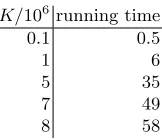
OurSharemindcluster consists of three computers with 48 GB of RAM and a 12-core 3 GHz CPU with Hyper Threading running Linux (kernel v.3.2.0-3-amd64), connected by an Ethernet local area network with link speed of 1 Gbps. On this cluster, we have benchmarked the execution time of the OEP application protocol for extended permutations inF200+K,2K+100 (for various values ofK),
K/106 running time
0.1 0.5
1 6
5 35
7 49
8 58
Table 1.Execution times for applying an OEP from (K+ 200) inputs to (2K+ 100) outputs (times in seconds)
in Table 1. The running time t(K) (in seconds) is very well approximated by 4.54·10−7·KlnK.
10
Private evaluation of branches
We have proposed a new, efficient construction for oblivious extended permu-tations, that is fully integrable with secure multiparty computation protocols for other operations. Practically usable private function evaluation is a possible application of our techniques, if combined with private evaluation of the gates in circuits. Recent advances in private function evaluation may make it a practical tool for certain subtasks in secure multiparty computation, e.g. for handling the branching on private values. Currently, such branchings are handled through the execution of both branches, followed by an oblivious choice [33].
It is reasonable to assume that any application of PFE will still attempt to use as much information that can be publicly deduced about the computed func-tion. Flexibility of PFE techniques is necessary, in order to absorb all available information. The oblivious extended permutations proposed in this paper allow a much greater multitude of potential usage scenarios than [36]. It is possible to evaluate a function without anyone knowing, which function is being evaluated. This allows us to obliviously select the representation of a private function and then evaluate it, enabling branching on private values. In this case, we still need to construct private representations of both branches, but this computation can be moved to the offline phase. The actual selection of the privately executed branch can be very efficient [29].
In the following we describe how the representations of private functions could be prepared offline, and how the selection could be made during online phase. Our construction is geared towards the representations and protocols employed bySharemind, using additive sharing among three parties. Consider the program fragment
switch(i) {
case 1: f_1; break; case 2: f_2; break;
...
}
where the value of iis secret. Let the topology of the circuitfi be represented
by the EPφi and the operations in its gates be recorded in the vectorv(i). We
assume that for all i, the vectors v(i) have the same length andφi ∈Fn,m for
some n and m not depending on i. This assumption is necessary for avoiding leaking information aboutithrough the size of the branch. In practice, we expect padding to be used to make this assumption hold. The EPs φi and vectors
v(i) are public. Let (σ
i, τi) ∈ Sn×S`n,m be the representation of φi as two
permutations. Let c1, . . . , ck be public upper bounds on the number of times
that the control flow reaches the switch-statement above, while the variablei has the value 1, . . . , k, respectively. Letc=c1+· · ·+ck.
We show how to construct a private vectorJsKof lengthccontainingcicopies
of σi in random order, and how to later select from it according to a private
indexi. The construction algorithm (for offline running) is given in Alg. 10 and the selection algorithm in Alg. 11. The construction algorithm can be adapted for private function evaluation — instead of σi it should receive as input the
entire description of the functionfi, consisting of two permutationsσi and τi,
as well as the encodings of the gates offi. The adapted algorithm would return
several vectors instead of JsK. The selection algorithm stays almost the same, only picking the`-th element of all vectors, not justs.
The selection algorithm needs to perform private lookups from vectorsJw (i)
K.
For this, we could use the algorithms from [29], which perform only a constant number of multiplications (and other expensive operations) during the actual execution, having shifted most of their complexity to the offline pre-processing phase.
We see that the order of private permutations in the vectorJsKconstructed in Alg. 10 is determined by the composition of random permutationsξ, π∈Sc. No
party knows both permutations, hence the it has no information about the order through ξ or π. Also, the resharing operations that the parties perform with the permutations σi only make the parties to receive random permutations in
Sn, hence they cannot associate the values they receive with the original values
σi and the orderξ◦πdoes not leak through it. Finally, the operations Alg. 10
performs to produce the vectorsJw(1)K, . . . ,Jw(k)Konly use the ABB operations and do not leak anything.
In Alg. 11, elements of the vectorJsK are selected one by one, by exposing
the index of the element to be returned. Each element is selected at most once, and the order of selection is completely random — the results of declassification could be simulated by generating random elements of{1, . . . , c}without repeats.
Acknowledgements
Algorithm 10:Constructing a vector of private permutations Data: Publicσ1, . . . , σk∈Sn,c1, . . . , ck∈N
Result: Permutedσ-s: a vectorJsKof lengthc=c1+· · ·+ck containingci shared copies ofσi(of sort 0) in random positions.
Result: For eachia vectorJw(i)Kof lengthci, indicating, which elements ofs are equal toσi.
Letz∈Nc be a non-decreasing vector containingcicopies ofi P2 randomly choosesξ∈Sc
foreachi∈ {1, . . . , c}do P2 setsσi0←σzξ(i)
P2 chooses randomσi,01, σ
0
i,3∈Sn, such thatσ
0
i,1◦σ
0
i,3=σ
0
i P2 sendsσi,01toP1
P2 sendsσi,03toP3
P1 andP3 agree on a randomπ∈Sc foreachi∈ {1, . . . , c}do
P1 andP3 agree on randomπi1, πi3∈Sn P1 setsJsiK1←σπ0(i),1◦π
−1
i1 and sends it toP2 P3 setsJsiK3←π
−1 i3 ◦σ
0
π(i),3 and sends it toP2 P1 andP3 setJsiK2←πi1◦πi3
Jξ −1
K←input(ξ −1) ;
// P2 shares ξ−1 foreachi∈ {1, . . . , c}doP1 and/orP3setvπ(i)←i
JvK←input(v) ; // P1 and/or P3 shares v JwK←apply(JvK;Jξ
−1
K)
foreachi∈ {1, . . . , k}do offseti←Pi−1
j=1cj
foreachj∈ {1, . . . , ci}doJw
(i)
j K←Jwoffseti+jK
returnJsK,Jw(1)K, . . . ,Jw(k)K
Algorithm 11:Selecting a private permutation Data: Publicσ1, . . . , σk,c1, . . . , ck
Data: VectorsJsK,Jw(1)
K, . . . ,Jw
(k)
Koutput by Alg. 10
Data: Private indexJidxKwithidx∈ {1, . . . , k} Result: A private permutationJtK, such thatt=σidx Internal state:numbersJj1K, . . . ,JjkK(initially 0)
foreachi∈ {1, . . . , k}do
JbiK←(JidxK
? =i)
JjiK:=JjiK+JbiK J`iK←lookup(Jw
(i)
K,JjiK)
`←declassify(Pk
i=1JbiK·J`iK)
Development Fund through the Estonian Center of Excellence in Computer Sci-ence (EXCS).
References
1. SecureSCM. Technical report D9.1: Secure Computation Models and Frameworks. http://www.securescm.org, July 2008.
2. Assaf Ben-David, Noam Nisan, and Benny Pinkas. FairplayMP: a system for secure multi-party computation. InCCS ’08: Proceedings of the 15th ACM conference on Computer and communications security, pages 257–266, New York, NY, USA, 2008. ACM.
3. Dan Bogdanov and Aivo Kalu. Pushing back the rain—how to create trustworthy services in the cloud. ISACA Journal, 3:49–51, 2013.
4. Dan Bogdanov, Liina Kamm, Sven Laur, and Pille Pruulmann-Vengerfeldt. Secure multi-party data analysis: end user validation and practical experiments. Cryptol-ogy ePrint Archive, Report 2013/826, 2013. http://eprint.iacr.org/.
5. Dan Bogdanov, Sven Laur, and Jan Willemson. Sharemind: A framework for fast privacy-preserving computations. In Sushil Jajodia and Javier L´opez, editors, ESORICS, volume 5283 of Lecture Notes in Computer Science, pages 192–206. Springer, 2008.
6. Dan Bogdanov, Margus Niitsoo, Tomas Toft, and Jan Willemson. High-performance secure multi-party computation for data mining applications. Int. J. Inf. Sec., 11(6):403–418, 2012.
7. Dan Bogdanov, Riivo Talviste, and Jan Willemson. Deploying secure multi-party computation for financial data analysis - (short paper). In Angelos D. Keromytis, editor,Financial Cryptography, volume 7397 ofLecture Notes in Computer Science, pages 57–64. Springer, 2012.
8. Peter Bogetoft, Dan Lund Christensen, Ivan Damg˚ard, Martin Geisler, Thomas P. Jakobsen, Mikkel Krøigaard, Janus Dam Nielsen, Jesper Buus Nielsen, Kurt Nielsen, Jakob Pagter, Michael I. Schwartzbach, and Tomas Toft. Secure mul-tiparty computation goes live. InFinancial Cryptography, pages 325–343, 2009. 9. Martin Burkhart, Mario Strasser, Dilip Many, and Xenofontas Dimitropoulos.
SEPIA: Privacy-preserving aggregation of multi-domain network events and statis-tics. InUSENIX Security Symposium, pages 223–239, Washington, DC, USA, 2010. 10. Ran Canetti. Universally composable security: A new paradigm for cryptographic
protocols. InFOCS, pages 136–145. IEEE Computer Society, 2001.
11. Ivan Damg˚ard, Matthias Fitzi, Eike Kiltz, Jesper Buus Nielsen, and Tomas Toft. Unconditionally secure constant-rounds multi-party computation for equality, com-parison, bits and exponentiation. In Shai Halevi and Tal Rabin, editors, TCC, volume 3876 ofLecture Notes in Computer Science, pages 285–304. Springer, 2006. 12. Ivan Damg˚ard, Marcel Keller, Enrique Larraia, Valerio Pastro, Peter Scholl, and Nigel P. Smart. Practical Covertly Secure MPC for Dishonest Majority - Or: Breaking the SPDZ Limits. In Jason Crampton, Sushil Jajodia, and Keith Mayes, editors,ESORICS, volume 8134 ofLecture Notes in Computer Science, pages 1–18. Springer, 2013.
14. Martin Geisler.Cryptographic Protocols: Theory and Implementation. PhD thesis, Aarhus University, February 2010.
15. Rosario Gennaro, Michael O. Rabin, and Tal Rabin. Simplified vss and fact-track multiparty computations with applications to threshold cryptography. InPODC, pages 101–111, 1998.
16. Craig Gentry. Fully homomorphic encryption using ideal lattices. In Michael Mitzenmacher, editor,STOC, pages 169–178. ACM, 2009.
17. Oded Goldreich, Silvio Micali, and Avi Wigderson. How to Play any Mental Game or A Completeness Theorem for Protocols with Honest Majority. InSTOC, pages 218–229. ACM, 1987.
18. Roberto Guanciale, Dilian Gurov, and Peeter Laud. Private Intersection of Regular Languages. InProceedings of the 12th Annual Conference on Privacy, Security and Trust. IEEE, 2014.
19. Koki Hamada, Dai Ikarashi, Koji Chida, and Katsumi Takahashi. Oblivious radix sort: An efficient sorting algorithm for practical secure multi-party computation. Cryptology ePrint Archive, Report 2014/121, 2014. http://eprint.iacr.org/. 20. Koki Hamada, Ryo Kikuchi, Dai Ikarashi, Koji Chida, and Katsumi Takahashi.
Practically efficient multi-party sorting protocols from comparison sort algorithms. In Taekyoung Kwon, Mun-Kyu Lee, and Daesung Kwon, editors, ICISC, volume 7839 ofLecture Notes in Computer Science, pages 202–216. Springer, 2012. 21. Wilko Henecka, Stefan K¨ogl, Ahmad-Reza Sadeghi, Thomas Schneider, and Immo
Wehrenberg. TASTY: tool for automating secure two-party computations. InCCS ’10: Proceedings of the 17th ACM conference on Computer and communications security, pages 451–462, New York, NY, USA, 2010. ACM.
22. Yan Huang, David Evans, and Jonathan Katz. Private set intersection: Are garbled circuits better than custom protocols? InNDSS. The Internet Society, 2012. 23. Dai Ikarashi, Ryo Kikuchi, Koki Hamada, and Koji Chida. Actively private and
correct mpc scheme int < n/2 from passively secure schemes with small overhead. Cryptology ePrint Archive, Report 2014/304, 2014. http://eprint.iacr.org/. 24. Yuval Ishai and Anat Paskin. Evaluating branching programs on encrypted data. In
Salil P. Vadhan, editor,TCC, volume 4392 ofLecture Notes in Computer Science, pages 575–594. Springer, 2007.
25. Kristj´an Valur J´onsson, Gunnar Kreitz, and Misbah Uddin. Secure multi-party sorting and applications. Cryptology ePrint Archive, Report 2011/122, 2011.http: //eprint.iacr.org/.
26. Liina Kamm, Dan Bogdanov, Sven Laur, and Jaak Vilo. A new way to protect privacy in large-scale genome-wide association studies. Bioinformatics, 29(7):886– 893, 2013.
27. Vladimir Kolesnikov and Thomas Schneider. A practical universal circuit construc-tion and secure evaluaconstruc-tion of private funcconstruc-tions. In Gene Tsudik, editor,Financial Cryptography, volume 5143 of Lecture Notes in Computer Science, pages 83–97. Springer, 2008.
28. Peeter Laud and Alisa Pankova. Verifiable computation in multiparty protocols with honest majority. Cryptology ePrint Archive, Report 2014/060, 2014. http: //eprint.iacr.org/.
29. Peeter Laud and Jan Willemson. Universally composable privacy preserving finite automata execution with low online and offline complexity. Cryptology ePrint Archive, Report 2013/678, 2013. http://eprint.iacr.org/.
31. Sven Laur, Jan Willemson, and Bingsheng Zhang. Round-Efficient Oblivious Database Manipulation. In Proceedings of the 14th International Conference on Information Security. ISC’11, pages 262–277, 2011.
32. Johann Peter Gustav Lejeune Dirichlet. Uber die Bestimmung der Mittleren¨ Werthe in der Zahlentheorie.Abhandlungen der K¨oninglich Preussischen Akademie der Wissenschaften, pages 69–83, 1849.
33. Chang Liu, Yan Huang, Elaine Shi, Jonathan Katz, and Michael Hicks. Automating Efficient RAM-Model Secure Computation. InProceedings of 2014 IEEE Sympo-sium on Security and Privacy. IEEE, 2014.
34. Lior Malka and Jonathan Katz. Vmcrypt - modular software architecture for scalable secure computation. Cryptology ePrint Archive, Report 2010/584, 2010. http://eprint.iacr.org/.
35. Payman Mohassel, Saeed Sadeghian, and Nigel P. Smart. Actively secure private function evaluation. Cryptology ePrint Archive, Report 2014/102, 2014. http: //eprint.iacr.org/.
36. Payman Mohassel and Seyed Saeed Sadeghian. How to Hide Circuits in MPC: an Efficient Framework for Private Function Evaluation. In Thomas Johansson and Phong Q. Nguyen, editors, EUROCRYPT, volume 7881 ofLecture Notes in Computer Science, pages 557–574. Springer, 2013.
37. Adi Shamir. How to share a secret. Commun. ACM, 22(11):612–613, 1979. 38. Abraham Waksman. A permutation network. J. ACM, 15(1):159–163, 1968. 39. Andrew Chi-Chih Yao. Protocols for secure computations (extended abstract). In