REVIEW ON CAR COOLING USING SOLAR ENERGY
S.Ahtesham Husain
1, Manoj Dhawade
2, Suprabhat A.Mohod
3 1Department of Mechanical Engineering, Lokmanya Tilak College of Engineering,
Koparkhairane, Navi Mumbai (India)
2,3
Asst.Professor Department of Mechanical Engineering, Lokmanya Tilak College of Engineering,
Navi Mumbai (India)
ABSTRACT
This paper shows how we can make use of solar energy for cooling purpose in cars. As we know that number of cars are increasing day by day, and we cannot totally depend on fossil fuels, so we have to make use of alternative energy source such as solar energy, which is freely available. The car is less efficient while keeping the Air conditioning (AC) ON as compared to OFF. So to increase the efficiency of car, the battery which runs the AC will b powered by Solar energy, with the help of solar panels built on the roof of the car. The energy developed by Solar panels can also be used to provide electricity to other devices in the car itself. When the sun is shining bright, it will store the energy in the battery and it can be used at night when the sun is not present. This also proves the “law of conservation of energy” that is „energy can never be created nor be destroyed, It can b just converted from one form to another useful form.
Keyword: Alternative energy, Conservation, Efficiency, Fossil fuels,
I. INTRODUCTION
Fossil fuels are depleting day by day, we cannot be totally dependent on these energy sources. This also causes a
great effect on the environment. Petrol vehicles releases exhaust gases which are very harmful for environment.
And to prevent these harmful hazards we need to think about clean fuel. The best fuel which is abundantly
available for us is solar energy. Earth receives around 174,000 terawatts (TW) of incoming solar radiation out of
this 30-40% is sent back to space. Even if we use the remaining energy it is more than enough for the whole
world.
Solar energy is the Sun’s light which falls on earth’s surface. It is then harvested from it using several
technologies for different applications like heating, providing electricity, artificial photosynthesis, and car
Figure1.1 : Energy Absorbed and Rejected by Earth’s Surface
The above Fig: 1 states the energy absorbed and rejected by Earth’s surface. In 2002 a study say that the earth
received about 3,850,000 exajoules (EJ) per year in one hour, which is sufficient enough to provide electricity
for the whole world for one year.
The total amount of energy which the earth receives in one year is equal to the total energy produced by Earth’s
combined non-renewable sources available. Use of solar energy got exposure after 1960, but the only thing
which comes as an obstruction in utilizing this energy is that we do not get sunlight all the time. As the sun sets,
the process stops. Therefore we need to store energy.
Table1.1: Energy consumption
Sr.No Name of energy Human consumption peer year
1 Solar 3850000
2 Wind 2250
3 Biomass 200
4 Electricity 536
5 Primary energy use 67
1.1 Some Energy Storage Methods are
Thermal energy storage
Mechanical energy storage
Thermochemical energy storage
Electrical storage
Harvesting of solar energy is done by the help of solar panels of Photovoltaic cells or panels. These panels
These solar cells are arranged in group of solar cells called as modules. Usually in 6x10 format. These modules
contain a system of photovoltaic system which generates and supplies electricity for personal use at our homes
of commercial use.
The rating of these modules done upon it DC output power which ranges from 100 to 365 watts. A single unit of
module can provide very little amount of power, therefore modules are always set in a set of groups to produce
large amount of electricity or heating.
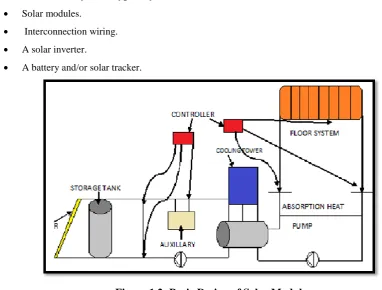
1.2 A Photovoltaic System Typically Includes
Solar modules.
Interconnection wiring.
A solar inverter.
A battery and/or solar tracker.
Figure 1.2: Basic Design of Solar Module
1.3 Materials Used to Make Photovoltaic Cells are as Follows
Crystalline silicon cells
Silicon which includes single-crystalline, multi-crystalline, amorphous silicon
Polycrystalline thin films which copper indium dieseline (CIS), cadmium telluride (CdTe), and
thin-film silicon
Single-crystalline thin films which includes materials like gallium arsenide(GaAs)
1.4 The Material Should Posses Following Properties
Crystallinity: This indicates how perfectly the atoms are arranged in the crystal structure.
Band gap: The energy required for the electron to move from bound state to free state
Absorption: how good the material is in absorbing the rays from sun. These materials should posses’
high coefficient of absorption.
Manufacturing complexity: As the setup may require several layers of semi-conductor material, hence
As we studied about harvesting solar energy, solar panels, photovoltaic cells etc, we can hereby use it for
air-conditioning of our cars. These technologies have to be applied inside our cars for an efficient vehicle and a
clean environment.
1.5 Equipments Used Are
Car battery
Cooler
Solar collector panel
Fan
Air conditioning unit
II. REVIEW OF SOME RESEARCHERS
2.1 M.F. Basar, M. Musa, M.Y. Faizal, and N.H.A. Razik et al [1]
Millions of people travel by cars totheir workplace, tourist etc. They all have to park the car somewhere. In countries like India where there is lack
of proper parking facility, it has to be parked under open sun. As the car is parked for a continuous session of
6-7 hours under direct sunlight, the inside temperature of the car rises to a great extent. Sometimes the temperature
even rises up to 70°C which can damage the goods kept inside as well as lead to aging of car. People inside the
car should feel comfortable, but it takes times to cool the car from the AC. So, to prevent the above consequence
from happening, a portable car cooling system is to be used. Portable car cooler is used to cool the car on hot
sunny day. As this system uses solar energy, hence it won’t require any power from the car, which makes the car
more fuel efficient. And because the temperature inside is maintained at normal temperature by solar energy, as
we enter the car the AC does not have to work too hard to make feel comfortable.
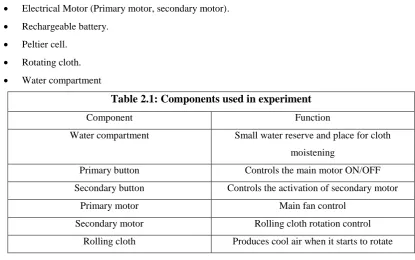
2.1.1 .Components used in this experiment
Electrical Motor (Primary motor, secondary motor).
Rechargeable battery.
Peltier cell.
Rotating cloth.
Water compartment
Table 2.1: Components used in experiment
Component Function
Water compartment Small water reserve and place for cloth
moistening
Primary button Controls the main motor ON/OFF
Secondary button Controls the activation of secondary motor
Primary motor Main fan control
Secondary motor Rolling cloth rotation control
2.1.2 Experimentation
This experiment uses a 12V DC motor which is used to run fan blades at the speed of 5m/sec. And
simultaneously a 6V DC motor known as secondary motor also runs to run the wet cloth. So due to this the
system produces cooling and vapours which thereby brings coziness.
The battery used is lithium polymer which is rechargeable, which can be charged by a charger or peltier cell. In
this setup there are several peltier cell placed on the either side.
Peltier cell: these produces electricity when one side of the cell is exposed to hot air and other side of it is
exposed to cold air. The temperature difference is directly proportional to the electricity produced, higher the
difference in the temperature, higher is the electricity produced.
Due to high velocity of propeller blades, air pressure will decrease and the hot air will be sucked into the
portable cooling system.
Results: The testing of this experiment was done under direct sunlight. Due to which the temperature of the car
raised up to 620 C, but when the portable cooler were fixed in it, it was able to maintain the temperature inside
the car to about 250C.
2.1.3 Result
This experiment proves that the portable cooling system was successfully developed, and was working properly.
It maintained the temperature of the inside area of the car to 25-30oC as compared to 700 C, which was without
the cooling system.
2.2 R. Saidur, H. H. Masjuki [2
] In this paper the use of ventilator is shown, the ventilator removes the hotair from inside. Solar energy can be used to run this ventilator on a sunny day, but on a cloudy day it can be run
on car’s battery. As we have studied earlier about the car getting het up, this kind of ventilation can be to just
throw out the hot air and keep the cold air inside. The solar radiation is absorbed by the car, which makes the car
hotter and harder for it to be cooled. So the driver has to start the AC before he starts the drive. Due to this, the
car consumes more fuel which thereby decreases the efficiency of car. If somehow the temperature inside the
car is reduced it will directly lead to fuel saving. The technique which was used to cool down the car was the use
of ventilator. This ventilator is connected to the battery as well as the power supply can be given by solar cells.
Due to this when the car is parked under direct sunlight, the ventilator keeps on working to keep the car
temperature cool.
2.2.1 Specification
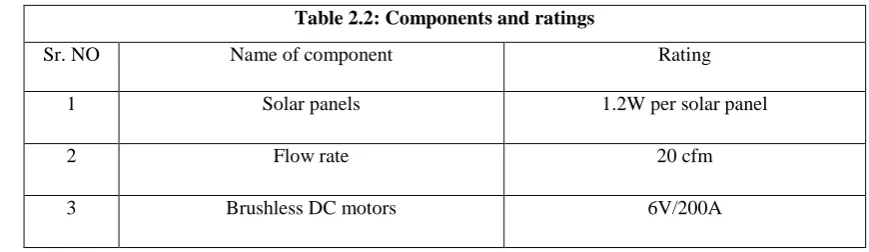
Table 2.2: Components and ratings
Sr. NO Name of component Rating
1 Solar panels 1.2W per solar panel
2 Flow rate 20 cfm
2.2.2 Result
With the use of ventilator cooling can be provided inside the car, in this ventilator power supply is given by
solar energy using solar panels.
2.3 George Ban-Weiss, Pablo Rosado, Riccardo Paolini et al [3]
Studied how to lower the temperaturein the interior of the car by using solar reflectors. Using of solar reflectors or absorbers absorbs the sun’s rays
falling on the vehicle, thereby not allowing it to enter the car’s interior. When the car is stationary or parked at a
particular place for a longer period of time. It tends to heat up the interior space of the car. And for this AC have
to work a lot to bring it back to room temperature. Due this extra work done by car it requires more fuel. As we
have scarcity of fuel already, we cannot afford this to happen. So by using solar panels we can absorb the heat
which is falling on the car by placing the panels on the roof, doors etc. by performing this experiment it was
observed that the temperature inside of the car was lowered by 5-60C . As the car was at lower temperature the
AC has to work less, thereby reducing its work and consuming less fuel.
2.3.1 Technologies to Reduce AC load include
Solar reflective glazing.
Solar reflective shells.
Ventilation.
Insulation.
Window shading.
Since the sunlight is responsible for 70% of cars high temperature
2.3.2 Vehicle Surface Specification
Table2.3: Surface properties
Surface Solar reflection Thermal
emmitance
Area
Roof 0.05 0.83 2.0
Ceiling 0.58 0.79 2.0
Dashboard 0.41 n/a 0.6
Wind shield 0.06 0.88 0.9
Door 0.38 n/a 3.0
Seat 0.11 n/a 2.4
2.3.3 Result
In this method heat from outside is reflected back to atmosphere and is not allowed to enter the car by using
solar reflectors. Due to this, most of the solar heat is reflector by the solar reflectors.
2.4 Y.-A.Yan, C.-Y. Tseng et al [4
] Studied the use of solar powered cooling inside an electric car wherethe use of cooling device was done. As we know there should be a decrease in the use of fossil fuels due its
harmful effects on environment, electric cars should be used. The drawback of using an electric car is its weight,
time taken to charge the vehicle. This car runs on a set of batteries inside the car, which also supplies power to
a lot of difference on its economy as well as mileage. Therefore cooling of this car was given a separate power
input from an external source which is solar.
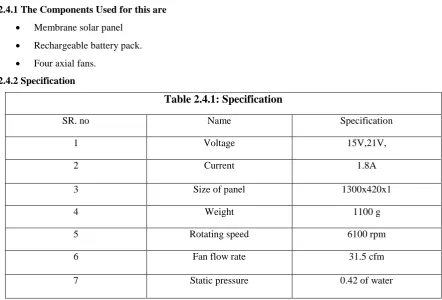
2.4.1 The Components Used for this are
Membrane solar panel
Rechargeable battery pack.
Four axial fans.
2.4.2 Specification
Table 2.4.1: Specification
SR. no Name Specification
1 Voltage 15V,21V,
2 Current 1.8A
3 Size of panel 1300x420x1
4 Weight 1100 g
5 Rotating speed 6100 rpm
6 Fan flow rate 31.5 cfm
7 Static pressure 0.42 of water
This paper studies the work of KYMCO which is a two-wheeler manufacturing company based in Taiwan. It is
manufacturing 2 wheelers since 1963. KYMCO has now manufactured KYMCO UXV-500 which has
concentrated towards solar power to prevent emission of harmful gases and prevent green house effect. Also
using this solar energy for cooling purpose by letting out the hot air from inside and allowing the fresh cool air
from outside It consists of a diverging channel which has axial fans arranged in parallel. These fans works n
such a way that when switched ON it creates a pressure difference which sends out the hot air put of the car
2.4.3 Result
The above study states that if we are able to create a proper boundary condition we can allow the hot air from
inside of the car to flow outwards. And also let the outside cold air inside, which keeps the car cool. To run
these fans solar energy is preferable
.
III. CONCLUSION
Use of fossil fuels cannot be used permanently, because of its limited resource as well as its harmful effects on
the environment like pollution which directly effects in rise of the earth’s temperature. This leads to global
warming, which is a very important issue for us.
Therefore, use of natural fuels like solar energy should be encouraged. As it is available abundantly and also
cars can save a lot of fuel, which reduces pollutant from the exhaust. And it also causes comfort to the person
sitting inside
.
REFERENCE
[1] M.F. Basar, M. Musa, M.Y. Faizal, N.H.A. Razik: ―Alternative Way in Reducing Car Cabin Temperature
Using Portable Car Cooling System (Car-Cool)‖. ISSN: 2278-3075, Volume-3, Issue-3, August 2013
[2] R. Saidur, H. H. Masjuki and M. Hasanuzzaman: ―Performance of an improved solar car ventilator‖.Vol. 4
(2009), No. 1, 24 -34.
[3] Pablo Rosado, George Ban-Weiss, and Riccardo Paolini: ―Potential benefits of solar reflective car shells:
Cooler cabins, fuel savings and emission reductions‖. Applied Energy 88 (2011) 4343–4357
[4] Y.A.Yan, C.-Y. Tseng:‖ Feasibility of Solar Powered Cooling Device for Electric Car‖. Energy Procedia
14 (2012) 887 – 892
[5] Yasuro H, Kawashima T. ―Basic Research on a Novel Zero-Emission ―Public Transportation System.
Journal of Environment And Engineering 2010‖; 5: 168–82.
[6] Farrington R, Rugh J. ―Impact of Vehicle Air-Conditioning on Fuel Economy, Tailpipe Emissions, and
Electric Vehicle Range ―Earth Technologies Forum Washington D.C.; Oct. 31, 2000.
[7] Heydari A, Jani S. ―Entropy-minimized optimization of an automotive air-conditioning and HVAC
system. Paper presented at SAE World Congress, March, Detroit, MI, USA‖; doi: 10.4271/2001-01-0592.
[8] R. Saidur, H.H. Masjuki, M. Hasanuzzaman. (2009). ―Performance of an Improved Solar Car Ventilator.
International Journal of Mechanical and Materials Engineering (IJMME)‖, Vol. 4, No. 1, pp 24-34, 2009
[9] Akbari H, Berdahl P, Levinson R‖Measuring solar reflectance—Part I: Defining ametric that accurately
predicts solar heat gain‖. Solar Energy2010; 84:717–1744.
[10] Baier W, Wiesler B, Raulot A, Rugh J, Wolfahrt J, Bharathan D. ―Aspects of cabinfluid dynamics, heat
transfer, and thermal comfort in vehicle thermal management simulations. Paper presented at Vehicle
Thermal Management Systems Conference & Exhibition, May, Toronto, ON, Canada‖;
2005.doi:10.4271/2005-01-2000.
[11] Burch S, Cuddy M, Bharathan D, Johnson V, Wipke K, Markel A, et al. ADVISOR2.0: ―a
second-generation advanced vehicle simulatory for systems analysis‖. 14 pp. NREL Report No. TP-540-25928,
Golden, CO: NREL; 1999.
[12] Dai L, Xu G, Zhang H, Li Y, Chen W.‖Studies of air-flow and temperature fields inside a passenger
compartment for improving thermal comfort and saving energy. Part I: Test/numerical model and
validation‖. App. Therm Eng2009; 29(7):2022–7.
[13] M.Bouzidi, A.Mezrhab (2006). ―Computation ofthermal comfort inside a passenger car