Bio-organic, bio-chemical fertilizers and N-Fixer (N-Bio Booster) improve paddy yields in the field trials at Langkat in Medan, Indonesia
Shih Hao Tony Peng*1, Chee Kong Yap2, Siti Maryam Harahap3, Nur Faizatulakma Mohamed Sazali1,
Nurul Aimi Thuraya1, Roslan Arshad1, Muhammad Hazim Zainal1, Charles Then Khoon Thiam1, Kiki
Munthe1 and Ee Wen Chai1
1All Cosmos Bio-Tech Holding Corporation, PLO650, Jalan Keluli, Pasir Gudang Industrial Estate,
81700 Pasir Gudang, Johor, Malaysia
2Department of Biology, Faculty of Science, Universiti Putra Malaysia, 43400 UPM, Serdang,
Selangor, Malaysia
3Indonesian Agency for Agricultural Research and Development, Ministry of Agriculture, North
Sumatera, Indonesia
*Corresponding author: [email protected] Abstract
The aim of the present study was to assess the efficacy of All Cosmos Industries (ACI) bio-organic and bio-chemical fertilizers and ACI N-Fixer (N-Bio Booster) on the paddy yields based on the field trial plots at Langkat, Medan, Indonesia. This application of ACI bio-organic fertilizer (NPK 5/5/5) and ACI bio-chemical (NPK 15/15/15) fertilizer and ACI N-Fixer tests were conducted at the paddy farm at Langkat from May-October 2018. This study employed a factorial randomized complete block design which consisted of two factors, namely: Factor I with four types of fertilizers while Factor II consisted of two paddy varieties (Inpari 30 and Inpari 32). Overall, the filled grains in the ACI treatments are significantly (P< 0.05) higher than those in the control treatments that used Normal Chemical Compound NPK. Overall, total weight per meter² (368-617g) in ACI treatments are also significantly (P< 0.05) higher than those (319-371g) in the control treatments. At harvesting time at 105 days after transplanting, significantly higher (P< 0.05) colony counts (13-15 x 106 CFU/mL) (for ACI treatments),
than those (8 x 10⁶ CFU/mL) in the controls positively indicated higher total yields of paddy grains per
hectare. It was found that the application of ACI bio-organic and bio-chemical fertilizers and ACI N-Fixer can improve paddy yields of the two rice varieties, between 16.4-38.2% (up to 5.75 MT/ha), in the field trial plots at Langkat. These commercial fertilizers play an imperative role in refining the soil fertility and thereby can increase the yield of rice production. Therefore, it is highly recommended that ACI bio-organic and ACI bio-chemical fertilizers and ACI N-Fixer (N-Bio Booster) can be employed to increase the paddy yield in this region.
Keywords: Bio-organic fertilizer; Bio-chemical fertilizer; Grain yield; N-Fixer.
Funding: All Cosmos Industries did not have any additional role in the study design, data collection and analysis, decision to publish, or preparation of the manuscript. The specific roles of these authors are articulated in the ‘authorcontributions’ section.
Conflicts of Interests: The authors declare that they have no conflicts of interests.
I. INTRODUCTION
To meet the increasing needs of rice in North Sumatera in Indonesia [1], a solution is needed to provide fertilizer with the right type and dosage. If the plants experience a lack of NPK, this can result in low quality and quantity of production. For example, if a plant has a P nutrient deficiency effect on the paddy such as an upsurge in the percentage of empty grain, reducing the weight and quality of the grains [2].
The total area of paddy land and paddy yield have progressively reduced over the years in North Sumatera [1]. The rice production problem, at Medan, North Sumatera, has been a research
focus by a few researchers [1, 3-4]. Barus et al. [3] found that IR 42 and Banyuasin had the best growth and high adaptability on saline soil as compared with other genotypes in the paddy growth at Paluh Merbau in Medan. Abdi et al. [4] investigated the causes effecting the decisions of farmers in the production of paddy seeds in Deli Serdang Regency.
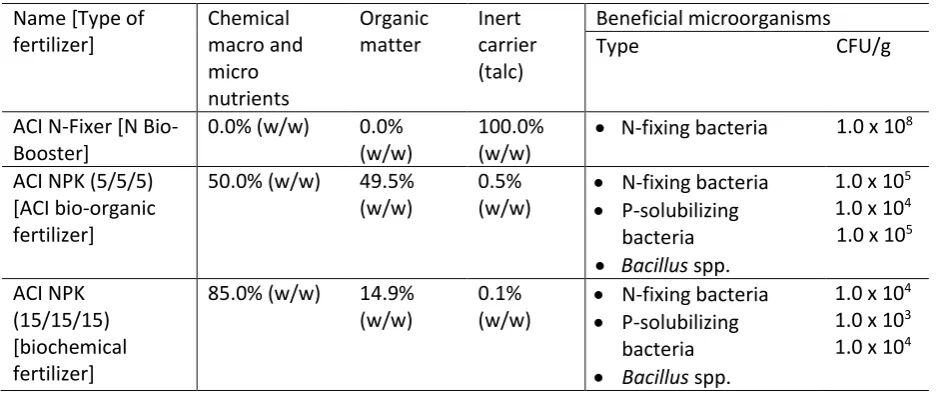
Except for Normal Chemical Compound NPK (15/15/15), the four treatments of different fertilizers used in this field trial plot experiment are commercial fertilizer products consisting of beneficial microorganisms, from All Cosmos Industries (ACI) Sdn Bhd. They are ACI N-Fixer, ACI NPK (5/5/5) and ACI NPK (15/15/15). The ACI N-Fixer is commercially known as N-Bio Booster RealStrong Fertilizer (Table 1). It contains a free-living nitrogen-containing bacterium, Bacillus sp. which can convert nitrogen gas in the atmosphere (insoluble) to ammonia, nitrate or nitrite, which can be freely taken up by plants for the better plant growth [5].
The ACI NPK (5/5/5) is a bio-organic fertilizer, known as RealStrong Soil Improver 5/5/5 (Table 1). The soil improver contains high concentration of beneficial microorganisms, and its ingredients nclude 65% organic matter, 30% chemical raw materials and 5% zeolite. It can amend and improve the soil structure by helping increase the pH value of the soil, recovering and improving the soil fertility [6].
The ACI NPK (15/15/15) is bio-chemical fertilizer, which was a tailor-made fertilizer product for this project, as compared to Normal Chemical Compound NPK (15/15/15) which is an inorganic fertilizer. It also consists of beneficial microorganisms (Table 1). It can effectively improve the soil structure which is caused by the excessive use of inorganic fertilizers [7].
Table 1: Composition of different types of microbial fertilizers. Name [Type of
fertilizer] Chemical macro and micro nutrients Organic matter Inert carrier (talc) Beneficial microorganisms
Type CFU/g
ACI N-Fixer [N Bio-Booster]
0.0% (w/w) 0.0% (w/w)
100.0% (w/w)
• N-fixing bacteria 1.0 x 10⁸
ACI NPK (5/5/5) [ACI bio-organic fertilizer]
50.0% (w/w) 49.5% (w/w)
0.5% (w/w)
• N-fixing bacteria • P-solubilizing
bacteria • Bacillus spp.
1.0 x 10⁵
1.0 x 10⁴
1.0 x 10⁵
ACI NPK (15/15/15) [biochemical fertilizer]
85.0% (w/w) 14.9% (w/w)
0.1% (w/w)
• N-fixing bacteria • P-solubilizing
bacteria • Bacillus spp.
1.0 x 10⁴
1.0 x 10³
1.0 x 10⁴
Since there has been no study conducted on the efficacy of using biofertilizers with the ACI’s products in the paddy production in Indonesia, the objective of this study was to assess the efficacy of ACI bio-organic and bio-chemical fertilizers and ACI N-Fixer (N-Bio Booster) on the paddy yields based on the field trial plots at Langkat, Medan, Indonesia.
II. RESULTS AND DISCUSSION
Plant heights, NPK levels in topsoils and productive tillers
Plant heights (cm) of paddy collected at 20, 30, 40 and 60 DAT, concentrations of N (%), P (%) and K (mg/100g) in the topsoils, and productive tillers collected during harvesting time (105 DAT) are presented in Table 2.
Plant
heights N P K
Total number of productive tillers Treatment 20 DAT 30 DAT 40 DAT 60 DAT 105 DAT 105 DAT 105 DAT 105 DAT
T1V1 47.9a 73.3a 78.8a 89.5a 0.08a 0.26a 0.64a 8.25a
T1V2 49.9a 71.1a 88.5a 102a 0.08a 0.26a 0.59a 9.75a
T2V1 51.4a 75.6a 85.2a 94.0a 0.15b 0.21a 0.56a 10.3ab
T2V2 49.4a 73.7a 87.4a 99.2a 0.17b 0.23a 0.58a 11.5c
T3V1 49.4a 72.0a 84.9a 86.3a 0.19bc 0.22a 0.84b 13.3c
T3V2 54.4a 75.1a 88.8a 102a 0.14b 0.23a 0.58a 14.5c
T4V1 48.7a 73.3a 82.4a 90.7a 0.19bc 0.26a 0.50a 12.3bc
T4V2 54.9a 73.3a 85.4a 100a 0.16b 0.23a 0.50a 10.0ab
Note: Means with the different letters are significantly (P< 0.05) different. Details of Treatments can be referred to Table 6.
For the plant heights, there are no significant (P> 0.05) difference among the control treatments (T1V1 and T1V2), with other treatments). For the NPK in the topsoils collected during harvest period (105 DAT), the levels of N (0.14-0.19%) in T2V1, T2V2, T3V1, T3V2, T4V1 and T4V2 are significantly (P< 0.05) higher than those (0.08%) in the control treatments (T1V1 and T1V2). However, for P levels in the topsoils, there are no significant (P> 0.05) difference between the control treatments (0.26%; T1V1 and T1V2), and those (0.21-0.26%) in treatments of T2V1, T2V2, T3V1, T3V2, T4V1 and T4V2. For K levels, there are also no significant (P> 0.05) difference between the control treatments (0.59-0.64%; T1V1 and T1V2), and those (0.56-0.58%) in treatments of T2V1, T2V2, T3V1, T3V2, T4V1 and T4V2. However, the K level (0.84%) in T3V1 is significantly (P< 0.05) higher than those (0.56-0.64%) in other treatments.
The productive tillers (11.5-14.5) in T2V2, T3V1, T3V2 and T4V1 are significantly (P< 0.05) higher than those in the control treatments (8.25-9.75; T1V1 and T1V2), T2V1 (10.3), and T4V2 (10.0). Asbur [8] reported the number of productive tillers was 48.1 based on 21 day-old seedlings based on one seedling per hill at paddy field of Deli Serdang of North Sumatera in the 2012. Syatrianty et al. [9] reported a lowering number of tillers and number of productive tillers by intensifying the number of seedling per hill.
Number of filled grains and empty grains per panicle
Filled and unfilled grain per panicle collected during harvesting time (105 days of planting) are shown in Table 3. Overall, the filled grains (110-121) in T2V2, T3V1, T3V2 and T4V1 are significantly (P< 0.05) higher than those in the control treatments (71.8-83.6; T1V1 and T1V2), T2V1 (102) and T4V2 (85.7). On the contrary, the unfilled grains (26.5-38.6) in the control treatments (T1V1 and T1V2) are higher (but not significant, P> 0.05) than those (15.3-25.5) in T2V1, T2V2, T3V1, T3V2, T4V1 and T4V2. Asbur [8] reported a significant positive correlation between number of grain per panicle and grain yield. They found the uppermost grain yield per plant and per plot initiated greater number of grain per panicle (113 grain) and lesser number unfilled grain (26.2 grain) per panicle. Sanico et al. [10] also reported a significant correlation between number of grain per panicle and rice grain yield. Table 3: Numbers of filled and unfilled grain per panicle collected during harvesting time (105 days of transplant) in the field trial plots at Langkat.
Treatment Filled grain/panicle Unfilled grain/panicle
T1V1 71.8a 38.6a
T1V2 83.6ab 26.5ab
T2V1 102abcd 21.6ab
T2V2 110bcd 19.9ab
T3V2 121d 15.3a
T4V1 112bcd 16.7a
T4V2 85.7abc 25.5ab
Note: Means with the different letters are significantly (P< 0.05) different. Details of Treatments can be referred to Table 6.
Grain weight per meter, grain weight per plot and total yield per hectare
Total weight per meter², total weight per plot of the paddy grains, and total yields of paddy grains per hectare, collected during harvesting time (105 DAT) are given in Table 4. Overall, total weight per meter² (368-617g) in T2V1, T2V2, T3V1, T3V2, T4V1 and T4V2 are significantly (P< 0.05) higher than those (319-371g) in the control treatments (T1V1 and T1V2). Total weight of paddy grains per plot (8.23-11.5 kg) in T2V1, T2V2, T3V1 and T3V2 are significantly (P< 0.05) higher than those (6.93-7.49 kg) in the control treatments (T1V1 and T1V2). However, the values (6.83-7.38) for T4V1 and T4V2 are not significantly higher than those in the control treatments. Total yield per hectare (4.57-5.75 MT/ha) in T2V2, T3V1 and T3V2 are significantly (P< 0.05) higher than those in the control treatments (3.47-3.74 MT/ha; T1V1 and T1V2). Again, nonetheless, the values (3.41-3.69 MT/ha) for T4V1 and T4V2 are not significantly higher than those in the control treatments.
With the applications, ACI NPK (5/5/5) and ACI NPK (15/15/15), and N-Fixer (N-Bio Booster), the paddy yield at Langkat can be increased up to 5.75 MT/ha. Asbur [8] reported the uppermost grain yield per plot 4.94 kg in one seedling per hill for the 21-day-old seedlings at paddy field of Deli Serdang of North Sumatera.
Table 4: Total weight per meter² (g), total weight per plot (kg) of the paddy grains, and total yields of paddy grains per hectare (MT/ha), collected during harvesting time (105 days of planting) in the field trial plots at Langkat.
Treatment
Total weight of paddy grains per
meter² (g)
Total weight of paddy grains per
plot (kg)
Total yield per hectare
(MT/ha)
T1V1 319a 6.93a 3.47a
T1V2 371b 7.49a 3.74ab
T2V1 423c 8.23c 4.11abc
T2V2 519d 9.14c 4.57bc
T3V1 516d 10.1cd 5.03cd
T3V2 617e 11.5d 5.75d
T4V1 367b 6.83a 3.41a
T4V2 381b 7.38a 3.69ab
Note: Means with the different letters are significantly (P< 0.05) different. Details of Treatments can be referred to Table 6.
Number of colonies in topsoils
The numbers of colony counts in the topsoils of paddy field collected at 35, 60 and 105 DAT are presented in Table 5. At harvesting time at 105 DAT, the significantly higher (P< 0.05) colony counts (13-15 x 106 CFU/mL) (for T2V1, T2V2, T3V1, T3V2, T4V1 and T4V2), than those (8 x 10⁶ CFU/mL) in
Table 5: Numbers of colony counts (x 10⁶) in the topsoils of paddy field collected at 35, 60 and 105 (harvesting time) days after transplanting (DAT) in the field trial plots at Langkat.
Treatment
Initial count (Before treatment)
35 DAT 60 DAT 105 DAT
(Harvesting)
T1V1 4.50a 5.00a 3.00a 8.00a
T1V2 4.50a 11.0b 5.00a 8.00a
T2V1 4.50a 7.00a 7.00ab 13.0b
T2V2 4.50a 11.0b 13.0b 14.0b
T3V1 4.50a
7.00a 20.0c 14.0b
T3V2 4.50a 19.0c 30.0d 15.0b
T4V1 4.50a
19.0c 9.00b 15.0
T4V2 4.50a 21.0c 13.0b 13.0
Note: Means with the different letters are significantly (P< 0.05) different. Details of Treatments can be referred to Table 6.
The present findings show that the application of organic fertilizer NPK (5/5/5) and bio-chemical fertilizer NKP (15/15/15) can positively influence the paddy yields of Inpari 30 and Inpari 32 varieties. Most interestingly, the N-Fixer (N-Bio Booster) enhanced biofertilizer can increase the paddy yield. The mechanism for this favourable effect could be attributable to enhanced absorption of nitrogen and other minerals by the plant [12]. Kader et al. [13] found that N-fixation bacteria living in rhizosphere can improve the root growth by stimulating phytohormone production such as Indole Acetic Acids that can propagandize the nutrient uptake from soils. This can affect the plant reproductive and vegetative growth. Combining these bio-organic and bio-chemical fertilizers can add nutrients to plants and improve soil quality. The presence of microorganisms in the N-Fixer biofertilizer can help plants absorb nutrients from the soil more efficiently. However, the response of paddy yields to both biofertilizer and N fertilizer could be strongly influenced by the factors of weather and seasonal growing conditions [14]. However, the relationship between the weather conditions (temperature and rainfall; Figure 1) and paddy yields at Langkat is evidently not clear to our knowledge.
The insignificant difference (P> 0.05) between the control treatments and T4V1 and T4V2 in the total weight of paddy grains per meter, total weight of paddy grains per plot, and total yield per hectare could be attributable to several factors. These factors included uninvited pests and human error in the measurements in which could potentially result in this negative outcomes. Of course, from ecological point of view, there are many uncontrolled factors that could not be studied at the trial plot sites. However, the positive results from T2V1, T2V2, T3V1 and T3V2, have overruled the negative results of T4V1 and T4V2. This has almost confirmed the effectiveness of using ACI bio-organic and bio-chemical fertilizers and ACI N-Fixer for improving the paddy yield at Langkat.
Normal Chemical Compound NPK fertilizer is an inorganic fertilizer while ACI fertilizers used in the present study were bio-organic and bio-chemical fertilizers. Both the ACI fertilizers showed better paddy yields than inorganic Normal Chemical Compound NPK fertilizer. This can be explained by the beneficial influence of bio-organic materials in stocking the essential NPK to the plants. Therefore, they can stimulate the cation exchange capacity in the habitat soils, thus facilitating them to sustain the essential nutrients longer in the habitat soils that can promote the uptake of essential NPK in the paddy root zone. This can improve the biological activities in the habitat soils and increase the soil fertility [15].
The present finding on positive relationships between biofertilization and increased microbial counts in the paddy have been well supported by many reported studies in other commercial plants. EI-Sawah et al. [17] recommended the use of the dual bacterial inoculum (Azotobacter chroococcum MF135558 and Klebsiella oxytoca MF135559) in the presence of 75% dose of N for enhancing growth and yield of wheat plants and reduce chemical fertilizers usage. Gao et al. [18] reported joint application of biofertilizer mixture with organic fertilizers could boost the growth and yield of maize. This can reduce the use of chemical fertilizers. Afify et al. [19] reported that the microbial inoculation could enhance the significant growth parameters of onion plants.
The use of microorganisms in the biofertilizers of ACI’s products are well supported by many reported in the literature. Khan [20] found that the greater advantages of biofertilizer application with microbes Azospirillum and Trichoderma. This can supplement chemical N fertilizer with optimal paddy yields. In Philippines, Banoya et al. [21] showed the positive effect on paddy grain yields by using three different biofertilizers including Trichoderma and Azospirillum. Subashini et al. [11] also reported the positive effect of biofertilizers (with N-Fixer Azospirillum) on the paddy yields of rice varieties at Puducherry, India. Simarmata et al. [22] summarized that application of consortia of biofertilizers (Trichoderma combined with composted straw) could improve the induced systemic resistance and rice productivity. Therefore, the present study using ACI’s biofertilizers holds a good future perspective in the paddy rice plantation [23-24] in this region.
III. CONCLUSIONS
Overall, the filled grains in the ACI treatments are significantly (P< 0.05) higher than those in the control treatments that used Normal Chemical Compound NPK. Overall, total weight per meter² (368-617g) in ACI treatments are also significantly (P< 0.05) higher than those (319-371g) in the control treatments. At harvesting time at 105 days after transplanting, the significantly higher (P< 0.05) colony counts (13-15 x 106 CFU/mL) (for ACI treatments), than those (8 x 10⁶ CFU/mL) in the controls
positively indicated higher total yields of paddy grains per hectare. It was found that the application of ACI bio-organic and bio-chemical fertilizers and ACI N-Fixer can improve paddy yields of the two rice varieties, between 16.4-38.2% (up to 5.75 MT/ha), in the field trial plots at Langkat. Based on the present field trial plots at Langkat, it can be concluded that that the ACI bio-organic NPK (5/5/5) fertilizer, ACI bio-chemical NPK (15/15/15) fertilizer, and ACI N-Fixer (N-Bio Booster) which was applied in the field trial plots at Langkat can improve the paddy yields of the two rice varieties (Inpari 30 and Ipari 32). Most importantly, the application of the ACI fertilizers can increase paddy yields between 16.4-38.2% in the field trial plots at Langkat. Therefore, it is highly recommended that ACI bio-organic and bio-chemical fertilizers and ACI N-Fixer can be used to increase the paddy production in this region.
IV. MATERIALS AND METHODS
Study area and experimental design
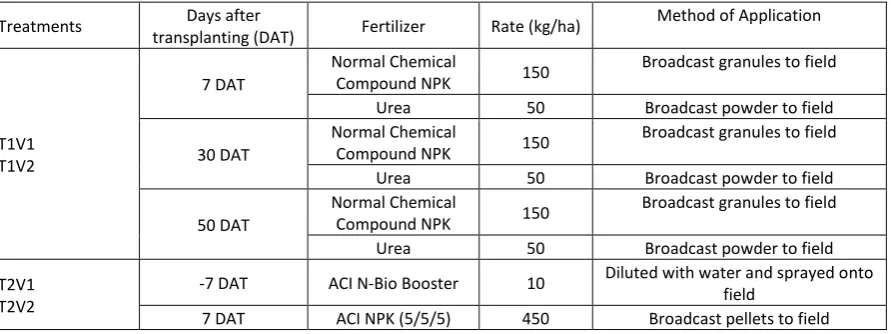
the distance between the plots was 50 cm and the distance between replications was 1 m. Manuring programs and the methods of application in the field trial plots at Langkat are presented in Table 7. Figure 2 shows the temperature and rainfall from May to October 2015 at Kuala Langkat, North Sumatera, Indonesia [25].
Table 6: Combinations of treatments and paddy variety in the field trial plots at Langkat, Medan, Indonesia.
Factor 1: Fertilizers Factor II:
Variety Treatments T1 (Control): Normal Chemical Compound NPK (15/15/15) + Urea V: Inpari 30 T1V1 T1 (Control): Normal Chemical Compound NPK (15/15/15) + Urea V: Inpari 32 T1V2 T2: ACI (NPK 5/5/5) + ACI (N-Fixer) + Urea V: Inpari 30 T2V1 T2: ACI (NPK 5/5/5) + ACI (N-Fixer) + Urea V: Inpari 32 T2V2 T3: ACI (NPK 15/15/15) + ACI (N-Fixer) + Urea V: Inpari 30 T3V1 T3: ACI (NPK 15/15/15) + ACI (N-Fixer) + Urea V: Inpari 32 T3V2 T4: ACI NPK (5/5/5) + ACI (NPK 15/15/15) + ACI (N-Fixer) + Urea V: Inpari 30 T4V1 T4: ACI NPK (5/5/5) + ACI (NPK 15/15/15) + ACI (N-Fixer) + Urea V: Inpari 32 T4V2
Figure 1: Location map of the field trial plots Deli Serdang, Langkat, Medan, Indonesia (arrow).
Table 7: Manuring programs and methods of application in the field trial plots at Langkat,
Medan, Indonesia.
Treatments Days after
transplanting (DAT) Fertilizer Rate (kg/ha)
Method of Application
T1V1 T1V2
7 DAT
Normal Chemical
Compound NPK 150
Broadcast granules to field
Urea 50 Broadcast powder to field
30 DAT
Normal Chemical
Compound NPK 150
Broadcast granules to field
Urea 50 Broadcast powder to field
50 DAT
Normal Chemical
Compound NPK 150
Broadcast granules to field
Urea 50 Broadcast powder to field
T2V1 T2V2
-7 DAT ACI N-Bio Booster 10 Diluted with water and sprayed onto
field
Urea 50 Broadcast powder to field
30 DAT ACI NPK (5/5/5) 450 Broadcast pellets to field
Urea 50 Broadcast powder to field
40 DAT ACI N-Bio Booster 10 Diluted with water and sprayed onto
field
50 DAT Urea 50 Broadcast powder to field
T3V1 T3V2
-7 DAT ACI N-Bio Booster 10 Diluted with water and sprayed onto
field
7 DAT ACI NPK (15/15/15) 150 Broadcast pellets to field
Urea 50 Broadcast powder to field
30 DAT ACI NPK (15/15/15) 150 Broadcast pellets to field
Urea 50 Broadcast powder to field
40 DAT ACI N-Bio Booster 10 Diluted with water and sprayed onto
field
50 DAT Urea 50 Broadcast powder to field
T4V1 T4V2
-7 DAT ACI N-Bio Booster 10 Diluted with water and sprayed onto
field
7 DAT
ACI NPK (5/5/5) 250 Broadcast pellets to field
ACI NPK (15/15/15) 65 Broadcast pellets to field
Urea 50 Broadcast powder to field
30 DAT
ACI NPK (5/5/5) 250 Broadcast pellets to field
ACI NPK (15/15/15) 65 Broadcast pellets to field
Urea 50 Broadcast powder to field
40 DAT ACI N-Bio Booster 10 Diluted with water and sprayed onto
field
50 DAT Urea 100 Broadcast powder to field
(a)
Figure 2: Temperature (°C; (a)) and rainfall (mm; (b)) from May to October 2015 at Kuala Langkat, North Sumatera, Indonesia (Graphs cited and edited from the original source of World Weather Online [25]).
Rice agronomic data and soil samplings
The levels of NPK in the topsoils of the paddy farms were analysed after treatment (harvest period; collected at 105 days after transplanting (DAT)). The colony growth in the paddy soils were analysed before and after treatments.
For the paddy plant samples, the plant heights were measured at 20, 30, 40, 60 DAT. The total numbers of productive tillers were counted at 60 DAT. Numbers of filled and unfilled grain, total weight of paddy grains per meter², total weight of paddy grains per plot and total yield per hectare were determined at harvest period at 105 DAT.
Soil and plant analyses
Soil and plant analyses were conducted at the laboratory of Institute for Agricultural Technology (BPTP) in Medan, North Sumatra, Indonesia. The chemical parameters of the soils were determined quantitively based on the criteria of soil analysis of the Soil Research Institute (Balai Penelitian Tanah; BPT) of Bogor [26]. The methods of NPK determinations followed the FAO’s standard methods [27].
Microbial colony analyses
Number of colony counts (x 10⁶) in the topsoils of paddy field were determined at 35, 60 and 105 (harvesting time) DAT. Analysis of the number of colony was carried out in the microbiology laboratory of the University of North Sumatra, followed the standard test method Automated Colony Forming Unit (CFU) Assays by ASTM [28].
Briefly, 10 g of soil samples were suspended in 100 ml of sterile phosphate saline buffer and shaken using an orbital shaker (DLAB SK-0330-PRO, China) at 200 rpm for 30 minutes to produce a homogenous soil suspension. Serial dilutions of the soil suspensions were diluted to a factor of 10-7
using sterile distilled water. Diluted suspensions (0.10ml) were transferred aseptically onto nutrient agar and spread in duplicates using a flame-sterilized glass spreader. The inoculated plates were then incubated in an incubator (Memmert IN110, Germany) for 3 to 5 days at 28°C. The CFU of each plate was recorded on a daily basis. The type of microorganisms counted was total bacterial count. Statistical analysis
For data analysis, the means of all parameters were statistically tested based on Duncan Multiple Range Test in order to see if there is any significant difference (P< 0.05) among the four treatments [29]. Data analysis was performed using the SPSS program (SPSS 15.0 (2006 by SPSS Inc); Chicago; USA).
Authors’ Contributions: SHTP initiated, designed, and monitored the whole experiment. SMH, NFMS, and NAT performed the soil analysis, plant analysis and the chemical analysis of the paddy, and performed the microbiological measurements. RA, MHZ, CTKT, PK and EWC prepared the biofertilizers and assisted in monitoring the experiment in the field. SMH performed the statistical data. CKY wrote the first draft of the manuscript, revised and edited the final version of the manuscript. All authors have read and agreed to the published version of the manuscript.
Acknowledgments:
1. Siagian, D. R., Shrestha, R. P., Shrestha, S., and Kuwornu, J. K. M. Factors driving rice land change 1989–2018 in the Deli Serdang Regency, Indonesia. Agriculture 9 (2019): 186. oi:10.3390/agriculture9090186.
2. Dobermann, A., and Fairhurst, T. Rice Nutrition Disorder and Nutrient Management. International Rice Research Institute and Potash & Phosphate Institute of Canada. 2000.
3. Barus, W. A., Rauf, A., Damanik, S. J. B., and Rosmayati. Screening and adaptation in some varieties of rice under salinity stress (Case study at Paluh Merbau, Deli Serdang District, North Sumatera, Indonesia). Journal of Rice Research 1 (2013): 112. doi: 10.4172/jrr.1000112
4. Abdi, A. M., Rahmanta, and Tavi Supriana. Factors Affecting the Decision of Farmers to Produce Rice Seeds in Deli Serdang Regency. IOSR Journal of Agriculture and Veterinary Science (IOSR-JAVS) 12.1 (2019): 63-66.
5. ACBT (All Cosmos Bio-Tech). 2020a. N-Bio Booster Realstrong Fertilizer. https://allcosmos.com/services-view/n-bio-booster-realstrong-fertilizer/ (Searched on 24 May 2020).
6. ACBT (All Cosmos BioTech). 2020b. Soil Improver (5/5/5). https://allcosmos.com/zh/services-view/soil-conditioner-2/ (Searched on 24 May 2020).
7. ACBT (All Cosmos Bio-Tech). 2020c. NPK Compound Fertilizer. https://allcosmos.com/zh/product-services/fertilizer/npk-compound-fertilizer/ (Searched on 24 May 2020).
8. Asbur, Y. Effect of seedling number per hill and seedling age on plant growth and grain yield ciherang rice. Proceedings of The 3rd Annual International Conference Syiah Kuala University (AIC Unsyiah) 2013 in conjunction with the 2nd International Conference on Multidisciplinary Research (ICMR) 2013 October 2-4, 2013, Banda Aceh, Indonesia. 3.3 (2013).
9. Syatrianty, A. S., Nadira, S. S., dan Maryam, Y. Pertumbuhan dan produksi padi hibrida pada pemberian pupuk hayati dan jumlah bibit per lubang tanam. J. Agrivigor 11.2 (2012): 202-213. 10. Sanico, A. L., Peng, S., Lteyaza, R. C., and Visperas, R. M. Effect of seedling age and seedling number
per hill on snail damage in irrigated rice. Crop Protection 21 (2002): 137–143.
11. Subashini, H.D., Malarvannan, S., and Kumaran, P. Effect of biofertilizers (N-Fixers) on the yield of rice varieties at Puducherry, India. Asian Journal of Agricultural Research 1 (2007): 146-150. 12. Peng, S. H., Wan-Azha, W. M., Wong, W. Z., Go, W. Z., Chai, E. W., Chin, K. L., and H’ng, P. S. Effect
of using agro-fertilizers and N-fixing Azotobacter enhancer biofertilizers on the growth and yield of corn. Journal of Applied Sciences 13. 3 (2013): 508-512.
13. Kader, M. A., Mian, M. H, and Hoque, M. S. Effects of Azotobacter inoculant on the yield and nitrogen uptake by wheat. Journal of Biological Science 2 (2002): 259-261.
14. Rose, M., Phuong, T., Nhan, D., Cong, P., Hien, N., and Kennedy. Up to 52% N fertilizer replaced by biofertilizer in lowland rice via farmer participatory research. Agronomy for Sustainable Development, Springer Verlag/EDP Sciences/INRA, 34.4 (2014): 857-868.
15. Sarker, A. Kashem, A., and Osman, K. T. Comparative effect of city finished compost and NPK fertilizer on growth and availability of phosphorus to radish (Raphanus sativus L.) in an acid soil. International Journal of Agricultural Science 2 (2012): 146-154.
16. Hauka, F.I.A., Afify Aida, H., and El-Sawah, A.M. Efficiency Evaluation of some Rhizobacteria isolated from Egyptian Soils, In vitro as Biofertilizers. Journal of Agriculture and Chemical Biotechnology, Mansoura University 8 (2017): 231–235.
17. El-Sawah, A.M.; Hauka, F.I.A. and Afify Aida, H. Dual inoculation with Azotobacter chroococcum MF135558 and Klebsiella oxytoca MF135559 enhance the growth and yield of wheat plant and reduce N-fertilizers usage. Journal of Food Dairy Science 10 (2018): 67–76.
19. Afify, A.H., Hauka, F.I.A., and El-Sawah, A.M. Plant Growth-Promoting Rhizobacteria enhance Onion (Allium cepa L.) productivity and minimize requisite chemical fertilization. Environmental Biodiversity and Soil Security 2 (2018): 119–129.
20. Khan, H. I. Appraisal of biofertilizers in rice: To supplement inorganic chemical fertilizer. Rice Science 25.6 (2018): 357-362.
21. Banayo, N. P. M., Cruz, P. C. S., Aguilar, E. A., Badayos, R. B., and Haefele, S. M. Evaluation of biofertilizers in irrigated rice: Effects on grain yield at different fertilizer rates. Agriculture 2 (2012): 73-86.
22. Simarmata, T., Hersanti, Turmuktini, T., Fitriatin, B. N., Setiawati, M. R., and Purwanto. Application of bioameliorant and biofertilizers to increase the soil health and rice productivity. HAYATI Journal of Biosciences 23.4 (2016): 181-184.
23. Aggani, S. L. Development of bio-fertilizers and its future perspective. Sch Acad J Pharm 2 (2013): 327-332.
24. Ghany, T. A. M., Alawlaqi, M. M., and Al Abboud, M. A. Role of biofertilizers in agriculture: a brief review. Mycopath 11 (2013): 95-110.
25. World Weather Online. https://www.worldweatheronline.com/kuala-langkat-weather-history/north-sumatra/id.aspx (Searched on 26 June 2020). (2020).
26. Balai Penelitian Tanah (BPT) of Bogor. Petunjuk Teknis Analisa Kimia Tanah, Tanaman, Air Dan Pupuk. Badan Penelitian dan Pengembangan Pertanian, Departemen Pertanian, Bogor. (2005). 27. Motsara, M. R., and Roy, R. N. Guide to laboratory establishment for plant nutrient analysis. FAO
(Food and Agriculture Organization of the United Nations, Rome. FAO Fertilizer and Plant Nutrition 19 (2008): 219 pages.
28. ASTM. F2944-12, Standard Test Method for Automated Colony Forming Unit (CFU) Assays—Image Acquisition and Analysis Method for Enumerating and Characterizing Cells and Colonies in Culture, ASTM International, West Conshohocken, PA. (2012).