Available online: https://edupediapublications.org/journals/index.php/IJR/ P a g e | 29
Data acquisition and reporting things using IOT
Chandaluri. Mahendra & B. Rajesh
1PG Student, Dept. OfECE, Universal College of Engg& Tech. Perecherla, Guntur, A P, India 522438. 2Assistant Professor, ECE Dept. Universal College of Engg& Tech. Perecherla, Guntur, A P, India 522438.
Abstract: The main objective of this paper is to develop Arduino microcontroller based online ambient monitoring system. This system contains Arduino based atmega328 microcontroller, low power wireless sensors, router & serial peripheral interface. The parameters such as temperature, relative humidity, Co2 level and absolute pressure are measured from the indoor spaces by using low power wireless sensors. These parameters are converted into data values by means of atmega328(Nano Microcontroller Board) microcontroller. The microcontroller is interfaced with the internet through serial peripheral interface. After that the data values are loaded into the internet for remote monitoring. The Internet of Things scenario offers the possibility of remotely visualizing the data values.
Key words: Ambient monitoring Arduino microcontroller Internet of Things Wireless sensors.
I.INTRODUCTION
Internet of Things is one of the new computing technologies in the modern world. IoT concept is millions of devices connected and to communicate with each other through the internet from anywhere in the world. Without human intervention, the devices could run more complicated analysis and quick responds to local needs. IoT refers to the general idea of things that are recognizable,
addressable, locatable, readable and
controllable via the Internet.
Intelligentshopping system is one of application in IoT platform. This system could monitor the habits of purchasing individual users in a store by tracking their specific mobile phones. Users provided with special offers on their favorite products and location of the items that they need, which has automatically conveyed through the phone. INDOOR air quality refers an important factor affecting the health, the comfort and also the
safety of building residents. This
problemleads to a set of symptoms such as
dizziness, headaches, difficulties in
concentration.
Figure 1: The Basic IoT Data Acquisition System.
Basic measurements including
Available online: https://edupediapublications.org/journals/index.php/IJR/ P a g e | 30 can provide more information useful in
solving these problems. The paper presents the development of arduino microcontroller based ambient monitoring system which monitors the ambient temperature, relative humidity, the co2 level and an absolute pressure in indoor spaces and loaded these datato the internet. Iot provides the possibility of remote gathering and processing of data from anywhere in the world. Another excellent application of Internet of Things is to bring the picture in home. Home automation is the best application of IoT in energy management as well as security purpose. The reduced energy profile is gained by using low power core microcontroller, having lowest power consumption in the market.
During earthquake and tsunami, IoT device provides the emergency services in more effective way. It covers the large geographic area by connecting billions of devices and sensors. Cloud computing is one of the platform to support the IoT applications. Such systems could collect information ranging from natural ecosystems to buildings and factories, therefore finding applications in the fields of urban planning and environmental sensing.
IoT based environmental monitoring applications utilize sensors to assist in environmental protection by monitoring water or air quality, soil conditions or atmospheric, also include areas like monitoring the movements of wildlife and their habitats. The development of Internet of Things with
wireless sensor networks achieving
importance in advance information and
communication technologies and also
connected and integrated with the Internet industrial applications.
The power consumptionand
communication overhead are important issues in wireless sensor network design because most wireless sensor devices are resource.
Hardware Architecture
Overview: An ARDUINO (ATMEGA328)
microcontrollerbased online ambient
monitoring system using low power wireless
sensors (CO2, Relative Humidity,
Temperature and Pressure) was designed. This system monitors the carbon dioxide level, temperature, relative humidity and absolute pressure in indoor spaces.
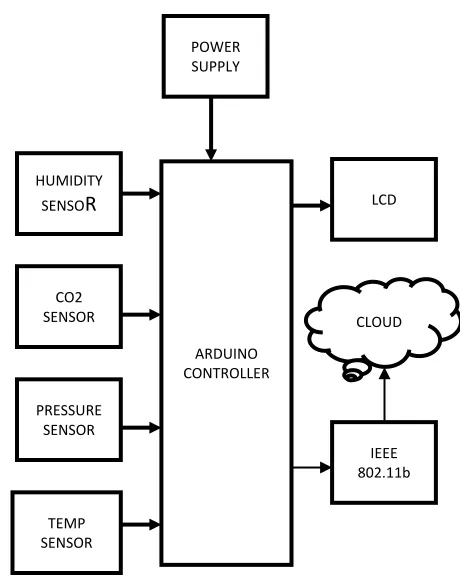
Fig. 2: Block diagram of ambient system.
After that the measured values are applied as input to the microcontroller which provides data values. Finally, these data values are loaded into the internet. The resulting parameters will monitor from anywhere in the world through Internet of Things. The Internet
HUMIDITY SENSOR
CO2 SENSOR
PRESSURE SENSOR
POWER SUPPLY
ARDUINO CONTROLLER
LCD
IEEE 802.11b CLOUD
Available online: https://edupediapublications.org/journals/index.php/IJR/ P a g e | 31 of Things scenario provides the possibility of
remotely visualizing numerical values and graphical values over time, setting triggers.
Arduino Uno Microcontroller: The Arduino
Uno is anATmega328 microcontroller-based board. It has 14 digital input/output pins, 6 analog inputs, an ICSP header, a 16 MHz ceramic resonator, a power jack, a USB connection and a reset button. It contains everything in a single microcontroller board. This board can simply connect to a computer through USB cable and power it with a battery or AC-to -DC adapter to get started. The main feature of the Uno is 16U2 programmed as an USB- to-serial converter. The Uno is different from other boards because it does not use FTDI USB-to-serial driver chip.
Program memory of the system is reprogrammed using on chip ISP Flash through the serial peripheral interface, by an On- chip Boot program running on the AVR core or by a conventional nonvolatile memory
programmer. High density nonvolatile
memory technology is used for device manufacturing. The boot program can use any
interface to download the application program from application flash memory. The Boot Flash section software will continue to run while the Application Flash section is updated, also provide the Read-Write operation. A powerful microcontroller of Atmel ATmega32 provides a highly-flexible and cost-effective
solution to many embedded system
applications.
Input and Output Function of Arduino
Uno: Arduino Unocontains 14 digital pins
which can be used as an input or output, using digital Read(), digital Write() and pin Mode() functions. It can operate at 5 volts. Each pin can receive or provide a maximum current of 40 mA and has an internal pull-up resistor of 20-50 KOhms. The Uno has 6 analog inputs labeled as A0 to A5, each of the pin provides 10 bits of resolution. The resolution is measured from ground to 5 volts though the change of upper end of their range using the analog Reference () function and the AREF pin. Windows requires an .inf file for run the program.driver because the standard USB drivers incorporate with the 16U2 firmware
Figure.3: The Basic Arduino Nano Board.
Communication: The Arduino Uno has lot
of facilities forcommunicating with a computer, other microcontrollers and another Arduino. The ATmega328 microcontroller is
incorporated with arduino Uno which provides UART TTL serial communication. It is also available on digital pins1 (TX) and0 (RX). An ATmega16U2 on the board connect this serial communication over USB. It shows as a virtual communication port to software on the computer. There is no need of external
Available online: https://edupediapublications.org/journals/index.php/IJR/ P a g e | 32 serial communication on the Arduino Uno's
digital pins. The ATmega328 also supports the protocols such as I2C, PPI and SPI communication. The Arduino software conquers a Wire library for the use of I2Cbus.
Humidity Sensor: The sensor is used to
measure therelative humidity. Humidity sensors are employed to provide an indication of the moisture levels in the environment. Monitoring and controlling humidity is very importance in many industrial & domestic applications. Present water vapor in air can affect human of comfort as many manufacturing processes in well as industries. It also influences various physical, chemical
and biological processes. Humidity
measurement is critical in industries because it may affect the health and safety of the personnel.
Fig. 4: Humidity sensor.
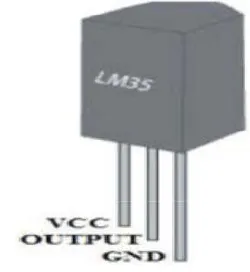
Temperature Sensor: LM35 is one of the
most precisionICtemperature sensor.
Temperature measurement is more
accurately than a thermistor. The range of operating temperature is from -55°C to 150°C. The sensor circuitry is fully sealed and there is no oxidation and other processes. The output voltage is proportional to ambient
temperature varies by 10mV in response to every °C rise/fall in temperature.
Fig. 5: LM 35 temperature sensor
Gas Sensor: MQ-2 gas sensorsuse a small
heaterand an electro chemical sensor is placed inside the heater. It is used to determine the CO2 concentrations in the air. It has high sensitivity and fast response time. It is sensitive for a range of gasses in indoors at room temperature. A know concentration of measured gas is needed for the calibration. Sensor can operate at 5v power supply. This type of sensor can detect the concentration of CO2 anywhere from 200ppm to 10000ppm. The drive circuit is needed for giving power to the heater coil with 5V by adding a load resistance. This type of sensor provides the output of analog signal which can be read as
an analog input of the Arduino
Available online: https://edupediapublications.org/journals/index.php/IJR/ P a g e | 33
Fig. 6: MQ-2 Gas sensor
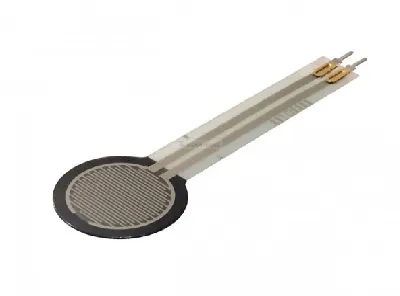
Pressure Sensor:This is a force sensitive
resistor with a round, 0.5" diameter, sensing area. This FSR will vary its resistance depending on how much pressure is being applied to the sensing area. The harder the force, the lower the resistance. When no pressure is being applied to the FSR its resistance will be larger than 1MΩ. This FSR can sense applied force anywhere in the range of100g-10kg.Two pins extend from the bottom of the sensor with 0.1" pitch making it bread board friendly. There is a peel-and-stick rubber backing on the other side of the sensing area to mount the FSR.Just Connect a resistor to form a voltage divider and measure the voltage at the junction to find the force applied. These sensors are simple to set up and great for sensing pressure, but they aren't incredibly accurate. Use them to sense if it's being squeezed, but you may not want to use it as a scale.
Fig. 7: Pressure sensor.
ESP-01 ESP8266 Serial WIFI Wireless
Transceiver Module: The ESP8266 Wi-Fi
Module is a self-contained SOC with integrated TCP/IP protocol stack that can give any microcontroller access to your Wi-Fi network. The ESP8266 is capable of either hosting an application or offloading all Wi-Fi
networking functions from another application processor. Each ESP8266 module comes pre-programmed with an AT command set firmware, meaning, you can simply hook this up to your Arduino device and get about as much WiFi-ability as a WiFi Shield offers (and that’s just out of the box)! The ESP8266 module is an extremely cost-effective board with a huge, and ever growing, community.
This module has a powerful enough on-board processing and storage capability that allows it to be integrated with the sensors and other application specific devices through its GPIOs with minimal development up-front and minimal loading during runtime. Its high degree of on-chip integration allows for minimal external circuitry, including the front-end module, is designed to occupy minimal PCB area. The ESP8266 supports APSD for VoIP applications and Bluetooth co-existance interfaces, it contains a self-calibrated RF allowing it to work under all operating conditions and requires no external RF parts.
There is an almost limitless fountain of information available for the ESP8266, all of which has been provided by amazing community support. In the Documents section below, you will find many resources to aid you in using the ESP8266, even instructions on how to transforming this module into an IoT (Internet of Things) solution!
Note: The ESP8266 Module is not capable of 5-3V logic shifting and will require an external Logic Level Converter. Please do not power it directly from your 5V dev board.
Note: This new version of the ESP8266 Wi-Fi Module has increased the flash disk size from 512k to 1MB.
Features:
IEEE 802.11 b/g/n
Available online: https://edupediapublications.org/journals/index.php/IJR/ P a g e | 34
Integrated TCP/IP protocol stack
Integrated TR switch, balun, LNA,
power amplifier and matching network
Integrated PLLs, regulators, DCXO
and power management units
+19.5dBm output power in 802.11b
mode
Power down leakage current of <10uA
1MB Flash Memory
Integrated low power 32-bit CPU
could be used as application processor
SDIO 1.1 / 2.0, SPI, UART
STBC, 1×1 MIMO, 2×1 MIMO
A-MPDU & A-MSDU aggregation &
0.4ms guard interval
Wake up and transmit packets in <
2ms
Standby power consumption of <
1.0mW (DTIM3)
Software Architecture: This architecture
containswireless sensors, application web server and client device. The collection of information from the sensor is loaded into the web server through user datagram protocol. This protocol provides the connectionless
services. Combinations of wireless
connectivity with ambient sensors provide useful solution. This solution is used to reduce the overall energy consumption. Finally the data from the device is loaded into the web application for public display. Application running on the pc gives ability to read data from multiple devices and send the reduced packet to the internet.
Fig.8: System Architecture.
Web page is created for monitoring and controlling the data from the sensors. Web page will appear by entering the IP address to the web browser. This web page gives the details about ambient temperature, pressure, humidity and co2 level from indoor spaces. All the data parameters are stored in the cloud at different
intervals.The data will be analyzed and controlled by theuser anytime from anywhere in the world. The web page is created by java or .net because these two platforms are supported for the web server applications.
Arduino IDE: Arduino is an open-source
Available online: https://edupediapublications.org/journals/index.php/IJR/ P a g e | 35 The Arduino platform gives an integrated
development environment (IDE) for
programming the microcontrollers. Serial communication interfaces including USB is used for loading programs from personal computers. It can also support C, C++ and Java programming languages.
Program Compilation: The Arduino Uno can
beprogrammed by using Arduino software. The Atmega 328 on the Arduino Nano comes preburned with a bootloader that allows a new code to upload it without an external hardware programmer. The STK500 protocol is used for original communication. It can also bypass the
boot loadand programming the
microcontroller through Arduino ISP with ICSP header. The embedded c code is compiled initially. Then it will convert into hex file by the means of this software and also stored in temporary file. To compile the program by using ARDUINO IDE until without errors, after compilation the program is dumped on the microcontroller.
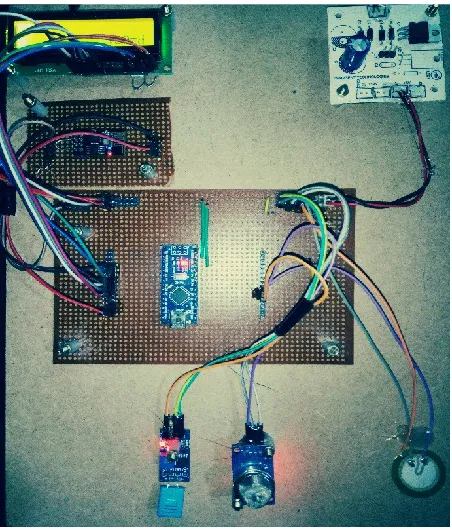
Figure 11: Implemented Prototype Project.
Fig :11 Final data values.
CONCLUSION
Arduino microcontroller based online ambient monitoring system was designed. This system
monitors the carbon dioxide level,
temperature, relative humidity and absolute pressure in indoor space. The measured data values are loaded into the internet through
serial peripheral interface. It was
automatically self-calibrates the attached Co2 sensor and offers the possibility of operation without maintenance for a long time. Instead of change the sensor in this device also possible for remote monitoring. the freedom to express my views. Words are inadequate to express the gratitude to my beloved parents and friends for their excellent and never ending co-operation.
REFERENCES
1. Silviu C. Folea and George Mois, 2015.
Available online: https://edupediapublications.org/journals/index.php/IJR/ P a g e | 36
2. Vinay, Sagar K. and S. Kusuma, 2015.
“Home Automation Using Internet of Things” IRJET, pp: 2.
3. Bharani, M., S. Elango, S.M. Ramesh and
R. Preetilatha, 2014. “An embedded system based monitoring system for industries by interfacing sensors with atmega microcontroller,” IJARECE 3(11):
4. Burak, Kantarci and Hussein T. Mouftah,
2014. “Trustworthy sensing for public safety in cloud-centric internet of things” IEEE Internet Of Things Journal, 1(4).
5. Chinmaya Mahapatra, Zhengguo Sheng,
Chunsheng Zhu and Victor C.M. Leung, 2015. “Recent Advances in Industrial Wireless Sensor Networks Toward Efficient Management in IoT” IEEE Internet Of Things Journal.
6. Jelicic, V., M. Magno, D. Brunelli, G.
Paci and L. Benini, 2013.
“Contextadaptive multimodal wireless sensor network for energy-efficient gas monitoring,” IEEE Sensors J., 13(1): 328-338.
7. Mahmoud Elkhodr, SeyedShahrestani and
Hon Cheung, 2013. “A Contextual-adaptive Location Disclosure Agent for General Devices in the Internet of Things” IEEE International Workshop.
8. Larios, D., J. Barbancho, G. Rodríguez, J.
Sevillano,F.Molina and C. León, 2012. “Energy efficient wireless sensor network communications based on computational intelligent data fusion for environmental monitoring,” IET Commun., 6(14): 2189-2197.
9. See, C.H., K.V. Horoshenkov, R.A.
Abd-Alhameed,
YHu and S. Tait, 2012. “A low power wireless sensor network for gully pot monitoring in urban catchments, ” IEEE Sensors J., 12(5): 1545-1553.
10.Ko, J., C. Lu, M.B. Srivastava, J.A.
Stankovic, A. Terzis and M. Welsh, “Wireless sensor networks for healthcare,” Proc. IEEE, 98(11): 1947-1960.
8. Sharma, S., V.N. Mishra, R. Dwivedi and
R.R. Das, “Quantification of individual gases/odors using dynamic responses of gas sensor array with ASM feature technique,” IEEE Sensors J., 14(4): 1006-1011.
9. Tozlu, S., M. Senel, W. Mao and A.
Keshavarzian, 2012. “Wi-Fi enabled sensors for internet of things:
A practical approach,” IEEE Commun.
Mag., 50(6): 134-143.
13.Lee, C.S, D.H. Kim and J.D. Kim, 2014.
“An energy efficient active RFID protocol to avoid overhearing problem, ” IEEE Sensors J., 14(1): 15-24.
14.Pandharipande, A. and S. Li., 2013.