Better Evaluation for Grammatical Error Correction
Daniel Dahlmeier1 and Hwee Tou Ng1,2
1NUS Graduate School for Integrative Sciences and Engineering
2Department of Computer Science, National University of Singapore
{danielhe,nght}@comp.nus.edu.sg
Abstract
We present a novel method for evaluating grammatical error correction. The core of our method, which we callMaxMatch(M2), is an algorithm for efficiently computing the sequence of phrase-level edits between a source sentence and a system hypothesis that achieves the highest overlap with the gold-standard annotation. This optimal edit se-quence is subsequently scored using F1
mea-sure. We test our M2 scorer on the Helping
Our Own (HOO) shared task data and show that our method results in more accurate eval-uation for grammatical error correction.
1 Introduction
Progress in natural language processing (NLP) re-search is driven and measured by automatic eval-uation methods. Automatic evaleval-uation allows fast and inexpensive feedback during development, and objective and reproducible evaluation during testing time. Grammatical error correction is an important NLP task with useful applications for second lan-guage learning. Evaluation for error correction is typically done by computing F1 measure between a set of proposed system edits and a set of human-annotated gold-standard edits (Leacock et al., 2010). Unfortunately, evaluation is complicated by the fact that the set of edit operations for a given system hypothesis is ambiguous. This is due to two reasons. First, the set of edits that transforms one string into another is not necessarily unique, even at the token level. Second, edits can consist of longer phrases which introduce additional ambiguity. To see how
this can affect evaluation, consider the following source sentence and system hypothesis from the re-cent Helping Our Own (HOO) shared task (Dale and Kilgarriff, 2011) on grammatical error correction:
Source : Our baseline system feeds word into PB-SMT pipeline.
Hypot. : Our baseline system feeds a word into PB-SMT pipeline.
The HOO evaluation script extracts the system edit
( → a), i.e., inserting the articlea. Unfortunately, the gold-standard annotation instead contains the ed-its (word → {a word, words}). Although the ex-tracted system edit results in thesamecorrected sen-tence as the first gold-standard edit option, the sys-tem hypothesis was considered to be invalid.
In this work, we propose a method, called Max-Match(M2), to overcome this problem. The key idea is that if there are multiple possible ways to arrive at the same correction, the system should be eval-uated according to the set of edits that matches the gold-standard as often as possible. To this end, we propose an algorithm for efficiently computing the set of phrase-level edits with the maximum overlap with the gold standard. The edits are subsequently scored using F1measure. We test our method in the context of the HOO shared task and show that our method results in a more accurate evaluation for er-ror correction.
The remainder of this paper is organized as fol-lows: Section 2 describes the proposed method; Sec-tion 3 presents experimental results; SecSec-tion 4 dis-cusses some details of grammar correction evalua-tion; and Section 5 concludes the paper.
2 Method
We begin by establishing some notation. We con-sider a set ofsource sentencesS={s1, . . . ,sn}
to-gether with a set ofhypothesesH = {h1, . . . ,hn}
generated by an error correction system. LetG =
{g1, . . . ,gn} be the set of gold standard
annota-tions for the same sentences. Each annotationgi =
{gi1, . . . , gri} is a set of edits. An edit is a triple
(a, b, C), consisting of:
• start and end (token-) offsets aandbwith re-spect to a source sentence,
• a correctionC. For gold-standard edits,Cis a set containing one or more possible corrections. For system edits,Cis a single correction.
Evaluation of the system output involves the follow-ing two steps:
1. Extracting a set of system edits ei for each
source-hypothesis pair(si,hi).
2. Evaluating the system edits for the complete test set with respect to the gold standardG.
The remainder of this section describes a method for solving these two steps. We start by describing how to construct anedit latticefrom a source-hypothesis pair. Then, we show that finding the optimal se-quence of edits is equivalent to solving a shortest path search through the lattice. Finally, we describe how to evaluate the edits using F1measure.
2.1 Edit lattice
We start from the well-established Levenshtein dis-tance (Levenshtein, 1966), which is defined as the minimum number of insertions, deletions, and sub-stitutions needed to transform one string into an-other. The Levenshtein distance between a source sentence si = s1i, . . . , ski and a hypothesis hi = h1
i, . . . , hli can be efficiently computed using a two
dimensional matrix that is filled using a classic dy-namic programming algorithm. We assume that bothsi andhi have been tokenized. The matrix for
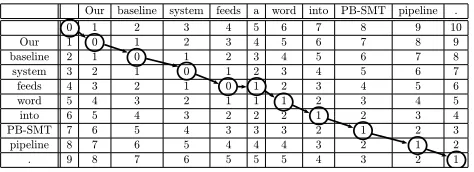
the example from Section 1 is shown in Figure 1. By performing a simple breadth-first search, similar to the Viterbi algorithm, we can extract the lattice of all shortest paths that lead from the top-left corner to the bottom-right corner of the Levenshtein ma-trix. Each vertex in the lattice corresponds to a cell
Our baseline system feeds a word into PB-SMT pipeline .
0 1 2 3 4 5 6 7 8 9 10
Our 1 0 1 2 3 4 5 6 7 8 9
baseline 2 1 0 1 2 3 4 5 6 7 8
system 3 2 1 0 1 2 3 4 5 6 7
feeds 4 3 2 1 0 1 2 3 4 5 6
word 5 4 3 2 1 1 1 2 3 4 5
into 6 5 4 3 2 2 2 1 2 3 4
PB-SMT 7 6 5 4 3 3 3 2 1 2 3
pipeline 8 7 6 5 4 4 4 3 2 1 2
[image:2.612.313.550.57.143.2]. 9 8 7 6 5 5 5 4 3 2 1
Figure 1: The Levenshtein matrix and the shortest path for a source sentence “Our baseline system feeds word into PB-SMT pipeline .” and a hypothesis “Our baseline system feeds a word into PB-SMT pipeline .”
in the Levenshtein matrix, and each edge in the lat-tice corresponds to an atomic edit operation: insert-ing a token, deletinsert-ing a token, substitutinsert-ing a token, or leaving a token unchanged. Each path through the lattice corresponds to a shortest sequence of ed-its that transformsiintohi. We assign a unit cost to
each edge in the lattice.
We have seen that annotators can use longer phrases and that phrases can include un-changed words from the context, e.g., the gold edit from the example in Section 1 is
(4,5,word,{a word, words}). However, it seems unrealistic to allow an arbitrary number of un-changed words in an edit. In particular, we want to avoid very large edits that cover complete sentences. Therefore, we limit the number of unchanged words by a parameteru. To allow for phrase-level edits, we add transitive edges to the lattice as long as the number of unchanged words in the newly added edit is not greater thanuand the edit changes at least one word. Lete1 = (a1, b1, C1) ande2 = (a2, b2, C2) be two edits corresponding to adjacent edges in the lattice, with the first end offsetb1 being equal to the second start offseta2. We can combine them into a new edite3 = (a1, b2, C1+C2), whereC1+C2is the concatenation of stringsC1 andC2. The cost of a transitive edge is the sum of the costs of its parts. The lattice extracted from the example sentence is shown in Figure 2.
2.2 Finding maximally matching edit sequence
Our goal is to find the sequence of edits ei with
the maximum overlap with the gold standard. Let
cor-0,0 Our (1) 1,1 baseline (1) 2,2
3,3 system (1)
4,5 feeds/feeds a (2)
4,4
feeds (1) 5,6
word (1) ε/a (1)
word/a word (-45)
6,7 into (1)
7,8
PB-SMT (1) pipeline (1) 8,9 . (1) 9,10
system feeds/system feeds a (3) feeds word/feeds a word (3)
[image:3.612.72.541.61.153.2]word into/a word into (3)
Figure 2: The edit lattice for “Our baseline system feeds (→a) word into PB-SMT pipeline .” Edge costs are shown in parentheses. The edge from (4,4) to (5,6) matches the gold annotation and carries a negative cost.
responding edit has a match in the gold standard to
−(u+ 1)× |E|. An edit ematches a gold edit g
iff they have the same offsets and e’s correction is included ing:
match(e, g)⇔e.a=g.a∧e.b=g.b∧e.C∈g.C
(1) Then, we perform a single-source shortest path search with negative edge weights from the start to the end vertex1. This can be done efficiently, for ex-ample with the Bellman-Ford algorithm (Cormen et al., 2001). As the lattice is acyclic, the algorithm is guaranteed to terminate and return a shortest path. Theorem 1. The set of edits corresponding to the shortest path has the maximum overlap with the gold standard annotation.
Proof. Lete=e1, . . . , ekbe the edit sequence cor-responding to the shortest path and letpbe the num-ber of matched edits. Assume that there exists an-other edit sequencee0with higher total edge weights
butp0 > pmatching edits. Then we have
p(−(u+ 1)|E|) +q ≤ p0(−(u+ 1)|E|) +q0(2)
⇔(q−q0) ≤ (p0−p)(−(u+ 1)|E|),
whereqandq0denote the combined cost of all non-matching edits in the two paths, respectively. Be-cause p0 −p ≥ 1, the right hand side is at most
−(u + 1)|E|. Because q and q0 are positive and bounded by(u+ 1)|E|, the left hand side cannot be smaller than or equal to−(u+ 1)|E|. This is a con-tradiction. Therefore there cannot exist such an edit sequence e0, ande is the sequence with the maxi-mum overlap with the gold-standard annotation.
1
To break ties between non-matching edges, we add a small costζ 1to all non-matching edges, thus favoring paths that use fewer edges, everything else being equal.
2.3 Evaluating edits
What is left to do is to evaluate the set of edits with respect to the gold standard. This is done by computing precision, recall, and F1 measure (van Rijsbergen, 1979) between the set of system edits
{e1, . . . ,en}and the set of gold edits{g1, . . . ,gn}
for all sentences
P =
Pn
i=1|ei∩gi|
Pn
i=1|ei|
(3)
R =
Pn
i=1|ei∩gi|
Pn
i=1|gi|
(4)
F1 = 2×
P×R
P+R, (5)
where we define the intersection betweenei andgi
as
ei∩gi ={e∈ei| ∃g∈gi(match(e, g))}. (6)
3 Experiments and Results
We experimentally test our M2 method in the con-text of the HOO shared task. The HOO test data2 consists of text fragments from NLP papers to-gether with manually-created gold-standard correc-tions (see (Dale and Kilgarriff, 2011) for details). We test our method by re-scoring the best runs of the participating teams3in the HOO shared task with our M2scorer and comparing the scores with the of-ficial HOO scorer, which simply uses GNUwdiff4
to extract system edits. We obtain each system’s output and segment it at the sentence level accord-ing to the gold standard sentence segmentation. The
2
Available at http://groups.google.com/group/hoo-nlp/ after registration.
3
Except one team that did not submit any plain text output. 4
M2scorer . . . should basic translational unit be (word→a word). . .
HOO scorer . . . should basic translational unit be *(→a) word. . .
M2scorer . . .
development set similar (with→to) (→the) test set. . .
HOO scorer . . . development set similar *(with→to the) test set. . .
M2scorer (→The) *(Xinhua portion of→xinhua portion of) the English Gigaword3. . .
[image:4.612.121.494.57.125.2]HOO scorer *(Xinhua→The xinhua) portion of the English Gigaword3. . .
Table 2: Examples of different edits extracted by the M2scorer and the official HOO scorer. Edits that do not match the gold-standard annotation are marked with an asterisk (*).
Team HOO scorer M2scorer
P R F1 P R F1
JU (0) 10.39 3.78 5.54 12.30 4.45 6.53 LI (8) 20.86 3.22 5.57 21.12 3.22 5.58 NU (0) 29.10 7.38 11.77 31.09 7.85 12.54 UI (1) 50.72 13.34 21.12 54.61 14.57 23.00 UT (1) 5.01 4.07 4.49 5.72 4.45 5.01
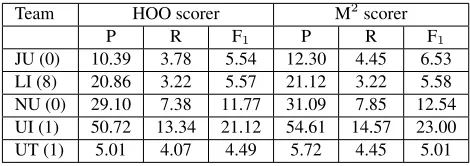
Table 1: Results for participants in the HOO shared task. The run of the system is shown in parentheses.
source sentences, system hypotheses, and correc-tions are tokenized using the Penn Treebank stan-dard (Marcus et al., 1993). The character edit offsets are automatically converted to token offsets. We set the parameteruto 2, allowing up to two unchanged words per edit. The results are shown in Table 1. Note that the M2 scorer and the HOO scorer adhere to the same score definition and only differ in the way the system edits are computed. We can see that the M2 scorer results in higher scores than the offi-cial scorer for all systems, showing that the offioffi-cial scorer missed some valid edits. For example, the M2 scorer finds 155 valid edits for the UI system compared to 141 found by the official scorer, and 83 valid edits for the NU system, compared to 78 by the official scorer. We manually inspect the output of the scorers and find that the M2scorer indeed ex-tracts the correct edits matching the gold standard where possible. Examples are shown in Table 2.
4 Discussion
The evaluation framework proposed in this work dif-fers slightly from the one in the HOO shared task.
Sentence-by-sentence. We compute the edits between source-hypothesis sentence pairs, while the HOO scorer computes edits at the document level. As the HOO data comes in a sentence-segmented format, both approaches are equivalent, while sentence-by-sentence is easier to work with.
Token-level offsets. In our work, the start and end of an edit are given as token offsets, while the HOO data uses character offsets. Character offsets make the evaluation procedure very brittle as a small change, e.g., an additional whitespace character, will affect all subsequent edits. Character offsets also in-troduce ambiguities in the annotation, e.g., whether a comma is part of the preceding token.
Alternative scoring. The HOO shared task de-fines three different scores: detection, recognition, andcorrection. Effectively, all three scores are F1 measures and only differ in the conditions on when an edit is counted as valid. Additionally, each score is reported under a “with bonus” alternative, where a system receives rewards for missed optional ed-its. The F1 measure defined in Section 2.3 is equiv-alent tocorrection without bonus. Our method can be used to compute detection and recognition scores and scores with bonus as well.
5 Conclusion
We have presented a novel method, called Max-Match (M2), for evaluating grammatical error cor-rection. Our method computes the sequence of phrase-level edits that achieves the highest over-lap with the gold-standard annotation. Experi-ments on the HOO data show that our method overcomes deficiencies in the current evaluation method. The M2 scorer is available for download at http://nlp.comp.nus.edu.sg/software/.
Acknowledgments
[image:4.612.71.306.176.259.2]References
T. Cormen, C.E. Leiserson, R.L. Rivest, and C. Stein. 2001. Introduction to Algorithms. MIT Press, Cam-bridge, MA.
R. Dale and A. Kilgarriff. 2011. Helping Our Own: The HOO 2011 pilot shared task. In Proceedings of the 2011 European Workshop on Natural Language Gen-eration.
C. Leacock, M. Chodorow, M. Gamon, and J. Tetreault, 2010. Automated Grammatical Error Detection for Language Learners, chapter 5. Morgan and Claypool Publishers.
V. Levenshtein. 1966. Binary codes capable of correct-ing deletions, insertions, and reversals. Soviet Physics Doklady, 10(8):707–710.
M.P. Marcus, M.A. Marcinkiewicz, and B. Santorini. 1993. Building a large annotated corpus of English: The Penn Treebank. Computational Linguistics, 19. C. J. van Rijsbergen. 1979. Information Retrieval.