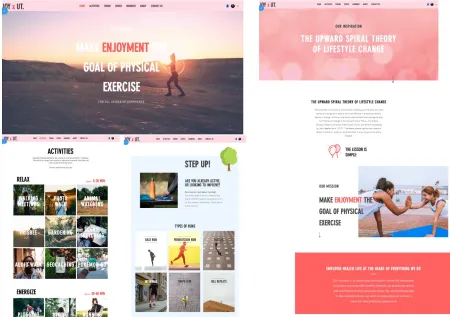
Building a Platform to Improve Sedentary
Behaviour by Centralising Joy in Physical Activity
Graduation Project Thesis
Creative Technology
Faculty of Electrical Engineering, Mathematics and Computer Science (EEMCS)
Author: John Kim
July 2019
Supervisor(s):
ABSTRACT
ACKNOWLEDGEMENT
I would like to deeply thank my supervisors Alma Schaafstal and Femke Nijboer for providing me with the critical questions, guidance and feedback during the development of this graduation project. This project would not have been possible without your efforts.
I would also like to thank Andreas Kamilaris for his close communication and assistance whenever needed to bring improvements to this platform.
TABLE OF CONTENTS
1. INTRODUCTION 7
1.1. Motivation 7
1.2. Goals & Challenges 8
1.3. Research Questions 9
2. STATE OF THE ART 10
2.1. Literature Review 10
2.1.1. Introduction 10
2.1.2 Psychological factors that can influence behaviour change 10
2.1.2.1 Grit 10
2.1.2.2 Self Efficacy 11
2.1.2.3 Motivation 12
2.1.2.4 Resilience 12
2.1.3 Positive Affect and Enjoyment 12
2.1.3.1 The Upward Spiral theory of lifestyle change 13
2.1.4 Conclusion/ Discussion 14
2.2. Market Research 14
2.2.1. The selected platforms 14
2.2.2. Market research conclusion 20
3. METHODOLOGY AND TECHNIQUES 21
3.1. The Design Framework of Creative Technology 21
3.2. Brainstorm 23
3.3. Stakeholder Analysis 24
3.4. Interviews 25
3.5. iPACT Analysis 25
3.6. FICS Analysis 25
3.7. MoSCoW Analysis 25
3.8. Platform Iterations 26
4. IDEATION 27
4.1. Interview 27
4.2. Brainstorm 27
4.3. Stakeholders 34
4.5.2 Platform Moodboard 38
4.6. Preliminary Requirements 39
5. SPECIFICATION 40
5.1. FICS Analysis 40
5.2. User Test 1: Primary requirements of the platform 41
5.2.1. User Test 1 Improvements 42
5.2.2. Evaluation of results from User Test 1 43
5.3. User Test 2: Intermediate users and other platform requirements 47
5.3.1. User Test 2 Findings 47
5.3.2. User Test 2 Improvements 51
5.4. MoSCoW 52
5.5. Future Improvements 53
6. REALISATION 55
6.1. The Web Platform 55
6.1.1. Decision to use an online Web-building tool 55
6.1.2. The decision to use Wix 55
6.1.3. How Wix was used 56
6.2. Visuals and Media 56
6.2.1. Images 57
6.2.2. Video 58
6.2.2.1. Editing Process of the Homepage video for the final version of the platform 58
6.2.3. Website colour scheme 60
6.2.4. Typography 61
6.3. Iterations to the Platform 62
6.3.1. Platform version 1 62
6.3.1.1 Website Map v1 63
6.3.2. Platform version 2 63
6.3.2.1 Website Map v2 64
6.3.3. Platform version 3 65
6.3.3.1 Website Map v3 66
6.4. Questionnaires 66
7. EVALUATION 67
7.1. Functional Test 67
7.2. User Test 3 69
7.2.1. System Usability Scale (SUS) 69
7.2.2.2. Motivation 72
7.2.2.3. Social aspects 73
7.2.2.4. Skills in physical activity 74
7.2.2.5. Inspiration 76
7..2.2.6. Visual and Media 76
7.2.3. General Remarks and Feedback for Future Development 77
7.2.3.1. Open Remarks 77
7.2.3.2. Future Improvements 78
7.2.3.3. Testing the Platform’s Practical use 79
7.2.3.4. The General Concept test 79
7.2.3.5. User Knowledge of Similar Interventions 79
7.2.3.6. Interest in further development of the platform 80
8. DISCUSSION 81
8.1. General Discussion and the Research Questions 81
8.2. Unexpected findings 82
8.3. Limitations and Strengths 83
9. CONCLUSION 85
9.1. Conclusion 85
References 87
Appendix A: User Test 90
A1. User Test Consent Form 90
A2. User Test 1 Protocol 92
A3. User Test 2 Protocol 95
A4. User Test 2 Questionnaire 98
A5. User Test 2 Questionnaire Results 101
A6. User Test 3 Online Protocol 106
A7. User Test 3 Questionnaire 108
A8. User Test 3 Questionnaire Results 110
Appendix B: Platform Versions 120
B1. Platform version 1 120
B2. Platform version 2 126
1. INTRODUCTION
1.1. Motivation
Changing one’s lifestyle to a healthier one is difficult. Losing weight is desired by many, however it is hard to maintain weight loss once reached. The same is true for the desire to exercise more, most people fall back into their old lifestyle after a few months. Much seems to go wrong during this process, and the sustainability and limitations of lifestyle interventions could be questioned. Research shows that people have difficulties in acting according to their intentions, and in general, health compromising behaviours are very hard to change (Schwarzer, 2008). However, an approach towards enjoyment in physical activity has seen extremely promising results in promoting and encouraging long term behaviour change (Van Cappellen et al. 2018). Together with the focus on enjoyment, other psychological factors such as self-efficacy, motivation (intrinsic & extrinsic), grit and resilience can also empower an individual to shift their behaviour to a healthier one, when used concurrently.
1.2. Goals & Challenges
The goal of this project is to introduce a behaviour-change intervention to promote physical activity amongst employees at the University of Twente. University employees have been observed to fall into a sedentary lifestyle with increased levels of physical inactivity, therefore increasing their risk of developing chronic diseases such as obesity and other cardiovascular diseases. Furthermore, the risk of developing musculoskeletal diseases (MSDs) are also on the rise due to inactivity (Hanna et al, 2019). We have found that positive emotions play an impactful role in motivating individuals in physical activity. Therefore, sustainable and engaging solutions will be discussed and developed to encourage physical activity in the workplace, and cater for these health problems that employees face.
However, there are always several challenges in any project. The target group in question are the employees of the University of Twente, however within this target group, there are a wide range of different nationalities, gender, age, personal interests and technical knowledge. Many employees may not even have the motivation to trigger a change, while some may wish to find a platform that can fuel their current motivation. Creating a platform to adhere to users with different interests and backgrounds, and promoting enjoyment to all individuals will be a challenging task.
1.3. Research Questions
The research questions regarding this Graduation Project are as follows:
Main RQ: How can an online platform designed to enhance positive experience, with the main focus on enjoyment, encourage physical activity amongst University employees?
With this main research question, we can also derive the following sub-questions:
Sub Q1: How can social features in a platform encourage physical activity amongst users?
2. STATE OF THE ART
2.1. Literature Review
2.1.1. Introduction
This literature research will aid in pursuing the objective of the graduation project. In order to understand how to successfully introduce a sustainable lifestyle intervention to promote physical activity through enjoyment, much research has to be done about various psychological factors and also how positive emotions can impact physical health. Therefore, the purpose of this literature research is to learn much about various psychological factors that can impact behaviour change, and to understand which factors can efficiently and effectively impact a change towards a healthy lifestyle. The central focus of this research is to find out:
What are some psychological factors that are important for goal attainment, and how can Positive Affect encourage healthy behaviour change in people?
2.1.2 Psychological factors that can influence behaviour change
There are several psychological factors that can allow for a behaviour shift in individuals, and it is crucial to understand these in order to create an effective system for the final graduation project. These psychological factors can branch out to grit, self efficacy, motivation and resilience.
2.1.2.1 Grit
Grit is recently understood as an important psychological factor that is known to impact positive
perform well in certain tasks to achieve their long term goals. Based on case studies, it has also overtaken intelligence and talent in its ability to predict performance (Duckworth et al. 2007).
However, there are few people that question the construct. Firstly,Jachimowicz, Wihler, Bailey, & Galinsky (n.d.). Argue that grit and the developed grit scale has accommodated inconsistent information in prior case studies and research due to the absence of a critical role;
Passion. Alternatively, Grit is seen to be misapplied in literature due to the fact that it overlaps
frequently with other constructs, such as resilience, therefore making it conceptually weak (Stoffel & Cain, 2018). Lastly, Credé et al. (2017) argues that despite the fact that grit is an excellent method of predicting success, people work in different ways to achieve different goals, and therefore grit may not prove effective across different domains. Thus, grit may be effective, but interventions arranged to increase levels of grit in individuals may not benefit everybody the same.
2.1.2.2 Self Efficacy
Self Efficacy is often mentioned as a factor that can influence behaviour change. It refers to an
individual’s confidence levels in their ability to successfully carry out a specific behaviour (Milam, Cohen, Mueller & Salles, 2019). Simultaneously, according to Duan et al. (2018), self efficacy is the factor that regulates how much effort should be invested in goal achievement, and how much persistence should be maintained in the presence of any obstacles or setbacks. Additionally, self efficacy is constituted in several models such as the Transtheoretical Model
2.1.2.3 Motivation
Motivation is another psychological factor that should be present in an individual in order to
successfully work towards a goal. People should be motivated first to change unhealthy behaviours, i.e. physical inactivity, and motivation is seen to be particularly important to people who have no intention to change their unhealthy behaviours. Motivation improves the perceived self efficacy of individuals, risk perception and positive outcome expectancies to support the formation of goal intentions (Duan et al., 2018) . In addition to highlighting the importance of motivation in lifestyle interventions, Livia et al. (2016) strongly expresses that it is important to note that motivation is a dynamic state. People’s motivation can fluctuate in certain stages of behavioural change because of many personal factors, and motivation works well when modified during different change processes.
2.1.2.4 Resilience
Resilience is a psychological factor similar to grit that is also a dynamic process, and this concept
very similar to grit can be influenced by the environment, external factors, the individual and the outcome. The ability to bounce back from a failure or adversity is a strong psychological factor which works very well with self efficacy and motivation, and the important thing to note is that it can be developed as a skill within individuals (Garcia-Dia, DiNapoli, Garcia-Ona, Jakubowski, & O’Flaherty, 2013) . The fact that a psychological skill as important as resilience can be learnt is a significant discovery, and will be highly useful if implemented in the final graduation project.
2.1.3 Positive Affect and Enjoyment
2.1.3.1 The Upward Spiral theory of lifestyle change
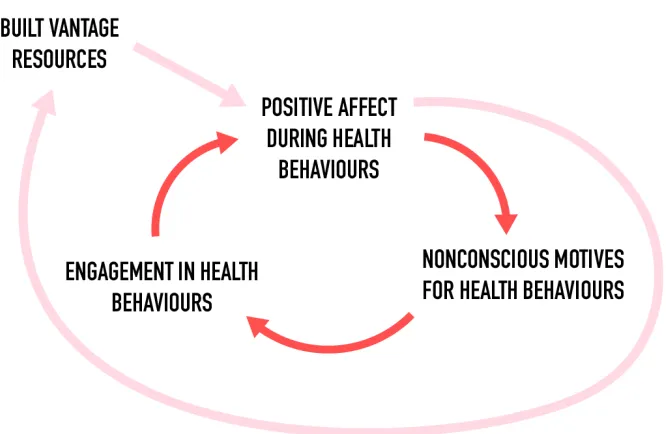
A theoretical framework developed by Fredrickson (2013) as seen in fig. 2.1, highlights the importance of positive affect and how it can aid long term fidelity to positive health behaviours. This framework explains how enjoyment in an activity can fuel the repetition of healthy behaviour, and as positive emotions are experienced, people unconsciously develop personal motives and resources that grow stronger over time (as shown in the inner loop) to support subsequent and repeated decisions to engage in that behaviour again (Van Cappellen et al., 2018). The outer loop suggests that positive affect builds internal resources (Fredrickson, 2013) - that can be seen as Vantage Resources - and render people more perceptive to following positive experiences (Pluess & Belsky, 2013, as cited in van Cappellen et al, 2018).
[image:14.612.152.485.384.601.2]She further elaborates on the necessity to prioritise positivity in healthy behaviours, and that people should start to focus on working toward healthy behaviours that focus on joy (Van Cappellen et al., 2018). This can be an important focus point for the graduation project, abreast psychological factors such as grit, motivation, self efficacy and resilience.
2.1.4 Conclusion/ Discussion
We conclude that positive affect can play a huge role in the graduation project, due to the fact that it increases long term engagement in people. The project can benefit by focusing on positive emotions, together with psychological factors such as motivation, self efficacy, resilience and grit. In the future development of the platform, it may be important to expand the field of research to identify other important psychological factors that will help bridge the intention-gap behaviour of pursuing a healthy lifestyle.
2.2. Market Research
A traditional approach to a market research (otherwise known as competitor analysis) would be to observe and analyse existing platforms that are similar to the GP platform. However, this analysis will take a different approach, by analysing a wide range of platforms that can help with the inspiration in designing the GP platform. The platforms selected have elements of social interaction, positive/ shared experiences, physical activity and friendly UX & UI, because the solution we wish to create also focuses on these factors. This approach ensures that the analysis is not limited to physical activity only. Therefore, through the analysis of a wide range of different platforms that excel in its own core features, we can identify its benefits and drawbacks, and allow us to create a unique project that stands out to its target audience. The findings are discussed respectively.
2.2.1. The selected platforms
1. Reddit
Description A social news and media aggregation website that encourages discussion of wide topics
Key features 1. Any topic can be widely discussed via ‘subreddits’
2. Connection between strangers who are interested in common topics
3. Anybody can post and start a discussion at any time 4. Moderators of subreddits can control and filter out any
harassment
Disadvantages 1. Complicated and unfriendly UX and UI for new users
2. Posts get lost over time, thus not suitable to use every time you want to arrange a social meet-up
3. For posts to be recognised, they need significant amounts of recognition via ‘upvotes’
4. Does not motivate users to partake in physical activity on its own without prior motivation
5. Does not prioritise on enjoyment. Monthly users 330 million
2. Strava
Figure 2.3. Strava logo and its application support in different hardware
Description A social fitness network that tracks physical activity via GPS. The social network for athletes
Key features 1. Social integration allows you to share and connect with friends and family
2. Ability to track and analyse progress - allows for intrinsic motivation
3. Activities can be measured and tracked amongst various hardware devices
4. The implementation of GPS allows the platform to track outdoor exercises.
Disadvantages 1. Very reliant on GPS. If GPS disconnects due to network or hardware failure, then tracking terminates for outdoor activities such as running.
2. The social integration occurs only after an event has happened. It does not suggest activities nor does it allow people to arrange events together
The strongest feature of strava comes from the ability to connect to the friendly athletic community, and offer encouragement with “kudos” and comments. You can also join local clubs and be part of a larger athletic community outside the app.
3. AirBnB Activities
Figure 2.4. Airbnb logo and website
Description As an additional feature to the AirBnB platform, it introduces unique experiences (food & health, concerts, sports, nature etc. ) to travellers Key features 1. Any local host can arrange an experience for travellers based
on their interests
2. Extremely well defined overview before an activity, such as host information, time, location, language support etc.
3. A review feature which allows the future users to get some insight, and also for the host to improve an arranged activity 4. Great focus on enjoyment
Disadvantages 1. Only the host can arrange events, and is time consuming to arrange
nature Monthly users 150 million
The strongest feature of this platform is the activity suggestion based on the popular interests of users. For example, if a user is interested in football or in cooking, it will suggest local activities together with well-equipped facilities. The ability to “sell” experiences are also a strong feature of this platform, and if the GP can incorporate this feature within its solution, it would be favourable.
4. Nike Training Club
Figure 2.5. Nike Training Club logo and App screenshots
Description A mobile workout application that mimics a personal trainer and suggests workout plans for the users
Key features 1. Ability to share workout progress with friends 2. The personal trainer ‘adapts’ based on analytics 3. User friendly design
resilience
6. Trains discipline
Disadvantages 1. Heavily focused on athletes. May not be the best approach towards all university employees.
2. The social features are limited 3. No focus on joy
Monthly users 28 million
The platform has a great approach in providing workout suggestions based on previous exercises/ interests. Its bold visuals are also able to inspire its users and make them feel like they can achieve their goals.
5. Forest App
Figure 2.6. Forest App logo and app screenshots
Description A productivity app that aims at phone addiction and manage their time in an interesting way
3. Extremely effective way of changing user behaviour
4. The developers have partnered with a real tree planting organisation that plant trees around the world when done in the mobile application
5. Ability to measure and analyse productivity
Disadvantages 1. Does not target physical activity, but rather sedentary productivity
2. Dependent on keeping the phone turned on to run the application
Monthly users 2 million
This productivity app has attracted many users for its features, but also because of its beautiful design. The main reason we analyse this application is due to its strong behaviour-changing feature, and friendly UX/UI.
2.2.2. Market research conclusion
3. METHODOLOGY AND TECHNIQUES
This chapter of the report will introduce all the methods that I will use during the development of this project in its respective order, to explore and validate the project idea. These methods range from, and are not limited to brainstorms, interviews and discussions, as well as various analysis frameworks.
3.1. The Design Framework of Creative Technology
A framework developed by Mader (2014) outlines the four stages towards designing and
developing a project idea in a Creative Technology project (as seen in fig.3.1). These four stages are Ideation, Specification, Realisation and Evaluation respectively.
● Ideation
The ideation stage is where a simple creative idea or a design question is developed, through an iterative process of analysing stakeholder requirements or user needs and connecting them to existing technologies. These are done using creative thinking methods such as brainstorms and tinkering, together with the use of literature research and interviews. The respective findings from these methods are then taken to the specification stage to further develop in the realisation stage. The ideas are analysed using methods such as the iPACT analysis (People, Activities, Context and Technologies).
● Specification
● Realisation
The realisation stems from the specifications from the previous stage, and this stage of advanced prototyping can be done multiple times. For this project, the platform prototype will be tested and improved iteratively based on feedback and recommendations from the users.
● Evaluation
The evaluation stage looks into user testing and functional testing of the platform prototype. Based on this evaluation the platform can further be improved in either stage of the design framework.
3.2. Brainstorm
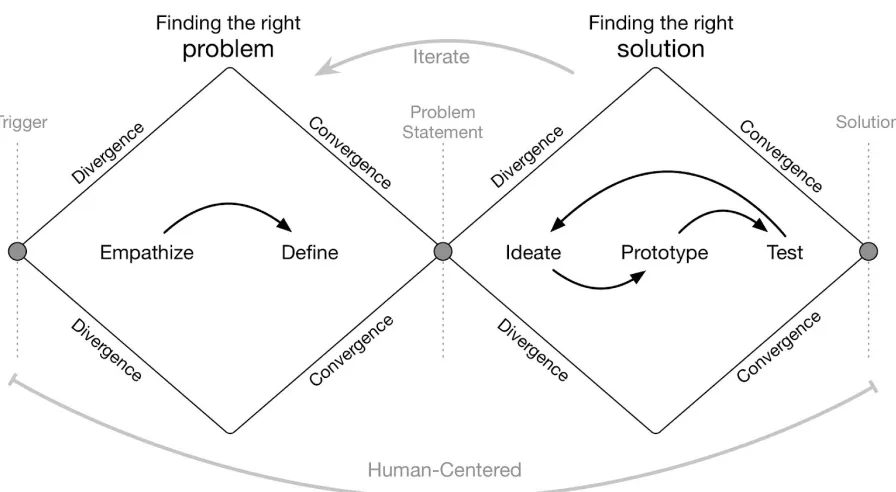
[image:24.612.84.532.314.560.2]Brainstorms can be done either individually or in groups, and it is a discussion session that is held to solve problems or produce ideas. The brainstorm process undertaken in this project , as seen in Chapter 4: Ideation , involves a divergence of ideas to explore alternatives, followed by a convergence to narrow down the potential ideas into one that is feasible and well defined considering the skills and time frame that is available. This divergence and convergence may happen multiple times depending on the situation, and this method can be explained using the illustration by Liu, J. (2016) in fig. 3.2.
Figure 3.2. The divergence-convergence model, Liu. J (2016).
selected to be prototyped and tested. In some cases, the few ideas are the merge of the few best alternatives. An iterative process follows the divergent and convergent process, whereby the designers will work to improve and develop new solutions, as there is simply no perfect solution to any given problem. Continuous prototyping and alterations are made, and during the process, designers will learn much more about the target audience and may return to redefine certain problems. During this whole design process, the Human-Centered Design is kept as the foundation, catering for any stakeholder of the project.
3.3. Stakeholder Analysis
A stakeholder analysis is done to determine who the respective stakeholders are for this specific project, and how much each stakeholder should be taken into account when making a decision within the project.
A stakeholder, according to Freeman (1984), is any group or individual that affects or can be affected by the achievement of an organisation's purpose/ objectives. Moreover, Sharp, H., Finkelstein, A., and Galal, G. (1999) state that stakeholders can be identified in 4 categories:
● Users
These are people who interact with the platform directly and will be using the platform either on a day to day basis, infrequently, or no interaction at all but are affected by its development and introduction.
● Developers
These are people who are designing and developing the platform for the users.
● Legislators
Legislators are people who have authority, and may provide guidelines that could affect the development of the project.
● Decision makers
3.4. Interviews
Formal, Informal, Structured, Semi-Structured, Unstructured. Interviews can be done in various ways to gain significant insight from users, developers and experts to aid in the development of the project.
3.5. iPACT Analysis
An iPACT analysis is done to understand the system from a user’s perspective. By being in the user’s perspective, the designer can understand the features and functionalities needed to effectively achieve the goal he/she intended to. This acronym stands for Intention, People, Activites, Context and Technologies. It is essentially a mockup of a personality, predicting how a user will be using the platform.
3.6. FICS Analysis
FICS stands for Functions and events, Interaction and usability, Content and structure, and Style and Aesthetics. FICS is an analysis tool used to understand the system from the system’s point of view, just like the way the iPACT does for the users.
3.7. MoSCoW Analysis
MoSCoW is an abbreviation for Must Haves, Should Haves, Could haves and Won’t Haves. This analysis is extremely useful when determining the platform requirements and is mostly evaluated after user tests with an operating prototype.
● Must haves - Represent core features that are essential to the platform
● Should haves - Features that are beneficial to have in the platform, but are not necessary for basic operation of the platform
● Could haves - Lower priority than Should haves, they represent possible features the platform could have but are not noticed if left out.
3.8. Platform Iterations
The platform will develop in iterative steps with each user test carried out. Each version of the website will be an improved version of its previous one, with its improvements determined after user tests. Prototyping the different versions of the platform will be a co-creation process to a certain extent, as the improvement suggestions made by employees are implemented for the next version of the platform. This process can be illustrated using the flowchart below (fig.3.3).
4. IDEATION
This chapter will look into how the platform was created, with the use of the methodology and techniques mentioned in the previous chapter. It walks through how the problem was defined in the beginning, what options were explored and the solution that was chosen to tackle the problem.
4.1. Interview
Series of informal and unstructured interviews/ discussions were held with three university employees, with two of them as the supervisor and critical advisor of the graduation project. The initial question that was in discussion was:
How can we empower people to achieve a healthy lifestyle?
Given this general question, and the discussions from it, it was evident that a new approach towards enjoyment in lifestyles was favoured, much over trying to avoid negative consequences of having poor health.
However, with the main research question being such a large scope, the problem needed to be narrowed down to a specific one, within a specific target group. This in turn, lead to the reformation of the question:
How do we reduce sedentary behaviour amongst workers, specifically University of Twente employees?
4.2. Brainstorm
The brainstorm was carried out by:
1. Mentioning anything & everything that comes into mind when the problem statement is read.
2. Categorise said words based on similarity.
3. Develop solutions based on the words within its category. 4. Analyse and evaluate solutions.
5. Select the most favoured solution (or merge if more than one).
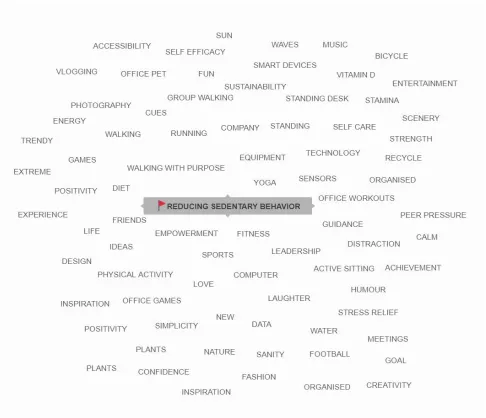
Due to the project being very open-ended with a large scope of possibilities, the brainstorm session resulted in a wide range and large quantity of potential solutions.
Figure 4.1. Brainstorm 1, listing of subjects related to sedentary behaviour.
The category headers were hobbies, physical health, lifestyle, values, environment, social, mental, entertainment and technology.
Hobbies: ● Yoga ● Football ● Sports ● Games ● Biking Physical Health: ● Fitness ● Stamina ● Strength ● Energy ● Extreme ● Vitamin D
Lifestyle: ● Diet ● Self care ● Trendy ● Fashion ● Sustainable ● Goal Values: ● Humour ● Simplicity ● Fun ● Experience ● Eco-friendly ● Design ● Guidance ● Accessibility ● Organise ● Creative Environment: ● Sun ● Waves ● Water ● Nature ● Plants ● Scenery ● Sustainability ● Recycle ● Inspiration ● Distraction Social: ● Friends ● Love
Categorisation of the key words allowed us to carry out the brainstorm smoothly and systematically by pitching several solutions for each branch. The discussed solutions for each category was as follows:
CATEGORY IDEAS
HOBBY
1. Smart Yoga mat 2. Smart Yoga ball
3. Hobby coach/ assistant
○ UT facility based activity suggestor 4. Smart Office Sports
5. Pedal Chair 6. Dance Mat
○ Inspiration: Dance Dance Rev.
PHYSICAL HEALTH
7. Smart dumbbells ○ Calculate reps
○ Calculate calories burnt (altimeter or accelerometer)
○ Dumbbell alarm 8. Smart Pull-Up bar 9. Bodyweight training 10. Mobile/ movable meetings 11. UT exercise networks
LIFESTYLE
12. UT uniform
○ Tight uniform to make people more aware of their health
○ Smart uniform 13. UT fashion day
LIFESTYLE 16. UT Student vs Teacher
VALUES
17. Experience suggestor 18. #Trashtag/ Plogging 19. Negative coach
○ Humour coaching ○ Negative psychology 20. Organiser
○ Personal planner 21. Activity during lectures
ENVIRONMENT
22. Environment specific cues 23. Playful office
○ Smart mini golf ○ Giant chess board
i. Chess pieces are a certain amount of weight ii. VR games
iii. Kinect area ○ Maintaining a garden ○ Exercise group discussions
SOCIAL
24. UT Hobby connector 25. Smart foosball table
26. UT interactive activity overview map
○ Showing people what there is to do around campus 27. Digital sports friend/ assistant
○ Encourages activity through emotional bond 28. Tamagotchi-like virtual pet
29. Video chatting software to make friends around the UT 30. Actual human coaching through app
31. Be a kid again
SOCIAL
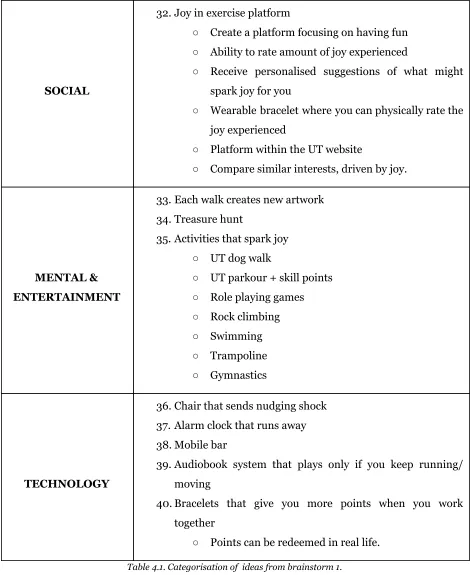
32. Joy in exercise platform
○ Create a platform focusing on having fun ○ Ability to rate amount of joy experienced
○ Receive personalised suggestions of what might spark joy for you
○ Wearable bracelet where you can physically rate the joy experienced
○ Platform within the UT website
○ Compare similar interests, driven by joy.
MENTAL & ENTERTAINMENT
33. Each walk creates new artwork 34. Treasure hunt
35. Activities that spark joy ○ UT dog walk
○ UT parkour + skill points ○ Role playing games ○ Rock climbing ○ Swimming ○ Trampoline ○ Gymnastics
TECHNOLOGY
36. Chair that sends nudging shock 37. Alarm clock that runs away 38. Mobile bar
39. Audiobook system that plays only if you keep running/ moving
40. Bracelets that give you more points when you work together
[image:34.612.71.541.75.650.2]○ Points can be redeemed in real life.
These solutions were analysed and evaluated in terms of the following factors: 1. Is the project suitable for a full graduation project
2. Is the idea executable within the given time frame 3. Is the solution feasible and unique
The most favoured idea was from the Social category, a platform that focuses on enjoyment in physical exercise amongst the University of Twente employees. The idea is able to merge multiple sub-solutions introduced in the brainstorm through events and activities, and will allow university employees to explore and connect with other employees with similar interests, through activities they can do in and around the University campus. The focus on enjoyment is supported by initial literature and aims to fuel the intrinsic motivation of employees.
4.3. Stakeholders
The platform has three types of stakeholders; the user, developer and the decision maker.
Users: The users of this platform will be all University of Twente employees. These users have varying levels of interest, but with a large level of influence in the platform. They are able to access and make use of the platform at any time any given day.
Developers: The developers of this platform are John Kim and Fredrika Åström. They are also the primary researchers of this project, having a high interest and high influence regarding the platform.
4.4. iPACT analysis
The iPACT analysis is being carried out to analyse the system from a potential user’s perspective.
Intention
The platform’s intention is to encourage the employees of the University of Twente to partake in physical activity with the main focus being enjoyment.
People
A potential user of this platform can be Laura van Dijk, a Communications Science lecturer in the university. She is 32 years old, and her involvement in physical activity has been slowly deteriorating. Laura has been finding it difficult to motivate herself to exercise regularly, especially when alone. She has great communication skills and loves to talk to people, and enjoys activities with friends. She has tried to download several fitness apps only to find that they are very focused on high functioning athletes, or the apps require a payment. She has sufficient knowledge that the university provides various facilities for lots of activities.
Another user of this platform can be Andreas Lee, aged 28. He is a lecturer in the Industrial Design course and spends several hours designing and planning out class and exam material. He is already quite active in the university, occasionally doing sports activities in the university campus alone. He would love to find some people who can go on occasional runs or badminton games with him, but he has no way of looking for people with similar interests on campus. He is also very interested in technology, and is always up to date with the latest tech news.
Activities
Context
The platform has been designed to be available to every employee at any time and in any location. It can be accessed via any digital device, at any social or organisational context.
Technology
This web platform is being developed with Wix. The platform can be accessed using any web browser that is currently available to every day users.
4.5. Organisational Identity
4.5.1 Core Values
An organisational identity is crucial for a platform to help identify its core values. The development of this identity allows the developers to design the platform accordingly based on its mission and vision statement. Furthermore an identity can create a sense of belonging amongst users. The developers of this platform, John Kim and Fredrika Åström held another brainstorming session to help identify the platform’s core values. The name of the platform was also decided as JOYxUT.
Just like the divergence-convergence model, this started by writing down what values we wish to incorporate within JOYxUT, and was as follows:
● Enjoyment ● Workouts ● Positivity ● Inspiring ● Social ● Hobbies ● Welcoming ● Friendly ● Mental health ● Physical health
● Design ● Unique ● Different
Three top values; Enjoyment, Sustainable healthy lifestyle and Social were selected amongst the brainstorm list. These following three values will help design the platform accordingly, together with the mission statement that we aim to follow along the development of this platform. This can be seen as follows:
Core Values of JOYxUT: 1. Enjoyment
One of the most important predictors of continued health behaviour, is the level of positive emotion experienced during the exercise. Focusing on physical activities that brings you joy is a guiding value for our service.
2. Sustainable Healthy Lifestyle
Our goal is to encourage lifestyle changes that are not just temporary, but that are sustained over time. Each individual’s journey is different, but what will make them more likely to succeed is doing what they enjoy.
3. Social
Sharing experiences, thoughts and ideas with others is the foundation of what we do. We believe that positive emotion is amplified when it is shared.
JOYxUT Mission
Our mission is to encourage and inspire university employees to acquire a sustainable healthy lifestyle, by practicing sports and activities that they genuinely enjoy. By connecting people to like-minded others, we wish to make physical activity a more fun and gratifying experience.
JOYxUT Vision
4.5.2 Platform Moodboard
[image:39.612.111.508.443.661.2]To aid in the development of the website’s colour scheme, emotional themes, etc. a brainstorm with Fredrika Åström was carried out, resulting in the following moodboards for the website’s theme.
Figure 4.2. Moodboard 1: General landing page theme.
4.6. Preliminary Requirements
Based on the previous interviews and brainstorms, as well as the iPACT analysis, the following preliminary requirements have been determined for the project. Please note that these requirements may change or be improved, based on user testing feedback, towards the Specification and Realisation stage.
1. The platform should offer a wide range of enjoyable physical activities that employees can choose from.
○ The aim is to nudge employees to try out activities that they already enjoy in university
○ Employees can also be nudged to try out new activities with ease and comfort within the university campus
2. The platform’s main focus is on enjoyment, and not athletic achievement. ○ Every user must feel comfortable in choosing what they want to do.
3. Social integration in the platform should allow users to connect easily and find similar interests.
4. JOYxUT must be a clean, simple aesthetic to make sure that users are not confused or irritated by cluttered design.
○ As the target audience may not have the same experience when using technology, UX and UI design must be done to cater for all levels of users.
5. SPECIFICATION
The Specification chapter will look into the preliminary requirements listed in the previous chapter and put them to test using a prototype. The prototype will be analysed with the user test 1 & 2 conducted to evaluate if these requirements are sufficient or need certain improvements. An FICS analysis will be carried out to evaluate the system from the system’s perspective, and will conclude with a summary of the requirements needed for the following Realisation chapter via a MoSCoW analysis, and possibly future improvements to the platform.
5.1. FICS Analysis
The FICS analysis, as described in section 3.6, is used to analyse the platform from the system’s perspective. The following cover the categories:
Functions and Events
There are 4 key functions in the JOYxUT platform, and these are:
1. Presenting a wide range of activities that are possible to do in and around the university campus with minimal effort.
2. Providing specific activities and learning much about them to inspire and help employees bridge the intention-behaviour gap.
3. Providing a communication tool for socialisation, present as a forum/ discussion page and instant messaging.
4. Showcasing various events that the employees of the university can partake in via a pre-registration and information page.
Interaction and Usability
Content and Structure
The platform shows informative and relevant content to users who wish to partake in activities around the university. Additionally a list of the content and structure present in the platform can be observed in section 4.6. Preliminary Requirements.
Style and Aesthetics
Style and Aesthetics are an important component in this project. Both the style and aesthetics of this platform needs to reflect positive emotions, with the main emotion being enjoyment. Each page of the website must be clean and simple in order for it to be intuitive and usable across different users, while simultaneously conveying enjoyment and positivity in every section of the platform. It is also very visual, with the aid of various photography and videography materials to engage users and providing them with an enjoyable experience.
Therefore, the style of this platform can be described as visual- heavy, yet minimalistic, and its aesthetics concentrate on conveying positivity and enjoyment.
5.2. User Test 1: Primary requirements of the platform
An early prototype of the website was built in Wix using the preliminary requirements of the platform (section 4.6). The early prototype was then used to carry out the first user test, with 8 employees of the University of Twente (4 from Creative Technology, 3 from Psychology and 1 from Communications department). The findings from the user test were used to develop the necessary requirements needed for the functioning JOYxUT platform.
Method:
The users sit together with the developers of this platform, and freely interact with different pages of the website. They also speak out loud as they perform any actions, and are free to ask any questions during the user test. After they have familiarised themselves with the platform, a set of questions are asked by the developers about the website’s functionality.
5.2.1. User Test 1 Improvements
The fundamental improvements needed to be made on the platform, based on the User Test 1, can be seen below:
● The platform requires information that is tailored to employees of the UT. Make any information in the platform specific and relatable to the university.
● The platform needs an explanation to clarify what it is about, and purpose needs to be clear. This will be solved with an Aboutpage with the incorporation of the Mission and Vision Statement as defined in Chapter 4.5.1 Ideation: Core Values.
○ Include a section in the platform that explains the research done to support the project idea e.g. the Upward Spiral theory
● The homepage image makes it seem too athletic, and may be intimidating to new users. Introduce a background that is less athletic.
● The website needs to cater to different types of users (casual, intermediate and advanced)
○ Beginner - low to no physical activity in a week ○ Intermediate - frequent physical activity every week
○ Expert users - frequent physical activity every week at an advanced level ● Activities need to be more diversified, and arranged in a specific order
○ Introduce additional casual activities that are less time consuming or need less preparation
○ Needs more unusual/ niche activities
○ Arrange activities in order of intensity or difficulty ● Needs more focus on enjoyment throughout the platform
○ Include more activities that concentrate on having fun rather than athletic sports ○ Embed enjoyment in the platform’s visual theme. This can be achieved by
smarter use of visuals and media.
● Organise the activity “groups”, to be able to connect to like minded people
○ Make the forum pages group specific, e.g. runners on the running forum, swimmers on the swimming forum, etc.
● Tailor each specific activity page to encourage engagement amongst employees. This can be done by phrasing sentences in a way that is less intimidating and more welcoming for new users
● Make the website more accessible in terms of navigation and interaction ○ Such as larger icon size, more clickable text etc.
● Add more information about activity-specific events, such as events specifically for runners on the running page.
● Ensure that the website always answers the four W’s: What, When, Where and with Whom?
● Phrasing of words must be done to be more inviting across the whole website, and not just in the forum
○ Some users felt intimidated because of the way a sentence was phrased
● Not everybody wants to exercise together, therefore the platform needs to cater for solo activities
● Incorporate a reminder/ subscription regarding activities and events, this can be achieved via reminder emails
● The blog needs to be more about joy, not announcements. Improve the blog, or remove it ● Integrate more information similar to the UT Sports Centre
● Add APA references to the “tips” for credibility, as researchers are the main target group.
5.2.2. Evaluation of results from User Test 1
After the user test and evaluation of the feedback, some important decisions were made regarding the platform.
1. 3 main types of users were determined;
a. Beginner users - low to no physical activity in a given week
b. Intermediate users - moderate physical activity/ exercise at least once every week c. Expert users - high physical activity/ exercise once or multiple times every week
With the current research question, the target group of this project was much more suitable to the beginner and intermediate users. Therefore, expert users will be excluded as a target group for the development of this platform. The platform, however, will still be available to the expert users.
2. I will specifically focus on improving the experience of the Intermediate users, and further carry out research and development with intermediate users in mind.
The needs of the beginner users will be catered by Fredrika Åström of Creative Technology. Later on, both beginner and intermediate factors will be implemented together to ensure coherence in style and structure of the platform.
3. The blog feature will be removed as it served no major purpose in the platform. Most users found the feature to be unnecessary, or sometimes confusing.
4. The Mission and Vision statement will be expanded as “Our Vision” and “Our Inspiration” pages on the website. The text in these sections were written by Fredrika Åström, but designed/ edited and incorporated to the platform by both developers.
5. Due to time constraints, few improvements that were introduced from the user test 1 will be moved to section 5.6. Future Improvements.
5.2.2.1. Intermediate user needs
The current target group (intermediately active users) has differing requirements as compared to the beginner users that are being catered for by Fredrika Astrom. Table 5.1 below illustrates the differences defined after user test 1:
Beginner Requirements Intermediate Requirements
1. Visual content should not feel intimidating
2. Visual content must not be too sporty
activities that are not very intense 4. Users want to connect with
like-minded others on a similar beginner level
5. Additional tips on how, where and when they can get started in an activity
similar intermediate level
3. Visual media should neither be too casual nor too athletic as intermediate users are still below expert users 4. Users need additional Intermediate
tips as compared to beginner tips 5. Additional information about
upcoming events within the activities that users already do
6. More information about different aspects of the activities the users already do
Table 5.1 Differences in Beginner and Intermediate Requirements
To fulfil the intermediate users’ requirements in the platform, new features were introduced after user test 1. At this point in time, one specific-activity page is being used as a pilot-activity page, therefore any improvements that need to be made in activities are all currently being made to the running page. These features, specialised for the running activity, were:
● Introduce different types of running, to make running more fun to users who already know how to run
● Adding a “challenge” element to the page to engage and inspire intermediate users ● Show information of upcoming running events that users can take part in and challenge
Figure 5.1. Improvements for intermediate users.
5.3. User Test 2: Intermediate users and other platform
requirements
After various improvements were made based on the feedback from user test 1, a second user test was carried out with the University of Twente employees. The user test 2 involved 16 employees, representing different faculties in the university.
Method:
The users would sit and explore the website for 5-10 minutes, and perform a few tasks specified by the developers. The users will speak out loud as they perform certain actions, and are free to ask any questions at any time. All actions performed by the users were recorded to be analysed afterwards. After the specific tasks are completed, the users will answer an online questionnaire which takes an additional 5 to 10 minutes.
The central objective of user test 2 was to learn more about:
1. Additional general feedback from the users above the improvements from user test 1 2. Specific insight about the platform from the Intermediate users
a. What can be improved in the platform to cater for the needs of employees that are already fairly active?
b. What new features can be introduced to the platform for these users?
See Appendix A3 for the full User Test 2 Protocol that was followed.
5.3.1. User Test 2 Findings
Out of the 16 employees that took part in the user test, 7 identified themselves as intermediately active users (while the other 7 identified themselves as beginners, and the remaining 2 identified as expert level.)
From the full 16 user participants:
1. The age distribution was relatively wide, with ages ranging from 24 to 50 years. The average age of these users was 34 years (± 7.96).
2. The gender ratio was 62.5% male and 37.5% female.
3. The current lifestyle of the 16 employees can be analysed with the table:
I rarely exercise (or never) 25%
I exercise sometimes, but not every week (irregularly) 18.8%
I exercise regularly (once per week) 6.3%
I exercise regularly (multiple times a week) 37.5%
I exercise on an advanced, or expert level (once or multiple times a week) 12.5%
Table 5.2. Lifestyle analysis of the 16 employees.
The highlighted users (3rd and 4th results in the table) represent the intermediately active users in the University. The first 2 results represent the beginner users, and the last result represents the expert users.
The Intermediate users were then directed to specific questions that were tailored for them. The analysis of the 7 intermediate user questions are as follows:
1. 100% of the users felt that the platform was designed for them; 71.4% of users stating that they agree, and 28.6% saying that they strongly agree. This is a good indication that shows that the information in the website is well curated for employees.
2. Every page on the website was voted as users’ favorite page, except the Members page
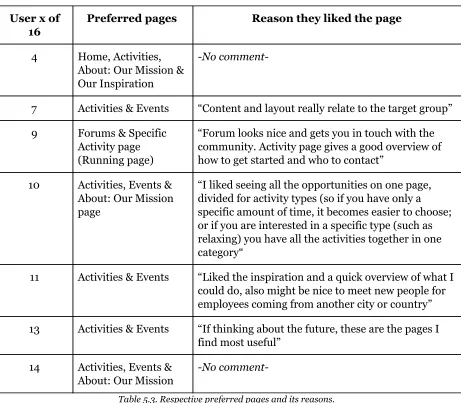
3. The users were asked why they like the specific pages:
User x of 16
Preferred pages Reason they liked the page
4 Home, Activities, About: Our Mission & Our Inspiration
-No comment-
7 Activities & Events “Content and layout really relate to the target group” 9 Forums & Specific
Activity page (Running page)
“Forum looks nice and gets you in touch with the community. Activity page gives a good overview of how to get started and who to contact”
10 Activities, Events & About: Our Mission page
“I liked seeing all the opportunities on one page, divided for activity types (so if you have only a specific amount of time, it becomes easier to choose; or if you are interested in a specific type (such as relaxing) you have all the activities together in one category“
11 Activities & Events “Liked the inspiration and a quick overview of what I could do, also might be nice to meet new people for employees coming from another city or country” 13 Activities & Events “If thinking about the future, these are the pages I
find most useful” 14 Activities, Events &
About: Our Mission
[image:50.612.79.540.104.507.2]-No comment-
Table 5.3. Respective preferred pages and its reasons.
4. Intermediate users perform and enjoy a wide distribution of sports, ranging from gym & fitness, tennis, walking, cycling, yoga, running, football, hiking, rowing, beach volleyball, bootcamp and swimming. The users enjoy these wide range of activities equally, and not one in particular.
6. 71.4% of users state that they are interested in exercising both with friends/ colleagues and alone. 28.6% of users voted that they with to exercise alone only, and 14.3% voted for exercising with friends/ colleagues only. This shows that people who wish to exercise alone exist, and should be catered for too.
7. Majority of users (57.1%) wish to improve their current level of exercise, while 28.6% of users wish to maintain it. Incorporating a feature that allows users to challenge themselves can target those who wish to improve their physical activity. Challenges at a lower intensity level can also cater for users who wish to maintain physical activity.
8. Any open remarks:
User x of 16
Comment
7 “The website looks amazing. I'm looking forward to the final version!” 10 “I like your website, keep up the good work! I haven't explored if it is
possible to create groups as well, with colleagues with whom you can undertake activities regularly, this would be interesting for me”
11 “Although I like cycling I don't make the time for it often enough, for a team sport I notice this is way easier because you commit to it, this week I actually decided to dedicate an evening with my girlfriend to go cycling so we "have to"/commit to it. For running or swimming I would need a challenge, for beach volleyball it was a bonding thing as well with colleagues you get to know them a bit differently, rowing was more of a getting to know a sport just to learn a bit about it (both by "accident" also research related)”
13 “I hope this webpage gets available soon. Good luck!”
Table 5.4. Open remarks.
In addition to the questionnaire responses, other general remarks were made during the user test:
● The Coming Up andTypes of Running features in the specific activity page were found
useful
● Half of all the users struggled to find the chat icon on the platform, and will need clarification to make it more visible.
● Users navigated the platform with ease during the specific tasks required to do during the user test
5.3.2. User Test 2 Improvements
Following the observations of the responses, these are the specific improvements to be made in the 2nd alteration of the platform:
● Clarify what the website is about on the home page. This can be done by expanding the home page and including additional info of the specific features provided by the platform ● Make the introduction text in the Activities page more clear to the users. This can be
done in the top of the page before the list of activities
● Add a condensed list of all activities at the bottom of the Activities page for users who
wish to see an overview
● Add a descriptive sentence for each category of the activities, to clarify what each section is about
● Add anchors that link the user to beginner and intermediate information respectively (tunneling), for users who wish to save time and effort of scrolling
● The Messenger icon is often overlooked by users. Clarify the Messenger feature by
explaining it at the top of the Members page
● Use images and videos that are UT-specific, with real photos of the University with real employees for a better tailored experience.
5.4. MoSCoW
As described in chapter 3.7., the MoSCoW analysis is done to determine the core requirements of the platform. After having user tests carried out with the first prototype, this analysis can now be seen as an improved version of the requirement list based on user feedback. The analysis will be used to continue working on the Realisation phase.
Must haves:
● Physical activity suggestions to allow users to explore and engage in different activities ● Each physical activity page must have its detailed respective information about its
activity (e.g. location, definition etc.), and nudge users to try them out
● Word and sentence phrasing that feel more inviting and less intimidating to users ● Visual design to specifically cater for the UT employees
○ For example, if visual media of sporty athletes are used, they may put off university employees that have no experience in physical activity
● A social communication tool for users to connect to others with similar interests ● Free and accessible by every University of Twente employee
● Embed enjoyment in its corporate identity
○ Visual theme, content, interaction and copyright.
Additional: Please refer to section 5.2.1 (User Test 1 Improvements)
Should haves:
● Intuitive UX and UI design to cater for users of different backgrounds ● Mission & Vision statement to explain what the platform is about
● Visual elements elicit positive emotion, and is relatable to the target groups ● Duration and difficulty of specific events to give users an overview
● Specific tips and information tailored for intermediate users in each given activity ● Cater for users who wish to exercise alone.
Could haves:
● Activity specific information, for example, tailored running routes for the running activity, location tracking for movement activities, recommended gear for outdoor activities, etc.
● Gamification of activities, motivating users by unlocking “achievements” ● Tunneling specific information to cater for respective users
Won’t haves:
● Information specifically tailored to expert athletes
● Visual media that represents users that are not within the target group e.g. expert athletes or teenagers.
5.5. Future Improvements
This section of the report highlights features that would benefit the platform if implemented, but has been excluded in the development due to the narrow time frame allocated for this project. The following are improvements that may be implemented in the future to enhance user experience:
1. Specific Activities
a. Incorporate a subscription functionality to get weekly news
b. Route maps and GPS tracking for activities such as cycling, running, etc. c. Music and podcast suggestions during an activity
d. Challenges that a user can choose to partake in
2. Events
a. Information to show who amongst your friends are going to specific activities b. Additional organised, external events
c. A calendar overview synced with UT employee profiles
b. Ability to connect to like minded users on similar levels
4. News/ Blog
a. A feature weekly article about joy, positivity, enjoyment and exercise b. Research posts that can be read by UT employees
5. Personal Profile Page
a. Ability to add personal stories b. History of activities
c. Ability to quantify the amount of enjoyment experienced during an activity
6. Data Collection
6. REALISATION
This chapter of the report looks into the various design choices made by the developers, Fredrika Åström and I, in order to design a platform that effectively realises the goal of the GP. With the discoveries from the user tests in the Specification phase, the various steps taken to reach an effective design of the platform are explained. This final prototype will then be used to evaluate the project in the next chapter.
6.1. The Web Platform
6.1.1. Decision to use an online Web-building tool
Once the idea of developing a web platform was established, it was evident that an online website building tool would have to be used due to several reasons. Given the timeframe of 10 weeks to realise the project goal, it would be much more efficient and effective to use an online web-building tool rather than programming the platform from scratch. As developers, our main strengths were in visuals and UX /UI design, therefore working on Javascript, HTML and CSS would not have been the most optimal decision. Moreover, web builders allowed complex features within the website (such as user log-in databases, online chat servers for real time communication and live email alerts) to be introduced via the use of plugins, instead of developing these features separately within the platform in the given time frame.
6.1.2. The decision to use Wix
Before the decision to use Wix, other online web-building tools, such as Squarespace, WordPress and CraftCMS, were analysed to see what the most suitable one would be. Without going to extensive details and pros & cons of each, Wix, compared to the rest, excelled in its ease of use and wide variety of plugins, as well as having the lowest cost to develop. It also fulfilled the following:
1. Ability to make a user profile and log-in using an existing google or facebook account 2. Flexible design options, especially for startup websites
6.1.3. How Wix was used
Despite the fact that Wix offers a wide range of templates that developers can use to customise their web pages, this feature was not used. The JOYxUT platform was built from an empty template to tailor the pages according to UT employee’s needs, without any predetermined themes. During development, the Wix Premium plan was purchased, which allowed us to:
● Remove any advertisements visible on the platform. Advertisements hindered user experience and needed to be eliminated.
● Receive 10GB of online storage and unlimited bandwidth. This was especially important due to the heavy visuals in the platform, as it would make the loading times much faster. ● Upload up to 1 hour of video, which is also important for moving visuals.
The empty template of Wix is shown below (fig. 6.1.), which was the starting point of designing the platform.
Figure 6.1. The starting empty template of Wix.
6.2. Visuals and Media
6.2.1. Images
The process of selecting images suitable for this platform was a challenging task, as every image selected to represent a specific element in the platform must fulfill the following criteria:
● Images must convey positive emotion if it includes human expression
● Any persona within an image must relate to the target group in terms of age, appearance and athletic ability
● Images must represent the environment that the University employees are in
For the first and second iteration of the platform prototype, free stock images were used from Unsplash and Wix Images . For the final version of this platform, photographs were taken1 2 within the University of Twente using a Canon 80D camera. These photos were then edited using Adobe Lightroom CC 2019 and Adobe Photoshop CC 2019.
Figure. 6.3 Adobe Photoshop CC 2019 workspace, with the Animal Watching activity photo.
6.2.2. Video
The selection of video for the platform went through the same criteria as the images. A free stock video from Wix was used for the landing-page of the platform in the second prototype, however, for the final iteration of the website, the landing-page video was replaced with a video that was recorded within the University of Twente. This new video featured actual employees of the UT, representing both beginner and intermediate users. The video was planned and organised with the joint effort of both developers, but filmed and edited by John Kim.
6.2.2.1. Editing Process of the Homepage video for the final version of
the platform
campus nature track, frisbee in the UTrack and the University of Twente sign on the main campus entrance.
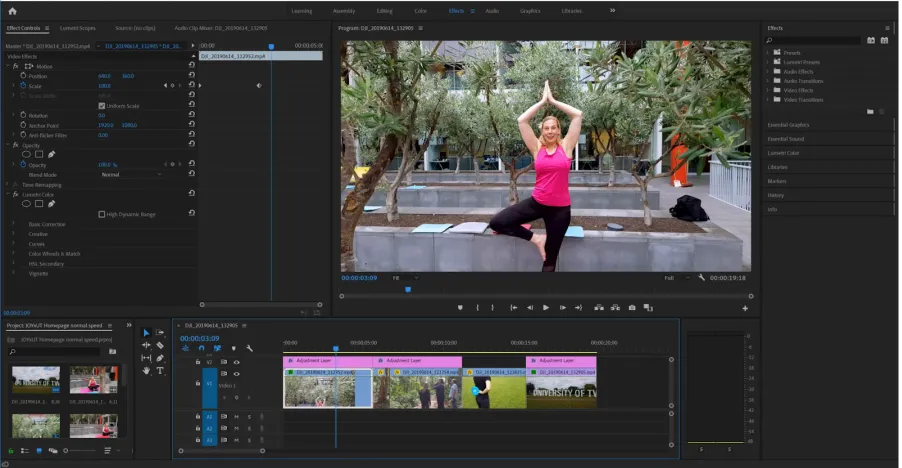
[image:60.612.81.532.116.350.2]Figure 6.4. Adobe Premiere Pro CC workspace with effect controls and timeline for the Yoga edit.
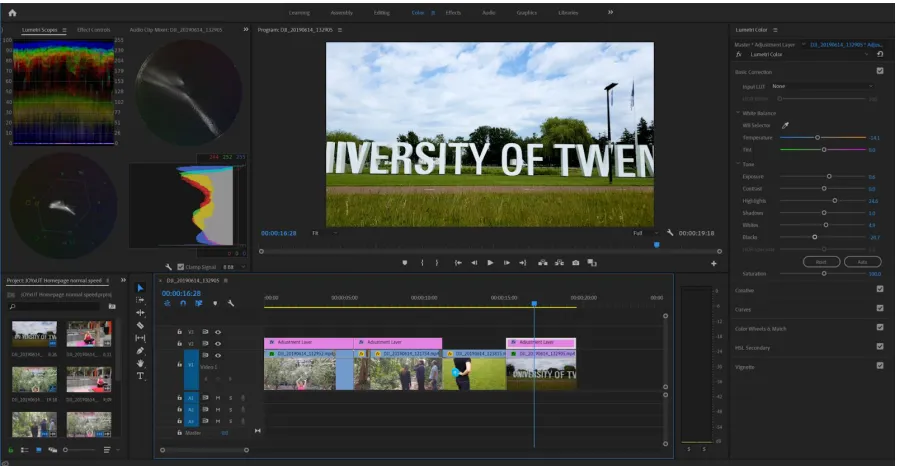
Figure 6.5. Adobe Premiere Pro CC workspace with effect controls and timeline for the photowalk edit.
for the viewer of the platform video. Editing would be finalised by exporting the video in 1080p, and compressed before uploading to Wix in order to reduce loading time of the website.
Figure 6.6. Adobe Premiere Pro CC timeline and Colour-grading workspace with lumetri colour effect controls.
6.2.3. Website colour scheme
[image:61.612.82.531.129.362.2]The colour scheme of the website was chosen to work around black and white and one or two primary colours. This would ensure that the website looks clean and modern, yet bright to reflect on positive emotions together with health and wellbeing.
6.2.4. Typography
There are two font styles used for the platform, the DIN Neuzeit Grotesk for any headers or titles, and DIN Next light for body text. These are both Serif fonts, which reflect on modern
typefaces that allow for a clean yet easily legible design.