| GENETICS OF SEX
A Novel Candidate Gene for
Temperature-Dependent Sex Determination in the
Common Snapping Turtle
Anthony L. Schroeder,*,1Kelsey J. Metzger,†Alexandra Miller,* and Turk Rhen*,2
*Department of Biology, University of North Dakota, Grand Forks, North Dakota 58202, and†Center for Learning Innovation, University of Minnesota, Rochester, Minnesota 55904
ABSTRACTTemperature-dependent sex determination (TSD) was described nearly 50 years ago. Researchers have since identified many genes that display differential expression at male-vs.female-producing temperatures. Yet, it is unclear whether these genes (1) are involved in sex determination per se, (2) are downstream effectors involved in differentiation of ovaries and testes, or (3) are thermo-sensitive but unrelated to gonad development. Here we present multiple lines of evidence linkingCIRBPto sex determination in the snapping turtle,Chelydra serpentina. We demonstrate significant associations between a single nucleotide polymorphism (SNP) (c63A.C) inCIRBP, transcript levels in embryonic gonads during specification of gonad fate, and sex in hatchlings from a thermal regime that produces mixed sex ratios. The A allele was induced in embryos exposed to a female-producing temperature, while expression of the C allele did not differ between female- and male-producing temperatures. In accord with this pattern of temperature-dependent, allele-specific expression, AA homozygotes were more likely to develop ovaries than AC heterozygotes, which, in turn, were more likely to develop ovaries than CC homozygotes. Multiple regression using SNPs inCIRBPand adjacent loci suggests that c63A . C may be the causal variant or closely linked to it. Differences inCIRBPallele frequencies among turtles from northern Minnesota, southern Minnesota, and Texas reflect small and large-scale latitudinal differences in TSD pattern. Finally, analysis ofCIRBP
protein localization reveals that CIRBPis in a position to mediate temperature effects on the developing gonads. Together, these studies strongly suggest thatCIRBPis involved in determining the fate of the bipotential gonad.
KEYWORDSgenetics of sex; cold-inducible RNA-binding protein; temperature-dependent sex determination; genetic association
S
EX determination in vertebrates is divided into two broad categories, either genotypic or environmental. Genotypic sex determination (GSD) occurs at fertilization and is gov-erned by an individual’s genotype. GSD species often, but not always, display morphologically distinct sex chromosomes, as observed in mammals, birds, snakes, some lizards, and some turtles. While some GSD systems are monogenic, other GSD systems involve two or more genes (Moore and Roberts 2013; Bachtroget al. 2014). Environmental sex determina-tion occurs when extrinsic factors influence whether anembryo develops into a female or a male. Various abiotic and biotic factors determine sex in metazoans, but tempera-ture is the only environmental factor known to influence sex determination in amniotes (Bull 1983; Janes et al. 2010; Merchant-Larios and Díaz-Hernández 2013). This phenome-non is referred to as temperature-dependent sex determina-tion (TSD) and is observed in many lizards, numerous turtles, and all crocodilians studied to date (Ewertet al.1994, 2004; Lang and Andrews 1994; Vietset al.1994; Deeming 2004; Harlow 2004). However, GSD and TSD are not as distinct as this simple description suggests. It has long been recognized that genes and the environment interact to determine sex in TSD species (Bullet al.1982; Janzen 1992; Rhen and Lang 1998) and that TSD and GSD can coexist in the same species (Conover and Heins 1987). More recent work has shown that extreme temperatures can override GSD in a species with heteromorphic sex chromosomes (a ZZ/ZW system) and that an evolutionary transition from GSD to TSD can occur in one Copyright © 2016 by the Genetics Society of America
doi: 10.1534/genetics.115.182840
Manuscript received October 5, 2015; accepted for publication February 18, 2016; published Early Online March 1, 2016.
Supplemental material is available online atwww.genetics.org/lookup/suppl/doi:10. 1534/genetics.115.182840/-/DC1.
1Present address: Math, Science, and Technology Department, University of
Minnesota, Crookston, MN 56716.
2Corresponding author: Department of Biology, Box 9019, 10 Cornell St., University of
generation with loss of the W chromosome (Quinn et al.
2007; Holleleyet al.2015).
The key event during sex determination in gonochoristic vertebrates is irreversible commitment of the bipotential gonads to testicular or ovarian fate. In reptiles with TSD, sex is determined during the middle of embryogenesis when gonads are responsive to changes in ambient temperature (Yntema 1976, 1979; Bull 1987; Mrosovsky and Pieau 1991; Wibbels et al. 1991; Lang and Andrews 1994; Merchant-Larios et al. 1997, 2010; Burke and Calichio 2014; Rhen
et al.2015). A substantial number of genes are differentially expressed in developing gonads at male-vs.female-producing temperatures (reviewed in Place and Lance 2004; Shoemaker and Crews 2009; Rhen and Schroeder 2010). Such genes are candidate sdetermining genes. However, differential ex-pression alone does not reveal whether genes (1) are involved in sex determinationper se, (2) are downstream effectors in-volved in differentiation of ovaries and testes, or (3) are thermo-sensitive but unrelated to sex determination or gonad differentiation. Consequently, the mechanism that transduces temperature into a biological signal for ovaryvs.testis devel-opment has not been found in any species. In fact, we do not even know whether there is a single master TSD gene or whether TSD is polygenic (a.k.a. “parliamentary system”) (Crews and Bull 2009; Georgeset al.2010). Here, we define “TSD gene”as a thermosensitive gene involved in determining the fate of the bipotential gonad (i.e.,thermosensitives ex-determining gene).
Genetic association and linkage studies have been used to identify sex-determining genes or sex-linked chromosomal regions in several species with GSD (Anderson et al.2012; Hattoriet al.2012; Kamiyaet al.2012; Myoshoet al.2012; Yanoet al.2012; Wilsonet al.2014). Segregating variation for sex determination has been reported in a TSD lizard (Rhen et al. 2011) and two fish with TSD (Vandeputte
et al. 2007; Yamamoto et al. 2014), suggesting that DNA-based genetic analyses could be used to distinguish TSD genes from other classes of genes (i.e., downstream genes involved in gonad differentiation or thermo-sensitive genes that play no part in sexual differentiation of the gonads). Studies that integrate DNA sequence variation, environmen-tal perturbations, and expression data are a particularly pow-erful way to identify loci causally related to phenotype (Cordell and Clayton 2005; Schadt et al. 2005; Ott et al.
2011; Lewis and Knight 2012; Gagneur et al. 2013). Yet, genetic analyses of this sort have never been conducted in a reptile with TSD.
The common snapping turtle,Chelydra serpentina, dis-plays several characteristics that make genetic studies of TSD feasible. Females develop at low and high incubation temperatures, while males are produced at intermediate temperatures (Yntema 1976; Rhen and Lang 1994; Ewert
et al.2005). Shifting eggs from a male-producing (26.5°) to a female-producing (31°) temperature for 5 days of a 65-day incubation period is sufficient to induce ovary de-velopment in all embryos (Rhen et al.2015). This brief
temperature-sensitive period (TSP) provides a unique oppor-tunity to identify TSD genes because shorter exposures to 31° reveal variation in thermo-sensitivity:i.e., exposure to 31°for 2.5 days causes some individuals to develop ovaries while other individuals develop testes. Controlled breeding studies demonstrate that susceptibility to this temperature shift is genetically determined and that genetic variance is entirely additive (T. Rhen, unpublished results).
Variation in TSD pattern in snapping turtles incubated at constant temperatures also supports the premise that TSD has a genetic basis. Studies within populations have found among-family variation in sex ratio at temperatures that produce mixed sex ratios, which suggests that TSD pattern is heritable (Janzen 1992; Rhen and Lang 1998). Ewertet al.
(2005) describe a dramatic latitudinal cline for TSD pattern across North America, indicating that snapping turtles are genetically differentiated across distinctive thermal environ-ments. Turtle embryos from Minnesota and Texas also differ in their response to shifts between female- and male-producing temperatures (Rhenet al.2015). These observations provide compelling evidence that a balance between migration and selection maintains the observed cline in TSD pattern, in close accord with theoretical predictions for geographic clines (Haldane 1948; Fisher 1950; Conover and Heins 1987; Schulteet al.2000; Uminaet al.2005). In short, seg-regating variation for sex determination within populations and population differentiation make genetic association studies a practical and powerful approach tofind TSD genes. Cold-inducible RNA-binding protein (CIRBP) wasfirst iden-tified as a candidate TSD gene based on differential expression of messenger RNA (mRNA) in embryonic gonads at male-vs.
female-producing temperatures (Rhen and Schroeder 2010). The molecular, cellular, and biological function of CIRBP in other species makes this a promising gene for further study. CIRBP has a glycine-rich carboxy terminus and a single RNA recognition motif (RRM) near its amino terminus that plays a crucial role in mRNA processing, RNA export, and translation (Dreyfusset al.2002; Mariset al.2005). CIRBP is known to regulate temperature-dependent cellular processes through translational repression and mRNA stabilization (Yanget al.
2006; De Leeuwet al.2007; Xiaet al.2012; Liuet al.2013). Furthermore, research suggests thatCIRBPis involved in re-production, although its precise function remains unclear (Elliot 2004; Xiaet al.2012).
Here, we conduct experiments spanning multiple levels of biological organization to test the hypothesis thatCIRBPplays a role in TSD. We confirm the temporal pattern of CIRBP
mRNA expression described in an earlier article (Rhen and Schroeder 2010) and provide new data on protein localiza-tion in embryonic and hatchling gonads. More importantly, we identify a single nucleotide polymorphism at codon 63 in
other allele (C) is not. We also detect significant associations betweenCIRBPgenotype,CIRBPexpression in embryonic go-nads, and sex determination at the individual, family, and population level. In contrast, adjacent loci were not associ-ated with sex determination when tested via multiple logistic regression. Taken together, these studies meet all criteria for establishing the veracity of genetic associations, including moderate sample size, replication, and protection from bias due to genotyping error or population stratification (Ioannidis
et al.2008). To our knowledge, this is thefirst genetic asso-ciation between a specific gene and sex to be reported in any TSD reptile. As such, it sets the stage for genome-wide asso-ciation studies to elucidate the genetic architecture underly-ing TSD in the snappunderly-ing turtle (i.e., the number of loci, magnitude of gene effects, allele frequencies, allelic effects, and interactions among sex-determining genes).
Materials and Methods
Collection of eggs and adults
We collected eggs from snapping turtles nests in June 2008, 2009, and 2010. Adult turtles were collected in June, July, and August of the same years. Collection sites extended from the Iowa border to the Canadian border within the state of Minnesota. Adult snapping turtles were also collected on the Lake Lewisville U.S. Army Corps of Engineers property, Lewisville, Texas, in May of 2013 and 2014. Eggs and adults were transported to the animal quarters in the Biology De-partment at the University of North Dakota. Experiments were carried out according to a protocol approved by the Institu-tional Animal Care and Use Committee at the University of North Dakota (Protocol #0905-1).
Egg incubation and tissue collection
Eggs were washed in tepid water and candled to separate fertile and infertile eggs. Eggs from each clutch were randomly assigned to various experimental treatments, placed in plastic containers, and completely covered in moist vermiculite (1 part vermiculite:1 part water by mass). Egg containers were placed in foam box incubators set to a nominal temperature of 26.5°, which produces exclusively male hatchlings. Depend-ing upon the particular study, eggs were either maintained at 26.5° throughout incubation or shifted to 31° for varying periods of time during the TSP. Embryos from each clutch were periodically sampled to monitor developmental rate and ensure embryos were at the desired stages for treatments [staging according to Yntema (1968)]. Equal (or roughly equal) numbers of eggs from each clutch were randomly assigned to each experimental group within each study. Thus, we were able to use clutch identity as a blocking factor/ independent variable in all studies.
This experimental design is based on an extensive set of studies where eggs were shifted between different female-and male-producing temperatures at various stages of devel-opment to define the TSP for sex determination (Rhenet al.
2015). The entire TSP broadly encompasses Yntema stage 14
to stage 21 (Supplemental Material, Figure S1), but varies with the order of temperature shifts (male to femalevs. fe-male to fe-male), the precise temperatures used (some temper-atures are more potent at masculinizing or feminizing embryos than other temperatures), as well as the duration and timing of exposure to different temperatures. Those stud-ies uncovered a brief sex-determining period in snapping tur-tles exposed to a specific thermal regime. Moving embryos from a male temperature (26.5°) to a female temperature (31°) for 5 days of a 65-day incubation period induces ovar-ian development in all stage 17 embryos. The sex-determining period for this thermal regime in snapping turtles (8% of embryogenesis) is comparable to the sex-determining period in mice (10% of embryogenesis) (Figure S1).
We used this temperature shift paradigm to produce mixed sex ratios instead of a constant pivotal temperature for two major reasons. First, we can focus on a brief period when high temperature (31°)first specifies (days 1–3 of the shift) and then determines (days 4–5 of the shift) ovarian fate (expo-sure starting at stage 17–17.5). Gonads in embryos kept at 26.5° during this same 5-day period are fated to become testes. This facilitates identification of causal TSD genes by allowing analysis of molecular changes precisely when tem-perature specifies gonad fate. In contrast, we would have to sample embryos over a 2-week period from stage 14 to stage 21 (the entire TSP) if eggs were incubated at a constant pivotal temperature. Second, incubation of eggs at a constant pivotal temperature throughout development is unnatural. Eggs in nature normally experience temperaturefluctuations on various temporal scales (Wilhoftet al.1983; Packardet al.
1985; Congdonet al.1987; Kolbe and Janzen 2002). Thus, a temperature-shift paradigm is arguably a more natural way to produce mixed sex ratios and reveal phenotypic and ge-netic variation in temperature sensitivity.
Euthanasia of embryos and hatchlings was by rapid de-capitation. Adrenal–kidney–gonad complexes were quickly dissected from embryos and hatchlings and either placed in RNAlater orfixed in 4% paraformaldehyde. Tissues in RNA-later were kept at220°for long-term storage. Tissues in 4% paraformaldehyde were kept overnight at 4°, then washed in 13PBS, and transferred to 70% ethanol for long-term storage.
RNA extraction from gonads and Complementary DNA synthesis
we measured gene expression in pure gonad preparations that were completely separated from adrenal and kidney tissue.
DNA extraction from kidneys
Genomic DNA was isolated from kidneys using TRI Reagent according to the manufacturer’s instructions (Molecular Re-search Center, Cincinnati). Genomic DNA was isolated from blood using a phenol/chloroform/isoamyl alcohol protocol avail-able online athttp://www.genome.ou.edu/protocol_book/ protocol_partIII.html#III.H. The concentration and purity of DNA was measured with a NanoDrop ND-1000 spectro-photometer (NanoDrop Technologies, Wilmington, DE). The integrity of DNA was determined by agarose gel elec-trophoresis. Purified genomic DNA was stored at220°until used for genotyping.
PCR methods for measuring gene expression and for genotyping
We used dye-based and probe-based PCR to measureCIRBP
expression and to determineCIRBPgenotypes. Real-time PCR was performed using the Bio-Rad CFX 384 Real-Time PCR System with SsoFast EvaGreen supermix according to the manufacturer’s instructions (Bio-Rad). Each 10-ml PCR reac-tion contained 5ml of the 23EvaGreen supermix, 0.3ml of the forward primer (0.3mMfinal concentration), 0.3ml of the reverse primer (0.3mMfinal concentration), 2.4ml of water, and 2 ml of cDNA (input = 2.5 ng total RNA). Standard curves were made via serial dilution of purified PCR products as described in Rhenet al.(2007).
We designed Taqman probes (Life Technologies) and pri-mers to distinguish the SNP at position c63A.C in the open reading frame of snapping turtleCIRBP. SsoFast probes super-mix (Bio-Rad) was used for allele-specific expression assays and genotyping. We isolated PCR products that contained only the A allele or only the C allele. We empirically determined the optimal annealing and extension temperature (64.3°) for dis-tinguishing these alleles. We then made standard curves that were specific for eachCIRBPallele: the A probe was hydro-lyzed only when the A template was present (Figure S2A), while the C probe was hydrolyzed only when the C template was present (Figure S2B). Slopes and intercepts for standard curves were statistically homogeneous. We could therefore directly and quantitatively compare the abundance of tran-scripts for each allele and accurately genotype individuals.
We also designed primers for high-resolution melt temper-ature (HRM) analysis of PCR products to confirmCIRBP ge-notypes for the SNP at position c63A .C. We determined optimal conditions for distinguishing AA homozygotes, AC heterozygotes, and CC homozygotes using 10 ng of genomic DNA as template. Amplification was via three-step PCR. Sam-ples were heated to 98°for 2 min and then subjected to 40 PCR cycles: 98°for 5 sec (denature), 53°for 1 sec (anneal), and 60°for 5 sec (extend). After 40 cycles, we collected HRM data from 60° to 85° at 0.2°increments and 10-sec read times. HRM data were imported into Bio-Rad Precision Melt Analysis Software. Optimal settings for CIRBP genotyping
were determined using pure A standard as template, pure C standard as template, and an equal mix of A and C standards as template (premelt temperature = 70.4–70.5°; postmelt temperature = 75.7–75.8°; temperature shift bar height = 0.20; melt shape = 35; Tm = melt temperature difference = 0.25°).
In addition, we designed primers for HRM genotyping of loci presumably linked toCIRBP. The snapping turtle genome has not yet been sequenced so we used comparative genomics to identify seven protein-coding genes that display conserved gene order in human, chicken, painted turtle, and Chinese softshell turtle genomes:STK11,ATP5D,MIDN,CIRBP,C19orf24,
EFNA2, andCAMK4L. Given the synteny across mammals, birds, and divergent turtle species, these genes are most likely linked in the snapping turtle. We used Illumina sequencing data from the snapping turtle to identify SNPs within these genes (more details are provided in SequencingandBioinformatics,
SNP identification,and RNA-Seqbelow). We optimized HRM genotyping for these SNPs as described above. Sequences for PCR primers and probes are provided inTable S1.
Temperature shifts to characterize CIRBP mRNA and protein expression patterns
We conducted an experiment to define the time course for
CIRBPmRNA induction. We collected gonads from embryos incubated at 26.5°and from clutch mates shifted from 26.5° to 31°at stage 16. Approximately equal numbers of embryos from each temperature were sampled at 6, 12, 24, and 48 hr of the temperature shift. Tissue was collected and RNA extracted from embryonic gonads as described above.
A similar experiment was conducted to examine CIRBP protein expression during and after the sex-determining pe-riod. Eggs were incubated at 26.5° until embryos reached stage 16. At that time, half of the eggs were kept at 26.5° to produce males, while half were shifted to 31°for 6 days to produce females. Embryos were sampled from both temper-atures on days 1, 2, 3, 4, 5, and 6 of the shift. We also sampled embryos after eggs at 31°were returned to 26.5°(days 11, 21, 31, and at hatch). Adrenal–kidney–gonad complexes werefixed in 4% paraformaldehyde for 24 hr at 4°and then transferred to 70% ethanol for long-term storage.
CIRBP expression–sex ratio correlation study
determine sex ratios for each clutch. The sex of hatchlings was diagnosed based on gross morphology of gonads and reproduc-tive tracts as previously described (Rhen and Lang 1994).
Sequencing
We used cDNA from the gene expression–sex ratio correlation study described above as template for PCR amplification of the entire CIRBP-coding sequence in multiple individuals. Purified PCR products were Sanger-sequenced using BigDye as previously described (Rhenet al.2007). Sequencher soft-ware was used to align sequences and search for SNPs.
We also collected 12 clutches from southern Minnesota and 13 clutches from northern Minnesota for RNA-Seq (range in latitude = 43.511°North to 48.720°North). Approximately equal numbers of eggs from these clutches were separated into two experimental groups. One group of eggs was incu-bated at 26.5°throughout development to produce males. The other group of eggs was incubated at 26.5°until stage 17.5, and eggs were then shifted to 31°for 6 days to produce females and returned to 26.5°for the rest of development. Embryos from both groups were sampled on days 1, 2, 3, 4, and 5 of the temperature shift. Tissue was collected and RNA was extracted from embryonic gonads as described above.
We combined an equivalent amount of total RNA from gonad pairs from individual embryos to make 20 pools for RNA-Seq: 2 temperatures35 days32 biological replicates. Total RNA from 25 embryos was pooled for each biological replicate. All together, we sampled 500 embryos from 25 clutches collected across a wide geographic range to capture as much genetic variation as possible (5°range in latitude from the southern-most clutch to the northern-most clutch within Minnesota). Ten pools (2 temperatures35 days) were from eggs collected in southern Minnesota (12 clutches). The other 10 pools (2 temperatures 35 days) were from eggs collected in northern Minnesota (13 clutches). Clutches of eggs from northern and southern Minnesota were separated by latitude of 46°559N. Total RNA was sent to the W. M. Keck Center for Comparative and Functional Genomics at the Uni-versity of Illinois at Urbana-Champaign for sequencing. Twenty individual cDNA libraries were prepared with unique barcodes and sequenced on Illumina HiSeq 2000 (100 bp, single-end reads; 156.4 million reads).
Additional sequence data using tissues derived from all three germ layers enabledde novoassembly of a more com-plete snapping turtle transcriptome. The data described above were supplemented with sequence data from eight hypothalamus/pituitary libraries (50 bp, single-end Illumina reads; 172.2 million reads), two intestine libraries (50 bp, single-end Illumina reads; 31.8 million reads), as well as normalized embryonic gonad libraries (454 Sequencing, av-erage read length = 350 bp; 2.8 million reads).
Individual and population-based genetic association studies
Snapping turtle eggs from another 15 clutches from north-ern Minnesota were incubated at 26.5°until stage 17.5 of
development. Eggs were shifted to 31°for 2.5 days and then shifted back to 26.5°. Similar numbers of embryos were sam-pled from each clutch at 24 and 48 hr of the exposure to 31°. Tissue was collected and RNA was extracted from embryonic gonads as described above. A subset of eggs from each clutch was allowed to hatch to determine sex ratios and to collect tissue for genotyping. Hatchling sex was diagnosed, adrenal– kidney–gonad complexes were dissected, snap-frozen, and stored at280°until genomic DNA was isolated from kidneys. Hatchlings were genotyped using TaqMan MGB probes. Ge-notypes were verified using a different set of PCR primers and high-resolution melt temperature analysis.
Equal numbers of adult turtles were collected from the southern half and the northern half of Minnesota to compare allele frequencies in meta-populations experiencing gene
flow, but differing slightly in TSD pattern. A small number of turtles from Texas were available for comparison to a geographically distinct population unlikely to experience gene flow with turtles in Minnesota. We drew blood from the subcarapacial vein of adult turtles as described by Moon and Hernandez Foerster (2001). Whole blood was trans-ferred to a microfuge tube and kept on ice until genomic DNA was extracted (within a few hours).
We genotyped adult snapping turtles captured in northern Minnesota (n= 28), southern Minnesota (n= 28), or north-ern Texas (n= 9). Genotypes for 481 individual embryos and hatchlings were also available from 15 clutches collected in northern Minnesota (i.e., from the genetic association study). To avoid pseudoreplication (i.e., siblings within a clutch are not independent samples), we used genotype frequencies within families to infer parental genotypes. Most clutches (n = 14) exhibited genotype frequencies consistent with Mendelian inheritance from a single mother and a single father. One clutch displayed genotype frequencies, suggest-ing multiple paternity. Thus, we inferred 31 genotypes for parents of embryos and hatchlings from the genetic associa-tion study.
Bioinformatics, SNP identification, and RNA-Seq
We used CLC Genomics Workbench (CLC bio, Cambridge, MA) for read mapping, SNP verification, and RNA-Seq anal-yses. We mapped reads to full-lengthCIRBPcDNA and determined the number of reads that were mapped and not mapped from each cDNA library (20 total gonad librar-ies). We used the SNP detection tool to identify polymor-phisms inCIRBPcDNA. Parameters for SNP detection required a minimum coverage of 20 reads for each SNP and a minimum variant frequency of 10%. Illumina reads uniquely mapped to
The same procedure was used to identify SNPs in a set of genesflankingCIRBP. The snapping turtle genome has not yet been sequenced so we used comparative genomics to identify genes likely to be linked toCIRBP. Six protein-coding genes are syntenic with CIRBP in human, chicken, painted turtle, and Chinese softshell turtle genomes in the following chromosomal arrangement: STK11, ATP5D, MIDN, CIRBP,
C19orf24,EFNA2, andCAMK4L. These genes span650 kb in a painted turtle scaffold (gi|371559100|gb|JH584733.1) and exhibit highly correlated physical distances in the homol-ogous Chinese softshell turtle scaffold (gi|351669362|gb| JH209284.1) (r= 0.9988,n= 7). We used sequence data from snapping turtle gonads, hypothalamus/pituitary, and intestine to identify 12 common SNPs in these genes.
We used Illumina single-end reads to measure allelic-specific CIRBP expression. We normalized gene expression using reads per kilobase of exon per million mapped reads (RPKM) (Mortazaviet al.2008). We explicitly estimate allele-specific expression by counting only those reads that contain the SNP (Jiang and Wong 2009). We calculated ex-pression values for alternative alleles using uniquely mapped reads (n= 4,744) that included position 63 within theCIRBP -coding sequence. We used 199 bp as the length of the tran-script for allele-specific RPKM calculations because Illumina reads from gonads were 100 bp long and had to overlap the SNP to be informative. Other methods, such as RNA-Seq by Expectation-Maximization, use uninformative reads to calcu-late expression values for splice isoforms (or alleles) by assigning fractions of uninformative reads in proportion to counts from informative reads (Liet al.2010). The assump-tion that uninformative reads are from a particular isoform (or allele) is unfounded and could lead to biased expression estimates for splice variants and for alternative alleles. Thus, we have chosen to be conservative and only use informative, uniquely mapped reads for our analysis of allelic-specific ex-pression. Two other SNPs were detected in the 39UTR of
CIRBP. Although we can unambiguously map reads contain-ing these SNPs, we cannot determine linkage relationships
among SNPs separated by.100 bp from single-end RNA-Seq data. We therefore analyzed each SNP separately.
Linkage analysis
We used PCR and HRM analyses to determine genotypes for markers inSTK11,ATP5D,MIDN,CIRBP,C19orf24,EFNA2, and CAMK4Lin 56 adult snapping turtles from Minnesota. We assigned numerical values of 0, 1, or 2 based to the ge-notype at each locus: homozygotes for rare allele = 0, het-erozygotes = 1, and homozygotes for common allele = 2. We excludedATP5Dfrom further analysis because the frequency of the rare allele was too low (0.027) to be useful as a marker. We calculated pairwise correlations among genotypes for all other loci and squared this value (r2) to get a standardized measure of LD as outlined by Rogers and Huff (2009).
Immunohistochemistry
Paraformaldehyde-fixed tissues were embedded in paraffin, sectioned at 6mm, and placed on microscope slides. Sections were de-paraffinized and rehydrated using standard immu-nohistochemistry protocols. The primary CIRBP antibody was diluted 1:500 (caalog no. ARP40348_P050, Aviva Systems Biology, San Diego). Negative controls were incubated in blocking solution without the primary antibody. The Vecta-Stain ABC Elite kit (Vector Laboratories) was used to detect the primary/secondary antibody complex. Staining was per-formed using fresh 3, 39-diaminobenzidine (Vector Laborato-ries) and counterstained with hematoxylin. Images were captured with an Olympus BX-51 microscope equipped with an Infinity 2 digital camera (Lumenera, Ottawa) using Rincon HD software (Imaging Planet, Goleta, CA).
Statistical analyses
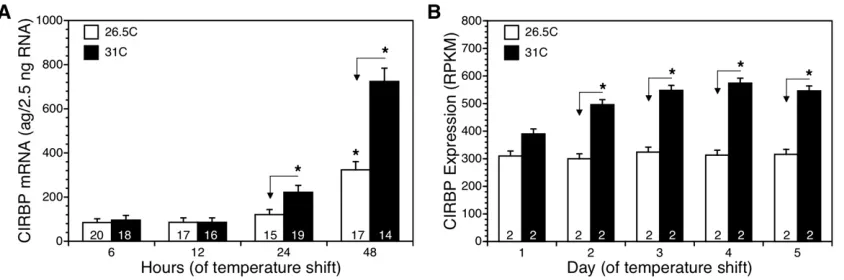
We used three-way analysis of variance (ANOVA) with clutch, temperature, and day as main effects to analyzeCIRBPmRNA expression in the quantitative PCR (qPCR) study. Significant main or interaction effects were followed by comparisons among specific groups of interest. The Dunn-Sidák method was used to correct for multiple comparisons. The nominal Figure 1 Expression ofCIRBPmRNA increased in gonads of snapping turtle embryos shifted from 26.5°to 31°, but not in gonads from embryos kept at
significance level was calculated as a’= 1 2 (12 a)1/k, wherekis the number of comparisons for an experiment-wise
a= 0.05. Spearman’s rank correlation was used to test for a correlation betweenCIRBPmRNA expression and sex ratio in clutch mates. This nonparametric test is appropriate when data do not meet assumptions for the Pearson product-moment correlation (i.e., a linear relationship between variables). We used likelihood-ratio (LR) chi-square tests or Fisher’s Exact Tests for variation in sex ratios among clutches and for associations between genotype and sex. In another test for association between CIRBP genotype and sex, we used a matched-pairst-test to control for genetic background: al-lele frequencies in males and females were compared after pooling clutches with very similar numbers of males and females (Risch and Teng 1998; Teng and Risch 1999). We used the Cochran–Mantel–Haenszel test to compare allele frequencies between northern and southern Minnesota pop-ulations while controlling for temperature effects on tran-script levels in the RNA-Seq study. In other words, data were stratified by temperature, thus allowing comparison of northern and southern Minnesota populations. Statistics for gene expression and genetic associations were performed us-ing JMP 5.0.1.2 software (SAS Institute, Cary, NC). Effects were considered significant atP#0.05. Throughout the text, means are given6SEM (6SE).
Data availability
Datafiles are uploaded as supplementaryfiles: Data for Figure 1 contain raw and processed expression data for Figure 1. Data for Figure 3 contain clutch sex ratios and mean sion data for Figure 3. Data for Figure 3 contain raw expres-sion data for Figure 3. Data for Figure 4A contain read counts
for alternative CIRBP alleles from RNA-Seq study and sum-mary data plotted in Figure 4A. Data for Figure 4B contains raw expression data and summary data plotted in Figure 4B. Data for Figure 4C, Table 2, andFigure S2contain individual genotype and phenotype data for those figures and table. Data for Figure 5 contain raw data presented in Figure 5. Data for Figure 6 and Figure 7 contain individual genotype data for thosefigures.
Results
CIRBP mRNA and protein expression patterns
We incubated three clutches of eggs at 26.5°until embryos reached stage 16. Half of the eggs from each clutch were then shifted to 31°, while half were kept at 26.5°. We sampled embryos at 6, 12, 24, and 48 hr to measure CIRBP mRNA expression. Temperature (ANOVA, F1,130 = 23.0, P , 0.0001), time (ANOVA, F3,130 = 70.8, P , 0.0001), and the temperature 3time interaction (ANOVA, F3,130 = 7.9,
P,0.0001) all influencedCIRBPmRNA levels. Expression of
CIRBPmRNA did not differ between male and female temper-atures at 6 hr (P= 0.65) or 12 hr (P= 0.97), but was signif-icantly different at 24 hr (P= 0.005) and 48 hr (P,0.0001) (Dunn-Sidáka’#0.005 for 10 comparisons; Figure 1A).
We tested for developmental changes within each temper-ature. At 31°, there was no detectable change from 6 to 12 hr (P = 0.75). Expression of CIRBP mRNA increased signifi -cantly from 6 to 24 hr (P= 0.0002) and from 6 to 48 hr at 31°(P,0.0001) (Figure 1A). At 26.5°, there was no detect-able change from 6 to 12 hr (P= 0.95) or from 6 to 24 hr (P= 0.19). However,CIRBPexpression did increase significantly from 6 to 48 hr at 26.5°(P,0.0001) (Figure 1A).
We also examined data from an independent RNA-Seq study in which embryos were sampled on days 1, 2, 3, 4, and 5 of the temperature shift (Figure 1B). Temperature (ANOVA,F1,10= 313.2,P,0.0001), time (ANOVA,F4,10= 9.5, P = 0.002), and the temperature 3 time interaction (ANOVA,F4,10= 7.9,P= 0.004) were all significant. Expres-sion ofCIRBPmRNA was higher in 31°RNA libraries compared to 26.5°RNA libraries on day 1, but the difference was not significant (P = 0.01) after the Dunn-Sidák correction (a’#0.005 for 10 comparisons). Expression ofCIRBPwas significantly higher in 31°RNA libraries than in 26.5°RNA libraries on days 2–5 (P,0.0001 for all comparisons; Fig-ure 1B). There was a significant increase inCIRBP expres-sion in 31°embryos from day 1 to days 2–5 (P= 0.002,P= 0.0001,P,0.0001,P= 0.0001, respectively) (Figure 1B). In contrast, there was no detectable change inCIRBP expres-sion between day 1 and days 2–5 at 26.5°(P= 0.70,P= 0.59,P= 0.91,P= 0.81, respectively). These data indicate that a steady-state difference inCIRBPexpression between male- and female-producing temperatures is established within 48 hr.
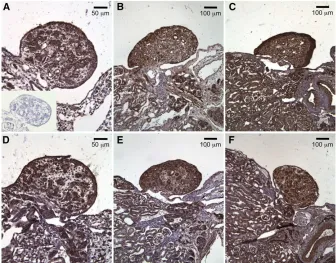
We next used immunohistochemistry to examine the spatial pattern of CIRBP protein expression during sex de-termination (days 1–6 of a temperature shift) and during gonad differentiation (days 11, 21, 31, and hatch). Eggs were incubated at 26.5°throughout embryogenesis to pro-duce males or were exposed to 31°for 6 days to produce females. Staining for CIRBP was very strong in embryonic gonads (compare Figure 2A to the negative control shown in the inset). Expression patterns were very similar at female- and male-producing temperatures during the TSP (Figure 2, A and D, respectively). CIRBP was expressed in the primary sex cords and in cells of the coelomic epithe-lium. Expression patterns began to diverge after the tem-perature shift on day 21. While staining of medullary sex cords was no longer evident in differentiating ovaries, stain-ing of these structures remained prominent in differentiat-ing testes (Figure 2, B and E, respectively). The spatial pattern of CIRBP expression differed even more dramati-cally on day 31: staining clearly defined the ovarian cortex in female embryos and seminiferous tubules in male em-bryos (Figure 2, C and F, respectively).
Family-based correlation between CIRBP expression and sex ratio
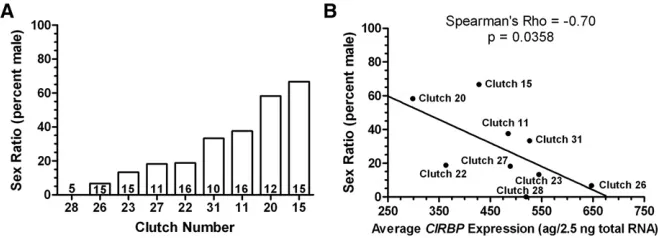
Nine clutches of eggs were incubated at a male-producing temperature (26.5°) for most of development and exposed to a female-producing temperature (31°) for 2.5 days during the TSP. Exposure to 31°started at stage 17.5 and produced an overall sex ratio of 30% males (34 males:80 females). There was significant variation in sex ratio among clutches, ranging from one clutch that produced exclusively females to one clutch that produced a male-biased sex ratio (LR x2= 25.9, d.f. = 8,P= 0.0011; Figure 3A).
A subset of embryos from each clutch was sampled on day 1 or 2 of the temperature shift to measure CIRBPexpression. Levels of CIRBP mRNA were affected by clutch identity (ANOVA,F8,78= 2.06,P= 0.05) but not by day of sampling (ANOVA,F1,78= 2.19,P= 0.14) or the clutch3day inter-action (ANOVA,F8,78= 1.74,P= 0.10). We used RNA ex-traction kit as an independent variable in the model because we used two different kits for this experiment (ANOVA,
F1,78= 13.6,P= 0.0004). We also used 18S ribosomal RNA (rRNA) as a covariate (ANOVA,F1,78= 9.65,P= 0.003) to control for variation in RNA extraction efficiency. We ob-served a negative correlation betweenCIRBPmRNA expres-sion and sex ratio among clutches (Spearman’s Rho =20.70,
P= 0.0358; Figure 3B). Clutches with lowerCIRBPmRNA expression produced more males, while clutches with higher
CIRBPmRNA expression produced more females. SNP identification and verification
We sequenced the CIRBP-coding sequence in four clutches with the most extreme sex ratios to search for polymorphisms that might explain this familial correlation. We identified a SNP at position c63A . C in the open reading frame for
CIRBP. Offspring from female-biased clutches were AA homo-zygotes (n= 8 individuals), while offspring from male-biased clutches were either AA homozygotes (n= 6 individuals) or AC heterozygotes (n= 5 individuals). Genotype frequencies differed among groups even though sample size was small (Fisher’s Exact Test, d.f. = 1,P= 0.0445).
156.4 million Illumina reads from embryonic gonads, 176,583 reads mapped uniquely toCIRBPcDNA. This analy-sis revealed that the SNP c63A.C was fairly common: 3939 reads mapping to this position contained an A, while 805 reads contained a C. These variants are synonymous (TCA to TCC) for serine 21 in the primary structure of CIRBP. Two additional SNPs were found in the 39UTR at position 1147 (5756 reads with G; 3423 reads with A) and position 2092 (3919 reads with T; 1026 reads with A) of full-lengthCIRBP
cDNA. Finally, we recovered two isoforms produced by al-ternative splicing of exons at the carboxy terminus ofCIRBP. These isoforms are conserved among snapping turtles, chickens, and humans.
Temperature-dependent, allele-specific expression of CIRBP
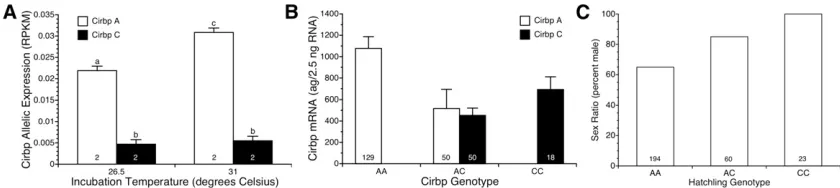
We utilized RNA-Seq data to test for temperature effects on expression of alternative CIRBP alleles and splice variants. Both splice variants displayed the same expression pattern (results not shown). Temperature had different effects on expression of alternativeCIRBPalleles at position 63 as in-dicated by a significant temperature 3 allele interaction (ANOVA,F1,20= 14.7,P= 0.001). The A allele was induced by shifting embryos to 31°, while expression of the C allele did not differ between embryos at 31°and 26.5°(Figure 4A). A similar pattern was observed for SNPs at position 1147 and position 2092 within the 39UTR: exposure to 31°increased expression of the common allele, but not the rare allele (re-sults not shown). These data reveal temperature-dependent, allele-specific expression ofCIRBPin gonads during the TSP. Genetic association between CIRBP and
sex determination
We used TaqMan MGB probes to directly test for associations between CIRBP c63A . C genotype, allele-specific expres-sion, and sex in individual embryos and hatchlings (rather than pooled samples as for RNA-Seq). We repeated the study in which eggs were incubated at 26.5°and exposed to 31°for 2.5 days during the TSP to produce mixed sex ratios. Em-bryos from 15 clutches were sampled on day 1 or 2 of the
temperature shift to measure allele-specific expression or allowed to hatch to test for associations between genotype and sex. Homozygotes for the A allele had higherCIRBP ex-pression than homozygotes for the C allele when exposed to the female-producing temperature (Figure 4B). The A allele in heterozygotes was expressed at roughly half the level observed in AA homozygotes (Figure 4B). Expression of the C allele in heterozygotes was about half the level observed in CC homo-zygotes (Figure 4B). Although mean levels of the A and C alleles did not differ in heterozygotes, expression of the A allele was significantly more variable than the C allele when we compared their variance (F49,49 = 6.8,P ,0.00001; Figure 4B). These results were consistent with the allele-specific pattern of expression in the RNA-Seq study.
The 2.5-day exposure to 31°produced a sex ratio of 72% males (200 males:77 females). Sex ratio was more male-biased in this study than in the previous study, but there was still significant variation in sex ratio among clutches (LRx2= 83.4, d.f. = 14, P,0.0001). In fact, one clutch produced exclusively females while another clutch produced only ma-les (Figure S3). There was a significant association between hatchling genotype and sex (LR x2= 25.4, d.f. = 2, P, 0.0001): 65% of A/A homozygotes were males, 85% of A/C heterozygotes were males, and 100% of C/C homozygotes were males (Figure 4C).
all females were homozygotes for the A allele (clutch 36 in
Figure S3). The distribution of families among the remaining groups was quite even (i.e., two families/group for six groups and one family in the last “group”). Sample size was very similar for each group so we applied a matched pairst-test. The mean difference in frequency of the C allele between males and females (0.02660.009 SE,n= 7) was signifi -cantly different from zero (t-ratio = 2.8, d.f. = 6,P= 0.03). The C allele was found at a higher frequency in males than in females, even after excluding two clutches that could have driven the genetic association at the individual level. These
findings demonstrate that the C allele is associated with testis determination while the A allele is associated with ovary determination.
Population-based genetic association between CIRBP and sex determination
We used RNA-Seq data to test for a population difference in frequency ofCIRBPc63A.C variants. Using the Cochran– Mantel–Haenszel test to control for temperature effects on transcript levels, we found that the C allele was more com-mon in northern Minnesota (0.204) than it was in southern Minnesota (0.135) (LRx2= 38.25, d.f. = 1,P,0.0001). In agreement with this result, allele frequencies also differed between southern and northern populations within each tem-perature (at 26.5°, LRx2= 45.58, d.f. = 1,P,0.0001; at 31°, LRx2= 5.27, d.f. = 1,P= 0.02). These populations differ by
0.5°in their pivotal temperature (i.e., the constant temper-ature that produces a 1:1 sex ratio) (Figure 5).
Because estimation of allele frequencies from RNA-Seq data is a relatively new approach (Konczal et al.2013), we also estimated CIRBPallele frequencies in a completely in-dependent study using traditional DNA-based genotyping.
Genotypes for 96 individuals from three populations are shown in Table 1. Samples from northern Minnesota were combined for subsequent analyses because there was no dif-ference in genotype frequencies between adults that were directly genotyped and inferred parental genotypes (based on 481 embryo and hatchling genotypes from 15 clutches) (LR x2= 2.69, d.f. = 2,P= 0.26). In agreement with the RNA-Seq study, the C allele was more common in northern (0.161) than in southern Minnesota (0.054) (Fisher’s Exact Test, d.f. =1,P= 0.0348). Moreover, the C allele was not detected in Texas turtles. Differences inCIRBPallele frequen-cies among northern Minnesota, southern Minnesota, and Texas turtles reflect small- and large-scale latitudinal differ-ences in TSD pattern (Figure 5).
Linkage disequilibrium, association, and expression analyses for genes adjacent to CIRBP
Although the genetic associations described above are robust (i.e., significant at the individual, family, and population lev-els), it is possible thatCIRBPc63A.C is in linkage disequi-librium with a distinct causal locus (i.e., another SNP or even another sex-determining gene). To test this hypothesis, we examined genes in the region surroundingCIRBP. All of the SNPs detected were either synonymous or found in noncod-ing regions: STK11 (silent),ATP5D(silent),MIDN(silent),
CIRBP(silent and 39UTR),C19orf24(39UTR and 39UTR),
EFNA2(59UTR, 59UTR, silent, and 39UTR), andCAMK4L
(59UTR). A hypothetical physical map of these markers, based on the painted turtle scaffold, is shown in Figure 6.
We used PCR and HRM analyses to determine genotypes for these markers in 56 adult snapping turtles from Minnesota. We detected significant linkage disequilibrium (LD) among some markers (6 of 55 pairwise comparisons) in unrelated adults from across Minnesota, indicating that these genes are indeed linked in the snapping turtle (Figure 6). However, LD decayed rapidly with hypothesized physical distance (Figure 7). This suggests that enough recombination has occurred historically to allow mapping of the causal variant to a fairly small interval. Figure 5 Sex ratio in hatchling snapping turtles as a function of
incuba-tion temperature and populaincuba-tion origin. Eggs were collected from natural nests in southwestern Minnesota (n= 8 nests in the Pipestone area) and north central Minnesota (n = 24 nests near Lake Itasca). Eggs were brought to the University of North Dakota for incubation under identi-cal conditions. Sex ratios for snapping turtles from Claiborne Parish, Louisiana, are from data reported by Ewertet al.(2005). Bars represent binomial standard errors.
Table 1 Summary ofCIRBPgenotype frequencies for adult snapping turtles from different populations
Population CIRBPgenotype Frequency
Northern Minnesota AA 21
Northern Minnesota AC 7
Northern Minnesota CC 0
Northern Minnesota (parents of eggs) AA 21
Northern Minnesota (parents of eggs) AC 8
Northern Minnesota (parents of eggs) CC 2
Southern Minnesota AA 25
Southern Minnesota AC 3
Southern Minnesota CC 0
Texas AA 9
Texas AC 0
Texas CC 0
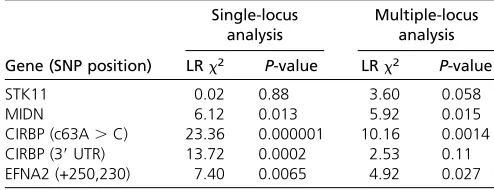
We therefore determined genotypes for a subset of markers in hatchling turtles from the genetic association study described above (i.e., 15 clutches). Simple logistic regression revealed thatCIRBPc63A.C was strongly associated with sex and that the strength of associations forflanking markers declined with distance fromCIRBPc63A.C (Table 2). We also used mul-tiple logistic regression (i.e., composite interval mapping) to test for associations while controlling for genotype at other loci (Table 2). Our original marker,CIRBPc63A.C, displayed a significant association with sex whileflanking markers were either not associated with sex (STK11, marker in CIRBP 39 UTR) or were weakly associated with sex (MIDN,EFNA2).
Finally, we used RNA-Seq data to test whether temperature affected expression of genesflankingCIRBP. Incubation tem-perature did not influence expression ofSTK11(F1,10= 0.4,
P= 0.54),ATP5D(F1,10= 0.5,P= 0.5), orMIDN(F1,10= 0.92,
P= 0.4) in embryonic gonads. However, we did observe small but significant temperature effects on expression ofc19orf24
(F1,10= 11.4,P= 0.007),EFNA2(F1,10= 10.8,P= 0.008), andCAMK4L(F1,10= 7.4,P= 0.02). Overall,c19orf24 expres-sion was slightly higher at 26.5°(mean = 28.760.5 RPKM,
n= 10) compared to 31°(mean = 26.160.5 RPKM,n= 10). Although expression ofCAMK4Lwas barely detectable, it was higher at 26.5°(mean = 2.1260.14 RPKM,n= 10) compared to 31°(mean = 1.60 60.14 RPKM, n= 10). In contrast, expression ofEFNA2was slightly higher at 31°(mean = 8.16 0.5 RPKM,n= 10) compared to 26.5°(mean = 5.860.5 RPKM,n= 10). When we usedCIRBPexpression as a covariate, temperature effects onc19orf24,EFNA2, andCAMK4L expres-sion were no longer significant. Conversely, temperature still had a strong effect on expression ofCIRBPeven when
c19orf24,EFNA2, orCAMK4Lwere used as covariates.
Discussion
Temperature-dependent sex determination is found in many reptiles and has been studied for several decades. Yet, the mech-anism underlying this mode of sex determination remains
obscure. Here we demonstrate, for the first time, genetic associations between a specific gene and sex in a TSD reptile. We provide multiple lines of evidence thatCIRBPis involved in determining gonad fate in the snapping turtle,C. serpentina. Significant associations betweenCIRBPgenotype and gonadal phenotype (sex determination) were detected in independent experiments at the individual, family, and population levels. Additional analyses of LD, genetic association, and expression offlanking genes suggest thatCIRBPc63A.C could be the causal variant or is close to it. In fact, CIRBPc63A.C was associated with sex while a second SNP within the 39UTR of
CIRBP(2200 bp downstream) was not associated with sex when tested via multiple logistic regression.
Moreover, expression of adjacent genes either was not affected by incubation temperature (STK11, ATP5D, and
MIDN) or was weakly affected by temperature (c19orf24,
EFNA2, andCAMK4L). Flanking genes not affected by tem-perature were on one side of CIRBP while weakly affected genes were on the other side of CIRBP, suggesting that the temperature effect on expression of adjacent genes was due to a shared chromatin domain rather than a direct tempera-ture effect. Such regional effects of chromatin structempera-ture are known to contribute to co-expression patterns of neighboring genes (Chenet al.2010). In agreement with this idea, adja-cent genes were not affected by temperature when CIRBP
expression was used as a covariate. The converse was not true. Together these observations indicate that temperature had a direct effect onCIRBPexpression and an indirect effect on adjacent genes.
We provide evidence that the association betweenCIRBP
CIRBP protein within developing turtle gonads. These data show that CIRBP is physically in a position to mediate tem-perature effects on the bipotential gonads. Protein expression patterns diverged after sex determination, suggesting that CIRBP may be involved in other aspects of ovary and testis development. For example, staining for CIRBP was pro-nounced in the cortex but was less intense in the medulla of differentiating ovaries. Given the consistency of the rela-tionship between genotype, transcript levels, and phenotype, we are confident that the association between theCIRBP ge-notype and gonadal sex is real.
Elevated expression ofCIRBPmay be involved in specifi -cation of ovarian fate in snapping turtles because it precedes the appearance of key granulosa cell markers. Independent experiments (short-term qPCR study, long-term qPCR study, and RNA-Seq study spanning both time frames) indicate that a slight, but significant, expression difference emerges 24 hr after a temperature shift from a male to a female tempera-ture. A twofold steady-state difference is established 48 hr after the shift to a female temperature (this study; Rhen and Schroeder 2010). We have previously shown that FoxL2 and aromatase genes are not induced until day 3 of the shift to a female-producing temperature (Rhenet al.2007). Granulosa cells, which derive from the coelomic epithelium in other species (Sawyer et al.2002; Mork et al.2012), are critical for steroid production and normal ovary development. We detected a significant genetic correlation between CIRBP
expression and sex ratio in siblings briefly exposed to 31° (Figure 3B). In contrast, aromatase expression during the shift was not correlated with sex ratio (Figure S4). These results indicate that CIRBP is upstream while aromatase andFOXL2are downstream effectors in the network for ovary determination. The increase inCIRBPexpression in embryos shifted to a female temperature also precedes a decline in Sox9 and PdgfB expression (testis-determining genes), which starts 3 days after the shift (Rhenet al.2007, 2009).
We do not know how differences in CIRBP expression influenced sex determination, but there are intriguing hints
from the literature. Proteins in the RRM family, which in-cludes CIRBP, regulate splicing and translation of target mRNAs involved in a range of biological processes. One of the best-characterized members of this family isSex-lethal, the master sex-determining gene inDrosophila melanogaster
(Salz 2011). SXL protein regulates splicing of Transformer
mRNA to produce female-specific Tra protein. In turn, Tra and its binding partner Tra2 (also RRM family members) regulate female-specific splicing of Doublesex mRNA. This splicing cascade is a shared feature of sex determination in insects (Salz 2011).
We hypothesize thatCIRBPmight play a similar regulatory role in RNA processing during sex determination in snapping turtles. Studies in other vertebrates show that CIRBPis in-volved in germ-cell development and reproduction (Elliot 2004; Xiaet al.2012). Paralogs ofCIRBPin humans include
TRA2a, TRA2b, RNA-binding motif protein 3 (RBM3), X-linked RNA-binding motif protein (RBMX), and the Y-linked RNA-binding motif protein family (RBMYs). In Xenopus, CIRBP displays nucleocytoplasmic shuttling and has distinct roles in each cellular compartment (Aoki et al.2002). Nu-clear CIRBP is associated with cell growth and differentiation (Lleonart 2010; Emmanuelet al.2011; Masudaet al.2012). In response to various environmental stressors, CIRBP moves from the nucleus to the cytoplasm where it associates with stress granules to regulate RNA metabolism (Yang and Carrier 2001; De Leeuwet al.2007). It would be particularly informa-tive to determine whether CIRBP interacts with transcripts from other sex-determining genes. For example, we recently reported that incubation temperature rapidly influences ex-pression and splicing ofWT1in snapping turtle embryos: the ratio of +KTS:2KTS isoforms is very precisely regulated in gonads (Rhenet al.2015).
Homozygotes for the A allele had higherCIRBPexpression than homozygotes for the C allele when shifted to 31°. As expected based on dosage, the A and C alleles in heterozygotes were expressed at about half the level of the corresponding homozygotes. There was also a significant association between Figure 7 Plot of linkage disequilibrium (r2)vs. hypotheti-cal distance among SNPs within the snapping turtle ge-nome. Physical distances among markers are based on the region of the painted turtle genome that containsCIRBP. Red diamonds indicate SNP pairs that display significant linkage disequilibrium in unrelated adult snapping turtles from Minnesota. Black diamonds indicate SNP pairs that are in linkage equilibrium. The black line is the regression ofr2vs.log
CIRBP genotype and hatchling sex: AA homozygotes were more likely to develop ovaries than AC heterozygotes, which, in turn, were more likely to develop ovaries than CC homozy-gotes. Turtles were nearly four times more likely to be female for each A allele they carried (Unit Odds Ratio = 3.9; 95% C.I. 2.1–8.3), which indicates a relatively strong effect on sex de-termination. We estimate that this SNP accounts for25% of the heritability for TSD pattern (T. Rhen, unpublished data). This association was not due to a structural change in CIRBP because sequence variants are synonymous. Polymorphisms in adjacent genes were synonymous or in noncoding regions, further indicating the association betweenCIRBPand sex results from a cis regulatory SNP. In short, temperature-dependent expression of the A allele appears to play a role in transducing high temperatures into a signal for ovary determination.
Whatever the molecular mechanism, the association be-tweenCIRBPgenotype and sex determination extends to the population level. A continent-wide cline in TSD pattern sug-gests that snapping turtles are genetically differentiated across their species range (Ewertet al.2005). Here we show that this cline is evident at smaller spatial scales: turtle pop-ulations separated by 3°latitude within Minnesota differ by 0.5°in their pivotal temperatures. IfCIRBPwere causally in-volved in TSD, we would expect variation in allele frequen-cies among populations due to a balance between geneflow and selection on TSD pattern. In accord with this prediction, two independent experiments using very different method-ologies (RNA-Seq of pooled samples and direct genotyping of individuals) revealed population differences inCIRBPallele frequencies. Moreover, the direction of the difference is con-sistent with the TSD pattern: the C allele (less responsive to feminization) was more common in the population with a higher pivotal temperature while the A allele (more respon-sive to feminization) was more common in the population with a lower pivotal temperature.
To the best of our knowledge, this is the first study to demonstrate genetic associations between a specific candi-date gene and gonadal sex within a TSD reptile. However, recent analysis of Dmrt1 evolution among species has revealed a relationship between a pair of amino acid changes and a
transition from TSD to GSD (Janeset al.2014). Evidence that
CIRBPplays a role in TSD spans multiple levels of biological organization: we present molecular, cellular, developmental, organismal, and population analyses supporting this hypoth-esis. RNA-binding proteins like CIRBP are capable of regulat-ing numerous mRNAs in a coordinated fashion (Bandziulis
et al.1989; Keene 2007) and play a role in sex determination in other organisms. Taken together, the data described here suggest that CIRBP is involved in transducing temperature into a molecular signal for ovaryvs.testis determination in the snapping turtle. Further research is required to experi-mentally test whether CIRBP actually mediates temperature effects on sex determination. The ultimate test will involve manipulation ofCIRBPexpression and gonad development at male- and female-producing temperatures. WhileCIRBP ex-plains substantial variation in thermosensitive sex determi-nation (25% of the heritability for gonadal sex), additional genes must be involved in sensing temperature because there was not perfect concordance between genotype and sex. This observation provides the first suggestion that TSD is poly-genic. The current study also provides proof of principle that genome-wide association studies could be used to identify other TSD genes and unravel the genetic architecture of this unusual mode of sex determination. WhetherCIRBPplays a role in TSD in other species remains an open question.
Acknowledgments
We thank the Minnesota Department of Natural Resources for permits to collect turtle eggs and adults; Jeffrey W. Lang for collecting eggs near Pipestone, Minnesota; Dane A. Crossley for providing turtles from Texas; Jeffrey W. Lang, Manu, and two anonymous reviewers for constructive comments on an earlier version of the manuscript; Hugo’s supermarkets for donating produce to feed adult turtles; and Mr. Jamie McWalter for access to his property to keep adult turtles in seminatural conditions. Support for this work came from National Institute of Child Health and Human Development grant 5R21HD049486; National Science Foundation (NSF) award IBN IOS-0923300; NSF award DBI-0959369; NSF award IBN IOS-1558034; and a Biology Department Research Committee award to T. Rhen. A. Schroeder was supported by NSF EPSCoR Doctoral Disser-tation Award #EPS-0814442. A. Miller was supported by North Dakota EPSCoR Advanced Undergraduate Research Award #0923300.
Literature Cited
Anderson, J. L., M. A. Rodriquez, I. Braasch, A. Amores, P. Hohenlohe
et al., 2012 Multiple sex-associated regions and a putative sex chromosome in zebrafish revealed by RAD mapping and popula-tion genomics. PLoS One 7: e40701.
Aoki, K., Y. Ishii, K. Matsumoto, and M. Tsujimoto, 2002 Methylation of Xenopus CIRP2 regulates its arginine- and glycine-rich region-mediated nucleocytoplasmic distribution. Nucleic Acids Res. 30: 5182–5192.
Table 2 Association of SNPs and sex in hatchling snapping turtles exposed to 31° for 2.5 days during the TSP (15 clutches, 248 hatchlings)
Single-locus analysis
Multiple-locus analysis Gene (SNP position) LRx2 P-value LRx2 P-value
STK11 0.02 0.88 3.60 0.058
MIDN 6.12 0.013 5.92 0.015
CIRBP (c63A.C) 23.36 0.000001 10.16 0.0014
CIRBP (39UTR) 13.72 0.0002 2.53 0.11
EFNA2 (+250,230) 7.40 0.0065 4.92 0.027
Bachtrog, D., J. E. Mank, C. L. Peichel, M. Kirkpatrick, S. P. Otto
et al., 2014 Sex determination: Why so many ways of doing it? PLoS Biol. 12: e1001899.
Bandziulis, R. J., M. S. Swanson, and G. Dreyfuss, 1989 RNA-binding proteins as developmental regulators. Genes Dev. 3: 431–437. Bull, J. J., 1983 Evolution of Sex Determining Mechanisms.
Benjamin-Cummings, Menlo Park, CA.
Bull, J. J., 1987 Temperature-sensitive periods of sex determina-tion in a lizard: similarities with turtles and crocodiles. J. Exp. Zool. 241: 143–148.
Bull, J. J., R. C. Vogt, and M. G. Bulmer, 1982 Heritability of sex ratio in turtles with environmental sex determination. Evolution 36: 333–341.
Burke, R. L., and A. M. Calichio, 2014 Temperature-dependent sex determination in the diamond-backed Terrapin (Malaclemys terrepin). J Herp 48: 466–470.
Chen, W. H., J. de Meaux, and M. J. Lercher, 2010 Co-expression of neighboring genes in Arabidopsis: separating chromatin ef-fects from direct interactions. BMC Genomics 11: 178. Congdon, J. D., G. L. Breitenbach, R. C. Van Loben Sels, and D. W.
Tinkle, 1987 Reproduction and nesting ecology of snapping turtles (Chelydra serpentina) in southeastern Michigan. Herpe-tologica 43: 39–54.
Conover, D. O., and S. W. Heins, 1987 Adaptive variation in en-vironmental and genetic sex determination in a fish. Nature 326: 496–498.
Cordell, H. J., and D. G. Clayton, 2005 Genetic association stud-ies. Lancet 366: 1121–1131.
Crews, D., and J. J. Bull, 2009 Mode and tempo in environmental sex determination in vertebrates. Semin. Cell Dev. Biol. 20: 251–255. Deeming, D. C., 2004 Prevalence of TSD in crocodilians, pp. 33–
41 inTemperature-Dependent Sex Determination in Vertebrates, edited by N. Valenzuela, and V. Lance. Smithsonian Institution Press, Washington, D.C.
De Leeuw, F., T. Zhang, C. Wauquier, G. Huez, V. Kruys et al., 2007 The cold-inducible RNA binding protein migrates from the nucleus to cytoplasmic stress granules by a methylation de-pendent mechanism and acts as a translational repressor. Exp. Cell Res. 313: 4130–4144.
Dreyfuss, G., V. N. Kim, and N. Kataoka, 2002 Messenger-RNA-binding proteins and the messages they carry. Nat. Rev. Mol. Cell Biol. 3: 195–205.
Elliot, D. J., 2004 The role of potential splicing factors including RBMY, RBMX, hnRNPG-T and STAR proteins in spermatogene-sis. Int. J. Androl. 27: 328–334.
Emmanuel, C., N. Gava, C. Kennedy, R. L. Balleine, R. Sharmaet al., 2011 Comparison of expression profiles in ovarian epithelium in vivo and ovarian cancer identifies novel candidate genes in-volved in disease pathogenesis. PLoS One 6: e17617.
Ewert, M. A., D. R. Jackson, and C. E. Nelson, 1994 Patterns of temperature-dependent sex determination in turtles. J. Exp. Zool. 270: 3–15.
Ewert, M. A., C. Etchberger, and C. E. Nelson, 2004 Turtle sex-determining modes and TSD patterns, and some TSD pattern correlates, pp. 21–32 inTemperature-Dependent Sex Determina-tion in Vertebrates, edited by N. Valenzuela, and V. Lance. Smithsonian Institution Press, Washington, D.C.
Ewert, M. A., J. W. Lang, and C. E. Nelson, 2005 Geographic variation in the pattern of temperature-dependent sex determi-nation in the American snapping turtle (Chelydra serpentina). J. Zool. (Lond.) 265: 81–95.
Fisher, R. A., 1950 Gene frequencies in a cline determined by selection and diffusion. Biometrics 6: 353–361.
Gagneur, J., O. Stegle, C. Zhu, P. Jakob, M. M. Tekkedil et al., 2013 Genotype-environment interactions reveal causal path-ways that mediate genetic effects on phenotype. PLoS Genet. 9: e1003803.
Georges, A., T. Ezaz, A. E. Quinn, and S. D. Sarre, 2010 Are reptiles predisposed to temperature-dependent sex determina-tion? Sex Dev. 4: 7–15.
Haldane, J. B. S., 1948 The theory of a cline. J. Genet. 48: 277– 284.
Harlow, P. S., 2004 Temperature-dependent sex determination in lizards, pp. 42–52 inTemperature-Dependent Sex Determina-tion in Vertebrates, edited by N. Valenzuela, and V. Lance. Smithsonian Institution Press, Washington, D.C.
Hattori, R. S., Y. Murai, M. Oura, S. Masuda, S. K. Majhi et al., 2012 A Y-linked Anti-Mullerian hormone duplication takes over a critical role in sex determination. Proc. Natl. Acad. Sci. USA 109: 2955–2959.
Holleley, C. E., D. O’Meally, S. D. Sarre, J. A. Marshall Graves, T. Ezazet al., 2015 Sex reversal triggers the rapid transition from genetic to temperature-dependent sex. Nature 523: 79–82. Ioannidis, J. P. A., P. Boffetta, J. Little, T. R. O’Brien, A. G. Uitterlinden
et al., 2008 Assessment of cumulative evidence on genetic asso-ciations: interim guidelines. Int. J. Epidemiol. 37: 120–132. Janes, D. E., C. L. Organ, and S. V. Edwards, 2010 Variability in
sex-determining mechanisms influences genome complexity in reptilia. Cytogenet. Genome Res. 127: 242–248.
Janes, D. E., C. L. Organ, R. Stiglec, D. O’Meally, S. D. Sarreet al., 2014 Molecular evolution ofDmrt1accompanies change of sex-determining mechanisms in reptilia. Biol. Lett. 10: 20140809. Janzen, F. J., 1992 Heritable variation for sex ratio under
envi-ronmental sex determination in the common snapping turtle (Chelydra serpentina). Genetics 131: 155–161.
Jiang, H., and W. H. Wong, 2009 Statistical inferences for isoform expression in RNA-Seq. Bioinformatics 25: 1026–1032. Kamiya, T., W. Kai, S. Tasumi, A. Oka, T. Matsunagaet al., 2012 A
trans-species missense SNP inAmhr2associated with sex deter-mination in the tiger pufferfish,Takifugu rubripes(Fugu). PLoS Genet. 8: e1002798.
Keene, J. D., 2007 RNA regulons: coordination of post-transcriptional events. Nat. Rev. Genet. 8: 533–543.
Knight, J. C., B. J. Keating, K. A. Rockett, and D. P. Kwiatkowski, 2003 In vivo characterization of regulatory polymorphisms by allele-specific quantification of RNA polymerase loading. Nat. Genet. 33: 469–475.
Kolbe, J. J., and F. J. Janzen, 2002 Impact of nest site selection on nest success and nest temperature in natural and disturbed hab-itats. Ecology 83: 269–281.
Konczal, M., P. Koteja, M. T. Stuglik, J. Radwan, and W. Babik, 2013 Accuracy of allele frequency estimation using pooled RNA-Seq. Mol. Ecol. Resour. 14: 381–392.
Lang, J. W., and H. V. Andrews, 1994 Temperature-dependent sex determination in crocodilians. J. Exp. Zool. 270: 28–44. Lewis, C. M., and J. Knight, 2012 Introduction to genetic
associ-ation studies. Cold Spring Harb. Protoc. 2012: 297–306 Li, B., V. Ruotti, R. M. Stewart, J. A. Thomson, and C. N. Dewey,
2010 RNA-Seq gene expression estimation with read mapping uncertainty. Bioinformatics 26: 493–500.
Liu, Y., W. Hu, Y. Murakawa, J. Yin, G. Wanget al., 2013 Cold-induced RNA-binding poteins regulate circadian gene expression by controlling alternative polyadenylation. Sci. Rep. 3: 2054. Lleonart, M. E., 2010 A new generation of proto-oncogenes:
cold-inducible RNA binding proteins. Biochim. Biophys. Acta 1805: 43–52. Maris, C., C. Dominguez, and F. H. Allain, 2005 The RNA recog-nition motif, a plastic RNA-binding platform to regulate post-transcriptional expression. FEBS J. 272: 2118–2131.
Masuda, T., K. Itoh, H. Higashitsuji, N. Nakazawa, T. Sakuraiet al., 2012 Cold-inducible RNA-binding protein (Cirp) interacts with Dyrk1b/Mirk and promotes proliferation of immature male germ cells in mice. Proc. Natl. Acad. Sci. USA 109: 10885–10890. Merchant-Larios, H., and V. Díaz-Hernández, 2013 Environmental