Water Quality Measurement System with
Wireless Sensor Networking
V. S. Kale1, R. K. Deshmukh2
Vice principal, K.T.H.M. College, Nashik, Maharashtra, India1
M. Phil Student, K.T.H.M College, Nashik, Maharashtra, India2
ABSTRACT: Water pollution is one of the key threats for the green globalization. In earlier days, the water pollution
was detected by chemical test or laboratory test by using this system the testing equipment will be in stationary and samples will be given to testing equipment. Quality of water can be predicted using various parameters. Basically two kinds of impurities are present into water. Suspended impurities and dissolved impurities. Water quality can be decided using different parameters like pH, Dissolved Oxygen [DO], Total Dissolved Solid and many more. pH and DO are the recommended parameter to be measured for deciding a quality of water at the fish farm. Considering such theory, author(s) present an application of wireless network. Application required sensor module for sensing a required data, wireless module for data transmission through radio channel and a gateway module as monitoring centre. This project proposes a Sensor-Based Water Pollution Detection, which will detect the pollutant present in the water. The sensor pH, turbidity and DO will be kept at any water surface and the data captured by the sensor will be given to Arduino UNO, then the data are transmitted wirelessly using Zigbee module after calculating the inference from the sensed data. The uniqueness of authors proposed paper is to obtain the water monitoring system with high pervasiveness, high mobility at low powered.
KEYWORDS: Green globalization, impurities, pH, DO, turbidity, wireless network, Zigbee module, Wireless
transmission etc
I. INTRODUCTION
Water pollution is one of the key threats for the green globalization. To prevent the water pollution, first we have to detect the pollutant. There are various sensors which include pH, turbidity, conductivity and temperature sensor for such parameter detections [1]. Routinely monitored parameters of water quality are temperature, pH, turbidity, conductivity, dissolved oxygen (DO), Chemical Oxygen Demand (COD), biochemical oxygen demand (BOD), ammonia nitrogen, nitrate, nitrite, phosphate, various metal ions and so on[7]. Traditional methods that are not only costly but also lack capability for real-time data capture, analyses and fast dissemination of information [3].
In order to increase the pervasiveness, testing equipment can be placed in the river water and detection of pollution can be made remotely [5]. It's very important to conduct research on underwater sensor networks because they can benefit many areas of science and industry such as water quality monitoring, ocean graphic data collection, disaster detection and prevention, oilfield monitoring, etc [6]. With the rapid development of the economy, more and more serious problems arises in the environment, water pollution is one among them [7].
So, author decided to present such a system that will perform the same task with very low and affordable cost. The system proposed for the same is Water Quality Measurement System with Wireless Sensor Networking as entitled above.
II. LITERATURE SURVEY
data acquisition module and information transmission module [1]. Water quality can be decided using different parameters like pH, Dissolved Oxygen [DO], Total Dissolved Solid and many more. pH and DO are the recommended parameter to be measured for deciding a quality of water [8]. It's very important to conduct research on underwater sensor networks because they can benefit many areas of science and industry [7]. Traditional methods- collect the samples manually and then send them to laboratory for analysis, rely on collecting water samples, testing and analyses in water laboratories are not only costly but also lack capability for real-time data capture, analyses and fast dissemination of information to relevant stakeholders for making timely and informed decisions [3]. Water is a limited resource and essential for agriculture, industry and creatures existence on earth including human beings [6]. Hence, author proposes a system as entitled above.
III. PROPOSED SYSTEM
Proposed system required sensor module for sensing a required data, wireless module for data transmission through radio channel and a gateway module as monitoring center. This project proposes a Sensor-Based Water Pollution Detection, which will detect the pollutant present in the water. The sensor pH, turbidity and DO will be kept at any water surface and the data captured by the sensor will be given to Arduino UNO, then the data are transmitted wirelessly using Zigbee module after calculating the inference from the sensed data.
Fig 1: Calibration of sensors
(Transmitting section)
Fig 3: Block diagram of “Water Quality Measurement System with Wireless Sensor Networking”
(Receiving section)
Fig 2. and Fig 3. shows transmitting and receiving sections of block diagram of Water Quality Measurement System with Wireless Sensor Networking respectively. In fig 2, transmitting section, we used different sensors to sens desired parameters. Their output will be given to arduino development board and after comparing this output to their threshold levels, final output will be shown on monitoring screen. We also used a Zigbee module so that wireless data transmission is possible. This data will be received using Zigbee receiver and will be given to owner/user of the system.
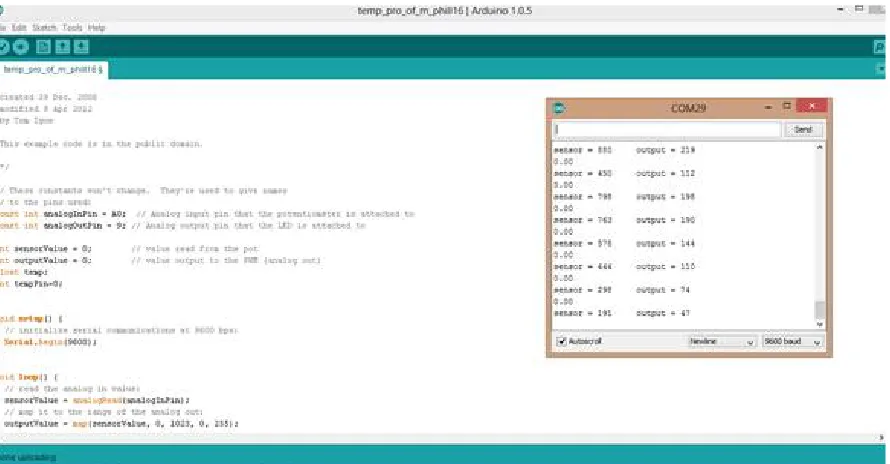
Fig 4: Displaying real time output on screen using Arduino Uno hardware and software.
IV. PROPOSED ALGORITHM AND FLOWCHART
Proposed Algorithm:
1. Start
2. Initialize sensors
DS18B20 Programmable Resolution 1-Wire Digital Thermomete: WQ201 pH Sensor
WQ-FDO Optical Dissolved Oxygen Sensor
Convert analog input into digital (used inbuilt ADC) using microcontroller (ATmega328)
3. Check the sensed parameters using respective sensors used .
4. If these parameters are less/greater/different than threshold values (desired values) then report it to the user.
5. If system is externally OFF, then, stop the system, else repeat step 2.
Above is the flowchart for Water Quality Measurement System with Wireless Sensor Networking. Stepwise, it will perform detection of parameters, comparison, displaying the same values and repeating the same. The system will be OFF when it is externally switched off.
V. RESULT
Using this system the user/owner of the system will get to know the status of different parameters of water like temperature, turbidity and pH etc.
Sr.no. Temperature0C Sensor output [mv]
1 30 210.3mv
2 35 212.0mv
3 40 212.1mv
4 45 212.5mv
5 50 213.2mv
6 55 213.7mv
7 60 214.6mv
8 65 215.7mv
9 70 216.7mv
10 75 217.9mv
Likewise, different parameters can also be detected, measured and compared. When these parameters are compared using hardware then it will be displayed on monitoring screen. Wireless transmission of data is possible using Zigbee module. Hence data can be seen over a long distance according to data transmission range of respective Zigbee module. Hence we/user(s) will get to know whether the water that we are using is usable or not! This system is beneficial considering health, economy and applicability of user.
VI. CONCLUSION
Water quality monitoring is essential to control physical, chemical anti-biological characteristics of water. Using “Water Quality Measurement System with Wireless Sensor Networking” we can measure the quality of water and many diseases, infections and microbial growth can be controlled, measured and monitored. And as it costs less than any other systems available, it is affordable, user friendly and easy to repair because it is having simple design.
REFERENCES
1] Akanksha Purohit, “Design and Implementation of Real Time System for Water Quality Measurement Using GSM”, IJARCSMS, Volume 2, Issue 1, January 2014, page 223-226.
2] R. Balaji , R. Ganesan, “Remote Water Pollution Monitoring System Using GSM”,Proc, of the Conf. on ACEEE.
3] Anthony Faustine, “Wireless Sensor Networks for Water Quality Monitoring and Control within Lake Victoria Basin: prototype development”, December 2014, SciRes: http://www.scirp.org/journal/wsn
4] Shruti Sridharan,’ ,Water Quality Monitoring System Using Wireless Sensor Network”, (IJARECE) Volume 3, Issue 4, April 2014. 5] Ms. Amruta Boyne, H. N. Kulkarni, “Build out of Embedded PLC for Water Quality Monitoring”, IJSTE, Volume 1, Issue 12, june 2015. 6] Feng Zhang , “Underwater Sensor Networks for Water Quality Monitoring”,
7] K.Rajasekar , “Measurement and Analysis of water quality using GSM”. IJATES, Volume No. 3, Issue No. 3, March 2015. 8] Nirav M Parmar, Rahul S. Goradia , “IEEE 802.15.4 Based Water Quality Monitoring System”.IJARIIE,Vol 1, Issue 2, 2015 9] www.arduino.com
10] http://www.alldatasheet.com/view.jsp?searchword=CC2500.
BIOGRAPHY
Rashmi Kishor Deshmukh,