Explicit positive representation for complex weights on
R
dBła˙zejRuba1,,and AdamWyrzykowski1,
1Jagiellonian University, Łojasiewicza 11, 30-348 Kraków, Polska
Abstract.It is an old idea to replace averages of observables with respect to a complex weight by expectation values with respect to a genuine probability measure on com-plexified space. This is precisely what one would like to get from complex Langevin simulations. Unfortunately, these fail in many cases of physical interest. We will de-scribe method of deriving positive representations by matching of moments and show simple examples of successful constructions. It will be seen that the problem is greatly underdetermined.
1 Introduction
Numerical simulations involving Monte Carlo methods are only possible if averages with respect to genuine probability distributions are to be computed. This fact prevents lattice calculations in theories defined by complex effective actions, including QCD at finite chemical potential. In [1,2] it was
proposed that probability distribution could be constructed by setting up a stochastic process on com-plexification of the integration manifold - the idea known as the complex Langevin approach. It was speculated that the simulation time average of this process converges to the correct value of the path integral, in analogy with the real Langevin dynamics. In [3–5] arguments for this were presented. Unfortunately, in applications [6–9] many difficulties were encountered. In particular convergence
to wrong results was occasionally observed. Much effort was put it understanding these phenomena
[10–15], but complete picture is not available until today. Nevertheless, it is known that probabilistic representations of complex measures exist under mild assumptions. Some constructions were pre-sented in [16–23]. In [24] representations of a class of measures on compact group manifoldsU(1)d
were constructed using Fourier techniques. In this work we extend this method to distributions on real vector spacesRd. In Section2we explain the general strategy. It is based on directly solving the matching conditions, which express compatibility of probabilistic measure with given complex weight. For simplicity of presentation we start from the case of one degree of freedom. Then we discuss the issue of imposing positivity of constructed distributions. Large underdeterminacy of the problem is exploited by choosing an ansatz for the solution of matching conditions which leads to particularly simple final formula. It turns out that positive measure can be expressed by the Fourier transform of the complex weight continued to complex wave vectors. We show that for weights de-creasing at infinity sufficiently rapidly this continuation exists. Moreover our construction defines an
Speaker, e-mail: [email protected]
analytic function decreasing rapidly at infinity. Subsection2.4contains a brief discussion of distribu-tions on compact group manifolds. In Section3we discuss examples. Extension to larger number of variables is described in Section4. We summarize in Section5.
2 Construction of positive representations
2.1 Matching conditionsIn what follows we assume that a complex weightρonRd is given and ask whether it is possible to construct a probability distribution functionPonCd = R2d such that for some class of analytic functionsOwe have
Oρ≡
Rdddtρ(t)O(t)
Rdddtρ(t) =
R2dd
dxddyP(x, y)O(x+iy)≡ O
P. (1)
In other words, it is required that expectation values of observables with respect to the two distribu-tions agree. First we will consider the case of one degree of freedom and then generalize the results to larger number of variables. Note that it is formally sufficient to consider polynomial observables,
i.e. impose equality of moments
tk
ρ(t)=
(x+iy)k
P(x,y). (2)
If this condition is satisfied, (1) follows from Taylor-expandingO(t) and applying (2) term by term. For this argument to be correct it is required to justify that we can interchange infinite summation involved in Taylor expansion ofO(t) with integration. This point will be addressed later.
In order to solve the moment matching condition (2) we introduce polar coordinates (r, θ) inR2= {(x, y)}and perform Fourier transformation in angular direction only:
P(r, θ)= 1
2π
∞
k=−∞
Pk(r)eikθ, (3)
whereP−k(r)=Pk(r)∗by assumed reality ofP(r, θ). Equation (2) is then equivalent to
∞
0 dr P−k(r)r
k+1=tk
ρ(t), k≥0. (4)
Clearly this system is greatly underdetermined - we have a countably infinite family of arbitrary functionsPk(r), each subject to one linear constraint.
2.2 Conditions for positivity
Solving the matching conditions using Fourier transformation introduces additional difficulty - it is in
general difficult to decide whether a function given by Fourier series is positive. Abstract
character-ization is provided by Bochner’s theorem [25], but checking whether its assumptions are satisfied is intractable in practice. Therefore it is desirable to find less general, but simpler criteria.
Our construction is based on the observation that in the sum (3) only the lowest (k=0) term can
be positive everywhere. Therefore we anticipate that it should be the largest one if the whole sum is to be positive. This can be made more precise as follows. For nonnegativeP(r, θ) we have|Pk(r)| ≤P0(r)
for allk:
|Pk(r)|=
2π
0 dθe
−ikθP(r, θ) ≤
2π
0 dθP(r, θ)
analytic function decreasing rapidly at infinity. Subsection2.4contains a brief discussion of distribu-tions on compact group manifolds. In Section3we discuss examples. Extension to larger number of variables is described in Section4. We summarize in Section5.
2 Construction of positive representations
2.1 Matching conditionsIn what follows we assume that a complex weightρonRd is given and ask whether it is possible to construct a probability distribution functionPonCd = R2d such that for some class of analytic functionsOwe have
Oρ≡
Rdddtρ(t)O(t)
Rdddtρ(t) =
R2dd
dxddyP(x, y)O(x+iy)≡ O
P. (1)
In other words, it is required that expectation values of observables with respect to the two distribu-tions agree. First we will consider the case of one degree of freedom and then generalize the results to larger number of variables. Note that it is formally sufficient to consider polynomial observables,
i.e. impose equality of moments
tk
ρ(t)=
(x+iy)k
P(x,y). (2)
If this condition is satisfied, (1) follows from Taylor-expandingO(t) and applying (2) term by term. For this argument to be correct it is required to justify that we can interchange infinite summation involved in Taylor expansion ofO(t) with integration. This point will be addressed later.
In order to solve the moment matching condition (2) we introduce polar coordinates (r, θ) inR2= {(x, y)}and perform Fourier transformation in angular direction only:
P(r, θ)= 1
2π
∞
k=−∞
Pk(r)eikθ, (3)
whereP−k(r)=Pk(r)∗by assumed reality ofP(r, θ). Equation (2) is then equivalent to
∞
0 dr P−k(r)r
k+1 =tk
ρ(t), k≥0. (4)
Clearly this system is greatly underdetermined - we have a countably infinite family of arbitrary functionsPk(r), each subject to one linear constraint.
2.2 Conditions for positivity
Solving the matching conditions using Fourier transformation introduces additional difficulty - it is in
general difficult to decide whether a function given by Fourier series is positive. Abstract
character-ization is provided by Bochner’s theorem [25], but checking whether its assumptions are satisfied is intractable in practice. Therefore it is desirable to find less general, but simpler criteria.
Our construction is based on the observation that in the sum (3) only the lowest (k=0) term can
be positive everywhere. Therefore we anticipate that it should be the largest one if the whole sum is to be positive. This can be made more precise as follows. For nonnegativeP(r, θ) we have|Pk(r)| ≤P0(r)
for allk:
|Pk(r)|=
2π
0 dθe
−ikθP(r, θ) ≤
2π
0 dθP(r, θ)
=P0(r). (5)
In particular,P0(r) is nonnegative everywhere. Therefore the triangle inequality implies that
P(r, θ)≥21πP0(r)−21π
k0
|Pk(r)|. (6)
Hence for positivity ofP(r, θ) it is sufficient that we have an estimate
∞
k=−∞
|Pk(r)| ≤P0(r). (7)
In what follows we will impose this condition.
2.3 Our ansatz
There is large freedom in choosing the coefficient functionsPk(r). It should be used to simplify the
problem. It will be seen later that the following ansatz achieves this goal:
P0(r)=c0exp(−σ0r2), (8a)
Pk(r)=ckr|k|exp(−σr2), k0, (8b)
where 0< σ0 < σare free parameters andck=c∗−kare to be determined from the moment matching
condition. This leads to
ck= 2σ k+1
k!
tk∗
ρ(t), k≥0. (9)
DistributionP(r, θ) takes the form
P(r, θ)=σ0
π e
−σ0r2+2σ
π e
−σr2∞
k=1 Re 1 k!
σre−iθtk
ρ(t)
. (10)
Now suppose that it is correct to interchange the infinite summation overkwith averaging with respect toρ(t). Then the summation can be performed for anyρ(t), leading to
P(r, θ)=σ0
π e
−σ0r2+2σ
π e
−σr2
Re expσre−iθt−1ρ(t). (11)
Probability distributionPis expressed in terms of the Fourier transform of ρextended to complex arguments.
We have been rather cavalier about mathematical correctness of manipulation performed so far. We will now work out a set of conditions for which they are under control. First note that the average with respect toρin (11) is unambiguously defined only ifρdecreases fast at infinity. It is sufficient if |ρ(t)| ≤Ce−α|t|1+
for some positive constantsC, α, . Under this assumption the integral is sufficiently
well behaved that it is correct to differentiate under the integral sign, hence we see explicitly thatPis
an analytic function ofx, y. We still need to chooseσ, σ0in such a way thatPdecreases at infinity
and is positive everywhere. We will do this assuming that ≥1. Moreover we take (without loss of generality)Z= dtρ(t)=1. Then moments ofρcan be estimated by
tk
ρ(t)≤
CΓk+21
hence fork>0 we have
|Pk(r)|
P0(r) ≤ C
α
Γk+21 k!
σ σ0
σr
α
k
e−(σ−σ0)r2. (13)
Forσ > σ0 the right hand side is a bounded function ofr. Replacing it by its maximum value we
obtain
|Pk(r)|
P0(r) ≤ C
α
Γk+21 k!
σ
σ0
σ2k
2eα2(σ−σ0) k
2
. (14)
From this inequality and properties of the Gamma function it follows that
k0 |Pk(r)|
P0(r) ≤
4√πC
α σ σ0
∞
k=1 kk2 Γk+22
σ
8α2e(1−σ0 σ)
k 2
. (15)
For fixedσ0
σ <1 and sufficiently smallσthe series on the right hand side converges absolutely. Hence
it defines an analytic function of√σwith Taylor expansion starting at the linear term. Therefore it can be made as small as one wishes if sufficiently smallσis chosen. Criteria derived in previous section show that this is sufficient for positivity ofP. Moreover we see that there exist positive constants
0<a<Asuch that
aP0(r)≤P(r, θ)≤AP0(r). (16)
Estimates for|P(r, θ)|and|Pk(r, θ)|derived so far are sufficiently strong to justify the interchange of
sums and integrals performed to derive (11). Hence (2) is satisfied. Moreover for functions of the form
O(t)= ∞
k=0
Oktk (17)
we see from (12) that for correctness of interchanging the order of summation overkand averaging with respect toρandP(and hence for (1)) it is sufficient that the coefficientsOksatisfy
∞
k=0
Γk+21|Ok|
αk <∞. (18)
2.4 Distributions on compact group manifolds
The reasoning leading to (11) can be performed also for distributionsρ(t) on toriiU(1)d. In this case
a probabilistic measureP(x, y) on complexified manifoldU(1)d×Rdcan be represented as
P(x, y)= 1
(2π)d
k∈Zd Pk(y)ei
k·x
, (19)
where the coefficient functionsPn(y)=P−n(y)∗satisfy the moment matching conditions
Rdd
dyP
k(y)e k·y
=
e−ik·t
ρ(t). (20)
Several proposals forPn(y) were explored in [24]. In particular it was found thatP(x, y) can be chosen
as a convolution of weightρ(t) with a smoothing kernel on U(1)d. Generalization to nonabelian
hence fork>0 we have
|Pk(r)|
P0(r) ≤ C
α
Γk+21 k! σ σ0 σr α k
e−(σ−σ0)r2. (13)
Forσ > σ0the right hand side is a bounded function ofr. Replacing it by its maximum value we
obtain
|Pk(r)|
P0(r) ≤ C
α
Γk+21 k!
σ
σ0
σ2k
2eα2(σ−σ0) k
2
. (14)
From this inequality and properties of the Gamma function it follows that
k0 |Pk(r)|
P0(r) ≤
4√πC
α σ σ0 ∞ k=1 kk2 Γk+22
σ
8α2e(1−σ0 σ)
k 2
. (15)
For fixedσ0
σ <1 and sufficiently smallσthe series on the right hand side converges absolutely. Hence
it defines an analytic function of√σwith Taylor expansion starting at the linear term. Therefore it can be made as small as one wishes if sufficiently smallσis chosen. Criteria derived in previous section show that this is sufficient for positivity of P. Moreover we see that there exist positive constants
0<a<Asuch that
aP0(r)≤P(r, θ)≤AP0(r). (16)
Estimates for|P(r, θ)|and|Pk(r, θ)|derived so far are sufficiently strong to justify the interchange of
sums and integrals performed to derive (11). Hence (2) is satisfied. Moreover for functions of the form
O(t)= ∞
k=0
Oktk (17)
we see from (12) that for correctness of interchanging the order of summation overkand averaging with respect toρandP(and hence for (1)) it is sufficient that the coefficientsOksatisfy
∞
k=0
Γk+21|Ok|
αk <∞. (18)
2.4 Distributions on compact group manifolds
The reasoning leading to (11) can be performed also for distributionsρ(t) on toriiU(1)d. In this case
a probabilistic measureP(x, y) on complexified manifoldU(1)d×Rdcan be represented as
P(x, y)= 1
(2π)d
k∈Zd Pk(y)ei
k·x
, (19)
where the coefficient functionsPn(y)=P−n(y)∗satisfy the moment matching conditions
Rdd
dyP
k(y)e k·y
=
e−ik·t
ρ(t). (20)
Several proposals forPn(y) were explored in [24]. In particular it was found thatP(x, y) can be chosen
as a convolution of weightρ(t) with a smoothing kernel on U(1)d. Generalization to nonabelian
compact groups is also possible, see e.g. [18].
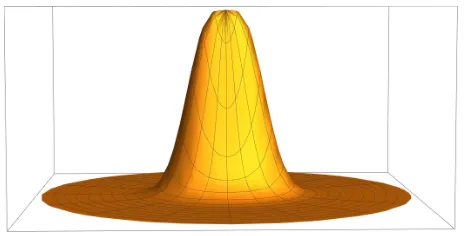
Figure 1.Positive representation of a complex gaussian.
3 Examples
3.1 Gaussian weights
As a first example we choose complex gaussiansρ(t)=e−λt2,λ=λR+iλI. Then (11) leads to
P(r, θ)=σ0
πe
−σ0r2+2σ
π e
−σr2
Re
exp
σ2r2e2iθ
4λ
−1
. (21)
Plot ofP(r, θ) forλ = 12+i,σ0 = 14,σ= 25 is presented in Fig. 1. The limit Argλ → ±π2 converges
and moments ofρare properly reproduced also in this case. This is in contrast with the positive representation found in [26] using the complex Langevin method,
P(r, θ)=Ne−2(1+q2)λRr2 ∞
n=−∞
ein(2θ+ψ)I n
2q
λRr2
sinψ
=Ne−2λR(x2+2qxy+(1+2q2)y2), (22)
whereq=cotψ= λRλI,N= 2λR √
1+q2
π . This distribution is an example of a positive representation not
satisfying (7).
3.2 Exponential of a monomial
Now we considerρ(t)=e−λt4. Equation (11) gives
P(r, θ)=σ0
π e
−σ0r2+2σ
π e
−σr2
Re
0F2
1 2 34
; ζ2 256
−1+Γ
3 4
ζ
2Γ140F2
5 4 32
; ζ2
256, (23)
whereζ= σ2r√2e2iθ
λ and0F2
b1b2;z
is the generalized hypergeometric function:
pFq
a1 ... ap b1 ... bq;z
=
∞
k=0
a1(a1+1)...(a1+k−1)...ap(ap+1)...(ap+k−1)
b1(b1+1)...(b1+k−1)...bq(bq+1)...(bq+k−1)
zk
k!. (24)
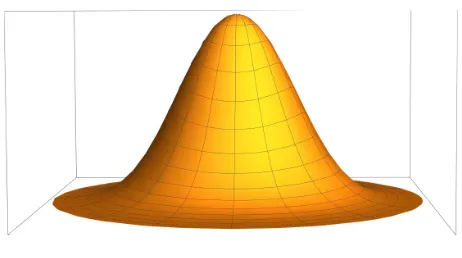
DistributionP(r, θ) is presented in Fig.2. This calculation extends without further difficulties to
expo-nentials of higher degree monomials, the only difference being that in this case higher hypergeometric
functionspFq
a1...ap
b1...bq;z
Figure 2.Positive representation of an exponential of a quartic monomial.
Figure 3.Positive representation of an exponential ofρ(t)=exp−it−12t2+it3−t4.
It is interesting to see what happens for the weightρ(t) = eit33. Its moments are defined using
regularization: we multiplyρ(t) by a test functionφ(t) such thatφ(0) =1. It is required thatφis
smooth and vanishes at infinity together with all its derivatives faster than any power of 1
t. Then we
take the limit → 0. The result is finite and doesn’t depend on the choice ofφ. This can be seen
by repeatedly using the identity −ie−it
t2+1 ddteitρ(t) =ρ(t) and integrating by parts. Each steps makes the
integrand better behaved at infinity due to powers of 1
t2+1. After this is done sufficiently many times
the limit→0 can be taken under the integral and dependence onφdisappears. The average in (11)
is divergent forθ±π
2. Analytic continuation from this line to whole plane yields
P(r, θ)= σ0
π e
−σ0r2+ σ
πAi(0)e−
σr2
Aiiσreiθ+Ai−iσre−iθ−2Ai(0), (25)
where Ai is the Airy function and Ai(0) = 1
323Γ(23) is its value at 0. Direct computation shows that
the moment matching condition (2) is satisfied. Moreover the procedure described above turns out to be equivalent to deforming the contour of integration in complextplane to makeρ(t) exponentially
Figure 2.Positive representation of an exponential of a quartic monomial.
Figure 3.Positive representation of an exponential ofρ(t)=exp−it−12t2+it3−t4.
It is interesting to see what happens for the weightρ(t) = eit33. Its moments are defined using
regularization: we multiplyρ(t) by a test functionφ(t) such thatφ(0) = 1. It is required thatφ is
smooth and vanishes at infinity together with all its derivatives faster than any power of 1
t. Then we
take the limit → 0. The result is finite and doesn’t depend on the choice ofφ. This can be seen
by repeatedly using the identity −ie−it
t2+1 ddteitρ(t) =ρ(t) and integrating by parts. Each steps makes the
integrand better behaved at infinity due to powers of 1
t2+1. After this is done sufficiently many times
the limit→0 can be taken under the integral and dependence onφdisappears. The average in (11)
is divergent forθ±π
2. Analytic continuation from this line to whole plane yields
P(r, θ)= σ0
π e
−σ0r2+ σ
πAi(0)e−
σr2
Aiiσreiθ+Ai−iσre−iθ−2Ai(0), (25)
where Ai is the Airy function and Ai(0) = 1
323Γ(23) is its value at 0. Direct computation shows that
the moment matching condition (2) is satisfied. Moreover the procedure described above turns out to be equivalent to deforming the contour of integration in complextplane to makeρ(t) exponentially
decreasing fort→ ∞. In this example formula (10) holds, but the interchange of order of summation and integration leading to (11) is incorrect.
3.3 Exponential of a polynomial
For exponential of a general polynomial analytic computation of the average in (11) turns out to be intractable. Figure (3) presents the results of numerical integration forρ(t)=exp−it−12t2+it3−t4.
The coefficients of the polynomial in the exponent were chosen just for the sake of example. Quite
general oscillatory weights can be treated in this manner.
4 Extension to larger number of variables
Extension of (11) to larger number of variables is straightforward. Extended spaceR2dis parametrized bydradii anddangles (x1+iy1=r1eiθ1,x2+iy2=r2eiθ2and so on). Then we can takePto be
Pr, θ= σ
0
π
d
e−σ0r2+2 σ
π
d
e−σr2
Reexpσt·z∗−1ρ(t), (26)
wherez∗=(r1e−iθ1, ...,rde−iθd). Arguments presented in Section2.3can be repeated with only minor
modifications to account for the larger number of variables. Therefore one can choose coefficients
σ,σ0 so that (26) defines an analytic probability distribution function onR2d, at least ifρvanishes
rapidly at infinity.
4.1 Gaussian distributions
For Gaussian distributionsρ
ρ(t)=exp
−12tiMi jtj,
(27)
whereMis a symmetric matrix with all eigenvalues in the right half-plane the formula (26) gives
P(r, θ)= σ
0
π
d
e−σ0r2+2 σ
π
d
e−σr2
Re
exp
σ2
2 z∗iMi j−1z∗j
−1
. (28)
To avoid evaluation ofM−1one may change variables tow∗
i = M−1i j z∗i,wi =(M−1i j )∗zi at the cost of
introducing positive Jacobian|detM|2.
5 Summary
We have constructed probabilistic representations of complex weights onRd by explicitly solving the moment matching conditions. Simple Gaussian ansatz led to expression in terms of the weight’s Fourier transform extended to complex wave vectors. This relation is remarkably simple. Its math-ematically rigorous justification required restriction to weights which decay rapidly at infinity. Nev-ertheless, we successfully applied it also to pure phase measures. Closed-form expressions were ob-tained for Gaussian distributions and for exponentials of monomials. Representation for exponential of a general polynomial was obtained in a particular case numerically. The most important challenge for future is to find out whether this approach can be applied efficiently for distributions depending on
References
[1] G. Parisi, Phys. Lett.131B, 393 (1983) [2] J.R. Klauder, Phys. Rev.A29, 2036 (1984) [3] H. Nakazato, Prog. Theor. Phys.77, 20 (1987)
[4] K. Okano, L. Schulke, B. Zheng, Prog. Theor. Phys. Suppl.111, 313 (1993) [5] G. Aarts, E. Seiler, I.O. Stamatescu, Phys. Rev.D81, 054508 (2010) [6] J. Ambjorn, M. Flensburg, C. Peterson, Nuc. Phys. B275, 375 (1986) [7] J. Bloch, J. Mahr, S. Schmalzbauer (2015),arXiv:1508.05252
[8] R.W. Haymaker, J. Wosiek, Phys. Rev. D37, 969 (1988)
[9] D. Sinclair, Complex Langevin Simulations of QCD at Finite Density – Progress Report, in
Proceedings,35th International Symposium on Lattice Field Theory (Lattice2017): Granada, Spain, to appear in EPJ Web Conf.
[10] L.L. Salcedo, Phys. Lett. B305, 125 (1993)
[11] G. Aarts, F.A. James, E. Seiler, I.O. Stamatescu, Eur. Phys. J.C71, 1756 (2011) [12] J. Nishimura, S. Shimasaki (2015),arXiv:1504.08359
[13] L.L. Salcedo, Phys. Rev. D94, 114505 (2016)
[14] E. Seiler, D. Sexty, I.O. Stamatescu, Phys. Lett. B723, 213 (2013)
[15] E. Seiler,Status of the Complex Langevin Method, inProceedings,35th International Sympo-sium on Lattice Field Theory (Lattice2017): Granada, Spain, to appear in EPJ Web Conf. [16] L.L. Salcedo, J. Math. Phys.38, 1710 (1997)
[17] D. Weingarten, Phys. Rev. Lett.89, 240201 (2002) [18] L.L. Salcedo, J. Phys. A40, 9399 (2007)
[19] J. Wosiek, JHEP04, 146 (2016)
[20] L.L. Salcedo, Phys. Rev. D94, 074503 (2016)
[21] L.L. Salcedo,Representation of complex probabilities and complex Gibbs sampling, in Proceed-ings,35th International Symposium on Lattice Field Theory (Lattice2017): Granada, Spain, to appear in EPJ Web Conf.
[22] J. Wosiek,Positive Representations of a Class of Complex, Periodic Measures, inProceedings,
35th International Symposium on Lattice Field Theory (Lattice2017): Granada, Spain, to appear in EPJ Web Conf.
[23] A. Wyrzykowski,Matching Conditions in Complex Langevin Approach, inProceedings,35th International Symposium on Lattice Field Theory (Lattice2017): Granada, Spain, to appear in EPJ Web Conf.
[24] E. Seiler, J. Wosiek (2017),arXiv:1702.06012
[25] M. Reed, S. Barry, Methods of Modern Mathemathical Physics II: Fourier Analysis, Self-Adjointness(Academic Press, 1975)