A Novel Discrete cosine transforms & Distributed
arithmetic
Miss.M Ramadevi1&Mr. R. Srinivasa Rao2
1
M. Tech Dept. VLSI in Khammam Institute of Technology and Sciences, Khammam District
2
Associate professor in the Department of ECE at Khammam Institute of Technology and Sciences,
Khammam District, Telangana
Abstract
In this paper, first a comparative simulation study of PSNR is done for two quantization tables, one
recommended byJPEG committee and another suitable for hardware Simplification. Simulation results
indicate that quantization table suitable for hardware simplification can be used fordesigning JPEG
baseline coder circuitry. Then we present asimple finite state machine (FSM) based VLSI architecture
andits FPGA implementation from discrete cosine transform (DCT)to zig-zag ordering of transformed
coefficients for JPEGbaseline coder. 1-D DCT implementation is done for thecompressed distributed
arithmetic (DA) algorithm reported in previous literature with shifting performed by division operator.
Quantizer using only shifter (no adder) and 2-D DCT a recombined in single step. Implementation is
done on XC2VP30device on Xilinx Virtex-II Pro FPGA board.
Keywords:Discrete cosine transform (DCT), Distributed arithmetic (DA).
1.
Introduction
A discrete cosine transform (DCT) expresses a
sequence of finitely many data points in terms
of a sum of cosine functions oscillating at
different frequencies. DCTs are important to
numerous applications in science and
engineering, from lossy compression of audio
and images (where small highfrequency
components can be discarded), to spectral
methods for the numerical solution of partial
differential equations. The use of cosine rather
than sine functions is critical in applications
such as compression. The cosine functions are
much more efficient where as for differential
equations the cosines express a particular choice
of boundary conditions. As like Fourier-related
transform, DFT, discrete cosine transforms
(DCTs) express a function or a signal in terms
of a sum of sinusoids with different frequencies
and amplitudes. And which operates on a
function at a finite number of discrete data
points. However, this visible difference is
merely a consequence of a deeper distinction. A
DCT implies different boundary conditions than
the DFT or other related transforms. Frequency
the most popular transform technique for image
compression and is adopted on various
standardized coding schemes. Some
applications require real-time manipulation of
digital images. Because this, fast algorithms and
specific circuits for DCT have been developed.
Among the methods for two-dimensional DCT,
the indirect method based on row-column
decomposition is the best method for hardware
implementation. The energy compaction
property of the DCT is well suited for image
compression since, as in most images, the
energy is concentrated in the low to middle
frequencies, and the human eye is more
sensitive to the middle frequencies. A large
majority of useful image contents change
relatively slowly across images, i.e., it is
unusual for intensity values to alter up and down
several times in a small area, for example,
within an 8 x 8 image block. Translate this into
the spatial frequency domain; it says that,
generally, lower spatial frequency components
contain more information thanthe high
frequency components which often correspond
to less useful details and noises. The Discrete
Cosine Transform transforms data into a format
that can be easily compressed. The
characteristics of the DCT make it ideally suited
for image compression algorithms. These
algorithms let you minimize the amount of data
needed to recreate a digitized image. Reducing
digitized images into the least amount of data
possible has some advantages such as less
memory required to store images, less time may
be needed to analyze images, Channel
bandwidth efficiency increased when
transmitting images. Performing the DCT on a
digitized image creates a data array that can be
compressed by data compaction algorithms.
Then, data can be stored or transmitted in its
compacted form. The image quality depends on
the amount of quantization used in the
compaction algorithm. To reproduce the original
image, the data is retrieved from memory,
uncompacted, and an inverse DCT is performed.
Some of today's most popular image data
compression applications include,
Teleconferencing using motion-compensated
video codec’s, ISDN multimedia
communications including voice, video, text,
and images, Video channel transmission using
commercial geosynchronous tele
communications satellites, Digital facsimile
transmission using dedicated equipment and
personal computers. Several image data
compression algorithms use the DCT to remove
spatial data redundancies in two-dimensional
(2D) data. Images are subdivided into smaller,
two-dimensional blocks. These blocks are then
processed independently of the neighboring
blocks. In general, the two dimensional, discrete
n) data array into an (n x n) result array. First
the DCT transforms the columns, and then it
transforms the rows.
2.
Related Work
2.1 DESIGN OF DA-BASED DCT
STRUCTUREL:
Discrete cosine transform (DCT) is unitary of
the major compression schemes owing to its
near optimal performance and delivers energy
compaction efficiency greater than any other
transform. The transformation algorithm is
presented in [6].
2.1.1 DCT ARCHITECTURE:
By using DCT architecture, then DWT is that
there is higher throughput, lesser complexity
and also no need to manipulate complex
number. When computing 2D DCT, a greater
number of multipliers and adders are required
for enforcing the compression organization in
harder, which shows the most timeconsuming
process, it can be completely avoided in the
proposed DA-based DCT architecture with
Kogge_Stone_Adder. A minimum number of
additions are used to the DCT based on the
Distributed Arithmetic.
2.2 DA-BASED DCT
Distributed Arithmetic (DA) is an efficient
method for computing inner products. It uses
look up tables and replaced the accumulators
instead of multipliers for computing inner
products in DCT. DA-based DCT architecture is
considerably known for VLSI implementation
due to its reducing ROM size, by this area
reduced [8]. DA-based DCT uses even-odd
frequency decomposition of the DCT along with
memory reduction. The 1D 8-point DCT are
constructed using a DA-Butterfly-Matrix that
has even and odd processing elements and
Parallel Prefix Adder (Kogge_Stone_Adder) are
show in Fig.1.
Fig.1. Architecture of 1D 8-point DA-DCT.
The 1D-DCT employs the DA-based
architecture [6] and proposed
Kogge_Stone_Adder to achieve a high-speed,
small area and low power design. The 1D
8-point DCT can be expressed as follows in Eq.
By neglecting the scaling factor ½, the 1D
8-point DCT in Eq. (1) can be divided into odd
and even parts as presented in [7].
The DA-based DCT operation performs even,
odd decomposition of input pixels and the
representation of cosine basis in Canonical Sign
Digit (CSD) [7]. Image compression operations
are taking place as, the input image is broken
into 8 × 8 block and they are multiplied by DCT
matrix. After multiplication, addition process
has taken place. For instance, take the input
pixel value 120 is multiplied with the DCT
fraction value 0.707 answers as 84.84, where the
complexity is more and also delay increases due
to the carry part. To overcome this complexity
and delay state in this paper at DAbased DCT
structure Canonical Sign Digit are used [6] by
neglecting the unwanted LSB’s this is
accomplished by reproducing the input pixels
with larger number as 210 are shown below.
By this proposed method the decimal values are
completely carried away and complexity
reduces largely by left shifting as described the
cosine basis in [6].
3.
Implementation
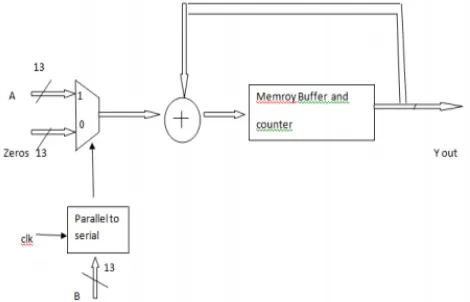
Distributed arithmetic is a bit level
rearrangement of a multiply accumulate to hide
the multiplications. It is a powerful technique
for reducing the size of a parallel hardware
multiply accumulates that is well suited to
FPGA designs. It can also be extended to other
sum functions such as complex multiplies,
Fourier transforms. Distributed arithmetic (DA)
is an effective method for computing inner
products. It uses Look up Tables (LUT) and
accumulators instead of multipliers.
Distributed arithmetic (DA) provides
application in Very Large Scale Integration
(VLSI) implementations of Digital Signal
Processing (DSP) algorithms. Most of these
applications, for example Discrete Cosine
Transform (DCT) calculation, are arithmetic
intensive with multiply/accumulate (MAC)
being the predominant operation. The advantage
of DA approach is that it alerts the basic
assumption of using multipliers and adders for
computing the DCT.
Figure 2. Distributed Arithmetic.
DCT is a computational intensive operation. It
requires large number of adders and multipliers
more power and hence distributed arithmetic
(DA) is used to implement multiplication
without multiplier.
The architecture of 1D-DCT
Figure 3. Overall architecture for DA base DCT.
4.
Experimental Work
Figure (4): simulation results
Synthesis Results:
RTL schematic:
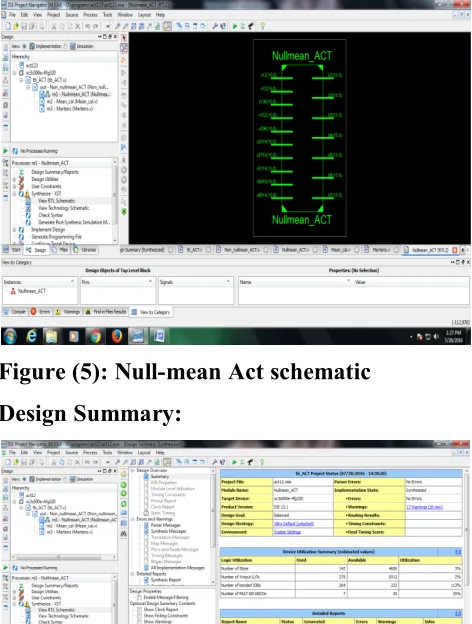
Figure (5): Null-mean Act schematic
Design Summary:
Figure (6): Design summary
5.
Conclusion
In this paper, we have proposed an efficient
VLSI architecture for the 2D-DWT to meet the
requirements of real-time image and video
processing. The advantages of the proposed
architecture are saving embedded memories,
fast computing time, low power consumption,
and low control complexity. This hardware is
designed to be used as part of a complete high
performance and low power JPEG2000 encoder
system for digital cinema applications. The
verified by the VHDL Language. It routed in
Altera Stratix III to work at 350 MHz and
Cyclone II FPGA at 290 MHz’s The FPGA
implementation can code 48 frames (4096 x
2160) per second with 24 bpp. Moreover, it can
be applied very well to the implementation of
the coder used in real time video processing,
such as MPEG-4.
6. References
[1] Vijay Kumar Sharma, K. K. Mahapatra and
Umesh C. Pati,”An efficient distributed
arithmetic based VLSI architecture for DCT”
IEEE transaction on devices and
communications 2011.
[2] T. Acharya and P. Tsai, “JPEG2000
Standard for ImageCompression: Concepts,
Algorithms and VLSI Architectures” J. Wiley &
sons. NJ, 2005.
[3] Gregory K. Wallace, “The JPEG Still
Picture Compression Standard,”IEEE
Transactions on Consumer Electronics,
vol.38(I), Feb. 1992.
[4] R. C. Gonzalez, R. E. Woods, “Digital
Image Processing,”2nd.Ed.,Prentice Hall, 2002.
[5] F.H.P. Fitzek, M. Reisslein, “MPEG-4 and
H.263 Video Traces for Network Performance
Evaluation,”IEEE Network, vol.15, no.6,
pp.40-54, Nov/Dec 2001.
[6] Luciano Volcan Agostini, Ivan Saraiva Silva
and Sergio Bampi,“Multiplierless and fully
pipelined JPEG compression soft IP targeting
FPGAs,” Microprocessors and Microsystems,
vol. 31(8), 3 pp.487-497,Dec. 2007.
[7] S. A. White, “Applications of distributed
arithmetic to digital signal processing: a tutorial
review,” IEEE ASSP Magazine, vol.6, no.3,
pp.4-19, Jul.1989.
[8] M.-T. Sun, T.-C. Chen, A.M. Gottlieb, VLSI
Implementation of a 16x16 Discrete Cosine
Transform,” IEEE Transactions on Circuits and
Systems, vol.36, no. 4, pp. 610 – 617, Apr.1989.
[9] A. Shams, A. Chidanandan, W. Pan, and M.
Bayoumi, “NEDA: A low power high
throughput DCT architecture,” IEEE
Transactions on Signal Processing, vol.54(3),
Mar. 2006.
[10] Peng Chungan, Cao Xixin, Yu Dunshan,
Zhang Xing, “A 250MHz optimized distributed
architecture of 2D 8x8 DCT,” 7th International
Conference on ASIC, pp. 189 – 192, Oct. 2007.
[11] M. Kovac, N. Ranganathan, “JAGUAR: A
Fully Pipelined VLSI Architecture for JPEG
Image Compression Standard,” Proceedings of
the IEEE, vol.83, no.2, pp. 247- 258,Feb.1995.
[12] Yuan-Ho Chen, Tsin-Yuan Chang,
Chung-Yi Li, “High Throughput DA Based DCT With
High Accuracy Error-Compensated Adder
Tree,” IEEE Transactions on Very Large Scale
Integration (VLSI) Systems, vol. PP, issue 99,
pp. 1-5, Jan 2010.
[13] A. Kassem, M. Hamad, E. Haidamous,
International Conference on Advances in
Computational Tools for Engineering
Applications, 2009, ACTEA '09, pp.320-323,
15-17 July 2009.
Authors Profiles
Miss.MRamadevi
Miss.MRamadevi received her B. Tech degree from Khammam Institute of Technology and Sciences affiliated to JNTU, Hyderabad and pursuing M. Tech (VLSI) in Khammam Institute of Technology and Sciences, Khammam District, Telangana, India and her area of interests includes VLSI System design, signal processing and communications.
Mr. R.SrinivasaRao
Mr. R.SrinivasaRaois
working as an Associate
professor in the
Department of Electronics and
CommunicationEngineering at Khammam
Institute of Technology and Sciences, KhammamDistrict, Telangana, India. He has 11 years of teaching experience and a research scholar from Vignan University, Guntur and his current area of research interests are Signal