h
HB: a Harder HB
+
Protocol
Ka Ahmad Khoureich
∗Abstract
In 2005, Juels and Weis proposed HB+, a perfectly adapted authentication proto-col for resource-constrained devices such as RFID tags. The HB+protocol is based on the Learning Parity with Noise (LPN) problem and is proven secure against active adversaries. Since a man-in-the-middle attack on HB+ due to Gilbert et al. was published, many proposals have been made to improve the HB+ protocol. But none of these was formally proven secure against general man-in-the-middle adversaries. In this paper we present a solution to make the HB+protocol resistant to general man-in-the-middle adversaries without exceeding the computational and storage capabilities of the RFID tag.
Keywords. RFID, Authentication, LPN, HB+, Man-In-the-Middle
1
Introduction
Radio-frequency identification (RFID) belongs to the family of Automatic Identification systems. RFID system consists of tags and readers that communicate wirelessly. The RFID tag attached to an object can be used for access control, product tracking, identifi-cation, etc. Since the tag is programmable, a malicious person can then create counterfeit tags and benefit from it. Hence the need to secure the protocol run between the tag and the reader.
RFID tags have a low computational and storage capacity. Therefore, it is impossible to use classical cryptographic algorithms to secure the protocol they execute. At Crypto 2005, Juels and Weis proposed HB+ [15], a perfectly adapted authentication protocol for resource-constrained devices such as RFID tags. The protocol consists of a number of rounds of challenge-response authentication. HB+ is based on the Learning Parity with Noise (LPN) problem — which is known to be NP-Hard — and is proven secure against active adversaries [15, 16]. Since a simple man-in-the-middle attack on HB+ due to Gilbert et al [10]. was published, many proposals [4, 5, 7, 18, 20] have been made to improve the HB+ protocol. But none of these was formally proven secure against general man-in-the-middle adversaries [9, 12, 21].
In this paper we present a solution to make HB+ resistant to general man-in-the-middle adversaries without exceeding the computational and storage capabilities of the RFID tag.
Our paper is organized as follow: (1) we give a definition of the LPN problem, (2) we describe the HB+protocol, (3) we present our protocol based on HB+and provide security proofs, (4) we conclude with some observations and future work.
∗Dept. of Computer Science, Alioune Diop University of Bambey, Senegal.
2
The LPN Problem
The LPN problem is a very known one [1–3,13,14,17,22]. Lethw(v)denote the Hamming weight of a binary vector v.
Definition 2.1. Let A be a random q×k binary vector matrix, let x be a random k-bit vector, let ε ∈]0,12[ be a constant noise parameter, and let ν be a random q-bit vector such that hw(ν) < εq. Given A, ε, and z = (A⋅x) ⊕ν, find a k-bit vector x′ such that hw(A⋅x′⊕z) ≤εq.
The difficulty of findingx(solving the LPN) comes from the fact that each bit of A⋅x
is flipped independently with probability ε, thus making hard to get a system of linear correct equations in x which can be easily solved using the Gaussian elimination.
Let Berε denote the Bernoulli distribution with parameter ε, (i.e. ν ← Berε, Pr[ν =
1] =1−Pr[ν =0] =ε) and let Ax,ε be the distribution define by {a← {0,1}k;ν ←Berε ∶
(a, a⋅x⊕ν)}. One consequence of the hardness of the LPN problem with noise parameter
ε is thatAx,εis indistinguishable from the uniform distributionUk+1 on (k+1)-bit strings;
see [16].
Although many algorithms solving the LPN problem has been published [3, 8, 19], the current most efficient one due to Blum, Kalai, and Wasserman [3] has a runtime of 2O(logkk).
3
The HB
+Protocol
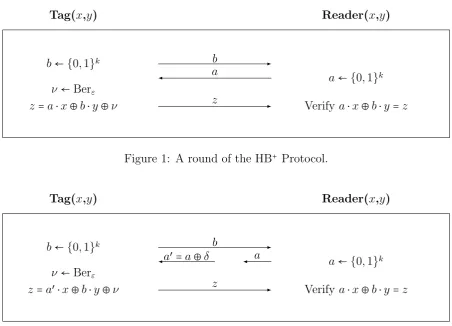
HB+ is an authentication protocol based on the LPN problem and designed for low-cost devices like RFID tags. The protocol consists of r=r(k) challenge-response authentica-tion rounds between the reader and the tag who share two random secrets keysxandyof lengthk. A round consists of the following steps (see fig 3 for a graphical representation):
1. the tag randomly chooses and sends to the reader a vectorb← {0,1}k called
”blind-ing factor”,
2. the reader randomly chooses and sends to the tag a challenge vectora← {0,1}k
3. the tag gets a bit ν following Berε and responses to the reader by sending a bit
z=a⋅x⊕b⋅y⊕ν,
4. the reader accepts the authentication round ifa⋅x⊕b⋅y=z.
The parameters of HB+ are: the shared secrets x and y each of length k, the number of rounds r=r(k), the Bernoulli parameter ε and the threshold u=u(k). The threshold
u is such that it is greater thanε⋅r so the reader accepts the tag if the number of rounds for which Verify a⋅x⊕b⋅y=z returnsfalseis less thanu. Because ofν in the responsez of the tag, the probability that an authentication round be unsuccessful even for the honest tag is not null. Therefore the event called false rejection that the reader rejects an honest tag happens with probability
PF R= r
∑
i=u+1
(r
i)ε
i(1−ε)r−i.
At the same time an adversary sending random responses z to the reader can be accepted with probability
PF A=
1 2r
u
∑
i=0
(r
Tag(x,y) Reader(x,y)
b← {0,1}k b
a← {0,1}k
a ν ←Berε
z =a⋅x⊕b⋅y⊕ν z Verify a⋅x⊕b⋅y=z
Figure 1: A round of the HB+ Protocol.
Tag(x,y) Reader(x,y)
b← {0,1}k b
a← {0,1}k
a a′=a⊕δ
ν ←Berε
z=a′⋅x⊕b⋅y⊕ν z Verify a⋅x⊕b⋅y=z
Figure 2: The GRS attack. The adversary adds a perturbation on the challenge vector a
and looks if the whole authentication process will be disturbed or not.
This event is called false acceptance. Fortunately these probabilities (PF R and PF A) are
negligible in k because r=r(k) (the use of Chernoff bound helps to see it).
3.1
Attacks on HB
+HB+is in fact an improvement of an earlier protocol named HB [14] which is secure against passive attack but vulnerable to active ones. In an active attack the adversary plays the role of a reader and tries to get the secrets from an honest tag. HB+ is proven secure against this type of attack [15, 16] but is defenseless against more powerful adversaries like man-in-the-middle (MIM). In such attacks the adversary stays between the reader and the tag and have the abilities to tamper with messages exchanged between them.
In [10] Gilbert, Robshaw, and Silbert present a MIM-attack against HB+ called GRS attack. The attack is depicted in fig 3.1. In the GRS attack, in order to reveal the secret
x, the adversary does not need to modify all the messages exchanged between the tag and the reader but only the challenge vector a. The adversary adds a perturbation δ on the challenge vector a and looks if the whole authentication process will be successful or not. The reader will verify ifa′⋅x⊕b⋅y=z that is ifδ⋅x⊕ν=0. If the honest tag continues to be authenticated normally i.e. with negligible fails (PF R) then the whole authentication
process is not disturbed and it means that δ⋅x= 0 otherwise δ⋅x =1. By using δ =ei
the vector with 1 at position i and 0s elsewhere, the adversary gets the bit xi of x. By
Much work [4, 5, 7, 18, 20] has been done in order to propose a protocol based on the LPN problem and resistant to the GRS attack. But none of these has been formally proven secure against general man-in-the-middle attacks [9, 12, 21].
4
Our proposal
Intuitively we believe that the weakness of HB+ to the man-in-the-middle attack is due to the fact that the secrets x andy do not change. This intuition is reinforced by our ob-servation of random-HB# [11] — partially resistant to this type of attack (GRS attack),
see [21] — which can be viewed as an HB+ protocol where the secrets x and y vary in each round (although in fact parallel) but remains fixed for each instance of the protocol. The main idea is to let the reader choose a random n-bit secret Γ and then sends it to the tag in a secure way. The random binary string Γ is a concatenation of the secrets
x and y of the HB+ protocol. Our protocol denoted hHB for harder HB+ consists of two stages. In the first stage the reader selects a random secret Γ=x∣∣y that it transmits to the tag and in the second stage hHB is identical to HB+. The secret Γ is transmitted bit by bit from the reader to the tag. The reader randomly selects three bits (τ, ξ0,
ξ1) and sets the value Γi (a bit of Γ) to ξτ. After that the three bits are mapped by a
function fs (see Algorithm 1 and 2) according to the 3-bit to 3-bit S-box given in table 1
and securely communicated to the tag using the vector s⊕pi where s is a shared secret
and pi a vector obtained from the prefix of length i of Γ, pi = Γ1Γ2...(Γi)(∣s∣−i+1) . This
operation is repeated (n+1) times. The hHB protocol is outlined in figure 3. The first triplet transmitted is used for the initialization of p0 and the following triplets for the
transmission of Γ. In order to cancel the effet of a MIM attack on the first triplet, the ci
vectors used for the second triplet (only for this one) are chosen such that their Hamming weight are even. The second stage of hHB is identical to a round of HB+ and is run r
times. An authentication round is successful if Verify a⋅x⊕b⋅y =z returns true. The reader accepts the tag if the number of unsuccessful rounds is less than a threshold u.
Input 0 1 2 3 4 5 6 7
Output 5 6 4 7 3 2 1 0
Table 1: The 3-bit to 3-bit S-box representation. It’s quite similar to the one used in the CTC cipher [6]
Algorithm 1 Functionfs that substitutes elements of a triplet (λ1,λ2,λ3)
function fs(λ1, λ2,λ3, pi)
λ′1λ′2λ′3 =S-box(λ1λ2λ3)
c1← {0,1}k t1 =c1⋅ (s⊕pi) ⊕λ′1
c2← {0,1}k t2 =c2⋅ (s⊕pi) ⊕λ′2
c3← {0,1}k t3 =c3⋅ (s⊕pi) ⊕λ′3
return ((c1, t1),(c2, t2),(c3, t3))
Algorithm 2 Functionf−1 s
function f−1
s ((c1, t1),(c2, t2),(c3, t3), pi)
λ′1 =c1⋅ (s⊕pi) ⊕t1
λ′2 =c2⋅ (s⊕pi) ⊕t2
λ′3 =c3⋅ (s⊕pi) ⊕t3
λ1λ2λ3 =inverse S-box(λ′1λ′2λ′3)
return (λ1, λ2, λ3)
end function
Tag(s) Reader(s)
τ ← {0,1}ξ0← {0,1} ξ1 ← {0,1}
(α, β, γ) =fs(τ, ξ0, ξ1,0∣s∣)
(α, β, γ)
θ=ξτ
p0 =θ∣s∣
(τ, ξ0, ξ1) =fs−1(α, β, γ,0∣s∣)
θ=ξτ
p0 =θ∣s∣
Repeat n times
τ ← {0,1}ξ0← {0,1} ξ1 ← {0,1}
(α, β, γ) =fs(τ, ξ0, ξ1, pi−1)
(α, β, γ)
Γi =ξτ
pi=Γ1Γ2...(Γi)(∣s∣−i+1)
(τ, ξ0, ξ1) =fs−1(α, β, γ, pi−1)
Γi=ξτ
pi=Γ1Γ2...(Γi)(∣s∣−i+1)
Repeat r times. wherex=Γ1Γ2 ...Γk1 and y=Γk1+1Γk1+2 ...Γn
b← {0,1}n−k1 b
a← {0,1}k1
a
ν←Berε
z =a⋅x⊕b⋅y⊕ν z Verify a⋅x⊕b⋅y=z
Figure 3: The hHB authentication protocol.
5
Security Proofs
5.0.1 Notation and Security definitions
We call negl any negligible function, that is which tends to zero faster than any inverse polynomial. That is, for any polynomial p(⋅) there exist an N such that for all integer n
greater than N we have negl(n) < p(1n).
The parameters of hHB are: the shared secret s, one-time secrets x and y each of lengthk, the number of roundsr=r(k)of its second part, the Bernoulli parameterεand the threshold u=u(k). The parameters ε, r and u are the same as for the HB+ protocol. LetTs,ε,r andRs,ε,u,r denote the algorithms respectively run by the honest tag and the
from the reader to the tag and vice versa forq(k)executions of the protocol, and after that tries to authenticate to the reader. The adversary’s advantage according to the model of attack can be defined as follow
Advactive
A (ε,u,r)def= Pr[s← {0,1}k;ATs,ε,r(1k) ∶ ⟨A,Rs,ε,u,r⟩ =accept],
AdvAmim(ε,u,r)def= Pr[s← {0,1}k;ATs,ε,r,Rs,ε,u,r(1k) ∶ ⟨A,R
s,ε,u,r⟩ =accept],
where⟨A,Rs,ε,u,r⟩ denote an attempt of A to authenticate to the reader.
5.1
Security of the
h
HB Protocol against Active Attacks
Theorem 5.1. If HB+ with parameters 0<ε< 1
2, r=r(k) and u>ε⋅r is secure against
active attacks then hHB with the same settings of parameters is secure against active attacks.
Proof. Let Abe a probabilistic polynomial-time adversary interacting with the hHB tag in at most q executions of the protocol and achievingAdvactive
A (ε,u,r) =δ.
We construct a probabilistic polynomial-time adversary A′ who performs an active attacks on HB+and usesAas a sub-routine. For the first phase of the attack,A′simulates for A the hHB tag for q times as follows:
1. A′ receives the triplets (αi, βi, γi) fori=1..(n+1)sent by A, n=2k.
2. A′ forwards b sent by the honest HB+ tag toA,
3. A replies to A′ by sending a challenge vector a which is then forwarded by A′ to the honest HB+ tag,
4. A′ forwards z sent by the honest tag HB+ toA,
Steps 2., 3. and 4. are run r times. For the second phase of the attack,A′ simulates for
A the hHB reader as follows:
5. A′ generates n+1 triplets (αi, βi, γi) and sends it to A,
6. A sends b to A′ which it forwards to the honest HB+ reader,
7. A′ sends to Athe challenge vector a which it received from the honest HB+ reader, 8. A sends z toA′ which it forwards to the honest HB+ reader,
Steps 6., 7. and 8. are run r times. It is not difficult to see that the view of A when run as a sub-routine byA′ is distributed identically to the view ofAwhen performing an active attack on hHB (Because even ifAhas carefully chosen the triplets (αi, βi, γi) it has
sent in step 1, the blinding vector b prevents it to distinguish the effects of its choices in the value of z). So,
AdvactiveA (ε,u,r) =δ=AdvactiveA′,HB+(ε,u,r).
Because HB+ is secure against active attack, there is a negligible function negl such that
AdvAactive′,HB+(ε,u,r) ≤negl(k).
5.2
Security of the
h
HB against MIM Attacks on the second
stage of the protocol
The second stage of the hHB protocol is identical to HB+.
Theorem 5.2. Assume theLPNεproblem is hard, where0<ε< 12. Then the hHBprotocol
with parameters r=r(k) and u>ε⋅r is secure against man-in-the-middle attacks on its second stage.
Proof. LetAbe a probabilistic polynomial-time adversary tempering with messages of the second stage ofhHB in at mostqexecutions of the protocol and achievingAdvMIM
A (ε,u,r) =
δ.
In the first phase of its attack, suppose A eavesdrops and modifies messages at will in order to gain informations on the secret x (the proof is the same if the adversary tries to gain informations on y) by correlating its actions with the decision of the reader (acceptance or rejection). For the second phase of the attack, we say for simplicity that
A uses valuesb=0.
Ahas the probability δ of being authenticated by the reader. This means with prob-ability δ, A does a good guess of the value of z in at least r−u rounds. Therefore the probability that A gets an equation in the secret x is at least δr1−u. On the other hand,
because each bit xi of x comes from one element of a triplet (α, β, γ), A gets a correct
equation in xif she finds the element of (α, β, γ) which corresponds toxi. LetGoodChoice
denote the event find the good element in the triplet, F1 the event all the elements in the
triplet are equal, F2 the event two elements in the triplet are equal and F3 the event all
the elements in the triplet are distinct. Since the way in which xis transmitted to the tag is an instance of the LPN problem and the application offs, we have:
Pr[GoodChoice] =Pr[GoodChoice∣F1] ⋅Pr[F1] +Pr[GoodChoice∣F2] ⋅Pr[F2]
+Pr[GoodChoice∣F3] ⋅Pr[F3]
=( 1
2ks+1)2[1+
3 2(2
ks+1−1) +1
3(2
ks+1−1)(2ks+1−2)]
=1
3+ 1 2ks+2 +
1 6(2ks+1)2
≤1
3+ 1 2ks+1,
where ks is the length ofs.
It follows thatδr1−u ≤ 1
3+ 1
2ks+1, this implies thatδ≤ (
1 3+
1
2ks+1)r−u. Since ksand r−uare
functions of k, (13 +2ks1+1)
r−u is negligible in k then δ itself is negligible. This completes
the proof.
5.3
Security of the
h
HB against MIM Attacks on the first stage
of the protocol
The first stage of the hHB protocol consists of the transmission of Γ which is the con-catenation of x and y from the reader to the tag.
Lemma 5.3. Let M be a square (n×n) matrix over F2. If the Hamming weight of each
Proof. For n=1 and n =2, it is easy to verify that the lemma is true. Let’s prove it for
n≥3.
LetM be as in the lemma. M =
⎡⎢ ⎢⎢ ⎢⎢ ⎢⎢ ⎣ r1 r2 ⋮ rn ⎤⎥ ⎥⎥ ⎥⎥ ⎥⎥ ⎦
where ri = [mi1 mi2 ⋯min]. We sometimes use
the same letter M to denote the set of row vectors of the matrix M.
Assume toward a contradiction thatdet(M) ≠0. Let Pk be the set of k-combinations
of the set of integers {1,2, . . . , n}. Consider
SM = ⋃ P∈Pk; 2≤k≤n
{∑
i∈P
ri; ri the i-th row vector ofM}
the set of sums of row vectors of M. ∣SM∣ = ∑nk=2( n k) = 2
n−n−1. Let E denotes the
set of vectors of even Hamming weight of Fn
2. Since the sum of binary vectors of even
Hamming weight is a vector of even weight and det(M) ≠ 0, the set SM is a subset of
E∖M. ∣E∖M∣ =2n−1−n. For n≥3 we have ∣S
M∣ > ∣E∖M∣, the pigeonhole principal tells
us that there must be at least two elements of SM which are equal thus the vectors of
M are linearly dependent contradicting the assumption thatdet(M) ≠0. This completes the proof of the lemma.
Theorem 5.4. Assume theLPNεproblem is hard, where0<ε< 12. Then the hHBprotocol
with parameters r=r(k) and u>ε⋅r is secure against man-in-the-middle attacks on its first stage.
Proof. In a the man-in-the-middle attack on the first stage of thehHB protocol, two cases can be considered:
Case 1. The adversary perturbs the first triplet which is used to initialize p0: This
perturbation can lead the tag to receive ¯θ instead of θ, and to consider without loss of generality thatx1 =c1⋅(s⊕θ¯∣s∣)⊕t1, while for the readerx1=c1⋅(s⊕θ∣s∣)⊕t1. The effect of
this perturbation is canceled when c1 is chosen such that c1⋅θ¯∣s∣=c1⋅θ∣s∣. This means the
Hamming weight of c1 is even. Therefore by choosing the elements of the second triplet
with even Hamming weight, the perturbation the adversary adds in the first triplet will have no effect on the protocol.
Case 2. The adversary perturbs triplets that carry bits of x (the proof is the same if the perturbation is on triplets that carry bits of y): Suppose the adversary adds a perturbation
δ to eachc in the(i+1)-th triplet, 1≤i≤k1. This leads the tag to consider without loss
of generality thatxi = (c1⊕δ)⋅(s⊕pi−1)⊕t1 while the reader takesxi =c1⋅(s⊕pi−1)⊕t1. If
the reader no longer authenticates the honest tag normallyi.e. with negligible fails (PF R)
then the whole authentication process is disturbed and it means that δ⋅s⊕δ⋅pi−1 = 1
otherwise δ⋅s⊕δ⋅pi−1=0. Each of these equations inscontains a noise parameterδ⋅pi−1.
There are two subcases to consider:
1. The adversary chooses a perturbation δ of odd Hamming weight: In this case, with-out loss of generality suppose the perturbation is added to the second triplet. Then the noise parameter δ⋅p0 will be equal to θ which is randomly chosen from {0,1}.
Thus in order to find the secret s the attacker has to solve the LPNε problem.
then δ⋅p0=0. The attacker gets a clean equation in sbut in the light of lemma 5.3
he will not be able to obtain a system of equations consisting of linearly independent vectors δ. Therefore he can’t compute the secret bits of s.
This means the adversary can’t benefit from a man-in-the-middle attack on the first stage of the hHB protocol and completes the proof.
5.4
h
HB security settings
We respectively denote by ks, kx and ky the length of the secrets s, x and y. The first
phase of hHB consists of the secure transmission of Γ = x∣∣y which relies on the LPN problem with secret s and ε ∈ [0.49,0.5[. Taking into account the recommendations of Levieil et al [19], we can useks=256 to achieve at least 88 bits security. We set r=1164
and u=0.348×rso the probability of false acceptance and false rejection will respectively be 2−80 and 2−40.
For the second stage of the hHB protocol corresponding to an execution of the HB+, we do not follow the recommendations from [19] since in our case xand y are not a fixed keys but session keys (they only last for the duration of an instance of the protocol). The only concern here is the transmission cost of Γ=x∣∣ywhile avoiding insignificant values for the lenghts of xand y. If the lenght of Γ is n, its transmission cost is 3(n+1)(ks+1). So
by considering x and y as challenge vectors typically with 32 bits each, the transmission cost of Γ is equal to 50115 bits. For hHB that transmission cost is added to that of HB+ and is substantially high. Nevertheless, the storage and computation cost of hHB remain low thus suited for low-cost hardware implementation.
6
Conclusions
In this paper we have presented a new protocolhHB which is a solution to thwart the man-in-the-middle attack against HB+. The transmission cost of our protocol is quite high. But the hHB tag remains a tag as it is not overloaded (the storage and computation cost are substantially the same as for HB+). Does securing HB+ worth that transmission cost ? We say yes, but it would be very interesting to find a way to lower it while keeping the same level of security.
Acknowledgment
I would like to thank Carl L¨ondahl and Wang Shaohui for many helpful discussions.
References
[1] E. R. Berlekamp, R. J. McEliece, and H. C. Van Tilborg. On the inherent in-tractability of certain coding problems. IEEE Transactions on Information Theory, 24(3):384–386, 1978.
[3] A. Blum, A. Kalai, and H. Wasserman. Noise-tolerant learning, the parity problem, and the statistical query model. Journal of the ACM (JACM), 50(4):506–519, 2003.
[4] J. Bringer and H. Chabanne. Trusted-HB: a low-cost version of HB+ secure against man-in-the-middle attacks. arXiv preprint arXiv:0802.0603, 2008.
[5] J. Bringer, H. Chabanne, and E. Dottax. HB++: a lightweight authentication protocol secure against some attacks. In Security, Privacy and Trust in Pervasive and Ubiq-uitous Computing, 2006. SecPerU 2006. Second International Workshop on, pages 28–33. IEEE, 2006.
[6] N. T. Courtois. How fast can be algebraic attacks on block ciphers? In online proceedings of dagstuhl seminar 07021, symetric cryptography, pages 7–12, 2006.
[7] D. N. Duc and K. Kim. Securing HB+ against GRS man-in-the-middle attack. In
Institute of Electronics, Information and Communication Engineers, Symposium on Cryptography and Information Security, 2007.
[8] M. P. Fossorier, M. J. Mihaljevi´c, H. Imai, Y. Cui, and K. Matsuura. An algorithm for solving the LPN problem and its application to security evaluation of the HB protocols for RFID authentication. In Progress in Cryptology-INDOCRYPT 2006, pages 48–62. Springer, 2006.
[9] D. Frumkin and A. Shamir. Un-trusted-HB: Security vulnerabilities of trusted-HB.
IACR Cryptology ePrint Archive, 2009:44, 2009.
[10] H. Gilbert, M. Robshaw, and H. Sibert. Active attack against HB+: a provably secure lightweight authentication protocol. Electronics Letters, 41(21):1169–1170, 2005.
[11] H. Gilbert, M. J. Robshaw, and Y. Seurin. : Increasing the security and efficiency of HB+. In Advances in Cryptology–EUROCRYPT 2008, pages 361–378. Springer, 2008.
[12] H. Gilbert, M. J. Robshaw, and Y. Seurin. Good variants of HB+ are hard to find. In Financial Cryptography and Data Security, pages 156–170. Springer, 2008.
[13] N. J. Hopper and M. Blum. A secure human-computer authentication scheme. In
Technical Report CMU-CS-00-139. Carnegie Mellon University, 2000.
[14] N. J. Hopper and M. Blum. Secure human identification protocols. In Advances in cryptology—ASIACRYPT 2001, pages 52–66. Springer, 2001.
[15] A. Juels and S. A. Weis. Authenticating pervasive devices with human protocols. In
Advances in Cryptology–CRYPTO 2005, pages 293–308. Springer, 2005.
[16] J. Katz and J. S. Shin. Parallel and concurrent security of the HB and HB+protocols. In Advances in Cryptology-EUROCRYPT 2006, pages 73–87. Springer, 2006.
[17] M. Kearns. Efficient noise-tolerant learning from statistical queries. Journal of the ACM (JACM), 45(6):983–1006, 1998.
[19] ´E. Levieil and P. A. Fouque. An improved LPN algorithm. In Security and Cryptog-raphy for Networks, pages 348–359. Springer, 2006.
[20] J. Munilla and A. Peinado. HB-MP: A further step in the HB-family of lightweight authentication protocols. Computer Networks, 51(9):2262–2267, 2007.
[21] K. Ouafi, R. Overbeck, and S. Vaudenay. On the security of HB# against a
man-in-the-middle attack. In Advances in Cryptology-ASIACRYPT 2008, pages 108–124. Springer, 2008.
[22] O. Regev. On lattices, learning with errors, random linear codes, and cryptography.