Fast Multiple Point Multiplication on Elliptic
Curves over Prime and Binary Fields using the
Double-Base Number System
Jithra Adikari
†, Vassil S. Dimitrov
†, and Pradeep Mishra
‡†
Department of Electrical and Computer Engineering
Schulich School of Engineering
‡
Department of Mathematics and Statistics
The University of Calgary
2500 University Drive N.W.
Calgary AB
Canada T2N 1N4
{
jithra.adikari, dimitrov
}
@atips.ca, [email protected]
Abstract— Multiple-point multiplication on elliptic curves is the highest computational complex operation in the elliptic curve cyptographic based digital signature schemes. We describe three algorithms for multiple-point multiplication on elliptic curves over prime and binary fields, based on the representations of two scalars, as sums of mixed powers of 2 and 3. Our approaches include sliding window mechanism and some pre-computed values of points on the curve. A proof for formulae to calculate the number of double-based elements, doublings and triplings below 2n
is listed. Affine coordinates and Jacobian coordinates are considered in both prime fields and binary fields. We have achieved upto 24% of improvements in new algorithms for multiple-point multiplication.
I. INTRODUCTION
The public key cryptography which was proposed by Diffie and Hellman in [5] in 1976, changed directions, in the field of cryptography. Thereafter, the RSA[23] algorithm dominated the commercial world for public key cryptography. In 1985, Koblitz[18] and Miller[21] proposed the elliptic curve cryptog-raphy (ECC) which is based elliptic curve discrete logarithm
problem (ECDLP). The main advantage of the elliptic curve
cryptography is the relatively small key-size. For an example, a 160-bit elliptic curve key provides the same security as a 1024-bit RSA key[15].
The concept of Digital signature which is derived from public key cryptography, is equivalent to that of handwritten signature in paper-based communications. RSA signature[23], Elgamal signature[13], and Digital Signature Algorithm (DSA) [1][2] are widely used in today’s commercial applications. Elliptic curve digital signature algorithm (ECDSA)[2] and elliptic curve Korean certificate-based digital signature algo-rithm (EC-KCDSA)[16] are the most common two elliptic curve cryptographic digital signature algorithms.
Generally, elliptic curve point multiplication consumes high computational power in elliptic curve cryptography. Number of techniques have been introduced to overcome this problem [3], [15], [19]. In addition to that, in elliptic curve digital signature verification, the multiple point multiplication con-sumes huge amount of computational power. Shamir method simultaneous multiple point multiplication[13], fast Shamir method, non-adjacent form (NAF)[25], joint sparse form[24] and interleaving with NAF and sliding window methods[15] have been used for improving the efficiency of the multiple point multiplication. In this paper, we propose double-base number system techniques to improve the efficiency of verify-ing the digital signature in both prime and binary fields. The coordinate systems that we considered, are Affine coordinates and Jacobian projective coordinates over both fields.
The double-base number system (DBNS) was introduced in [9] for cryptographic applications and later extended for elliptic curve cryptography in [7] and [8]. We apply double-base number system for multiple point multiplication because it inherits sparsity and redundancy in the DBNS number representation. We propose three new algorithms for multiple point multiplication derived from double-base number system. Moreover, combination of doublings and triplings with point additions improves performance in prime and binary fields.
II. BACKGROUND
Theory of elliptic curve cryptography and double-base num-ber system are briefly reviewed in this section.
A. Elliptic Curve Cryptography
Elliptic curves have been introduced to public key cryptography by Koblitz and Miller independently in 1985.
1) Elliptic Curve Cryptography:
-Definition 1 (elliptic curve): An elliptic curve E over a field
K is defined by the Weierstrass equation, given by
E:y2+a1xy+a3y=x3+a2x2+a4x+a6 (1) where,{a1, a2, a3, a4, a6} ∈K and∆6= 0, where ∆ is the discriminant of E and is defined as follows:
∆ =−d22d8−8d43−27d62+ 9d2d4d6
d2=a12+ 4a2
d4= 2a4+a1a3
d6=a32+ 4a6
d8=a12a6+ 4a2a6−a1a3a4+a2a32−a42 (2)
E is defined over K, and coefficients a1, a2, a3, a4, a6 are elements of K. The condition∆6= 0ensures that elliptic curve is smooth, which means that there are no points at which the curve has two or more distinct tangent lines.
The field K can be either prime, binary, ternary or optimal extension field. All of these fields are used for cryptographical purposes. Properties of the elliptic curve depends on the field and the characteristics of the Eqn. 1.
If K is a prime field (Fp), E transforms into the curve which is represented in Eqn. 3.
y2=x3+ax2+b (3)
where, a, b ∈ K and the discriminant of this curve is ∆ =
−16(4a3+ 27b2). The Weierstrass equation, E can be reduced to Eqn. 4, if K is a binary field (F2m) anda16= 0.
y2+xy=x3+ax2+b (4) where, a, b ∈ K and ∆ = b. Such a curve is said to be non-supersingular.
2) Elliptic Curve Arithmetic:
-Let E be an elliptic curve defined over the field K and
P, Q be two points in E/K. The third point in E/K which
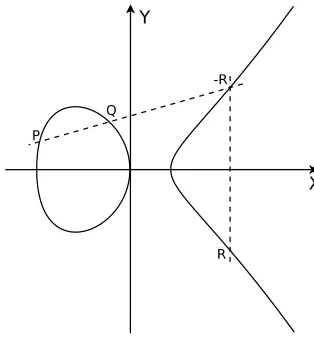
is derived by adding two points in E/K by using the chord-and-tangent rule [3], [15]. The set of points E/K forms an abelian group with ∞ serving as its identity. The sum of P and Q is defined as follows: draw a line through P and Q; the intersection of this line and the elliptic curve is the negation of the resultant point; take the reflection of that point about the
x-axis. This point gives the resultant point as depicted in the
Fig. 1. The double of a point, P is defined: draw the tangent
line to the point P; intersection of this tangent line and the elliptic curve is the negation of the double of the point; take the reflection about x-axis to get the resultant point. Given
Fig. 1. Elliptic Curve Addition
a point P ∈ E(K) and k ∈ N, the operation of computing the new point k×P is called point multiplication or scalar multiplication. This operation is computationally dominant in ECC.
Digital signature algorithms need multiple point multiplica-tion for the verificamultiplica-tion process. In this process, much of the computational power is spent on multiple point multiplication. If both points P, Q are on the elliptic curve and both integers
k, l are less than the order of the elliptic curve over the field,
the operation of computing the new point kP + lQ is called the multiple point multiplication.
TABLE I
OPERATION COUNTS FOR POINT ADDITION,DOUBLING&TRIPLING OVER PRIME FIELD USINGAFFINE COORDINATES& JACOBIAN PROJECTIVE
COORDINATES[8], [12], [15]. Curve operation Affine Jacobian Addition 1I + 2M + 2S 12M + 4S Doubling 1I + 2M + 1S 4M + 6S Tripling 2I + 3M + 3S 10M + 6S
Key: I - inversion, M - multiplication, and S - squaring.
TABLE II
OPERATION COUNTS FOR POINT ADDITION,DOUBLING&TRIPLING OVER BINARY FIELD USINGAFFINE COORDINATES& JACOBIAN PROJECTIVE
COORDINATES[8], [12], [15]. Curve operation Affine Jacobian Addition 1I + 2M + 1S 6M + 3S Doubling 1I + 2M + 1S 5M + 5S Tripling 2I + 6M + 3S 15M + 7S
Key: I - inversion, M - multiplication, and S - squaring.
coordinates and Jacobian projective coordinates. Table II-A.2 & II-A.2 gives the number of field operations involved in elliptic curve operations over prime and binary fields in Affine coordinates and Jacobian projective coordinates.
Jacobian coordinates are a special class of projective coordinates, where the point (X :Y :Z) corresponds to the affine point X/Z2:Y /Z3
, when Z 6= 0. The point at infinity is represented as (1:1:0). The opposite of(X :Y :Z)
is(X:−Y :Z). For further details on projective coordinates, reader can refer to [8], [12], [15].
3) Elliptic Curve Digital Signature Algorithms:
-Digital signatures serve authentication, data integrity, and non-repudiation in the digital space [3], [15], [20], [22]. A signature scheme consists of four segments: namely, domain parameter generation, key generation, signature generation and signature verification algorithms [20]. Two standardized signa-ture schemes based on elliptic curve cryptography are Elliptic Curve Digital Signature Algorithm (ECDSA) and Elliptic Curve Korean Certificate-based Digital Signature Algorithm (EC-KCDSA) [15].
ECDSA is the most widely standardized elliptic curve-based signature scheme. ANSI X9.62, FIPS 186-2, IEEE 1363-2000 and ISO/IEC 15946-2 standards have included ECDSA. EC-KCDSA appears in the ISO/IEC 15946-2 standard. Both sig-nature schemes need to perform multiple point multiplication in the signature verification process.
Domain parameters define the elliptic curve, E which is defined over a finite field, Fq. These parameters should be chosen in a way that the elliptic curve discrete logarithm problem (ECDLP) is resistant to all known attacks [15]. In both signature schemes we have to use domain parameters, field order (q), field representation (F R), a seed if the elliptic curve is randomly generated (S), two coefficients of the equation (a, b∈Fq), a finite point (P = (xp, yp)∈Fq), order
of finite point (n) and the cofactor (h= #E(Fq)/n). Further details on digital signatures are available in [5], [13], [20] and elliptic curve digital signature schemes can be found in [15].
B. Double-Base Number System
The double-base number system (DBNS) has been studied extensively, due to its applicability in signal processing and cryptography. We will begin DBNS background study with following definition from [4], [6], [9], [10], [11].
Definition 2 (s-integer): An s-integer is a positive integer,
whose largest prime factor does not exceed the s-th prime number.
Definition 3 (based number system): The
double-based number system (DBNS) is a representation scheme in which every positive integer, n, is represented as the sum or difference of 2-integers that is, numbers of the form 2a3b.
n=
M X
i=1
si2bi3ti (5)
where,si∈ {−1,1}, andbi, ti≥0.
The DBNS representation is highly sparse and redundant. If only the positive signs (si = 1) are considered for the
DBNS representations; 100 has exactly 402 different DBNS representations and 1000 has exactly 1,295,579 different DBNS representations. The following theorems give an important result about DBNS[10].
Theorem 1: Every positive integer,n, can be represented as the sum of at mostOlog loglognn2-integers.
Theorem 2: There exists an absolute constant, C, such that
there is always a number of the form 2b3t between n and
n− n
(logn)C.
Algorithm 1: A greedy algorithm to convert integers to DBNS
Input : A positive integern.
Output : the sequence of exponents (bn, tn) leading to one
DBNS representation ofn.
1. whilen >0do.
2. findz= 2a3b, the largest 2-integer less than or equal ton.
3. print(b, t). 4.n←n−z.
Some of these representations have the minimal number 2-integer representation. An 2-integer can be represented as the sum of m 2-integers, but cannot be represented as the sum of (m−1) 2-integers. That is called canonic representation and very sparse. The Algorithm 1 gives a nearly canonical unsigned DBNS representation of a number (in this case,si=
1 only).
In the new point multiplication algorithm we need to calculate number of DBNS elements below some2n number.
This helps us to calculate the required number of doublings and triplings involved in the algorithms. The total number of DBNS elements below 2n (d
n) is given by the following
expression:
dn= n X
i=1
The inductive method is used to prove Eqn. 6 in Proof 1. We have extended Eqn. 6 to calculate number of doublings and triplings involved in calculating all DBNS elements below 2n.
Proof 1: Number of DBNS Elements less than 2n
Consider the expression for n= 1
d1= 1
X
i=1
⌈log32i⌉
=⌈log321⌉
= 1
dn is the number of elements less than 21. The only DBNS
element less than 21 is 1.
Assuming the Eqn. 6 is true for n−1, then; dn−1=
n−1
X
k=1
⌈log32k⌉
Find the number of DBNS elements in2n−1,2n
: First element =2n−1
Second element = 2n−2·3 Third element = 2n−4·32
· · ·
Last element = 2x·3⌊log32n⌋, In this case 0≤x < n.
According to the above calculation we have⌈log32n⌉number of elements in
2n−1,2n
. Therefore,
dn=dn−1+⌈log32n⌉
=
n X
k=1
⌈log32k⌉
We use tripling algorithm to calculate all 3i (i ∈
[1,⌊log32n⌋]) DBNS elements less than2n. To calculate other DBNS elements we use doublings. We can calculate number of doublings (DBLn) and triplings (T P Ln) that we need to
calculate all DBNS elements less than 2n in the following
manner:
T P Ln=⌊log32n⌋
DBLn=dn−T P Ln−1
=
n X
k=1
⌈log32k⌉ − ⌊log32n⌋ −1
=
n X
k=1
⌈log32 k
⌉ − ⌈log32 n
⌉
=
n−1
X
k=1
⌈log32 k
⌉
(7)
We have minimized calculation of tripling operations in DBNS element calculations, because tripling operation utilizes more cost than doubling operation.
III. MULTIPLEPOINTMULTIPLICATIONALGORITHMS
In elliptic curve digital signature algorithms, we consider the resultant, kP + lQ for multiple point multiplication. Where k and l are t-bit numbers, both P and Q are two points on the elliptic curve. There are number of multiple point multiplication algorithms have been proposed, namely simultaneous multiple point multiplication based on Shamir’s trick, sliding window and non-adjacent form (NAF), joint sparse form (JSF) and interleaving with NAF [14], [15], [24].
A. Simultaneous Multiple Point Multiplication (SMPM)
In this method, we represent k and l in w-bit, d =
⌈t/w⌉ number of blocks and do the pre-computation for iP +jQ for 0 ≤ i, j < 2w. Then, k and l are represented
Kd−1k....kK1kK0 andLd−1k....kL1kL0respectively. Calcu-lating R ←2wR+ (KiP+LiQ) ford−1 times, the final
answer can be obtained. See Algorithm 2.
Algorithm 2: Simultaneous Multiple Point Multiplication
Input : Window width w, k, l, P, Q∈E(Fq)
Output :kP +lQ
1. computeiP+jQfor all i, j∈[0,2w−1].
2. writek=Kd−1k....kK1kK0 andl=Ld−1k....kL1kL0 where allKi, Li arew-bit long and d=⌈t/w⌉.
3.R← ∞.
4. forifromd−1downto0 do 4.1 R←2wR.
4.2 R←R+ (KiP+LiQ).
5. returnR.
Sliding window method can be used to improve this algorithm [15]. In Table VI & VII, cost of SMPM and that of sliding SMPM are compared. Further note that storage required for the sliding SMPM is less than storage required for SMPM. 9 + 15t/32 and 2 +t give the number of additions and doublings involved in the elliptic curve additions of two t-bit numbers, under the Simultaneous Multiple Point Multiplication.
B. Simultaneous Multiple Point Multiplication with NAF (NAF-SMPM) and Joint Sparse Form (JSF)
For fixed-window, we have3t/4point additions on average forkP+lQ. When the non-adjacent form (NAF) representa-tion of bothkandl are considered the average point addition comes down to 5t/9. The joint sparse form (JSF) of two integers introduced by Solinas in [24] reduces the average point addition to t/2. Algorithm 3 explains the JSF and it needs only 4 storage positions for the calculation.
Algorithm 3: Joint Sparse Form
Input : Positive integersk1 andk2
Output : JSF(k1, k2) 1. l←0,d1←0,d2←0. 2. while (k1+d
1>0 ork2+d2>0) 2.1 l1←d1+k1, l2←d2+k2. 2.2 for ifrom 1to2 do
ifli is even thenu←0;
else
u←li mods4.
if li≡ ±3 (mod 8)andl3−i≡2 (mod 4)
thenu← −u. ki
l ←u.
2.3 forifrom1 to2 do
if2di= 1 +kli thendi←1−di.
ki← ⌊ki/2⌋.
2.4 l←l+ 1. 3. return JSF(k1, k2).
Under the joint sparse form, the number of additions and doublings involved in an elliptic curve addition of two t-width numbers are 2 +t/2 andt, respectively.
C. Interleaving with w-NAF (I-w-NAF)
The interleaving with w-NAF method needs pre-computation of iPj for i ∈
1,3, ...,2wj−1−1 and
1 ≤ j ≤ 2. Therefore, required storage positions are 2wj−2
for the point Pj. The other benefit of this method is that
we can use different windows, wj for different points, Pj.
Algorithm 4 describes the steps for interleaving with NAF forv number of points.
Algorithm 4: Interleaving with w-NAF
Input :v, Positive integerskj, widthsw
j and pointsPj,1≤
j ≤v
Output : Pv j=1kjPj
1. compute iPj fori∈
1,3, ...,2wj−1−1 ,1≤j≤v.
2. calculateN AFwj(kj),1≤j≤v
3. let l=max{lj: 1≤j≤v}.
4. define kij= 0 forlj≤i≤l,1≤j≤v
5. Q← ∞.
6. fori froml−1downto0 do 6.1 Q←2Q
6.2 forj from1 tov do ifkji 6= 0then
if kji >0 thenQ←Q+k j iPj;
else Q←Q−kjiPj
7. return Q.
When we add two t-bit numbers with interleaving with w-NAF algorithm, there are 3 + 11t/30 additions and 1 +t doublings. This algorithms can easily be extended for any
other number of point multiplication.
IV. DBNSBASEDALGORITHMS FORMULTIPLEPOINT
MULTIPLICATION
We have proposed three algorithms based on DBNS, namely, sliding DBNS, sliding DBNS with simultaneous point multiplications and interleaving with signed DBNS. In all three approaches, we consider the point,P is known in advance.
A. Sliding DBNS Algorithm
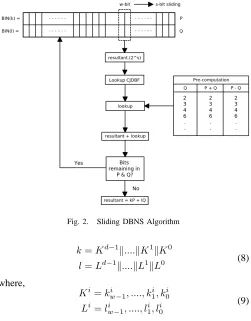
In sliding DBNS algorithm, we usew-bit blocks to represent k andl numbers as in Eqn. 8 and Eqn. 9. In that case, we have maximum ofd=⌈t
w⌉number of blocks in a given pair
oft-bit numbers. This algorithm is shown in the Fig. 2 and it represents k= k1, l = k2,P =P
1 andQ =P2. Note that BIN(k) gives the binary representation ofk, in Fig 2.
Fig. 2. Sliding DBNS Algorithm
k=Kd−1k....kK1kK0
l=Ld−1k....kL1kL0 (8) where,
Ki=kwi−1, ...., k i 1, k
i 0
Li=lwi−1, ...., l i 1, l
i 0
(9)
We have pre-computed all the DBNS elements less than 2w
forQ, P+Q andP −Q. Then the canonical joint double-base format (CJDBF) for a pair of numbers is considered. This enables to get aP+QorP−Qrepresentation into the point multiplication. Our approach has a sliding window mechanism to improve the performance further. Sliding is considered from left-to-right. Once the adding is done for the i-th block, we take the first non-zero column as the most significant of the
Algorithm 5: Sliding DBNS
Input : t-bit positive integers, kj, width, w, and points Pj,
j = 2
Output : P2 j=1kjPj
1. compute iP2,i(P1+P2),i(P1−P2) for
i∈
1,2,3, ...,2ax3bx ,
0≤ax< w,0≤bx<⌊log32w⌋,2ax3bx <2w. 2. Q← ∞
3. p←0
4. s←0
5. forp from d−1 downto0 do 5.1 lookup CJDBF of(K1p)and(K
p 2) forrfrom0 toy do
lookup=dr
qPq ordrq(P1+P2)ordrq(P1−P2)
Q←Q+lookup 5.2 p←p+ 1
5.3 find the next non-zero column on the right & shift sbits to right
5.4 take leftmost bit as the MSB ofKp q
5.5 Q←2s·Q
5.6 if no columns then; break
6. return Q.
Table III gives the average number of additions involved in the multiple point multiplication for w−bit width window (w ∈ [4,8]). In this calculation we assume that we have pre-computed all the DBNS elements less than 2w for Q,
P +Q and P −Q. The Eqn. 10 gives the average number
TABLE III
AVERAGE NUMBER OF ADDITIONS INVOLVED IN THE MULTIPLE POINT MULTIPLICATION FORw−BIT WIDTH WINDOW.
window width average additions
8 2.26
7 1.99
6 1.77
5 1.52
4 1.22
of elliptic curve additions (ADDw) needed for the multiple
point multiplication using the above algorithm with w−bit window. The average number of elliptic curve additions for w−bit window (aw) can be taken from the Table III. Further
the numbers of elliptic curve doublings (DBLw) and triplings
(T P Lw) can be obtained by equation 7. Because we have to
pre-calculateQ,P+QandP−Qour elliptic curve doublings and triplings as follows:
ADDw= (1 +aw)·
1− 1
4w
· t w
DBLw= 3× w−1
X
k=1
⌈log32k⌉
T P Lw= 3× ⌊log32w⌋
(10)
Cost involved in pre-computation of P terms is excluded, assuming thatP is known in advance.
B. Sliding DBNS Simultaneous Multiple Point Multiplication Algorithm (Sliding DSMPM)
In sliding DBNS simultaneous multiple point multiplication algorithm, the t-bit number is broken intodnumber of w-bit numbers and with the sliding mechanism, it reduces the number of w-bit numbers less thand.
Algorithm 6: Sliding DBNS Simultaneous Multiple Point Multiplication
Input : t-bit positive integers, kj, width, w, and points Pj,
j= 2
Output :P2 j=1kjPj
1. computeiP2 fori∈1,2,3, ...,2ax3bx ,
0≤ax< w,0≤bx<⌊log32w⌋,2ax3bx<2w. 2.Q← ∞
3.p←0
4.s←0
5. forp fromd−1 downto0 do 5.1 for q from1 to2do
lookupDBN S(Kp
q) =d0q+· · ·+dyq
forrfrom0 toy do lookup=dr
qPq
Q←Q+dr qPq
5.2 p←p+ 1
5.3 find the next non-zero column on the right & shift sbits to right
5.4 take leftmost bit as the MSB of Kp q
5.5 Q←2s·Q
5.6 if no columns then; break
6. returnQ.
In previous algorithm we had pre-computed all DBNS repre-sentation point multiplications of P1, P1−P2 andP1+P2. However in this algorithm, only the DBNS element point multiplications of P2 is pre-computed, to save memory.
TABLE IV
AVERAGE NUMBER OF ADDITIONS INVOLVED IN ALL NUMBERS INw−BIT WIDTH WINDOW.
window width average additions
10 1.32
9 1.16
8 0.98
7 0.86
6 0.75
5 0.61
4 0.47
sliding DBNS simultaneous multiple point multiplication is described in Algorithm 6.
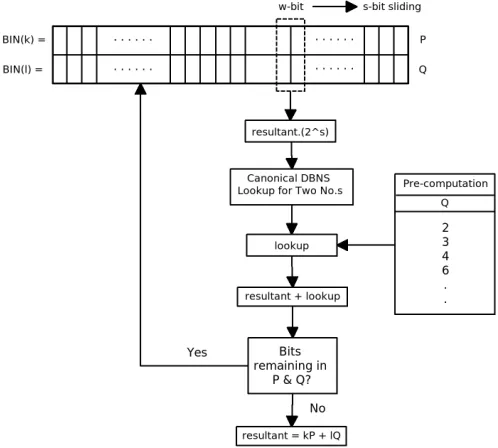
The main advantage of this algorithm is that we need less memory compared to the previous algorithm, because we calculate only all the DBNS representations of pointP2. Fig. 3 illustrates the sliding DBNS simultaneous multiple point multiplication.
Fig. 3. Sliding DBNS Simultaneous Multiple Point Multiplication Algorithm
The Table IV gives the average number of additions that needs for the DBNS representations of all the numbers be-low 2w (w−width window). Eqn. 11 gives the number of
elliptic curve additions, doublings and triplings. Comparing with sliding DBNS, we have one more elliptic curve addition introduced to a window. Refer Eqn. 11.
ADDw= (2 +aw)·
1− 1
4w
· t w
DBLw= w−1
X
k=1
⌈log32 k
⌉
T P Lw=⌊log32w⌋
(11)
However, number of doublings and triplings has gone down
in this algorithm by a factor of 2/3. Further, number of storage also has gone down by the same factor.
C. Interleaving with DBNS (I-DBNS)
The third algorithm is based on non-adjacent form (NAF)[17] representation of numbers. When the w-NAF representation is used we need only to calculate odd numbers below2w−1. For an example, if we consider 5-NAF representation of a number, there will be odd co-efficients from -15 to 15. The w-NAF representation of a number
reduces the non-zero elements in the representation. Therefore the sliding mechanism of the DBNS representation ofw-NAF has less number of elliptic curve additions. Algorithm 7 demonstrates the Interleaving with double-base number system.
Algorithm 7: Interleaving with DBNS
Input : w-bit positive integers,kj, width, w, and pointsPj,
j∈ {1,2} Output :P2
j=1kjPj
1. computeiPj fori∈1,2,3, ...,2ax3bx ,j∈ {1,2},
0≤ax< w,0≤bx<⌊log32w⌋,2ax3bx<2w. 2.Q← ∞
3.p←0
4.s←0
5. forp fromd−1 downto0 do 5.1 for q from1 to2do
lookupDBN S(Kp
q) =d0q+· · ·+dyq
forrfrom0 toy do lookup=dr
qPq
Q←Q+dr qPq
5.2 p←p+ 1
5.3 find the next non-zero column on the right & shift sbits to right
5.4 take leftmost bit as the MSB of Kp q
5.5 Q←2s·Q
5.6 if no columns then; break
6. returnQ.
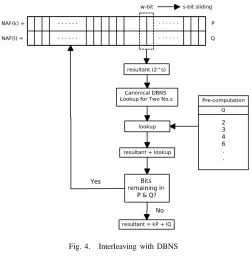
Fig. 4 shows the Interleaving with DBNS algorithm for a w−bit sliding window. Note that we have the NAF represen-tation of the two numbers before coming into sliding window mechanism. In Fig. 4, NAF(k) means that the non-adjacent form representation ofk.
Table V gives the average number of additions that needs for the DBNS representations of all the odd numbers below2w
(w−width window). We have considered only the odd numbers because in thew−NAF representation we need to have only the odd numbers below(w−1)−width.
TABLE V
AVERAGE NUMBER OF ADDITIONS INVOLVED IN ALL ODD NUMBERS IN w−BIT WIDTH WINDOW.
window width average additions
11 1.5
10 1.36
9 1.13
8 1.03
7 0.91
6 0.75
5 0.63
non-Fig. 4. Interleaving with DBNS
zero elements in each number.
ADDw= (2 +aw)·
t
(w+ 1)
DBLw= w−1
X
k=1
⌈log32k⌉
T P Lw=⌊log32w⌋
(12)
When the additions are calculated, we assume that we
have t/(w+ 1) number of elements in each number’s NAF representation. Calculating number of Doublings and Triplings are same as Sliding DSMPM algorithm.
V. COMPARISON
In this section we compare sliding simultaneous multiple point multiplication, joint sparse form, interleaving with w -NAF with our new algorithms which are based on sliding DBNS, sliding DBNS simultaneous multiple point multipli-cation and Interleaving with DBNS, respectively. For the comparison, we consider 2-bit window width for the simulta-neous multiple point multiplication and sliding simultasimulta-neous multiple point multiplication, while 5-bit and 4-bit window is used for Interleaving with NAF. We have used 4-bit to 8-bit window sizes for the sliding DBNS and 5-8-bit to 10-8-bit window width for sliding DBNS simultaneous multiple point multiplication. Finally, 5-bit to 12-bit window sizes are used for the Interleaving with DBNS algorithm.
Table VI gives the experimental results of operational counts for computingkP+lQover prime fields. When the operation cost is calculated, both affine and Jacobian coordinates are considered. It is assumed that field cost per a squaring over a prime field is equal to 0.8 times of a multiplication. Com-parison has been carried out for 160-bit, 230-bit and 570-bit
numbers. We have assumed one point is known as a domain parameter and point multiplications related to that point are pre-calculated. Similarly, Table VII gives the experimental results of operational counts for computing kP +lQ over binary fields. Again this table gives the operational cost for the both affine and Jacobian coordinates. For the final calculation, we have assume that squaring is almost free in binary fields.
TABLE VI
EXPERIMENTALRESULTS OFOPERATIONALCOUNTS FORCOMPUTING kP+lQOVERPRIME FIELDS
Algorithm bit length operational cost Affine Jacobian sliding SMPM
160 10326 2608 230 14634 3682 570 35560 8896 JSF
160 10423 2654 230 14945 3802 570 36909 9378 I-w-NAF
160 9603 2362 230 13728 3372 570 33765 8276 sliding DBNS
160 11465 2860 230 16050 3965 570 37420 9126 sliding DSMPM
160 10323 2470 230 14464 3446 570 34077 8112 I-DBNS
160 9856 2349 230 13904 3297 570 33099 7761
In Table VI & VII, the window size and the storage required are different in the new alorithms for different bit lengths.
A. Curves defined overFp with Affine Coordinates
According to the Table VI, it is noticable that sliding DBNS does not give us any improvement compared to any other algorithms in consideration. However we can notice that sliding DBNS window width is increasing with the bit length of the two numbers.
Sliding DBNS simple multiple point multiplication has an improvement with respect to sliding SMPM and JSF. The improvement is significant when the bit length is increasing. According to our calculations the improvement for 570-bit is 8% against JSF.
Interleaving DBNS with w-NAF algorithm is giving the most impressive improvements. The most existing algorithm for multiple point multiplication is interleaving withw-NAF. The new algorithm based on w-NAF and DBNS is 2% more efficienct than the interleaving with w-NAF. When it is compared with JSF, it is a 10% improvement.
B. Curves defined overFp with Jacobian Coordinates
is due to the inversions in the calculations using affine coor-dinates. When it comes to Jacobian coordinates, we eliminate inversions and it saves a lot of computational power.
In prime fields Jacobian coordinates give a some improve-ment with sliding DBNS over JSF. This advantage is visible when the bit length is high. For an example, 570-bit length is having a clear improvment with the new algorithm.
Considering the sliding DBNS simultaneous multip point multiplication and JSF, we can notice that 7%, 9% and 14% improvements for 160-bit, 230-bit and 570-bit numbers respec-tively. However, there is no notable improvements, compared to the interleaving with w-NAF.
TABLE VII
EXPERIMENTALRESULTS OFOPERATIONALCOUNTS FORCOMPUTING kP+lQOVERBINARY FIELDS
Algorithm bit length operational cost Affine Jacobian sliding SMPM
160 10072 2055 230 14276 2886 570 34696 6926 JSF
160 10164 2112 230 14574 3022 570 35994 7442 I-w-NAF
160 9374 1800 230 13402 2565 570 32966 6277 sliding DBNS
160 10958 2216 230 15429 3052 570 36082 6952 sliding DSMPM
160 9930 1834 230 13944 2546 570 32931 6007 I-DBNS
160 9502 1736 230 13418 2419 570 32123 5654
Interleaving DBNS withw-NAF has 6% and 17% improve-ment compared to interleaving withw-NAF and JSF for 570-bit numbers. Table VI gives the costs for 160-570-bit and 230-570-bit numbers using the same algorithm.
C. Curves defined overF2m with Affine Coordinates
In the binary fields we have the advantage in squaring because that can be considered as a no cost operation. Fur-ther, inversion costs less than ten multiplications in binary fields. This reduces overall cost in binary fields with affine coordinates.
Table VII gives the summary of the operational cost for all the algorithms. In comparison, we can notice that sliding DBNS has 9% improvement against JSF. While interleaving DBNS with w-NAF has gained 3% improvement against interleaving withw-NAF. The improvement is 11% when we compare the same algorithm with JSF. Further all of above comparisons are valid for 570-bit numbers.
D. Curves defined over F2m with Jacobian Coordinates
The improvement due to new algorithms is noticable when they are operated in the binary field with Jacobian coordinates. In this combination, we have less cost for the squaring and field inverse. That leads to a significant improvement in these algorithms.
Considering 160-bit numbers, sliding DBNS multiple point multiplication gives 13% enhancement over JSF. This number goes upto 16% and 19% with the same algorithm when the bit length is increased to 230-bit and 570-bit numbers.
Interleaving DBNS with w-NAF has 4%, 6% and 10% improvements over Interleaving with w-NAF with 160-bit, 230-bit and 570-bit numbers, respectively. When the same al-gorithm is compared with JSF, it gives upto 24% improvement with 570-bit numbers. For other two bit lengths, i.e. 160-bit and 230-bit, improvement is 18% and 20% over JSF.
VI. CONCLUSIONS
In all three new algorithms, the required memory is larger than the other algorithms due to pre-computations. However the performance has been improved, specially, in the Inter-leaving with DBNS algorithm upto 24%. In the conclusion, we have draw the attention to the most popular multiple point multiplication algorithms, JSF and interleaving with w-NAF.
Sliding DBNS algorithm needs to have more memory and it is not giving greater performance improvements in 160-bit numbers. However, when the 230-160-bit and 570-160-bit numbers are considered it gives much improved performances. It never beats JSF and Interleaving with NAF for 4 and 5-bit widths. 4-bit width window is giving the optimum performance when the 160-bit numbers are considered. Whereas, 230-bit numbers and 570-bit numbers will have optimum performances with the sliding DBNS algorithm, when the window sizes are 6-bit and 7-bit, respectively.
Sliding DBNS simultaneous multiple point multiplication gives better performances against JSF, with Jacobian coordi-nates over binary fields. It has 13%, 16% and 19% improve-ment in 160-bit, 230-bit and 570-bit numbers, respectively and window sizes are 10-bit for all cases.
Finally, we have the most successful algorithm which is Interleaving with DBNS is giving 18%, 20% and 24% im-provements with the JSF and 4%, 6% and 10% imim-provements with Interleaving NAF for 160-bit, 230-bit and 570-bit num-bers respectively in each case, with Jacobian coordinates over binary fields. According to the comparison, we can conclude that Interleaving DBNS with w-NAF algorithm gives the optimal performance with Jacobian coordinates over binary fields.
For future work, research will be carried out to im-prove the calculation of multiple point multiplication of
REFERENCES
[1] FIPS 186. Digital signature standard. National Institute of Standards
and Technology, 1994.
[2] FIPS 186-2. Digital signature standard. National Institute of Standards
and Technology, 2000.
[3] H. Cohen, G. Frey, R. Avanzi, C. Doche, T. Lange, K. Nguyen, and F. Vercauteren. Handbook of Elliptic and Hyperelliptic Curve Cryptography. Chapman & Hall/CRC, July 2005.
[4] B. M. M. de Weger. Algorithms for diophantine equations. volume 65, Amsterdam, 1989. Centrum voor Wiskunde en Informatica.
[5] W. Diffie and M. Hellman. New directions in cryptography. Information
Theory, IEEE Transactions on, 22:644–654, 1976.
[6] V. S. Dimitrov and T. Cooklev. Two algorithms for modular exponen-tiation using nonstandard arithmetics. Technical report of IEICE. ISEC, 93(525):11–17, 1994.
[7] V. S. Dimitrov, L. Imbert, and P. Mishra. Fast elliptic curve point multiplication using double-base chains. 2005.
[8] V. S. Dimitrov, L. Imbert, and P. Mishra. The double base number system and its application to elliptic curve cryptography. 77(262):10751104, April 2008.
[9] V. S. Dimitrov, G. A. Jullien, and W. C. Miller. Theory and applications for a double-base number system. In ARITH ’97: Proceedings of the
13th Symposium on Computer Arithmetic, page 44, Washington, DC,
USA, 1997. IEEE Computer Society.
[10] V. S. Dimitrov, G. A. Jullien, and W. C. Miller. An algorithm for modular exponentiation. 66:155–159, 1998.
[11] V.S. Dimitrov and G.A. Jullien. Loading the bases: a new number representation with applications. Circuits and Systems Magazine, IEEE, 3(2):6–23, 2003.
[12] Christophe Doche, Thomas Icart, and David R. Kohel. Efficient scalar multiplication by isogeny decompositions. 2005.
[13] T. Elgamal. A public key cryptosystem and a signature scheme based on discrete logarithms. Information Theory, IEEE Transactions on, 31:469– 472, 1985.
[14] D. M. Gordon. A survey of fast exponentiation methods. J. Algorithms, 27(1):129–146, 1998.
[15] D. Hankerson, A. J. Menezes, and S. Vanstone. Guide to Elliptic Curve
Cryptography. Springer, 1 edition, 2004.
[16] ISO/IEC. Information technology - security techniques - cryptographic techniques based on elliptic curves - part 2: Digital signatures.
Interna-tional Organization for Standardization, 2002.
[17] D. E. Knuth. THE ART OF COMPUTER PROGRAMMING VOLUME
2 SEMINUMERICAL ALGORITHMS. Addsion Weslsey Longman Publishing Group, May 1969.
[18] N. Koblitz. Elliptic curve cryptosystems. Mathematics of Computation, 48:203–209, 1987.
[19] N. Koblitz. CM-Curves with Good Cryptographic Properties, page 279. 1992.
[20] A. J. Menezes, P. C. van Oorschot, and S. A. Vanstone. Handbook of
Applied Cryptography. CRC, October 1996.
[21] V. S. Miller. Use of Elliptic Curves in Cryptography, page 417. 1986. [22] C. P. Pfleeger and S. L. Pfleeger. Security in Computing. Prentice Hall
PTR, 3 edition, December 2002.
[23] R. L. Rivest, A. Shamir, and L. Adleman. A method for obtaining digital signatures and public-key cryptosystems. Commun. ACM, 21:120–126, 1978.
[24] J. Solinas. Low-weight binary representations for pairs of integers, 2001. [25] J.H. van Lint. Introduction to Coding Theory. Springer, 3rd rev. and
![Table III gives the average number of additions involved inthe multiple point multiplication forPpre-computed all the DBNS elements less than( w−bit width windoww ∈ [4, 8])](https://thumb-us.123doks.com/thumbv2/123dok_us/1861862.1241933/6.595.373.498.636.732/additions-involved-multiple-multiplication-forppre-computed-elements-windoww.webp)