Fast point multiplication algorithms for binary elliptic curves
with and without precomputation
Thomaz Oliveira1, Diego F. Aranha2, Julio L´opez2?, and Francisco Rodr´ıguez-Henr´ıquez1
1
Computer Science Department, CINVESTAV-IPN 2 Institute of Computing, University of Campinas
Abstract. In this paper we introduce new methods for computing constant-time variable-base point multiplications over the Galbraith-Lin-Scott (GLS) and the Koblitz families of elliptic curves. Using a left-to-right double-and-add and a right-to-left halve-and-add Montgomery ladder over a GLS curve, we present some of the fastest timings yet reported in the literature for point multiplication. In addition, we combine these two procedures to compute a multi-core protected scalar multiplication. Furthermore, we designed a novel regularτ-adic scalar expansion for Koblitz curves. As a result, using the regular recoding approach, we set the speed record for a single-core constant-time point multiplication on standardized binary elliptic curves at the 128-bit security level.
Keywords: binary elliptic curves, scalar multiplication, software implementation
1
Introduction
From the cryptographic perspective, one of the most interesting consequences of the Snowden rev-elations, is the increased awareness about the importance of implementing security protocols that offer the Perfect Forward Secrecy (PFS) property. The PFS property guarantees that in a given protocol, none of its past short term session keys can be derived from the long term server’s private key. One tangible example of this situation is the recent announcement by the Internet Engineering Task Force that the Transport Layer Security (TLS) protocol version 1.3, will no longer include cipher suites based on RSA key transport primitives [34]. Instead, the client-server secret key estab-lishment will be performed via either the Ephemeral Diffie-Hellman or the Elliptic Curve Ephemeral Diffie-Hellman (ECDHE) methods. Because of the significant performance advantage of the latter over the former, it is anticipated that in the years to come, ECDHE will be the favorite choice for establishing a TLS shared secret.
The specifications of all the TLS protocol versions [8–10] include support for prime and binary field elliptic curve cryptographic primitives. In the case of binary elliptic curves, the TLS protocol supports a selection of several standardized random curves as well as Koblitz curves [23] at the 80-, 128-, 192- and 256-bit security levels. Koblitz curves allow performance improvements, due to the availability of the Frobenius automorphismτ. Also, their generation is inherentlyrigid (in the SafeCurves sense [2]), where the only degree of freedom in the curve generation process consists in choosing a suitable prime degree extensionmthat produces a curve with almost-prime order. This severely limits the possibility of “1-in-a-million attacks” [35] aiming to reach a weak curve after testing many random seeds.
Point multiplication is the single most important operation of (hyper) elliptic curve cryptog-raphy, for that reason, considerable effort has been directed towards achieving fast and compact software/hardware implementations of it. A major result that has influenced the latest implemen-tations was found in 2009, when Galbraith, Lin and Scott (GLS), building on a previous technique introduced by Gallant, Lambert and Vanstone (GLV) [14], constructed efficient endomorphisms for
a class of elliptic curves defined over the quadratic fieldFq2, whereqis a prime number [13]. Taking
advantage of this result, the authors of [13] performed a 128-bit security level point multiplication that took 326,000 clock cycles on a 64-bit processor. Since then, a steady stream of algorithmic and technological advances has translated into a significant reduction in the number of clock cycles required to compute a (hyper) elliptic curve constant-time variable-base-point multiplication at the 128-bit security level [1, 11, 24, 5, 4, 16, 38].
The authors of [24, 11] targeted a twisted Edwards GLV-GLS curve defined overFp2, withp=
2127−5997.That curve is equipped with a degree-4 endomorphism allowing a fast point multiplication computation that required just 92,000 clock cycles on an Ivy Bridge processor [11]. Boset al.[5] and Bernstein et al. [1], presented an efficient point multiplication on the Kummer surface associated with the Jacobian of a genus 2 curve defined over a field generated by the primep= 2127−1. Each iteration of the Montgomery ladder presented in [1] costs roughly 25 field multiplications, which implemented on a Haswell processor permits to compute a point multiplication in 72,000 clock cycles.
In 2014, Oliveiraet al.introduced theλ-projective coordinate system that leads to faster binary field elliptic curve arithmetic [31, 32]. The authors applied that coordinate system into a binary GLS curve that admits a degree-2 endomorphism and a fast field arithmetic associated with the quadratic field extension of the binary fieldF2127. When implemented on a Haswell processor, this approach
permits to perform one constant-time point multiplication computation in just 60,000 clock cycles.
Contributions of this paper.This work presents new methods aimed to perform fast constant-time variable-base-point multiplication computation for both random and Koblitz binary elliptic curves of the formy2+xy=x3+ax2+b.In the case of random binary elliptic curves, we introduce a novel right-to-left variant of the classical Montgomery-L´opez-Dahab ladder algorithm presented in [25], which efficiently adapted the original ladder idea introduced by Peter Montgomery in his 1987 landmark paper [26]. The new variant presented in this work does not require point doublings, but instead, it uses the efficient point halving operation available on binary elliptic curves. In con-trast with the algorithm presented in [25] that does not admit the benefit of precomputed tables, our proposed variant can take advantage of this technique, a feature that could be proved valu-able for the fixed-base-point multiplication scenario. Moreover, we show that our new right-to-left Montgomery ladder formulation can be nicely combined with the classical ladder to attain a high parallel acceleration factor for a constant-time multi-core implementation of the point multiplication operation. As a second contribution, we present a procedure that adapts the regular scalar recoding of [21] to the task of producing a regularτ-NAF scalar recoding for Koblitz curves. This approach has faster precomputation than related recodings [30] and allows us to achieve a speed record for single-core constant-time point multiplication on standardized binary elliptic curves at the 128-bit security level.
The remainder of this paper is organized as follows. In Section 2 we give a short description of the GLS and Koblitz curves, their arithmetic and their security. In Section 3 we present new variants of the Montgomery ladder for binary elliptic curves. Then, in Section 4, we introduce a regularτ-NAF recoding amenable for producing protected point multiplication implementations on Koblitz curves. In Section 5, we present our experimental implementation results and finally, we draw our conclusions in Section 6.
2
Mathematical background
2.1 Quadratic field arithmetic
A binary extension fieldFq, q= 2m, can be constructed by taking an degree-mpolynomial f(x)∈
polynomialg(u)∈Fq[u] irreducible overFq. In this case, the fieldFq2 is isomorphic toFq[u]/(g(u))
and its elements can be represented as a0 +a1u, with a0, a1 ∈ Fq. Operations in the quadratic extension are performed coefficient-wise. For instance, the multiplication of two elementsa, b∈Fq2
is computed at the cost of three multiplications in the base field using the customary Karatsuba formulation,
a·b= (a0+a1u)·(b0+b1u) (1)
= (a0b0+a1b1) + (a0b0+a1b1+ (a0+a1)·(b0+b1))u,
witha0, a1, b0, b1∈Fq.
In [31, 32], the authors developed an efficient software library for the fieldF2m and its quadratic
extensionF22m,withm= 127,generated by means of the irreducible trinomialsf(x) =x127+x63+1
andg(u) =u2+u+ 1, respectively. The computational cost of the field arithmetic in the quadratic extension field gets significantly reduced by using that towering approach. To be more concrete, let M and m denote the cost of one field multiplication over Fq2 and Fq, respectively. The execution
of the arithmetic library of [32] on the Sandy Bridge and Haswell microprocessors yields a ratio M/m of just 2.23 and 1.51, respectively. These experimental results are considerably better than the theoretical ratioM/m = 3 that one could expect from the Karatsuba formulation of Eq (1). The aforementioned performance speedup can be explained from the fact that the towering field approach permits a much better usage of the processor’s pipelined execution unit, which potentially can improve the speed of one 64-bit carry-less multiplication3 from 7 clock cycles to the maximum achievable throughput of just 2 clock cycles [12].
2.2 GLS binary elliptic curves
LetEa,b(Fq2) denote the additive abelian group formed by the point at infinity O and the set of
affine pointsP = (x, y) withx, y∈Fq2 that satisfy the ordinary binary elliptic curve equation given
as,
E:y2+xy=x3+ax2+b, (2)
defined over Fq2=22m, with a ∈ Fq2 and b ∈ F∗q2. Let #Ea,b(Fq2) denote the size of the group
Ea,b(Fq2),and let us assume thatEa,b(Fq2) includes a subgrouphPiof prime orderr.
The point multiplication operation, denoted byQ=kP, corresponds to addingP to itselfk−1 times, withk∈[0, r−1]. The average cost of computingkP by a randomn-bit scalar kusing the traditional double-and-add method is aboutnD+n2A, whereDandAare the cost of doubling and adding a point, respectively. If the elliptic curveEof Eq. (2) is equipped with a non-trivial efficiently computable endomorphismψ such thatψ(P) =δP ∈ hPi, for someδ ∈[2, r−2]. Then the point multiplication can be computed`a la GLV as,
Q=kP =k1P+k2ψ(P) =k1P+k2·δP,
where the subscalars|k1|,|k2| ≈n/2,can be found by solving a closest vector problem in a lattice [13]. Having split the scalarkinto two parts, the computation ofkP =k1P+k2ψ(P) can be performed by applying simultaneous multiple point multiplication techniques [18] that translates into a saving of half of the doublings required by the execution of a single point multiplicationkP.
Inspired by the GLS technique of [13], Hankerson, Karabina and Menezes presented in [17] a family of binary GLS curves defined over the fieldFq2,withq= 2m,which admits a two-dimensional
endomorphism. This endomorphism can be computed at the inexpensive cost of just three additions inFq. Furthermore, by carefully choosing the elliptic curve parameters a, bof Eq. (2), the authors
of [17] showed that it is possible to find members of that family of GLS curves with an almost-prime group order of the form #Ea,b(Fq2) =hr, withh= 2 and whereris a (2m−1)-bit prime number.
Security of GLS curves Given a pointQ∈ hPi, the Elliptic Curve Discrete Logarithm Problem (ECDLP) consists of finding the unique integerk∈[0, r−1] such thatQ=kP. To the best of our knowledge, the most powerful attack for solving the ECDLP on binary elliptic curves was presented in [33] (see also [20, 36]), with an associated computational complexity of O(2c·m2/3logm), where c <2,and wheremis a prime number. This is worse than generic algorithms with time complexity O(2m/2) for all prime field extensions mless thanN = 2000, a bound that is well above the range used for performing elliptic curve cryptography [33]. On the other hand, since the elliptic curve of Eq. (2) is defined over a quadratic extension of the fieldFq,the generalized Gaudry-Hess-Smart (gGHS) attack [15, 19] to solve the ECDLP on the curveE,applies. To prevent this attack, it suffices to verify that the constantbofEa,b(Fq2) is not weak. Nevertheless, the probability that a randomly
selectedb∈F∗q is a weak parameter, is negligibly small [17].
2.3 Koblitz curves
A Koblitz curve, also known as an anomalous binary curve or subfield curve, is defined as the set of affine pointsP = (x, y)∈Fq×Fq, q= 2m, that satisfy the Weierstraß equationEa :y2+xy= x3+ax2+ 1, a ∈ {0,1}, together with a point at infinity denoted by O. In λ-affine coordinates, where the points are represented as P = (x, λ = x+ yx), x 6= 0, the λ-affine form of the above equation becomes [32], (λ2+λ+a)x2=x4+ 1.A Koblitz curve forms an abelian group denoted as Ea(F2m) of order 2(2−a)r, for an odd primer, where its group law is defined by the point addition
operation.
Frobenius map. Since their introduction in [23], Koblitz curves were extensively studied for their additional structure that allows, in principle, a performance speedup in the point multiplication computation. The Frobenius map τ : Ea(Fq) → Ea(Fq) defined by τ(O) = O, τ(x, y) = (x2, y2),
is a curve automorphism satisfying (τ2 + 2)P = µτ(P) for µ = (−1)1−a and all P ∈ E a(Fq). By solving the equation τ2+ 2 = µτ, the Frobenius map can be seen as the complex number τ = µ+
√ −7
2 . Notice that in λ-coordinates the Frobenius map action remains the same, because, τ(x, λ) = (x2, λ2) = (x2, x2+y2
x2), which corresponds to theλ-representation ofτ(x, y). LetZ[τ] be
the ring of polynomials inτwith coefficients inZ. Since the Frobenius map is highly efficient, as long as it is possible to convert an integer scalarkto its τ-representationk=Pl−1
i=0uiτ
i, its action can be exploited in a point multiplication computation by adding multiplesuiτi(P), withuiτi ∈Z[τ].
Solinas [37] proposed exactly that, namely, aτ-adic scalar recoding analogous to the signed digit scalarNon-Adjacent Form representation.
Security of Koblitz curves From the security point of view, it has been argued that the availability of additional structure in the form of endomorphisms can be a potential threat to the hardness of elliptic curve discrete logarithms [3], but limitations observed in approaches based on isogeny walks is evidence contrariwise [22]. Furthermore, the generation of Koblitz curves satisfy by definition the rigidity property. Constant-time compact implementations for Koblitz curves are also easily obtained by specializing the Montgomery-L´opez-Dahab ladder algorithm [25] for b = 1, although we show below that this is not the most efficient constant-time implementation strategy possible. Another practical advantage is the adoption of Koblitz curves by several standards bodies [27], which guarantee interoperability and availability of implementations in many hardware and software platforms.
3
New Montgomery ladder variants
Algorithm 1Left-to-right Montgomery ladder [26] Input: P= (x, y), k= (1, kn−2, . . . , k1, k0)
Output: Q=kP
1: R0←P;R1←2P; 2: fori=n−2downto0do 3: if ki= 1then
4: R0←R0+R1;R1←2R1 5: else
6: R1←R0+R1;R0←2R0 7: end if
8: end for 9: return Q=R0
Algorithm 1 describes the classical left-to-right Montgomery ladder approach for point multipli-cation [26], whose key algorithmic idea is based on the following observation. Given a base pointP and two input pointsR0andR1,such that their difference,R0−R1=P,is known, thex-coordinates of the points, 2R0,2R1 andR0+R1,are fully determined by thex-coordinates of P, R0 andR1.
More than one decade after its original proposal in [26], L´opez and Dahab presented in [25] an optimized version of the Montgomery ladder, which was specifically crafted for the efficient computation of point multiplication on ordinary binary elliptic curves. In this scenario, compact formulae for the point addition and point doubling operations of Algorithm 1 can be derived from the following result.
Lemma 1 ([25]). Let P = (x, y), R1 = (x1, y1), and R0 = (x0, y0) be elliptic curve points, and assume that R1−R0 =P, and x0 6= 0. Then, thex-coordinate of the point (R0+R1),x3, can be computed in terms ofx0, x1,andxas follows,
x3=
(
x+ x0·x1
(x0+x1)2 R06=±R1
x2 0+xb2
0
R0=R1
(3)
Moreover, the y-coordinate ofR0 can be expressed in terms of P, and the x-coordinates ofR0, R1 as,
y0=x−1(x0+x)(x0+x)(x1+x) +x2+y+y (4) Let us denote the projective representation of the pointsR0, R1andR0+R1,without considering theiry-coordinates as,R0= (X0,−, Z0)R1= (X1,−, Z1) andR0+R1= (X3,−, Z3).Then, for the caseR0=R1,Lemma 1 implies,
(
X3=X04+b·Z04 Z3=X02·Z02
(5)
Furthermore, for the caseR06=±R1,one has that,
(
Z3= (X0·Z1+X1·Z0) 2
X3=x·Z3+ (X0·Z1)·(X1·Z0) (6)
From Equations (5) and (6) it follows that the computational cost of each ladder step in Algo-rithm 1 is of 5 multiplications, 1 multiplication by the curve b-constant, 4 or 5 squarings4 and 3 additions over the binary extension field where the elliptic curve has been defined.
In the rest of this Section, we will present a novel right-to-left formulation of the classical Mont-gomery ladder.
4
Either b = 1 or √b is precomputed. Formula (5) can also be computed as Z3 = (X0·Z0)2 and X3 = (X2
0 + √
3.1 Right-to-left double-and-add Montgomery-LD ladder
Algorithm 2 presents a right-to-left version of the classical Montgomery ladder procedure. At the end of thei-th iteration, the points in the variablesR0, R1are,R0= 2i+1P,andR1=`P+P
2,where `is the integer represented by the i rightmost bits of the scalar k. The variable R2 maintains the relationship,R2=R0−R1from the initialization (step 1), until the execution of the last iteration of the main loop (steps 2-9). This comes from the fact that at each iteration, ifki = 1, then the differenceR0−R1remains unchanged. If otherwise,ki= 0,then bothR2 andR0are updated with their respective original values plusR0,which ensures thatR2=R0−R1,still holds. Notice however that, although the differenceR2=R0−R1,is known, it may vary throughout the iterations.
Algorithm 2Montgomery-LD double-and-add scalar multiplication (right-to-left) Input: P= (x, y), k= (kn−1, kn−2, . . . , k1, k0)
Output: Q=kP
1: R0←P;R1←P2;R2←P2 = (R0−R1); 2: fori= 0ton−1do
3: if ki= 1then
4: R1←R1+R0; 5: else
6: R2←R2+R0; 7: end if
8: R0 ←2R0; 9: end for
10: return Q=R1−P2
As stated in Lemma 1, the point additions of steps 4 and 6 in Algorithm 2 can be computed using thex-coordinates of the pointsR0, R1andR2,according to the following analysis. Ifki= 1, then the x-coordinate ofR0+R1is a function of thex-coordinates ofR0,R1andR2, becauseR2=R0−R1. Ifki = 0, the x-coordinate of R2+R0 is a function of the x-coordinates of the pointsR0, R1 and R2, becauseR0−R2=R0−(R0−R1) =R1. Hence, considering the projective representation of the pointsR0= (X0,−, Z0),R1= (X1,−, Z1),R2= (X2,−, Z2) andR0+R1= (X3,−, Z3),where all they-coordinates are ignored, and assumingR06=±R1,we have,
T = (X0·Z1+X1·Z0)2 Z3=Z2·T
X3=X2·T+Z2·(X0·Z1)·(X1·Z0)
(7)
From Equations (5) and (7), it follows that the computational cost of each ladder step in Algorithm 2 is of 7 multiplications, 1 multiplication by the curve b-constant, 4 or 5 squarings and 3 additions over the binary field where the elliptic curve lies.
Although conceptually simple, the above method has several algorithmic and practical shortcom-ings. The most important one is the difficulty to recover, at the end of the algorithm, they-coordinate ofR1, as in none of the available points (R0,R1 andR2) the correspondingy-coordinate is known. This may force the decision to use complete projective formulae for the point addition and doubling operations of steps 4, 6 and 8, which would be costly. Finally, we stress that to guarantee that the caseR0 = R2 will never occur, it is sufficient to initialize R1 with P2, and perform an affine subtraction at the end of the main loop (step 10).
3.2 Right-To-Left halve-and-add Montgomery-LD ladder
Algorithm 3Montgomery-L´opez-Dahab halve-and-add (right-to-left) Input: P= (x, y), k0= (k0n−1, k0n−2, . . . , k01, k00)
Output: Q=kP
1: Precomputation:x(Pi),wherePi=2Pi,fori= 0, . . . , n
2: R1←Pn;R2←Pn;
3: fori= 0ton−1do 4: R0 ←Pn−1−i;
5: if k0i= 1then
6: R1←R0+R1; 7: else
8: R2←R0+R2; 9: end if
10: end for 11: R1←R1−Pn
12: return R1
Algorithm 3 presents a right-to-left Montgomery ladder procedure similar to Algorithm 2, but in this case, all the point doubling operations are substituted with point halvings. A left-to-right approach using halve-and-add with Montgomery ladder was published in [29], however, this method requires one inversion per iteration, which degrades its efficiency due to the cost of this operation.
As in any halve-and-add procedure, an initial step before performing the actual computation consists of processing the scalark such that it can be equivalently represented with negative pow-ers of two. To this end, one first computes k0 ≡ 2n−1k modr, with n = |r|. This implies that, k≡Pn
i=1k
0
n−i/2i−1 modrand therefore, kP =
Pn
i=1k
0
n−i( 1
2i−1P). Then, in the first step of
Al-gorithm 3,nhalvings of the base pointP are computed. We stress that all the precomputed points Pi= 2Pi,fori= 0, . . . , ncan be stored in affine coordinates. In fact, just thex-coordinate of each one
of the abovenpoints must be stored (with the sole exception of the point Pn, whosey-coordinate is also computed and stored).
As in the preceding algorithm notice that at the end of the i-th iteration, the points in the variablesR0, R1are,R0= 2n−i−1P ,andR1=`P+Pn,where in this case`is the integer represented
as,`= i
P
j=0 k0j
2n−j modr. Notice also that the variableR2 maintains the relationship,R2=R0−R1, until the execution of the last iteration of the main loop (steps 3-10). This comes from the fact that at each iteration, ifki = 1, then the difference R0−R1 remains unchanged. If otherwise, ki = 0, then bothR2 andR0are updated with their respective original values plus R0,which ensures that R2=R0−R1,still holds.
Since at every iteration, the values of the pointsR0, R1andR0−R1,are all known, the compact point addition formula (7) can be used. In practice, this is also possible because they-coordinate of the output pointkP can be readily recovered using Equation 4, along with the point 2P. Moreover, since the points in the precomputed table were generated using affine coordinates, it turns out that thez-coordinate of the point R0 is always 1 for all the iterations of the main loop. This simplifies (7) as,
T = (X0·Z1+X1)2 Z3=Z2·T
X3=X2·T+Z2·(X0·Z1)·(X1)
Hence, the computational cost per iteration of Algorithm 3 is of 5 multiplications, 1 squaring, 2 additions and one point halving over the binary field where the elliptic curve lies.
GLS Endomorphism The efficient computable endomorphism provided by the GLS curves can be used to implement the 2-GLV method on the Algorithm 3. As a result, onlyn/2 point halving operations must be computed. Besides the speed improvement, the 2-GLV method reduces to a half the number of precomputed points that must be stored.
3.3 Multi-core Montgomery ladder
As proposed in [38], by properly recoding the scalar, one can efficiently compute the scalar multipli-cation in a multi-core environment. Specifically, given a scalarkof sizen, we fix a constanttwhich establishes how many scalar bits will be processed by the double-and-add, and by the halve-and-add procedures. This is accomplished by computing,k0= 2tkmodr,which yields,
k=k
0
0 2t +
k01
2t−1 +· · ·+ k0t−1
21
| {z }
halve−and−add
+k
0
t 20 + 2
1k0
t+1+ 2 2k0
t+2+· · ·+ 2
(n−1)−tk0
n−1
| {z }
double−and−add
In a two-core setting, it is straightforward to combine the left-to-right and right-to-left Mont-gomery ladder procedures of Algorithms 1 and 3, and distribute them to both cores. In this scenario, the number of necessary pre-computed halved points reduces to∼ n
4. In a four-core platform, we can apply the GLS endomorphism to the left-to-right Montgomery ladder (Algorithm 1). Even though the GLV technique is ineffective for the classical Montgomery algorithm (due to the fact that we cannot share the point doublings between the base point and its endomorphism), the method per-mits an efficient splitting of the algorithm workload into two cores. In this way, one can use the first two cores for computing t-digits of the GLV subscalarsk1 and k2 by means of Algorithm 3, while we allocate the other two cores to compute the rest of the scalar’s bits using Algorithm 1, as shown in Algorithm 6 (see Appendix A).
3.4 Cost comparison of Montgomery ladder variants
Table 1 shows the computational costs associated to the Montgomery ladder variants described in this Section. The constantst2andt4represent the values of the parametertchosen for the two- and four-core implementations, respectively.5 All Montgomery ladder algorithms require a basic post-computation cost to retrieve the y-coordinate, which demands ten multiplications, one squaring and one inversion. Due to the application of the GLV technique, the Montgomery-LD-2-GLV halve-and-add version (corresponding to Algorithm 3), requires some few extra operations, namely, the subtraction of a point and the addition of two accumulators, which is performed using the L´ opez-Dahab (LD) projective coordinate formulae. In the end, one extra inversion is needed to convert the point representation from LD-projective coordinates to affine coordinates.
In the case of the parallel versions, the overhead is given by the post-computation done in one single core. The exact costs are mainly determined by the accumulator additions that are performed via full and mixed LD-projective formulae. In all of the timings reported in Section 5, we consider the LD-projective to affine coordinate transformation cost.
5
Table 1.Montgomery-LD algorithms cost comparison. In this table, M, Ma, Mb, S, I denote the
follow-ing field operations: multiplication, multiplication by the curve a-constant, multiplication by the curve
b-constant, squaring and inversion. The point halving operation is denoted byH.
Method Cost
1-core
Alg. 1: Montgomery-LD (double-and-add, left-to-right)
pre/post 10M+ 1S+ 1I
sc. mult. n(5M+ 1Mb+ 4S)
Alg. 3: Montgomery-LD-2-GLV (halve-and-add, right-to-left)
pre/post 48M+ 1Ma+ 13S+ 3I
sc. mult. (n
2 + 1)H+n(5M+ 1S)
2-core
Montgomery-LD-2-GLV
(double-and-add, left-to-right) core I
pre/post 25M+ 1Ma+ 5S+ 2I
sc. mult. (n−t2)(5M+ 1Mb+ 4S)
Montgomery-LD-2-GLV
(halve-and-add, right-to-left) core II
pre/post 46M+ 2Ma+ 12S+ 2I
sc. mult. (t2
2 + 1)H+t2(5M+ 1S)
Overhead 15M+ 5S+ 1I
4-core
Montgomery-LD-2-GLV (double-and-add, left-to-right)
cores pre/post 10M+ 1S+ 1I
I & II sc. mult. (n2 −t4)(5M+ 1Mb+ 4S)
Montgomery-LD-2-GLV (halve-and-add, right-to-left)
cores pre/post 16M+ 1Ma+ 4S+ 1I
III & IV sc. mult. (t4
2 + 1)H+t4(5M+ 1S)
Overhead 34M+ 1Ma+ 12S+ 1I
4
A novel regular
τ
-adic approach
4.1 Recoding inτ-adic form
The recoding approach proposed by Solinas finds an elementρ∈Z[τ],of as small norm as possible,
such thatρ≡k (mod ττm−−11). Aτ-adic expansion with average non-zero density13can be obtained by repeatedly dividingρbyτ and assigning the remainders to the digitsui to obtaink=P
i=l−1 i=0 uiτi. An alternative approach that does not involve multi-precision divisions, is to compute an element ρ0 =k partmod (mod τm−1
τ−1 ) by performing a partial reduction procedure [37]. A width-w τ-NAF expansion with non-zero densityw+11 , where at most one of anywconsecutive coefficients is non-zero, can also be obtained by repeatedly dividingρ0 byτw and assigning the remainders to the digit set {0,±α1,±α3, . . . ,±α2w−1−1}, forαi=imodτw. Under reasonable assumptions, this window-based
recoding has lengthl≤m+ 1 [37].
In this section, a regular recoding version of the (width-w) τ-NAF expansion is derived. The security advantages of such recoding are the predictable length and locations of non-zero digits in the expansion. This eliminates any side-channel information that an attacker could possibly collect regarding the operation executed at any iteration of the scalar multiplication algorithm (point doubling/Frobenius map or point addition). As long as querying a precomputed table of points to select the second operand of a point addition takes constant time, the resulting algorithm should be resistant against any timing-based side-channel attacks.
Let us first consider the integer recoding proposed by Joye and Tunstall [21]. They observed that any odd integer i in the interval [0,2w) can be written as i = 2w−1+ (−(2w−1−i)). Repeatedly dividing an oddn-bit integerk−((kmod 2w)−2w−1) by 2w−1maintains the parity and assigns the remainders to the digit set{±1, . . . ,±(2w−1−1)}, producing an expansion of lengthd1 + n
w−1] with non-zero density 1
w−1. Our solution for the problem of finding a regularτ-adic expansion employs the same intuition as explained next.
Let φw : Z[t] → Z2m be a surjective ring homomorphism induced by τ 7→ tw, for t2w+ 2 ≡
µtw (mod 2w), with kernel {α ∈ Z[τ] : τw divides α}. An element i = i0+i1τ from Z[τ] with
{0,±α1,±α3, . . . ,±α2w−1−1}. The resulting expansion has always length d1 + m+2
w−1e and non-zero density w1−1. Algorithm 4 presents the recoding process for any w ≥ 2. The resulting recoding can also be seen as an adaption of the SPA-resistant recoding of [30], mapping to the digit set {0,±α1,±α3, . . . ,±α2w−1−1}instead of integers. While the non-zero densities are very similar, our
scheme provides a performance benefit in the precomputation step, since the Frobenius map is usually faster than point doubling and preserves affine coordinates and consequently faster point additions.
Algorithm 4Regular width-w τ-recoding forn-bit scalar
Input: w,tw,αu=βu+γuτ foru={±1,±3,±5, . . . ,±2w−1−1}, ρ=r0+r1τ∈Z[τ] with oddr0, r1
Output: ρ=
dw−1n+2e
X
i=0
uiτi(w−1)
1: fori←0todn+2
w−1e- 1do 2: if w= 2then
3: ui←((r0−2r1) mod 4)−2 4: r0←r0−ui
5: else
6: u←(r0+r1twmod 2w)−2w−1
7: if u >0thens←1elses← −1 8: r0←r0−sβu, r1←r1−sγu, ui←αu
9: end if
10: forj←0to(w−2)do 11: t←r0, r0←µr0/2, r1← −t/2 12: end for
13: end for
14: if r06= 0andr16= 1then 15: ui←r0+r1τ, i←i+ 1 16: else
17: if r16= 0then 18: ui←r1, i←i+ 1 19: else
20: ui←r0, i←i+ 1 21: end if
22: end if
4.2 Left-to-right regular approach
Algorithm 5 presents a complete description of a regular scalar multiplication approach that uses as a building block the regular width-w τ-recoding recoding procedure just described.
For benchmarking purposes we also included a baseline implementation of the customary Mont-gomery L´opez-Dahab ladder. This allows easier comparisons with related work and permits to eval-uate the impact of incomplete reduction in the field arithmetic performance (cf. subsection 5.2).
5
Implementation issues and results
In this Section, we discuss several implementation issues. We also present our experimental results and we compare them against state-of-the-art protected point multiplication implementations at the 128-bit security level.
5.1 Mechanisms to achieve a constant-time GLS-Montgomery ladder implementation
To protect the previously described algorithms against timing attacks, we observed the following precautions,
Algorithm 5Protected scalar multiplication Input: P= (x, λ),k∈Z, widthw
Output: Q=kP
1: Computeρ0=r0+r1τ =k partmod (mod τ
m−1
τ−1 ) 2: if 2|r0 thenr00 =r0+ 1
3: if 2|r1 thenr10 =r1+ 1
4: Compute width-wlength-lregularτ-adic ofr00+r
0
1τ as Pd
n+3 w−1e
i=0 uiτi(w−1)(Alg. 4)
5: fori∈ {1, . . . ,2w−1−1}do 6: ComputePu=αuP
7:
8: Q← O
9: fori=l−1downto0do 10: Q←τw−1(Q)
11: Perform a linear pass to recoverPui
12: Q←Q+Pui
13: end for
14: returnQ=Q−(r00−r0)P−(r01−r1)τ(P).
Data veiling To guarantee a constant memory access pattern in the main loop of the Montgomery ladder algorithms, we proposed an efficient data veiling method, as described in Algorithm 7 of Appendix B. Algorithm 7 evaluates the actual and the previous scalar bits to decide whether the variables containing the Montgomery-LD accumulators values should or should not be masked. This strategy saves a considerable portion of the computational effort associated to Algorithm 1 of [4].
Field arithmetic Two of the base field arithmetic operations over Fq were implemented through look-up tables, namely, the half-trace and the multiplicative inverse operations. The half-trace is used to perform the point halving primitive, which is required in the pre-computation phase of the Montgomery-LD halve-and-add algorithm. The multiplicative inverse is one of the operations in the y-coordinate retrieval procedure, at the end of the Montgomery ladder algorithms. Also, whenever post-computational additions are necessary, inverses must be performed to convert a point from LD-projective to affine coordinates.
Although we are aware of the existence of protocols that consider the base point as a secret information [6], in which case onecould not consider that our software provides protection against timing attacks, in the vast majority of protocols, the base point is public. Consequently, any attacks aimed at the two field operations mentioned above would be pointless.
5.2 Mechanisms to achieve a constant-time Koblitz implementation
Implementing Algorithm 5 in constant time needs some care, since all of its building blocks must be implemented in constant time.
Finite field arithmetic. Modern implementations of finite field arithmetic can make extensive use of vector registers, removing timing variances due to the cache hierarchy. For our illustrative im-plementation of curve NIST-K283, we closely follow the arithmetic described in Bluhm-Gueron [4], adopting the incomplete reduction improvement proposed by Negre-Robert [28].
implemented in constant time by removing all of its branches. Notice that the requirement forr0, r1 to be odd is not a problem, since partial reduction can be modified to always result in odd inte-gers, with a possible correction at the end of the scalar multiplication by performing a (protected) conditional subtraction of points (line 14 of Algorithm 5).
5.3 Results
Our implementation was mainly designed for the Intel Haswell processor family, which supports vectorial sets such as SSE and AVX, a carry-less multiplication and some bit manipulation instruc-tions. The programming was done in C with the support of assembly inline code. The compilation was performed via GCC version 4.7.3 with the flags-m64 -march=core-avx2 -mtune=core-avx2 -O3 -fomit-frame-pointer -funroll-loops. Finally, the timings were collected on an Intel Core i7-4700MQ, with the Turbo Boost and Hyperthreading features disabled6.
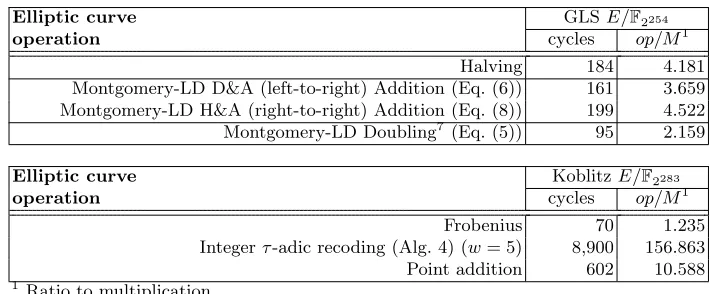
Table 2 presents the experimental timings obtained for the most prominent building blocks required for computing the point multiplication operation on the GLS and Koblitz binary elliptic curves.
Table 2.Timings (in clock cycles) for the elliptic curve operations in the Intel Haswell platform.
Elliptic curve operation
GLSE/F2254
cycles op/M1
Halving 184 4.181 Montgomery-LD D&A (left-to-right) Addition (Eq. (6)) 161 3.659 Montgomery-LD H&A (right-to-right) Addition (Eq. (8)) 199 4.522 Montgomery-LD Doubling7 (Eq. (5)) 95 2.159 Elliptic curve
operation
KoblitzE/F2283
cycles op/M1 Frobenius 70 1.235 Integerτ-adic recoding (Alg. 4) (w= 5) 8,900 156.863 Point addition 602 10.588 1 Ratio to multiplication.
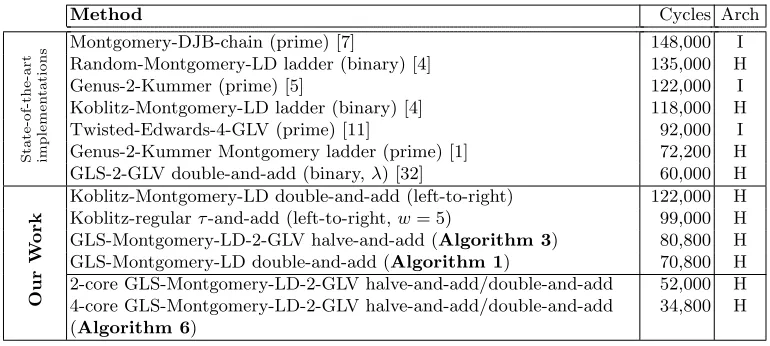
We present in Table 3 a comparison of our timings against a selection of state-of-the-art imple-mentations of the point multiplication operation on binary and prime elliptic curves. Due to the Montgomery-LD point doubling efficiency, which costs 49% less than a point halving, the GLS-Montgomery-LD-double-and-add achieved the fastest timing in the one-core setting, with 70,800 clock cycles. This is 13% faster than the performance obtained by the and-add algorithm. In the known-base point setting, we can ignore the GLS-Montgomery-LD-halve-and-add pre-computation expenses associated with its table of halved points. In that case, we can compute the scalar multiplication in an estimated time of 44,600 clock cycles using a table of just 4128 bytes.
Furthermore, the GLS-Montgomery-LD-halve-and-add is crucial for implementing the multi-core versions of the Montgomery ladder. When compared with our one-core double-and-add implemen-tation, Table 3 reports a speedup of 1.36 and 2.03 in our two- and four-core Montgomery ladder versions, respectively. Here, besides the overhead costs commented in Section 3, we can clearly
6
We intend to submit our software to the ECRYPT Benchmarking of Cryptographic Systems (eBACS) SUPERCOP toolkit in the near future.
7
The flexibility for finding a curve b-constant, provided by the GLS curves, allow us to have a small√b
perceive the usual multicore management penalty. Finally, we observe that our GLS-Montgomery-LD-double-and-add surpasses by 48%, 40% and 2% the Montgomery ladder implementations of [4] (Random), [4] (Koblitz) and [1], respectively.
As for our Koblitz implementations, the fastτendomorphism allows us to have a regular-recoding implementation that outperforms a standard Montgomery ladder for Koblitz curves by 18%. In addition, our fastest Koblitz code surpasses by 16% the recent implementation reported in [4] 8. Finally, note that, in spite of the fact that theτ endomorphism is 26% faster than the Montgomery-LD point doubling, the superior efficiency of the GLS quadratic field arithmetic produces faster results for the GLS Montgomery ladder algorithms.
Table 3.Timings (in clock cycles) for 128-bit level scalar multiplication with timing-attack resistance in the Intel Ivy Bridge (I) and Haswell (H) architectures.
Method Cycles Arch
State-of-the-art implemen
tations
Montgomery-DJB-chain (prime) [7] 148,000 I Random-Montgomery-LD ladder (binary) [4] 135,000 H
Genus-2-Kummer (prime) [5] 122,000 I
Koblitz-Montgomery-LD ladder (binary) [4] 118,000 H Twisted-Edwards-4-GLV (prime) [11] 92,000 I Genus-2-Kummer Montgomery ladder (prime) [1] 72,200 H GLS-2-GLV double-and-add (binary,λ) [32] 60,000 H
Our
W
ork
Koblitz-Montgomery-LD double-and-add (left-to-right) 122,000 H Koblitz-regularτ-and-add (left-to-right,w= 5) 99,000 H GLS-Montgomery-LD-2-GLV halve-and-add (Algorithm 3) 80,800 H GLS-Montgomery-LD double-and-add (Algorithm 1) 70,800 H 2-core GLS-Montgomery-LD-2-GLV halve-and-add/double-and-add 52,000 H 4-core GLS-Montgomery-LD-2-GLV halve-and-add/double-and-add
(Algorithm 6)
34,800 H
6
Conclusion
We presented several algorithms that permit to compute a constant-time high-security point multipli-cation operation over two families of binary elliptic curves, namely, the GLS and the Koblitz curves. Although this work was completely focused on a high-end desk computation of the variable-base point multiplication, the possibility of applying Algorithm 3 to the fixed-base point multiplication setting is highly appealing since that procedure requires a comparatively small pre-computed table of roughly 2n·(n+ 1) bits for computing a point multiplication at the n-bit security level. The above combined with the Montgomery ladder unique feature of performing all the computations using only two point coordinates, should be attractive for deployments of public key cryptography on constrained computing environments.
References
1. D. J. Bernstein, C. Chuengsatiansup, T. Lange, and P. Schwabe. Kummer strikes back: new DH speed records. Cryptology ePrint Archive, Report 2014/134, 2014. http://eprint.iacr.org/.
2. D. J. Bernstein and T. Lange. SafeCurves: choosing safe curves for elliptic-curve cryptography. http: //safecurves.cr.yp.to.
3. D. J. Bernstein and T. Lange. Security dangers of the NIST curves. Invited talk, International State of the Art Cryptography Workshop, Athens, Greece, 2013.
4. M. Bluhm and S. Gueron. Fast Software Implementation of Binary Elliptic Curve Cryptography. Cryp-tology ePrint Archive, Report 2013/741, 2013. http://eprint.iacr.org/.
5. J. W. Bos, C. Costello, H. Hisil, and K. Lauter. Fast Cryptography in Genus 2. In T. Johansson and P. Q. Nguyen, editors,Advances in Cryptology - EUROCRYPT 2013, volume 7881 ofLNCS, pages 194–210. Springer, 2013.
6. S. Chatterjee, K. Karabina, and A. Menezes. A New Protocol for the Nearby Friend Problem. In M. G. Parker, editor,Cryptography and Coding, 12th IMA International Conference, Cryptography and Coding 2009, volume 5921 ofLNCS, pages 236–251. Springer, 2009.
7. C. Costello, H. Hisil, and B. Smith. Faster Compact Diffie-Hellman: Endomorphisms on the x-line. In P. Nguyen and E. Oswald, editors,Advances in Cryptology EUROCRYPT 2014, volume 8441 ofLNCS, pages 183–200. Springer Berlin Heidelberg, 2014.
8. T. Dierks and C. Allen. The TLS Protocol Version 1.0. RFC 2246 (Proposed Standard), Jan. 1999. Obsoleted by RFC 4346, updated by RFCs 3546, 5746, 6176.
9. T. Dierks and E. Rescorla. The Transport Layer Security (TLS) Protocol Version 1.1. RFC 4346 (Proposed Standard), Apr. 2006. Obsoleted by RFC 5246, updated by RFCs 4366, 4680, 4681, 5746, 6176.
10. T. Dierks and E. Rescorla. The Transport Layer Security (TLS) Protocol Version 1.2. RFC 5246 (Proposed Standard), August 2008.
11. A. Faz-Hern´andez, P. Longa, and A. H. Sanchez. Efficient and Secure Algorithms for GLV-Based Scalar Multiplication and Their Implementation on GLV-GLS Curves. In J. Benaloh, editor,Topics in Cryptology - CT-RSA 2014, volume 8366 ofLNCS, pages 1–27. Springer, 2014.
12. A. Fog. Instruction Tables: List of Instruction Latencies, Throughputs and Micro-operation Break-downs for Intel, AMD and VIA CPUs., Accessed: May 14 2014. Available at:http://www.agner.org/ optimize/instruction_tables.pdf.
13. S. D. Galbraith, X. Lin, and M. Scott. Endomorphisms for Faster Elliptic Curve Cryptography on a Large Class of Curves. In A. Joux, editor,Advances in Cryptology - EUROCRYPT 2009, volume 5479 ofLNCS, pages 518–535. Springer, 2009.
14. R. P. Gallant, R. J. Lambert, and S. A. Vanstone. Faster Point Multiplication on Elliptic Curves with Efficient Endomorphisms. In J. Kilian, editor,Advances in Cryptology CRYPTO 2001, volume 2139 of LNCS, pages 190–200. Springer Berlin Heidelberg, August 2001.
15. P. Gaudry, F. Hess, and N. P. Smart. Constructive and destructive facets of Weil descent on elliptic curves.Journal of Cryptology, 15:19–46, March 2002.
16. S. Gueron and V. Krasnov. Fast Prime Field Elliptic Curve Cryptography with 256 Bit Primes. Cryp-tology ePrint Archive, Report 2013/816, 2013. http://eprint.iacr.org/.
17. D. Hankerson, K. Karabina, and A. Menezes. Analyzing the Galbraith-Lin-Scott Point Multiplication Method for Elliptic Curves over Binary Fields. Computers, IEEE Transactions on, 58(10):1411 – 1420, October 2009.
18. D. Hankerson, A. Menezes, and S. Vanstone. Guide to Elliptic Curve Cryptography. Springer-Verlag New York, Inc., Secaucus, NJ, USA, 2003.
19. F. Hess. Generalising the GHS Attack on the Elliptic Curve Discrete Logarithm Problem.LMS Journal of Computation and Mathematics, 7:167–192, June 2004.
20. Y.-J. Huang, C. Petit, N. Shinohara, and T. Takagi. Improvement of Faug`ere et al.’s Method to Solve ECDLP. In K. Sakiyama and M. Terada, editors,Advances in Information and Computer Security -IWSEC 2013, volume 8231 ofLNCS, pages 115–132. Springer, 2013.
21. M. Joye and M. Tunstall. Exponent Recoding and Regular Exponentiation Algorithms. In B. Preneel, editor,Progress in Cryptology – AFRICACRYPT 2009, volume 5580 ofLNCS, pages 334–349. Springer Berlin Heidelberg, 2009.
22. A. H. Koblitz, N. Koblitz, and A. Menezes. Elliptic curve cryptography: The serpentine course of a paradigm shift. Journal of Number Theory, 131(5):781 – 814, 2011. Elliptic Curve Cryptography. 23. N. Koblitz. CM-curves with good cryptographic properties. In J. Feigenbaum, editor, Advances in
24. P. Longa and F. Sica. Four-Dimensional Gallant-Lambert-Vanstone Scalar Multiplication. Journal of Cryptology, 27(2):248–283, 2014.
25. J. L´opez and R. Dahab. Fast Multiplication on Elliptic Curves over GF(2m) without Precomputa-tion. In C¸ etin Kaya Ko¸c and C. Paar, editors, Cryptographic Hardware and Embedded Systems, First International Workshop, CHES’99, volume 1717 ofLNCS, pages 316–327. Springer, 1999.
26. P. L. Montgomery. Speeding the Pollard and elliptic curve methods of factorization. Mathematics of Computation, 48:243–264, 1987.
27. National Institute of Standards and Technology. Recommended Elliptic Curves for Federal Government Use. NIST Special Publication, 1999. http://csrc.nist.gov/csrc/fedstandards.html.
28. C. N`egre and J.-M. Robert. Impact of Optimized Field Operations AB,AC and AB+CD in Scalar Multiplication over Binary Elliptic Curve. InProgress in Cryptology AFRICACRYPT 2013, volume 7918 ofLNCS, pages 279–296. Springer Berlin Heidelberg, 2013.
29. C. N`egre and J.-M. Robert. New Parallel Approaches for Scalar Multiplication in Elliptic Curve over Fields of Small Characteristic. 2013. http://hal.archives-ouvertes.fr/docs/00/90/84/63/PDF/ parallelization-ecsm8.pdf.
30. K. Okeya, T. Takagi, and C. Vuillaume. Efficient representations on koblitz curves with resistance to side channel attacks. InACISP, volume 3574 ofLNCS, pages 218–229. Springer, 2005.
31. T. Oliveira, J. L´opez, D. F. Aranha, and F. Rodr´ıguez-Henr´ıquez. Lambda Coordinates for Binary Elliptic Curves. In G. Bertoni and J.-S. Coron, editors,Cryptographic Hardware and Embedded Systems - CHES 2013, volume 8086 ofLNCS, pages 311–330. Springer, 2013.
32. T. Oliveira, J. L´opez, D. F. Aranha, and F. Rodr´ıguez-Henr´ıquez. Two is the fastest prime: lambda coordinates for binary elliptic curves. J. Cryptographic Engineering, 4(1):3–17, 2014.
33. C. Petit and J.-J. Quisquater. On Polynomial Systems Arising from a Weil Descent. In X. Wang and K. Sako, editors,Advances in Cryptology - ASIACRYPT 2012, volume 7658 ofLNCS, pages 451–466. Springer, 2012.
34. J. Salowey. Confirming Consensus on removing RSA key Transport from TLS 1.3. Transport Layer Security working group of the IETF Mailing List, May 3 2014.
35. M. Scott. Re: NIST announces set of Elliptic Curves. https://groups.google.com/forum/message/ raw?msg=sci.crypt/mFMukSsORmI/FpbHDQ6hM_MJ, 1999.
36. M. Shantz and E. Teske. Solving the Elliptic Curve Discrete Logarithm Problem Using Semaev Polyno-mials, Weil Descent and Gr¨obner Basis Methods – an Experimental Study. Cryptology ePrint Archive, Report 2013/596, 2013. http://eprint.iacr.org/.
37. J. A. Solinas. Efficient Arithmetic on Koblitz Curves.Designs, Codes and Cryptography, 19(2-3):195–249, 2000.
A
Multi-core Montgomery ladder
Here we present the four-core GLS-Montgomery-LD ladder algorithm. Givent4the integer constant that establishes the workload of each algorithm,P∈E(Fq2), and the scalarkrepresented ask1+k2·δ
using the GLS-GLV method, coresIandII are both responsible for computingbn
2c −t4bits of the subscalarsk1andk2using the Montgomery-LD double-and-add method. In turn, the coresIIIand IV, both compute t4 bits of k1 andk2 with the Montgomery-LD halve-and-add algorithm. In the end, on a single core, it is necessary to add all the accumulatorsQi, fori= 0. . .3.
Algorithm 6Parallel Montgomery ladder scalar multiplication (four-core) Input: P∈E(Fq2), scalarkof bit lengthn, integer constantt4
Output: Q=kP k0←2t4k
Representk0=k01+k20λ, whereψ(P) =λP
{Initialization}
R0 ← O, R1←P fori=dn
2edowntot4do
b←k10,i∈ {0,1}
R1−b←R1−b+Rb
Rb←2Rb
end for
Q0←R0
{Barrier} Core I
{Initialization}
R0← O, R1←P fori=dn
2edowntot4do
b←k20,i∈ {0,1}
R1−b←R1−b+Rb
Rb←2Rb
end for
Q1←R0
{Barrier} Core II
{Precomputation}
fori= 1downtot4+ 1do
Pi← 2Pi
end for {Initialization}
R1 ←Pt4+1,R2←Pt4+1
fori= 0downtot4−1do
R0←Pt4−i b←k10,i∈ {0,1}
R2−b←R2−b+R0 end for
Q2←R1−Pt4+1
{Barrier} Core III
{Precomputation}
fori= 1downtot4+ 1do
Pi← 2Pi
end for {Initialization}
R1←Pt4+1,R2←Pt4+1
fori= 0downtot4−1do
R0←Pt4−i b←k20,i∈ {0,1}
R2−b←R2−b+R0 end for
Q3←R1−Pt4+1
{Barrier} Core IV
B
Memory access pattern
The following data veiling algorithm ensures a fixed memory access pattern for all Montgomery-LD ladder algorithms. Given the two Montgomery-LD ladder accumulators A and B, and the scalar k= (kn−1, kn−2, . . . k0), this method allows us, in the beginning of thei-th main loop iteration, to
use the bits ki−1 and ki to decide if A and B will or will not be swapped. As a result, it is not necessary to reapply the procedure at the end of thei-th iteration.
Algorithm 7Data veiling algorithm
Input: Scalar digitskiandki−1, Montgomery-LD ladder accumulatorsAandB Output: Montgomery-LD ladder accumulatorsAandB
mask←0−(ki−1⊕ki)
tmp←A⊕B tmp←tmp∧mask A←A⊕tmp B←B⊕tmp
return A, B
C
GLS elliptic curve parameters
For achieving a greater benefit from the multiplication by theb-constant in the Montgomery-LD doubling formula
X3=X04+bZ04= (X02+√bZ02)2
we carefully selected a GLS curve with a 64-bitb-parameter square-root. As a result, we saved two carry-less multiplication and a dozen of SSE instructions per field multiplication. Next, we describe the parameters, as polynomials represented in hexadecimal, for our GLS curveEa,b/Fq2:y2+xy=
x3+ax2+b.
– a=u
– b=0x54045144410401544101540540515101
– √b=0xE2DA921E91E38DD1
The 253-bit prime orderrof the main subgroup ofEa,b/Fq2 is,
r=0x1FFFFFFFFFFFFFFFFFFFFFFFFFFFFFFFA6B89E49D3FECD828CA8D66BF4B88ED5.
The base pointP = (x, y) of orderr used in this work is,
x=0x4A21A3666CF9CAEBD812FA19DF9A3380+ 0x358D7917D6E9B5A7550B1B083BC299F3·u
y=0x6690CB7B914B7C4018E7475D9C2B1C13+ 0x2AD4E15A695FD54011BA179D5F4B44FC·u.