Fault Analysis Study of the Block Cipher FOX64
Ruilin Li1, Jianxiong You1, Bing Sun1,2, and Chao Li1,3
1
Department of Mathematics and System Science, Science College, National University of Defense Technology, Changsha, 410073, China
2
State Key Laboratory of Information Security, Institute of Software, Chinese Academy of Sciences, Beijing, 100190, China
3
College of Computer, National University of Defense Technology, Changsha, 410073, China
Abstract. FOX is a family of symmetric block ciphers from MediaCrypt AG that helps to secure digital media, communications, and storage. The high-level structure of FOX is the so-called (extended) Lai-Massey scheme. This paper presents a detailed fault analysis of the block cipher FOX64, the 64-bit version of FOX, based on a differential property of two-round Lai-Massey scheme in a fault model. Previous fault attack on FOX64 shows that each round-key (resp. whole round-keys) could be recovered through 11.45 (resp. 183.20) faults on average. Our proposed fault attack, however, can deduce any round-key (except the first one) through 4.25 faults on average (4 in the best case), and retrieve the whole round-keys through 43.31 faults on average (38 in the best case). This implies that the number of needed faults in the fault attack on FOX64 can be significantly reduced. Furthermore, the technique introduced in this paper can be extended to other series of the block cipher family FOX.
Keywords:Side-channel attacks, Fault attacks, Block ciphers, Lai-Massey scheme, FOX
1
Introduction
1.1 Backgrounds
Last fifteen years saw the rapid development of physical attacks on symmetric key primitives based on the implementation of cryptographic algorithms in hardware or software environments. Among these attacks, side-channel attacks and fault attacks attract more attention. Side-channel attack is a kind of passive attack that could be used to retrieve the secrete key by exploiting some leakage of the internal states during the encryption process. These leakage includes timing information, power consumptions, electro-magnetic radiations, etc., and can be collected by some special equipments. After obtaining these leakage, adversary can efficiently deduce the key through some statistical tools or algebraic methods.
referred as Differential Fault Analysis. Since then, fault attacks have been used to attack many other symmetric key ciphers.
1.2 Related Works
Fault Attacks on Block Ciphers. Besides DES-like (Feistel structure) block ciphers, many research concentrate applying fault attacks against other kinds of block ciphers that adopt (gener-alized) unbalanced Feistel structure, SPN structure or Lai-Massey structure. For instance, among fault based attacks on AES [1, 10, 14, 16, 17, 24, 30–32, 36], the works in [31] show the feasibility of extracting the 128-bit key through one single byte fault under Piret’s attack model [32]. And by studying the properties of mixing operations (⊕,,⊙) on different groups, a fault attack on the nice block cipher IDEA was carefully analyzed in [15].
Faults Attacks on Stream Ciphers. Hoch and Shamir firstly applied fault based attack to sev-eral stream ciphers [19], including LFSR-based traditional ciphers (schemes based on memoryless filters and combiners, such as LILI-128 and Sober) and RC4 etc. in 2004. Then in 2005, Biham et al. investigated impossible fault and differential fault analysis of RC4 [9]. However, those fault attacks do not work in general for stream ciphers that use combiners with memory. This problem was later solved in [4] by Armknecht and Meier who developed fault attacks against general com-biners with memory based on LFSRs (see e.g. E0 and SNOW 2.0). More recently, many winners of the stream ciphers from eSTREAM project, such as Trivium, Rabbit, HC-128, were also shown to be suffered from fault attacks [7, 20, 21, 25, 26].
Fault Models and Implementation Aspects. When applying fault attacks, it is usually as-sumed that the adversary could inject faults during a calculation of the encryption (decryption) algorithm, thus the fault model (the location and timing of fault injection, and the values of faults) is the main issue that one must take into account. Many ingredients influence the model, such as the inner structure, the data register, the powerful equipments possessed by the adversary, etc. In fact, there are many ways of performing a fault attack [2, 3, 5, 18, 35], such as glitch attack, light attack, magnetic attack, etc. These methods could induce faults at bit, byte or even multi-bytes levels.
Countermeasures. Another important issue of fault attacks is the countermeasures. Compared with the existing fault attacks on various ciphers, the countermeasures seem to belong to another independent field, and there are many general countermeasures (hardware or software oriented) [6, 23, 29, 33, 34] for protecting ciphers from fault attacks. The main principle is to provide inherent resistance to prevent specific transient fault, or to offer redundant calculation for error detection. However, as demonstrated in [12, 27], providing countermeasures against fault attacks of block ciphers maybe a challenging and hard task.
1.3 Main Contribution and Outline of This Paper
a variable key length ranging from 8 to 256 bits. The high-level structure of FOX is the so-called (extended) Lai-Massey scheme, whose provable security had been carefully studied in [28, 37]. The round function is of SPS-type with three layers of round key addition, which could meanwhile provide its security against differential and linear cryptanalysis.
Another feature of FOX is its key schedule, as has been declaimed in [22]. Unlike most other block ciphers, given any single or even several round-keys of FOX, it is hard to invert the round-key generation process to obtain the master key. Due to this, any adversary that basing fault attacks to deduce the secrete key has to retrieve the whole round-keys, which implies that the number of faults injected must be large. In fact, this has been verified by Breveglieri, Koren, and Maistri in [13], where they introduced a first fault attack on FOX64, the 64-bit version of FOX, and demonstrated that one round-key could be recovered by 11.45 faults on average in the random byte fault model, and the whole round-keys could be recovered by 183.20 faults on average.
Main Contribution. This paper presents a detailed fault analysis of FOX64, and proposes an improved fault attack. This is mainly based on an observation of a differential property of two round Lai-Massey scheme in a fault model. Using the proposed method, faulty ciphertexts that are obtained when faults are injected in the i-th round can be used twice (previous fault attack use those ciphertexts only once for deducing thei-th round-key): one for deducing the (i+ 1)-th round-key, and the other for deducing the i-th round-key, thus the number of needed faults are significantly reduced. The simulation result shows that the 64-bit round-key could be revealed by 4.25 faults on average, and the whole round-keys can be deduced through only 43.31 faults on average. Furthermore, such a method could be generalized to other series of the block cipher family FOX.
Outline. The outline of this paper is as follows: we begin with a brief description of FOX in Section 2, and then present some properties of the components of FOX in Section 3. The previous fault attack is described in Section 4, and our improved fault attack is presented in Section 5. Section 6 demonstrates experimental results, and finally, Section 7 is the conclusion.
2
Description of the Block Cipher FOX
This section briefly describes FOX64, for other series, one can refer [22].
2.1 Encryption of FOX64
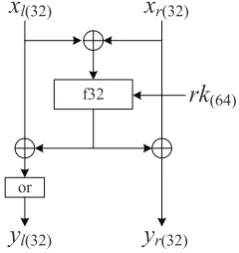
FOX64 has a 64-bit block size and a 128-bit key length. It iterates 15 times the round transformation lmor64, as illustrated in Fig.1, followed by a final round transformation calledlmid64.
The round transformation lmor64, which employs a Lai-Massey scheme, transforms a 64-bit inputx(64) and a 64-bit round keyrk(64) into a 64-bit outputy(64), which is defined as
y(64)=lmor64(xl(32)∥xr(32), rk(64))
f32
or
x
l(32)x
r(32)y
l(32)y
r(32)rk
(64)Fig. 1.Round transformationlmor64
x
l(16)x
r(16)y
l(16)y
r(16)Fig. 2.Orthomorphismor
The orthomorphismoris a function that takes a 32-bit inputx(32)and returns a 32-bit output y(32), as illustrated in Fig.2, which is defined by a simple Feistel transformation as
yl(16)||yr(16)=or(xl(16)||xr(16)) =xr(16)||(xl(16)⊕xr(16)).
Thelmid64function is a slightly modified version of lmor64, where the transformationoris replaced by a identify transformation.
The encryptionc(64) by FOX64 of a 64-bit plaintext p(64) is defined as c(64)=lmid64(lmor64(· · ·lmor64(p(64), rk0),· · ·, rk14), rk15),
where rki, i = 0,1,· · ·,15, are round-keys generated through the key schedule from the master key.
2.2 Round Function f32
The round functionf32consists of three main parts: a substitution part, denoted sigma4, a diffusion part, denoted mu4, and a round key addition part. Formally, the round functionf32takes a 32-bit inputx(32) , a 64-bit round keyrk(64)=rk0(32)||rk1(32) and returns
y(32)=f32(x(32), rk(64))
=sigma4(mu4(sigma4(x(32)⊕rk0(32)))⊕rk1(32))⊕rk0(32).
The fuction sigma4 takes a 32-bit input x(32) = x0(8)∥x1(8)∥x2(8)∥x3(8) and returns a 32-bit outputy(32), it consists of 4 parallel computations of a non-linear mappingsbox, i.e.
y(32)=sigma4
(
x0(8)∥x1(8)∥x2(8)∥x3(8)
)
=sbox(x0(8))∥sbox(x1(8))∥sbox(x2(8))∥sbox(x3(8)).
The function mu4 takes a 32-bit input x0(8)∥x1(8)∥x2(8)∥x3(8) and returns a 32-bit output y0(8)∥y1(8)∥y2(8)∥y3(8). It is defined by
y0(8) y1(8) y2(8) y3(8)
=
1 1 1θ 1z θ1 z θ1 1 θ1z1
×
x0(8) x1(8) x2(8) x3(8)
whereθ∈GF(28) is the root of the irreducible polynomialm(x) =x8+x7+x6+x5+x4+x3+ 1∈ GF(2)[x] andz=θ−1+ 1.
2.3 Key Schedule
The key schedule procedure of FOX64 generates 16 round-keysrki,i= 0,1, . . . ,15, from a master key K. Each round-key is 64-bit, denoted as a concatenation of two 32-bit strings, i.e. rki = rki,0∥rki,1.
The key schedules of FOX series are very complex compared with other existing block ciphers, each round-key is related to the secret key and it is very difficult to acquire information about secret key or other round-keys from some certain round-keys. Due to this, in this paper, we assume that all round-keys are independent with each other. One can refer [22] for the detail of the key schedule.
3
Some Properties of the Components of FOX64
In this section, we study some properties of the components of FOX64 that are related to the fault attacks.
3.1 Differential Property of the S-box in the Substitution Layer
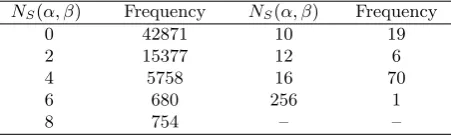
Given an 8×8 Sbox S(·),α, β ∈ {0,1}8, define NS(α, β) = #{x∈ {0,1}8 : S(x)⊕S(x⊕α) = β}, then the differential property of the Sbox can be characterized by all the possible triplets (α, β, NS(α, β)). Table 1 summarizes the differential property of the Sbox employed in the substi-tution layer of FOX64.
Table 1.Differential property of the Sbox in FOX64
NS(α, β) Frequency NS(α, β) Frequency
0 42871 10 19
2 15377 12 6
4 5758 16 70
6 680 256 1
8 754 – –
Remark 1. AssumeS(·) is the Sbox of FOX64, ifNS(α, β)̸= 0, then the expected value ofNS(α, β) is
65536
65536−42871 ≈2.89
3.2 Inverse Property of the Diffusion Layer
The differential branch number of mu4is 5, which implies that any input with one non-zero byte will lead to some output with four non-zero bytes. Moreover, the inversion of mu4, denoted as mu4−1, can be expressed as follow:
a c d e a d e c a e c d b a a a
,
wherea=θ6+θ5+θ4+θ3+θ2+θ,b=θ7+θ6+θ+ 1,c=θ7+θ6+θ5+ 1,d=θ7+θ5+θ3+θ2+ 1 ande=θ7+θ5+θ4.
4
Previous Fault Attack on FOX64
To briefly describe the previous fault attack [13] and our improved fault attack on FOX64 in the next section, we first introduce the following notations that will be used throughout this paper.
– Assume all the round-keys, generated from the secret master keyKthrough the key schedule, arerki=rki,0∥rki,1,i= 0,1,2, . . . ,15.
– Denote a plaintext byp=pl∥pr, and the corresponding ciphertext byc=EK(p) =cl∥cr. This ciphertext is called theright ciphertext and any indeterminate states corresponding to it are called theright indeterminate states.
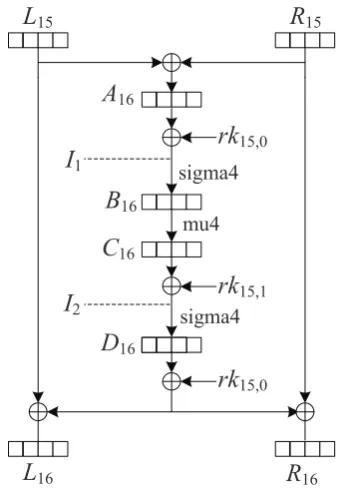
– Consider the last round of FOX64: LetA16denote the input of the round functionf32;I1and B16 denote the input and output of the first substitution layer, respectively, i.e.I1 =A16⊕ rk15,0,B16=sigma4(I1);C16 denote the output of the diffusion layer, i.e.C16=mu4(B16);I2 andD16 denote the input and output of the second substitution layer, i.e.I2 =C16⊕rk15,1, D16=sigma4(I2).
– Given a 32-bit right stateX, X∗ denotes thefaulty counterpart, and ∆X=X⊕X∗ denotes their difference.
As discussed in Section 2.3, due to the complexity of the key schedule, any fault attack on FOX64 aims to deduce all the round-keys.
Take the last round of FOX64 as an example, see Fig.3, both the previous fault attack and our improved fault attack (as described later) try to retrieve the 64-bit round-key by recovering the right intermediate stateI1andI2. OnceI1andI2 are known, one can do as follows:
– According toI1=A16⊕rk15,0=cl⊕cr⊕rk15,0, we thus haverk15,0=cl⊕cr⊕I1.
– According toI2=C16⊕rk15,1=mu4(B16)⊕rk15,1=mu4(sigma4(I1))⊕rk15,1, we thus have rk15,1=I2⊕mu4(sigma4(I1)).
In order to recover the right stateI1andI2, previous fault attack adopts the random byte fault model and divides the attack procedure into the following two phases.
rk
15,0rk
15,1rk
15,0L
15R
15L
16R
16sigma4
mu4
sigma4
A
16B
16C
16D
16I
2I
1Fig. 3.Last round of FOX64
– In the second phase, the adversary also injects faults into the calculation of the round function and the location this time is only before the first substitution layer. He then applies differential cryptanalysis to the first substitution layer to recover I1 based on the correct ciphertext and those faulty ciphertexts. The number of faults in this phase is about 8∼28 and 8.51 on average. In total, about 8∼31 faults (11.45 on average) are needed to recover the right stateI1 andI2.
5
Improved Fault Attack On FOX64
In this section, we present our improved fault attack on FOX64, which is, in fact, based on a differential property of two-round Lai-Massey Scheme in a fault model.
5.1 A Differential Property of Two-round Lai-Massey Scheme In a Fault Model
f32
or
L
0R
0f32
L
1R
1L
2R
2D
0A
0A
1D
1Fig. 4.Two round Lai-Massey scheme in a fault model
Proof. From ∆A0̸= 0, we have∆D0̸= 0. Assume∆D0= (x0, x1, x2, x3), then ∆L1=or(∆L0⊕∆D0) =or(x0, x1, x2, x3) = (x2, x3, x0⊕x2, x1⊕x3), ∆R1= (x0, x1, x2, x3).
Notice that∆A1=∆L1⊕∆R1=∆L2⊕∆R2, thus
∆A1= (α0⊕β0, α1⊕β1, α2⊕β2, α3⊕β3) is known. Meanwhile, from
(x2, x3, x0⊕x2, x1⊕x3)⊕(x0, x1, x2, x3) = (α0, α1, α2, α3)⊕(β0, β1, β2, β3), we get
(x0, x1, x2, x3) = (α2⊕β2, α3⊕β3, α0⊕α2⊕β0⊕β2, α1⊕α3⊕β1⊕β3).
Thus
∆D1=∆R2⊕∆R1
= (β0, β1, β2, β3)⊕(x0, x1, x2, x3)
= (α2⊕β0⊕β2, α3⊕β1⊕β3, α0⊕α2⊕β0, α1⊕α3⊕β1).
which ends the proof. ⊓⊔
5.2 General Idea of the Improved Fault Attack
We adopt the same attack model as in [13] and improve the efficiency of the previous fault attacks in the following two ways:
– To retrieve the 64-bit round-key for some certain round, say the i-th round, previous fault attack injects sufficient faults (about 8∼31) to the samei-th round, while ours is to induce (less) faults at both thei-th and (i−1)-th rounds to deduce the round-key, and it can decrease the number of needed faults.
– In our improved attack, the faulty ciphertexts that are obtained when faults are injected in the i-th round are used twice (one for deducing the (i+ 1)-th round-key, and the other for deducing thei-th round-key), thus the number of needed faults is reduced (previous fault attack use those ciphertexts only once for deducing the i-th round-key).
We briefly summarize the improved fault attack below:
1. Choose an arbitrary plaintext, encrypt it with the secret key and obtain the ciphertext. For the same plaintext, induce several random byte faults into the input of the round function in each round, obtain these faulty ciphertexts.
2. Deduce the last round-key through the right ciphertext and the faulty ciphertexts that are obtained when faults are induced in the last round and penultimate round.
(a) Consider the right ciphertext and faulty ciphertexts that are obtained when faults are induced into the last round, recover the right input state before the second substitution layer sigma4 in the last round.
(b) Consider the right ciphertext and faulty ciphertexts that are obtained when faults are in-duced into the penultimate round, recover the right input state before the first substitution layer sigma4 in the last round.
(c) Use the right intermediate states obtained from (a)(b) and the correct ciphertext, directly deduce the 64-bit round-key in the last round.
3. Since the last round-key is obtained, we can peel off the last round encryption to obtain the output of the penultimate round, thus the other faulty ciphertexts could be similarly used to recover the last second round-key. In general, this technique can be iteratively adopted to deduce all round-keys from the 2nd round to the 15-th round in the reverse order.
4. Recover the first round-key as described in Section 4.
5.3 Attack Procedure
Step 1 Data gathering. Choose an arbitrary plaintextp=pl∥pr, and obtain the right ciphertext c=cl∥cr under the secret user keyK. For the same plaintextp, induce several random byte faults into the input of the round function f32 in each round, and obtain these faulty ciphertexts.
rk
15,0rk
15,1rk
15,0
L
15
R
15
L
16
R
16 sigma4
mu4
sigma4
A
16
B
16
C
16
D
16zero difference
non-zero difference
I
2I
1Fig. 5.Attack last round in Step 2.1
rk14,0
rk14,1
rk14,0
L14 R14
sigma4
mu4
sigma4
rk15,0
rk15,1
rk15,0
L15 R15
L16 R16
sigma4
mu4
sigma4 A16
B16
C16
D16
A15
B15
C15
D15
or
zero difference non-zero difference
I2 I1
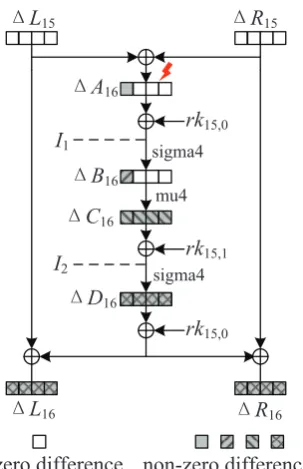
Step 2.1 Recover the right input state I2 before the second substitution layer in the last round This is finished by considering the right ciphertext and faulty ciphertextsc∗=c∗l∥c∗r, which are obtained when faults are induced into the last round. The attack procedure is depicted in Fig.5.
On the basis of assumption of one random byte fault, ∆A16 has 4×255 = 1020 possibilities, so is∆B16, thus∆C16 =mu4(∆B16) also has only 1020 possibilities. The output difference after the second substitution layer can be calculated by ∆D16 = ∆L16⊕∆L15 = cl ⊕c∗l. For all possible values of (∆C16, ∆D16), when apply differential cryptanalysis, this would lead to many possibilities ofI2=C16⊕rk15,1. We can further decrease the number ofI2candidates by repeating the above method through other collected faulty ciphertexts, until the candidate set ofI2has only one element.
Step 2.2 Recover the right input state I1 before the first substitution layer in the last round This is finished by considering the right input stateI2 deduced in step 2.1 and the faulty ciphertextsc∗=c∗l∥c∗r, which are obtained when faults are induced in the penultimate round. The attack procedure is depicted in Fig.6.
Since the round-key addition layer doesn’t influence the difference, according to proposition 1, both ∆A16 and ∆D16 could be calculated by ∆L16 = ∆cl and ∆R16 = ∆cr. Moreover, D16 is obtained throughD16=sigma4(I2), thusD16∗ =D16⊕∆D16is known, and∆C16can be obtained as
∆C16=C16⊕C16∗
=sigma4−1(D16)⊕rk15,1⊕sigma4−1(D16∗ )⊕rk15,1 =sigma4−1(D16)⊕sigma4−1(D∗16),
wheresigma4−1is the inversion of sigma4.
According tomu4−1,∆B16 can be calculated by∆B16=mu4−1(∆C16). After getting sufficient pairs (∆A16, ∆B16) from the correct and faulty ciphertexts, we can apply the differential crypt-analysis on the first substitution layer to uniquely deduce the right input stateI1=A16⊕rk15,0 before this substitution layer.
Step 2.3 Recover the last round-keyrk15,0and rk15,1 This is finished by directly calculating these round-keys from the right intermediate stateI1,I2 as described in Section 4.
Step 3 Recover round-keys from the 2-nd round to the 15-th round in reverse order. Since the last round-key is obtained, we can peel off the last round to obtain the output of the penultimate round. Then the same technique as described in Step 2 could be used to recover other round-keys. More precisely, we can do as follows:
Fori= 2,3, . . . ,15, consider the right ciphertext and faulty ciphertexts when faults are induced in the (16−i)-th and (17−i)-th round, peel off the last (i−1)-th round(s) according to the deduced round-key(s), and use these outputs of the (17−i)-th round to recover the (17−i)-th round-key. This can be finished by adopting the same technique as in Step 2.
ciphertexts when faults are induced in the first round. Retrieve the first round-key using the same technique as described in Section 4.
5.4 Complexity Analysis
To evaluate how many faults are needed to recover the whole round-keys, we firstly concentrate on the one round situation. It is easy to show that, to recover one round-key, the main complexity is dominated by step 2.1 and step 2.2.
In step 2.1,∆C16 has 1020 possibilities, so to uniquely deduce all bytes of I2 (thusD16), the number of faulty ciphertexts, denoted byN, must be satisfied
2564×
(
1020 2554
)N
≤1.
In general, if the differential distribution table of the S-box is good enough, two faults (i.e.N = 2) can uniquely retrieveI2.
According to the differential property of the Sbox of FOX64, if NS(α, β)̸= 0, this difference pair (α, β) will lead to about 2.89 ≈ 3 possible inputs to the Sbox. Then we can use a similar technique [17] to analyze the complexity in step 2.2 as follows:
When the number of faulty ciphertexts is 2, we have one possible value left forI1with probability
Prob=
((255 2
)
×(255−2 2 ) (255 2 )2 )4
≈93.88%.
When the number of faulty ciphertexts is 3, we have one possible value left forI1with probability
Prob= 2 ∑ k=0 ((255 2 ) ×(2
k
)
×(255−2 2−k
) (255
2
)2 ×
(255 k
)
×(255−k 2
) (255
k
) ×(255
2
) )4
≈99.95%.
The above analysis indicates that, in most cases, about 4 ∼6 faults are enough to uniquely deduce the round-key (excluding the first round). Note that, to recover the first round-key, we have to use the same technique as in [13], i.e. we must induce about 8∼31 faults. Thus, to retrieve the whole round-keys, we need 2×16 + 6 = 38 faults in the best case. The general case of the needed faults for obtaining the whole (each) round-key(s) are analyzed in Section 6.
6
Experimental Results
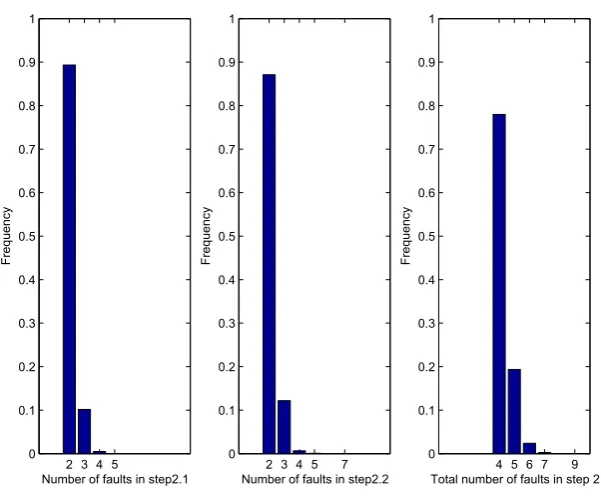
Our proposed fault attack against the last round of FOX64 has been successfully implemented through computer simulation, and the fault injection is simulated by computer software. We im-plement the attack procedure in C++ code and execute it on a PC with Intel Pentium 1.80 GHz processor. We repeat the attack 10000 times and the results are shown in Fig.7.
2 3 4 5 0 0.1 0.2 0.3 0.4 0.5 0.6 0.7 0.8 0.9 1
Number of faults in step2.1
F re q u e n cy
2 3 4 5 7 0 0.1 0.2 0.3 0.4 0.5 0.6 0.7 0.8 0.9 1
Number of faults in step2.2
F re q u e n cy
4 5 6 7 9 0 0.1 0.2 0.3 0.4 0.5 0.6 0.7 0.8 0.9 1
Total number of faults in step 2
F re q u e n cy
Fig. 7.Simulation results of the improved fault attack against the last round of FOX64
Table 2.Comparison with fault attacks against the last round of FOX64
Fault Location No. of Faults No. of Faults No. of Faults Source
Minimum Average Maximum
Last round 8 11.45 31 [13]
Last and penultimate round 4 4.25 9 Section 5
Table 3.Comparison with fault attacks against the whole rounds of FOX64
No. of Fault Locations No. of Faults No. of Faults Source
Best Case Average
16 128 183.20 [13]
16 38 43.31 Section 5
7
Conclusion
A detailed fault analysis of FOX64 is studied in this paper, after carefully observing a differential property of two round Lai-Massey scheme in a fault model, an improved fault attack on FOX64 is proposed. Compared with the previous attack, the number of needed faults in the proposed attack is significantly reduced, this is caused by the fact that many faulty ciphertexts can be used twice according to the observed property.
We remind that the technique of the new attack on FOX64 can also be extended to other series of the block cipher family FOX. We also point out that, due to the characteristic of the key schedule, it seems hard to improve the efficiency of the fault based attack on FOX.
Acknowledgements
The work in this paper is supported by the National Natural Science Foundation of China (No: 61103192, 61070215), the Program for Changjiang Scholars and Innovative Research Team in University of Ministry of Education of China (No: IRT1012), the Fund for Creative Research Groups of the Natural Science Foundation of Hunan Province, China (No: 11FH002), and the open research fund of State Key Laboratory of Information Security (No: 01-02-5).
References
1. S. Ali and D. Mukhopadhyay and M. Tunstall. Differential Fault Analysis of AES using a Single Multiple-Byte Fault. Cryptology ePrint Archive: Report 2010/636, available through: http://eprint.iacr.org/2010/636.
2. R. Anderson and M. Kuhn. Tamper resistance – a cautionary note. Second USENIX workshop on eletronic commerce, 1996, pp. 1–11.
3. R. Anderson and M. Kuhn. Low cost attacks on tamper resistant devices. Security Protocols 1997, LNCS 1361, pp. 125–136, Springer, 1997.
4. Frederik Armknecht and Willi Meier. Fault Attacks on Combiners with Memory. SAC 2005, LNCS 3897, pp. 36–50, Springer, 2006.
5. H. Bar-El, H. Choukri, D. Naccache, M. Tunstall, and C. Whelan. The sorcerer’s apprentice guide to fault attacks. Proceedings of the IEEE, Vol 94(2): 370–386, 2006.
6. G. Bertoni, L. Breveglieri, I. Koren, P. Maistri, and V. Piuri, Error Analysis and Detection Proce-dures for a Hardware Implementation of the Advanced Encryption Standard, IEEE Transactions on Computers, Vol 52(4): 492–505, 2003.
7. Alexandre Berzati, C´ecile Canovas-Dumas, and Louis Goubin. Fault Analysis of Rabbit: Toward a Secret Key Leakage. INDOCRYPT 2009, LNCS 5922, pp. 72–87, Springer, 2009.
8. E. Biham and A. Shamir. Differential Fault Analysis of Secret Key Cryptosystems. CRYPTO 97, LNCS 1294, pp. 513–525, Springer, 1997.
9. E. Biham, L. Granboulan and P. Q. Nguyn, Impossible Fault Analysis of RC4 and Differential Fault Analysis of RC4. FSE 2005, LNCS 3557, pp. 359-367, Springer, 2005.
10. J. Bl¨omer and J.-P. Seifert. Fault Based Cryptanalysis of the Advanced Encryption Standard (AES). FC 2003, LNCS 2742, pp. 162–181, Springer, 2003.
11. D. Boneh, R. A. DeMillo, R. J. Lipton. On the importance of checking cryptographic protocols for faults. EUROCRYPT’97, LNCS 1233, pp. 37–51, Springer, 1997.
13. L. Breveglieri, I. Koren, and P. Maistri. A Fault Attack Against the FOX Cipher Family. FDTC 2006, LNCS 4236, pp. 98–105, Springer 2006.
14. C.-N. Chen and S.-M. Yen. Differential Fault Analysis on AES key Schedule and Some Countermea-sures. ACISP 2003, LNCS 2727, pp. 118–129, Springer, 2003.
15. C. Clavier, B. Gierlichs, and I. Verbauwhede. Fault Analysis Study of IDEA. In CT-RSA 2008, LNCS 4964, pp. 274-287, Springer, 2008.
16. P. Dusart, G. Letourneux and O. Vivolo. Differential Fault Analysis on A.E.S. ACNS 2003, LNCS 2846, pp. 293–306, Springer, 2003.
17. C. Giraud. DFA on AES. AES 2004, LNCS 3373, pp. 27–41, Springer, 2005.
18. C. Giraud and H. Thiebeauld. A survey on fault attacks. CARDIS 2004, pp. 159–176, Springer, 2004. 19. Jonathan J. Hoch, A. Shamir. Fault Analysisi of Stream Ciphers. CHES 2004. LNCS 3156, pp.240-253.
Springer, 2004.
20. M. Hojsik and B. Rudolf. Differential Fault Analysis of Trivium. FSE 2008, LNCS 5086, pp. 158-172, Springer, 2008.
21. M. Hojsik and B. Rudolf. Floating Fault Analysis of Trivium. INDOCRYPT 2008, LNCS 5365, pp. 239–250, Springer, 2008.
22. P. Junod and S. Vaudenay. FOX: A New Family of Block Ciphers. SAC 2004, LNCS 3357, pp. 114–129, Springer, 2005.
23. M. Karpovsky, K. J. Kulikowski, and A. Taubin. Robust Protection against Fault-Injection Attacks on Smart Cards Implementing the Advanced Encryption Standard. DSN 2004, pp. 93–101, IEEE Computer Society, 2004.
24. C. H. Kim and J.-J. Quisquater. New Differential Fault Analysis on AES Key Schedule: Two Faults Are Enough. CARDIS 2008, LNCS 5189, pp. 48–60, Springer, 2008.
25. A. Kircanski and Amr M. Youssef. Differential Fault Analysis of Rabbit. SAC 2009, LNCS 5867, pp. 197–214, Springer, 2009.
26. A. Kircanski and Amr M. Youssef. Differential Fault Analysis of HC-128. AFRICACRYPT 2010, LNCS 6055, pp. 261–278, Springer, 2010.
27. Y. Li, K. Sakiyama, S. Gomisawa, T. Fukunaga. Fault Sensitivity Analysis. CHES 2010, LNCS 6225, pp. 320–334, Springer, Springer, 2010.
28. Y. Luo, X. Lai, Z. Gong. Pseudorandomness analysis of the (extended) Lai-Massey scheme. Information Processing Letters, Vol 111(2): 90–96, Elsevier, 2010.
29. P. Maistri and R. Leveugle. Double-data-rate computation as a countermeasure against fault analysis, IEEE Transactions on Computers, Vol 57(11): 1528–1539, 2008.
30. A. Moradi, M. T. M. Shalmani, and M. Salmasizadeh. A Generalized Method of Differential Fault Attack Against AES Cryptosystem. CHES 2006, LNCS 4249, pp. 91-100, Springer, 2006.
31. D. Mukhopadhyay. An Improved Fault Based Attack of the Advanced Encryption Standard. AFRICACRYPT 2009, LNCS 5580, pp. 421–434, 2009.
32. G. Piret and J.-J. Quisquater. A Differential Fault Attack Technique against SPN Structures, with Application to the AES and KHAZAD. CHES 2003, LNCS 2779, pp. 77-88, Springer, 2003.
33. J. Rajendran, H. Borad, S. Mantravadi and R. Karri. SLICED: Slide-based Concurrent Error Detection Technique for Symmetric Block Ciphers. HOST 2010, IEEE International Symposium, pp. 70–75. 34. A. Satoh, T. Sugawara, N. Homma, T. Aoki. High-Performance Concurrent Error Detection Scheme
for AES Hardware. CHES 2008, LNCS 5154, pp. 100–112, Springer, 2008.
35. S.P. Skorobogatov, R.J. Anderson. Optical fault induction attacks. CHES 2002, LNCS 2523, pp. 2–12, Springer, 2003.
36. J. Takahashi, T. Fukunaga, K. Yamakoshi. DFA Mechanism on the AES Key Schedule. FDTC 2007, pp. 62–74, IEEE Computer Society, 2007.