IJEDR1803019
International Journal of Engineering Development and Research (
www.ijedr.org
)
101
Power Loss Minimization with Multiple DG in
Distribution System using Gravitational Search
Algorithm
1Himani Bharti, 2 Jai Singh Arya1, 3Aadesh Kumar Arya 1 M.Tech Student, 2Associate Professor & Head, 3 Assistant Professor
1,2,3 Department of Electrical Engineering
1,2Geeta Institute of Management and Technology, Kurukshetra, India, 3College of Engineering Roorkee, Roorkee, India
_____________________________________________________________________________________________________
Abstract— Today electrical energy crises is increasing in our country as well as in whole world. This energy crises problem can be solve with the integration of Distributed Generation (DG) in distribution system. Now-a-days, meta-heuristic optimization techniques are used to determination of optimal allocation of Distributed Generation. In this paper, Gravitational Search Algorithm (GSA) is used for optimal allocation of Distributed Generators (DG) for minimization of power loss and voltage profile improvement. The forward-backward sweep methodology is used for load flow analysis on distribution system. The performance of this proposed methodology is tested on IEEE 33 & 69-Bus distribution system.
Index Terms— Gravitational Search Algorithm (GSA), Distribution System, Power Loss minimization, Distributed Generation (DG)
_____________________________________________________________________________________________________
I. INTRODUCTION
Integration of distributed generation (DG) is a part of smart grid which is presently forming the backbone of modern era power distribution system [1]. A modern power system means the system should be satisfying various operating criteria for stability at any time. Now -a –days, the modern power system has the challenged with the increasing load demands from the domestic and commercial sectors [2, 3]. The large demand gap of electricity between utilities and consumers has caused congestion in transmission lines which lead to instability in the power system operation [4]. The significance of the power system instability is the blackouts [5]. So the major concerns of smoothly operation of power system to maintain the voltage stability during operation. Voltage stability is a major problem in present power system. The concept of DG is a electricity generation at low-scale in distribution system. this concept is fairly new idea in the economics point of view about electricity markets, but the idea behind it is not new at all [6].Distributed generation is adopted by many utilities worldwide to improve voltage stability. The main objective of all utilities in throughout the world to enhancement of voltage stability by injection of distributed generation [7]
In balanced radial distribution system, The proper DG allocation have very serious problem for impact of optimal location and sizing for power loss, voltage profile, line loadability, operational cost, reliability of power supply, pollution of distribution systems. Therefore optimal DG allocation has been a changeling task for both the academia and the industry [8]. The reactive power losses increases and voltage profile decreases by improper the integration the DGs to the proper buses in distribution system. Various research literatures have been reported on the optimal allocation of DGs in distribution systems.
The literature has been shown in various references. El-Khattam [9] describes a successive elimination algorithm to site and size the DGs. N. S. Rau [10] describes a new heuristic method based on cost benefit analysis to optimally determine the capacity and location of the DG from the prospect of a distribution company. R. Rao [11] has used a mixed integer programming (MIP) formulation with branch and bound optimization for an industrial power plant. A. R. Wallace [12] deals with a genetic algorithm optimization for deploying a DG resource in a distribution system. In [13], the problem of determining size and location of DG has been formulated to minimize the cost of power, energy losses and the total required reactive power. Nowadays, electrical power systems are facing different technical, economical and environmental issues. The Presence of distributed generation (DG) in distribution systems has significant impacts. K.R. Devabalaji et al applied Bacterial Foraging Optimization Algorithm (BFOA) to find the capacity of and Loss sensitivity factor (LSF) was used for location. BFOA is a swarm intelligence technique which is inspired by stochastic search algorithm [14]. Yuvaraj Thangaraj et al applied lightning search algorithm (LSA) for calculation of optimal allocation of DG for analyzed multi-objective function [15]. In [16], the authors discuss Cuckoo search Algorithm for optimal location and sizing of DG. Due to the following reasons, efficient solving of DG allocation problem is very significant and important from technical, economical parameters [17].
• By proper placing of DGs, the reliability of power system is improved and power quality is enhanced.
• By proper placing of DGs, the investment and operational costs are decreased.
• By proper placing of DGs, the harmful environmental effects of power generation are mitigated
IJEDR1803019
International Journal of Engineering Development and Research (
www.ijedr.org
)
102
By proper placement and size of DG unit in the distribution system, the power system achieves the optimized performance, minimizing power loss, enhancement in the voltage profile and reduced in total harmonic distortion (THD). Nowadays, the application of distributed generation systems is increase. The heuristic algorithms are the different type’s viz. Particle Swarm Optimization (PSO), Simulated Annealing, Genetic algorithm (GA), Krill Herd Algorithm and Shuffled Bat Algorithm, etc. In the present study, for the sizing of DGs, the methodology applies the Particle Swarm Optimization (PSO).In this paper Voltage Stability Index (VSI) approach is used to optimal placement of DGs and a particle swarm optimization (PSO) algorithm is presented, to solve and sizing problem DG units in the radial distribution system (RDS).Firstly a brief literature review about distributed generation and optimization technique in section I. Section II explains the Distributed Generation Technology. The meta heuristic techniques and algorithm of GSA are discussed in Section III. A problem formulation is discussed in Section IV. The results and discussion are presented in Section V. And finally the conclusion is given in Section VI.
II. Distributed Generation Technology
As known, distributed generation signify the electric power generation within distributed network to meet the rapid energy demand of consumers. However, There are many terms and definitions used for explain DG and that’s create a various perspectives:
• The Electric Power Research Institute (EPRI) defines distributed generation as generation from ‘a few kilo-watts up to 50 MW’ [19].
• International Energy Agency (IEA) defines distributed generation as generating plant serving a customer on-sit or providing support to a distribution network, connected to the grid at distributed level voltages [20].
• The International Conference on large High Voltage Electric Systems (CIGRE) defines DG as ‘smaller than 50-100 MW’ [21].
Although there are variations in definitions, however, the concept is almost same. DG can be treated as small scale power generation to mitigate the consumer energy demand. Distributed Generation can come from a variety of sources and technology. Here, we will consider the Distributed Generation as an Electric power source connected directly to the distribution system.
III. Gravitational Search Algorithm:
There are various optimization techniques in exciting literature viz. Kalman filter algorithm, Hybrid PSO (HPSO), Genetic algorithm (GA), Particle Swarm Optimization algorithm (PSO), Tabu search (TS), Evolutionary Programming (EP), Differential Evolution (DE), Ant Colony Search Algorithm (ACS), GA-Fuzzy, Search Algorithm (SA), Stochastic Search Algorithms, Analytic Hierarchy Process, Conventional Weighted Aggregation Based Multi Objective PSO, Artificial Intelligence Algorithm, Probabilistic Approach, Pattern Recognition Techniques, Human experts heuristic rules, Graph search algorithm, Discrete genetic algorithm, Adaptive hybrid genetic algorithm, Simulated Annealing, Constrained Decision Problems Approach, Harmony Search Algorithm, Monte Carlo based techniques, Krill Herd Algorithm, Shuffled Bat.
One of the most recent meta heuristic algorithms is the Gravitational Search Algorithm (GSA) is GSA developed as metaheuristic optimization algorithm based on Newton’s law of gravity and mass interactions. Since 2009, GSA [22] is applied in various areas of engineering, day-by-day the application increased rapidly. In this optimization algorithm, each agent has four features: position, inertial mass, active and passive gravitational mass. The position of the mass regarding to a best solution of the optimization problem, and its mass represents fitness function
.
Step 1: Choose the parameters that are to be optimized by using GSA. Here the parameters are real and reactive powers that are injected through DG into distributed system i.e size of DG in order to minimize the losses and improve voltage. Step 2: Choose the Positions of the N number of agents are initialized
(Xi = ( xi1 ,…xid , …, xin), for i= 1,2,..,N)
Step 3: Generate the random values for DG size. Step 4: Update the G, best and worst of the population
Step 5: Fitness evolution and best fitness computation Step 6:Gravitational constant (G) computation
𝐺(𝑡) = 𝐺0𝑒(−𝛼𝑡/𝑇)
Step 7: Masses (M) of the agents’ calculation mi(t) =
Fiti(t)−worst(t)
best(t)−worst(t), Mi(t) = mi(t) ∑Nj=1mj(t)
Step 8: Accelerations (a) of agents’ calculation aid(t) =
Fid(t) Mii(t),
IJEDR1803019
International Journal of Engineering Development and Research (
www.ijedr.org
)
103
Step 9: Update velocity and position𝑣𝑖𝑑(𝑡 + 1) = 𝑟𝑎𝑛𝑑𝑖 𝑥 𝑣𝑖𝑑(𝑡) + adi(t) 𝑥𝑖𝑑(𝑡 + 1) = 𝑥𝑖𝑑(𝑡) + vid(t + 1)
Step 10: Iterate through all the values of fitness function and the particle with minimum loss is considered as the gbest. Step 11: Initialize the acceleration coefficients as c1=2 and c2=2
Step 12: Initialize the loop and iteration count. For each particle calculate and update the velocity and position. vijt+1= vijt + c1r1jt(Pbest,it − xijt) + c2r2jt(Gbest,it − xijt)
xijt+1= xijt + vijt+1
Step 13: Run the load flow after placing DG and obtain the new fitness function for each particle. If the new fitness value for any masses is better than previous pbest value then pbest value for that particle is set to present fitness value. Similarly gbest value is identified from the latest pbest values.
Step 14: If it reaches maximum iteration count then terminate the loop and plot the results. Otherwise increment the iteration count and go to step 4.
Step 15: gbest value gives the size of DG IV. PROBLEM FORMULATION
The objective of this research is to minimize the active power loss in the distribution network as well as to improve the voltage profile of the distribution system by using the optimal placement and sizing of distributed generator.
The PSO (Particle Swarm Optimization) algorithm is used to calculate the minimize loss of distribution system and find out the optimal sizing of DGs, The programming of load flow analysis and GSA algorithm is written in MATLAB software.
The formulation for system power loss minimization
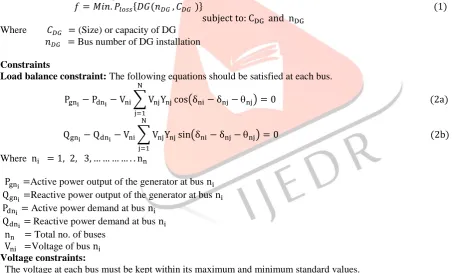
𝑓 = 𝑀𝑖𝑛. 𝑃𝑙𝑜𝑠𝑠{𝐷𝐺(𝑛𝐷𝐺 , 𝐶𝐷𝐺 )} (1) subject to: CDG and nDG
Where 𝐶𝐷𝐺 = (Size) or capacity of DG 𝑛𝐷𝐺 = Bus number of DG installation Constraints
Load balance constraint: The following equations should be satisfied at each bus. Pgni− Pdni− Vni∑ VnjYnj
N
j=1
cos(δni− δnj−nj) = 0 (2a)
Qgni− Qdni− Vni∑ VnjYnj N
j=1
sin(δni− δnj−nj) = 0 (2b)
Where ni = 1, 2, 3, … … … … . . nn
Pgni =Active power output of the generator at bus ni Qgni=Reactive power output of the generator at bus ni
Pdni= Active power demand at bus ni
Qdni = Reactive power demand at bus ni nn = Total no. of buses
Vni =Voltage of bus ni Voltage constraints:
The voltage at each bus must be kept within its maximum and minimum standard values.
Vnimin≤ Vni≤ Vnimax (3)
DG technical constraints: The DG capacity or size is limited by the energy resources at any given location, so it is necessary the size of DG should be between the maximum and the minimum levels.
Pgimin≤ Pgni≤ Pgimin (4)
V. SIMULATION RESULTS
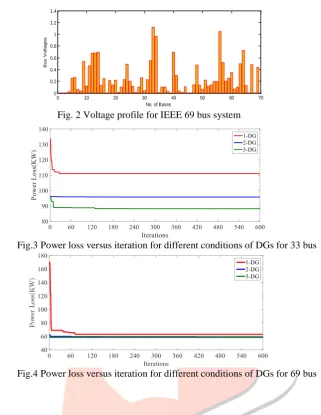
In this paper, two cases are considered (i) IEEE-33 buses and IEEE-69 buses. For the both cases, the location and size of multi DGs is identified .Fig.1 shows the voltage profile for IEEE 33bus system. Fig.2 shows the voltage profile for IEEE 69buses system. Fig.3 and Fig.4 represent Power loss versus iteration for different conditions of DGs for 33 buses and 69 buses respectively.
IJEDR1803019
International Journal of Engineering Development and Research (
www.ijedr.org
)
104
compared exciting technique [15] and [16]. It is found that the applied method is better technique. The load flow is done on the IEEE 33 and IEEE 69 bus system and the voltages are shown in Fig.1 and Fig.2 respectivelyTable 1: Performance of 33-bus test system for different condition of DGs Cases Results
GSA (Proposed)
[14] GSA
1- DG
Power loss (kW) 111.03 111.17
DG size in kW 2570 2690
Location 6 6
2 -DG
Power loss (kW) 95.81 -
DG size in kW 2570 470
-
Locations 6, 15
3 -DG
Power loss (kW) 88.20 -
DG size in kW 2570 470 640
-
Locations 6, 15, 25 -
Table 2: Performance of 69-bus test system for different condition of DGs
Cases Results
GSA (Proposed)
[15] for 1-DG [16] for 3-DG
1- DG
Power loss (kW) 63.13 83.21
DG size in MW 1870 1870
Location 60 61
2 -DG
Power loss (kW) 59.22
DG size in MW 1870
550
Location 60, 66
3- DG
Power loss (kW) 58.62 70.7091
DG size in MW 1870
550 510
1850 420 630
Location 60, 66, 49 61,20,11
. .
Fig. 1 Voltages Profile for IEEE 33 bus system
0 5 10 15 20 25 30 35
0 0.2 0.4 0.6 0.8 1
BUS NUMBER
V
O
L
TA
G
E
IJEDR1803019
International Journal of Engineering Development and Research (
www.ijedr.org
)
105
Fig. 2 Voltage profile for IEEE 69 bus systemFig.3 Power loss versus iteration for different conditions of DGs for 33 bus
Fig.4 Power loss versus iteration for different conditions of DGs for 69 bus Conclusion
In this research paper, the meta heuristic optimization technique, GSA is validate for the same cases viz. individual position of DG and combination of two and three DG . As per existing literature, one method is required for determine location and other method is required capacity of DGs. The allocation of DGs can be obtained by GSA technique. So there is no necessity of other methods. The proposed method is applied to IEEE 33-bus, and 69-bus RDN with different cases. The results are simulated with GSA along with forward/backward load flow analysis and compared to existing methods. The proposed method is better for power loss minimization. Indeed, various studies and applications have illustrated that gravitational Search is very efficient algorithm.
References
[1] Ankit Uniyal, Ashwani Kumar, “Optimal Distributed Generation Placement with Multiple Objectives Considering Probabilistic Load”, Procedia Computer Science, vol. 125, p.p. 382–388, 2018
[2] Singh D, Singh D, Verma KS, “Multiobjective optimization for DG planning with load models” IEEE Trans Power System, vol.24 (1), p.p., 427–36, 2009
[3] Jamian JJ, Aman MM, Mustafa MW, Jasmon GB, Mokhlis H, Bakar AHA, “Comparative study on optimum DG placement for distribution network”, Przegla˛dElektrotechniczny vol. 89(3A), p.p.,199–205, 2013
[4] Vijayakumar K, Jegatheesan R “Optimal location and sizing of DG for congestion management in deregulated power systems” In: Swarm, evolutionary, and memetic computing, Berlin Heidelberg: Springer, p.p., 679–86, 2012.
[5] Guedes RBL, Alberto LFC, Bretas NG, “Power system low-voltage solutions using an auxiliary gradient system for voltage collapse purposes”, IEEE Trans Power System vol. 20(3)p.p., 1528–37, 2005.
[6] Bindeshwar Singh, Deependra Kumar Mishra, “A survey on enhancement of power system performances by optimally placed DG in distribution networks”, Energy Reports, vol.4, p.p.129-158, 2018
[7] Joos G, Ooi BT, Mcgillis D, Galiana FD, Marceau R. The potential of distributed generation to provide ancillary services. Proc. IEEE PES Summer Meeting, Seattle, USA, Vol.3, p.p., 1762–7, 2000
[8] Imran Ahmad Quadri, S. Bhowmick, D. Joshi, “A comprehensive technique for optimal allocation of distributed energy resources in radial distribution systems”, Applied Energy, vol. 211 p.p. 1245–1260, 2018
0 10 20 30 40 50 60 70
0 0.2 0.4 0.6 0.8 1 1.2 1.4
No. of Buses
B
u
s
V
o
lt
a
g
e
IJEDR1803019
International Journal of Engineering Development and Research (
www.ijedr.org
)
106
[9] W. El-Khattam, M.M.A. Salama, “Distributed generation technologies, definitions and benefits”, Electric Power SystemsResearch, vol., 71, p.p., 119–128, 2004
[10] N. S. Rau and Y. H. Wan, “Optimum location of resources in distributed planning,” IEEE Trans. Power Syst., vol. 9, no. 4, p.p., 2014–2020, Nov.1994
[11] R. Rao, K. Ravindra, K. Satish, and S. Narasimham, “Power loss minimization in distribution system using network reconfiguration in the presence of distributed generation,” IEEE Trans. Power System , vol. 28, no. 1, p.p., 317–325, Feb. 2013
[12] A. R. Wallace and G. P. Harrison, “Planning for optimal accommodation of dispersed generation in distribution networks,” In Proc. 17th Int. Conference Elect. Distrib. (CIRED’03), Barcelona, Spain, p.p., 1–6, May 12–15, 2003
[13] Vovos PN, Kiprakis AE, Wallace AR, Harrison GP. Centralized and distributed voltage control: impact on distributed generation penetration. IEEE Trans Power System vol., 22(1), p.p., 476–83, 2007
[14] Devabalaji K R, Ravi K: Optimal size and siting of multiple DG and DSTATCOM in radial distribution system using Bacterial Foraging Optimization Algorithm. Ain Shams Engineering Journal, 2016, 7: 959–971
[15] Yuvaraj T, Ravi K: Multi-objective simultaneous placement of DG and DSTATCOM using novel lightning search algorithm. Journal of Applied Research and Technology, 2017, 15: 477–491
[16] Khoa T H, Nallagownden P, Baharudin Z, Dieu V N. One Rank Cuckoo Search Algorithm for Optimal Placement of Multiple Distributed Generators in Distribution Networks. In Proceedings of the Region 10 Conference, TENCON 2017, Penang: Malaysia, 2017
[17] Ahmad Rezaee Jordehi, “Allocation of distributed generation units in electric power systems: A review”, Renewable and Sustainable Energy Reviews, vol. 56, p.p., 893–905, 2016
[18] C. Wang and H. Nehrir, “Analytical approaches for optimal placement of distributed generation sources in power systems,” IEEE Trans. Power Syst., vol. 19, no. 4, p.p., 2068–2076, Nov. 2004
[19] See Electric Power Research Institute web-page (January 1998):http://www.epri.com/gg/newgen/disgen/index.html. [20] Gas Research Institute, Distributed Power Generation: A Strategy for a Competitive Energy Industry, Gas Research
Institute, Chicago, USA 1998.
[21] CIGRE, Impact of increasing contribution of dispersed generation on the power system; CIGRE Study Committee no 37, Final Report, September 1998.
![Table 1: Performance of 33-bus test system for different condition of DGs GSA [14]](https://thumb-us.123doks.com/thumbv2/123dok_us/8200652.1369781/4.595.151.446.89.563/table-performance-bus-test-different-condition-dgs-gsa.webp)