University of Pennsylvania
ScholarlyCommons
Publicly Accessible Penn Dissertations
2018
Chinese Fertility: Past, Present And Future
Menghan ZhaoUniversity of Pennsylvania, [email protected]
Follow this and additional works at:https://repository.upenn.edu/edissertations
Part of theAsian Studies Commons, and theDemography, Population, and Ecology Commons
This paper is posted at ScholarlyCommons.https://repository.upenn.edu/edissertations/3210
For more information, please [email protected].
Recommended Citation
Zhao, Menghan, "Chinese Fertility: Past, Present And Future" (2018).Publicly Accessible Penn Dissertations. 3210.
Chinese Fertility: Past, Present And Future
Abstract
China has witnessed profound socioeconomic changes over the past four decades. This dissertation is comprised of three papers that investigate the demographic, social, and economic determinants of fertility trends in China. In Chapter 1, I discuss how birth control policies, which have been implemented since 1980, are related to Chinese women’s timing of giving first birth during a period with substantial socioeconomic development. The results suggest that such birth control policies still influence women’s childbearing behavior, even after controlling for the urban/rural distinction and provincial variation; however, this influence has diminished over time. In Chapter 2, I examine the relationship between different motherhood stages and urban women’s economic positions in the labor market between 1991 and 2011, and how this relationship has changed with the development of local economies. The analysis shows that very young children have an inhibiting effect on mothers’ labor force activities, and this effect is exaggerated with the development of local economies. On the other hand, women’s income is positively correlated with the presence of school-aged children, but this positive relationship is eroded with local economic development. In Chapter 3, I propose that the legacies from state socialism, the reduction in educational gender inequality, and the marketization process lead to a modern-traditional mosaic that shapes a curvilinear relationship between gender-role ideology and fertility intentions in China. Capitalizing on three waves of data from the Chinese General Social Survey, I empirically explore the relationship between women’s fertility intentions of having two or more children and different gender-role attitudes by using structural equation modeling. The results suggest that both the ‘modern’ (with more egalitarian gender-role ideology) and ‘traditional’ (with less egalitarian gender-role ideology) women show higher fertility intentions.
Degree Type
Dissertation
Degree Name
Doctor of Philosophy (PhD)
Graduate Group
Demography
First Advisor
Hans-Peter Kohler
Subject Categories
Asian Studies | Demography, Population, and Ecology
CHINESE FERTILITY: PAST, PRESENT AND FUTURE
Menghan Zhao
A DISSERTATION
in
Demography
Presented to the Faculties of the University of Pennsylvania
in
Partial Fulfillment of the Requirements for the
Degree of Doctor of Philosophy
2018
Supervisor of Dissertation
______________________
Hans-Peter Kohler
Frederick J. Warren Professor of Demography
Graduate Group Chairperson
_________________________
Michel Guillot, Professor of Sociology
Dissertation Committee
Emily Hannum, Professor of Sociology and Education
CHINESE FERTILITY: PAST, PRESENT AND FUTURE
COPYRIGHT
2018
Menghan Zhao
This work is licensed under the Creative Commons Attribution- NonCommercial-ShareAlike 3.0 License
To view a copy of this license, visit
iii
ACKNOWLEDGMENT
First and foremost, I would like to thank my invaluable dissertation committee. This work
would not have been possible without the constructive criticism, encouragement, and support
from my committee chair, Hans-Peter Kohler. Thanks for the trust and enthusiasm in my research
for all these years. I am also very thankful to Emily Hannum for being an outstanding mentor. She
has always made me feel cared for by including me on projects and meetings, and sharing
information and experience. I am also very grateful to Paul Allison for being patient, and providing
detailed suggestions on my statistical analyses. I also feel grateful for having had the opportunity
to learn from him in various methods courses.
I would also like to thank my cohort colleagues and friends for all the comments, support
and help, throughout my time at Penn.
Furthermore, I would like to thank Tanya Yang, Dawn Ryan, Audra Rodgers, Nykia Perez
Kibler, and Julia Crane for their administrative support.
I am very grateful to my professors at Renmin University of China, whose guidance and
encouragement were central in my endeavor to pursue a Ph.D. in Demography abroad.
iv
ABSTRACT
CHINESE FERTILITY: PAST, PRESENT AND FUTURE
Menghan Zhao
Hans-Peter Kohler
China has witnessed profound socioeconomic changes over the past four decades. This
dissertation is comprised of three papers that investigate the demographic, social, and economic
determinants of fertility trends in China. In Chapter 1, I discuss how birth control policies, which
have been implemented since 1980, are related to Chinese women’s timing of giving first birth
during a period with substantial socioeconomic development. The results suggest that such birth
control policies still influence women’s childbearing behavior, even after controlling for the
urban/rural distinction and provincial variation; however, this influence has diminished over time.
In Chapter 2, I examine the relationship between different motherhood stages and urban
women’s economic positions in the labor market between 1991 and 2011, and how this
relationship has changed with the development of local economies. The analysis shows that very
young children have an inhibiting effect on mothers’ labor force activities, and this effect is
exaggerated with the development of local economies. On the other hand, women’s income is
positively correlated with the presence of school-aged children, but this positive relationship is
eroded with local economic development. In Chapter 3, I propose that the legacies from state
socialism, the reduction in educational gender inequality, and the marketization process lead to a
modern-traditional mosaic that shapes a curvilinear relationship between gender-role ideology
and fertility intentions in China. Capitalizing on three waves of data from the Chinese General
Social Survey, I empirically explore the relationship between women’s fertility intentions of having
two or more children and different gender-role attitudes by using structural equation modeling.
The results suggest that both the ‘modern’ (with more egalitarian gender-role ideology) and
v
TABLE OF CONTENTS
ABSTRACT … ... II CHAPTER 1 : EFFECTS OF BIRTH CONTROL POLICIES ON WOMEN’S AGE AT
FIRST BIRTH IN CHINA ... 1
Introduction ... 1
Analyzing Effects of Birth Control Policies ... 3
Data and Variables ... 8
Results ... 15
Conclusion and Discussion ... 20
Tables and Figures ... 25
Appendix ... 33
CHAPTER 2 : FROM MOTHERHOOD PREMIUM TO MOTHERHOOD PENALTY? HETEROGENEOUS EFFECTS OF MOTHERHOOD STAGES ON WOMEN’S ECONOMIC OUTCOMES IN URBAN CHINA ... 39
Introduction ... 39
Motherhood and Women’s Economic Activities... 41
Women’s Economic Activities in China during Transition ... 43
Data and Methods ... 47
Results ... 53
Conclusion and Discussion ... 58
Tables... 62
Appendix ... 70
CHAPTER 3 : BETWEEN TRADITION AND MODERNITY: THE DRIVING FORCE OF CHINESE FERTILITY ... 81
Introduction ... 81
Gender Equity and Fertility ... 85
Chinese Context and Hypotheses ... 88
Data and Analytical Approach ... 94
Results ... 99
Conclusion and Discussion ...103
Tables and Figures ...107
Appendix ...116
vi
LIST OF TABLES
Chapter 1
Table 1-1 Descriptive statistics of main variables by cohort groups………...26
Table 1-2 Younger age at first birth for women who are prescribed to follow less strict policies across three cohort groups.………...27
Table 1-3 Younger age at first birth for women with lower educational levels across three cohort groups………28
Table 1-4 Cox model predicting hazard of first birth, by cohort………...29
Table 1-5 Cox models predicting hazards of first birth, by cohort, with interaction between education and policy………...30
Table 1-6 Proportion of following different policies for women who graduated from high school or above……….31
Table 1-7 Proportion of graduating from high school or above for women who followed different policies………..………32
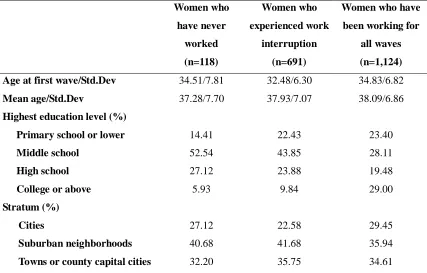
Chapter 2 Table 2-1 Descriptive statistics of analytical sample by different working experience……….63
Table 2-2 Value of economic component score of communities by year………...64
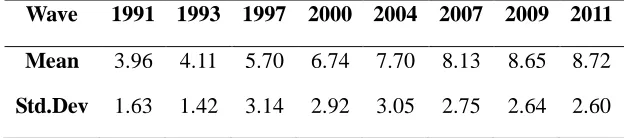
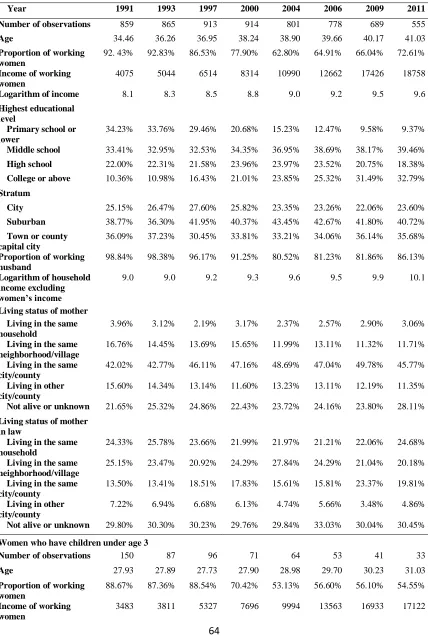
Table 2-3 Descriptive statistics by year………...65
Table 2-4 Coefficients of logistic model predicting working………..67
Table 2-5 Coefficients of linear model of women’s logged income……….69
Chapter 3 Table 3-1 Mean values of women’s gender-role ideology indicators across subgroups………...109
Table 3-2 Factor loadings and structural coefficients in MIMIC model……….110
Table 3-3 Results of fit statistics for MIMIC model………..111
Table 3-4 Factor loadings and structural coefficients………..112
vii
LIST OF ILLUSTRATIONS
Chapter 1
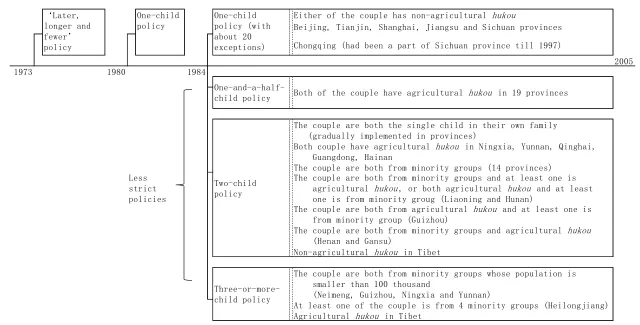
Figure 1-1 Variation in birth control policies in China between 1973 and 2005………33
Chapter 3
Figure 3-1 Sex ratio for people with vocational college or above education by birth cohort
between 1961 and 1990………..…114
Figure 3-2 Path diagram of MIMIC model with gender-role ideology as the latent variable…….115
Figure 3-3 Educational distribution of women………..116
1
CHAPTER 1 :
Effects of Birth Control Policies on Women’s Age at
First Birth in China
Co-authored with Hans-Peter Kohler
Introduction
The fertility transition and fertility level in China have received considerable
attention due to both the strict birth control policies and the country’s sheer population
size. The intention of limiting population growth in China started around 1953, when the
population was 581 million. In 1962, the total population increased dramatically to 700
million, which pushed the government to advocate later marriage and promote a few
urban educational programs directed towards maternal and child health. National
population policies and population programs started in the early 1970s, when the total
fertility rate (TFR) was above 5 and the population was 850 million. At this point, China
accounted for more than one fourth of the world population, but only 7 percent of the
world’s arable farmland. The ‘later, longer and fewer (wan-xi-shao)’ campaign, which
started in 1973, was the first influential national policy. It stressed later marriage (wan),
longer intervals between births (xi), and fewer children (shao). The more widely known
one-child policy was launched in 1980 when the population of China was almost 1 billion
people and the majority were to be in childbearing ages (with half under 21 years old and
two-thirds under 30 years old). However, great resistance to this strict policy resulted in a
more flexible policy known as ‘kai xiaokou, du dakou’ in 1984, allowing more couples to
2
second births. On Oct 29th, 2015, the largest change in China’s birth control policies since
the 1990s was announced – a second child is now generally allowed.
The decline of fertility in China has been remarkable, dropping from a TFR
higher than 5 in the early 1970s to replacement level (TFR around 2.1) in the early 1990s
(UNPD 2015). It continued dropping until 2000 and has stabilized around 1.60 since then.
The rapid decline of TFR has ushered in a new era with its own set of challenges, namely
population aging. The proportion of the population older than 60 years is now more than
15 percent (NBS 2015), and the baby boomers (born between 1962 and 1970) will start to
enter this group in the next couple of decades. This challenge, together with current low
fertility levels, has pushed the government to relieve the birth control policy.
Popular media and policy discussions have hence focused on one critical question
since the announcement of the policy reversal in 2015: How much influence will the
2015 loosened policy have on Chinese childbearing behavior? While there seems to be
some consensus that the potential effect is likely to be small (Attané 2016b; Buckley
2015; The Economist 2015; Zhao 2015) and that the policy should have been
implemented earlier (Hesketh, Lu, and Xing 2005; F. Wang 2005; F. Wang, Cai, and Gu
2013), there is a lack of direct micro-level analysis on nationally representative data.
After the 2015 two-child policy, there were about 17.86 million and 17.23 million births
in 2016 and 2017, respectively, compared to around 16 million in the past decade. The
number of second births increased from 6.48 million in 2015 to 7.15 million in 2016, and
further to 8.82 million in 2017 (China Daily 2018).
In this chapter, based on nationally-representative micro-level data, we examine
3
indicator of childbearing behavior rather than fertility level, before 2005. The results
suggest that women who were prescribed to different birth control policies entered into
motherhood at different ages. This is even true for young cohorts during a period of rapid
socioeconomic development in China in the late 1990s and early 2000s. After adjusting
for geographic variation, women who were prescribed to follow less strict policies tended
to have first births earlier than those who followed the strictest one-child policy. Besides,
a U-shaped effect of policy among young cohorts is also indicated by our analysis, which
shows that the less strict policies were more related to earlier timing of childbearing
among the least educated and most educated groups.
Analyzing Effects of Birth Control Policies
The effects of the birth control policies on women’s childbearing behavior have
been debated. Some studies on policy effects claimed that around 300 to 400 million
births were averted before the 21th century in China due to the policy influence (W. Chen
and Zhuang 2004; J. Wang 2006; Mosher 2011) and more than half of the drop in
Chinese fertility from pre-transitional levels before 1970 to near replacement level in
1990 were due to government influence (Feeney and Wang 1993). A simulation of the
fertility rate (based on the experience of other countries) sought to examine what the
fertility rate in China would have been in the absence of birth control policies, and put
Chinese TFR at 2.5 in 2008 (Tao and Yang 2011), in contrast to the actual TFR of around
1.6. However, rapid socioeconomic development and globalization in recent decades
have brought about an ideational shift from resisting to embracing the ‘small family’
ideal in Chinese families (Merli and Smith 2002; H. Zhang 2007). Some evidence
one-4
child policy, as socioeconomic development has played a decisive role (J. Chen et al.
2009; Zheng et al. 2009; Cai 2010). One meta-analysis reported that the ideal number of
children has stabilized between 1.6 and 1.8 since 2000 (Hou 2015).
The task of assessing the impacts of birth control polices on women’s
childbearing behavior is complicated by the fact that, since 1984, local governments have
started to make their own birth control policies. At least 20 minor exceptions have been
made for a second child (Gu et al. 2007) and the localized policies can be grouped into
four categories: 1) One-child policy: each couple is expected to have only one child. 2)
One-and-a-half-child policy: couples are allowed to have a second child after a specified
birth interval if the first birth is a girl. 3) Two-child policy: couples are allowed to have
two children. 4) Three-or-more-child policy: couples from minority groups or couples
who meet several criteria can have more than two children (Figure 1-1).
FIGURE 1-1 ABOUT HERE
It is true that these policy categories are closed related to couples’ hukou status.1
Specifically, the second policy category (one-and-a-half-child policy) was mainly applied
to people with ‘agriculture’ hukou. However, the ‘one-child policy’ or other policies do
not equal urban (including towns) or rural areas. Because of the rapid economic
development since the late 1990s, more agricultural land was (Seto, Kaufmann, and
Woodcock 2000, 20) and is being converted while the ‘agriculture’ hukou status of
people live there stayed unchanged. According to 2000 Census, people with
‘non-agriculture’ hukou only accounted for about 25 percent of the total population while
1Hukou status is the status of each person registered in the Household Registration System in Mainland China. It
mainly has two statuses: non-agriculture and agriculture. The distinction between ‘non-agriculture’ and ‘agriculture’
5
about 37 percent of the total population living in urban areas. In 2005, the proportion of
people with ‘non-agriculture’ hukou increased trivially to 26 percent while the proportion
of the population living in urban areas grew to about 45 percent. Gu et al. (2007)
computed the average provincial and national policy fertility levels (zhengce shengyulu)2
based on different birth policies of 420 prefecture-level units3 in China. It turns out that
during late 1990s, only about 35.4 percent of Chinese people were covered by the
one-child policy while the majority of Chinese lived in areas with a policy fertility level at 1.3
to 2.0 children per couple. Thus, even in urban areas or in the same province, different
women were prescribed to follow different policies, which is also verified in our data as
shown later. One recent study decomposed China’s fertility gaps by hukou and place of
residence (rural areas versus urban areas) by using 2011 data. The results suggested that
the effects of having a ‘non-agricultural’ hukou are more than three times larger than the
effects of urban residence on fertility (Liang and Gibson 2017).
However, most of the current research has estimated the policy effects based on
the change of aggregate fertility rate at either the regional or national level, which
estimates the fertility level of a group of women who actually followed different policies.
Given the large variation of birth control polices even within the same region, it is hard to
connect individual’s childbearing behavior to the exact policy settings by examining
aggregate data (Attané 2016a; Morgan, Guo, and Hayford 2009; Wang 2011). Others
have concentrated their studies on subgroups with less policy variation and indicated that
socioeconomic development was the most important factor of the transition to
below-replacement fertility in China (Zheng et al. 2009; Cai 2010). However, the conclusions
6
from these studies are only for highly-selected subgroups4 (less than 10 percent of
Chinese population) and not for the general population. In all, current studies on Chinese
fertility level did not show clearly how the previous birth control policies shaped
women’s childbearing behavior at the individual level.
A further complication is that the impact of birth control policies on childbearing
behaviors is intertwined with the influence of educational expansion. According to the
sixth census conducted in 2010, only around 20 percent of the women in the 1970 birth
cohort received at least high school education, while it rose to about 38 percent for
women born in 1983 and further increased to around 50 percent for women in the 1989
birth cohort. Rapid educational expansion and socioeconomic development in China have
changed people’s fertility intentions, which mitigates the policy constraints for young
cohorts. More importantly, in China, the educational expansion helped spread the
knowledge of reproductive health and reasons for implementing birth control. Most
people started to learn the same language (Mandarin) for communication after going to
school, as the Chinese language consists of hundreds of local language varieties, many of
which are not mutually intelligible.5 According to diffusion theory (Bongaarts and
Watkins 1996; McNicoll 2011) for contemporary fertility transitions observed in other
countries, fertility decline is not simply an adjustment to changing socioeconomic
circumstances. Social interaction, which is largely based on sharing the same language
4 The two provinces (Zhejiang and Jiangsu) studied are the most developed provinces with the highest GDP per capita
since the early 1990s. Zhejiang province was one of the only two provinces (another is Xinjiang with much less strict birth control because of a high proportion of minority groups) that actually accomplished the goal of birth control policies in 1989 (Peng 2009). Jiangsu province is one of the two provinces (another is Sichuan province) with the strict one-child policy since 1980 without loosened one-and-a-half-child policies.
5 These varieties can be classified into seven to ten groups, the largest being Mandarin (e.g. Beijing dialect), Wu (e.g.
7
intelligible to one another, acts as a channel for fertility change. More rapid fertility
decline occurs in countries where a multiplicity of channels connects communities, and
slower fertility decline happens where such channels are sparse.
Thus, accompanied with educational expansion, the effects of birth control
policies on childbearing behavior become unclear. Though education and urbanization
were producing conditions for an incipient transition and the fertility decline was
underway in some subgroups even before direct birth control policies were implemented
(Lavely and Freedman 1990), we can never assign education as the ‘cause’ of the
substantial drop of fertility level in China. This is because women’s education levels are
also a proxy for other community-level factors, such as more developed cities with better
health services and stricter birth planning programs. Previous studies proved that the
strong relationship between education and fertility weakened in China after the onset of
government-sponsored fertility control programs, undermined by policy goals and
bureaucratic regulations tailored to specific urban levels (Lavely and Freedman 1990).
Further, concurrent with the rapid educational expansion, the composition of
women, in terms of different policies, shifts across cohorts, and affects studies on the
effects of birth control policies. A previous study has indicated that there is a lower
selectivity into higher education over time for young women who achieve higher levels
of grade attainment (Berelson 1974), especially under the rapid educational expansion.
That is, because of rapid educational expansion and also the growing urban areas, the
population composition of underlying factors affecting childbearing behaviors also
8
could now have more access to educational resources (Grant 2015). In this sense,
educational expansion has led to more heterogeneity in young cohorts.
As will be explained in the following data and method sections, we solve the first
problem by coding the exact birth control policy that a woman was prescribed to follow
and examining the timing of giving first birth rather than fertility level directly, after
controlling for the urban/rural distinction and provincial variation. The second problem is
solved by conducting statistical models separately for successive cohorts to capture the
undergoing educational expansion and its impacts on women’s childbearing behavior.
Specifically, the semi-parametric method (Cox model) used in this chapter allows us to fit
the models by allowing the hazard functions to vary across both urban/rural areas and
provinces. This method helps control for the unknown impacts from various
socioeconomic development levels and reduces the impact of the endogeneity that the
birth control policies in each province were imposed based on local conditions.
Data and Variables
Data
The data used for this chapter are a 20 percent random sample drawn from
China’s 2005 1% Population Inter-census Survey (mini-census), conducted by the
National Statistics Bureau. This nationally-representative survey covers demographic
information of all household members, living conditions, and the number of children that
a woman has ever borne.
Based on this micro-level information, the specific birth control policy that a
woman was prescribed to follow can be identified according to the personal
9
literature that the exact birth control policy cannot be identified from aggregate data. Also,
because this survey covers samples from all provinces in mainland China, individuals are
clustered in the provincial level, allowing us to control for the different socioeconomic
development speed among provinces in our statistical models.
Dependent Variable: Age at First Birth
In this chapter, we look at the impact of different birth control policies on another
important indicator of childbearing behavior, age at first birth (AFB).6 Studying AFB
contributes to our understanding about how the birth control policies are related to
women’s timing of entering into parenthood, one of the important life-course stages. Also,
because the association between early childbearing and higher completed fertility has
long been widely observed (Bumpass, Rindfuss, and Jamosik 1978; Trussell and Menken
1978; Morgan and Rindfuss 1999), 7 studying AFB also complements the discussions on
the policy effects on women’s childbearing behavior. In Chinese contexts, it would make
sense for women who followed less strict policies to have more children during their
lifespan than women who followed the one-child policy. This is because, under less strict
policy settings in some places, the second child can only be allowed after certain years’
6 Though we have children ever born reported in these data, we cannot conduct analysis on fertility level directly. This
is because the complete cohort fertility level can only be calculated for women older than 49 years old (the oldest age of conventional childbearing age). However, because we focus on the effect of policies after 1984 on the childbearing behavior of women born between 1970 and 1983, women were between age 22 and age 35 in 2005. They were censored in terms of giving birth when the survey was conducted.
7 Empirical research has also proved that, after eliminating possible genetic influences, there are connections between
10
spacing. Families that have the chance to have a second child will try to avoid a late first
birth to make sure that they will not have the second child too late.8
Further, by learning how much the timing of childbearing has been affected by
these policies, we also warrant further research estimating how much the TFR change
under the universal two-child policy can be attributed to the changing timing of giving
birth and how much to the quantum fertility level. Scholars have long highlighted that the
conventional estimate of observed period TFR is biased if the timing of childbearing is
changing (Ryder 1956, 1980; Bongaarts and Feeney 1998), known as the tempo effect or
tempo distortion. Both the quantum and tempo changes, confounded with period and
cohort changes, give rise to the observed year-by-year changes in fertility rate (Bongaarts
and Sobotka 2012). The tempo-affected TFR might introduce both some
misinterpretation of fertility level trends and exaggeration of the gap between intended
and achieved family size. If the loosened policy will affect women’s AFB, further
research about the impacts of the 2015 loosened policy should take the tempo distortion
into account when studying the fluctuation of the period TFR that will be observed in the
near future.
The data provide the birth year of women and her children, so we can estimate the
AFB for women from different birth cohorts. Because different birth control policies
were implemented in 1984, we only focus on women born between 1970 and 1983 (22 to
35 years old in 2005). When the policies were localized, the 1970 cohort was 14 years old,
one year younger than the conventional used youngest age (15 years old) of childbearing
8 Our final analytical data also showed that, for those who have given birth, the younger the age at first birth, the more
11
age for women. Those born in 1983 were 22 years old9 in 2005. The AFB is not explicitly
incorporated in the mini-census questionnaire, so we estimate AFB by subtracting the
birth year of the household head or the wife of the household head from her first child’s
birth year (see detailed description of the estimation procedure in Appendix).10 For any
study concerning the timing of life-course events, observed cases are censored in
cross-sectional data. Women who had not had their first birth before 2005 are right censored
and are also included in our data.
Specifically, we also consider the potential selection issue resulting from getting
information from the women who are the household head or the wife of the household
head. That is, single or childless women are less likely to be a household head or a wife
of a household head, especially women in young cohorts who are likely to receive more
education and postpone getting married. To eliminate this selection issue, we also draw
childless women who were coded as ‘daughters’ in the household (34,162 observations),
into our database.
Independent Variable: Birth Control Policies
The coding of birth control policy for each woman is based on the major policy
settings of different local policies in 1984 as shown in Figure 1-1,11 because other
9 In China, a student who progressed through school on time and without interruptions would be expected to finish
middle school by age 15 and graduate from a university by age 22.
10 The estimation procedure is based on the assumption that whether women are matched with their children is
unrelated with their AFB because we have random samples from the original data. We are aware of the potential bias lead from the violation of this assumption. Specifically, the numbers of children ever born (CEB) of migrant mothers are less likely to be matched with the number of children within household. However, because rural-urban migrants account for most of the migrants in China, the likelihood of separation is expected to be higher for women from less development places with loosened birth control (and also those who are more likely to give birth early). Thus, the exclusion of women whose reported CEB is unmatched with their children within household tend to give us more conservative estimates of the policy impacts.
11 For those who can follow less strict policies, information of both couple is needed, thus there is a potential selection
12
exceptions for a second child or child at higher order only cover a trivial proportion (Gu
et al. 2007, 20). Two categories of birth control policies are specified in this analysis: the
strictest one-child policy and the less strict policies, including the one-and-a-half-child
policy, two-child policy and the three-or-more-child policy.
The criteria for different birth control policies mainly consist of three components:
hukou status, minority or not, and provinces where the hukou is registered for both the
women and her husband. As explained, the distinction between ‘non-agriculture ’ and
‘agriculture’ in hukou status is not equivalent to the distinction between urban and rural
area, especially under rapid development and the urbanization process. Actually,
according to the published aggregate data of the 2005 mini-census, people with
‘non-agriculture’ hukou only account for 53.43 percent in the urban population, which means
almost half of the urban population have ‘agriculture’ hukou. Even in Beijing, about 35
percent people had ‘agriculture’ hukou in 2005, and this proportion was around 33
percent in Shanghai. As will be explained later, we also include the variable indicating
the distinction between urban and rural areas into our model. In fact, in our final analytic
data, about 37 percent of the women who could follow less strict policies lived in urban
areas and 12 percent of women who had to follow the one-child policy lived in rural
places.
For married women with matched husband’s information or women with
non-agricultural hukou, the birth control policies that they were prescribed to follow can be
easily identified. However, the policy cannot be directly identified for women who are
13
married but missing husbands’ information or single with agricultural hukou, because the
information on the husband is needed to meet the criteria for less strict birth control
policies. We solve this problem in two steps. First, we assume that those who were not
migrants in 2005 were likely to be married to males with the same hukou and follow less
strict policies. This assumption is legitimate because our sample only consists of those
older than age 22, and most of them should have finished their education. It is unlikely
for them to change hukou status, because the transition of hukou status is most likely to
happen when people graduate from universities or colleges. Also, even if single women
with agricultural hukou moved to urban areas after 2005, they were unlikely to marry a
man with non-agricultural hukou, who was considered more advantageous, because of the
traditional hypergamy in China (Mu and Xie 2014; Yu and Xie 2015). Second, single
female migrants with agricultural hukou are also coded to follow the less strict policies
and contribute person months to this category to provide a relatively conservative
estimate. That is, we code the policies only based on the eligibility of female. Less than
1.8 percent of the cases cannot be coded for this main independent variable in our study.
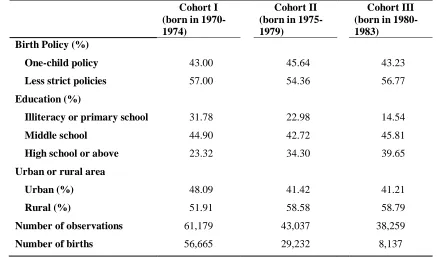
Our final dataset has 142,475 observations. The descriptive statistics are shown in Table
1-1.
TABLE 1-1 ABOUT HERE
Statistical Methods and Model Specification
We use the extended Cox regression to model the effects of different birth control
policies on the hazard rate of entry into parenthood. Compared with parametric models of
14
model). This method works reasonably well with a wide range of baseline hazard
functions when the shape of the hazard function is not a priori known, which allows us to
control for the possible socioeconomic effects, differences in urban and rural area, and
also the provincial variation even when their impacts are unknown. We stack the data
into a person-month structure and the Efron method is used for better approximation of
Cox regression for discrete-time data (Allison 2014). For this analysis, the risk of giving
birth is assumed to begin at age 15. Though the legal age of marriage in China is 22 years
old for males and 20 years old for females since 1981, some people still take the wedding
date as the start of marriage (instead of registered marriage), which is accepted by friends
and relatives. Births given after this culturally accepted marriage are rarely considered as
births out of wedlock. Some Chinese studies have suggested it true even for recent
cohorts (Yu and Xie 2015).
As explained, selectivity12 is high for old cohorts, because women who had more
access to education were living in urban areas and also had to follow the strictest
one-child policy. Nevertheless, women in young cohorts within high educational level tended
to show more variation of birth control policies, and revealed stronger policy effects than
women from older cohorts because of more heterogeneity within them. To capture the
changing relationship between policies and education over time, we conduct analysis on
childbearing behavior separately for successive birth cohorts. Due to fast socioeconomic
change, especially educational expansion, we divide all the birth cohorts (born between
1970 and 1983) into three groups: Cohort I (born between 1970 and 1974), Cohort II
(born between 1975 and 1979), and Cohort III (born between 1980 and 1983).
12 In this chapter, ‘selectivity’ is termed as women who are the most educated and tend to be those who have to follow
15
For control variables, because the hukou status (non-agriculture or agriculture) is
the main criterion of birth control policy and different from urban/rural distinction, it is
not included in the model. Instead, we conduct Cox models with stratification by both
actual urban/rural distinction and provinces in our analysis, with the assumption that the
baseline hazard is different for urban and rural area, and also different for each province.
So both the urban/rural differences and impact of endogeneity of local policies across
provinces can be controlled in our analysis.13
Results
Patterns of Timing at First Birth
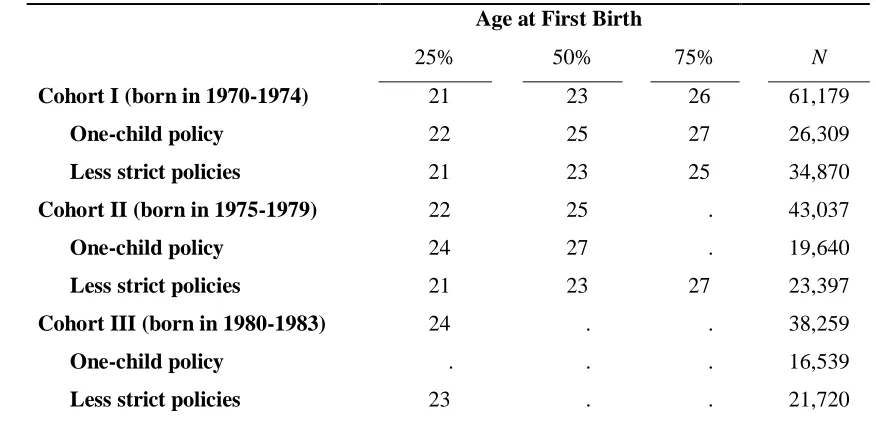
We describe how patterns of timing at first birth changed with respect to different
policies and educational levels for different cohorts, respectively. We present the first
quartile (25%), median (50%) and third quartile (75%) of the age at first birth by cohorts
and policies in Table 1-2, and also by cohorts and educational levels in Table 1-3. For
example, in Table 1-2, for women from Cohort II following the one-child policy, 25%
gave birth before age 24 and half of them gave birth before age 27. Because the sample is
censored at age 22-25 for Cohort III, some information is missing in some of the
percentiles. For the women in the youngest cohort group following the one-child policy,
less than 25% gave birth when they took the 2005 mini census.
TABLE 1-2 ABOUT HERE
TABLE 1-3 ABOUT HERE
13 There are 31 provinces in the data and binary distinction between rural and urban area. We use the option ‘strata’
16
Comparing the timing of giving first birth, young cohorts postponed their
childbearing behavior substantially. 25% of women from Cohort I and Cohort II gave
birth to their first child before age 21 and before age 22, respectively. But for Cohort III,
one-quarter of them gave birth before 24 years old. We also find a general pattern of
earlier childbearing across women who followed less strict birth control policies within
each cohort group. For example, in Cohort I, 25% of women following the one-child
policy had their first birth before age 22, but for those following less strict policies, it was
age 21. In Cohort II, half of the women who followed the one-child policy gave birth
before age 27, but for women who followed less strict policies, half of them gave birth
before age 23. Less than one quarter of the women who followed the one-child policy in
Cohort III gave birth before 2005, but of those who followed less strict policies, 25%
gave birth before 23 years old. Additionally, within each cohort group, women with
higher educational levels tended to give birth later (Table 1-3). This corresponds to the
findings in other research about the timing of first birth and education.
In sum, the postponement of childbearing behavior is clear across cohorts. Within
each cohort group, both the birth control policies and educational attainment are
associated with the timing of first birth.
Impacts of Birth Control Policies and Educational Expansion
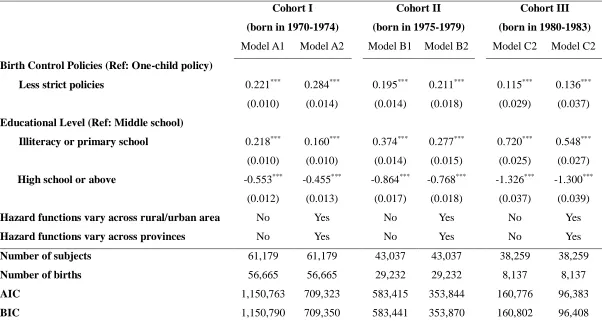
Table 1-4 presents coefficients from the Cox models by different cohort groups.
Negative coefficients indicate lower risks of entry into parenthood, namely older age at
first birth and/or higher chance of childlessness. The first columns for each cohort group
are the baseline models with our main independent variables. The results in the second
17
distinction and provinces, which allows for different hazard functions of time for both
urban/rural distinction and for each province without making any parametric assumption
(Allison 2014). Thus, these models not only account for the significant urban/rural
differences within China, but also take the impact of varying development speeds or
trajectories of different provinces into account. By comparing the coefficients of policies
between models with and without varying hazard functions across rural/urban area and
provinces within each cohort group, we can see that the effect sizes of policies are bigger
in models with varying hazard functions.
TABLE 1-4 ABOUT HERE
The models for all three cohorts show positive impacts of less strict birth control
policies on hazards of entering into motherhood.14 For Cohort I, compared with women
following one-child policy, women who were eligible for less strict policies have 32.84%
( ) higher hazards of parenthood. For Cohort II and Cohort III, the
hazards are 23.49% and 14.57% higher for women following less strict policies than
those who followed one-child policy. These persistent policy effects suggest that women
who were eligible for less strict polices tended to give birth earlier than those who
followed the one-child policy for all the cohorts. However, the coefficient of policies is
getting smaller15, which is consistent with the claim made in previous studies that the
14 For the youngest cohort group, we also conducted analysis on the data from 2015 inter-census survey (1984 birth
cohort is also included). With more information available, we have more controlled variables and specified the policy variables as time-varying variables. As shown in Appendix Table 1-3, the results support our argument that the birth control policies still affect women’s childbearing behavior, and the least educated and the most educated groups are more likely to be affected by the policy change.
15 The difference between the coefficients in Model A2 and Model B2 is significant at 0.05 level, because z score =
18
impact of birth control policies is smaller in younger cohorts. Besides, the effect sizes of
educational levels are a lot bigger in young cohorts, which also suggests that
socioeconomic development has gradually changed people’s fertility intentions
independently of policies.
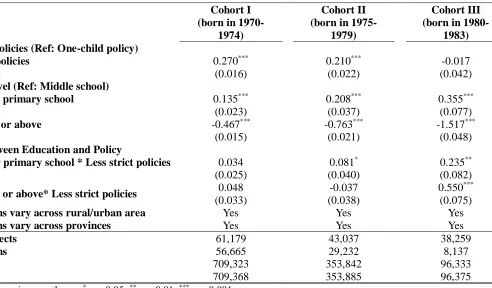
TABLE 1-5 ABOUT HERE
The results in Table 1-5 present the coefficients of policies, education, and their
interaction terms. For Cohort I, none of the coefficients of the interaction terms is
statistically significant, which indicates the same policy effects for all the educational
levels. For Cohort II, one interaction term shows significant different hazards of giving
birth. For women who were illiterate or finished primary school, those who followed less
strict policies have 33.78% ( ) higher hazards of giving first birth
than those who followed the one-child policy. Moreover, for Cohort III, both of the
interaction terms become statistically significant and positive, which indicates that after
the educational expansion, there was more heterogeneity within each educational level.
The AIC and BIC also indicate that the inclusion of the interaction terms improve the
models for the young cohorts but not the older cohorts. Both of the measures show that
for the Cohort I, the model without the interaction terms is better than that with the
interaction terms. However, for Cohort III, the model with the interaction terms has
smaller AIC and BIC than the model without the interaction term. Thus, we expect a
U-shaped influence of policy among people with different educational levels. That is, the
least educated and the most educated groups are more likely to be affected by the policy
19
As suggested in previous sections, the rapid educational expansion might have
changed the composition of fertility intentions among those who can follow the less strict
policy in the highly educated group, contributing to the strong interactive effects. To
verify this speculation, we further compare the composition of women following different
birth control policies among those who graduated from high school or above across
cohorts in Table 1-6. In Cohort I, only 9.99% of women who had finished at least high
school were eligible for less strict policies, but this proportion increased to 15.42% in
Cohort II and further grew to 21.40% in Cohort III. We can also find some proof by
comparing the educational composition within woman who followed the same policy
across cohorts in Table 1-7. Overall, educational improvement was fast across cohorts.
The biggest absolute increase of the proportion of women graduated from high school or
above happened to women who followed the one-child policy. However, the proportion
of those graduating from high school or above tripled from about 4% in Cohort I to
around 15% in Cohort III for those who were eligible for less strict policies. Thus, for
women who followed less strict policies, the educational expansion was more efficient
than those who followed one-child policy. With the educational expansion, women who
followed less strict policies from Cohort III were more likely to achieve higher
educational level than previous cohorts. 16 Also, for those who were highly educated, the
variation of birth control polices was bigger in Cohort III than in Cohort I and II.
TABLE 1-6 ABOUT HERE
TABLE 1-7 ABOUT HERE
16 The odds of graduating from high school or above if being eligible for less strict policies for Cohort III are 1.49 times
20
In summary, our analyses of policies and comparisons between cohorts suggest
that Chinese women’s childbearing behavior postponed considerably under the rapid
socioeconomic development, and the constraints imposed by the policies weakened over
time. However, even for young cohorts, the birth control polices still affected women’s
childbearing behavior significantly after controlling for both urban/rural differences and
regional variation. Along with educational expansion, the underlying shifting
composition in more educated women across cohorts promised greater heterogeneity of
childbearing behaviors and larger variation of birth control policies in younger and more
educated cohorts. The results also showed that even for the more educated population,
women who were eligible for less strict policies tended to give birth earlier and might
have had more children than their counterparts. Thus, for young cohorts, the policies
presented a U-shaped impact, implying that the least educated and the most educated
groups were likely to be most affected by a less restrictive birth-control policy.
Conclusion and Discussion
Previous studies on the impact of China’s birth control policies on childbearing
behaviors provided a mixed picture. The controversies over policy effects rise from the
difficulty in disentangling the influences of socioeconomic development on changing
people’s childbearing behavior. Also, the complicated birth control polices (Gu et al.
2007) prevented the studies on aggregate-level fertility from revealing the policy effects
on individual’s childbearing behavior. Capitalizing on micro-level data with
individual-level policy identification, we try to solve these two problems by 1) identifying the exact
policy that a woman is prescribed to follow, 2) conducting analysis separately for
21
the Cox model to control for both urban/rural and regional differences, and also minimize
the period effects. We also contribute to the studies on Chinese women’s childbearing
behavior by examining the timing of giving first births rather than fertility level directly.
Our descriptive results suggest that the postponement of childbearing behavior was
remarkable across cohorts. Within each cohort group, women with higher educational
level tended to have their first births later, which is consistent with other studies. Besides,
women who were eligible for less strict policies also had their first birth earlier than those
who had to follow the strictest one-child policy, suggesting strong effects of the policy on
women’s childbearing behavior even among young women in recent cohorts.
Through the comparisons of multivariate analyses among cohorts, we find that
both birth control policies and education were important factors shaping young Chinese
women’s childbearing behavior after controlling for urban/rural distinction and regional
variation. More importantly, we find that the interactions between policies and education
were significant for women in younger cohorts while no strong interactive effects were
shown for older cohorts. For young cohorts, the least educated group is selected to be
those who live in least developed area with more traditional high fertility intentions, so
they’re more likely to react to the policy change. However, for the most educated group,
the intuitive explanation is different. Under rapid educational expansion, some of the
highly educated younger cohorts, who still live in less developed area and have not
converged to very low fertility intentions, still tend to have a second child and give birth
early under more loosened policy. Though the rural reforms initiated in the early 1980s
gradually convinced couples of the benefits of fewer children, it does not weaken the
22
child. As a result, there is a U-shaped effect of policy: being subject to a more relaxed
policy regime had the strongest accelerating effect on childbearing among the least
educated (a group diminishing in size) and among the most educated (a group that is
rapidly expanding).
Some studies indicate that socioeconomic development is the reason for the drop
of fertility level in China (Zheng et al. 2009; Cai 2010; F. Wang, Whyte, and Cai 2015).
However, our results suggest that we cannot come to this conclusion for sure, because
birth control policies are still imposed in China and counterfactual facts can hardly be
built. Highly educated people showed higher acceptance of birth control policies (Merli
and Smith 2002) partly because they were more likely to have lower fertility intentions,
but they were also who were most likely to understand the rationale of implementing
birth control policies in China. Now, after decades of rapid educational expansion, the
highly educated groups had more heterogeneity and more variation of birth control
policies, so the strong policy effects started to show for these highly educated people. An
old Chinese proverb goes, ‘It takes ten years to grow trees but a hundred years to rear
people.’ Even though fast urbanization, educational expansion, and low fertility
intentions produced the conditions for low fertility level in China, some Chinese still
constrain their childbearing behavior to keep the low birth rate.
Our analysis also points to the impacts of 2015 loosened policy on the timing of
giving first birth. Because women who followed less strict birth control policies tended to
have their first births earlier, after controlling for other variables, we would expect that,
under the 2015 universal two-child policy, women will give birth earlier and might have
23
rate. Also, the changing timing of giving birth will bring tempo distortion to the fertility
measure. However, the rise of the fertility rate might be temporary, because the results
also show that the effect size of policies is declining with the impact of education
growing across cohorts. Besides, as revealed in some studies, any serious change in
China’s birth control policies is likely to derive from initiatives at the local level (Merli,
Qian, and Smith 2004). The policy change was made only after the government believed
there will be an appropriate reaction, which is neither a remarkable rise nor no effects at
all. The elimination of the strict one-child policy, in our opinion, is therefore likely to
lead to a rise of fertility rate in the short term, while overall, fertility will remain at a low
level in the long run.
The great shift of Chinese ideational change toward small family makes the strict
birth control unnecessary. The change to a general two-child policy might not receive
impressive reaction from the young cohorts. The long-term low fertility intentions
guarantee that the fertility rate will not rise substantially under the loosened policy. Also,
the increasing cost of raising a child has become a main concern of young cohorts about
giving birth (Attané 2016b). Besides, research has suggested that women’s position in the
labor market has deteriorated in urban China (S. Li and Ma 2007; C. Li and Li 2008),
after the government stopped guaranteeing jobs to graduates after 1996. Specifically, the
worsening trend is concentrated among mothers (Y. Zhang and Hannum 2015). The
increasing wage gap between mothers and childless women in urban China was partly
due to the economic transition that shifted part of the cost of childbearing from the state
and employers back to women (Jia and Dong 2012). The growing gender inequality
24
This increasing gender inequality might be a resistance to the decreasing trend of
son preference. Many studies revealed that the son preference affects the fertility level
positively and the actual fertility level is higher than the desired fertility level due to son
preference (J. Song and Tao 2012). Empirical analysis on fertility intentions of migrants
(Yang 2015) indicates that people may internalize the norms of having fewer children,
but having a son remains a must. This will lead to the uncertainty of Chinese fertility
level, and it may maintain higher fertility in China than that in South Korea or Japan. So
other related policies should be accompanied with the loosening of the birth control,
either for embracing the challenge or for people’s wellbeing.
As with most studies on this topic, this study is limited in some ways. First, we do
not have enough details to identify the individuals who were prescribed to less strict
policies, including whether either husband or wife came from one-child family. Second,
the policies are identified only based on provincial information, while more complicated
policies (more exceptions to allow a second child) were implemented at prefectural level.
Third, other possible variables - household economic conditions, family background,
local culture/neighborhood pressure of son preference - that are also related to the policy
25
Tables and Figures
Table 1-1 Descriptive statistics of main variables by cohort groups
Cohort I (born in 1970-1974)
Cohort II (born in 1975-1979)
Cohort III (born in 1980-1983)
Birth Policy (%)
One-child policy 43.00 45.64 43.23
Less strict policies 57.00 54.36 56.77
Education (%)
Illiteracy or primary school 31.78 22.98 14.54
Middle school 44.90 42.72 45.81
High school or above 23.32 34.30 39.65
Urban or rural area
Urban (%) 48.09 41.42 41.21
Rural (%) 51.91 58.58 58.79
Number of observations 61,179 43,037 38,259
26
Table 1-2 Younger age at first birth for women
who are prescribed to follow less strict policies across three cohort groups
Age at First Birth
25% 50% 75% N
Cohort I (born in 1970-1974) 21 23 26 61,179
One-child policy 22 25 27 26,309
Less strict policies 21 23 25 34,870
Cohort II (born in 1975-1979) 22 25 . 43,037
One-child policy 24 27 . 19,640
Less strict policies 21 23 27 23,397
Cohort III (born in 1980-1983) 24 . . 38,259
One-child policy . . . 16,539
Less strict policies 23 . . 21,720
27
Table 1-3 Younger age at first birth for women with lower educational levels
across three cohort groups
Age at First Birth
25% 50% 75% N
Cohort I (born in 1970-1974) 21 23 26 61,179
Illiteracy or Primary School 20 22 24 19,445
Middle School 21 23 25 27,468
High School or above 24 26 29 14,266
Cohort II (born in 1975-1979) 22 25 . 43,037
Illiteracy or Primary School 20 22 25 9,888
Middle School 22 24 27 18,386
High School or above 25 29 . 14,763
Cohort III (born in 1980-1983) 24 . . 38,259
Illiteracy or Primary School 21 24 . 5,564
Middle School 23 . . 17,526
28
Table 1-4 Cox model predicting hazard of first birth, by cohort
Cohort I
(born in 1970-1974)
Cohort II
(born in 1975-1979)
Cohort III
(born in 1980-1983)
Model A1 Model A2 Model B1 Model B2 Model C2 Model C2
Birth Control Policies (Ref: One-child policy)
Less strict policies 0.221***
(0.010) 0.284*** (0.014) 0.195*** (0.014) 0.211*** (0.018) 0.115*** (0.029) 0.136*** (0.037)
Educational Level (Ref: Middle school)
Illiteracy or primary school 0.218***
(0.010) 0.160*** (0.010) 0.374*** (0.014) 0.277*** (0.015) 0.720*** (0.025) 0.548*** (0.027)
High school or above -0.553***
(0.012) -0.455*** (0.013) -0.864*** (0.017) -0.768*** (0.018) -1.326*** (0.037) -1.300*** (0.039)
Hazard functions vary across rural/urban area No Yes No Yes No Yes
Hazard functions vary across provinces No Yes No Yes No Yes
Number of subjects 61,179 61,179 43,037 43,037 38,259 38,259
Number of births 56,665 56,665 29,232 29,232 8,137 8,137
AIC 1,150,763 709,323 583,415 353,844 160,776 96,383
BIC 1,150,790 709,350 583,441 353,870 160,802 96,408
29
Table 1-5 Cox models predicting hazards of first birth, by cohort,
with interaction between education and policy
Cohort I (born in
1970-1974)
Cohort II (born in
1975-1979)
Cohort III (born in
1980-1983) Birth Control Policies (Ref: One-child policy)
Less strict policies 0.270***
(0.016)
0.210*** (0.022)
-0.017 (0.042) Educational Level (Ref: Middle school)
Illiteracy or primary school 0.135***
(0.023)
0.208*** (0.037)
0.355*** (0.077)
High school or above -0.467***
(0.015)
-0.763*** (0.021)
-1.517*** (0.048) Interaction between Education and Policy
Illiteracy or primary school * Less strict policies 0.034
(0.025)
0.081* (0.040)
0.235** (0.082)
High school or above* Less strict policies 0.048
(0.033)
-0.037 (0.038)
0.550*** (0.075)
Hazard functions vary across rural/urban area Yes Yes Yes
Hazard functions vary across provinces Yes Yes Yes
Number of subjects 61,179 43,037 38,259
Number of births 56,665 29,232 8,137
AIC 709,323 353,842 96,333
BIC 709,368 353,885 96,375
30
Table 1-6 Proportion of following different policies
for women who graduated from high school or above
Proportion of Following Different Policies (%)
One-Child policy Less strict policies
Cohort I (born in 1970-1974) 90.01 9.99
Cohort II (born in 1975-1979) 84.58 15.42
31
Table 1-7 Proportion of graduating from high school or above
for women who followed different policies
Proportion of Women Who Graduated from High School or above (%)
Cohort I
(born in 1970-1974)
Cohort II
(born in 1975-1979)
Cohort III
(born in 1980-1983)
One-Child Policy 48.81 63.58 72.09
32
Figure 1-1 Variation in birth control policies in China between 1973 and 2005
Either of the couple has non-agricultural hukou
Chongqing (had been a part of Sichuan province till 1997)
2005
1973 1980 1984
The couple are both from minority groups (14 provinces)
Non-agricultural hukou in Tibet
At least one of the couple is from 4 minority groups (Heilongjiang) Agricultural hukou in Tibet
Less strict policies Two-child policy Three-or-more-child policy
The couple are both from agricultural hukou and at least one is from minority group (Guizhou)
The couple are both from minority groups and at least one is agricultural hukou, or both agricultural hukou and at least one is from minority groug (Liaoning and Hunan)
The couple are both from minority groups whose population is smaller than 100 thousand
(Neimeng, Guizhou, Ningxia and Yunnan)
The couple are both from minority groups and agricultural hukou (Henan and Gansu)
The couple are both the single child in their own family (gradually implemented in provinces)
Both couple have agricultural hukou in Ningxia, Yunnan, Qinghai, Guangdong, Hainan ‘Later, longer and fewer’ policy One-child policy One-child policy (with about 20 exceptions)
One-and-a-half-child policy Both of the couple have agricultural hukou in 19 provinces Beijing, Tianjin, Shanghai, Jiangsu and Sichuan provinces
33
Appendix
APPENDIX Table 1-1 Robust tests for models in Table 1-4
Cohort I (born in 1970-1974)
Cohort II (born in 1975-1979)
Cohort III (born in 1980-1983)
Model A1 Model A2 Model B1 Model B2 Model C2 Model C2
Birth Control Policies (Ref: One-child policy)
Less strict policies 0.194***
(0.010) 0.260*** (0.014) 0.200*** (0.015) 0.266*** (0.019) 0.210*** (0.030) 0.323*** (0.038) Educational Level (Ref: Middle school)
Illiteracy or primary school 0.223***
(0.010) 0.160*** (0.010) 0.377*** (0.014) 0.276*** (0.015) 0.706*** (0.025) 0.542*** (0.027)
High school or above -0.556***
(0.012) -0.446*** (0.013) -0.839*** (0.017) -0.724*** (0.018) -1.267*** (0.037) -1.221*** (0.039)
Hazard functions vary across rural/urban area No Yes No Yes No Yes
Hazard functions vary across provinces No Yes No Yes No Yes
Number of subjects 62,088 62,088 44,016 44,016 38,921 38,921
Number of births 57,484 57,484 29,931 29,931 8,418 8,418
AIC 1,169,456 721,499 598,847 363,628 166,614 99,956
BIC 1,169,484 721,526 598,873 363,654 166,640 99,982
34
APPENDIX Table 1-2 Robust tests for models in Table 1-5
Cohort I (born in 1970-1974)
Cohort II (born in 1975-1979)
Cohort III (born in 1980-1983) Birth Control Policies (Ref: One-child policy)
Less strict policies 0.248***
(0.016)
0.246*** (0.022)
0.209*** (0.043) Educational Level (Ref: Middle school)
Illiteracy or primary school 0.142***
(0.023)
0.224*** (0.039)
0.388*** (0.081)
High school or above -0.457***
(0.015)
-0.742*** (0.022)
-1.381*** (0.050) Interaction between Education and Policy
Illiteracy or primary school * Less strict policies 0.023 (0.026) 0.061 (0.042) 0.182* (0.086)
High school or above* Less strict policies 0.046
(0.032)
0.048 (0.039)
0.377*** (0.076)
Hazard functions vary across rural/urban area Yes Yes Yes
Hazard functions vary across provinces Yes Yes Yes
Number of subjects 62,088 44,016 38,921
Number of births 57,484 29,931 8,418
AIC 721,501 363,629 99,935
BIC 721,546 363,672 99,978
35
APPENDIX Table 1-3 Cox model predicting hazard of first birth
Cohort born in 1980-1984 Birth Control Policies (Ref: One-child policy)
Two-child policy 0.100** 0.078* -0.116
(0.032) (0.032) (0.073) 1.5-chd policy 0.150*** 0.163*** 0.160*** (0.026) (0.027) (0.033) Educational Level (Ref: Middle school)
primary school or lower 0.099** 0.130*** 0.083 (0.031) (0.031) (0.053) high school/vocational school -0.310*** -0.331*** -0.339***
(0.024) (0.025) (0.031) college or above -0.752*** -0.831*** -0.845***
(0.025) (0.030) (0.033) Interaction between Education and Policy
Two-child policy * primary school or lower 0.452** (0.152) Two-child policy * high school/vocational school 0.151
(0.098) Two-child policy * college or above 0.245**
(0.082) 1.5-chd policy* primary school or lower 0.045
(0.065) 1.5-chd policy* high school/vocational school 0.014
(0.052)
1.5-chd policy* college or above -0.094
(0.077) Pension (ref: rural pension)
No pension -0.123*** -0.123***
(0.029) (0.029)
State-owned pension -0.059 -0.055
(0.071) (0.071)
Urban residential pension -0.104* -0.104*
(0.041) (0.041) Health insurance (ref: rural health insurance)
No health insurance -0.194*** -0.192***
(0.043) (0.043)
State-owned insurance -0.156* -0.159*
(0.072) (0.072)
Urban residential insurance -0.036 -0.034
(0.037) (0.037) Housing (ref: self-built)
Self-owned 0.122*** 0.121***
(0.029) (0.029)
Rent 0.033 0.032
(0.034) (0.034) Others (no house or live collectively) -0.006 -0.005
(0.043) (0.043) Car ownership (ref: no car)
<100,000RMB car 0.354*** 0.353***
36
100,000-200,000RMB car 0.368*** 0.366***
(0.027) (0.027)
>200,000RMB car 0.419*** 0.415***
(0.041) (0.041) Hazard functions vary across rural/urban area Yes Yes Yes Hazard functions vary across counties (xian) Yes Yes Yes
No. of subjects 28,163 28,163 28,163
No. of births 22,812 22,812 22,812
AIC 76007 75543 75538
BIC 76061 75725 75785