IJSRSET1738184| Received : 20 Nov 2017 | Accepted : 15 Dec 2017 | November-December-2017 [(3) 8 : 641-648]
© 2017 IJSRSET | Volume 3 | Issue 8 | Print ISSN: 2395-1990 | Online ISSN : 2394-4099 Themed Section : Engineering and Technology
641
LMS-LMF Based ANFIS Control Algorithm with of DSTATCOM
for Power Quality improvement in Distribution System
1
Dr. M. Padma Lalitha,
2K. Sreedhar,
3I. Sudarshan Reddy
1
HOD,Department of Electrical and Electronics Engineering, Annamacharya Institute of Technology of Sciences, Rajampeta, Andhra Pradesh, India
2
Assistant professor, Department of Electrical and Electronics Engineering, Annamacharya Institute of Technology and Sciences, Rajampeta, Andhra Pradesh, India
3
M. Tech, Department of Electrical and Electronics Engineering, Annamacharya Institute of Technology and Sciences, Rajampeta, Andhra Pradesh, India
ABSTRACT
This paper proposes a combined east Mean Square-Least Mean Fourth (LMS-LMF) with adaptive neuro-fuzzy inference system (ANFIS) based control algorithm for power quality enhancement in three phase distribution systems. This algorithm is designing by using MATLAB/SIMULINK software for comparing the dynamic performance of the reactive current weights and supply reference currents. the proposed control algorithm is the combination of both LMF and LMS with adaptive neuro-fuzzy inference system (ANFIS) based controller. This control algorithm gives the quick and precise reaction.
Keywords: ANFIS, MATLAB/SIMULINK, LMS, LMF, CPD, DSTATCOM, UPQC, HVDC, VSC, ZVR
I.
INTRODUCTION
Solace and complex way of life has been on a exponential keep running since the innovation of the strong state devices. The current innovations and the new advancements in strong state types of gear and devices have prompted an extremely serene what's more, smooth life however it builds the power quality issues due to these strong state devices based burdens. Power quality issues are of real worry in the dispersion system which prompts diminish in effectiveness of the system and a genuine consideration is to be given to the expanding power contamination. The inexhaustible employments of nonlinear loads, for example, strong state control change devices, medicinal hardware, fluorescent lighting, sustainable power source systems, office and family hardware, HVDC (High Voltage Direct Current) transmission, electric traction, curve heaters, high frequency transformers, and so forth infuse sounds into the system and decrease the nature of energy. Additionally, because of unequal three phase or single phase loads, the idea of waveforms in the
dissemination system is irritated which in the long run influences the gear and clients close-by. Late research on control quality concentrates on relief of current quality issues like music disposal, control factor redress, stack adjusting, commotion cancelation and voltage quality issues like list, swells, driving forces, voltage unbalances, vacillations and different perspectives.
power quality issues [2]. DSTATCOM moreover discovers applications in electric ship control systems [3], micro grid [4], circulated era [5-7] and so on.
For the suitable operation of VSC based DSTATCOM, an appropriate control is required. So one forms algorithm for creating the suitable heartbeats for VSC to overcome the current based power quality issues. These algorithms are composed either in frequency space or in time area based on the kind of process they create the beats for the devices of VSC. Singh et. al. [2, 8-10] have very much clarified different designs and control algorithms, for example, unit format, PBT (control adjust hypothesis), I-cosø, CSD hypothesis (Current Synchronous Detection), IRPT (Instantaneous Reactive Power hypothesis), SRF (Synchronous Rotating Frame) hypothesis, ISC (Instantaneous Symmetrical Components) hypothesis, single PQ hypothesis, single DQ hypothesis, nonpartisan system LMS (Slightest Mean Square) adaline based control algorithm for DSTATCOM in both PFC (control factor redress) and ZVR (zero voltage control) mode. Singh et. al. [11] have too planned new control for the DSTATCOM with progressed execution with customary algorithm, for example, defective LMS algorithm, composite spectator algorithm [12], versatile hypothesis based enhanced straight sinusoidal tracer algorithm [13], SPD (straightforward pinnacle recognition) hypothesis algorithm [14], back propagation algorithm [15], Learning-based against hebbian algorithm, hyperbolic digression work based LMS algorithm, piece incremental met convergence algorithm, and variable overlooking component recursive slightest square algorithm . Every one of these algorithms are intended for ZVR and PFC for the specific system. This is accomplished by separating the reference supply currents from the detected signs of the system and after that contrasting them and they watched supply currents to deliver the required heartbeats for the VSC. Luo et. al. have outlined enhanced DPC (coordinate power control) algorithm in light of bum current controller and twofold bum current controller. Kumar et. al. have too outlined the controller for DSTATCOM with enhanced power quality, for example, voltage controlled DSTATCOM,[multifunctional DSTATCOM with new control algorithm, enhanced cross breed DSTATCOM topology, intelligent DSTATCOM working in CCM (current control mode) and VCM (voltage control mode). The most recent couple of decades have seen a noteworthy surge in the quantity of specialists chipping
away at control quality issues and they have thought of various propelled control procedures for the sounds concealment, PFC, ZVR, stack adjusting issues and numerous other power quality issues.
II.
PROPOSED SYSTEM CONFIGURATION
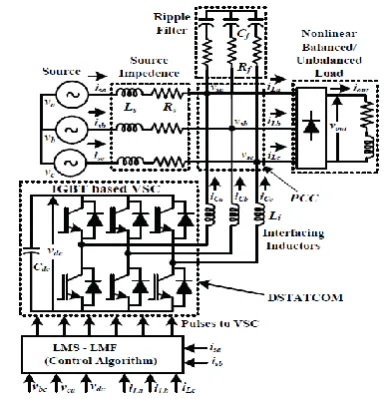
The power quality in the distribution system can be enhanced by utilizing the proposed setup as appeared in Fig.1. This system incorporates a three phase nonlinear load which is provided from a 415 V, 50 Hz, 3-phase AC supply with supply resistance (Rs) and supply inductance (Ls), VSC with a DC transport capacitor (Cdc) and swell filters (Rf, Cf) to take out the high switching frequency noise amid the operation of VSC. The VSC is connected to the Point of Common Coupling (PCC) through the interfacing inductors (Li) which are tuned with the end goal that they lessen the swells in the remunerating currents. A 3-phase diode connect rectifier (DBR) is utilized as a nonlinear stack with a RL branch on the DC side. For the simulation. Utilizing MATLAB programming, the uninvolved components, for example, swell filters (Rf and Lf) and interfacing inductors (Li) are planned considering the particulars of three phase PCC voltage at 415 V and the heap to work at 20 kW control rating.
Figure 1. Schematic diagram of distribution system with DSTATCOM
III.
CONTROL ALGORITHM
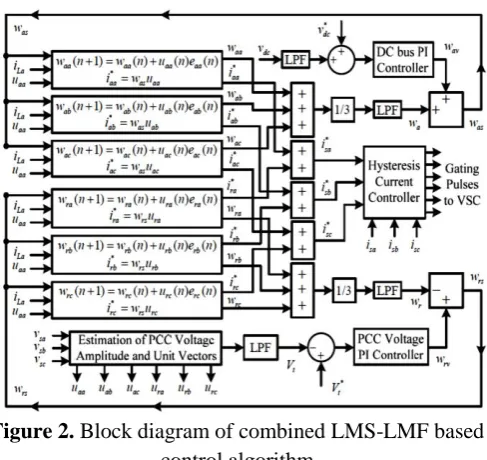
utilized to infer the required reference supply streams from the watched stack ebbs and flows (iLa, iLb, iLc), unit layouts (uaa, uab, uac) got from the detected supply voltages (vsa, vsb and vsc), the DC connect voltage over the compensator (vdc), and the size of supply voltages (Vt). The reference supply streams which are created from the calculation are connected with the supply streams detected from the framework and the subsequent blunder contrast is utilized to produce the proper heartbeats for the DSTATCOM by passing these blunder motions through hysteresis based current controller. At first one determines the dynamic unit format segments (uaa, uab, uac) for the three stages which are in-stage to the supply voltages (vsa, vsb and vsc) are communicated as [2],
where Vt is the amplitude of sensed supply voltages (vsa, vsb and vsc) or PCC voltage and is expressed as [2],
These unit formats are utilized to synchronize the acquired dynamic weights (waa, wab, wac) with the period of supply voltage to get the fitting errors(eaa, eab and eac).
The active weight component of the phase ‘a’ at sampling instant (n+1)th is estimated as,
where, e aa(n) is the genuine dynamic error vector of stage "a" for the proposed combined LMS-LMF based control algorithm and this error part is communicated as
Figure 2. Block diagram of combined LMS-LMF based control algorithm
Where eraa(n) is the error in active load component of phase ‘a’, at sampling instant (n)th and is estimated as,
The calculate utilized the arrangement of these conditions is k which is a step size and the reasonable incentive for this applications is 0.1.
Correspondingly, the dynamic weight segment for stage "b" and "c" are communicated as,
By adding (3), (6) and (7), the mean value of the fundamental l active weight components is obtained as,
The set DC voltage reference esteem is related with detected DC link voltage (vdc) of VSC and the error is given to the PI controller of DC transport voltage. The output of this controller is taken to be the DC loss weight segment and is communicated as
Mistake between of detected DC interface voltage of VSC and reference DC esteem at (n+1)th examining time. Child and Kpd are the necessary furthermore, corresponding increases of the DC transport voltage controller.
By adding the DC misfortune part to the normal key dynamic weight part, one gets the aggregate dynamic weight part (was) of the supply reference streams as,
The reactive unit format segments (ura, urb, urc) for the three stages which are quadrature to the supply voltages (vsa, vsb and vsc) are communicated as [2],
The reactive weight components for three phases a, b and c are estimated by using the following equations,
By adding (13), (14) and (15), the mean value of the fundamental reactive weight components is obtained as,
The normal magnitude of the supply voltage is detected and is connected with set reference extent esteem and the error contrast is given to the AC voltage PI (Proportional Integral) controller. The AC voltage controller yield is weighted to be the AC loss weight part and is communicated as,
where wrv(n+1), vdt(n+1) are the reactive power segment and blunder among detected AC interface voltage and reference extent esteem at (n+1)th sampling time. Pack and Kpt are the necessary and related increases of AC voltage controller. By subtracting the normal principal reactive weight segment from the receptive power segment, one gets the aggregate receptive weight part (wrs) of the supply reference currents and it is evaluated
as,
The reference reactive supply current components which are in quadrature with the three phase voltages are expressed as,
At long last including the dynamic and responsive reference segments of the supply currents of each of the three phase, reference supply currents are communicated as,
These reference supply streams (isa*, isb *, isc*) and detected supply streams (isa, isb, isc)The output given hysteresis current controller which generates the gating pulses to VSC [8].
IV.
SIMULATION RESULTS
The simulation model of appropriation system with DSTATCOM utilizing the combined LMS-LMF based control algorithm is produced by utilizing MATLAB programming. The display is keep running in both PFC and ZVR modes under nonlinear stack. The consistent state and dynamic exhibitions for the proposed consolidated LMS-LMF based control algorithm are considered in detail.
Case1: Characteristics of Intermediate Signals for Combined LMS-LMF Based Algorithm of DSTATCOM
In this case unbalanced the load by switching off the phase ‘a’ of load from 0.52 s to 0.54 s.
Harmonic FFT analysis of phase ‘a’ PCC voltage
Harmonic FFT analysis of phase ‘a’ supply current
Harmonic FFT analysis of phase ‘a’ load current
Case3: Dynamic Response of System in ZVR Mode In this paper we are studying the dynamic response of the system in the ZVR mode for a varying nonlinear load.
An adaptive neuro-fuzzy inference system
ANFIS is thought to be an all inclusive estimator. For utilizing the ANFIS as a part of a more productive and ideal way, one can utilize the best parameters acquired by hereditary calculation. ANFIS: Artificial Neuro-Fuzzy Inference Systems.
ANFIS are a class of adaptive networks that are functionally equivalent to fuzzy inference systems. ANFIS represent Sugeno e Tsukamoto fuzzy
models.
ANFIS uses a hybrid learning algorithm.
In the field of manmade brainpower neuro-fuzzy insinuates blends of fake neural frameworks and fuzzy method of reasoning. Neuro-fuzzy hybridization achieves a cream keen system that synergizes these two methods by joining the human-like considering style fuzzy systems with the learning and connectionist structure of neural frameworks. Neuro-fuzzy hybridization is genarelly named as Fuzzy Neural Network (FNN) or Neuro-Fuzzy System (NFS) in the composition. Neuro-fuzzy system (the more standard term is used from this time forward) wires the human-like considering style fuzzy systems utilizing fuzzy sets and a semantic model containing a course of action of IF-THEN fuzzy gauges. The essential nature of neuro-fuzzy systems is that they are boundless approximates with the ability to ask for interpretable IF-THEN standards.
The nature of neuro-fuzzy systems incorporates two clashing necessities in fuzzy showing: interpretability versus precision. For all intents and purposes, one of the two properties wins. The neuro-fuzzy in fuzzy exhibiting research field is isolated into two zones: semantic fuzzy showing that is fixated on interpretability, generally the Mamdani display; and correct fuzzy showing that is revolved around precision, fundamentally the Takagi-Sugeno-Kang (TSK) demonstrate.
Speaking to fuzzification, fuzzy surmising and defuzzification through multi-layers encourage forward connectionist systems. It must be called attention to that interpretability of the Mamdani-sort neuro-fuzzy frameworks can be lost. To enhance the interpretability of neuro-fuzzy frameworks, certain measures must be taken, wherein imperative parts of interpretability of neuro-fuzzy frameworks are additionally talked about.
A current research line tends to the information stream mining case, where neuro-fuzzy frameworks are consecutively refreshed with new approaching specimens on request and on-the-fly. Subsequently, framework refreshes don't just incorporate a recursive adjustment of model parameters, yet in addition a dynamic development and pruning of model to deal with idea float and powerfully changing framework conduct sufficiently and to keep the frameworks/models "avant-garde" whenever.
Case1 : Characteristics of Intermediate Signals for Combined LMS-LMF Based Algorithm of DSTATCOM
Case2 : Dynamic Response of System in PFC Mode In this paper we are studying the dynamic response of the system in the PFC mode for a varying nonlinear load.
Harmonic FFT analysis of phase ‘a’ PCC voltage
Harmonic FFT analysis of phase ‘a’ supply current
Case 3: Dynamic Response of System in ZVR Mode
V.
CONCLUSION
The proposed combined LMS-LMF based control algorithm using ANFIS controller of DSTATCOM has been executed and simulated for both ZVR and PFC modes under nonlinear balanced and unbalanced loads. In addition, this algorithm has likewise been checked on the equipment model of the DSTATCOM created in the lab. The proposed algorithm has been utilized for acquiring the reference supply currents from the dynamic and responsive weight segments with bends of the PCC voltages and supply currents well beneath 5% which is well inside the predetermined standard. The heap adjusting has likewise been accomplished keeping the waveforms of PCC voltages and currents as sinusoidal and in stage. Compare the results for both LMS-LMF based PI controller and ANFIS controller. LMS – LMF based ANFIS controller gives the better results.
VI.
REFERENCES
[1]. A. Ghosh and G. Ledwich, Power quality enhancement using custom power devices, Springer International Edition, Delhi, 2009. [2]. B. Singh, A. Chandra, and K. Al-Haddad, Power
quality: problems and mitigation techniques, John Wiley & Sons Ltd., U.K, 2015.
[3]. P. Mitra, and G. K. Venayagamoorthy, "An adaptive control strategy for DSTATCOM applications in an electric ship power system," IEEE Trans. Pow. Electron., vol. 25, no.1, pp. 95-104, Jan. 2010.
[4]. R. Majumder, "Reactive Power compensation in single-phase operation of microgrid," IEEE Trans. Ind. Electron., vol. 60, no. 4, pp.1403-1416, April 2013.
[5]. Chao-Shun Chen, Chia-Hung Lin, Wei-Lin Hsieh, Cheng-Ting Hsu, and Te-Tien Ku, "Enhancement of PV penetration with DSTATCOM in Taipower distribution system," IEEE Trans. Pow. Systems, vol. 28, no. 2, pp. 1560-1567, May 2013.
[6]. H. Bagheri Tolabi, M. H. Ali and M. Rizwan, "Simultaneous reconfiguration, optimal placement of DSTATCOM, and photovoltaic array in a distribution system based on Fuzzy-ACO approach," IEEE Trans. Sustainable Energy, vol. 6, no. 1, pp. 210-218, Jan. 2015.
[7]. Shih-Chieh Hsieh, "Economic evaluation of the hybrid enhancing scheme with DSTATCOM and active power curtailment for PV penetration in Taipower distribution systems," IEEE Trans. Ind. App., vol. 51, no. 3, pp. 1953-1961, May-June 2015.
[8]. B. Singh and J. Solanki, "A comparison of control algorithms for DSTATCOM," IEEE Trans. Ind. Electron., vol. 56, no. 7, pp. 2738-2745, July 2009.
[9]. Bhim Singh, P. Jayaprakash, D. P. Kothari, Ambrish Chandra, and K. Al Haddad "Comprehensive study of DSTATCOM configurations," IEEE Trans. Ind. Informatics, vol. 10, no. 2, May 2014.
[10]. B. Singh, S. R. Arya, A. Chandra, and K. Al-Haddad, "Power factor correction and zero voltage regulation in distribution system using DSTATCOM," IEEE Trans. Ind. App., vol. 50, no. 5, pp.3016-3036, Sep./Oct. 2014.
[11]. S. R. Arya and B. Singh, "Performance of DSTATCOM using leaky lms control algorithm," IEEE J. Emerging Selected Topics in Pow. Electron., vol. 1, no. 2, June 2013.
[13]. B. Singh and S. Arya, "Adaptive theory-based improved linear sinusoidal tracer control algorithm for DSTATCOM," IEEE Trans.
[14]. Pow. Electron., vol. 28, no. 8, pp. 3768-3778, Aug. 2013.
[15]. B. Singh, S. R. Arya, and C. Jain, "Simple peak detection control algorithm of distribution static compensator for power quality improvement," IET Pow. Electron., pp. 1736 - 1746, 2014.