*Prof. K. P. R. Chowdary
Mobile: 9866283578
E-mail: [email protected]
Address for correspondence
RECENT RESEARCH ON CYCLODEXTRIN COMPLEXATION IN FORMULATION DEVELOPMENT- A REVIEW
INTRODUCTION
Cyclodextrins (CDs), homologous cyclic oligosaccharides have long been known to increase the apparent solubility of many lipophilic drugs through non-covalent inclusion complexation1,2. Cyclodextrins and their derivatives play an important role in the formulation development due to their effect on solubility, dissolution rate, chemical stability and absorption of a drug3, 4.
The -, - and -cyclodextrins are cyclic oligosaccharides consisting of six, seven and eight glucose units respectively. While it is thought that, due to steric factors, cyclodextrins having fewer than six glucopyranose units cannot exist. Chemical and physical properties of the four most common cyclodextrins are given in Table 1. The melting points of -, -and -cyclodextrins are between 240o and 265oC, consistent with their stable crystal lattice structure5.
Table 1: Some Characteristics of -, -,- and
-Cyclodextrins
No. of glucopyranose
units 6 7 8 9
Molecular weight 972 1135 1297 1459 Central cavity diameter
(Ao) 4.7-5.3 6.0-6.5 7.5-8.3 10.3-11.2
Water solubility at 25oC
(g/100 ml) 14.5 1.85 23.2 8.19 They are enzymatic conversion products of starch. The enzyme cyclodextrin-glucosyl transferase produced by B. macerans acts on partially hydrolysed starch (a mixture of linear dextrins) and produces a mixture of cyclic and acyclic dextrins, from which pure cyclodextrins (CDs) are isolated6.
The structure of the most important CD,
-cyclodextrin is shown in Fig. 1.
O
OH HOH2C
HO O
O O CH2OH
HO HO
O CH2OH
HO
HO O
O
O
O
O OH
CH2OH
HO O OH OH O
CH2OH
O
HOH2C OH
OH HOH2C
OH
OH
Fig.1:The Structure of -cyclodextrin Cyclodextrin complexation is a topic of current interest in pharmaceutical product development. Cyclodextrins and their derivatives play an important role in the formulation development of poorly soluble BCS class II drugs. Several studies reported the application of cyclodextrins for enhancing the solubility, dissolution rate and bioavailability of BCS class II drugs. Literature on cyclodextrins, their properties and applications, pharmacokinetics and toxicity along with recent research on cyclodextrin complexation is reviewed in this article.
Key words:Cyclodextrins,Complexation, Formulation development, Recent research, Review
ABSTRACT K. P. R. Chowdary*,
K. Ravi Shankar Adinarayana Tanniru
Vikas Institute of Pharmaceutical Sciences,
Nidigatla Road, Rajahmundry- 533103
Journal of Global Trends in Pharmaceutical Sciences
Available online at www.JGTPS.com
ISSN: 2230-7346
Journal of Global Trends in Pharmaceutical Sciences
Volume- 5, Issue -2, pp – 1576-1583 - April –June (2014)
The 'torus' shaped macro-ring is built of -1,4-D-glucose units. As a consequence of conformation of glucopyranose units, all secondary OH- groups are located on one edge (wider edge) of the ‘torus’ like CD molecule while all primary OH-groups are on the other side (narrow side of torus). The lining of the internal cavity is formed by OH-atoms and glucosidic oxygen-bridge atoms, therefore, the inner surface is hydrophobic, but outer surface is hydrophilic.
Pharmacokinetics of Cyclodextrins7:
The parent CDs are poorly absorbed from the g.i. tract
Oral absorption studies have shown 2%, 0.1-0.3% and 0.1% absorption respectively with -, -, and - CDs.
Intravenously administered CDs disappear rapidly from systemic circulation; excreted mainly through kidney.The t1/2 of -CD 23.9 – 50.2 min in rat.
The t1/2 of HP--CD is 24 min in rat, 48 min in dog and 72-108 min in human. - and -CDs are excreted almost
completely in their intact form
Little or no distribution of most CDs into other tissues or storage compartments is observed.
Safety of Cyclodextrins:
Parent CDs are reported to be non-toxic and safe even at high oral doses.
The LD50 in rats is reported to be greater than 12.5, 18.8 and 8.0 g /kg body weight for -, -, and -CD respectively.
-and-CDs produced no toxic effects when fed to rats for 30-90 days at 1%, of the diet or at 1 and 2 g /kg daily doses.
Regulatory Status of Cyclodextrins:
Accepted as new pharmaceutical excipients by USFDA
A monograph on CD in USP 23/NF 18, 1995 and European Pharmacopoeia 3rdEd., 1997
Monographs on cyclodextrins in Hand book of Pharmaceutical Excipients.
Formation of Complexes:
One of the most important characteristics of CDs is their ability to form inclusion
complexes. Inclusion complexation involves entrapment of a guest molecule totally or partially in the cavity of host molecule without formation of any covalent bonds. CDs are typical host molecules and can entrap a wide variety of drug molecules resulting in the formation of monomolecular inclusion complexes8.Usually 1 : 1 complexes are formed, but when a guest molecule is too long to find complete accommodation in one cavity, its other end is also amenable to complex formation leading to 2 : 1 (CD : drug) or sometimes 3 : 1 or 4 : 1 complexes. It may also be possible to form 1: 2 and 1: 3 (CD: drug) complexes. The central cavity of the cyclodextrin molecule is linked with skeletal carbons and ethereal oxygens of the glucose residues. It is therefore lipophilic, the polarity of the cavity has been estimated to be similar to that of aqueous ethanolic solution. It provides a lipophilic microenvironment into which suitably sized drug molecules may enter and be included. No covalent bonds are formed or broken during drug-cyclodextrin complex formation, and in aqueous solutions, the complexes are readily dissociated. Free drug molecules are in equilibriumwith the molecules bound within the cyclodextrin cavity Measurements of stability or equilibrium constants (Kc) of the drug-cyclodextrin complexes are important properties of a compound upon inclusion.
Detection of inclusion complexation in the solution state:
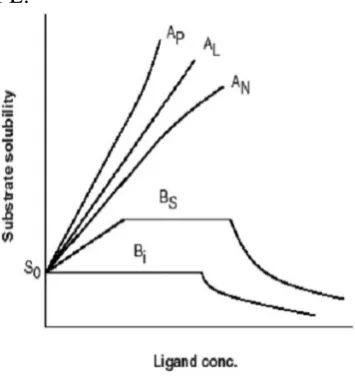
molecular state may be. A phase diagram is constructed by plotting, on the vertical axis, total molar concentration of S found in the solution phase against the molar concentration of L.
Fig. 2:Phase solubility diagram
The phase diagrams are observed to fall into two main classes, type A and type B with some variation wit in the classes (Fig 2).
The type A can be further classified in subtypes AL, APand AN, where the guest solubility of first
type increases linearly with cyclodextrin concentration while those of the second and third types deviate positively and negatively, respectively from the straight line.
The complex formation with a 1:1 stoechiometry gives the ALtype diagram, where
as the higher order complex formation in which more than one cyclodextrin molecules are involved in the complexation gives the AP-type. The interaction mechanism for the AN-type is complicated, because of a significant contribution of solute-solvent interaction to the complexation.
In the case of the Bs type, the initial ascending portion of the solubility change is followed by a plateau region and then a decrease in the solubility at higher cyclodextrin concentrations accompanying a microcrystalline precipitation of the complex. The Bi-type diagram is indicative of the formation of insoluble complexes in water. The stability constant (Ks) and stoechiometry of complexes are determined by analyzing quantitatively the phase solubility diagram.
Detection of inclusion complexation in the solid state:
Detection of the inclusion complexation in solid state can be done by Powder X-ray diffractometry, Single crystal X-ray structure analysis, Thermo analytical, Thin layer chromatography, Paper chromatography, Infrared spectroscopy, Scanning electron microscopy and Dissolution study methods
Methods of Preparation of CD Complexes:
Many techniques are known to form complexes with cyclodextrins, these are briefly described below.
1. Physical blending / Grinding method:
Inclusion complexes can be prepared by simply grinding/ triturating the drug with cyclodextrin in mortar, on small scale. Whereas on large scale, the preparation of complexes is based on extensive blending of the drug with cyclodextrin in a rapid mass granulator usually for 30 minutes10
2. Kneading method: Paste of cyclodextrin is prepared with small amount of water to which the drug is added without a solvent or in a small amount of ethanol. After grinding paste, solvent get evaporated and powder like complex is formed. On laboratory scale kneading can be achieved by using a morter and pestle11-13. On large scale the kneading can be done by utilizing the extruders and other machines. Parikh14 reported the dissolution enhancement of Nimesulide using complexation method.
3. Co-precipitation: Cyclodextrin is dissolved in water and the guest is added while stirring the cyclodextrin solution. By heating, more cyclodextrin can be dissolved (20%) if the guest can tolerate the higher temperature. The cyclodextrin and guest solution must be cooled under stirring before a precipitate is formed. The precipitate can be collected by decanting, centrifugation or filtration and washed. Moyano15had studied the solid-state characterization and dissolution characteristics of Gliclazide-Beta- cyclodextrin inclusion complexes.
and stirred to attain equilibrium. The resulting solution is evaporated to dryness preferably under vacuum.10
5. Neutralization method: Drug and cyclodextrin are separately dissolved in 0.1 N sodium hydroxide, mixed and stirred for about half an hour, pH is recorded and 0.1 N HCl is added drop wise with stirring until pH reaches 7.5, where upon complexes precipitates. The residue is filtered and washed until free from chlorine, It is dried at 2500C for 24 h. and stored in desiccators Doijad16had studied the enhancement of solubility of Piroxicam by complexation with beta-cyclodextrin.
6. Spray drying: In this method, first monophasic solution of drug and cyclodextrin is prepared using a suitable solvent. The solution is then stirred to attain equilibrium following which the solvent is removed by spray drying. Vozone17had developed complexation of budesonide in cyclodextrins and particle aerodynamic characterization of the complex solid form for dry powder Inhalation.
7. Lyophilization/ Freeze drying technique:
To get a porous, amorphous powder with high degree of interaction between drug and cyclodextrin, lyophilization/freeze drying technique is considered as a suitable18-19. Here, the solvent system from the solution is eliminated through a primary freezing and subsequent drying of the solution containing both drug and cyclodextrin at reduced pressure. Thermolabile substances can be successfully made into complex form by this method.
8. Melting: Complexes can be prepared by simply melting the guest, mixed with finely powdered cyclodextrin. In such cases there should be a large excess of guest, and after cooling this excess is removed by careful washing with a weak complex, forming solvent or by vacuum sublimation20.
9. Micro wave irradiation method: This technique involves the microwave irradiation reaction between drug and complexing agent using a microwave oven. The drug and CD in definite molar ratio are dissolved in a mixture of water and organic solvent in a specified proportion into a round bottom flask. The
mixture is reacted for short time of about one to twominutes at 60 °C in the microwave oven. After the reaction completes, adequate amount of solvent mixture is added to the above reaction mixture to remove the residual, uncomplexed free drug and CD. The precipitateso obtained is separated using whatman filter paper, and dried in vaccum oven at 40 °C for 48 hrs.21
precipitation of the solute and the solvent is carried away with the supercritical fluidflow28-29
Applications of Cyclodextrins:
Cyclodextrins (CDs) are cyclic torus-shaped molecules with a hydrophilic outer surface and lipophilic central cavity, which can accommodate a variety of lipophilic drugs. As a consequence of inclusion process many physico-chemical properties such as solubility, dissolution rate, stability and bioavailability can be favorably affected30-41
Recent Research Work on CD Complexation:
Several studies reported the cyclodextrin complexation of a variety of drugs for various
purposes. A summary of recent research on cyclodextrin complexation for enhancing the solubility, dissolution rate and bioavailability is given in Table 2.
CONCLUSION
Cyclodextrins have become versatile pharmaceutical excipients. Cyclodextrin complexation has been successfully used for enhancing the solubility, dissolution rate and bioavilabilityof several poorly soluble drugs in their formulation development. Cyclodextrins have been receiving increasing application in pharmaceutical product development in recent year due to their approval by various regulatory agencies.
Table 2: Summary of Recent Research on Cyclodextrin Complexation42-77
Sl.
No Drug Cyclodextrin used Purpose/Result Ref. No
I Analgesic ,Antipyretic, Anti-inflammatory Drugs
1 Nimesulide HP βCDβCD,
ME-βCD Improved solubility and oral bioavailability 42
2 Aceclofenac HP βCDβCD Improve solubility and dissolution rate 43
3 Diclofenac sodium 2-HPγCDγCD
Investigated aggregation of complexes through semi- permeable membranes and transmission
electron microscopy 44
4 Indomethacin Cationic βCDCP βCD Drug loading capacities of CP βCD wand complexes were confirmed by 1H NMR and ere studied DSC
45
5 Capsaicin HPβCD Improved percutaneous absorption 46
6 Etoricoxib Poloxamer 407,βCD,HP βCD,
PVP K30 Enhancement in solubility and dissolution rate 47
7 Ketrolac HPβCD Higher Transdermal Transport 48
8 Paracetamol α, β and γ cyclodextrin γ complexes are most stable than β complexes which are more
stable thanα complex 49
II Antimicrobial,Antifungal,Antiviral,Antibiotic Drugs
9 Acyclovir Fluorinated amphiphilicα cyclodextrins hexakis To prepare aqueous suspensions of nanoparticles 50
10 NovabiocinRifampin
Vancomycin βCD
Affinity based antibiotic delivery mechanisms
were developed 51
11 Sulfamethoxazole Hydroxypropyl-cyclodextrinβ- Increased solubility 52
12 SulfamethoxazoleTrimethoprim (α-,cyclodextrinsβ-,andγ-CDs)
The solubility enhancement of trimethoprim is much higher than that of sulfamethoxazole in the
presence of SDS micelles 53 13 Vancomycin β-cyclodextrin modified release with improved bioavailabity 54
III Anti hypertensive, Antianginal, Drugs
15 Irbesartan PEG 4000,βCD, PVP K90
Improved aqueous solubility, dissolution rate and Characterization of inclusion complexes by XRD,
DSC,FTIR and SEM 56
16 Carvidilol Citric acidβCD Characterization of inclusion complexes by XRD, Improved aqueous solubility, dissolution rate and
DSC,FTIR and SEM 57
17 Felodipine Cyclodextrins FTIR, DSC and XRPD showed the confirmation of complexation of cyclodextrin with felodipine 58
18 (Lovastatin,Simvastatin)Statins RMβCD Improved solubility 59
19 Valsartan βCD,HP βCD,PVP K30 Enhancement in solubility and dissolution rate 60
IV Sedatives, Antidepressant, Anti anxiety, Anticonvulsant Drugs
20 Lorazepam HPβCD Improved aqueoussolubility and dissolution rate 61
21 Lamotrigine βCD Improved solubility and bioavailability 62
22 Doxepin βCD Characterization of inclusion complexes byNMRspectroscopy 63
23 Promethazine monochlorotriazinyl-cyclodextrin β- alkaline medium is more favourable for producing the complex 64 24 Olanzapine methyl-β –CD Higher dissolution efficiency and stability 65
V Anti cancer Drugs
25 Tacrolimus Dimethyl-β-cyclodextrin improved delivery efficiency 66
26 Diferuloylmethane hydroxypropyl-cyclodextrinβ- improved the physical properties and antitumor activity 67 27 Betulin γ-Cyclodextrin Improved solubility both invitro and in vivo 68
VI Miscellaneous
28 (Anti Ulcer)Omeprazole MEβCD,βCD,
L- arginine Improved buccal permeation 69 29 (Anti Tussive)Noscapine βCD Improved aqueous solubility and pharmacokinetics 70
30 (Local Anaesthetic)Bupivacaine HCl β-CD epichlorohydrinα –CD Improved buccal delivery and Characterization of inclusion complexes by XRPD, DSC,FTIR and Environmental scanning electron microscopy 71 31 (Anti Coagulant)Warfarin βCD Improvement in the in vitro bioavailability of the drug in acidic media 72
32 (Antiatherogenic)Naringin β-cyclodextrin Improved aqueous solubility 73
33 (Anthelminthic)Albendazole 2-hydroxypropyl-cyclodextrin β- Improved solubility, pharmacokinetic profile and antitumor efficacy 74
34 (Anti Histamine)Meclizine 2-Hydroxypropyl-cyclodextrins and ββ-
-cyclodextrins Better release than marketed tablets 75
35 (Imunimodulator)Thalidomide Hydroxypropyl-cyclodextrinβ- Improved gastrointestinal absorption 76
36 RosuvastatinCa
(antihyperlipedimic) β-cd
Phase solubility profile indicated that the solubility of rosuvastatinCa was significantly
increased in the presence of β-CD 77
REFERENCES
1. Martin A, Bustamante, P. and chun, A.H.C., Eds., In: Physical Pharmacy: Physical Chemical Principles in the Pharm. Sciences, 4 Edn., B.I Waverly, Pvt. Ltd., 54, Janpath, New Delhi, 257, 1994.
2. Bekers 0., Uijtendaal, E.V., Beijnen, J.H., Bult, A. and Underberg, W.J.M., Drug Dev. Ind. Pharm., 17, 1503, 1991.
4. Rajewski, R.A. and Stella, V.J., J. Pharm. Sci., 85, 1142, 1996.
5. Nash, R.A., In: Hand book of Pharmaceutical Excipients, Wade, A., Weller, P.J., Eds., Am. Pharm. Assoc. & Phar. Press: London, 145, 1994.
6. Szejtli, J., Cyclodextrin Technology, Kluwer. Academic Publishers, Dordrecht, The Netherlands, 1988.
7. Szejtli, J., Drug Investigation, 2(suppl.), 11, 1990.
8. Szejtli, J., Cyclodextrins and their inclusion complexes, Akademiai, Kiado, Budapest, Hungary, p. 13, 1982.
9. Fromming, K. H. and Szejtii. J., Cyclodextrins in Pharmacy, Kluwer Acad. Publ., Dordrecht, 1994.
10. Manoj M, Nitalikar, Dinesh M, Sakarkar, Parag V. Jain, Journal of Current Pharmaceutical Research 2012; 10 (1): 01-06.
11. Fernandes CM, Veiga FJB, Chem. Pharm. Bull.50(12):1597-1602 (2002)
12. Cirri M, Rangoni C, Maestrelli F, Corti G, Mura P, Drug Dev. Ind. Pharm.31:697-707.(2005)
13. Cunha-Filho, MSS, Dacunha-Marinho B, Torres- Labandeira JJ, Martinez-Pacheco R, Landin M, .AAPS Pharm Sci. Tech.8:1-10 (2007)
14. Parikh R K, Mansuri NS, Gohel MC, SonlwalaM. Indian Drugs.42:2005:149- 53 15. Moyano J R, Blanco MJA, Gines JM,
Giordano F, Int. J. Pharm.48: 211-17, (1997)
16. Doijad RC, Kanakal MM, Manvi FV, Indian Pharmacists.VI: 94-98, (2007)
17. Vozone CM, Marques HMC, J. Incl. Phenom. Macroc. Chem. 44:111-15. (2003) 18. Cao FT, Guo J, Ping Q. Drug Dev. Ind.
Pharm.31:747-56. (2005)
19. Rodriquez-Perez AI, Rodriquez-Tenreiro C, Alvarez-Lorenzo C, Concheiro A, TorresLabardeira J J. J. Nanosci. Nanotecnol.6:3179-86, (2006)
20. Pandya S J, Mansuri JS, Patel P., Pharmainfo.net. 6, 2, (2008).
21. Amit Chaudhary, Upendra Nagaich, NehaGulati, V. K. Sharma, R. L. Khosa, Journal of Advanced Pharmacy Education & Research2 (1) 32-67 (2012)
22. J Fages, H Lochard, J-J Letourneau, M Sauceau, E Rodier. Powder Technol.141:2004:219-26.
23. G S Tirucherai, A K Mitra.AAPS Pharm.Sci.Tech.4:2003: E45.
24. T Van Hees, G Piel, B Evrard, X Otte, L Thunus, LDelattre. Pharm. Res.16:1999: 1864-1870.
25. M Charoenchaitrakool, F Dehghani, N R Foster.Int. J Pharm.239: 2009:103-112. 26. N Bandi W Wei C B Roberts, L P Kotra, U
BKmpella. Eur. J PharmSci.24: 2004:159-168.
27. E Rodier, H Lochard, M Sauceau, J-J Letourneau, BFreiss, J Frages. Eur. J, Pharm Sci.26: 2005;184-193.
28. Al-Marzouqui AH, Jobe B, Dowaidar AF, MaestrelliF, Mura P. J. Pharm. Biomed Anal.43:2007:566-74.
29. Vamsi KM, Gowrisankar D., Indian J. Pharm. Edu. Res. 41(1): 2007:10-17.
30. Higuchi, T. and Connors, K .A, Phase-Solubility Techniques, In: Advances in Analytical Chemistry and Instrumentation, Reilly, C.N., Ed., Wiley-Interscience. New York, 4, 117, 1965.
31. Uekama, K. and Otagiri, M., CRC Crit. Rev. Ther. Drug Carrier Sysfc., 3:1, 1987. 32. Uekama, K. and Irie, T., Pharm. Int., 6:1,
1985.
33. Saenger, W.,Angrew Chem. Int Ed. Engl., 19, 344, 1980.
34. Duchene, D., Debmeres, B. and Vaution, C., STP Pharma., 1:37, 1985.
35. Szejtli, J., In: Controlled Drug Bioavailability,Smolen, W.F. and Ball, L.A., Eds., Wiley., New York, U.S.A., 3, 365, 1985.
36. Szejtli, J., Pharm. Technol. Int., 3(2):20 and 3(3): 16, 1991.
37. Szejtli, J., Cyclodextrin Technology, Kluwer Acad. Publ., Dordrecht, 1988. 38. Uekama, K. and Irie, T., Drug
Investigation, 2 (suppl. 4), 22, 1990. 39. Pitha, J., Milecki, J., Fales, H., Pauvell, L.
and Uekama, K., Int. J. Pharm., 29, 73, 1986.
40. Chowdary, K.P.R., Buchi, N. Nalluri. and Murthy, K.V.R., Int. J. Pharma. Excip., Dec. 2002.
41. Gerold, Mosher. and Diane, 0.Thompson., Encyclopedia of Pharmaceutical Technology., pp. 531-558, 2002.
43. Ranpise, N.S., Kulkarni, N.S., Mair, P.D. and Ranade, A.N., Pharma. Dev. Technol., 2009.
44. Jansook, P., Kurkov, S.V. and Loftsson, T., J. Pharm. Sci., 99(2), 719--29, 2010.
45. Xin, J., Guo, J., Chen, X., Jiang, W., Li, J. and Li, M., Int. J. Pharm., 386(1-2), 221-8, 2010.
46. Zi, P., Yang, X., Kuang, H., Yang, Y. and Yu, L., Int. J. Pharm., 358(1-2), 151-8, 2008.
47. Chowdary, K.P.R., Prakasa Rao, K.S. and Madhuri, D., Int. J. Chem.Sci., 9 (2), 677-686, 2011.
48. Nagarsenker, M.S., Amin, L. and Date, A.A., AAPS Pharm Sci Tech., 9(4), 1165-70, 2008.
49. Anup Satish Balte, Praveen Kumar Goyal and Shridhar P. Gejji: Journal of Chemical and Pharmaceutical Research: 2012: 4 (5): 2391-2399.
50. Ghera, B.B., Perret, F., Chevalier, Y. and Parrot-Lopez, H., Int. J. Pharm., 375(1-2), 155-62, 2009.
51. Thatiparti, T.R. and Von Recum, H. A., Macromol. Diosci., 10(1), 82-90, 2010. 52. Carnero.C,Aiassa V, Longhi M :Journal of
Pharmaceutical and Biomedical Analysis : 2012: 63 (7) : 74-79.
53. Sinem Gokturk, Elif Caliskan, R.Yesim Yalman and UmranVas :Scientific World Journal :2012
54. MS Zarif, AR Afidah, JM Abdullah, AR Shariza :Biomed Res-India : 2012 : 23(4) :513-520.
55. Jessy Shaji, SmehaIyer:Asian J Pharm: 2012 :6 (3): 218-226.
56. Hirlekar, R.S., Sonawane, S.N. and Kdam,V.J., AAPS Pharm Sci Tech., 10(3), 858-63, 2009.
57. Pokharkar, V., Khanna, A., Venkatpurwar, V., Dhar, S. and Mandpe, L.Acta Pharm., 59(2), 121-32, 2009.
58. Patel, V.P., Gohel, M.C. and Parikh, R.K., Indo-Global J. of Pharmaceutical Sci., 1(2), 194-205, 2011.
59. Sarle, A., Szente, L. and Csempesz, F., J. Pharm. Sci., 98(2), 484-94, 2009.
60. Anjan, K.M., Murthy, P.N., Sudarsan, B., Abikesh, P.K.M. and Siba, P.P., Dissolution Technologies, 39-45, February, 2011.
61. Jug, M. and Be, A., Drug Dev. Ind. Pharm., 34(8), 817-26, 2008.
62. Shinde, V.R., Shelake, M.R., Shetty, S.S, Chavan-Patil, A.B., Pore, Y.V. and Late, S.G., J. Pharm. Pharmacol., 60(9), 1121-9, 2008.
63. Cruz, J.R., Becker, B.A., Morris, K.F., Larive, C.K., Magn Reson Chem., 46(9), 838-45, 2008.
64. Octavian Popescu and Aurelia Grigoriu: Cellulose Chemistry and Technology: 2012: 46 (5-6): 295-300.
65. Marcia Rocha de Freitas, Larissa AraujoRolim, Monica Felts de La Roca Soares, Pedro Jose Rolim- Meto, Miracy Muniz de Alvuquerque, Josclamartine Soares- Sobrinho: :Carbohydrate polymers : 2012:89; 1095-1100.
66. Gao S, Sun J, Fu D, Zhao H, Lan M, Gao F : Int J Pharm.2012: 427(2): 410-6.
67. QunyouTan, yi li, Jianyongwu, Hu Mei, ChunjingZaho, jinggingZhAng: Int J Nanomedicine:2012 : 5: 5385-5393.
68. CodrutaSoica ,cristinaDehelean, CorinaDanciu, Haiming Wang, Gerhard Wenz, Rita Ambrus, FlorinaBojin and Mariana AnghelInt J Mol Sci. 2012 : 13(11) :1499-15011.
69. Figueiras, A., Hombach, J., Veiga, F. and Bernkop, S.A., Eur. J. Pharm. Biopharm.,71(2), 339-45, 2009
70. Madan, J., Dhiman, N. and Parmar, V.K., Cancer Chemother. Pharmacol., 65(3), 537-48, 2010.
71. Jug, M., Maestrelli, F., Bargagni, M. and Mura, P., J. Pharm. Biomed. Anal., 52(1), 9-18, 2010.
72. Zingone, G. andRubessa, F., Int. J. of Pharmaceutics, 291 (1-2), 3-10, 2005. 73. Li Cui, Zhen-Hai Zhang, E sun and
Xiao-Bin Jia:Int J Mol Sci. 2012; 13(11): 14251– 14261.
74. Ehpeda A, Galettis P, Chu SW, Pillai K, Morris DL: Anticancer Res: 2012 :32(9):3659-3666.
75. SJ George, DT Vasudevan: Journal of young Pharmacists: 2012 : 4 (4): 220-227. 76. Jadel M. Kratz, Marima R.Teixeira, Karine
Ferronato, Helder F.Teixeira, Leticia S. Koester and Claudia M.O.Simoes: AAPS Pharm Sci Tech: 2012: 13(1): 118-124. 77. Akbari, B.V., Int. J. of Pharmaceutical &