Nurses' perceptions of the ethical climate existing in educational and medical
centers
Abstract
Background and Purpose: Organizational ethical climate (EC) refers to the shared perceptions of the ethical issues and the way of practicing these issues in the organization. Ethical values play an important role in the nurses’ behavior; moreover, the performance of the nurses may be affected by the EC of the nursing sectors. Regarding this, the present study was conducted with the aim of investigating the nurses’ perceptions of the EC in the training and medical centers of Hamedan University of Medical Sciences, Hamedan, Iran, in 2016.
Methods: This descriptive cross-sectional study was carried out on 259 nurses, working at the training and medical centers of Hamedan University of Medical Sciences in 2016. The research instruments included a demographic form and the standard Ethical Climate Questionnaire.
Results: According to the results, the age range of the nurses was 24-60 years. The highest and lowest dimensions of the EC perceived by the nurses were the individual self-interest and global benevolence, rendering the mean values of 2.33±0.52 and 2.00±0.61, respectively. Additionally, the mean total EC was 2.10±0.27.
Conclusion: As the findings of the present study indicated, it is essential to strengthen the benevolence and ethical principles at the global level in the nursing organizations. This can be achieved through the codification of the relevant strategies in nursing. The role of middle nurse managers is very important in the promotion of the benevolence and ethical principles at the global level.
Keywords: Ethical Climate, Nurses, Perception
Arezoo Shayan1, Hassan Ahmadinia2, Zahra Marzieh Hassanian3*
(Received: 17 Feb 2017; Accepted: 30 Apr 2017)
1 Department of Midwifery, Mother and Child Care Research Center, Hamadan University of Medical Sciences, Hamadan, Iran 2 School of Health, Hamadan University of Medical Sciences, Hamadan, Iran
3, * Corresponding author: Chronic Disease Home Care Research Center, Hamadan University of Medical Sciences, Hamadan, Iran; Department
of Nursing, School of Nursing and Midwifery, Hamadan University of Medical Sciences, Hamadan, Iran. Email: [email protected] Original article
Introduction
Nurses are responsible for their colleagues, profession, and community (1). Ethics-based performance is an important issue in nursing. Accordingly, the nurses work based on the intrinsic values of their career and ethics-based behavior even when their integrity is threatened (2). Ethical climate (EC) can be considered as the public perception of certain organizational performance and procedures containing ethical content (3).
The EC represents the atmosphere of the work environment, which is a reflection of the guidelines, procedures, and organizational policies with ethical results. The employees, who confirm the presence of appropriate EC in their organizations, enjoy enhanced satisfaction and commitment since they believe that the organizational relationships and interactions are fair (4, 5).
Hospitals are considered as the main health
organizations, which are closely related to the public health and have deep links with ethical issues. In some studies, ethics is regarded as the infrastructure of the hospital activities that play an important role in the efficiency of the doctors and nurses (6, 7). Ethical standards are implemented as reference in the organizational decision making and decision analysis process.
Based on the Kohlberg’s ethical reasoning (1984), the ethical standards are of three types, including self-interest (pre-contractual), benevolence (contractual), and ethical codes (post-contractual). Accordingly, people analyze their decisions at three levels, namely individual, local, and global levels (8, 9). The EC is a framework that creates and strengthens the acceptable norms, values, and beliefs, related to the way the activities are carried out (10).
Victor and Cullen (1988) developed a framework for measuring the employees’ perceptions about the EC, which was based on a combination of the theoretical constructs of cognitive development, ethical theory, and locus of analysis (11). Different climates of the organization might be associated with organizational performance and behavior of the individuals. The organizational EC can be categorized into three groups, including egoism, benevolence, and principle, which correspond to the Kohlberg’s (1981) ethical standards.
Another dimension of EC is the locus of analysis denoting the referent group that serves as a source of ethical rational (i.e., individual, local, and cosmopolitan). The ethical principles reveal the three major classes of ethical theory, including egoism, utilitarianism, and deontology. These concepts corresponds maximizing one’s own self-interests (egoism), maximizing the interests of as many persons as potential (benevolence), and devotion to universal standards and beliefs (principle), respectively (11).
The instrumental climate falls within the egoism and location of the personal analysis, while the sympathetic climate falls within the benevolence dimension and individual analysis. Additionally, the principle dimension in the global analysis of ethics finds the aspect of professional codes and laws (professional). In the instrumental aspect, the
people in the organization make effort for the sake of their own interests, whereas in the sympathetic dimension, the employees are interested in the welfare of others and consider all people who are affected by their decisions. In the dimension of adherence to principle, rules, and ethical codes, the individuals consider the professional rules in their activities and decisions (12, 13).
Ethical behavior is considered an important issue in the management of an organization. Therefore, a favorable organizational EC results in enhanced job satisfaction, reduced turnover intention, and improved service quality (14). In a study, it was reported that the employee’s emotional intelligence and ethical behavior had a significant effect on the ethical behavior of the nurses. The independent climate was also found to have a direct effect on the nurses’ ethical behavior (15).
The investigation of the organizational EC is a matter of fundamental importance since it increases the managers’ perceptions of factors that are associated with organizational ethics and ethical decision making. Given the significance of EC in the nursing profession, the present study aimed to investigate the nurses’ perceptions about the EC.
Materials and Methods
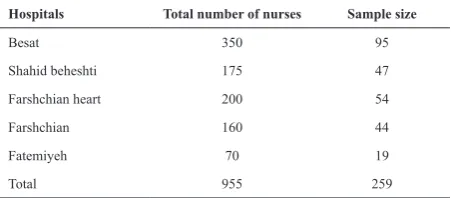
This descriptive cross-sectional study was con-ducted on 259 nurses of Hamedan University of Medical Sciences, Hamedan, Iran, in 2016. The participants were selected using the stratified sampling and simple random sampling methods, respectively. Based on the stratified random sampling technique, the samples were selected in proportionate to the nursing personnel in the healthcare centers; in other words, the health centers with more nurses had a higher share in the samples (Table 1).
The inclusion criteria were: 1) minimum education level of bachelor’s degree in nursing, 2) work experience of at least one year in the training and medical inpatient units of health centers, and 3) lack of chronic illnesses. On the other hand, the exclusion criteria included working at the wards other than the inpatient unit.
After making arrangement with the Office of
Nursing and obtaining the list of nursing staff, the samples were selected from each hospital. The researcher referred to these centers following the achievement of the necessary permissions from the University. Subsequently, the participants were met, and they were assured about the confidentiality of their personal information. Ultimately, they were provided with the questionnaires.
The data collection tools included the demographic form and Ethical Climate Questionnaire, which was developed by Cullen and Victor (1988). The questionnaire covers the ethical standards, including self-interest, benevolence, and ethical principles, as well as ethical reasoning references, namely individual, local, and global. Therefore, this questionnaire includes nine dimensions of EC theory, such as self-interest (instrumentalist), self-interest of the organization (instrumentalist), efficiency (sympathetic), friendship (sympathetic), team interests (sympathetic), social responsibility (sympathetic), personal ethics (independence), rules and procedures (rules), and professional codes and laws (professional), which are determined by a certified agent analysis.
Based on the literature, the assumptions of these nine dimensions are well-matched and even better with the data, compared to those of the five-part experimental model, which was used previously (1, 2). In this questionnaire, four items are dedicated to each dimension. The individual self-interest dimension (self-interest), global egoistic dimension (efficiency), individual principles dimension (personal ethics), and local egoistic dimension (interests of organization) are measured through items 1, 10, 6, 33, items 2, 19, 25, 36, items 3, 9, 11, 22, and items 4, 8, 17, and 29, respectively.
Additionally, items 5, 16, 32, 35, items 12, 27, 21, 31, items 7, 15, 18, 23, items 13, 14, 20, 24, and items 26, 28, 30, and 34 evaluated the individual benevolence (friendship), local benevolence (interest of group), local principle dimension (rules and procedures), global principle dimension (laws and professional codes ), and global benevolence dimension (social responsibility), respectively.
This questionnaire is rated on a five-point Likert scale, ranging from strongly agree to strongly disagree. The EC is determined by calculating the mean and standard deviation of each dimension (11). The content validity and reliability of this instrument were approved in a study conducted by Haydari and Hassanian (2012) using a panel of experts and Cronbach’s alpha coefficient (α=0.89), respectively (16). The data analysis was performed using the independent t-test, ANOVA, correlation coefficient, andlinear regression through the SPSS version 16. P-value less than 0.05 was considered statistically significant.
Results
According to the results of the study, the age range of the nurses was 24-60 years. Furthermore, 35.1% and 6.2% of the participants were within the age ranges of 28-36 and 52-60 years, respectively. As the results demonstrated, most of the participants (67.7%) were female. Furthermore, 43.5% and 2.7% of the nurses had 8-16 and 24-32 years of work experience, respectively. In terms of the education level, 93.8% and 6.2% of the participants had bachelor’s and master’s degrees, respectively.
As indicated in Table 2, the lowest and highest EC dimensions were the global benevolence and individual self-interest with the mean values of 2.00±0.61 and 2.23±0.52, respectively. In addition, the mean overall EC was 2.10±0.27. According to the results of the independent t-test, the EC dimensions had no significant relationship with the gender and marital status.
However, the ethical climate, gender and marital status showed a significant association with work experience (P=0.014), participation in the ethics workshop and self-interest (P=0.042),
Table 1. Selection of study population based on stratified random sampling technique
Sample size Total number of nurses
Hospitals
95 350
Besat
47 175
Shahid beheshti
54 200
Farshchian heart
44 160
Farshchian
19 70
Fatemiyeh
259 955
Total
local benevolence (P=0.015), professional codes (P=0.044), international benevolence (P=0.000), membership in the ethics workshop and local self-interest (P=0.018), passing the ethics course and global principles (P=0.048), and global benevolence (P=0.001) (Table 3).
The ANOVA demonstrated a statistically sig-nificant relationship between the local principles and nurses’ education level (P=0.058). Furthermore, the correlation coefficient revealed that the work experience had a statistically significant relationship with self-interest and individual principles (P=0.020 and P=0.022, respectively) (Table 4). In addition, the age demonstrated a significant relationship with individual principles and local self-interest (P=0.003 and P=0.040, respectively).
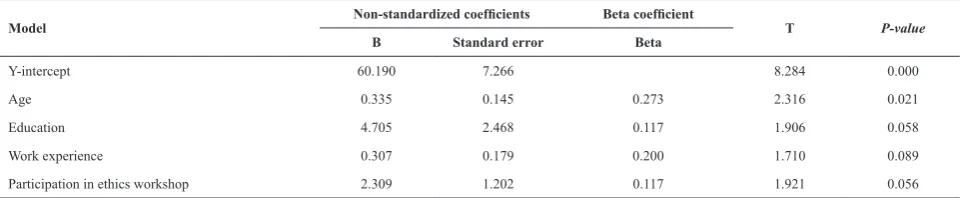
Additionally, the linear regression was employed to investigate the effect of different variables on the EC. To this aim, all the variables were entered into the model using backward selection method, and only the significant variables remained in the model.
The EC was found to Significant relationship with the age (Table 5).
Discussion
This study was conducted with the aim of
Table 2. Descriptive statistics of the nurses’ perceptions of organizational ethical climate
Ethical climate Minimum Maximum Mean Standard deviation
Individual egoistic 1 4 2.33 0.52 Global egoistic 1 4 2.19 0.52 Individual principle 1.25 3.5 2.11 0.52 Local egoistic 1 4 2.02 0.62 Individual benevolence 1 4 2.10 0.67 Local principle 1 4 2.05 0.62 Benevolence local 1 4 2.05 0.62 Global principle 1 4 2.06 0.66 Global benevolence 1 4 2.00 0.6.10 Ethical climate 1 4 2.10 0.27
Table 4. Correlationcoefficient between dimensions of ethical climate and work experience
Work experience Ethical climate dimensions
P-value
Correlation coefficient
0.020 0.145*
Individual self-interest
0.246 0.072
Global self-interest
0.022 0.142*
Individual principles
0.086 0.107
Local self-interest
0.648 0.029
Individual benevolence
0.810 0.015
Local benevolence
0.450 0.047
Local principles
0.833 0.013
Global principles
0.405 0.052
Global benevolence *Significant variables
Table 5. Coefficients effect of explanatory variables on the ethical climate in the backward selection method
Model Non-standardized coefficients Beta coefficient T P-value
B Standard error Beta
Y-intercept 60.190 7.266 8.284 0.000
Age 0.335 0.145 0.273 2.316 0.021
Education 4.705 2.468 0.117 1.906 0.058
Work experience 0.307 0.179 0.200 1.710 0.089
Participation in ethics workshop 2.309 1.202 0.117 1.921 0.056
Table 3. Correlation coefficient between the dimensions of ethical climate and age
Age
Ethical climate dimensions
P-value
Correlation coefficient
0.070 0.113
Individual self-interest
0.843 - 0.012
Global self-interest
0.003
*0.185
Individual principles
0.040
*0.128
Local self-interest
0.984 0.001
Individual benevolence
0.185 0.083
Local benevolence
0.322 0.062
Local principles
0.396 0.053
Global principles
0.812 0.015
Global benevolence
investigating the nurses’ perceptions of EC. As the findings revealed, the individual egoistic (self-interest) and global benevolence (social responsibility) had the highest and lowest mean scores among the nurses working in the training hospitals of Hamedan University. The EC is a framework to create and reinforce acceptable norms, values, and beliefs, covering how things must be done.
It seems that the establishment of EC in an organization along with job conscience, rationality, religious beliefs, as well as social and religious culture would result in a favorable condition for the employees. Under this circumstance, the creation and strengthening of the organization would be more institutionalized (17). According to the findings of the present study, the nurses were more likely to think of their own self-interest, and the global benevolence was prominently low among this population.
In a study conducted by Ulrich et al. (2007), the nurses were reported to feel fatigue, breakdown, and powerlessness when faced with ethical issues. In the mentioned study, it was revealed that the nurses experienced deprivation and fatigue when they were not able to solve the ethical issues (18). The self-interest dimension is defined as the attention to the needs and preference of the private owner, organization, or the larger social system, which is under the effect of the interests of the person, organization, or enhancement of the effectiveness of the organization (19, 20). The self-interest climate guides the individuals to make a decision based on the personal needs while paying minimum attention to the bylaws or even laws of the organization.
On the other hand, the benevolent climate is an atmosphere that emphasizes on the essence of the individual wills and provokes the individuals to pay attention to the effects of their own decisions and performances on others. This climate includes the behavior that provides the maximum pleasure and minimum pain for more people including the working group, organization, and community. Victor and Cullen identified the benevolent criteria as attention to the friendship, team interest, and social responsibility.
The benevolent climate focuses the attention on the working groups, organization members,
customers, and all stakeholders. According to the religious principles, the benevolence criterion is based on the circumstances and items, where the good of the people is considered both in this world and the hereafter (20). The inclusion of the ethics, especially the personal ethics, as the progress and selection criterion in the organizations can reduce the autonomy and self-interest in these places. Moreover, the employment of the ethical charters strengthens the team interests and social responsibility, which are parts of the benevolence dimension (13).
In a study carried out by Elci and Alpkan, it was demonstrated that the EC affected the personal satisfaction as well as personal interest, and had a negative influence on work satisfaction. They also reported that the benevolence dimensions had a positive effect on the job satisfaction and improvement of quality of service (21). Furthermore, Nadi et al. (2010) and Hassani (2014) demonstrated the direct relationship of the EC with job satisfaction and organizational commitment and its indirect relationship with turnover intentions (22, 23).
In another study conducted by Shakernia, which was conducted on 130 nurses in Rasht, the EC was reported to have a direct relationship with organizational support and nurses’ civil behavior (24). Regarding this, the nursing managers and supervisors are recommended to redouble their efforts to promote the EC based on the benevolence and codes of ethics at the global and local levels in the workplace.
A significant relationship was found between the local benevolence and work experience, participation in ethical workshops and individual self-interest, local benevolence and global principles and global benevolence, membership in a local ethical workshop and self-interest, passing ethicality/global principles and global benevolence and local principle courses, age and individual principles and local self-interest.
Regarding this, with the increase of work experience, the mean score of the local benevolence (interests of the group) was elevated, and the mean score of the individual principles (personal ethicality) was enhanced with the increase in the level of
education. Additionally, aging led to the enhancement of individual principle (personal ethics) and local self-interest scores (the organizational interests).
Consistent with the results of the present study, in a study conducted by Borhani et al. (25) and Mayer (26), the EC was reported to have a significant relationship with the age, work experience, education, and participation in the ethics workshop. Nevertheless, in other studies conducted in the USA and Colombia, the demographic variables were not significantly associated with the EC (27, 28).
In justification, the nurses with more work experience had higher local benevolence scores (interest group). The nurses with higher age had higher score in the individual principles (personal morality) and regional egoism (corporate profits) aspects. Furthermore, the more educated nurses gained higher score in individual principle (personal morality) dimension.
Conclusion
As the findings of the preset study indicated, the nurses had different perceptions about the EC and its various dimensions. It is of fundamental importance to attend to this issue and strengthen the benevolence in organizations, especially in the healthcare centers. This goal can be achieved through the reinforcement of appropriate ethical behavior by the managers. To develop the EC in nursing, it is necessary to consider the ethical principles and codes in the official programs of the nursing organizations. The ethical principles should be included in the strategic plans, and ethical codes should be considered in the operational plans. As a result observing and applying the ethical principles and codes at the global and local levels become a part of nursing culture and behavioral standards.
Conflicts of interest
None declared.
Authors’ contributions
All authors equally contributed to the writing
of the scientific proposal, data collection, and manuscript drafting. The final manuscript was
reviewed and approved by all the authors as well.
Acknowledgements
This study was approved by the Hamedan University of Medical Sciences, Hamedan, Iran (IR. UMSHA.REC.1395.67). We express our gratitude to the Deputy of Research of the University of Hamedan and the personnel of the Hamedan hospitals, who helped us to conduct this study.
References
1. Gallagher A, Tschudin V. Educating for ethical leadership. Nurse Educ Today 2010; 30(3):224–7.
2. Bjarnason D, LaSala CA. Moral leadership in nursing. J Radiol Nurs 2011; 30(1):18-24.
3. Downe J, Cowell R, Morgan K. What determines ethical behavior in public organizations: is it rules or leadership? Public Administrat Rev 2016; 76(6):898-909.
4. Martin KD, Cullen JB. Continuities and extensions of ethical climate theory: a meta-analysis review. J Busin Ethics 2006; 69(2):175-94.
5. Öncer AZ, Yıldız ML. The impact of ethical climate on relationship between corporate reputation and organizational identification. Proc Soc Behav Sci 2012; 58(12):714-23.
6. Abzry M. Management of organizational behavior. Isfahan: Components of the Publication; 2004.
7. Alkabba AF, Hussein GM, Albar AA, Bahnassy AA, Qadi M. The major medical ethical challenges facing the public and healthcare providers in Saudi Arabia. J Family Community Med 2012; 19(1):1-6.
8. Wells D, Schminke M. Ethical development and human resources training: an integrative framework. Hum Res Manage Rev 2001; 11(1):135–58.
9. Butts JB, Rich KL. Nursing ethics. Massachusetts: Jones& Bartlett Publishers; 2012.
10. Elci M, Alpkan L. The impact of perceived organizational ethical climate on work satisfaction. J Busin Ethics 2009; 84(3):297-311.
11. Cullen JB, Victor B, Bronson JW. The ethical climate questionnaire: an assessment of its development and validity. Psychol Rep 1993; 73(2):667-74.
12. Schwepker Jr CH, Hartline MD. Managing the ethical climate of customer-contact service employees. J Serv Res 2005; 7(4):377-97
13. Sherril DW. An exploratory study of ethical climate perceptions of the mortgage banking industry in the charlotte, North Carolina region. Minneapolis, US: Capella University; 2008.
14. Chonko LB, Wotruba TR, Loe TW. Direct selling ethics at the top: an industry audit and status report. J Personal Sell Sales Manage 2002; 22(2):87-95.
15. Deshpande SP, Joseph J. Impact of emotional intelligence, ethical climate, and behavior peers on ethical behavior of nurses. J Busin Ethics 2008; 85(3):403-10.
16. Haydari A, Hassanian ZM, Mazloum H. Study of relationship between nurses’ perceptions of ethical climate and the ethical behavior of nurses in hospitals of Mashhad University of Medical Sciences. [Master Thesis]. Mashhad, Iran: Nursing and Midwifery faculty, Mashhad University of Medical Sciences; 2013.
17. Hong LC, Kaur S. Relationship between organizational climate, employee personality and intention to leave. Int Rev Busin Res Paper 2008; 4(3):1-10.
18. Ulrich C, O’Donnell P, Taylor C, Farrar A, Danis M, Grady C. Ethical climate, ethics stress, and the job satisfaction of nursesand social workers in the United States. Soc Sci Med 2007; 65(8):1708-19.
19. Hort L, Manning M, Shacklock A. Dimensions and types of ethical climate within public sector human resource management. J N Busin Ideas Trends 2011; 9(1):51-66. 20. Victor B, Cullen JB. A theory and measure of ethical
climate in organizations. Res Corp Soc Perform Policy
1987; 9(1):51-71.
21. Elci M, Alpkan L. The impact of perceived organizational ethical climate on work satisfaction. J Busin Ethics 2009; 84(3):297-311.
22. Nadi MA, Hazeghy F. Structural equation modeling of the relationship between the intention to quit and ethical climate, job satisfaction, and organizational commitment among the staff of shiraz private hospitals. Health Inform Manage 2011; 8(5):699-708 (Persian).
23. Hasani M, Bashiri J. The relationship of ethical climate with positive and negative organizational outcomes. Ethics Sci Technol 2016; 10(4):27-36.
24. Shakerinia I. The ethical climate relationships with organizational supports in organizational behaviors of nurses in public hospitals in Rasht province. Hospital 2012; 11(1):19-28.
25. Borhani F, Jalali T, Abbaszadeh A, Haghdoost A. Viewpoint of nurses about ethical climate of educational hospitals at medical science university of Kerman. Med Ethics J 2016; 5(17):27-44 (Persian).
26. Mayer DM, Kuenzi M, Greenbaum RL. Making ethical climate a mainstream management topic. Florida: Psychological Perspectives on Ethical Behavior and Decision Making; 2009. P. 181-213.
27. Filopova AA. Perceived organizational support and ethical work climates as predictors of turnover intention of licensed nurses in skilled nursing facilities. Michigan, US: Western Michigan University; 2007.
28. Goldman A, Tabak N. Perception of ethical climate and its relationship to nurses’ demographic characteristics and job satisfaction. Nurs Ethics 2005; 17(2):233-46.