A Review Paper Solution of Single Area Unit
Commitment Problem in Electrical Power
System
Ashish Kumar Ashu
1, Mr. Prabodh Khampariya
21
Department of Electrical Engineering, Sri Satya Sai University of Technology and Medical Sciences, Sehore, MP
2
Assistant Professor, Department of Electrical Engineering, Sri Satya Sai University of Technology and Medical Sciences, Sehore, MP
ABSTRACT
The topic of unit commitment has been and continues to be of interest to many researchers and to many utilities. A significant part of the past research has used number programming, dynamic programming, straight programming, angle coordinated hunt, and heuristic strategies. This examination consolidates both direct programming and dynamic programming to tackle the unit responsibility issue as a choice investigation issue. The outcome gives the greater part of the benefits of direct programming and dynamic programming with less stringent necessities on the pre-arrangement data required for unit change successions.
I. INTRODUCTION
Electrical power plays a pivotal role in the modern world to satisfy various needs. It is therefore very important that the electrical power generated is transmitted and distributed efficiently in order to satisfy the power requirement. The Economic Load Dispatch (ELD) issue is the most critical issue of streamlining in estimating the age among warm producing units in control framework. The ELD issue is to design the yield control for each gave creating unit to such an extent that the cost of activity is limited alongside coordinating force working points of confinement, stack request and satisfying various framework constraints. The ELD issue is a noteworthy issue in the activity of warm/hydro creating station. It is viewed as an improvement issue, and is characterized for limited aggregate age cost, subject to different non-direct and straight imperatives, with a specific end goal to take care of the power demand.
The ELD issue is arranged in two diverse courses, as arched ELD issue and non-curved ELD issue. The curved ELD issue is displayed by considering the target work as limiting the generator cost capacities thinking about straight confinements/requirements. In the nonconvex ELD issue the non-direct impediments/imperatives are considered close to straight confinements while lessening cost work. The straight imperatives, that is the age limit and power adjust drives the ELD issue as inexact, streamlined issue and the attributes bend is thought to be piecewise direct. A more exact and precise issue is demonstrated by having the non-straight limitations, for example, disallowed working zones, valve point impacts and incline rate limits.
The issue of ELD is generally multimodal, irregular and very nonlinear. In spite of the fact that the cost bend of warm creating units are for the most part displayed as a smooth bend, the inputoutput attributes are nonlinear by nature in light of valve-point stacking impacts, Prohibited Operating Zones (POZ), incline rate breaking points et cetera. Substantial steam turbine generators ordinarily have different valves in steam turbines. These valves are opened and shut to keep the genuine power adjust. Be that as it may, this impact creates the swells in the cost work. This impact is known as valve-point stacking impact. Overlooking of valve-point impacts prompts incorrect age dispatch. Other than this, the producing units may have clear range where activity is deserted because of the physical restrictions of mechanical parts. Such confined areas of stacking arecommonly known as POZ.
At the point when a creating unit has POZ, its working district breaks into remote sub-locales, along these lines framing a non-arched choice space. Besides, the working reach for online units is confined by their slope rate limits. To keep warm changes in the turbine inside safe restricts and to abstain from shortening of life, the rate of increment or decline of energy yield of producing units is constrained inside a range. Such slope rate limitation makes the customary ED issue as a Dynamic Economic Dispatch (DED) issue. The nearness of these nonlinearities in handy generator task makes taking care of the ED issue additionally difficult.
power stations. The age of power from coal discharges a few contaminants, similar to Sulfur Oxide (SOx), Nitrogen Oxide (NOx) and Carbon Oxide (COx) in climate. This makes negative impacts human wellbeing and the personal satisfaction. It likewise makes harm vegetation, corrosive rain, diminishing perceivability and a dangerous atmospheric devation. The hindering impact to condition by release of gases from coal based power plants can be decreased by booking of proper load to every generator. Be that as it may, this may cause ascend in the working expense of generators. In this way, it is essential to find out an answer which gives nonpartisan outcome amongst discharge and cost. This can be achieved by Combined Economic Emission Dispatch issue.
Generator Operating Cost
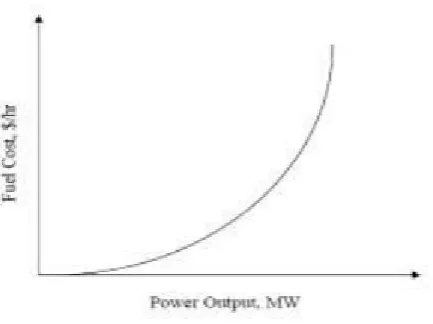
The general task's cost comprises of the cost of work, fuel cost, upkeep and supplies. Typically upkeep, supplies and expenses of work are set parts of arriving coal costs. The power yield of fossil plants is brought up in arrangement by opening an arrangement of valves to its steam turbine at the delta. To control each generator yield control, the power plant utilizes a few valves. The valve point stacking impact happens when each steam gulf valve in the turbine begin to open and throttling misfortunes happen. The disentangled model of warm/fossil plant is appeared in figure 1. The plant's working expense has the frame as appeared in figure 2. For dispatch purposes, this cost is by and large assessed by at least one quadratic sections. In this way, in the dynamic power age, the bend of fuel cost takes up a quadratic shape, given as:
Figure 1. Simplified model of a thermal plant
Figure 2. Classic fuel cost curve of thermal generating unit
The fuel cost curve may have a lot of irregularities. The anomalies happen when the yield control is raised by methods for supplementary steam condensers, boilers or additional equipment's. The incremental fuel cost can be passed on by various piece-wise linearization inside the constant range.
II. LITERATURE REVIEW
The generators are to be planned for such a path, to the point that generators with least cost are utilized however much as could be expected. Likewise the developing open awareness of ecological insurance has authorized the utilities to adjust their operational strategies to diminish the contamination and air outflows. In India, two third of the electrical power produced is from coal based power stations. The age of power from coal discharges a few contaminants, similar to Sulfur Oxide (SOx), Nitrogen Oxide (NOx) and Carbon Oxide (COx) in air. This makes negative impacts human wellbeing and the personal satisfaction. It likewise makes harm vegetation, corrosive rain, decreasing perceivability and an Earth-wide temperature boost. The adverse impact to condition by release of gases from coal based power plants can be lessened by booking of fitting burden to every generator. Yet, this may cause ascend in the working expense of generators. Along these lines, it is indispensable to find out an answer which gives nonpartisan outcome amongst discharge and cost. This can be accomplished by Combined Economic Emission Dispatch issue.
From the year 1959 to up until this point, calculable research work is done in the region of unit responsibility issue. The concise review of some imperative research papers as indicated by different procedures is recorded underneath:
Sisworahardjo N. S. furthermore, El-Keib A. A. [3] displayed the Ant Colony Search Algorithm (ACSA)- based strategy for taking care of the unit responsibility issue utilizing a 10-unit framework. Chusanapiputt S. et al. [4] proposed another philosophy called half breed subterranean insect framework/need list technique (HASP) to take care of unit responsibility issue with working limitations for a test framework 100 producing units. Yu D. et al. [5] anticipated a cross breed calculation made out of insect settlement enhancement (ACO) calculation and Lambda-emphasis named as HACO powerful to find answer for UCP in the scope of 10 to 60 producing units. Chitra N. et al. [6] concentrated on control quality change in self-governing microgrid thinking about voltage recurrence (Vf) direction and consonant examination as the principle parameters.
Senjyu T. et al. [7] exhibited an answer for the warm UCP utilizing Genetic Algorithm (GA) for least up or least down time imperatives. Damousis I.G. et al. [8] built up another Genetic Algorithm based answer for UCP. The number coding utilized as a part of new hereditary calculation separates it from past paired GA and the test performed on 100-unit framework indicated better outcomes contrasted with the LR technique. Ouiddir R. et al. [9] utilized the hereditary calculation to discover the arrangement of a financial dispatch issue in the Western Part of the Algerian power organize. Babu A.S. et al. [10] depicted a Hybrid Genetic Algorithm for building a departmental class timetable. Kushwaha N. et al. [11] proposed a hereditary calculation (GA) based bacterial rummaging (BF) calculation for advancement of a capacity. The proposed technique gives an accentuation on transformation, hybrid, advance sizes and the lifetime of microorganisms. Bilolikar V.S. et al. [12] displayed a hybridized approach utilizing reenacted toughening (SA) and hereditary calculation (GA) to unravel multi mode asset obliged venture booking issue.
Valenzuela J. what's more, Smith A. E. [13] exhibited that a memetic calculation (MA) joined with Lagrangian unwinding (LR) can be productively utilized for tackling vast unit duty issues. Mafteiu L. O. what's more, Mafteiu-Scai E. J. [14] built up a memetic calculation (MA) for the arrangement of direct arrangement of conditions by changing over into an enhancement issue. Mafteiu-Scai L. O. [15] proposed a procedure utilizing memetic calculation (MA) for the change of union of iterative strategies to tackle direct or nonlinear frameworks of conditions. Sanusi H. A. et al. [16] examined the execution of GA and MA for an obliged improvement and found that MA unites faster than GA and delivers more ideal outcomes however the time taken by cycle in GA is not as much as that in MA.
Yare Y. et al. [17] proposed the differential advancement (DE) approach for generator support planning (GMS) and monetary dispatch (ED) of the Indonesian power framework to improve the cost of activity of 19 units. Chakraborty S. et al. [18] displayed a fluffy adjusted differential advancement approach for taking care of warm UC issue coordinated with wind control framework. Sharma R. et al. [19] built up another technique to illuminate the financial dispatch (ED) issue known as Self-Realized Differential Evolution which was tried for 40-unit framework and 10-unit framework. Hardiansyah et al. [20] explored the highlights of manufactured honey bee state calculation (ABC), differential development (DE) calculation and molecule swarm improvement (PSO) for 3 and 6-unit frameworks and found that differential advancement calculation joins speedier than counterfeit honey bee province calculation and molecule swarm streamlining. Ravi C.N. also, Rajan C. C. A. [21] utilized differential advancement (DE) streamlining calculation to fathom ideal power stream (OPF) issue considering IEEE 30 transport standard power framework.
examples of buyer stack for standard 6-transport framework, standard IEEE-14 transport framework, and the standard IEEE-30 transport framework.
Xue-hui L. et al. [28] embraced a meta-heuristic calculation, the rearranged frog-jumping calculation (SFLA) and connected to take care of voyaging sales representative issue. Reddy A. S. furthermore, Vaisakh K. [29] tweaked the rearranged frog-jumping calculation into a changed rearranged frog-jumping calculation (MSFLA) for understanding the monetary emanation stack dispatch issue for IEEE-30 transport framework. Pourmahmood M. et al. [30] additionally proposed a changed rearranged frog-jumping (MSFL) calculation. Jebaraj L. et al. [31] connected SFLA to streamline the area and the extent of the two FACTS gadgets, TCSC and SVC, for IEEE 30-transport framework under certain thought about conditions. Anita J. M. furthermore, Raglend I. J. [32] displayed the use of SFLA improvement calculation to discover the arrangement of UCP to a 10-unit warm framework.
Tooth H., et al. [33] exhibited another snake calculation which is shown to beat the disadvantages of customary snake/form calculations for shape following of numerous items all the more adequately and productively. The exploratory aftereffects of the tests completed have demonstrated that the proposed strategy is vigorous, compelling and precise as far as finding the limit arrangements of various items.
Simon D. [34] created biogeography-based streamlining (BBO) calculation and tried for 14 benchmark capacities utilizing BBO and contrasted the outcomes and GA, PSO, DE, ES, stud hereditary calculation (SGA), PBIL and ACO. Du D. [35] exhibited the BBO procedure in the wake of being altered utilizing transformative methodology (ES) strategies. Besides, the altered BBO strategy had been connected to the voyaging sales representative issue and contrasted the outcomes and GA and found that BBO is preferable in activity over GA. Kundra H. et al. [36] proposed another enhancement strategy consolidating the highlights of BBO and PSO to enhance the unwavering quality of underground water infiltration. Khokhar B. et al. [37] utilized BBO calculation to take care of the financial dispatch issue of ideal booking taking certain cases more than 24-hour time.
Scheidegger C. et al. [38] stretched out the standard BBO system to another calculation which had been named as circulated BBO (DBBO). Du D. et al. [39] joined highlights of ES for changing BBO and a refusal approach is additionally incorporated into BBO. The changed BBO had been tried for 14 benchmarks. Rarick R. et al. [40] connected BBO calculation and GA to a similar power stream issue on IEEE 30-transport framework to make an examination between the two heuristic strategies. Simon D. et al. [41] demonstrated that BBO is summed up type of GA with worldwide uniform recombination frequently known as GA/GUR. BBO had been contrasted and GA/GUR taking certain benchmark issues/cases and examination has been gotten from the Markov models of the two procedures.
III. SINGLE AREA UNIT COMMITMENT PROBLEM FORMULATION
The principle target of unit duty is to locate the ideal calendar for working the accessible producing units with a specific end goal to limit the aggregate working expense of the power age. Add up to working expense of energy age incorporates fuel cost, start up and close down expenses. The fuel costs are ascertained utilizing the information of unit warm rate and fuel value data which is ordinarily a quadratic condition of energy yield of every generator at every hour dictated by Economic Dispatch(ED) [43].
where, Ai, Bi, Ci are the cost coefficients. The total fuel cost over the given time period „T‟ is
where, Xi (t) is the position or status of ith unit at tth hour. Start up cost is that cost which occurs while bringing the thermal generating unit online. It is expressed in terms of the time (in hours) for which the units have been shut down. On the other hand, shut down cost is a fixed amount for each unit which is shut down. A start up cost can be expressed as [43]:
where,
DTi- Shut down time
HSCi- Hot start up cost
CSCi- Cold start up cost
CSHi- Cold start hour of ith unit.
CONCLUSIONS
The Economic Load Dispatch is the essential and vital step in power system operational planning. In addition to the ED objective, environmental concern that arises from the emission produced by fossil fuel electric power plants becomes a major problem to be addressed. The emanation and monetary dispatch are clashing in nature and they must be viewed as together to discover ideal dispatch. The issue is detailed as a multi-objective monetary load dispatch issue in which both the goals (outflow and economy) must be limited. In this examination three distinct cases have been explained for Economic dispatch with differing test frameworks by applying Gray Wolf enhancement (GWO) system. In first case straightforward financial load dispatch has been performed for two distinctive test frameworks by utilizing GWO and results are contrasted and lambda emphasis, molecule swarm enhancement, ordinary quadratic strategy and cuckoo seek. GWO performs superior to different strategies. Fuel cost is lessened by 29.731 Rs/hr for 500 MW (3 unit framework) and 62.368 Rs/hr for 800 MW (6 unit framework) when contrasted and lambda cycle strategy. Along these lines GWO gives preferred outcomes for ELD over different procedures.
REFERENCES
[1]. Gaing, Zwe-Lee. "Particle swarm optimization to solving the economic dispatch considering the generator constraints." IEEE Transactions on Power Systems,vol. 18 , no. 3, pp: 1187-1195, 2003. [5].R. T. F. Ah King and H. C. S. Rughooputh, “Elitist Multi-objective Evolutionary Algorithm for Environmental/Economic Dispatch,” Congress on Evolutionary computation, vol. 2, pp. 1108-14, 8-12 Dec.2003.
[2]. Navpreet Singh Tung, Amit Bhardwaj, Ashutosh Bhadoria, Kiranpreet Kaur, Simmi Bhadauria, Dynamic programming model based on cost minimization algorithms for thermal generating units, International Journal of Enhanced Research in Science Technology & Engineering, Volume 1, Issue 3, ISSN: 2319-7463, 2012.
[3]. T. Aruldoss Albert Victoire and A. Ebenezer Jeyakumar ,“Hybrid PSO-SQP for economic dispatch with valve-point effect” Electric Power Systems Research; 71,pp: 51-9, 2004.
[4]. NS Tung, V Kamboj, A Bhardwaj, “Unit commitment dynamics-an introduction”, International Journal of Computer Science & Information Technology Research Excellence, Volume 2, Issue 1, Pages 70-74, 2012.
[5]. M. Sudhakaran, S.M.R Slochanal, R. Sreeram and N Chandrasekhar, “Application of Refined genetic Algorithm to Combined Economic and Emission Dispatch” J. Institute Of Engg. (India) ,vol. 85, pp: 115-119, Sep. 2004.
[6]. Bhardwaj, A., Tung, N. S., Shukla, V. K., & Kamboj, V. K. (2012). The important impacts of unit commitment constraints in power system planning. International Journal of Emerging Trends in Engineering and Development, 5(2), 301-306.
[7]. M. Sudhakaran and S.M.R Slochanal, “Integrating Genetic Algorithm and Tabu Search for Emission and Economic Dispatch Problem” J. Institute of Engg. (India) ,vol. 86, pp: 22- 27, June.2005.
[8]. Chiang, Chao-Lung. "Improved genetic algorithm for power economic dispatch of units with valve-point effects and multiple fuels." IEEE Transactions on Power Systems, vol. 20, no. 4, pp: 1690-1699, 2005.
[9]. VK Kamboj, A Bhardwaj, HS Bhullar, K Arora, K Kaur, Mathematical model of reliability assessment for generation system, Power Engineering and Optimization Conference (PEDCO) Melaka, Malaysia, 2012 IEEE.
[10]. Senjyu T., Yamashiro H., Shimabukuro K., Uezato K. and Funabashi T., “Fast solution technique for large-scale unit commitment problem using genetic algorithm”, IEEE Proc. Generation, Transmission and Distribution, Vol. 180, No. 6, Nov. 2003, pp. 753- 760.
[11]. Damousis I.G., Bakirtzis A.G. and Dokopoulos P.S., “A Solution to the Unit-Commitment Problem Using Integer-Coded Genetic Algorithm”, IEEE Transactions on Power Systems, Vol. 19, No. 2, May 2004, pp. 1165- 1172.
[12]. Ouiddir R., Rahli M. and Abdelhakem-Koridak L., “Economic Dispatch using a Genetic Algorithm: Application to Western Algeria‟s Electrical Power Network”, Journal of Information Sciences and Engineering, 2005, pp. 659-668.
[13]. Bhardwaj A., Tung N. S., Shukla V. K. and Kamboj V. K., “ The Important Impacts of Unit Commitment Constraints in Power System Planning”, International Journal of Emerging Trends in Engineering and Development, Vol. 5, No. 2, July 2012, pp. 301- 306.
[14]. Yu D., Wang Y. and Guo R., “A hybrid ant colony optimization algorithm based Lambda-iteration method for unit commitment problem”, Proc. 2nd WRI Global Congress on Intelligent Systems, Wuhan, China, 16- 17 Dec. 2010, pp. 19-22. [15]. Chitra N., Prabaakaran K., Kumar A.S. and Munda J., “Ant Colony Optimization Adopting Control Strategies for Power
Quality Enhancement in Autonomous Microgrid”, International Journal of Computer Applications (0975 – 8887), Vol. 63, No. 13, Feb. 2013, pp. 34-38.