RESEARCH ARTICLE
Psychometric properties of the Persian version of the
functioning after pediatric cochlear implantation
Salar Faramarzi1*, Alireza Mohseni Ezhiyeh1, Seyed Hamidreza Abtahi2, Mahsa Sepehrnejad3
1
- Department of Psychology of Children with Special Needs, Faculty of Psychology and Educational Sciences, University of Isfahan, Isfahan, Iran
2- Department of ENT, School of Medicine, Isfahan University of Medical Sciences, Isfahan, Iran
3- Department of Audiology, School of Rehabilitation Sciences, Isfahan University of Medical Sciences, Isfahan, Iran
Received: 25 Apr 2015, Revised: 13 Jul 2015, Accepted: 20 Jul 2015, Published: 23 Sep 2015
Abstract
Background and Aim: One of the main objectives of cochlear implant surgery for parents, specialists, and trainers is that children can realize their needs using verbal communi-cation skills. This is while there are a few instr-uments for evaluating children’s communication performance after cochlear implant surgery. The present study was conducted with the aim of adapting and investigating psychometric properties of the Persian version of the Func-tioning after Pediatric Cochlear Implantation (FAPCI).
Methods: The present study is a test development, in which FAPCI was translated into Persian and then culturally adapted with conditions in Iran. To do so, 60 parents of children with cochlear implant (37 boys and 23 girls) were selected randomly. The age of these children ranged from 2 years and 3 months old to 6 years and 5 months old. The results were analyzed using correlation of items with total score, construct validity, and internal consis-tency.
Results: The correlation coefficients of items with the total score were significant in all cases. The results of factor analysis indicated that the scale consists of one factor which totally expl-ains 65% of the variance. The Chronabch’s alpha coefficient for the whole inventory was calculated as 0.95.
Conclusion: According to the results obtained from the present study, it seems that the Persian version of the FAPCI enjoys acceptable psycho-metric properties and it can be used for evalu-ating the communication performance of pre-school children.
Keywords: Communication performance; cochlear implant; psychometric properties; children
Introduction
Hearing impairment is defined based on the degree of impairment, the age in which the impairment occurs, and the type of the impair-ment. Deafness means the hearing loss to the extent that a child, whether with earphone or without it, cannot process linguistic infor-mation via hearing [1]. This disorder is the most common neurosensory impairment in human beings, and its prevalence rate is estimated as one to three cases per 1000 live births, about one per 1000 cases suffers from severe bilateral
*
Corresponding author: Department of Psychology of Children with Special Needs, Faculty of
Psychology and Educational Sciences, University of Isfahan, Azadi Square, Isfahan, 81746-73441, Iran. Tel: 00983117932214,
hearing loss (70 dB or more), and about three cases per 1000 children suffer from 30 dB or more hearing loss [2]. In the etiology of this disorder, different hypotheses have been presen-ted, which in general, a combination of environ-mental and genetic effects can be referred to. The denial of entry of preliminary hearing in children with hearing defects does not only pre-vent the development of abilities of perceiving and producing speech, but also causes delay in other developmental skills [3]. Specialists beli-eve that deafness is something more than a hearing impairment and it can be a social reality which influences the whole life of a person [4]. When hearing loss is serious at birth, infants’ perception and interpretation of the world are deeply influenced. The child who has not access to oral communication and visual information, has to communicate with others in a different way [5]. In other words, children who suffer from hearing loss cannot hear the continuous and repeated flow of linguistic interactions in their environment and unlike children with natural hearing cannot experience a lot of lingu-istic stimuli available in his environment in the first years of their lives.
One of the promising treatments which recently has been presented for children with hearing loss is cochlear implant. Cochlear implant is a new technology of hearing equipment and an accepted therapeutic method for children with hearing loss which cannot use hearing aids [6]. The implanted cochlear is an auditory prosthesis which is implanted in the inner ear via surgery, and stimulates auditory nerve fibers for extract-ing hearextract-ing sense in individuals sufferextract-ing from severe and profound neurosensorial hearing loss [7,8]. One of the main objectives of performing cochlear implant for parents, specialist, and tutors is that children can realize their needs by verbal communicative skills. In fact, verbal communicative skills are bases for children’s development in academic achievement, langu-age development, social and quality of life in adulthood [9]. Principles and methods used in the rehabilitation of children with cochlear implants are mostly conducted with the obj-ective of communicative and linguistic skills
[10]. The results obtained from different studies indicate that using cochlear implant and rehab-ilitation training programs conducted after it, result in the development of communication, linguistic, and verbal skills in children [11,12,13].
Learning spoken language is surely one of the most important factors in fostering and developing children’s personality and their social and academic lives. Previous studies conducted on acquiring spoken language in children have shown that learning a language starts from primary auditory skills, i.e. exploring voices and then continues towards more complicated skills such as distinction, iden-tification, and perception which finally results in acquiring a language [14]. Spoken language is the basis of communication in which speech is applied for transforming thoughts and meanings (pragmatics) [15]. Using valid instrument for evaluating communicative skills and children’s development, customizing rehabilitation thera-pies, and investigating factors affecting the success of cochlear implant is particularly important.
responses in the form of “almost none” (0 to 4%), “few almost” (5 to 24%), “some” (24 to 49%), “most” (50 to 95%), and “almost all” (96-100%). Questions based on behavioral and performance examples were ranked into five levels each of which includes a behavioral example. The scoring for this scale was in the form of values from 0 to 4. The minimum score for each child in this scale was zero and the maximum was 115. Score zero is the minimum score (the least level of comm-unication performance) and score 115 is the maximum score (the highest level of communi-cation performance). This scale is standardized appropriately and its validity and reliability were confirmed by Lin et al. The validity of this scale, construct validity, content validity and criterion validity of its resource were investi-gated by Lin et al. which all indicated to the positive results and high correlation. The internal consistency of the total scale was calculated as 0.86 using Chronbach’s alpha [15].
Most of the instruments used for evaluating pre-school children with cochlear implants are instruments in the field of perceiving and producing speech and language, and most of them are administered by specialists and tutors in centers and clinics of cochlear implant [16]. However, clinical and research experiences have shown that some of these instruments may not completely exhibit children’s communi-cation performance in real life situations [15]. In other words, how a pre-school child with cochlear implant behaves in clinics and centers specialized for evaluating children with cochlear implants may be different with how the child behaves outside evaluation centers or at home [17]. In addition, there are a limited number of performance instruments which have been particularly designed for children with cochlear implants, or are compatible with necessary variables for the performance of children with cochlear implants [15]. Although for clinical investigation and research, techniques of obs-ervation and coding for evaluating the com-munication performance of children with coch-lear implants are accurate and valid, in practice
this method is expensive and time-consuming and it may face some difficulties [15,17]. Considering that in Iran and a lot of other societies, children spend a major part of their time with parents; therefore, parents are rich resources of information for their children [15]. Experts and researchers of the domain of children with cochlear implants require accurate and valid instruments for evaluating communi-cation performance of children with cochlear implants and should be aware of their deve-lopment. Keeping in mind that this scale only has 23 questions, the time required for completing the questionnaire is between 5 to 10 minutes; therefore, it can provide suitable information about the communication per-formance of children with cochlear implants in a short period of time. In addition, the advantage of this scale is that a series of information can be obtained via examples of everyday activities. This feature prevents the possibility of different personal interpretations since questions have single interpretation for different individuals. Regarding the fact that the psycho-metric properties of this scale has not be investi-gated in Persian-speaking children yet, in the present study, our aim is to translate and make this scale culturally compatible, and then invest-igate the psychometric properties of the per-formance of children after cochlear implant-ation.
Methods
score 0 indicates that translating was easy while score 100 indicates that it was difficult. A primary Persian version of the two mentioned translations, considering the best translation available for each item, was obtained by resea-rchers. In the next stage, the two translators back-translated the final Persian version into English. After this stage, the main English version was compared to the English version obtained from back-translation in terms of transparency, not using specialized terms, com-patibility with Iranian culture, and not changing concepts available in the main version. Finally, after being edited by an MSc student of Persian language, the final version of the scale was prepared. To investigate the face validity of the scale, the ideas and comments of experts (three professors at the Faculty of Psychology and Educational Sciences of University of Isfahan and three speech therapists in the Cochlear Implant Center in Al-Zahra Hospital (Isfahan, Iran) were collected. Then, the original version of the inventory, its translated versions, the back-translation, and the action plan were submitted to them and they were asked to study these versions and apply their comments regarding the relatedness of each question to the performance and features of children with cochlear implants and the appropriateness of the items. In this stage, some changes were made to the form of questions and examples in comparison with the original scale and a number of questions were presented in simple forms. Then, to supply the face validity, the scale was submitted to 10 mothers having children with cochlear implants in order to investigate the perception of all individuals regarding the content of items and the situation which should be drawn by reading each item. In this stage, by conducting interviews, some items were con-sidered as vague; therefore, they were revised. The Persian version of the Functioning after Pediatric Cochlear Implantation instrument is presented in Appendix 1.
The target population of this study was all of the children who had undergone cochlear implant surgery in Al Zahra Hospital (Isfahan, Iran). Among this population, 60 children (37 boys
and 23 girls) who had at least 9 months of experience of using cochlear implant prosthesis [15] were selected by the random sampling method. The inclusion criteria of the study were as follows: being 2 years old and above, and passage of 9 months after cochlear implant surgery. Also their parents had to have a tendency to cooperate in the study and fully complete the questionnaire. Exclusion criteria were as follows: blindness, children with mental or physical-motor disabilities, autism spectrum disorder, hyperactivity along with impairment and emotional-behavioral disorders. These chil-dren were investigated by a master of psycho-logy and education of children with special needs and also by referring to their files available in the center. In the last stage, the amended scale was conducted on 60 parents having children with cochlear implants. To conduct the present research, firstly, the aim of conducting the research was explained to mothers and their consents to participate were obtained. Mothers of subjects were assured that the extracted information and their names will remain confidential. Then, the characteristics of each of the subjects were recorded and their evaluations were conducted individually at the center of cochlear implant of Al-Zahra Hospital. In all stages of doing the research, moral considerations were observed. Evaluations and related interviews were simple and without any harm to individuals. In addition, it had no cost for the participants. In cases that during sessions of evaluations and interviews, an individual did not want to continue, he or she was allowed to leave.
were used. In this analysis, factors with eigenvalues higher than 1 were considered as main factors. To investigate the internal consistency of the FAPCI, Chronbach’s alpha and split-half technique were used. To inv-estigate the normality distribution of data, Kolmogorov-Smirnov nonparametric test and Shapiro-Wilk test were used. Data analysis was conducted using SPSS 22. The significance level of the test was considered as α=0.05.
Results
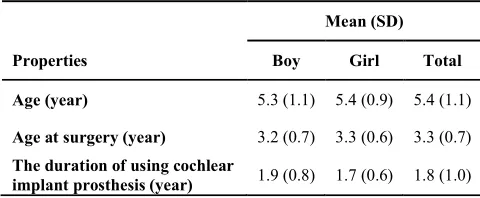
The age range of children was between 2 years and 3 months old to 6 years and 5 months old, and their mean age was 5 years and 4 months old. 23 (38.33%) children were girls and 37 (61.67%) of them were boys. Demographic properties of the children with cochlear implant are presented in Table 1. The obtained scores of the FAPCI were in the range of 26 to 111 with mean scores of 76.60 and standard deviation of 25.58. The results obtained from the correlation between demographic properties of the sample size and the total score of the inventory indicate that there is a positive and significant corre-lation between the FAPCI and age (r=0.48, p≤0.001), and age at the time of surgery (r=0.39, p≤0.001) and the duration of using cochlear implant prosthesis (r=0.52, p≤0.001). To compare the mean scores of girls and boys, independent t-test was used. The results indi-cated that there is no significant difference between the mean scores of girls and boys in the FAPCI (t≤0.17, p≤0.86).
Considering the results obtained from the face validity, the understanding of all participants
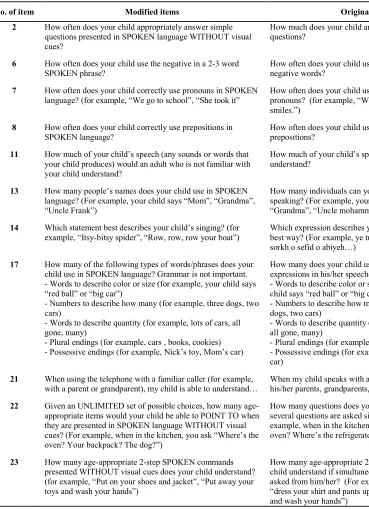
about the content of questions and the situation which should be prepared when reading each question for individuals were compatible with the original scale. Only some of the parents and experts had difficulties with items 2, 6, 7, 8, 11, 13, 14, 17, 21, 22, 23; therefore, some modifi-cations were adopted in the form of these items (Table 2).
To investigate the analysis of the materials of the questionnaire, the correlation between item-total score of FAPCI scale was calculated. The correlation coefficients of items with the total score were significant in all cases and varied in the range of 0.73 to 0.89. Therefore, in this stage, no item was deleted.
To investigate the construct validity of the FAPCI scale, the exploratory factor analysis was used. The value of the KMO for the present study is equal to 0.92 which indicates the sampling adequacy. Therefore, the sample size for this analysis was adequate. The value of Bartlett’s test of sphericity is equal to
X2=1494.214 (p≤0.001, df=25). The results
ind-icated that conducting factor analysis for the obtained data is justifiable. To conduct an appr-opriate factor analysis in the sampling adequacy test values of 0.60 and higher are required and it can be claimed that the data are appropriate for factor analysis when the value of the Bartlett’s test of sphericity is acceptable at the signifi-cance level. The results obtained from the factor analysis indicate that only in one case the special value which is related to the analysis of main components was higher than 1 which explains 65% of the variance of the scale. Therefore, the mentioned analysis indicates that Table 1. Demographic characteristics of children with cochlear implant
Mean (SD)
Properties Boy Girl Total
Age (year) 5.3 (1.1) 5.4 (0.9) 5.4 (1.1)
Age at surgery (year) 3.2 (0.7) 3.3 (0.6) 3.3 (0.7)
The duration of using cochlear
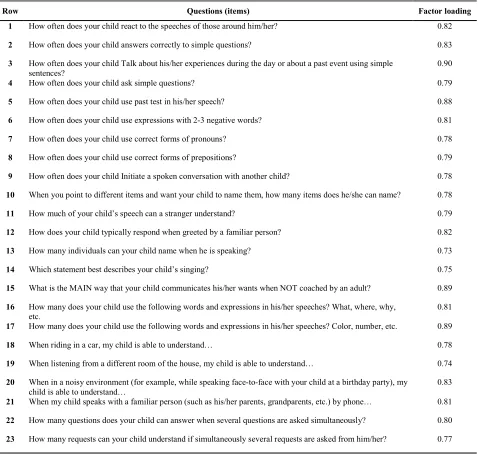
the scale is filled with one factor which explains 65% of the desired variance. These results are consistent with the main version of the scale designed by Lin et al [15]. The factor loadings
related to each item based on the single-factor model is presented in Table 3.
In this study, to investigate the internal con-sistency of the FAPCI sale, the Cronbach’s Table 2. Original and modified items in cultural adaptation scale of the Persian version of Functioning
after pediatric cochlear implantation instrument
No. of item Modified items Original items
2 How often does your child appropriately answer simple questions presented in SPOKEN language WITHOUT visual cues?
How much does your child answers correctly to simple questions?
6 How often does your child use the negative in a 2-3 word SPOKEN phrase?
How often does your child use expressions with 2-3 negative words?
7 How often does your child correctly use pronouns in SPOKEN language? (for example, “We go to school”, “She took it”
How often does your child use correct forms of pronouns? (for example, “We go to school”, “He/she smiles.”)
8 How often does your child correctly use prepositions in SPOKEN language?
How often does your child use correct forms of prepositions?
11 How much of your child’s speech (any sounds or words that your child produces) would an adult who is not familiar with your child understand?
How much of your child’s speech can a stranger understand?
13 How many people’s names does your child use in SPOKEN language? (For example, your child says “Mom”, “Grandma”, “Uncle Frank”)
How many individuals can your child name when he is speaking? (For example, your child says “Mom”, “Grandma”, “Uncle mohammad”)
14 Which statement best describes your child’s singing? (for example, “Itsy-bitsy spider”, “Row, row, row your boat”)
Which expression describes you child’s singing in the best way? (For example, ye tup daram ghelgheliyeh, sorkh o sefid o abiyeh…)
17 How many of the following types of words/phrases does your child use in SPOKEN language? Grammar is not important. - Words to describe color or size (for example, your child says “red ball” or “big car”)
- Numbers to describe how many (for example, three dogs, two cars)
- Words to describe quantity (for example, lots of cars, all gone, many)
- Plural endings (for example, cars , books, cookies) - Possessive endings (for example, Nick’s toy, Mom’s car)
How many does your child use the following words and expressions in his/her speeches?
- Words to describe color or size (for example, your child says “red ball” or “big car”)
- Numbers to describe how many (for example, three dogs, two cars)
- Words to describe quantity (for example, lots of cars, all gone, many)
- Plural endings (for example, cars , books, cookies) - Possessive endings (for example, Mehdi’s toy, Mom’s car)
21 When using the telephone with a familiar caller (for example, with a parent or grandparent), my child is able to understand…
When my child speaks with a familiar person (such as his/her parents, grandparents, etc.) by phone… 22 Given an UNLIMITED set of possible choices, how many
age-appropriate items would your child be able to POINT TO when they are presented in SPOKEN language WITHOUT visual cues? (For example, when in the kitchen, you ask “Where’s the oven? Your backpack? The dog?”)
How many questions does your child can answer when several questions are asked simultaneously? (For example, when in the kitchen, you ask “Where’s the oven? Where’s the refrigerator? The glass?”)
23 How many age-appropriate 2-step SPOKEN commands presented WITHOUT visual cues does your child understand? (for example, “Put on your shoes and jacket”, “Put away your toys and wash your hands”)
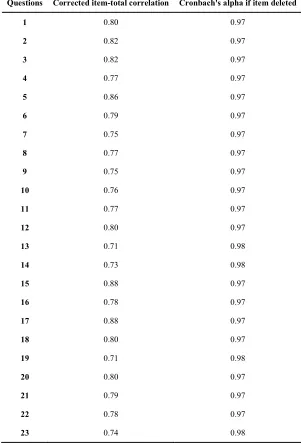
alpha coefficients were used. Accordingly, Cronbach’s alpha coefficients of the data were calculated. The obtained alpha coefficients for different items were in the range of 0.97 to 0.98. The alpha coefficient of the whole scale was equal to 0.95 (Table 4). In addition, the internal consistency of the scale was calculated using the split-half method. The split-half coefficient for
the first half of the data was equal to 0.96 and for the second half was equal to 0.95. The correlation between the two halves was 0.89. These findings show the acceptable internal consistency coefficients of the FAPCI scale.
Discussion
The purpose of this study was to investigate Table 3. Items and factor loading for the Persian version of functioning after pediatric cochlear
implantation instrument
Row Questions (items) Factor loading
1 How often does your child react to the speeches of those around him/her? 0.82
2 How often does your child answers correctly to simple questions? 0.83
3 How often does your child Talk about his/her experiences during the day or about a past event using simple sentences?
0.90
4 How often does your child ask simple questions? 0.79
5 How often does your child use past test in his/her speech? 0.88
6 How often does your child use expressions with 2-3 negative words? 0.81
7 How often does your child use correct forms of pronouns? 0.78
8 How often does your child use correct forms of prepositions? 0.79
9 How often does your child Initiate a spoken conversation with another child? 0.78 10 When you point to different items and want your child to name them, how many items does he/she can name? 0.78
11 How much of your child’s speech can a stranger understand? 0.79
12 How does your child typically respond when greeted by a familiar person? 0.82
13 How many individuals can your child name when he is speaking? 0.73
14 Which statement best describes your child’s singing? 0.75
15 What is the MAIN way that your child communicates his/her wants when NOT coached by an adult? 0.89 16 How many does your child use the following words and expressions in his/her speeches? What, where, why,
etc.
0.81 17 How many does your child use the following words and expressions in his/her speeches? Color, number, etc. 0.89
18 When riding in a car, my child is able to understand… 0.78
19 When listening from a different room of the house, my child is able to understand… 0.74 20 When in a noisy environment (for example, while speaking face-to-face with your child at a birthday party), my
child is able to understand…
psychometric properties of the Persian version of the communication performance evaluation of cochlear implanted children inventory which were designed by Lin et al. [15] in 2007 based on the ICF, disability, and health: ICF. The present study is significant because via investi-gating and confirming the psychometric charact-eristics of the FAPCI scale, the conceptual concepts and construct of the ICF can be
operationalized. Afterwards, interested research-ers, by applying the FAPCI scale to different groups of children with cochlear implants, can evaluate their communicative skills. Another significance of the present research is the appropriate characteristics of the FAPCI scale. This scale is a questionnaire which despite having few items can evaluate deep and comprehensive perception of individuals’ Table 4. Internal consistency of the Persian version of functioning after pediatric cochlear
implantation instrument
Questions Corrected item-total correlation Cronbach's alpha if item deleted
1 0.80 0.97
2 0.82 0.97
3 0.82 0.97
4 0.77 0.97
5 0.86 0.97
6 0.79 0.97
7 0.75 0.97
8 0.77 0.97
9 0.75 0.97
10 0.76 0.97
11 0.77 0.97
12 0.80 0.97
13 0.71 0.98
14 0.73 0.98
15 0.88 0.97
16 0.78 0.97
17 0.88 0.97
18 0.80 0.97
19 0.71 0.98
20 0.80 0.97
21 0.79 0.97
22 0.78 0.97
communicative performance. In addition, it enjoys a very powerful factor structure.
Determining face validity is one of the main requirements of each new test. When the final translation of the scale with 23 questions was investigated, the face validity was investigated by the experts. Formally, except few modifi-cations in a few questions, there was no impor-tant deficit in the scale and none of the partici-pants had major difficulty understanding the questions. Approximately, the scale was intere-sting to the participants and this issue indicates the face validity of the scale. In the study of Lin et al., face validity and content validity of the scale were investigated by three audiologists and 14 parents of children with cochlear implants. The obtained results indicated that this scale has acceptable face validity and content validity [15]. In the Brazilian version [19] and German one [20], researchers indicated that this scale enjoys appropriate face and content validity.
High correlation between the items and the total score (Intraclass correlation efficient: ICE) in the present research indicates the convergent validity. In other words, these results indicate the fact that each item in the related items has been appropriate and all items evaluate and investigate a common structure determining the construct validity of the FAPCI.
To investigate the construct validity of the FAPCI, factor analysis was used. The results of the factor analysis indicated that in this inven-tory, only one factor was bigger than 1 which totally explains the variance of 65%. Factor loading of the questions was appropriate. These results are consistent with the research of Lin et al. [15] which indicated that the FAPCI is constructed of one factor which totally explains the variance of 50%.
To investigate the internal consistency of the inventory, Chronbach’s alpha coefficient was used. The coefficient was 0.97 for the whole scale. Lin et al. reported internal consistency of the scale as 0.86 which indicates the consistency of the original one with the Persian version. The Chronbach’s alpha coefficient in the Brazilian version was 0.97 and in the German version was
0.86. The split-half coefficient for the first half was 0.96 and for the second half was 0.95. The correlation between the two halves was 0.89 which indicates that this scale has acceptable internal consistency. The correlation coefficient of 0.89 between the two halves is a very appro-priate coefficient because in scientific resources, the coefficient of 0.70 is considered an appro-priate coefficient for a test [21].
populations.
It is suggested that clinical psychologists and psychiatrists, by evaluating communicative skills of children with cochlear implants and presenting appropriate treatment interventions, provide required grounds for more rapid impro-vement of these individuals. In addition, further research for providing percentage scores, stan-dard scores, cut-off points, sensitivity and characteristics of the scale and also calculating the reliability using test-retest method is among the suggestions of the present study. As men-tioned, in the present study, a group of children who referred to the center for cochlear implant of Al-Zahra Hospital was used; therefore, in generalizing the results of the present study to other groups, cautions should be considered. Further, the results of the present study, as the results of other questionnaire researches, have limitations such as researchers’ tendency to social desirability and the difficulty of accessing to honest answers.
Conclusion
Regarding the obtained results, the FAPCI scale enjoys high levels of psychometric properties; therefore, it can be a valid instrument for evaluating the communication performance of the pre-school children with cochlear implants. Since the evaluation and treatment of this group of children have close relationships with each other, to obtain appropriate results of rehabi-litation, accurate and comprehensive evaluation seems important. Therefore, evaluation and ide-ntification of the communication performance of children with cochlear implants is considered as an important basis for the selection and presentation of therapeutic methods appropriate to their abilities and needs. Therefore, for princ-ipled and purposive foundation of rehabilitation intervention, applying standard instruments such as the FAPCI seems necessary.
Acknowledgments
Thereby, the respected authorities of the center for cochlear implant of Al-Zahra Hospital (Isfahan, Iran) and all families who participated and coordinated with us in conducting the
present study are appreciated.
REFERENCES
1. Adelabu B, Ojogbane V. Coping with handicapped and exceptional learners by student teachers of tertiary institutions. International Journal of Innovative Research and Development. 2012;1(11):69-80.
2. Norton SJ, Perkins JO. Early detection and diagnosis of infant hearing impairment. In: Cummings CW, Haughey BH, Thomas JR, Harker LA, Robbins KT, Schuller DE, et al., editors. Cummings otolaryngology-head and neck surgery. 4th ed. New York: W.B. Saunders Company; 2005. p. 4387-98.
3. Jeddi Z, Jafari Z, Motasaddi Zarandy M. Effect of aural rehabilitation on speech and cognition development in children with cochlear implant. Advances in Cognitive Sceince. 2012:14(2):35-44.
4. Rosen R. Deafness: a social perspective. In: Luterman D, editor. Deafness in Perspective.1st ed. San Diego: College-Hill Press; 1986. p. 241-5.
5. Scheetz NA. Psychosocial aspects of deafness. Boston: MA: Pearson Education; 2004.
6. Lima Júnior LR, Rocha MD, Walsh PV, Antunes CA, Dias Ferreira Calhau CM. Evaluation by imaging methods of cochlear implant candidates: radiological and surgical correlation. Braz J Otorhinolaryngol. 2008;74(3):395-400.
7. Peng SC, Tomblin JB, Turner CW. Production and perception of speech intonation in pediatric cochlear implant recipients and individuals with normal hearing. Ear Hear. 2008;29(3):336-51.
8. Ashoori M, Jalilabknar SS, Hasanzadeh S, Pourmohamadreza Tajrishi M. Speech intelligibility in children with cochlear implant, with hearing aids and normal hearing. Journal of Rehabilitation. 2013;14(3):8-15. Persian.
9. Summerfield AQ, Marshall DH. Paediatric cochlear implantation and health-technology assessment. Int J Pediatr Otorhinolaryngol. 1999;47(2):141-51.
10. Archbold S, Tait M. Facilitating progress after cochlear implantation: rehabilitation-rationale and practice. In: MacCormick B, Archbold S, editors. Cochlear implants for young children: the Nottingham approach to assessment and rehabilitation. 2nd ed. London: Whurr Publishers; 2003. p. 257-301.
11. Geers AE, Nicholas JG, Sedey AL. Language skills of children with early cochlear implantation. Ear Hear. 2003;24(1 Suppl):46S-58S.
12. Svirsky MA, Robbins AM, Kirk KI, Pisoni DB, Miyamoto RT. Language development in profoundly deaf children with cochlear implants. Psychol Sci. 2000;11(2):153-8.
13. Schorr EA, Roth FP, Fox NA. A comparison of the speech and language skills of children with cochlear implants and children with normal hearing. Commun Disord Q. 2008;29(4):195-210.
14. Erber NP. Auditory training. 1st ed. Washington, D.C.:
Alexander Graham Bell Association for the Deaf; 1982. 15. Lin FR, Ceh K, Bervinchak D, Riley A, Miech R,
Niparko JK. Development of a communicative performance scale for pediatric cochlear implantation. Ear Hear. 2007;28(5):703-12.
ME, Nikolopoulos TP, Sach TH. Paediatric cochlear implantation: evaluating outcomes. 1st ed. West Sussex:
Wiley; 2005.
17. Lin FR, Niparko JK. Measuring health-related quality of life after pediatric cochlear implantation: a systematic review. Int J Pediatr Otorhinolaryngol. 2006;70(10):1695-706.
18. Aaronson NK, Acquadro C, Alonso J, Apolone G, Bucquet D, Bullinger M, et al. International quality of life assessment (iqola) project. Qual Life Res. 1992;1(5):349-51.
19. Vassoler TM, Cordeiro ML. Brazilian adaptation of the Functioning after Pediatric Cochlear Implantation (FAPCI): comparison between normal hearing and cochlear implanted children. J Pediatr (Rio J). 2015;91(2):160-7.
20. Grugel L, Streicher B, Lang-Roth R, Walger M, von
Wedel H, Meister H. Development of a German version of the Functioning After Pediatric Cochlear Implantation (FAPCI) questionnaire. HNO. 2009;57(7):678-84. German.
21. Shahrivari K, Nategh E, Azimkhani A, Azizi Javan H. The construction and standardization of the rating scale for diagnosis of conduct disorder among the students in fifth grade of elementary school in Tehran city, central part of Iran (Teachers’ form). Journal of Fundamentals of Mental Health. 2010;12(3):574-83. Persian.
22. Polit DF, Beck CT, Owen SV. Is the CVI an acceptable indicator of content validity? Appraisal and recommendations. Res Nurs Health. 2007;30(4):459-67. 23. Anastasi A. Psychological testing. 5th ed. New York:
Collier Macmillan Ltd; 1982.
مرﺎﻬﭼ ﺖﻤﺴﻗ
22
كدﻮﮐ ﻪﺑ ﺮﮔا ﻪﻋﻮﻤﺠﻣ نﺎﺗ
ﯽﻣ درﻮﻣ ﺪﻨﭼ ﻪﺑ ،ﺶﻨﺳ ﻪﺑ ﻪﺟﻮﺗ ﺎﺑ ،دﻮﺷ هداد ﺎﻫرﻮﺘﺳد زا يا ؟ﺪﻨﮐ هرﺎﺷا ﺪﻧاﻮﺗ
)
،لﺎﺜﻣ ياﺮﺑ
ﯽﻣ ،ﺪﯿﺘﺴﻫ ﻪﻧﺎﺧﺰﭙﺷآ رد ﻪﮐ ﯽﻣﺎﮕﻨﻫ :ﺪﯿﺳﺮﭘ
»
ﺖﺳﺎﺠﮐ ﻪﺑﺎﺗ ﯽﻫﺎﻣ
«
،
»
ﯽﺘﺸﭘ ﻪﻟﻮﮐ ؟ﺖﺳﺎﺠﮐ تا
«
،
»
؟ﺖﺳﺎﺠﮐ ﮓﺳ
«
(
1 .
ﭻﯿﻫ ًﺎﺒﯾﺮﻘﺗ ) ماﺪﮐ 0 -4 (%
2 .
) ﺎﯿﺷا زا ﯽﻤﮐ داﺪﻌﺗ 5
-24 (%
3 .
) ﺎﯿﺷا زا ﯽﻀﻌﺑ 25 -49 (%
4 .
) ﺎﯿﺷا زا يرﺎﯿﺴﺑ 50
-95 (%
5 .
) ﺎﯿﺷا ﻪﻤﻫ ًﺎﺒﯾﺮﻘﺗ 96
-100 (%
23
ﻪﻠﺣﺮﻣ ود رﻮﺘﺳد ﺪﻨﭼ ،ﺶﻨﺳ ﻪﺑ ﻪﺟﻮﺗ ﺎﺑ ،ﺎﻤﺷ كدﻮﮐ ﯽﻣ ار يا
؟ﺪﻤﻬﻔﺑ ﺪﻧاﻮﺗ
)
،لﺎﺜﻣ ياﺮﺑ
ﺮﯿﻈﻧ ﯽﯾﺎﻫرﻮﺘﺳد
»
ﻦﮐ ﺖﻨﺗ ار تراﻮﻠﺷ و ﻦﻫاﺮﯿﭘ
«
،
»
بﺎﺒﺳا يزﺎﺑ ر ﺖﯾﺎﻫ ﺖﺳد و رادﺮﺑ ا رﻮﺸﺑ ار ﺖﯾﺎﻫ
«
(
1. ﭻﯿﻫ
ماﺪﮐ
2. ﮏﯾ
–
درﻮﻣ ود
3. ﻪﺳ
–
درﻮﻣ ﺞﻨﭘ
4. ﺶﺷ
–
درﻮﻣ هد
5. زا ﺶﯿﺑ 10 درﻮﻣ