I J H S
11 | International Journal of Health Studies 2019;5(3)
Original Article
International Journal of Health Studies
Effects of a 12-Week Global Corrective Exercise Intervention on Sway Back Posture in
Young Adults: A Randomized Controlled Trial
Aynollah Naderi1*, Wendy B Katzman2
1 School of Sport Sciences, Shahrood University of Technology, Shahrood, Iran.
2 Department of Physical Therapy and Rehabilitation Science, University of California, San Francisco, San Francisco, United States of America.
Received: 12 May 2019 Accepted: 17 September 2019
Abstract
Background: Sway back posture (SBP) is a common postural deviation of sagittal alignment and is the most common postural deviation in 18 to 28-year-old individuals, but there is no standard exercise protocol for treating SBP. Our objective was to assess the effectiveness of the global corrective exercise intervention (GCEI) on spinal posture of healthy individuals 18-25 years of age with SBP.
Methods: This study was a randomized controlled design with a parallel group, two-arm trial with 1:1 allocation ratio. Seventy participants (mean age 20.9 ± 2.1 years) with SBP (⩾ 10°) were enrolled in the study for 12 weeks. The participants were randomly assigned to an exercise (n = 35) or control group (n = 35). The targeted global spine strengthening and stretching exercise intervention included core and postural training, delivered by a corrective exercise specialist in 2 groups of 20 and 15 participants 3 times a week for 12 weeks. Forward head angle and sway angle were measured using a digitized side-view photograph. Kyphosis index and llordosis index were measured using a flex curve ruler.
Results: The 12-week intervention program resulted in significant within group differences in forward head, kyphosis, lordosis and postural sway angle (P < 0.001). There was also a significant between group difference in the changes of all postural variables (P < 0.001). Conclusions: The GCEI resulted in improved sway back posture in our sample of 18-25-year-old participants. This study supports the theoretical basis for clinical rehabilitation of postural deviations. Further studies are required to generalize these findings to other age and population groups.
Keywords: Posture, Sway back, Corrective exercise, Spinal alignment. *Corresponding to: A Naderi, Email: [email protected]
Please cite this paper as: Naderi A, B Katzman W. Effects of a 12-week global corrective exercise intervention on sway back posture in young adults: a randomized controlled trial. Int J Health Stud 2019;5(3):11-16.
I
ntroduction
Sway back posture (SBP) is a common deviation of sagittal alignment and is the most common postural deviation in individuals 18 to 28 years old.1-3 The major clinical
characteristics of this faulty posture include posterior displacement of the trunk relative to the pelvis, long thoracic kyphosis, reduced lumbar lordosis, posterior pelvic tilt, and extended hip and knee joints.4,5 This is a slumped, fatigue
posture, where the antigravity postural musculature expends a minimum of energy and the strain falls largely on the supporting ligaments of the trunk and pelvis.1,6,7
Although the precise etiology of SBP is unknown, there are many underlying musculoskeletal impairments associated with SBP.1-4,8 Some studies have shown decreased activity of the
lumbar stabilizer muscles, such as lumbar multifidus, internal
abdominal oblique and transversus abdominis, when adopting SBP.9,10 In addition, upper quarter muscle imbalance including
tightness of the upper trapezius and levator scapula, pectoralis major and minor, and weakness of deep cervical flexors, as well as middle and lower trapezius are associated with hyper-kyphosis (KI) and forward head posture (FHP) which are part of SBP.11,12 O’Sullivan et al. (2002)9 reported a failure of the
passive structures such as ligaments, capsule and bone in the maintenance of upright erect posture against gravity.
In SBP, there is trunk posterior sway and pelvic anterior sway, creating an angle between the upper and lower body described as Sway Angle (SA).3,9 Smith, O’Sullivan and
Straker3 have identified a significant gender-based correlation
between the increased SA and low back pain, such that male adolescents with increased SA are more prone to low back pain lasting three or more months than in those with a normal posture. This may be the result of postural malalignments associated with increased SA such as flattened lumbar angle, slumped posture, ligament and capsule strain, bone approximation, and muscular imbalances surrounding the lumbopelvic area.3,9,10,13 In response to the high frequency of
back pain in people with SBP, it is important to understand the factors that contribute to the development of SBP and to develop effective methods to prevent and correct the faulty posture.
Corrective exercise interventions are common methods to manage patients with postural deviations, such as hypo-lordosis,14 scoliosis,15 hyper-kyphosis,16 FHP17 and rounded
shoulder posture.18 We hypothesized that corrective exercises
that target the multiple components of SBP4,12 would improve
SBP. The purpose of this study was to investigate the effects of 12 weeks of targeted exercise training on the outcomes of Sway Angle (SA), Forward Head Angle (FHA), Kyphosis Index (KI), and Lordosis Index (LI) among healthy young adults age 18-25 years old with sway back posture.
Materials and Methods
the laboratory specialist assessing the postural variables and the data analyst were blinded to the allocation.
The population consisted of university students aged 18-25 years with SBP recruited from Bu Ali Sina university through flyers, posters and mass email to university colleagues. Ninety- six volunteers with suspected SBP were invited to the initial postural screening exam, and screened for participation based upon criteria for SBP (≥ 10) as assessed by computerized photographic analysis.8,19,20 Participants were excluded for
history of fracture, surgery and / or arthritic diseases in the spinal column, shoulder girdle, and pelvis, medical prescription specifically dictating therapeutic exercises for posture, scoliosis (> 5 degrees peak axial rotation on forward bending test), structural hyper-kyphosis as confirmed by radiographs, or regular weekly physical activity program.16,21 Before the initial
testing, the eligible participants signed an informed consent form approved by the physical education and sport science board of Bu Ali Sina university (clinical trial registration code: IRCT2017011431942N1).
SA and FHA were measured using the lateral photographic method,3,5,22 and KI and LI were measured using the flexicurve
method.23,24 Based upon SBP > 10 and after meeting all other
inclusion criteria, 70 participants (40 males and 30 female) were enrolled in the study.
Lateral photographic techniques were used to measure SA. Three anatomical landmarks of the acromion lateral tip, the midpoint of the femoral greater trochanter, and the lateral malleolus tip were identified and marked by removable red adhesive dots.8-10 A digital camera (Sony DSC-W35) placed on
a tripod 80 cm high and 250 cm on the left side of each individual was used to obtain photographic images in front of a non-reflective background. The participants were asked to adopt their habitual standing position and avoid conscious postural corrections. Digital photographs were stored on a PC and later processed using Adobe AutoCAD 2010 to calculate the angle (SA). The average SA from three photographs was recorded.
FHP was assessed using a digitized, side-view photograph taken in a relaxed-standing posture. First, the tragus of the subject’s ear was marked with a removable red adhesive dot, and a white plastic pointer was taped to the skin overlying the C7 vertebra. Next, the photograph was obtained and Adobe AutoCAD 2010 was used to calculate the angle between the vertical line passing through C7 and a line extending from the tragus of the ear to C7. Higher FHA indicates greater FHP.22,25
Thoracic kyphosis and lumbar lordosis were measured using a flexicurve ruler (Jakarflex 600 cm, Crystal edge). The validity of flexicurve postural measures has been previously established.26-29 We palpated the bony landmarks of the spinous
processes of the seventh cervical (C7) and first sacral vertebra (S1) and marked them with removable red adhesive dots according to Hoppenfeld, et al. (1976)30 and Youdas JW,
Suman VJ, (1995)31 methods. After marking these landmarks,
the participants were instructed to stand in their usual posture whilst the assessor placed the flexicurve ruler over the spinous processes of the thoracic and lumbar spine24,27 at the C7 mark
superiorly and S1 mark inferiorly, where the shape of the flexicurve ruler was conformed to the curvature of the spine. The flexicurve ruler was removed from the participant's spine and the side of the ruler contacting the participant's skin was traced onto a paper. A vertical line was drawn to connect the C7 (most superior point) and S1 (most inferior point) landmarks and a perpendicular line was drawn at the thoracolumbar level marking the transition between the thoracic and lumbar curves. The maximum width and the total length of each curve were measured in centimeters. A KI and LI were calculated from the width and length measures of the thoracic and lumbar portions of the spine using the following formula.
KI = thoracic width / thoracic length ×100
KI = lumbar width / lumbar length ×100
Higher indices indicated greater degrees of kyphosis / lordosis.
The flexicurve was molded to the spine 3 times, being flattened between each measurement. The average of the 3 measurements was used for analysis.
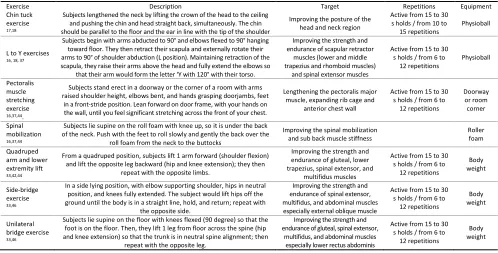
The intervention was a global, sway back-specific exercise program which was developed based on postural malalignments associated with sway back based on previous studies (table 1).16,18,21,31 Intervention included strengthening
exercise that targeted the periscapular, thoracic spine extensor, neck flexor and lumbopelvic muscles and stretching exercise that targeted the flexibility of the pectoral, suboccipital, and hamstring muscles. On the other hand, the stretching portion of the intervention aimed at increasing the flexibility of the pectoral, suboccipital, and hamstring muscles. The exercises were selected based on literature which suggested that selective activation of the lower and middle trapezius/middle trapezius,32
lumbar erector spine,33 gluteal,33 internal oblique and rectus
abdominal muscles,33 lengthening the pectoralis minor34,35 and
improving deep cervical flexor function36 improve the
posture.16,18,21,37 The participants in the intervention group were
initially trained using an instructional video of the exercises and illustrated handouts of the postural exercises each week. Each subject first warmed up with a light aerobic activity and general stretching exercises for five minutes and then performed exercises 1 to 7 sequentially. After that, the participants cooled down with general stretching exercises and slow walking for five minutes. The intervention participants performed the exercises of the program for 45 - 90-min, 3 sessions per week for 12-weeks. The exercises progressed in frequency, hold time, and intensity during the study as long as the participants were able to demonstrate good-quality movements. The intensity of the exercise was prescribed on an individual basis, using the rate of perceived exertion (RPE) of the Borg scale,38 where for all strengthening exercises it
13 | International Journal of Health Studies 2019;5(3) October to 30 December 2015. At the end of week 12, all
measurements were repeated and the SA, FHA, KI, LI were recorded. The control group participants were tested at baseline and 12-weeks and did not receive any intervention.
The baseline characteristics of the treatment and control groups were compared using independent t-tests. Two sample t-tests were used to assess the effects of the intervention on changes in SA, FHA, KI, LI, between the two groups. Paired t-tests were used to compare the baseline and post intervention SA, FHA, KI, LI data for each study group. Given the number of outcome measures, we divided the alpha of .05 by 4 and established statistical significance at P less than .0125. SPSS statistical software (version 18.0, SPSS Inc., Chicago, IL, USA) was used to analyze all data.
Based upon an expected difference between groups as 40% to 60% of the standard deviation for all postural variables,39 we
determined that a sample size of 70 participants would have 80% power in two-sided tests with a type-I error rate of 5%, and dropout rate of 10% to detect a change of 50% of the standard deviation for all postural variables.39 We used the
software package NCSS-PASS 1.0 to calculate the sample size.
Results
We screened 96 volunteers suspected of SBP and 70 participants were enrolled in the study (figure 1). The randomization assigned 35 participants to the corrective exercise group and 35 to the control group. Three participants did not complete the study; 2 for illness and 1 for excessive absence from visits. The 67 participants (38 males and 29 female) were included in the study with a mean age of 20.79 ±
2.09 years old, weight of 69.54 ± 12.01 kg, and height of 174.21 ± 7.21 cm (table 2). Subject characteristics did not differ between the groups at baseline.
There was a statistically significant between-group difference in changes of all postural variables, SA, FHA, KI and LI, with P < 0.001 (table 3).
There was a significant difference in changes of SA between the two groups of 3.7° (95% CI: -4.8, -2.8) (P < 0.001). SA decreased significantly within the exercise group -4.8 ± 1.8 (P < 0.001) but not within the control group -1.1 ± 1.2 (P > 0.0125).
There was a significant difference in the changes of FHA between the two groups of-4.7° (95% CI: -6.4 to-2.9), (P < 0.001). FHA diminished significantly within the exercise group -7.2 ± 2.9 (P < 0.001) and within the control group -1.3 ± 2.6 (P < 0.01).
There was a significant difference in the changes of KI between the two groups of -2.5 (95% CI: -3.3 to -1.6) (P < 0.001). KI dropped significantly within the exercise group -3.06 ± 1.3 (P < 0.001) but not within the control group -0.13 ± 0.9 (P > 0.0125).
There was a significant difference in in the variations of LI between the two groups of 1.5 (95% CI: 0.9 to 2.0), (P < 0.001). LI improved significantly within the exercise group 1.7 ± 1.12 (P < 0.001) but not within the control group 0.3 ± 1.13 (P > 0.0125).
None of the individuals reported adverse effects from the intervention.
Table 1. Global Corrective Exercises Intervention Framework
Exercise Description Target Repetitions Equipment
Chin tuck exercise 17,18
Subjects lengthened the neck by lifting the crown of the head to the ceiling and pushing the chin and head straight back, simultaneously. The chin should be parallel to the floor and the ear in line with the tip of the shoulder
Improving the posture of the head and neck region
Active from 15 to 30 s holds / from 10 to
15 repetitions
Physioball
L to Y exercises 16, 18, 37
Subjects begin with arms abducted to 90° and elbows flexed to 90° hanging toward floor. They then retract their scapula and externally rotate their arms to 90° of shoulder abduction (L position). Maintaining retraction of the scapula, they raise their arms above the head and fully extend the elbows so
that their arm would form the letter ‘Y with 120° with their torso.
Improving the strength and endurance of scapular retractor
muscles (lower and middle trapezius and rhomboid muscles)
and spinal extensor muscles
Active from 15 to 30 s holds / from 6 to
12 repetitions
Physioball
Pectoralis muscle stretching exercise
16,37,44.
Subjects stand erect in a doorway or the corner of a room with arms raised shoulder height, elbows bent, and hands grasping doorjambs, feet
in a front-stride position. Lean forward on door frame, with your hands on the wall, until you feel significant stretching across the front of your chest.
Lengthening the pectoralis major muscle, expanding rib cage and
anterior chest wall
Active from 15 to 30 s holds / from 6 to
12 repetitions
Doorway or room corner
Spinal mobilization 16,37,44
Subjects lie supine on the roll foam with knee up, so it is under the back of the neck. Push with the feet to roll slowly and gently the back over the
roll foam from the neck to the buttocks
Improving the spinal mobilization and sub back muscle stiffness
Roller foam
Quadruped arm and lower extremity lift 33,42,44
From a quadruped position, subjects lift 1 arm forward (shoulder flexion) and lift the opposite leg backward (hip and knee extension); they then
repeat with the opposite limbs.
Improving the strength and endurance of gluteal, lower trapezius, spinal extensor, and
multifidus muscles
Active from 15 to 30 s holds / from 6 to
12 repetitions
Body weight
Side-bridge exercise 33,46
In a side lying position, with elbow supporting shoulder, hips in neutral position, and knees fully extended. The subject would lift hips off the ground until the body is in a straight line, hold, and return; repeat with
the opposite side.
Improving the strength and endurance of spinal extensor, multifidus, and abdominal muscles especially external oblique muscle
Active from 15 to 30 s holds / from 6 to
12 repetitions
Body weight
Unilateral bridge exercise 33,46
Subjects lie supine on the floor with knees flexed (90 degree) so that the foot is on the floor. Then, they lift 1 leg from floor across the spine (hip and knee extension) so that the trunk is in neutral spine alignment; then
repeat with the opposite leg.
Improving the strength and endurance of gluteal, spinal extensor,
multifidus, and abdominal muscles especially lower rectus abdominis
Active from 15 to 30 s holds / from 6 to
12 repetitions
Table 2. Baseline characteristics of study participants
Characteristics Exercise group (n = 32)
Mean ± SD
Control group (n = 35)
Mean± SD
Between group difference
Mean (95%CI) Pvalue
Age(y) 21.11 ± 2.16 20.51 ± 2.15 0.6(-0.4 - 1.6) 0.25
Height(cm) 175.66 ± 8.69 172.89 ± 7.70 2.77 (-1.1 - 6.7) 0.91
Weight (Kg) 70.28 ± 13.21 68.87 ± 12.30 1.41 ( -4.7 - 7.5) 0.67
SA (°) 11.94 ± 1.41 12.22 ± 1.37 -0.28(-0.9 - 0.4) 0.39
FHA (°) 46.59 ± 3.93 45.52 ± 3.55 1.06(-0.7 - 2.8) 0.25
KI (%) 11.94 ± 1.92 11.48 ± 1.82 0.46 (-0.4 - 1.3) 0.31
LI (%) 4.06 ± 0.93 4.17 ± 1.09 -0.11 (-0.6 - 0.4) 0.64
Y = years, cm = centimeters, kg = kilograms, ° = degrees, % = percent, SA = Sway Angle; FHA = Forward Head Angle; KI = Kyphosis Index; LI = Lordosis Index; SD = Standard Deviation
Table 3. Change in postural variables after the intervention
Postural measures Within group changes (95%CI) Between group differences
(95%CI) Pvalue
Exercise Control
SA (°) -4.8 (-5-4 - (-4.12)) -1.1 (-1.4 - (-0.6)) -3.7(-4.8 - (-2.8)) <0.001*
FHA (°) -7.2 (-8.2 - (-6.2)) -1.3 (-2.2 - (-0.3)) -4.7 (-6.4 - (-2.9)) <0.001*
KI (%) -3.06 (-3.5 - (-2.5)) -0.13 (-0.5 - 0.2) -2.5 (-3.3 - (-1.6)) <0.001*
LI (%) 1.7 (1.3 - 2.1) 0.3(-0.5 - 0.4) 1.5 (0.9 - 2.0) <0.001*
° = degrees, % = percent *Pvalue for significance ≤ 0.0125
Discussion
We found that a 12-week GCEI targeting multiple components of SBP was safe (no adverse effects were reported) and effective in improving the SBP in individuals 18-25 years old with SBP. Theoretically, there is a close relationship between the postural deviations in SBP including FHP, hyper-kyphosis, and hypo-lordosis,4,16,40 and our designed GCEI
considered all postural deviations associated with SBP. We found a 4.8° change in SA after 12-week GCEI representing a 39% improvement in SBP from the baseline. Also, FHP and thoracic hyper-kyphosis decreased and lumbar hypo-lordosis increased, suggesting that the GCEI targeted multiple muscles that improved the spinal posture. The 7.34° change in FHP represented a 16% improvement from baseline and hyper-kyphosis and hypo-lordosis improved by 26% and 42%, respectively.
Our results in FHP are consistent with previous results of diminished FHP through strengthening and stretching corrective exercises.17,18,36 A study by Harman et al. (2005)17
found mitigated FHP following a 10-week intervention including stretching of the anterior shoulder muscles and strengthening of the posterior shoulder muscles. In addition, Lynch et al. (2010)18 successfully improved FHP following a
8-week pectoralis and cervical neck extensors stretching and periscapular muscle strengthening exercises program. In their study, Falla et al. (2007)36 used similar exercises to those of the
current study and found that greater strength, endurance and postural self-awareness improved the postural head alignment of the research participants. Pearson and Valmsly (1995)11
reported that the continuous chin tuck exercise improved the head and neck posture through deep neck flexor muscle strengthening and neck extensor muscle stretching; similarly, we used the chin tuck exercise as a low-load exercise targeting these muscles in FHP.4,35,36
In addition, we reported reduced hyper-kyphosis posture in our sample. This finding is in agreement with Vaughn and Brown (2007),21 who demonstrated the efficiency of a 13-week
home-based exercise program in decreasing the kyphosis angle of patients aged 39.8 ± 13.2 years with 23 – 80° of thoracic kyphosis. In addition, Seidi et al. (2014)16 observed improved
hyper-kyphosis in 20.84-year-old participants following a 12-week corrective exercise program. Ball et al. (2009)41 observed
that back extensor strengthening exercises can delay the progression of kyphosis in women 50 – 59 years of age. Similarly, several other studies have demonstrated that stretching and corrective exercise can improve age-related hyper-kyphosis.37,42,43 Recently, Katzman et al. (2016) noted
that multimodal spine strengthening exercise can significantly reduce hyper-kyphosis in older adults.44 Many of these studies
included the “L to Y” exercises that we used to target the thoracic spinal extensor and scapular retractor muscle strengthening.18,35,37,45 Electromyography studies have shown
that L to Y exercises strengthen the lower and middle trapezius muscles.32,33 Ekstrom et al. (2007)33 reported that prone
position shoulder flexion (Y drill) and horizontal abduction with external rotation (L drill) cause the maximum activity of the lower part of trapezius. Moseley et al. (1999)32 reported the
maximum electromyographic muscle activity of the middle trapezius during prone arm abduction and abduction with external rotation (L drill) which we used in our study.
In addition to strengthening the thoracic extensor and scapular retractor muscles, we used antagonist stretching and flexibility exercises (pectoralis muscle) to improve hyper-kyphosis deviations and SBP. Chest muscle stretching (especially pectoralis minor) and spinal mobilization using a foam roller are used in many kyphosis corrective exercise programs to improve the thoracic spine posture.16,18,37 Borstad
and Ludewig (2006)34 reported doorway pectoralis muscle
stretching as the most effective method to improve flexibility of these muscles. Seidi et al. (2014), Lynch et al. (2010), and Katzman et al. (2007) used pectoralis stretching and thoracic spine mobilization on a foam roller to stretch the pectoralis muscles, improve the thoracic extension, and reduce hyper-kyphosis. Ball et al (2009)41 reported that pectoralis muscle
15 | International Journal of Health Studies 2019;5(3) thoracic extensor muscles can prevent progression of thoracic
spine curve in elderly participants.
Another finding rarely examined in previous studies is the improvement in lumbar lordosis we observed after 12 weeks GCEI13. As electromyography studies suggest that lumbar
erector spinae, lumbar multifidus, transverse abdominus, abdominal external oblique, upper rectus abdominis, iliopsoas and gluteus maximus muscles are weaker in people with SBP,9,10 the increase in lumbar lordosis and improvement of
SBP we observed might suggest the correction of muscle imbalance in the gluteal, lumbar and abdominal muscles. We used quadruped arm and lower extremity lift, one of the best exercises proposed by Ekstrom et al. (2007) to correct these imbalances and to improve the strength and endurance of lumbar multifidus, erector spinae, and gluteal muscles.33 This
exercise was used by Sinaki & Huntoon (2011) and Ball et al. (2009) to improve the spinal posture of the elderly population in their programs.41,42 We also used the side bridge and
unilateral bridge exercises, known to facilitate gluteal, abdominal external oblique and lumbar spine extensor muscle activity on EMG33 and improve hypo-lordosis in elderly
populations.33,46 Note that the hamstring releasing exercises
may also increase the anterior pelvic tilt and in turn increase lumbar lordosis while reducing the thoracic hyper-kyphosis by postural chain reactions.4,40 Unilateral bridge exercise whereby
the trunk is in neutral spine alignment was also used in this study, as a previous study indicated development of only a slight activity in the upper rectus abdominis, though the lower rectus abdominis claims a greater proportion of the total abdominal work than with the sit-up.47 In addition, this exercise
would improve the strength and endurance of gluteal muscles, lumbar multifidus, and erector spinae, which based on previous studies was weak in the people with sway back.
Our study had several strengths. This is the first study demonstrating the effects of GCEI on multiple components of postural alignment in young adults 18-25 years old with SBP. One of the strengths and possible explanation of the positive results of the GCEI is that we designed a program based upon the multiple muscle imbalances associated with SBP. We found that a combination of chin tuck exercise, L to Y exercise, pectoralis muscle stretching exercise and spinal mobilization, targeting the upper quarter muscle imbalances associated with FHP and hyper-kyphosis, and quadruped arm and lower extremity lift, side-bridge and unilateral bridge exercises, targeting the muscle imbalances associated with lumbo-pelvic imbalance and hypo-lordosis, constitute an effective treatment for our sample with SBP. We used standardized measurements of posture that were performed by a corrective exercise specialist.
We acknowledge that our study has several limitations. As previous studies reported most prevalent SBP cases for 18-25-year-old individuals, only this age group was chosen which limits the generalizability of the results to other age groups with SBP. In the present study, the corrective exercise program targeted postural alignment and muscle imbalance reported by previous studies, but did not address muscle activation and movement patterns that may affect SBP. Future study that includes assessment and training of muscle activation during functional movement in a dynamic corrective exercise program
is warranted. Lack of participant blinding regarding group allocation may have influenced the results, however the laboratory specialist assessing the postural variables and data analyst were blinded to the allocation. In addition, we did not control for other exercise programs and leisure activity. Furthermore, the long-term effect of this exercise program was not investigated, and requires further study to determine whether the effects observed over 12 weeks can be sustained and whether participants with sway back can be motivated to continue a program over a number of years.
A 12-week targeted global spine strengthening and stretching exercise intervention improved the postural alignment in 18-25 years’ persons with SBP. To better understand the mechanisms, further studies are required to evaluate the changes in muscle and inter-joint coordination using electromyography and motion analysis systems. Nonetheless, this study provides preliminary evidence to support the use of GCEI to promote better postural alignment in young adults 18-25 years old with SBP.
Acknowledgement
The authors highly appreciate the participants for their enthusiastic participation.
Conflict of Interest
The authors declare that they have no conflict of interest.
References
1. Norris CM, Berry S. Occurrence of common lumbar posture types in the student sporting population: an initial investigation. Occupational Health and Industrial Medicine 1998;4:15-8.
2. O’Sullivan P. Clinical instability’of the lumbar spine: its pathological basis, diagnosis and conservative management. London; 2004.
3. Smith A, O'Sullivan P, Straker L. Classification of sagittal thoraco-lumbo-pelvic alignment of the adolescent spine in standing and its relationship to low back pain. Spine (Phila Pa 1976) 2008;33:2101-7. doi:10.1097/BRS.0b013e31817ec3b0
4. Kendall PF, McCreary KE, Provance GP. Muscles testing and function with posture and pain. 5th ed. Philadelphia: Lippincott Williams & Wilkins, 2005.
5. Seah SH, Briggs AM, O’Sullivan PB, Smith AJ, Burnett AF, Straker LM. An exploration of familial associations in spinal posture defined using a clinical grouping method. Man Ther 2011;16:501-9. doi:10.1016/j.math.2011.05.002
6. Kelly ED. Teaching posture and body mechanics. New York: AS Barnes 1949.
7. Kisner C, Colby LA, Borstad J. Therapeutic exercise: foundations and techniques. 7th ed. Philadelphia: Fa Davis; 2012.
8. Pezolato A, de Vasconcelos EE, Defino HL, Nogueira-Barbosa MH. Fat infiltration in the lumbar multifidus and erector spinae muscles in subjects with sway-back posture. Eur Spine J 2012;21:2158-64. doi:10.1007/s00586-012-2286-z
9. O’Sullivan PB, Grahamslaw KM, Kendell M, Lapenskie SC, Möller NE, Richards KV. The effect of different standing and sitting postures on trunk muscle activity in a pain-free population. Spine (Phila Pa 1976) 2002;27:1238-44. doi:10.1097/00007632-200206010-00019
10. Reeve A, Dilley A. Effects of posture on the thickness of transversus abdominis in pain-free subjects. Man Ther 2009;14:679-84. doi:10.1016/j.math.2009.02.008
11. Pearson ND, Walmsley RP. Trial into the effects of repeated neck retractions in normal subjects. Spine (Phila Pa 1976) 1995;20:1245-50.
doi:10.1097/00007632-199506000-00006
12. Sahrmann SA. Diagnosis and treatment of movement impairment syndromes. Philadelphia: Harcourt Health Sciences; 2002.
14. Gamboian N, Chatfield SJ, Woollacott MH. Further effects of somatic training on pelvic tilt and lumbar lordosis alignment during quiet stance and dynamic dance movement. Journal of Dance Medicine & Science 2000;4:90-8.
15. Mordecai SC, Dabke HV. Efficacy of exercise therapy for the treatment of adolescent idiopathic scoliosis: a review of the literature. Eur Spine J 2012;21:382-9. doi:10.1007/s00586-011-2063-4
16. Seidi F, Rajabi R, Ebrahimi I, Alizadeh MH, Minoonejad H. The efficiency of corrective exercise interventions on thoracic hyper-kyphosis angle. J Back Musculoskelet Rehabil 2014;27:7-16. doi:10.3233/BMR-130411
17. Harman K, Hubley-Kozey CL, Butler H. Effectiveness of an exercise program to improve forward head posture in normal adults: a randomized, controlled 10-week trial. Journal of Manual & Manipulative Therapy 2005;13:163-76. doi:10.1179/106698105790824888
18. Lynch SS, Thigpen CA, Mihalik JP, Prentice WE, Padua D. The effects of an exercise intervention on forward head and rounded shoulder postures in elite swimmers. Br J Sports Med 2010;44:376-81. doi:10.1136/bjsm.2009.066837
19. Yalfani A, Anbarian M, Nikoo MR, Naderi A. Relationship between postural control with Sway- back Malalignment in the non-athlete males. Journal of Ilam University of Medical Sciences 2014;22:189-201.
20. Yalfani A, Naderi A, Anbarian M, Raeisi Z, Nikuo MR. The effect of 12 weeks corrective exercise on the sway back of male students with 18-25 years old. Applied Sports Physiology Journal 2015;11:64-7. [Persian].
doi:10.22080/jaep.2015.1106
21. Vaughn DW, Brown EW. The influence of an in-home based therapeutic exercise program on thoracic kyphosis angles. Journal of Back and Musculoskeletal Rehabilitation 2007;20:155-65. doi:10.3233/BMR-2007-20404
22. Raine S, Twomey LT. Head and shoulder posture variations in 160 asymptomatic women and men. Arch Phys Med Rehabil 1997;78:1215-23.
doi:10.1016/S0003-9993(97)90335-X
23. Hinman MR. Interrater reliability of flexicurve postural measures among novice users. Journal of Back and Musculoskeletal Rehabilitation 2004;17:33-6. doi:10.3233/BMR-2004-17107
24. Barrett E, McCreesh K, Lewis J. Reliability and validity of non-radiographic methods of thoracic kyphosis measurement: a systematic review. Man Ther 2014;19:10-7. doi:10.1016/j.math.2013.09.003
25. Quek J, Pua YH, Clark RA, Bryant AL. Effects of thoracic kyphosis and forward head posture on cervical range of motion in older adults. Man Ther 2013;18:65-71. doi:10.1016/j.math.2012.07.005
26. Burton AK. Regional lumbar sagittal mobility; measurement by flexicurves. Clin Biomech (Bristol, Avon) 1986;1:20-6. doi:10.1016/0268-0033(86)90032-X
27. Milne JS, Williamson J. A longitudinal study of kyphosis in older people. Age Ageing 1983;12:225-33. doi:10.1093/ageing/12.3.225
28. Simpson SR. Evaluation of a flexible ruler technique for measuring lumbar lordosis in the clinical assessment of low back pain. J Soc Occup Med 1989;39:25-9.
29. Tilloston KM, Burton AK. Noninvasive measurement of lumbar sagittal mobility: an assessment of the flexicurve technique. Spine (Phila Pa 1976) 1991;16:29-33. doi:10.1097/00007632-199101000-00005
30. Hoppenfeld S, Hutton R,Thomas H. Physical examination of the spine and extremities. New York: Norwalk, CT: Appleton-Century-Crofts: Prentice Hall, 1976.
31. Youdas JW, Suman VJ, Garrett TR. Reliability of measurements of lumbar spine sagittal mobility obtained with the flexible curve. J Orthop Sports Phys Ther 1995;21:13-20. doi:10.2519/jospt.1995.21.1.13
32. Moseley JB Jr, Jobe FW, Pink M, Perry J, Tibone J. EMG analysis of the scapular muscles during a shoulder rehabilitation program. Am J Sports Med 1992;20:128-34. doi:10.1177/036354659202000206
33. Ekstrom RA, Donatelli RA, Carp KC. Electromyographic analysis of core trunk, hip, and thigh muscles during 9 rehabilitation exercises. J Orthop Sports Phys Ther 2007;37:754-62. doi:10.2519/jospt.2007.2471
34. Borstad JD, Ludewig PM. Comparison of three stretches for the pectoralis minor muscle. J Shoulder Elbow Surg 2006;15:324-30. doi:10.1016/j.jse.2005.08.011
35. Ruivo RM, Carita AI, Pezarat-Correia P. The effects of training and detraining after an 8 month resistance and stretching training program on forward head and protracted shoulder postures in adolescents: Randomised controlled study. Man Ther 2016;21:76-82. doi:10.1016/j.math.2015.05.001
36.Falla D, Jull G, Russell T, Vicenzino B, Hodges P. Effect of neck exercise on sitting posture in patients with chronic neck pain. Phys Ther 2007;87:408-17.
doi:10.2522/ptj.20060009
37. Katzman WB, Sellmeyer DE, Stewart AL, Wanek L, Hamel KA. Changes in flexed posture, musculoskeletal impairments, and physical performance after group exercise in community-dwelling older women. Arch Phys Med Rehabil 2007;88:192-9. doi:10.1016/j.apmr.2006.10.033
38. Muyor JM. Exercise intensity and validity of the ratings of perceived exertion (Borg and OMNI Scales) in an indoor cycling session. J Hum Kinet 2013;39:93-101. doi:10.2478/hukin-2013-0072
39. Pfeifer M, Kohlwey L, Begerow B, Minne HW. Effects of two newly developed spinal orthoses on trunk muscle strength, posture, and quality-of-life in women with postmenopausal osteoporosis: a randomized trial. Am J Phys Med Rehabil 2011;90:805-15. doi:10.1097/PHM.0b013e31821f6df3
40. Page P, Frank C, Lardner R. Assessment and treatment of muscle imbalance: the Janda approach. Windsor, Ontario, Canada: Human Kinetics; 2010: 297 p.
41. Ball JM, Cagle P, Johnson BE, Lucasey C, Lukert BP. Spinal extension exercises prevent natural progression of kyphosis. Osteoporos Int 2009;20:481-9. doi:10.1007/s00198-008-0690-3
42. Sinaki M, Huntoon E. Back pain in the osteoporotic individual: A physiatric approach. Techniques in Regional Anesthesia and Pain Management 2011;15:64-8. doi:10.1053/j.trap.2011.05.001
43. Naderi A, Rezvani MH, Shaabani F, Bagheri S. Effect of Kyphosis Exercises on Physical Function, Postural Control and Quality of Life in Elderly Men With Hyperkyphosis. Iranian Journal of Ageing 2019;13:464-79.
44. Katzman WB, Vittinghoff E, Kado D. Preliminary results of the study of hyperkyphosis, exercise and function of multimodal spine strengthening exercise in older (sheaf) randomized controlled trial. American Society for Bone and Mineral Research (ASBMR): Denver, Colorado. USA, 2016.
45. Naderi A. The comparison of effects 3 corrective exercise methods on the spinal alignment of the individuals with sway back posture. Journal of Applied Exercise Physiology. 2018;14(27):29-48.10.22080/jaep.2018.1793. [Persian].
doi:10.22080/jaep.2018.1793
46. Kuo YL, Tully EA, Galea MP. Sagittal spinal posture after Pilates-based exercise in healthy older adults. Spine (Phila Pa 1976) 2009;34:1046-51.
doi:10.1097/BRS.0b013e31819c11f8