Rangelov, D. and Tollner, T. and Muller, Hermann J. and Zehetleitner, M.
(2013) What are task-sets: a single, integrated representation or a collection
of multiple control representations?
Frontiers in Human Neuroscience 7
(524), ISSN 1662-5161.
Downloaded from:
Usage Guidelines:
Please refer to usage guidelines at
or alternatively
What are task-sets: a single, integrated representation or a
collection of multiple control representations?
Dragan Rangelov1
*, Thomas Töllner1
, Hermann J. Müller1,2
and Michael Zehetleitner1
1Department Psychologie, Allgemeine und Experimentelle Psychologie I, Ludwig-Maximilians-Universität München, München, Germany 2Birkbeck College, University of London, London, UK
Edited by:
Joy Geng, University of California Davis, USA
Reviewed by:
Ulrich Ansorge, University of Vienna, Austria
Nachshon Meiran, Ben-Gurion University, Israel
*Correspondence:
Dragan Rangelov, Department Psychologie, Allgemeine und Experimentelle Psychologie I, Ludwig-Maximilians-Universität München, Leopoldstr. 13, DE-80802 München, Germany
e-mail: [email protected]
Performing two randomly alternating tasks typically results in higher reaction times (RTs) following a task switch, relative to a task repetition. These task switch costs (TSC) reflect processes of switching between control settings for different tasks. The present study investigated whether task sets operate as a single, integrated representation or as an agglomeration of relatively independent components. In a cued task switch paradigm, target detection (present/absent) and discrimination (blue/green/right-/left-tilted) tasks alternated randomly across trials. The target was either a color or an orientation singleton among homogeneous distractors. Across two trials, the task and target-defining dimension repeated or changed randomly. For task switch trials, agglomerated task sets predict a difference between dimension changes and repetitions: joint task and dimension switches require full task set reconfiguration, while dimension repetitions permit re-using some control settings from the previous trial. By contrast, integrated task sets always require full switches, predicting dimension repetition effects (DREs) to be absent across task switches. RT analyses showed significant DREs across task switches as well as repetitions supporting the notion of agglomerated task sets. Additionally, two event-related potentials (ERP) were analyzed: the Posterior-Contralateral-Negativity (PCN) indexing spatial selection dynamics, and the Sustained-Posterior-Contralateral-Negativity (SPCN) indexing post-selective perceptual/semantic analysis. Significant DREs across task switches were observed for both the PCN and SPCN components. Together, DREs across task switches for RTs and two functionally distinct ERP components suggest that re-using control settings across different tasks is possible. The results thus support the “agglomerated-task-set” hypothesis, and are inconsistent with “integrated task sets.”
Keywords: task switching, task sets, attentional selection, perceptual processing, electroencephalography, executive control
INTRODUCTION
Surviving in an environment in which both internal and external conditions change dynamically presupposes an ability to change between control settings for old and new tasks. A successful switch implies that the set of expectations about the environ-ment (the topic of the present special issue) which was relevant in the previous task episode is replaced by one appropriate for the task at hand. Such switching processes are usually investigated in paradigms in which two or more different tasks vary across trials, requiring a change, on task-switch trials, in the internal control settings so as to fit the current task requirements. Incued task switching, prior to the stimulus display’s onset, a cue is pre-sented specifying the task to be performed on the upcoming trial. Across two consecutive trials, the task can either repeat or change. Reaction times (RTs) and errors are typically elevated for task switches relative to repetitions (Allport et al., 1994; Rogers and Monsell, 1995). Such task switch costs (TSCs) imply the existence of extra, time-consuming processes invoked on task switch trials, but not (or to a lesser degree) on repetition trials. To compre-hensively account for TSCs, answers to two related, yet separable questions are necessary: first, what cognitive mechanisms give rise to the TSCs, and, second, how are the representations on which
these mechanisms operate organized? The present study focused on the latter issue—more precisely, on whether or not having to changesomeexpectations automatically triggers a change inall expectations about task-relevant properties of the environment.
DETERMINANTS OF TSCs
1996, 2000, but seeMeiran et al., 2008). Critically, irrespectively of what mechanisms produce TSCs, all accounts assume that per-formance of a task is controlled by a set of representations that, following a task switch, are no longer appropriate. Thus, to meet the changed environmental demands, the control representations would have to change, too. Given this, the present study was designed to address the question of whatrepresentationschange across task switches.
Conceptually, tasks can differ in all or some of the fol-lowing respects: (i) criteria for spatial-attentional selection of the task-relevant stimulus; (ii) criteria for the identification of task-relevant stimulus properties; and (iii) task-appropriate stimulus-response (S-R) mappings. The set of cognitive rep-resentations specifying these criteria is considered collectively to constitute the task set. The available literature supports the notion of composite task set representations. For instance,Meiran (2000) demonstrated that while switching identification crite-ria can be performed in advance, actually performing the task is necessary for switching S-R mappings. Furthermore,Hübner et al. (2001)showed that the magnitude of TSCs increases with the number of task set components to be switched. Finally, a number of electrophysiological and imaging studies revealed neural correlates of a switch to co-vary with what task set component is being switched (Rushworth et al., 2002, 2005; Ravizza and Carter, 2008; Chiu and Yantis, 2009; Esterman et al., 2009; Hakun and Ravizza, 2012). In summary, the avail-able evidence converges on the view that task sets consist of several dissociable representations controlling different cog-nitive processes in the stimulus-response chain. However, it remains unclear whether, on task switch trials, different com-ponents are changed relatively independently of each other, as would be predicted by the notion of “agglomerated task sets.”
Studies investigating whether or not it is possible to change only those task set components that require a change and to reuse shared components across different tasks yielded somewhat inconsistent findings. For example,Arrington et al. (2003)asked their participants to report, on different trials, either the stimu-lus height, width, color, or luminance. Smaller TSCs were found for switches across similar tasks (e.g., switching from color to luminance discrimination) relative to switches across dissimilar tasks (e.g., from height to luminance discrimination), suggest-ing that some reussuggest-ing of control representations across different tasks is possible. By contrast,Vandierendonck et al. (2008)had their participants discriminate either the parity (odd/even) or the magnitude (greater/smaller than four) of stimuli consisting of several identical digits (e.g., five instances of the digit three). On different trials, either the number of digits or the digits them-selves were task-relevant. The critical comparison was between trials on which both the identification criterion (parity vs. mag-nitude) and the stimulus attribute (number vs. digit) switched, and trials on which only one criterion switched (e.g., from digit parity to magnitude discrimination). Although partial switches in principle allowed for old control representations to be reused, no difference was observed between full and partial switches— indicating that, following a task switch,alltask-set components are reset. Finally, in a study very similar toKleinsorge (2004);
Vandierendonck et al. (2008) (see alsoKleinsorge and Heuer, 1999) observed partial repetition costs, that is, partial switches took actually more time to be implemented than full switches. Kleinsorge explained these findings by assuming a hierarchical organization of task sets, according to which having to change task set components situated earlier in the stimulus-response chain (e.g., identification criteria) would trigger a switch in all subsequent criteria (e.g., S-R mapping rules). In summary, the available literature suggests that following a task-switch, task-sets are sometime reset, sometimes switched, and sometimes reused. It should be borne in mind, however, that the various studies used (i) different paradigms and (ii) different types of switches. These differences will be discussed in more detail in the General Discussion.
RESETTING, SWITCHING OR REUSING TASK-SET COMPONENTS
Depending on what tasks precisely vary across trials, task switch-ing could necessitate changes of either all components (full switches) or only those components in which the two tasks dif-fer (partial switches). To illustrate, consider a paradigm in which stimulus displays consist of many identical items with one of them (the singleton target) being different in either color or orientation from the rest. Participants are to, on different trials, either simply detect the presence vs. absence of the singleton target or discrim-inate its exact features, with a cue, presented prior to the display onset, announcing what task (detection or discrimination) is to be performed. Independently of the task sequence, the task-relevant dimension can also repeat or change. The dimension in which the singleton target is defined, although not informative about the response to be performed (i.e., knowing the dimension would not specify the exact response!), would be informative for both spatial-attentional selection and post-selective identification processes.
Concerning target selection, the available evidence suggests that when the dimension repeats across trials, spatial selection is speeded relative to dimension changes, as elaborated in the Dimension-Weighting Account of Müller and colleagues (e.g., Found and Müller, 1996; Müller and Krummenacher, 2006; Müller, 2010). Since both singleton detection and singleton dis-crimination tasks would require spatial selection, spatial selection processes forbothtasks would be sensitive to the singleton dimen-sion. Accordingly, dimension repetition effects (DREs) would be expected across (task repetition and switch) trials of both detection and discrimination tasks.
important for identification in the discrimination, but not in the detection task (seeTöllner et al., 2012b, for supporting EEG data). Differences between detection and discrimination tasks would determine whatcan beandisreused across trials. Following per-formance of a target-present detection task, the dimension should have been encoded and thus be available for reuse only for spatial selection. Following a discrimination task, the dimension should have been encoded in and thus be available for reuse for both the spatial selection and post-selective identification processes. Thus, the task on trialn−1, orprimetrial, determines what is avail-ablefor reusing. By contrast, the task on trial n, orprobetrial, determines whatisreused: in the detection task, reusing dimen-sion information would facilitate just spatial selection, while in discrimination task reusing dimension information would facili-tate both selection and identification processes. Consequently, on the hypothesis of agglomerated task sets, comparable DREs would be expected for detection→detection and detection→ discrim-ination sequences, because across these sequences, only spatial selection criteria are available and reused. By contrast, follow-ing performance of the discrimination task, both spatial selection and identification criteria would be available for reuse, but they would be reused only on the current discrimination trial, predict-ing stronger DREs for discrimination→discrimination relative to discrimination→detection sequences.
In contrast to the notion of agglomerated task sets, that of inte-grated task sets would predict that followinganyswitch, the task set would be reset; accordingly, there should not be a difference between full and partial switches. Finally, the notion of hierarchi-cal task sets would predict a reversal of DREs, that is: switching from, e.g., detection to discrimination, would also switch the expected dimension, resulting in worse performance following dimension repetitions relative to dimension switches.
ERP COMPONENTS SENSITIVE TO THE SPATIAL SELECTION AND POST-SELECTIVE IDENTIFICATION COMPONENTS
In the paradigm described above, preparatory adjustments with regard to the task-relevant (singleton) dimension are not possi-ble since the task cue is not dimension-specific1. Consequently,
the analyses of partial-switch effects for spatial selection and post-selective identification in the EEG domain have focused on areas and ERP components sensitive to the implementation of these processes.
As an index of spatial-attentional selection, parameters of the Posterior-Contralateral-Negativity (PCN, or N2-posterior-contralateral2) have been analyzed. This component manifests as
an increased negativity at posterior scalp electrode sites contralat-eral to the singleton position, relative to ipsilatcontralat-eral electrode sites, in the 175–300-ms time range post-stimulus. PCN parameters
1Note that most of the previous EEG studies on task switching used paradigms
in which preparatory adjustments of the task set component of interest were possible, to some extent. This work typically revealed involvement of pre-frontal areas when preparing for a task switch (Karayanidis et al., 2003; Nicholson et al., 2005; Karayanidis et al., 2009).
2As shown byShedden and Nordgaard(2001;Töllner et al., 2012a), the PCN
is independent of both the amplitude and latency of the non-lateralized N2. Thus, to avoid potential confusion associated with the term “N2pc,” we prefer the neutral term “PCN.”
are considered to reflect the dynamics of spatial selection pro-cesses (Luck and Hillyard, 1994; Eimer, 1996; Töllner et al., 2011). Importantly, PCN latencies are shorter for dimension repetitions relative to changes (Töllner et al., 2008). On the assumption of agglomerated task sets, substantial DREs are expected for both task repetitions and switches. By contrast, the assumption of integrated tasks sets would predict no DRE across task switches.
The second component of interest was the Sustained Posterior Contralateral Negativity (SPCN), manifesting as an increased negativity over posterior electrodes contralateral to the target, relative to ipsilateral electrodes, starting from 350–400-ms post-stimulus. The SPCN component is considered to be sensitive to the processing demands following stimulus selection (Jolicoeur et al., 2008). Importantly, the SPCN is weaker (Mazza et al., 2007; Töllner et al., 2013) in tasks that do not necessarily require percep-tual analysis following stimulus selection (e.g., singleton detection task), and more prominent (ibid.) in tasks that require stimulus analysis up to the feature levels (e.g., in singleton discrimination task). Thus, the available evidence predicts a stronger SPCN for the discrimination task, which requires explicit feature discrimi-nation, relative to the detection task, in which post-selective pro-cessing is not necessary for an accurate response. Furthermore, the hypothesis of agglomerated task sets predicts stronger DREs in the SPCN time range on trials preceded by (a trial with) the discrimination task, in which post-selective identification should be sensitive to the dimensional identity of the singleton, relative to trials preceded by the detection task, for which it is sufficient to determine that the selected item is a singleton, without necessarily identifying its precise dimension or feature properties.
METHODS
PARTICIPANTS
Sixteen males (mean age 29 years, 2 left-handed), all with nor-mal color vision and nornor-mal or corrected-to-nornor-mal visual acuity, participated in the experiment for monetary compensation. All participants had extensive experience with psychophysical tasks and all were naïve as to the purpose of the experiment. Due to excessive eye blinking, two participants were excluded from the analyses.
APPARATUS
Stimuli were presented on a 17 CRT monitor with a 1024× 768 pixels resolution and an 85-Hz refresh rate. Custom writ-ten C++ code controlled stimulus presentation and recorded responses. The experiment was conducted in a dimly lit, acous-tically and electromagneacous-tically shielded room. Head-to-monitor distance was 60 cm.
STIMULI AND PROCEDURE
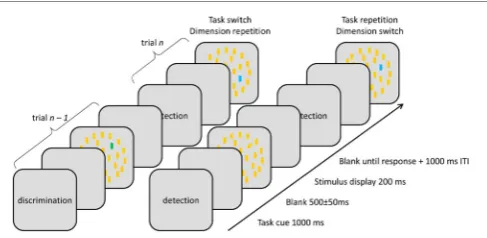
FIGURE 1 | Illustration of stimulus displays across different inter-trial sequences.
meridian) was replaced by either a blue (0.275, 0.541) or a green (0.211, 0.263)color singleton target or a right-titled (12◦ clockwise from vertical) or left-tilted (12◦counter-clockwise) ori-entationsingleton target, matched in luminance to the distractor bars (68 cd/m2).
Every trial started with a task cue (i.e., the word “detection” or “discrimination”) shown for 1000 ms, followed by a 500± 50-ms blank screen. Next, the stimulus display appeared for 200 50-ms, followed by a blank screen until response. In case of response errors, the standard intertrial interval (1000 ms) was doubled. Responses were given via pressing the left and right mouse keys using the left- and right-hand thumbs, respectively. Stimulus dis-plays were identical for both tasks, the difference being that, in the detection task, participants were required to discern the presence (on 60% of detection task trials) vs. the absence of a singleton target by pressing the corresponding response key with two pos-sible S-R mappings: (i) target-present→R1, -absent→R2and,
respectively, (ii) target-absent→R1, -present→R2. In the
dis-crimination task, a singleton was always present, with participants having to report the feature that distinguished it from distractors (blue, green, left-, and right tilted). Same-dimension singletons (e.g., blue and green) required different responses (e.g., R1 and
R2), while singletons from different dimensions (e.g., blue and
left-tilted) were mapped to a same response, resulting in four possible S-R mappings: (i) blue or left-tilted→R1, green or
right-tilted →R2, (ii) green or left-tilted →R1, blue or right-tilted
→R2, (iii) blue or right-tilted→R1, green or left-tilted→R2,
and (iv) green or right-tilted→R1, blue or left-tilted→R2. The
two possible S-R mappings in the detection task and the four S-R mappings in the discrimination task yielded eight different S-R mapping combinations, which were counterbalanced across participants.
The task (detection vs. discrimination) and the target’s dimen-sion (color vs. orientation) were randomly selected on every trial, resulting in four task sequences (detection on both prime and probe trials; discrimination on both trials; detection on prime, discrimination on probe trial; and discrimination on prime, detection on probe trial) and two dimension sequences (repeti-tion/change) across consecutive trials. Relevant dimensions were sampled with equal probability, however, in order to ensure com-parable numbers of target-present trials across the two tasks, the detection task was made more frequent (3:2 ratio).
Prior to experiment proper, participants received 1–4 practice blocks (80 trials per block); practice was terminated once a partic-ipant achieved≤10% errors per block. All participants met the criterion after 2–4 blocks. Following practice, participants com-pleted 1920 trials (in ca. 3 h), split in two equal-length sessions with a 15–30 min break in between.
EEG RECORDING AND ANALYSES
The EEG was sampled at 1 KHz using Ag/AgCl active elec-trodes (actiCAP system; Brain Products, Munich) from 64 scalp sites, arranged according to the 10–10 System (American Electroencephalographic Society, 1994), and amplified using BrainAmp amplifiers (BrainProducts, Munich) with a 0.1–250-Hz bandpass filter. Impedances were kept below 5 k. Electrodes were online referenced to FCz and re-referenced offline to aver-aged mastoids. Electrodes placed at the outer canthi of the eyes and the superior and inferior orbits monitored blinks and eye movements. Non-stereotyped noise was removed by visual inspection, followed by high-pass filtering using a Butterworth infinite impulse response filter at 0.5 Hz (24 dB/Oct). An infomax independent-component analysis was run to identify and remove effects of eye movements and blinks. Next, continuous EEG was epoched into −200–600 ms segments time-locked to stimulus display onset. Baseline correction was performed based on the −200–0 ms stimulus interval. Target-absent trials, trials pre-ceded by a target-absent trial, error response trials, as well as trials preceded by an error were excluded from the analyses. Finally, trials with (i) signals exceeding±60μV, (ii) bursts of electromyo-graphic activity (permitted maximal voltage steps/sampling point of 50μV), or (iii) activity lower than 0.5μV within intervals of 500 ms (indicating dead channels) were removed from fur-ther analyses on an individual channel basis. The remaining trials (mean=111 trials per participant per condition,SD=5 trials) were sorted according to experimental conditions, and averaged on an individual-channel basis.
DATA ANALYSES
Analysis of EEG signals focused on two event-related poten-tials (ERPs). The ERP components were quantified by sub-tracting ERPs measured at lateral parieto-occipital electrodes (PO7/PO8) ipsilateral to the target’s location from contralat-eral ERPs. The PCN peak latencies and amplitudes were defined per participant as the maximum negative-going deflection in the time period 170–270 ms post-stimulus. SPCN amplitudes were defined as the average of the time window the 430–510-ms post-stimulus.
re-using, which is determined on prime trials, the second set of analyses used a RANOVA with main terms for (i) task onprime trial, (ii) task onprobetrial, and (iii) dimension sequence (repeti-tion vs. change) across trials. Third, effects of response sequence on mean RTs and error rates were analyzed. Because only a small number of trials were available per cell for this analysis, the corresponding ERPs could not be examined.
RESULTS
ANALYSES OF OVERALL TASK DIFFERENCES
Behavioral results
Inspection of the overall mean RTs and error rates (shown
inTable 1) revealed performance to be faster and more
accu-rate for the detection task (mean RTs = 594 ms, mean error rate= 5.2%) than for the discrimination task (670 ms, 6.5%). Furthermore, task repetitions (598 ms, 4.5%) yielded faster and more accurate performance relative to task changes (666 ms, 7.1%), indicating substantial TSCs for both RTs and error rates (TSCRT= 68 ms, TSCerrors=2.6%). Finally, switching from
dis-crimination to detection incurred greater TSCs (81 ms, 3%) than switching from detection to discrimination (57 ms, 2.3%).
These observations were confirmed by RANOVAs of the mean RTs and error rates with main terms for task on probe trial (detection vs. discrimination) and task sequence (task-repetition vs. -change). The analysis of the mean RTs proved main effects of task, F(1,13)=36.44, p<0.01, η2p=0.74, task
sequence,F(1,13)= 18.65,p<0.01,η2p=0.60, as well as their
interaction,F(1,13)=6.18,p<0.05,η2p=0.32, to be significant.
The RANOVA of the mean error rates yielded likewise a sig-nificant main effect of task sequence,F(1,13)=20.94,p<0.01, η2
p=0.62, without, however, any of the other effects reaching
significance (allF<2.17, allp>0.16).
ERP results
[image:6.595.305.551.60.237.2]The stimulus-locked ERP waves obtained for the detection and discrimination tasks are shown on Figure 2. Figure 2A depicts the time course separately for electrodes contra- and ipsilat-eral to the target position, averaged across target positions3
Table 1 | Mean RTs (SEM) and percentage of errors (SEM) on probe
trials for the two different tasks, dependent on the task sequence.
Task on probe trial Task sequence RTs Errors
Detection Repetition 553 (23) 3.7% (0.4) Change 634 (30) 6.7% (0.8)
Discrimination Repetition 642 (27) 5.3% (1) Change 698 (32) 7.6% (1)
3Analyses of PCN and SPCN amplitudes revealed a significant target position
effect for the PCN component (3.50 and 3.25μV for left and right targets, respectively,F(1,13)=4.81,p<0.05,η2
p=0.27), and no difference between
left and right targets in the SPCN component (F=1.62,p=0.22). Most importantly, target position did not interact significantly with electrode site (ipsi- vs. contralateral), nor with any other experimental manipulation (all
Fs<2.16, allp>0.16)—indicating that the PCN and SPCN components were not specific for one visual hemifield.
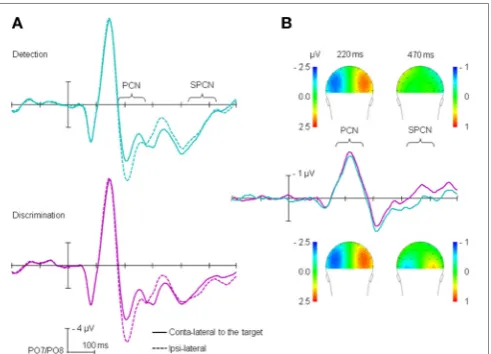
FIGURE 2 | Stimulus-locked ERPs: (A) for the ipsi-and contralateral electrodes relative to the target position, separately for the detection and discrimination tasks; (B) difference between contra- and ipsilateral electrodes.For the purpose of the presentation, data are presented filtered with 30-Hz low-pass filter.
(left vs. right), whileFigure 2B depicts the difference between contra- and ipsilateral electrodes. As can be seen fromFigure 2B, substantial lateralization effects, confirmed byt-tests against zero, were observed in the PCN time range (170–270 ms) for both the detection (−2.17μV,p<0.01) and the discrimination task (−2.41,p<0.01). Similar to what we already reported inTöllner et al. (2012a), PCN amplitude was higher for the discrimination than for the detection task, with comparable PCN latencies across the two tasks (221 and 222 ms for detection and discrimina-tion, respectively). The RANOVA of the PCN latencies with main terms for (i) task on probe trial and (ii) task sequence yielded no significant effects (allF<1). The RANOVA of the PCN ampli-tudes yielded a significant main effect of task,F(1,13)=6.61,p< 0.05,η2p=0.43; the main effect of task sequence non-significant
(F<1); the task× task sequence interaction approached sig-nificance,F(1,13)=3.70,p=0.08,η2p=0.22), owing to the fact
that switching task tended to increase the PCN amplitude for the detection task (−2.12μV and−2.22μV for detection→ detec-tion and discriminadetec-tion →detection sequences, respectively), while tending to decrease the amplitude for the discrimination task (−2.52 and−2.29μV for discrimination→discrimination and detection→discrimination sequences, respectively).
Furthermore, as Figure 2B shows, and as confirmed by t-tests against zero, lateralization effects in SPCN time range (430–510 ms) were observed for the discrimination task (mean amplitude= −0.36μV,p<0.01), but not for the detection task (0.14μV,p=0.18). A RANOVA of the SPCN mean amplitude with main terms for task and task sequence revealed the main effect of task to be significant,F(1,13)=72.74, p<0.01, η2p=
0.85, with no other effects reaching significance (allF<1).
ANALYSES OF RE-USING CONTROL SETTINGS ACROSS TASKS
Behavioral results
Figure 3 depicts the mean RT and error rate for a given task
[image:6.595.44.292.545.625.2]task on the prime trial (detection, discrimination), separately for dimension repetitions and changes (dimension sequence). As can be seen, RTs were faster for dimension repetitions (blue bars) than for dimension changes (red bars), in all conditions; error rates followed a similar pattern. These observations were con-firmed by a RANOVA of the mean RTs, which revealed all three main effects (all F>6.18, all p<0.05), all two-way interac-tions (allF>18.17, allp<0.01), and the three-way interaction between task on prime trial, task on probe trial, and dimension sequence,F(1,13)=21.27,p<0.01,η2p=0.62, to be significant.
An analogous RANOVA of the error rates yielded the following significant effects: main effect of dimension sequence,F(1,13)=
11.39, p<0.01, η2
p=0.47; task on probe trial × dimension
sequence interaction,F(1,13)=33.88, p<0.05,η2p=0.28; task
on prime trial×task on probe trial interaction,F(1,13)=20.94, p<0.01, η2p=0.62; and task on prime trial ×task on probe
trial×dimension sequence interaction,F(1,13)=8.16,p<0.5, η2
p=0.39.
To further investigate the significant three-way interactions, separate RANOVAs were run dependent on the specific task on prime trials (detection and, respectively, discrimination), with main terms for task on probe trial and dimension sequence. With the detection task on prime trials (left-hand panels in
Figure 3), the analysis of the (probe-trial) RTs revealed both
main effects to be significant: task on probe trial [145-ms dif-ference between discrimination and detection tasks, F(1,13)= 34.04,p<0.01,η2p=0.72] and dimension sequence [23-ms
dif-ference between dimension changes vs. -repetitions, F(1,13)=
22.00,p<0.01,η2p=0.63]; the interaction between the two was
far from significance (F<1). The RANOVA of the error rates revealed a significant main effect of task on probe trials [3% dif-ference between discrimination and detection, F(1,13)=16.68, p<0.01,η2p=0.56], and a marginally significant main effect of
dimension sequence, with dimension repetitions yielding 1.1% more accurate performance than dimension changes,F(1,13)=
[image:7.595.302.551.492.642.2]4.35, p=0.06; the interaction between the two was far from significance (F<1).
FIGURE 3 | Mean RTs (upper panels) and error rates (lower panels) for the different task sequences, separately for dimension repetitions (blue bars) and changes (red bars).Vertical lines denote±1SEM.
With the discrimination task on prime trials (right-hand pan-els in Figure 3), a RANOVA of the (probe-trial) RTs revealed the main effect of dimension sequence,F(1,13)=36.32,p<0.01, η2
p=0.81, and the task on probe trial × dimension sequence
interaction, F(1,13)=32.01, p<0.01, η2p=0.71, to be
signifi-cant. The interaction was caused by the dimension repetition (vs. change) effect being much larger for discrimination→ discrimi-nation sequences (125 ms) than for discrimidiscrimi-nation→detection sequences (18 ms). For the errors (on probe trials), the main effect of dimension sequence proved significant,F(1,13)=7.67, p<0.05,η2p=0.37, with accuracy being 1.4% higher for
dimen-sion repetitions relative to changes. The task on probe trial× dimension sequence interaction was also significant, F(1,13)=
8.31,p<0.5,η2
p=0.40, with a stronger DRE for the
discrim-ination relative to the detection task on the probe trial (3.2 vs. −0.3%, respectively).
In summary, significant DREs were observed in all experimen-tal conditions. When the task on the prime trial required simple target detection, DREs were comparable for detection and dis-crimination tasks on the probe trial. By contrast, with the task on prime trial required target discrimination, stronger DREs were observed for the discrimination task, relative to the detection, to be performed on the probe trial.
ERP results
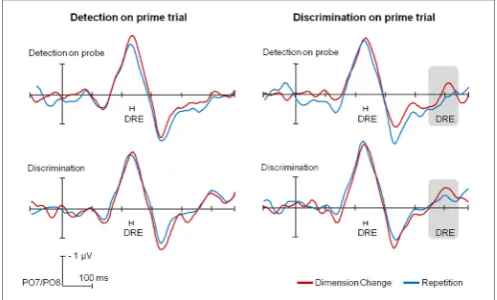
Lateralized ERPs are depicted inFigure 4for the probe trials, sep-arately for the different tasks on prime and on probe trials, as well as across different dimension sequences. As can be seen from
Figure 4, the PCN latency was delayed for dimension changes (red
lines) relative to dimension repetitions (blue lines), in all condi-tions. In the SPCN time range DREs were evident only for (probe) trials following the discrimination task.
PCN analyses
For (probe) trials preceded by the detection task (left-hand side
[image:7.595.45.292.509.667.2]ofFigure 4), a RANOVA of the PCN peak latencies revealed only
FIGURE 4 | Group-averaged time course of PCN and SPCN
a significant main effect of dimension sequence, with dimension repetitions being 17 ms faster than dimension changes,F(1,13)=
15.41,p<0.01,η2
p=0.54; no other effects reached significance
(allF<1). An analogous RANOVA for trials preceded by the dis-crimination task (right-hand side) also yielded only a significant main effect of dimension sequence [14-ms DRE,F(1,13)=5.09, p<0.05,η2p=0.23], with no other effects reaching significance
(allF<1).
SPCN analyses
With the task on the prime trial requiring target detection, analy-sis of the (probe-trial) mean SPCN amplitudes revealed only a sig-nificant main effect of task on probe trial, with an overall stronger SPCN component for the discrimination relative to the detection task (−0.37 vs. 0.18μV), F(1,13)=25.70, p<0.01, η2p=0.66;
no other effects reached significance (allF<1.94, allp>0.18). With the discrimination task on the prime trial, an analogous analysis also yielded a significant main effect of task on probe trial, F(1,13)=30.16, p<0.01, η2p=0.70, with the significant
SPCN for the discrimination relative to the insignificant SPCN for the detection task (−0.36 vs. 0.10μV). Importantly, the main effect of dimension sequence was also significant,F(1,13)=5.33, p<0.05, η2p=0.29, with the SPCN amplitude being stronger
for dimension changes relative to dimension repetitions (−0.23 vs.−0.02μV); the interaction task on probe trial x dimension sequence was far from significance (F<1).
In summary, analyses of the ERPs revealed longer PCN peak latencies for dimension changes vs. repetitions independently of the task on prime or probe trial; SPCN mean amplitudes were overall larger for the discrimination than for the detection task on probe trial, while significant DREs in the SPCN time interval were observed only for trials preceded by the discrimination task.
ANALYSES OF RESPONSE-SEQUENCE EFFECTS
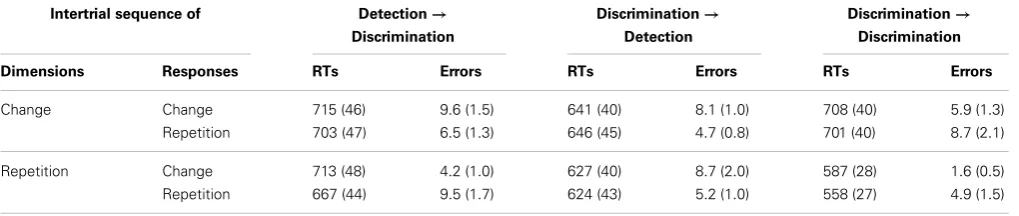
As can be seen fromTable 2, mean RTs were overall fastest for full repetitions (same task, dimension, and response), intermediate for partial repetitions, and slowest for full changes. By contrast, the errors varied as a function of task sequence. Importantly, though, there was no evidence that partial repetitions resulted in less accurate performance relative to full changes.
These observations were confirmed by three-ways RANOVAs (task- × dimension- × response sequence) of the mean RTs
and error rates with a focus on the main effect of and interac-tions involving response sequence. The RT analysis showed the main effect of response sequence to be significant,F(1,13)= 6.41, p<0.05, η2p=0.33, as well as the interaction of this factor
with dimension sequence, F(1,13)=9.04, p<0.01, η2p=0.41,
owing to a larger response repetition benefit when the dimen-sion repeated (30 ms,p<0.01) rather than changed (5 ms,p= 0.49). The task sequence × response sequence interaction was marginally significant,F(2,26)=1.67, p=0.07,η2p=0.18,
sug-gestive of a larger response repetition benefit for the discrimina-tion task (29 ms,p<0.01, and 23 ms,p<0.01, for detection→ discrimination and discrimination→discrimination sequences, respectively) relative to the detection task (−1 ms,p=0.93). The three-way interaction did not reach significance,F=1.67, p= 0.27.
Concerning the error analysis, the main effect of response sequence was non-significant (F<1). However, response sequence interacted with dimension sequence, F(1,13)=18.43, p<0.01, η2
p=0.59, and task sequence, F(2,26)=18.52, p< 0.01,η2
p=0.59; and the response-×dimension-×task sequence
interaction was significant,F(2,26)=8.55, p<0.01, η2p=0.40.
Post-hocanalyses revealed the pattern of response sequence effects (repetition benefit vs. cost) to vary across task and dimen-sion sequences. For discrimination→detection task sequences, dimension repetitions were associated with response repetition costs (−5.4%, p<0.01), whereas dimension changes yielded response repetition benefits (4.1%, p<0.01). By contrast, dis-crimination → detection task sequences resulted in response repetition benefits (3.5%, p<0.01) independently of dimen-sion sequence. Finally, discrimination → discrimination task sequences were associated with response repetition costs (−2.9%, p<0.05) independently of dimension sequence.
[image:8.595.45.555.594.702.2]In summary, analyses of response sequence effects on mean RTs showed either response repetition benefits or no effects of response sequence. This finding is at variance with hierarchi-cal task sets, which predict response repetition costs following a task or dimension change. Integrated task sets, which predict no response sequence effects following a task or dimension switch, also account poorly for the present findings. The results for error rates were less consistent across task and dimension sequences, with different patterns of response sequence effects across differ-ent experimdiffer-ental conditions.
Table 2 | Mean RTs (SEM) and percentage of errors (SEM) across different task-, dimension- and responseasequences.
Intertrial sequence of Detection→ Discrimination→ Discrimination→
Discrimination Detection Discrimination
Dimensions Responses RTs Errors RTs Errors RTs Errors
Change Change 715 (46) 9.6 (1.5) 641 (40) 8.1 (1.0) 708 (40) 5.9 (1.3) Repetition 703 (47) 6.5 (1.3) 646 (45) 4.7 (0.8) 701 (40) 8.7 (2.1)
Repetition Change 713 (48) 4.2 (1.0) 627 (40) 8.7 (2.0) 587 (28) 1.6 (0.5) Repetition 667 (44) 9.5 (1.7) 624 (43) 5.2 (1.0) 558 (27) 4.9 (1.5)
DISCUSSION
The present findings demonstrate that, consistent with “agglom-erated task sets,” it is possible to reuse control settings across different tasks, and that the reusing is associated with distinct ERP components, depending on precisely which task set com-ponent (selection vs. identification criteria) is reused across tasks. In particular, switching tasks was revealed to be easier when the task-relevant dimension repeated relative to when it changed, as indexed by DREs on task switch trials. The notion of agglomerated task sets is fully compatible with existing com-putational models of cognitive control (Logan and Gordon, 2001; Meiran et al., 2008). Both these accounts postulate sev-eral independent parameters influencing processes of selection, identification, and, respectively, responding. Importantly, since these parameters are independent, it is plausible that they can also be adjusted independently—which is the core assump-tion of the agglomerated-task-sets hypothesis. The compatibility with the computational models of cognitive control emphasizes another property of agglomerated task sets: their computational efficiency.
Note though that the DREs reported presently are consistent not only with agglomerated task sets, but also with two, relatively strong alternatives, namely: (i) switching between the detection and discrimination conditions did not involve a task switch, and (ii) the DREs are not dimension-specific, but rather feature- or response-specific. The former alternative would postulate that the two tasks used in the present study were effectively one task, in which participants always performed feature discrimination, but, depending on the cue, selected different responses. The lat-ter allat-ternative would imply that the substantial reusing of spatial selection and identification criteria (as revealed in the dimension-repetition effects) was not indicative of the reuse of task set components in general, but rather of the reuse of stimulus-response associations encountered on the previous trial (Hommel et al., 2001; Dreisbach et al., 2006, 2007).
The present findings argue against the hypothesis that no task switching took place in our paradigm. First, in the present study, substantial differences in mean RTs and errors rates were observed between the detection and discrimination tasks, suggesting that the two conditions were performed differently. Behavioral dif-ferences were accompanied by difdif-ferences in the ERPs: a reliable SPCN component was observed for the discrimination, but not for the detection task. Taken together, these findings suggest that solving the detection and, respectively, discrimination tasks involved the use of different task sets. Second, switching between the two conditions incurred substantial switch costs. Importantly, the switch cost magnitude differed, with stronger costs for dis-crimination→detection relative to detection→discrimination sequences. The asymmetry in the switch costs—with switch-ing to an easier, or dominant, task (presently, detection) beswitch-ing more effortful than switching to a more difficult task (presently, discrimination)—has frequently been reported in task-switching literature (Allport et al., 1994; Wylie and Allport, 2000) and inter-preted as an index of the interference between two concurrent task sets. On this background, it is likely that switching between the two tasks in the present study indeed involved task switch processes.
The second alternative explanation posits that DREs critically rely on repetitions of full stimulus-response episodes across tri-als, rather than on more abstract criterion repetitions. Studies investigating the role of S-R repetitions have typically found per-formance to be very good on full-repetition trials and worse on partial-repetition trials, that is, when either the stimulus or the response changed, while the other property repeated. Somewhat counter-intuitively, performance is typicallybetteron full switches, that is, when both stimulus and response change, compared to partial repetitions (Hommel, 1998, 2005; Töllner et al., 2008; Zehetleitner et al., 2012). Applied to the present study, if DREs were actually S-R repetition effects, then changing the dimension and repeating the response (i.e., partial repetitions) should have resulted in worse performance relative to changing both the dimension and the response (full repetitions). However, analyses of response sequence effects showed this not to be the case, arguing that the DREs reported presently are not reducible to S-R repetition effects.
That partial-repetition costs were not prominent in the present study does not necessarily imply that the processes generating these effects were inactive; rather, the paradigm and depen-dent measures may not have been sensitive to these processes. Previous work investigating electrophysiological correlates of DREs in a single task paradigm (Töllner et al., 2008) revealed partial repetition costs to correlate with ERP markers that were independent of the ERP markers for dimension and, respec-tively, response sequence effects. Importantly, the markers of partial-repetition costs were not investigated in the present study. Additionally, in a recent study of partial-repetition costs (Zehetleitner et al., 2012), numerical simulations showed that three different sequence-sensitive mechanisms (dimension-, S-R mapping-, and motor-response-specific) combine and can pro-duce any possible RT pattern, that is, with or without manifest partial repetition costs. Given this, until the boundary conditions for partial-repetition costs to arise are fully understood, it remains possible that the present paradigm simply did not meet these conditions.
DIRECTION OF PARTIAL-SWITCH EFFECTS: REUSING, RESETTING, OR SWITCHING
While the present study, together with several previous investiga-tions (Arrington et al., 2003; Rangelov et al., 2011, 2012), showed that reusing shared task set components across different tasks is possible, findings to the contrary have also been reported. In particular,Vandierendonck et al. (2008)failed to find any partial-switch effects, whileKleinsorge and colleagues (1999, 2004)found partial-switchcosts, relative to full switches, rather than bene-fits as reported presently. How can these disparate findings be reconciled?
string “number odd/even” served as a cue). This procedure pro-duced partial overlap between cue strings on partial switches (e.g., “number odd/even”→“digit odd/even”) and no overlap on full switches (e.g., “number smaller/greater”→“digit odd/even”). As has been shown by several studies (Logan and Schneider, 2006; Schneider and Logan, 2009), overlapping cues activate competing task sets, resulting in negative interference on partial-switch tri-als. As a consequence, any benefits from reusing shared control representations might have been masked by interference effects from overlapping cues, resulting in either insignificant partial-repetition effects or even partial-partial-repetition costs. By contrast, the present study used cues that did not overlap between the different tasks. Furthermore, the task-relevant dimension was unambiguously specified by the stimulus displays themselves, so no dimension cues were necessary. Consequently, in the present experiment, the negative interference effects would have been minimal—and, correspondingly, partial-repetition effects turned out significant.
ELECTROPHYSIOLOGICAL EVIDENCE FOR SEPARABLE CONTROL MECHANISMS
In contrast to the mixed behavioral findings regarding the direc-tion of partial-switch effects, investigadirec-tion of the ERP compo-nents related to the spatial selection and post-selective processing task components offers more conclusive findings. By assuming relative autonomy of the control systems for the different cogni-tive processes, “agglomerated task sets” predict the existence of multiple, relatively independent sources of DREs. Consistent with the prediction, EEG analyses revealedmultipleERP components to be sensitive to dimension sequences: dimension changes (rel-ative to repetitions) resulted in longer PCN latencies as well as larger SPCN amplitudes.
Analyses of the PCN latencies showed dimension changes (relative to repetitions) to be associated with longer latencies independently of the task sequence (see alsoTöllner et al., 2008, reporting similar findings in a single-task paradigm). This find-ing can be explained by assumfind-ing that both the detection and discrimination tasks required spatial selection processes, gov-erned by a task set component sensitive to dimension sequences. Dimension repetitions would permit reusing control settings from the previous trial, generating DREs for the PCN latency. Importantly, on the agglomerated-task-set hypothesis, reusing settings is possible even across tasks that differ in other task set components—as evidenced by the present finding of DREs across task switches for the PCN timing.
Analyses of the SPCN amplitudes showed, consistent with our predictions, a more pronounced SPCN for discrimina-tion relative to detecdiscrimina-tion task trials. Apparently, the SPCN amplitude increases continuously with increases in demands for post-selective perceptual processing, from no SPCNs in singleton detection (present study) and singleton localization tasks (Mazza et al., 2007) through singleton discrimination tasks (present study) to strong SPCNs in compound-search tasks (Mazza et al., 2007; Töllner et al., 2013), in which one target dimension (e.g., color) is selection-relevant, whereas another dimension (e.g., orientation) is response-relevant.
Furthermore, the SPCN amplitude was sensitive to dimen-sion sequence, but only on trials following the discrimination task. This finding is consistent with the conceptual analysis of the task sets for the detection and, respectively, the discrimination task and the functional interpretation of the SPCN component. Conceptual analysis of the detection task suggested that the sin-gleton dimension is not mandatorily encoded in the post-selective identification settings (for the detection task) and it would not be available for reuse on the following trial, predicting no DRE for the SPCN component following detection task trials. By contrast, post-selective identification in the discrimination task necessarily involved determining the singleton dimension, pre-dicting DREs for the SPCN component following trials of the discrimination task, consistent with the results of the present study.
The electrophysiological data are especially informative about the notion of a generalized switching mechanisms [as proposed byKleinsorge and Heuer (1999)], according to which one crite-rion switch enforces a switch in all criteria, rather than simple re-setting. If generalized switching were operating as a default task switch mechanism, then reconfiguring the spatial selection com-ponent should have triggered a switch in the post-selective iden-tification component as well. This would predict an obligatory coupling between DREs for the PCN and SPCN parameters—a prediction that is not supported by the present findings. Thus, in summary, the present ERP findings are fully consistent with, and yet independent of the behavioral findings of DREs across task switches, in their support for the notion of agglomerated task sets.
CONCLUSIONS
The present study investigated the nature of task-set represen-tations, defined as a set of criteria for spatial selection, post-selective identification, and S-R mapping rules. Two alternatives were considered: task sets as integral representations and task sets as agglomerations of relatively autonomous control set-tings guiding different processing stages. The key property of the “agglomerated-task-set” hypothesis is that following a task switch, different control instances can be reconfigured indepen-dently of each other, permitting reusing some of the control settings across different tasks. By contrast, the hypothesis of “inte-grated task sets” predicted no partial-switch effects, as changing any task set component would either reset all settings, or trig-ger a full switch. Consistent with agglomerated task sets, our findings demonstrate substantial partial-switch effects, opera-tionalized as DREs. Most importantly, evidence of DREs over PCN latencies and SPCN amplitudes, two functionally distinct ERP components, further supports the idea of task sets as a col-lection of autonomous control instances governing processes of spatial selection and perceptual/symbolic analysis, respectively.
ACKNOWLEDGMENTS
REFERENCES
Allport, D. A., Styles, E. A., and Hsieh, S. (1994). “Shifting inten-tional set: exploring the dynamic control of tasks,” inAttention and Performance, Vol. XV, eds C. Umilta and M. Moscovitch (Hillsdale, NJ: Erlbaum), 421–452.
Arrington, C. M., Altmann, E. M., and Carr, T. H. (2003). Tasks of a feather flock together: similarity effects in
task switching. Mem. Cogn. 31,
781–789. doi: 10.3758/BF03196116 Chiu, Y.-C., and Yantis, S. (2009).
A domain-independent source
of cognitive control for task sets:
shifting spatial attention and
switching categorization rules.
J. Neurosci. 29, 3930–3938. doi: 10.1523/JNEUROSCI.5737-08.2009 Dreisbach, G., Goschke, T., and Haider, H. (2006). Implicit task sets in task
switching. J. Exp. Psychol. Learn.
Mem. Cogn. 32, 1221–1233. doi: 10.1037/0278-7393.32.6.1221 Dreisbach, G., Goschke, T., and Haider,
H. (2007). The role of task rules
and stimulusresponse mappings
in the task switching paradigm.
Psychol. Res. Psychol. Forsch. 71, 383–392. doi: 10.1007/s00426-005-0041-3
Eimer, M. (1996). The N2pc com-ponent as an indicator of atten-tional selectivity.Electroencephalogr. Clin. Neurophysiol.99, 225–234. doi: 10.1016/0013-4694(96)95711-9 Esterman, M., Chiu, Y.-C.,
Tamber-Rosenau, B. J., and Yantis, S. (2009).
Decoding cognitive control in
human parietal cortex.Proc. Natl.
Acad. Sci. U.S.A.106, 17974–17979. doi: 10.1073/pnas.0903593106 Found, A., and Müller, H. J. (1996).
Searching for unknown
fea-ture targets on more than
one dimension: investigating a
“dimension-weighting” account.
Percept. Psychophys.58, 88–101. doi: 10.3758/BF03205479
Gilbert, S. J., and Shallice, T. (2002). Task switching: a PDP model.
Cognit. Psychol.44, 297–337. doi: 10.1006/cogp.2001.0770
Hakun, J. G., and Ravizza, S. M. (2012). Cognitive control: prepa-ration of task switching compo-nents.Brain Res.1451, 53–64. doi: 10.1016/j.brainres.2012.02.046
Hommel, B. (1998). Event files:
evidence for automatic
inte-gration of stimulus-response
episodes. Vis. Cogn. 5, 183. doi:
10.1080/713756773
Hommel, B. (2005). How much atten-tion does an event file need.J. Exp. Psychol. Hum. Percept. Perform.
31, 1067–1082. doi: 10.1037/0096-1523.31.5.1067
Hommel, B., Müsseler, J., Aschersleben, G., and Prinz, W. (2001). The theory of event coding (TEC): a framework for perception and action planning.
Behav. Brain Sci.24, 849–878. doi: 10.1017/S0140525X01000103
Hübner, R., Futterer, T., and
Steinhauser, M. (2001). On
attentional control as a source of residual shift costs: evidence from two-component task shifts.
J. Exp. Psychol. Learn. Mem. Cogn.
27, 640–653. doi: 10.1037/0278-7393.27.3.640
Jolicoeur, P., Brisson, B., and Robitaille, N. (2008). Dissociation of the
N2pc and sustained posterior
contralateral negativity in a choice
response task. Brain Res. 1215,
160–172. doi: 10.1016/j.brainres. 2008.03.059
Karayanidis, F., Coltheart, M., Michie, P. T., and Murphy, K. (2003).
Electrophysiological correlates
of anticipatory and poststimulus
components of task switching.
Psychophysiology40, 329–348. doi: 10.1111/1469-8986.00037
Karayanidis, F., Mansfield, E. L.,
Galloway, K. L., Smith, J. L., Provost, A., and Heathcote, A. (2009). Anticipatory reconfigura-tion elicited by fully and partially informative cues that validly pre-dict a switch in task.Cogn. Affect. Behav. Neurosci. 9, 202–215. doi: 10.3758/CABN.9.2.202
Kleinsorge, T. (2004). Hierarchical switching with two types of judg-ment and two stimulus dimensions.
Exp. Psychol. 51, 145–149. doi: 10.1027/1618-3169.51.2.145 Kleinsorge, T., and Heuer, H. (1999).
Hierarchical switching in a
multi-dimensional task space.
Psychol. Res. 62, 300–312. doi: 10.1007/s004260050060
Logan, G. D., and Gordon, R. D. (2001). Executive control of visual attention in dual-task situations.Psychol. Rev.
108, 393–434. doi: 10.1037/0033-295X.108.2.393
Logan, G. D., and Schneider, D. W. (2006). Priming or executive con-trol? Associative priming of cue encoding increases “switch costs” in the explicit task-cuing procedure.
Mem. Cogn. 34, 1250–1259. doi: 10.3758/BF03193269
Luck, S. J., and Hillyard, S. A. (1994).
Spatial filtering during visual
search: evidence from human elec-trophysiology.J. Exp. Psychol. Hum. Percept. Perform. 20, 1000–1014. doi: 10.1037/0096-1523.20.5.1000 Mazza, V., Turatto, M., Umiltà, C.,
and Eimer, M. (2007). Attentional selection and identification of visual objects are reflected by distinct
electrophysiological responses.
Exp. Brain Res.181, 531–536. doi: 10.1007/s00221-007-1002-4 Meiran, N. (1996). Reconfiguration
of processing mode prior to task
performance. J. Exp. Psychol. 22,
1423–1442. doi:
10.1037/0278-7393.22.6.1423
Meiran, N. (2000). Modeling cognitive
control in task-switching. Psychol.
Res.63, 234–249. doi: 10.1007/s004 269900004
Meiran, N., Kessler, Y., and Adi-Japha, E. (2008). Control by action representation and input selection (CARIS): a theoretical framework for task switching.Psychol. Res.72, 473–500. doi: 10.1007/s00426-008-0136-8
Monsell, S., and Driver, J. (2000).
Control of Cognitive Processes:
Attention and Performance
XVIII. Available online at: http:// eprints.ucl.ac.uk/18943/ (Accessed February 2, 2011).
Monsell, S., Sumner, P., and Waters, H. (2003). Task-set reconfiguration with predictable and unpredictable
task switches. Mem. Cogn. 31,
327–342. doi: 10.3758/BF03194391 Müller, H. J., and Krummenacher, J.
(2006). Visual search and selective
attention. Vis. Cogn.14, 389–410.
doi: 10.1080/13506280500527676 Müller, H. J., Krummenacher, J., and
Heller, D. (2004).
Dimension-specific intertrial facilitation in visual search for pop-out targets: evidence for a top-down modu-lable visual short-term memory effect.Vis. Cogn.11, 577–602. doi: 10.1080/13506280344000419 Müller, H. J., Töllner, T., Zehetleitner,
M., Geyer, T., Rangelov, D.,
and Krummenacher, J. (2010).
Dimension-based attention modu-lates feed-forward visual processing:
a reply to Theeuwes (2010). Acta
Psychol.135, 117–122. doi: 10.1016/ j.actpsy.2010.05.004
Nicholson, R., Karayanidis, F., Poboka, D., Heathcote, A., and Michie, P. T. (2005). Electrophysiological corre-lates of anticipatory task-switching
processes. Psychophysiology 42,
540–554. doi: 10.1111/j.1469-8986. 2005.00350.x
Rangelov, D., Müller, H. J.,
and Zehetleitner, M. (2011).
Independent dimension-weighting
mechanisms for visual
selec-tion and stimulus identificaselec-tion.
J. Exp. Psychol.37, 1369–1382. doi: 10.1037/a0024265
Rangelov, D., Müller, H. J., and
Zehetleitner, M. (2012). The
multiple-weighting-systems hypothesis: theory and empirical support.Attent. Percept. Psychophys.
74, 540–552. doi: 10.3758/s13414-011-0251-0252
Ravizza, S. M., and Carter, C. S. (2008). Shifting set about task switching: behavioral and neural evidence for distinct forms of cognitive flexibil-ity.Neuropsychologia46, 2924–2935.
doi: 10.1016/j.neuropsychologia.
2008.06.006
Rogers, R. D., and Monsell, S. (1995).
Costs of a predictable switch
between simple cognitive tasks.
J. Exp. Psychol.124, 207–231. doi: 10.1037/0096-3445.124.2.207 Rushworth, M. F. S., Passingham,
R. E., and Nobre, A. C. (2002). Components of switching
inten-tional set. J. Cogn. Neurosci. 14,
1139–1150. doi: 10.1162/089892902 760807159
Rushworth, M. F. S., Passingham, R. E., and Nobre, A. C. (2005). Components of attentional
set-switching.Exp. Psychol.52, 83–98.
doi: 10.1027/1618-3169.52.2.83 Schneider, D. W., and Logan, G. D.
(2009). Selecting a response in task switching: testing a model of com-pound cue retrieval.J. Exp. Psychol. Learn. Mem. Cogn.35, 122–136. doi: 10.1037/a0013744
Shedden, J. M., and Nordgaard, C. L. (2001). ERP time course of per-ceptual and post-perper-ceptual
mech-anisms of spatial selection. Brain
Res. Cogn. Brain Res.11, 59–75. doi: 10.1016/S0926-6410(00)00064-1 Töllner, T., Conci, M., Rusch, T.,
and Müller, H. J. (2013). Selective manipulation of target identifica-tion demands in visual search: the role of stimulus contrast in CDA activations.J. Vis. 13:23. doi: 10.1167/13.3.23
Töllner, T., Gramann, K., Müller, H. J., Kiss, M., and Eimer, M. (2008).
Electrophysiological markers of
visual dimension changes and
response changes. J. Exp. Psychol.
34, 531–542. doi: 10.1037/0096-1523.34.3.531
Töllner, T., Müller, H. J., and
Zehetleitner, M. (2012a).
Top-down dimensional weight set
determines the capture of visual attention: evidence from the PCN
component. Cereb. Cortex 22,
1554–1563. doi: 10.1093/cercor/
bhr231
Töllner, T., Rangelov, D., and Müller, H. J. (2012b). How the speed of motor-response decisions, but not focal-attentional selection, differs as a function of task set and target preva-lence.Proc. Natl. Acad. Sci. U.S.A.
109, E1990–E1999. doi: 10.1073/ pnas.1206382109
Stimulus saliency modulates pre-attentive processing speed in
human visual cortex. PLoS ONE
6:e16276. doi: 10.1371/journal.
pone.0016276
Vandierendonck, A., Christiaens, E., and Liefooghe, B. (2008). On the representation of task information in task switching: evidence from
task and dimension switching.
Mem. Cogn. 36, 1248–1261. doi: 10.3758/MC.36.7.1248
Waszak, F., Hommel, B., and Allport,
A. (2003). Task-switching and
long-term priming: role of
episodic stimulus-task bindings
in task-shift costs. Cogn.
Psychol. 46, 361–413. doi: 10.1016/S0010-0285(02)00520-0 Wylie, G. R., and Allport, A. (2000).
Task switching and the measure-ment of “switch costs.”Psychol. Res.
63, 212–233. doi: 10.1007/s00426 9900003
Zehetleitner, M., Rangelov, D., and
Müller, H. J. (2012). Partial
repetition costs persist in non-search compound tasks: evidence
for multiple-weighting-systems
hypothesis. Attent. Percept.
Psychophys. 74, 879–890. doi: 10.3758/s13414-012-0287-y
Conflict of Interest Statement: The authors declare that the research was conducted in the absence of any commercial or financial relationships that could be construed as a potential conflict of interest.
Received: 29 April 2013; accepted: 13 August 2013; published online: 03 September 2013.
Citation: Rangelov D, Töllner T, Müller HJ and Zehetleitner M (2013) What are task-sets: a single, integrated representa-tion or a collecrepresenta-tion of multiple control representations? Front. Hum. Neurosci. 7:524. doi: 10.3389/fnhum.2013.00524