T
TO
OW
WA
AR
RD
DS
S
R
RE
EF
FI
IN
NI
IN
NG
G
UN
U
NR
RA
AT
TE
ED
D
A
AN
ND
D
U
UN
NI
IN
NT
TE
ER
RE
ES
ST
TE
ED
D
I
IT
TE
EM
MS
S
FO
F
OR
R
E
EF
FF
FE
EC
CT
TI
IV
VE
E
C
CO
OL
LL
LA
AB
BO
OR
RA
AT
TI
IV
VE
E
F
FI
IL
LT
TE
ER
RI
IN
NG
G
RE
R
EC
CO
OM
MM
ME
EN
ND
DA
AT
TI
IO
ON
NS
S
A
A
b
b
b
b
a
a
A
A
l
l
m
m
u
u
11,
,
A
A
b
b
u
u
b
b
a
a
k
k
a
a
r
r
R
R
o
o
k
k
o
o
11,
,
A
A
m
m
i
i
n
n
u
u
M
M
o
o
h
h
a
a
m
m
m
m
e
e
d
d
11a
a
n
n
d
d
I
I
b
b
r
r
a
a
h
h
i
i
m
m
S
S
a
a
’
’
i
i
d
d
u
u
221
Dept. of Mathematics, Computer Science Unit, Usmanu Danfodiyo University, P.M.B 2346, Sokoto – Nigeria
2
Dept. of Information and Communications Technology, Usmanu Danfodiyo University, P.M.B 2346, Sokoto – Nigeria
Corresponding Author: Abba Almu, [email protected]
ABSTRACT: Collaborative filtering recommender systems
being the most successful and widely used plays an important role in providing suggestions or recommendations to users for the items of interest. However, many of these systems recommend items to individual users based on ratings which may not be possible if they are not sufficient due to the following problems: it may lead to the prediction of uninterested popular items already known to the users because of the penalty function employed to punish those items, the sparsity of the user-item rating matrix increases making it difficult to provide accurate recommendations and also it ignores the users general preferences on the recommended items whether they are of interest to users or not. Therefore, many times uninterested items can be found in the recommended lists of an individual user. This will make user to lose interest in the recommendations if these uninterested predicted items always appear in the lists. In this paper, we proposed a collaborative filtering recommendations refinement framework that combines the solutions to these three identified problems. The framework incorporates a popularise similarity function to reduce the influence of popular items during recommendations, an algorithm to fill up the missing ratings of unwanted recommendations in the user-item rating matrix thereby reducing the sparsity problem and finally an algorithm to solicit for user feedback on the recommended items to minimise uninterested recommendations.
KEYWORDS: Collaborative Filtering Recommendations,
Sparsity, User Preference, Popular items, Uninterested Recommended List.
1. INTRODUCTION
The increasing amount of information on the web and the emergence of e-commerce have led to the problem of information overload. Because of this problem, it becomes difficult for users to search for items of their interest. Therefore, a recommender system is essential in order to identify items based on user’s interest. The system is an information filtering system that recommends relevant items to users by analyzing the users explicitly mentioned preferences and interests [RV97, KAU16]. It saves a lot of time
and effort of users typically involve in issuing different queries about the items of interest, by simply prioritising and personalising large volume of information available at its disposal to find the unknown relevant items needed by the users. This prompted many research efforts on recommender systems [G+92, Bur02, LSY03, M+03, PB07, C+11a].
Recommender systems are categorized into three : Content-Based Filtering (CBF) [AT05, PB07], Collaborative Filtering (CF) [G+92, Z+05, YAL13, G+15, N+10, O+11, ZNC13, YW16, ERK10, X+13] and Hybrid Filtering (HF) [Bur02, C+12]. CBF recommends items to users that are similar in content to those items the users have already liked in the past [AT05]. It uses users’ profiles as content representation and then compares those profiles with new items features in order to provide recommendations. However the CBF fails to differentiate a good item from a bad item when both items use similar words (synonymy problem) and to retrieve multimedia item due to its perception of the content [C+11a]. CF on the other hand recommends items by considering users’ ratings of an item to find the match of rating patterns of some items involving other users with similar interests [MLR03, C+11b]. Unlike CBF, CF deals with users ratings given to items not content of the items but ignore to provide recommendation to new user without ratings, which is referred to cold start problem [KAU16]. HF employs the concept of CBF and the CF to provide recommendations. Among these systems, CF is the most popular and successful that provides personalised recommendation to users because it can be used to recommend any type of items to users such as books, movies, news, music, web pages and so forth [C+11b, PM12]. Therefore, this research focuses on CF recommender.
similar users. The general idea is, given a user u, the system ranks other users based on similarity with users, . It then predicts user preferences based on the preferences of 1,2,…,m users. The preference is on based a common set of objects or items . Normally, the users and objects are arranged in a matrix called rating matrix.
Several studies have been conducted on CF systems to provide accurate recommendations to users [Z+05, YAL13, G+15, N+10, O+11, ZNC13, YW16, C+11b, RAP16, X+13]. Specifically, some studies focus on how to developed effective similarity functions to determine similar users/items and predict correct item rating based on the users preferences/rating [Z+05, YAL13, G+15, N+10, O+11, ZNC13, YW16]. While other studies to reduce data sparsity [C+11b, RAP16, X+13]. Despite these studies, several shortcomings are left unresolved, which include: The existing approach fails to recommend popular items due to similarity metric used that highly penalise popular items; The approach also recommends items that are not of interest to users due to its failure to solicit for user opinion of the items; and in addition, it increases data sparsity problem because unwanted recommended items are ignored. These shortcomings pose significant challenges in providing good and acceptable recommendations to the active user. This current research work seeks to address the highlighted problems that affect the usefulness of the collaborative filtering recommender systems.
In this research work, we are particularly interested in proposing an effective CF-based framework that refines recommendation lists of item-based CF algorithms by incorporating the following: Firstly, a popularize similarity metric for recommending popular items to user by reducing the penalisation of these items is proposed; Secondly, an algorithm that solicits for users’ preferences in order to avoid recommending items that are not of user’s interest; Lastly, an algorithm to fill up the missing rating data in the matrix with a view to reducing the data sparsity problem caused by unwanted recommendations. The paper is organised into three sections as follows: In Section 1, we provide an introductory aspect of the proposed framework. In section 2, we investigated the CF recommender systems related works with a view to identify the gap that necessitated this research work. In section 3, we describe the proposed framework to address the identified gap. We conclude the paper by discussing the feature work in section 4.
2. RELATED WORKS
CF systems are the most popular recommender systems that recommend any type of items to the users. There are many research works conducted to
refine the algorithms for improving the quality and accuracy of the recommendations of these systems. In this section, some related works of these systems are presented as follows:
Ziegler et al. [Z+05] presented an algorithmic framework based on topic diversification to user and item-based CF for increasing the diversity of the top-N list of recommended items. The framework takes the accuracy of suggestions and user’s interest in specific topics into account. It uses a method that tends to balance and diversify the new recommendation lists of items so as to reflect the current user’s tastes. The framework is evaluated using precision, recall and intra-list similarity on BookCrossing dataset. It generates the recommendation list that goes beyond accuracy by including the users’ perceived list of diversity. However, the framework fails to consider a right mix of diverse recommended items to address the demand of multiple user interests.
Gasmi et al. [G+15] proposed a new temporal CF algorithm to reflect the dynamic nature of user interest changes on the recommended items. The algorithm incorporates a method that uses items in relation to the predicted one to produce the similarity scores needed to capture the reality of user preferences. The method consists of a simple weighting function that computes each score with a weight for the different items based on user’s interest changes according to time. The quality of the proposed temporal recommendation algorithm was evaluated on MovieLens dataset using Mean Absolute Error (MAE) metric. The results demonstrated that the proposed algorithm has lower MAE values than the traditional CF algorithm. However, it may not satisfy the user’s dynamic interests due to weakening the score value of the older items.
Nakatsuji et al. [N+10] presented a novel recommendations system to recommend items by expanding user interests. The system utilises a similarity method that model user interest based on items rated by the individual users and the taxonomy of items to measure similarity among users. This method uses an algorithm to adjust the similarity between users and items thereby; the recommendation of items is done to the active user by considering items with high novelty. The proposed system is evaluated on MovieLens and non-Japanese music artists’ datasets, by using MAE and coverage metrics to determine the effectiveness of the approach. Results show that, this system can recommend items with high novelty and a better accuracy than the existing methods used in the study. However, it may lead to poor accuracy of the recommendations provided to the active user because popular items are ignored.
Oh et al. [O+11] presented a novel recommendation system based on Personal Popularity Tendency (PPT) matching which recommends items to users. The system uses a popularity method to recommend items similar to PPT of each individual user while improving the recommendation accuracy of the active user interest. The system proposed uses an algorithm to penalise popular items while balancing novelty and preference of the active user during prediction process. The efficiency of the proposed method is evaluated on MovieLens dataset using popularity, diversity and accuracy metrics. The results indicated that, PPT method performs better in terms of novelty and accuracy of the recommendations than the existing methods. However, it may lead to inaccurate recommendation due to failure to penalise the popular items.
Zhao, Niu and Chen [ZNC13] proposed an opinion-based approach to deal with popularity bias in
user-based CF recommender system. The system introduces a weighting function that replaces the original weighting function used in measuring the similarity among users’ neighbours. The function reduces the influence of popular items by considering the opinion of users on the target item, which is also included in the similarity function. The proposed approach is evaluated on MovieLens dataset using normalised discounted cumulative gain, coverage and coverage in long tail metrics. The results demonstrated that, the approach outperforms the comparative approaches in dealing with popular items by decreasing items with similar opinions and increasing items with dissimilar ones based on high accuracy of the recommendations. But it fails to allow the user to specify the items that are not of interest to capture the real users’ interest.
Yang and Wang [YW16] studied the user-based and item-based CF system that recommends a list of items to a user. The system consists of a method that uses user active index and item popularity index to find neighbour of users (or items), and predictive score. The method also used algorithm that reduces the influence of highly active users and highly popular items. The proposed system was evaluated on MovieLens and GOMO datasets using three evaluation metrics namely, recall, coverage and average popularity. The experimental results indicated that, the system provides recommendations with better quality while decreasing average popularity than the traditional methods. However, it may not recommend popular items due to high reduction of the items popularity. The system also fails to solicit for user preferences of the items. Furthermore, it increases the sparsity of user-item rating matrix due to unwanted recommended items. Based on the investigated literature the afore-mentioned issues have not been incorporated properly in the existing CF recommendation framework. This forms the basis and motivation of our research work.
3. PROPOSED CF-BASED FRAMEWORK
3.1Building CF Algorithm
3.1.1Building User-Item Rating Matrix
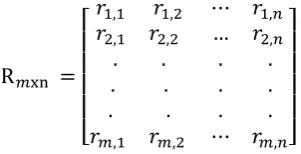
The recommender system normally has m users and n items that can be expressed in the form of mxn matrix as shown in (1). In the matrix, m means rows, n means columns and rij means the rating of user i on
item j. If the user i did not rate item j, then rij=0 and
this is what the algorithm is trying to predict.
(1)
3.1.2Finding User Neighbours
There are three (3) traditional methods used to find the similarity between the nearest users’ neighbours and the target user.
(i) Cosine Similarity: Since the user rating is seen as the n-dimensional vector space problem. Here, the items are represented as two vectors containing user ratings and the similarity between the two items (item i and item j) is computed as the cosine of the angle between these two vectors [S+01]. Therefore, it is assumed that if the user did not rate the item, the value will be set to 0. The Cosine Similarity formula is shown in (2).
(2)
(ii) Modified Cosine Similarity: Typically in the cosine similarity measure, the problem of different users rating preferences has not been taking into account. So, the modified cosine similarity measure assumes that users can normally give low or high ratings to some items. To address this highlighted problem, this similarity measure considers subtracting users’ or items’ average rating from the individual user given rating as shown in (3).
(3)
Where Ri and Rj are the average ratings for item i and item j.
(iii) Correlation Similarity: The Pearson Correlation Coefficient considers users rating over i and j together as a set of items with Iij, that is the
user i and user j is the similarity between the sim(i, j) as shown in (4).
(4)
3.1.3Generating Recommendation
To predict some item of interest to the target user, the predicted rating on item i of user u illustrated as Pui as in (5) is used by the collaborative filtering
recommendation prediction algorithm.
(5)
Where Ru is the user average rating and Pui is the predicted rating for user u on item i.
3.2Refinement Proposal for CF-Based Recommendations
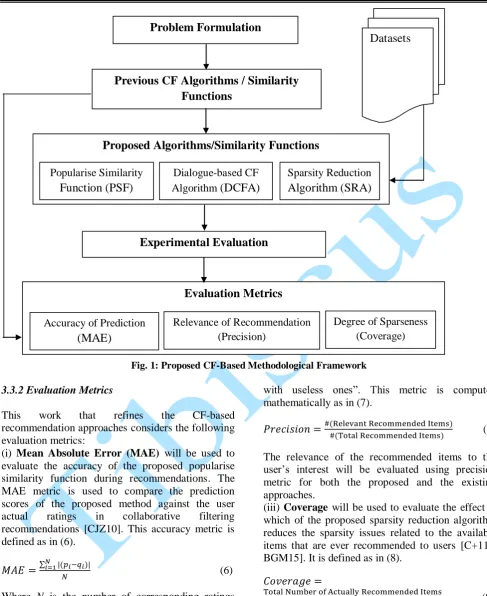
Both user-based and item-based CF methods used equation (3 or 4) to find the similarities between items or users. Each of the algorithms uses equation (5) to generate recommendations of items to users. These algorithms and their existing improvements are based on the CF architecture that normally terminated at the stage of recommendation list of items for the active user as described [IFO15]. Consequently, the user may or may not be interested in some of the items in the recommended list thereby causing fewer ratings for the items which in turn affects the prediction accuracy. Therefore, to alleviate the effect of these issues on the recommendations the CF refinement framework is proposed in this work as described in Fig. 1. It incorporates three (3) additional components namely a popularise similarity function to reduce the penalty on items, an algorithm to solicit for user preference on the items, and a sparsity reduction algorithm reduce the sparsity problem cause by these unrated recommended items in order to improve subsequent recommendations.
3.3 Experimental Evaluation
The incorporated strategies in the proposed refinement framework will be evaluated based on users’ interaction with the recommendations dataset provided by the Movielens recommender.
3.3.1Selection of Dataset
Fig. 1: Proposed CF-Based Methodological Framework
3.3.2Evaluation Metrics
This work that refines the CF-based recommendation approaches considers the following evaluation metrics:
(i) Mean Absolute Error (MAE) will be used to evaluate the accuracy of the proposed popularise similarity function during recommendations. The MAE metric is used to compare the prediction scores of the proposed method against the user actual ratings in collaborative filtering recommendations [CJZ10]. This accuracy metric is defined as in (6).
(6)
Where N is the number of corresponding ratings prediction pairs. The MAE will be used to compare the prediction accuracy of the proposed refined approach with the existing one.
(ii) Precision will be used to evaluate the relevance of the recommendations provided to the user by the proposed dialogue-based CF algorithm. Olmo and Gaudioso [18] stated that “precision shows the recommender’s capacity for showing only useful items, while trying to minimise the mixture of them
with useless ones”. This metric is computed mathematically as in (7).
(7)
The relevance of the recommended items to the user’s interest will be evaluated using precision metric for both the proposed and the existing approaches.
(iii) Coverage will be used to evaluate the effect at which of the proposed sparsity reduction algorithm reduces the sparsity issues related to the available items that are ever recommended to users [C+11b, BGM15]. It is defined as in (8).
(8)
4.CONCLUSIONS AND FUTURE WORK
Recommendation systems typically simplify the confusions cause to the users by the information overload problem when trying to find the items or product of interest. However, these systems did not take the effect of unwanted / unrated recommendations to users into account for improving
Problem Formulation
Previous CF Algorithms / Similarity
Functions
Experimental Evaluation
Proposed Algorithms/Similarity Functions
Popularise Similarity
Function (PSF)
Dialogue-based CF Algorithm
(DCFA)
Sparsity Reduction
Algorithm (SRA)
Evaluation Metrics
Accuracy of Prediction
(MAE)
Relevance of Recommendation (Precision)
Degree of Sparseness (Coverage)
subsequent recommendations. To overcome these limitations, we present an improved CF-based framework that refines the initial recommendations of item-based CF algorithms by exploiting unwanted recommendations to address user interest needs on those items to be recommended.
In future work, we will conduct an empirical evaluation of each component of the framework using Movielens datasets and other similar datasets available. Also a prototype CF-based system will be developed to test the proposed components/strategies to deal with the problem of unwanted recommendations. The accuracy and effectiveness of the proposed approaches will be evaluated using MAE, precision and coverage evaluation metrics. The future empirical study is expected to be useful in improving the performance of the proposed approaches with some state of the art approaches.
REFERENCES
[AT05] Adomavicius G., Tuzhilin A. -
Toward the Next Generation
Recommender Systems: A Survey of the
State-of-the-art and possible
extensions. IEEE Transactions on
Knowledge and Data Engineering, 17(6): 734-749, 2005.
[Bur02] Burke R. - Hybrid Recommender Systems. User Modeling and User-Adapted Interaction, 12(4):331-370, 2002.
[BGM15] Bokde D., Girase S., Mukhopadhyay
D. - Matrix Factorisation Model in
Collaborative Filtering Algorithms: A Survey. Procedia Computer Science, 49: 136-146, 2015.
[CJZ10] Chen Z., Jiang Y., Zhao Y. - A
Collaborative Filtering
Recommendation Algorithm Based on User Interest Change and Trust Evaluation. International Journal of Digital Content Technology and its Applications, 4(9):106-113, 2010.
[C+11a] Cacheda F., Carneiro V., Fernandez D., Formoso V. - Comparison of Collaborative Filtering Algorithms: Limitations of Current Techniques and
Proposal for Scalable,
High-performance Recommender Systems. ACM Transactions on the Web, 5(1): 1-33, 2011.
[C+11b] Chen Y., Wu C., Xie M., Guo X. - Solving the Sparsity Problem in
Recommender Systems using
Association Retrieval. Journal of
Computers, 6(9): 1896-1902, 2011.
[C+12] Chen W., Niu Z., Zhao X., Li Y. - A
Hybrid Recommendation Algorithm
Adapted in e-Learning Environment. Journal of World Wide Web, 1-14, 2012.
[ERK10] Ekstrand M. D., Riedl J. T., Konstan
J. A. - Collaborative Filtering
Recommender Systems. Foundations and trends in Human–Computer Interaction, 4(2): 81-173, 2010.
[G+15] Gasmi I., Seridi-Bouchelaghem H., Hocine L., Abdelkarim B. –
Collaborative Filtering Recommendation Based on Dynamic Changes of User
Interest. Intelligent Decision
Technologies, 9: 271-281, 2015.
[G+92] Goldberg D., Nichols D., Oki B. M., Douglas T. - Using Collaborative Filtering to Weave an Information
Tapestry. Communications of the
ACM, 35(12):61-70, 1992.
[HK15] Harper F. M., Konstan J. A. - The MovieLens Datasets: History and
Context. ACM Transactions on
Interactive Intelligent Systems (TiiS), 5(4):1-19, 2015.
[IFO15] Isinkaye F. O., Folajimi. Y. O., Ojokoh B. A. - Recommendation Systems: Principles, Methods and
Evaluation. Egyptian Informatics
Journal, 16: 261-273, 2015.
[KAU16] Khusro S., Ali Z., Ullah I. -
Recommender Systems: Issues,
Challenges and Research
Opportunities. Lecture Notes in
Electrical Engineering 376: Springer Science+Business Media Singapore, pp. 1179-1189, 2016.
[LSY03] Linden G., Smith B., York J. - Amazon.com Recommendations: Item-to-Item Collaborative Filtering. IEEE Computer Society, pp. 76-80, 2003.
Agents on the Internet. Artificial Intelligence Review, 19: 285-330, 2003.
[M+03] Miller B. N., Albert I., Lam S. K., Konstan J. A., Riedl J. - MovieLens
Unplugged: Experiences with an
Occasionally Connected Recommender System. In Proceedings of the 8th International Conference on Intelligent User Interfaces (IUI), Miami, Florida, USA, Pp. 263-266, 2003.
[N+10] Nakatsuji M., Fujiwara Y., Fujimura K., Tanaka A., Ishida T., Uchiyama
T. - Classical Music for Rock Fans:
Novel Recommendations for Expanding User Interests. In: Proceedings of the 19th ACM international conference on Information and knowledge management, Canada, 949-958, 2010.
[OG08] Olmo F. H. D., Gaudioso E. - Evaluation of Recommender Systems: A New Approach. Expert Systems with Applications, 35: 790–804, 2008.
[O+11] Oh J., Park S., Yu H., Song M., Park
S. - Novel Recommendation Based on
Personal Popularity Tendency. In: Proceedings of the 11th IEEE International Conference on Data Mining (ICDM), Vancouver, BC, Canada, 507-516, 2011.
[PB07] Pazzani M. J., Billsus D. - Content-Based Recommendation Systems. The Adaptive Web-Springer, 4321: 325-341, 2007.
[PM12] Ping H. Q., Ming X. - Research on Several Recommendation Algorithms. Procedia Engineering, 29: 2427-2431, 2012.
[RV97] Resnick P., Varian H. - Recommender Systems. Communications of the ACM 40 (3): 56-58, 1997.
[RAP16] Reshma R., Ambikesh G., Psanthi T.
- Alleviating Data Sparsity and Cold
Start in Recommender Systems using Social Behaviour. In Proceeding of 2016 Fifth International Conference on Recent Trends in Information Technology, Chennai, India, 2016.
[S+01] Sarwar B., Karypis G., Konstan J., Riedl J. - Item-based Collaborative
Filtering Recommendation Algorithms. In Proceeding of WWW10, Hong Kong, 2001.
[X+13] Xie F., Chen Z., Xu H., Feng X., Hou
Q. - TST: Threshold Based Similarity
Transitivity Method in Collaborative Filtering with Cloud Computing’. Tsinghua Science and Technology, 18(3): 318-327, 2013.
[YW16] Yang J., Wang Z. - An Improved Top-N Recommendation for Collaborative Filtering. In: Li Y., Xiang G., Lin H., Wang M. (eds) Social Media
Processing, SMP 2016.
Communications in Computer and Information Science, 669: 233-244. Springer, Singapore, 2016.
[YAL13] Yang C., Ai C. C., Li R. F. - Neighbour
Diversification-Based Collaborative
Filtering for Improving Recommendation
Lists. 2013 IEEE International
Conference on High Performance Computing and Communications (HPCC) and 2013 IEEE International Conference on Embedded and Ubiquitous Computing (EUC), 2013.
[Zha09] Zhang F. - Improving Recommendation
Lists Through Neighbor
Diversification. IEEE International
Conference on Inteligent Computing and Intelligent Systems, 222-225, 2009.
[Zha11] Zhang D. - Collaborative Filtering Recommendation Algorithm Based on User Interest Evolution. Advances in MSEC, 2(AISC 129), 279-283, Springer-Verlag, 2011.
[ZNC13] Zhao X., Niu Z., Chen W. - Opinion-Based Collaborative Filtering to Solve
Popularity Bias in Recommender
System. International Conference on Database and Expert Systems Applications, Springer-Heidelberg, 8056: 426-433, 2013.
[Z+05] Ziegler C., McNee S. M., Konstan J.
A., Lausen G. - Improving
Recommendation Lists Through Topic
Diversification. In Proceeding of