Bilateral Filter Based Selective Unsharp Masking
Using Intensity and/or Saturation Components
Noriaki Suetake, Yohei Kuramoto, and Eiji Uchino
Yamaguchi University/Graduate School of Science and Engineering, Yamaguchi 753-8502, Japan Email: {nsuetake, s10vc, uchino}@yamaguchi-u.ac.jp
Kazuhiro Tokunaga
Fuzzy Logic Systems Institute, Fukuoka 820-0067, Japan Email: [email protected],
Sadanori Hirose
Yamaguchi University/Faculty of Science, Yamaguchi 753-8512, Japan Email: [email protected]
Abstract—Conventionally, in order to sharpen and enhance
blurred digital images, unsharp masking (UM) has been used widely. However, over-enhancement is generated frequently in edge parts of the image and the artifacts such as jaggy and halo are sometimes seen in the resultant image. To cope with the problem, the selective UM methods were proposed so far. However, they were not always effective for the realization of the artifact suppression and image sharpening at the same time. In this paper, we propose new selective UM methods which employ the bilateral filter and Laplacian of intensity and/or saturation components of image. In the methods, the occurrence of jaggy and halo is suppressed by weakening the sharpening effect especially at the edge parts of objects in the image, and the image is well sharpened totally. Through the experiments using some images, the effectiveness of the proposed methods is illustrated.
Index Terms—image sharpening, unsharp masking, selective unsharp masking, bilateral filter
I. INTRODUCTION
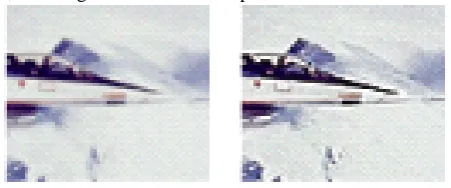
In order to sharpen and enhance the blurred images, unsharp masking (UM), in which the high frequency components of the image are calculated, weighted and added to the image, has been used widely because its calculation procedure is very simple and can produce good results [1]. However, UM sometimes generates artifacts such as jaggy and halo at the edge parts of the objects in the resultant image as shown in Fig.1. This is derived from uniform addition of the weighted high frequency components even into the parts of the edges. To cope with this problem, the selective UM methods have been proposed so far [2]--[4]. In this selective UM, the amounts of the high frequency components, which are added to the image, are adjusted based on the local image features. However, even in the selective UM methods, there were some cases where the artifacts were generated
Manuscript received January 5, 2013; revised March 3, 2013.
in the images or the sharpening effect was very weak, that is, the image was not well sharpened and enhanced.
Figure 1. Example of artifact. (a) original image, (b) image obtained by UM.
In this paper, we propose new selective UM methods, which use ratios of the local variances of the original input image and the edge-preserved smoothed image obtained by the bilateral filter in order to control sharpening effect, and uses high frequency components of the intensity and/or the saturation of the image to enhance the texture parts well. In these methods, the occurrence of jaggy and halo is suppressed by weakening the sharpening effect especially at the edge parts of objects in the image, and detail and texture parts of the image are well sharpened and enhanced totally.
In this study, the experiments using some images are executed in order to verify the effectiveness of the proposed methods.
II. PROPOSED METHOD
The proposed methods are realized by using the edge-preserving image smoothing and the image sharpening techniques. In this section, techniques used here, that is, the bilateral filter and the conventional UMs are described at first. Then details of the proposed methods are given.
A. Bilateral Filter
which is most typical edge-preserving smoothing filter [5] is employed.
Let Vin be V component (intensity) of input image in
HSV color space. Then the output image Vbf by BF is
given as follows:
.
r r l r r m r r l r r m in bf m j l i w m j l i V m j l i w j i V ) , ( ) , ( ) , ( ) , ( 1 1, (1)
where r is a positive constant to determine the size of the neighboring pixels of Vin (i, j) used to obtain the Vbf (i,
j). w1 can be expressed by the product of the spatial
weighting function wx and the photometric one wd as
follows: ) , ( ) , ( ) , (
1 i l j m w l m w i l j m
w x d . (2)
In general, wx is given as the following Gaussian
function which does not depend on the coordinate (i, j): ))
( exp( ) ,
(l m l2 m2
wx , (3) where is a positive constant. wd is given as:
], )) , ( ) , ( ( exp[ ) ,
(i l j m V i j V i l j m 2
wd in in
(4) where is a positive constant. wd has small value in
the case where the difference between Vin(i, j) and its
neighboring pixel Vin(i+l, j+m) is large. It has the effect of
edge-preserving B. Unsharp Masking
UM is a method to enhance high frequency components of an image. It mainly enhances edge parts of the objects in the image, and the resulting edge enhanced image gives sharpened impression to observers. In normal UM, the high frequency components of the intensity of the input image are extracted and weighed. Then, the image sharpening is achieved by adding them into the image. The sharpened image Vum obtained by UM
is calculated as follows:
) , ( ) , ( ) ,
(i j V i j 2V i j
Vun in V in , (5)
where V is a positive constant to adjust the strength of the sharpening effect. 2Vin(i,j) stands for the output of the high-pass filtering of the input image. In many cases, 4-neighbor Laplacian filter is employed as the high-pass filter in UM. 4-neighbor Laplacian filter used here is given as follows:
) , 1 ( ) , 1 ( ) , ( 4 ) , ( 2 j i V j i V j i V j i
Vin in in in
) 1 , ( ) 1 , (
Vin i j Vin i j . (6)
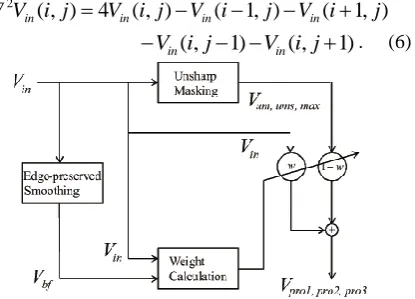
Figure 2. Processing flows of the proposed methods.
Furthermore, as the method which considers not only the high frequency component of the intensity but also that of the saturation in the sharpening of the image intensity, UM using spatially adaptive saturation feedback (UMS)[6] has been proposed by B.A. Thomas et al. In UMS, the detail and texture parts of the image are well enhanced in comparison with normal UM. The output image Vums of UMS is obtained as follows:
) , ( ) , ( ) ,
(i j V i j 2V i j
Vums in V in
) , ( ) , ( 2 j i j i Sin S
, (7)
where Sin(i, j) is S component (saturation) of the pixel
(i, j) of the input image in HSV color space, and S is also a positive constant to adjust the strength of the sharpening effect. In Eq.(7), (i,j) is a correlation coefficient in the pixel (i, j) between the intensity and saturation components in order to harmonize signs of intensity and saturation components, and is calculated by:
) , (i j
2 2 2 2 2 2 2 2 2 2 2 2 2 2 ) , ( ~ ) , ( ~ ) , ( ~ ) , ( ~ l m in l m in l m in in m j l i S m j l i V m j l i S m j l i V , (8) ) , ( ) , ( ) , ( ~ j i V m j l i V m j l iVin in in , (9)
) , ( ) , ( ) , ( ~ j i S m j l i S m j l i
Sin in in , (10)
where Vin(i,j) and Sin(i,j) are local averages of Vin(i, j) and Sin(i, j), respectively. In the proposed method, we
partially use the procedure of UMS in the sharpening process.
C. Algorithm of the Proposed Methods
In the proposed methods, firstly, an edge-preserved smoothed image Vbf is obtained by the bilateral filter.
Then, the image Vum, Vums, or Vm,ax is obtained by UM
processing described below. Finally, the output image Vpro1, Vpro2 or Vpro3 is obtained as the weighted sum of the
input image Vin and Vum, Vums or Vmax. The weight for each
pixel is decided by using the ratio of the local variances of Vin and Vbf. Fig. 2 shows the processing flows of the
proposed methods. The concrete procedures of the proposed methods are described using some equations as follows.
An output image Vpro1 of the proposed methods is
obtained as follows:
) , ( )) , ( 1 ( ) , ( ) , ( ) , (
1 i j wi jV i j wi j V i j
Vpro in um , (11)
, otherwise )) , ( / ) , ( ( , 0 ) , ( 0 ) , ( j i v j i v j i v j i w in bf in (12) , otherwise 1 , 1 )
(x x x (13) where w(i, j) is a weight for the pixel (i, j), and vin(i, j)
stands for a local variance of pixel values of Vin at the
coordinate (i, j). The local region surrounding Vin(i, j) of
or equal to 3) is considered, and the variance of pixels values in the region is calculated. vbf(i, j) is the local
variance of Vbf at the coordinate (i, j).
(a) (b)
(c) (d) (e)
Figure 3. Test images. (a) image 1, (b) image 2, (c) image 3, (d) image 4, (e) image 5.
(a) (b)
(c) (d) (e)
Figure 4. Weights calculated in each image. these values are normalized in a range [0,1] to show as gray-scale images. (a) image 1,
(b) image 2, (c) image 3, (d) image 4, (e) image 5.
The local variance is related to whether the edge is included in the local region or not. In the case where the local region includes the edges of the subjects, both vin(i,
j) and vbf(i, j) tend to be large values. Therefore the ratio
vbf(i, j)/vin(i, j) becomes near to 1. Contrastively, vbf tends
to be nearly 0 when the local region includes only plane region, and the ratio vbf(i, j)/vin(i, j) becomes near to 0 in
this occasion. At the pixels located near to or on the edge, the sharpening effect should be weakened in order to suppress the occurrence of artifacts. On the other hand, other regions including plane and detailed pattern regions should be sharpened and enhanced effectively. Eq.(11) executes the switched processing mentioned above without any parameter. The range of w(i, j) becomes [0, 1] after the calculation of .
An output image Vpro2 of the proposed methods is
obtained as follows:
) , ( )) , ( 1 ( ) , ( ) , ( ) , (
2 i j wi jV i j wi j V i j
Vpro in ums . (14)
In the output image Vpro2, it is expected that the
enhancement effect especially in the detail and texture parts of the objects is well realized comparing with the output image Vpro1.
Moreover, an output image Vpro3 of the proposed
methods is obtained as follows:
) , ( )) , ( 1 ( ) , ( ) , ( ) , (
3 i j wi jV i j wi j V i j
Vpro in max , (15)
. otherwise
) , ( ) , ( )
, (
), , ( )
, ( ) , (
) , ( )
, (
2
2 2
2
j i j i S j
i V
j i V j
i j i S
j i V j
i V
V
in S in
in V in
S in V in
max
(16) In the output image Vpro3, it is expected that the
over-enhancement is suppressed by adopting a maximum operator in the UM process in comparison with the output image Vpro2.
III. EXPERIMENTAL RESULTS
In order to verify the effectiveness of the proposed methods, the image sharpening/enhancement experiments using five test images are achieved. The test images used here are shown in Fig. 3.
Fig. 4 shows the weights calculated for the test images in the proposed methods. In Fig. 4, weight values are normalized in a range [0, 1] and are shown as the gray-scale images. As shown in Fig. 4, weights become large at edges of the objects, and as a consequence, the sharpening effect of the proposed methods is weakened at the edge part of the objects.
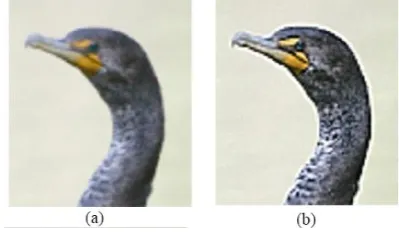
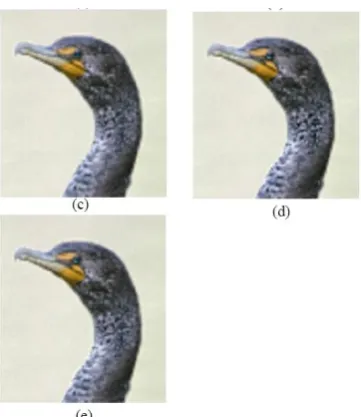
Figure 5. Experimental results for the test image 1. partially enlarged images are shown to save the space and to illustrate effectively the differences among methods. (a) original input image, (b) ums, (c) pro1,
(d)pro2, (e) pro3.
Figs. 6(a), (b), (c), (d) and (e) show the parts of the original and sharpened resultant images for the test image 4 in the similar manner to Figs. 5(a), (b), (c), (d) and (e). In UMS, the resultant image is unnatural due to over-enhancement as shown in Fig. 6(b). In Pro1, it can be said that the sharpening effect is not enough at detailed parts as shown in Figure 6(c). On the other hand, it can be seen that edges and detailed parts of the images obtained by Pro2 and Pro3 give us the natural impression like those of the original image, and are well sharpened and enhanced, as shown in Fig. 6.
(a) (b)
(c) (d)
(e)
Figure 6. Experimental results for the test image 4. partially enlarged images are shown in the similar manner to figure 5. (a) original input
image, (b) ums, (c) pro1, (d)pro2, (e) pro3.
Then, in order to show the effectiveness of the proposed methods quantitatively, the sharpening results are evaluated by using Scheffe's paired comparison test. In the paired comparison test, two stimuli are picked up from various stimuli and are evaluated. Concretely, two images arranged in right and left are compared and scored by the examinee. In the scoring, if the right image is judged as better than the left image then a positive value is given. Otherwise, a negative value is given. After the evaluations for all combinations, results are numerically represented by using the yardstick method, and it becomes possible to show which images is better for examinees.
In this study, the evaluation was achieved by 5 examinees, and scoring by each examinee was done by giving one of [-1, 0, 1]. Parameter values of each method were decided by each examinee for each image. And the evaluation and scoring were achieved by paying attention to the following two points: 1) whether a detailed part is clear or not, and 2) whether there is unnatural shape/color (jaggy/halo) in the edge or not.
Tables I and II show the numerical results of the paired comparison test. From Tables I and II, it is understood that the proposed methods Pro2 and Pro3 are superior to the other methods totally.
IV. CONCLUSIONS
In this paper, new selective UM methods, which use ratios of the local variances of the original input image and the edge-preserved smoothed image obtained by the bilateral filter in order to control sharpening effect, were proposed.
TABLE I. QUANTITATIVE EVALUATION BY PAIRED COMPARISON
METHOD IN THE VIEWPOINT OF SHARPENING
Images Original UMS Pro1 Pro2 Pro3
Image 2 -0.80 0.46 -0.02 0.32 0.04
Image 2 -0.48 0.48 -0.20 -0.06 -0.14
Image 3 -0.76 0.34 0.08 0.22 0.12
Image 4 -0.68 0.32 -0.36 0.46 0.26
Image 5 -0.68 0.52 -0.28 0.24 0.20
Average -0.68 0.42 -0.01 0.24 0.01
TABLE II. QUANTITATIVE EVALUATION BY PAIRED COMPARISON
METHOD IN THE VIEWPOINT OF IMPROVEMENT OF JAGGY/HALO
Images Original UMS Pro1 Pro2 Pro3
Image 2 0.10 -0.38 -0.10 0.18 0.20
Image 2 0.60 -0.66 0.18 -0.22 0.10
Image 3 0.22 -0.16 0.30 0.20 -0.16
Image 4 0.62 -0.66 0.30 -0.16 -0.10
Image 5 0.48 -0.40 -0.06 -0.04 0.02
In these methods, it was confirmed that the occurrence of jaggies and halos was suppressed especially at the edge parts of subjects and the image was well sharpened totally.
Furthermore, the experiments using some images were achieved. In the experiments, the resulting images were evaluated by a paired comparison test, and effectiveness of the proposed methods was verified.
Future works are to establish the auto-tuning method of the parameters, and to save the calculation costs to realize the real time processing.
REFERENCES
[1] A. K. Jain, Fundamentals of Digital Image Processing, Prentice-Hall, Englewood Cliffs, NJ, 1989.
[2] A. Polesel, G. Ramponi, and V.J. Mathews, “Image enhancement via adaptive unsharp masking,'' IEEE Tran. on Image Processing, vol.9, pp.505-510, Mar. 2000.
[3] G. Tanaka, N. Suetake, and E. Uchino, “An edge preserving filter-based selective unsharp masking for noisy images,'' in Proc. 23rd Int. Technical Conf. on Circuits/Systems, Computers and Communications, pp.469-472, 2008.
[4] R. C. Bilcu and M. Vehvilaine, “Constrained unsharp masking for image enhancement,'' In A. Elmoataz, O. Lezoray, F. Nouboud and D. Mammass (Eds.), Image and Signal Processing, LNCS 5099, Springer, pp.10-19, 2008.
[5] C. Tomasi and R. Manduchi, “Bilateral filtering for gray and color images,'' in Proc. 1998 IEEE Int. Conf. Computer Vision, pp.839-846, 1998.
[6] B. A. Thomas, et. al., “Color image enhancement using spatially adaptive saturation feedback,'' in Proc. IEEE Int. Conf. Image Processing, vol.3, pp.30-33, 1997.
Eiji Uchino received the Ph.D. degree in
systems engineering in 1988 from Hiroshima University, Japan. He is currently a professor of the Graduate School of Science and Engineering at Yamaguchi University, Japan. He is also a chairman of the board of directors at the Fuzzy Logic Systems Institute (FLSI), Japan. He was a Visiting Scientist at the Aachen Institute of Technology (RWTH), Germany, in 1994, and at the University of Bristol, UK, in 1996. His research interests include adaptive system modeling, intelligent signal, and image processing, and human brain based information processing system. He is an Honorary Member of the Ukrainian Academy of Sciences since 2002.
Noriaki Suetake received the B.E., M.E. and
Ph.D. degrees from Kyushu Institute of Technology, Japan, in 1992, 1994 and 2000, respectively. He is currently with the Graduate School of Science and Engineering, Yamaguchi University, Japan, where he is an associate professor. His research interests include digital signal processing, image processing, and intelligent systems. He is a member of IEEE, OSA, and d IEICE.
Kazuhiro Tokunaga received the B.E., M.E.
and Ph.D. degrees from Kyushu Institute of Technology, Japan, in 2001, 2003, and 2006, respectively. He is currently with the Fuzzy Logic Systems Institute, Japan, where he is a research scientist. His research interests include neural networks and pattern recognition. He is a member of JNNS.
Yohei Kuramoto received the B.S. degree
from Yamaguchi University, Japan, in 2012. He is currently with the Graduate School of Science and Engineering at Yamaguchi University, Japan, where he is a graduate student. He is interested in signal and image processing.
Sadanori Hirose is currently with the Faculty