_____________________________________________________________________________________________________
*Corresponding author: E-mail: [email protected];
Technology
3(4): 1-9, 2018; Article no.AJB2T.42025
ISSN:2457-0125
Production of Xanthan Gum Using
Xanthomonas
campestris
Isolated from Some Plants Leaves in
Keffi, Nigeria
M. D. Makut
1, P. E. Agbonkhese
1*and A. Bello
11
Department of Microbiology, Nasarawa State University Keffi, Nasarawa State, Nigeria.
Authors’ contributions
This work was carried out in collaboration between all authors. Author MDM designed the study, performed the statistical analysis, wrote the protocol and wrote the first draft of the manuscript. Authors PEA and AB managed the analyses of the study. Author AB managed the literature searches. All authors read and approved the final manuscript.
Article Information
DOI: 10.9734/AJB2T/2018/42025 Editor(s): (1)M. M. Youssef, Professor, Food Science and Technology Faculty of Agriculture , Alexandria University, Egypt.
Reviewers: (1)M. M. V Baig, Yeshwant Mahavidyalaya, Nanded, India. (2)Tan Geok Hun, Universiti Putra Malaysia, Malaysia. Complete Peer review History: http://prh.sdiarticle3.com/review-history/24980
Received 11th March 2018 Accepted 28th May 2018 Published 6th June 2018
ABSTRACT
Aim: This research is aimed to produce xanthan gum using Xanthomonas campestris isolated from some plant’s leaves in Keffi, Nigeria.
Study Design: To isolate and identify Xanthomonas campestris from some plant leaves (mango, orange, rice), to produce xanthan gum using Xanthomonas campestris, is done to determine the effects of fermentation time, temperature, pH, and carbon source on xanthan gum production by
Xanthomonas campestris isolates.
Place and Duration of Study: Department of Microbiology, Nasarawa State University Keffi, Nasarawa State, Nigeria, from January 2017 to December 2017.
Methodology: Leaves with dark rot spots were collected from Keffi area of Nasarawa state, Nigeria.
Xanthomonas campestris was isolated from the leaves were collected from Malt, Yeast Medium(YM), by following standard microbiological methods. Potato peel starch substrates extracted from potato peels were used as fermentation medium for the production of xanthan gum. The effect of time, temperature, pH and carbon source on xanthan gum production were observed. Results: Xanthomonas campestris were isolated from plants leaves in Keffi and they were able to
produce xanthan gum. It was also observed that 72 hours, 30°C, pH 6.0, potato peel substrate concentration 10% and sucrose as carbon source were the optimal factors for production of xanthan gum using Xanthomonas campestris.
Conclusion: From this study it can be deduced that Xanthamonas spp isolated from leaves in Keffi are capable of producing Xanthan gum at optimal conditions, further studies to standardize the inoculum and medium for xanthan gum production is necessary to achieve a product of greater and better quality.
Keywords: Xanthan; Xanthomonas campestris; Xanthan gum; optimization; potatoe peel.
1. INTRODUCTION
Xanthan gum is a microbial exopolysaccharide produced by the gram-negative bacterium
Xanthomonas campestris by fermenting glucose, sucrose, or other carbohydrate sources. This biopolymer is applied in the food, cosmetic, pharmaceutical, and petrochemical industries and in other sectors as a thickening agent, stabilizer, or emulsifier, and combined with other gums it can act as a gelling agent. Its primary structure is composed of repeating units of pentasaccharides consisting of two glucose, two mannose, and one glucuronic acid residues [1]. Commercially, the hydrocolloid is produced by fermentation using bacterial Xanthomonas campestris and the global xanthan market has progressively increased, at an annual rate of 5– 10% [2]. The carbohydrate source used in the commercial production of xanthan gum is the glucose obtained from corn starch, although sucrose has also been extensively used [3]. The selection of new strains and alternative fermentable substrates, which allow for the production of high yields of high viscosity xanthan gums, has been reported [4]. These xanthan may allow one to achieve the desired sample texture, viscosity, and/or stability at lower concentrations and thus with less color interference and lower end product costs. Mayer et al. studied the specifications of xanthan gum in the exploration of oil and concluded that low concentrations (0.48% m/v) showed good results [5]. High viscosity xanthan gum has been reported for use in applications such as flavor retention and as immobilization agents. This research work sets out to isolate Xanthamonas campestris plant leaves, use these isolates to produce xanthan gum, and check for the optimal conditions for xanthan gum production.
2. MATERIALS AND METHODS
2.1 Collection of Sample
Leaves were collected from different plants of selected farms within Keffi Metropolis and
transported to Nasarawa State University Keffi, Department of Microbiology Laboratory for analysis.
2.2 Isolation of Xanthomonas campestris
Isolation of Xanthamonas campestris was carried out following a method described by Singh et al. [6] briefly, 1g of leaves sample from infected plants with dark rot spot were submerged in sterile distilled water and ten-fold serial dilution were made by transferring one ml of the water into a test tube containing 9 ml of sterile distilled water. This step was repeated ten times to obtain a dilution factor of 10-7. From each of the last test tubes, 0.2 ml were taken and spread on Malt, Yeast (YM) medium containing (w/v) 0.3% yeast extract, 0.3% malt extract, 0.5% bacteriological peptone, 1.0% glucose, and 2.0% agar plates and were incubated at 35°C for 24 hours.
2.3 Identification of Xanthomonas
campestris
Identification of Xanthomonas campestris were carried out as described by Singh et al.
Identification was based on microbiological standard procedure using cultural such as colony characters and morphological characteristics such as Gram staining, Cell morphology, Cell motility, as well as biochemical test as described by Gumus et al. Aesculin test, Starch hydrolysis, Tween 80 lipolysis, H2S production, Urease
production, Milk proteolysis, Gelatin liquefaction, and Oxidase test [7]. And finally, molecular identification of the isolates.
2.4 Genomic DNA Extraction from
Bacteria
The isolates of X. campestris were grown in
nutrient broth at 28°C for 24h. Total DNA
from bacteria was extracted with guanidium thiocyanate as described earlier by
2.5 Primers and PCR Conditions
Primers:
DLH 120 forward 5’-
CCGTAGCACTTAGTGCAATG-3’ and DLH 125 reverse:
5’-GCATTTCCATCGGTCACGATTG-3’
With a predicted PCR product size 619 bp amplified the 3’ end of hrpF were taken (Berg et al. [8]. PCR assays were performed in thermocycler (BIO-RAD, C1000TM Thermal cycler). The amplifications were carried out in a final volume of 20 μm containing 1.5 mM MgCl2,
200 μM dNTPs (Promega), IX PCR buffer, 1 unit Taq Polymerase, 500 nM each hrpF primer and 1
μl 20 ng DNA template. Each PCR experiment included a control without DNA. Reactions were run for 40 cycles each consisting of 40 seconds at 95°C, 40 seconds at 63°C, 40 seconds at 72ºC with initial denaturation of 3 minutes at 95ºC and final extension of 5 minutes at 72°C.
2.6 Agarose Gel Electrophoresis
A 15 μl aliquot of each amplified PCR product was fractionated on a 1.0% agarose gel in 0.5% TBE, 80v for 1.5 hours, stained with ethidium bromide (0.5 μg/ml) and visualized under a UV transilluminator, and calculation was done by using used (BIO-RAD, GEL DOCTM XR+ with image LabTM software).
2.7 Preparation of Potato Peel Starch Substrates
Potato peels were collected, sun-dried and homogenized into powder form using clean grinding machine and sieve. Five hundred gram (500 g) powder form was added into 4 liter of distilled water and sieved to form a homogenous mixture and stored at 4°C for 24 h. The starch settled down and was separated from the supernatant liquid before being oven dried at 60°C overnight. A starch solution of 20 g/l was prepared and autoclaved at 5.0 lbs/in2 pressure (115°C) for 5 min. To liquefy starch, alpha-amylase (2.0 µ/ml) was added and heated at 95°C in a water bath for 15 min. For saccharification, amyloglucosidase (2.0 µ/ml) was added and heated at 55±C while constant stirring for about 4 h [9].
2.8 Inoculum Preparation of
Xanthomonas campestris
To obtain the inoculants, strains of Xanthomonas campestris were cultured into yeast malt broth
(YM) medium (0.3% malt extract, 0.3% yeast extract, 0.5% bacteriological peptone, and 1.0% glucose) and incubated at 28ºC for 24 hours as described by Souza and Vendruscolo [10].
2.9 Fermentation of Biomass and
Xanthan Gum Production by
Xanthomonas Campestris
The batch fermentation was carried out as described by Jamai et al. with slight modifications. Potato peels starch hydrolysate [potato peel starch (20 g/L), NH4Cl 0.4 g, KH2PO4 0.1 g, MgSO4, 7H2O 0.025 g] and was taken in 250 ml conical flasks. The flasks were plugged with cotton and autoclaved at 15 psi for 15 min. The sterilized flasks were inoculated with 5.0 ml of the inoculum under aseptic conditions. Sterilized ferrocyanide (200 ppm free ions concentration) was added to each flask. The flasks were placed in a shaker incubated at different temperature. All the experiments were run parallel in duplicates.
2.10 Effect of Temperature on Xanthan Gum Production
The effect of temperature on xanthan gum production were determined by incubating the fermentation medium at different temperature ranges, 28ºC, 32ºC, 35°C, 37ºC for 3 day [11].
2.11 Effect of pH on Xanthan Gum Production
The effect of pH on xanthan gum production were determined by adjusting the pH of the fermentation medium to different pH ranges such as 4.0, 4.5, 5.0, 5.5, 6.0 and 6.5 using 1M HCl.
2.12 Effect of Fermentation Time on Xanthan Gum Production
The effect fermentation Time on xanthan gum production were determined by incubating fermentation medium at different time interval such as 24 hours, 48 hours, 72 hours, 96 hours and 120 hours.
2.13 Production of Xanthan Gum Using Different Carbon Source
7H2O 0.025 g and water to liter, the medium (200
ml) was poured into each Erlenmeyer flask 250 ml and 5 ml of the standardize inoculum was inoculated into different fermentation medium (v/v)], [20 g of sucrose medium NH4Cl 0.4 g,
KH2PO4 0.1 g, MgSO4, 7H2O 0.025 g and water
to liter, the medium (200 ml) was poured into each Erlenmeyer flask 250 ml and 5 ml of the standardize inoculum was inoculated into different fermentation medium (v/v)], [20 g of lactose medium NH4Cl 0.4 g, KH2PO4 0.1 g,
MgSO4, 7H2O 0.025 g water to liter, the medium
(200 ml) were poured into each Erlenmeyer flask 250 ml and 5 ml of the standardize inoculum was inoculated into different fermentation medium (v/v)], [20 g of maltose medium NH4Cl 0.4 g,
KH2PO4 0.1 g, MgSO4, 7H2O 0.025 g water to
liter, the medium (200 ml) were poured into each Erlenmeyer flask 250 ml and 5 ml of the standardize inoculum was inoculated into different fermentation medium (v/v)] and [20 g of glucose medium, NH4Cl 0.4 g, KH2PO4 0.1g,
MgSO4, 7H2O 0.025 g water to liter, the medium
(200 ml) were poured into each Erlenmeyer flask 250 ml and 5 ml of the standardize inoculum was inoculated into different fermentation medium (v/v)].
2.14 Extraction of Pellet Supernatant for Quantification of the Xanthan Gum
After the fermentation at optimized conditions for the biomass and xanthan gum production, all flasks were centrifuged for extraction of biomass and xanthan gum. The media were centrifuged at 1000 rpm for 15 min for the pellets and supernatant. Pellets were suspended in deionized water for washing [11] and re-centrifuged at 4000 rpm for 10 min. To precipitate the biomass. The biomass were collected in pre-weighed plate with aluminum paper and dried in the oven at 60°C for two hours and weighed to determine the dry mass per liter medium.
2.15 Quantification of Xanthan Gum
The supernatant that was collected after extraction of biomass was mixed with 2 to 3 volumes of ethanol and was continually shook to precipitate the xanthan gum. The obtained precipitate was separated by centrifugation at 6000 rpm for 15 min. The collected residue was transferred into a pre-weighed micro-centrifuge tube. The tubes were kept in hot air oven for drying at 60°C for 20 hours. The microcentrifuge tube was cooled at room temperature then the
dry weight will be determined. The concentration of xanthan gum was obtained by calculating the dry weight of Xanthan gum per liter medium [11].
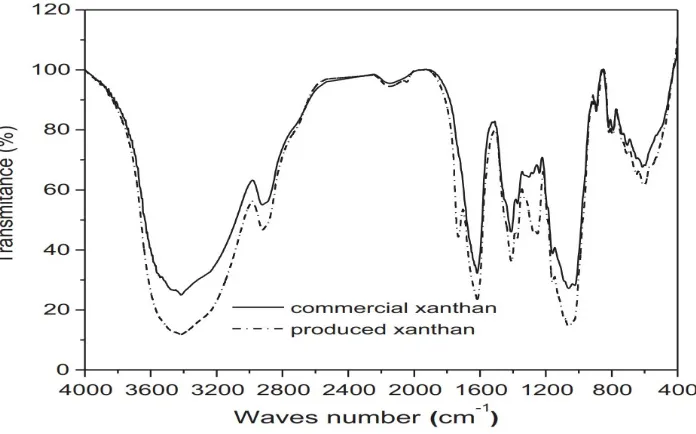
2.16 Analysis of the Functional Groups of the Xanthan Gum Produced
Functional group analysis of synthesized xanthan gum was carried out using the method described by Garcia (2000). The technique involves the use of FT-IR Shimadzu 9200S spectroscope. FT-IR
spectra dried powder of xanthan gum was used for the analysis. This dried powder of
xanthan gum was fused into KBr and pressed into pellet under pressure of the FT- IR Shimadzu 9200S spectroscope. The transmittance mode used during analysis of the xanthan gum was 4000 to 400 cm-1. The results were compared to those of commercial Xanthan gum for similarities.
3. RESULTS
3.1 Isolation and Identification of
Xanthomonas campestris from Plants Leaves
The colony count of the Xanthomonas campestris isolated from different plant leaves as given in Table 1 were the highest count was observed in Mango leaves as 4.0x10⁷cfu/g followed by Orange leaves was 3.1x10⁷cfu/g, Rice leaves was 1.8x10⁷cfu/g, Melon leaves 2.5x10⁷cfu/g, Sugar cane leaves was 2.0x10⁷cfu/g.
Table 1. Colony count of Xanthomonas campestris from different plant leaves
Isolation code Colony count (×107cfu/g)
Xc1 4.0x10⁷
Xc2 3.1 x10⁷
Xc3 1.8 x10⁷
Xc4 2.5 x10⁷
Xc5 2.0 x10⁷
Key: Xc1 - Mango leaves, Xc2- Orange leaves, Xc3- Rice, Xc4-Melon leaves, Xc5- Sugar cane leaves
3.2 Production of Xanthan Gum by
Xanthomonas campestris Isolated from Different Plant Leaves
The result of the production of xanthan gum by
3.3 Effect of Time on the Production of
Xanthan Gum by Xanthomonas
campestris
Xanthan gum and biomass produced by
Xanthomonas campestris at different time interval is as given in Fig. 2. Were the highest xanthan gum produce was at 72 hours 1.05 g/l and biomass 1.38 g/l followed by 96 hours 1.00 g/l, biomass 1.22 g/l; 120 hours 0.91g/l, biomass 1.00 g/l, 48 hours 0.89 g/l and biomass 1.01g/l, 144 hours 0.78 g/l and biomass 0.99 g/l and the lowest was at 24 hours 0.35 g/l, biomass 0.98 g/l respectively.
3.4 Effect of Temperature on Production
of Xanthan Gum by Xanthomonas
campestris
Xanthan gum and biomass produced by
Xanthomonas campestris is given in Fig. 3. Where the highest xanthan gum produce was at 30°C 1.11 g/l and biomass 1.81 g/l followed by 25°C0.86 g/l, biomass 1.69 g/l; 35°C 0.76 g/l, biomass 0.92 g/l, 40°C 0.65 g/l and biomass 0.80 g/l and the lowest was at 45°C 0.47 g/l and biomass 0.75 g/l g/l respectively.
3.5 Effect of Different Range of pH on
Xanthan Gum Production
Xanthomonas campestris
The yield of xanthan gum and biomass produced by Xanthomonas campestris at different pH range is as shown in Fig. 4. The highest yield of xanthan gum was produced at pH6.0 1.00 g/l and biomass of 1.78 g/l followed by pH 6.5 0.99 g/l;
biomass of 1.24 g/l, pH 5.5 0.87 g/l; biomass of 1.13 g/l; pH 5.0 0.74g/l; biomass of 0.99g/l; pH 4.5 0.65 g/l; biomass of 0.88 g/l and least at pH 4.0 0.44 g/l and biomass of 0.74 g/l respectively.
3.6 Effect of Different Carbon Source on Xanthan Gum Production
The yield of Xanthan gum and biomass produced
by Xanthomonas campestris using different carbon source is as given in Fig. 5
which shows that Sucrose produced the highest gum of 1.18 g/l, biomass of 1.71 g/l; R 0.19 g/l, biomass of 0.79 g/l; Glucose 1.01 g/l, biomass of 1.52 g/l and 0.17 g/l and biomass of 0.70 g/l respectively.
Fig. 1. Xanthan gum produced by Xanthomonas campestris isolated from different plant leaves
Fig. 2. Effect of fermentation time on the production of xanthan gum by Xanthomonas campestris isolated from orange leaves in Keffi
Fig. 3. Effect of temperature on production of xanthan gum by Xanthomonas campestris
isolated from orange leaves in Keffi
3.7 FT-IR Spectrum of Xanthan Gum
Samples in KBr Pellets for
Commercial Xanthan Gum (CX) and Produced Xanthan gum (PX)
Fig. 6 shows the infrared spectra of PX and CX. The most critical bands seen in the range of
4000–400 cm−1 were: (3200–3450 cm−1: axial deformation of –OH; 2850–2950 cm−1: axial strain of C–H (which could have been as a result of absorption of symmetrical and asymmetrical stretching of CH3 or even groups of CH2) and
1530–1650 cm−1: axial strain of C O of enols (-diketones); 1420–1430 cm−1: deflection angle
C–H; and 1050–1150 cm−1: axial deformation of C–O). Fig. 6 indicates that the infrared spectrum of the (CX) is closely similar to what was
obtained for the PX using the strain of
Xanthomonas campestris isolates. According to this result, it is possible to conclude that the isolated polysaccharide had similar spectral behavior as the standard.
Fig. 4. Effect of pH on the production of xanthan gum by Xanthomonas campestris isolated from orange leaves in Keffi
Fig. 6. FT-IR spectrum of xanthan gum samples in KBr pellets for CX and PX
4. CONCLUSION
The influence of time, temperature, substrate concentration and pH on xanthan gum production is an important parameter and has been greatly studied. Also from this study, it was observed that Xanthomonas species isolated from plants leaves produced xanthan gum than others isolated from the soil which agree with the study reported by Barua et al. that has the highest yield of xanthan gum from isolates from Citrus leaves [12]. From this research, it was observed that the optimum temperature for xanthan gum production was 30°C, time to beat 72hours of fermentation and at pH 6.0. This particular study showed that sucrose is the best carbon source for production of xanthan gum. Agro-waste is an alternative carbon source for xanthan gum production is also one of the other significant observations.
COMPETING INTERESTS
Authors have declared that no competing interests exist.
REFERENCES
1. Garc´ıa-Ochoa F, Santos VE, Casas JA, G´omez E. Xanthan gum: Production, recovery, and properties. Biotechnology Advances. 2000;18:7:549–579.
2. Gunasekar V, Reshma KR, Treesa G, Gowdhaman D, Ponnusami V. Xanthan from sulphuric acid treated tapioca pulp: Influence of acid concentration on xanthan fermentation, Carbohydrate. Polymers.
2014;102:669–673.
3. Palaniraj A, Jayaraman V. Production, recovery and applications of xanthan gum by Xanthomonas campestris. Journal of Food Engineering. 2011;106:1:1–12. 4. Mabrouk MEM, El-Ahwany AMD, Beliah M
MB, Sabry SA. Xanthan production by a novel mutant strain of Xanthomonas campestris: Application of statistical design for optimization of process parameters. Life Science Journal. 2013;10(1):1660– 1667.
5. Sujata C, Baig MMV. Relationship of biomass and xanthan gum production by
Xanthomonasn campestris: Optimization of parameters. British Biotechnology Journal. 2016;11(1):1-8.
6. Singh VB, Kumar A, Kirubakaran SI, Ayyadurai N, Kumar RS, Sakthivel N. Comparison of exopolysaccharides produced by Xanthomonas oryzae pv. oryzae strains, BXO1 and BXO8 that show varying degrees of virulence in rice (Oryza sativa L.). Journal of Phytopathology. 2006;154:410–413.
7. Gumus T, Demirci AS, Mirik M, Arici M, Aysan Y. Xanthan gum production of
plants. Food Science Biotechnology. 2010; 19(1):201–206.
8. Berg T, Tesoriero L, Hailstones DL. PCR-based detection of Xanthomonas campestris pathovars in Brassica seeds. Plant Pathol. 2005;54:416—427.
9. Kumar A, Ahuja M. Carboxymethyl gum kondagogu: Synthesis, characterization and evaluation as mucoadhesive polymer. Carbohydr. Polym. 2012;90:637–643. 10. Cintia Regina Rodrigues carignan;
Kassandra sussimustafeoliveira; Velaria Marta Gomes de lima; Pedro de olivaneto. New culture medium for xanthan gum production by Xanthomonas campestris pv
campestris. Indian Journal of Microbiology. 2011;51(3):283-288.
11. Gazal SMA. Genetically modified strains of
Xanthomonas campestris higher xanthan producer and capable to utilize whey. Current Research in Bacteriology. 2011; 4(2):44-62.
12. Barua R, Alam MJ, Salim M, Ashrafee TS. Small scale production and characterization of xanthan gum synthesized by local isolates of
Xanthomonas campestris. Indian Journal of Experimental Biology. 2016;54(2):151-5.
_________________________________________________________________________________
© 2018 Makut et al.; This is an Open Access article distributed under the terms of the Creative Commons Attribution License (http://creativecommons.org/licenses/by/4.0), which permits unrestricted use, distribution, and reproduction in any medium, provided the original work is properly cited.
Peer-review history: