The University of San Francisco
USF Scholarship: a digital repository @ Gleeson Library |
Geschke Center
Master's Theses
Theses, Dissertations, Capstones and Projects
Spring 5-22-2015
Investigations of Thioether Generation for
S-D-Ribosyl-L-homocysteine Synthesis
Brendan Corcoran
Follow this and additional works at:
https://repository.usfca.edu/thes
Part of the
Organic Chemistry Commons
This Thesis is brought to you for free and open access by the Theses, Dissertations, Capstones and Projects at USF Scholarship: a digital repository @ Gleeson Library | Geschke Center. It has been accepted for inclusion in Master's Theses by an authorized administrator of USF Scholarship: a digital repository @ Gleeson Library | Geschke Center. For more information, please [email protected].
Recommended Citation
Investigations of Thioether Generation for S-D-Ribosyl-L-homocysteine Synthesis
A Thesis Presented to the Faculty of the Department of Chemistry at the University of San Francisco in
Partial Fulfillment of the Requirements for the Degree of Master of Science in Chemistry
Written by
Brendan J. Corcoran
Bachelor of Arts
Saint Mary’s University of Minnesota
Investigations of Thioether Generation for S-
D-Ribosyl-
L-homocysteine Synthesis
Thesis written by Brendan Corcoran
This thesis is written under the guidance of the Faculty Advisory Committee, and approved by all its members, and has been accepted in partial fulfillment of the requirements for the degree of
Master of Science in Chemistry at the University of San Francisco
Thesis Committee
Megan Bolitho, Ph.D. Research Advisor
Claire Castro, Ph.D. Professor of Chemistry
Janet Yang, Ph.D. Assistant Professor of Chemistry
Acknowledgements
I had a wonderful advisor in Megan Bolitho. I would like to thank her for helping me shake off the rust
and for patiently polishing me into a chemist. I appreciate the guidance, conversation, and intellect she
shared with me on a daily basis.
Many thanks to the University of San Francisco faculty development fund and chemistry department for
their support and to the members of the chemistry department community. My special appreciation to
Deidre Shymanski, Angela Qin, and my fellow student researchers for all of their help and friendship.
Thank you to Chad Schwietert for endless stimulating conversation and assistance. Thank you to Andy
Huang for his enthusiastic teaching of the things you can’t find in the textbooks. Thank you to Emily
Showell-Rouse for her mentorship, continued discussions, and clear interruptions when I was about to
make irreversible mistakes.
My sincere gratitude to the members of my thesis committee. Claire Castro and Janet Yang provided
great insights for this thesis and much encouragement throughout my graduate research. I thank them for
their time and support.
Thank you to those who shaped my love for chemistry: my godfather Dean Schrandt, my mentors Jim
Vogel and Brett Bodsgard, and my family.
Unending love and appreciation to my lovely wife Amanda. She encourages, supports, and loves me in an
Table of Contents
Chapter 1. Targeting Bacterial Quorum Sensing as an Anti-Infective Strategy 1
1.1 Autoinducer-2 and System Two QS 3
1.1.1 Biosynthesis, Detection, and Function of AI-2 in vivo 5
1.1.1.1 Discerning a Target Option in System Two QS 6
1.1.1.2 Molecular Role of AI-2 in vivo 7
1.1.2 Targeting and Suppressing System Two QS 8
1.2 Competitive Inhibition of LuxS Using SRH Analogues 9
1.2.1 The LuxS Mechanism 9
1.2.2 Ellman’s Bioassay for LuxS Activity 11
1.3 Chemical Synthesis of SRH 12
1.3.1 Routes to Thioether Generation 12
1.3.2 Groundwork SRH Thioether Generation by
Bimolecular Nucleophilic Substitution 15
1.3.3 Radical Generation of Thioethers 18
1.4 Project Summary 19
Chapter 2. Preparation of the SRH Thioether by Bimolecular Nucleophilic Substitution 21
2.1 Previously Reported Generation of SRH-Related Thioethers by SN2 21
2.1.1 Previously Reported SRH Generation 23
2.1.2 Previously Reported SRH Analogues 23
2.2 General Features of the Bimolecular Nucleophilic Substitution Mechanism 24
2.3 New SN2 Conditions for Preparing the SRH Thioether 25
2.3.1 SN2 Retrosynthesis “A”: Nucleophilic Homocysteine 27
2.3.1.1 Reaction Condition Selection: Base and Solvent 27
2.3.1.2 Electrophile Screen for Efficient Coupling 28
v
2.3.1.4 Summary of SRH Thioether Generation by SN2 Approach “A” 33
2.3.2 SN2 Retrosynthesis “B”: Nucleophilic Thioribose 34
2.3.2.1 Preparation of Amino Acid Derived Electrophile 35
2.3.2.2 Nucleophilic Thioribose Preparation 36
2.4 Summary, Conclusions, and Future Directions of SN2 Thioether Generation 37
Chapter 3: Preparation of the SRH Thioether Bond by Thiol-Ene Coupling 39
3.1 Previously-Reported TEC Preparations of Thioether Bonds in Small Biomolecules 39
3.2 General Features of the TEC Mechanism 41
3.2.1 Conditions Used in TEC Reactions 42
3.2.1.1 Reaction Effects from the Alkene Substituent 42
3.2.1.2 Reactivity of the Thiol Substituent 43
3.3 Identification of TEC Strategies for Preparation of the SRH Thioether 43
3.4 TEC Retrosynthesis “A”: Carbohydrate as the Alkene Substituent 45
3.4.1 Generation of the Erythrofuranoside Olefin 45
3.4.2 TEC Strategy “A” for the Synthesis of SRH 46
3.4.2.1 Definitive Identification of Major Product as the
SRH-like Diastereomer 47
3.4.2.2 Three Dimensional Modeling of SRH Diastereomers 50
3.4.3 Summary of TEC Coupling Strategy “A” 52
3.5 TEC Retrosynthesis “B”: Vinylglycine as the Alkene Substituent 52
3.5.1 Preparation of Vinyl Glycine by Grieco Elimination 53
3.5.2 Preparation of D-Thioribose Derivative 55
3.5.3 Formal Synthesis of SRH by TEC 55
3.6 Summary and Future Directions 57
3.6.1 Proposed Synthesis for an Alkylated Vinyl Glycine Suitable
3.6.2 Proposed Synthesis for an Alkylated Homoserine Derivative
for SN2 Coupling 59
3.6.3. Additional LuxS Inhibition Targets 60
Experimental 61
References 77
Abstract
Creation of the thioether linkage is a fundamental step for the chemical preparation of the bacterial
quorum sensing molecule S-D-ribosyl-L-homocysteine (SRH). Although previous preparations of SRH
and its analogues have been reported in the literature, they employ assorted methods with varied results.
Therefore, a reassessment of the methodology used for synthetic preparation of the thioether bond in
SRH-like molecules is here considered. This work examines four methods of thioether generation
following two mechanisms, bimolecular nucleophilic substitution (SN2) and radical-initiated thiol-ene
coupling, in an attempt to generate SRH in a more efficient and reproducible manner. Both mechanisms
address key objectives for SRH preparation: consistent production of the target compound in an
analytically pure form, synthesis from easily obtained commodity materials, and improved understanding
of each variable involved in creating the thioether bond in this molecule. One application of the thiol-ene
coupling reaction generates the SRH thioether at a trial scale with a much-improved yield (93% over
70%) when compared to the most successful reported method to date. Other observations include
improved understanding of steric effects involved in both mechanisms, optimization of conditions,
assessment of electrophile choice, and the synthesis of a diastereomer of SRH, which may be considered
Chapter 1. Targeting Bacterial Quorum Sensing as an Anti-Infective Strategy
Antibiotic resistance is a major health issue worldwide. Certain strains of bacteria are no longer
responding to long-used treatments, and infections that were once easily cured are becoming difficult to
manage. The Infectious Diseases Society of America reports that bacterial evolution against conventional
therapies is far outpacing the rate of new drug development.1 Meanwhile, an estimated two million
infections developed annually in the United States are caused by antibiotic-resistant pathogens, resulting
in at least 23,000 deaths each year.2 The most well-known representation of this health crisis may be the
emergence of methicillin-resistant Staphylococcus aureus (commonly known as MRSA). During the
mid-1900’s, S. aureus began to develop resistance to penicillin and other related β-lactam antibiotics.
Evolving over time, some more recent strains have begun to show resistance to even some of the “last
resort” therapies such as vancomycin.3
While bacteria adapt in order to defend themselves against conventional antibiotic treatments, the
scientific community continues to explore new molecular pathways as avenues to treat infections.
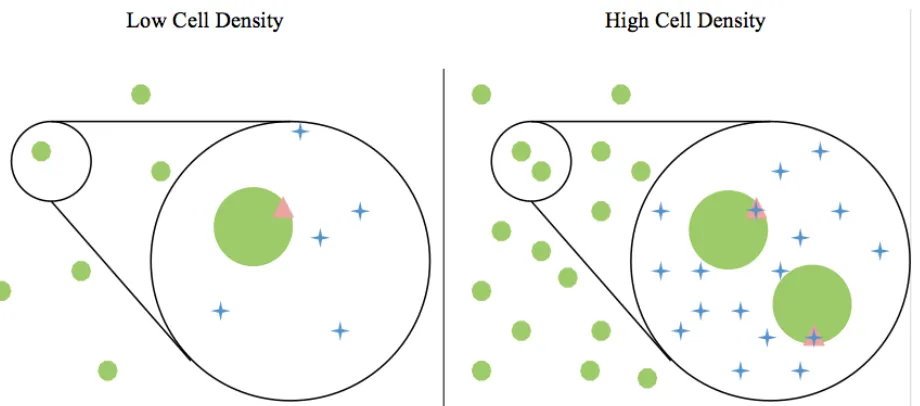
Bacterial quorum sensing (QS) is one enticing target option. QS is a molecular signaling system in which
bacteria secrete small organic molecules called autoinducers (AI’s) into their environment. When a
microbial population grows sufficiently large, the resulting concentration of secreted AI’s surpasses a
threshold value that is correlated to an optimal cell density (Figure 1). Once that signal threshold level is
achieved, each individual member of the community of bacteria is able to detect the AI, resulting in the
2
Figure 1. Bacterial AI biosynthesis and quorum sensing AI’s (blue crosses) are biosynthesized and secreted by bacteria (green circles) into the surrounding environment. After a certain concentration of AI’s has accumulated in proportion to cell density, a receptor (pink triangles) located at the surface (depicted above, i.e., LuxN, LsrB) or within the cytoplasm (not depicted, i.e., LuxR) of each bacterium is able to detect the AI’s. In QS-active species, this detection triggers a regulation in gene expression and associated behavioral changes throughout the colony.7
Both Gram-negative and Gram-positive species utilize AI’s for QS, and various bacterial behaviors have
been tied to AI-regulated activity. While some bacteria use QS circuits for benign behaviors such as
bioluminescence, others commonly regulate virulence factor expression. Table 1 lists a selection of
Table 1. Behaviors associated with QS in Gram-positive and Gram-negative species
Organism Gram Identity Regulated Behavior7
Bacillus thuringiensis
Enterococcus faecalis
Escherichia coli
Pantoea stewartii
Salmonella Typhimurium
Staphylococcus aureus
Streptococcus pneumoniae
Vibrio cholerae
Vibrio harveyi
Positive
Positive
Negative
Negative
Negative
Positive
Positive
Negative
Negative
Sporulation8
Conjugation & Adhesion9
Motility & Acid Resistance10
Adhesion11
Virulence & Motility12
Exotoxins & Biofilm13
Competence14
Biofilm & Virulence15
Bioluminescence16
Targeting QS as a new anti-infective strategy against associated virulent behaviors is attractive
particularly due to its potential for the development of a new class of non-lethal antibiotics. Upon
blocking the QS signal, it is reasonable to predict that the expression of virulent traits may be disrupted
without actually killing the bacteria, as QS-regulated behaviors are not generally critical to survival.7 This
non-lethal approach to treatment could subdue infection without “selecting for” chemically resistant
strains that possess an incentive to evolve antibiotic resistant traits.17 In fact, development of resistance to
an anti-cooperative treatment (i.e., resisting the prevention of activity induced by QS) could actually
prove disadvantageous to a bacterium expending its resources in an otherwise competitive environment.18
1.1 Autoinducer-2 and System Two QS
While many AI’s are species-specific (i.e., operate among only one species of bacteria), the system two
4
Hundreds of publications have reviewed and studied system two signaling, and behaviors in dozens of
bacterial species (several of which are virulent) have been attributed to AI-2 induction.20 For this reason,
it is believed that system two QS could act as something of a broad spectrum target for a potential
therapy. It is worth noting that AI-2 has been shown to operate in concurrence with other factors to
regulate behavior changes, suggesting that targeting AI-2 alone may not eliminate a particular phenotype.
For example, Vibrio harveyi requires three individual signaling molecules, AI-2, CAI-1, and HAI-1, to act
synergistically in order to elicit its maximum bioluminescence response.21 A list of representative
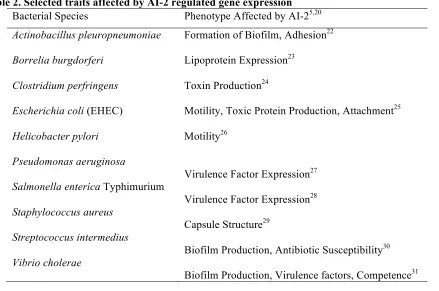
behaviors affected by AI-2 activated gene expression is summarized in Table 2.5,7,20
Table 2. Selected traits affected by AI-2 regulated gene expression Bacterial Species Phenotype Affected by AI-25,20 Actinobacillus pleuropneumoniae
Borrelia burgdorferi
Clostridium perfringens
Escherichia coli (EHEC)
Helicobacter pylori
Pseudomonas aeruginosa
Salmonella enterica Typhimurium
Staphylococcus aureus
Streptococcus intermedius
Vibrio cholerae
Formation of Biofilm, Adhesion22
Lipoprotein Expression23
Toxin Production24
Motility, Toxic Protein Production, Attachment25
Motility26
Virulence Factor Expression27
Virulence Factor Expression28
Capsule Structure29
Biofilm Production, Antibiotic Susceptibility30
Biofilm Production, Virulence factors, Competence31
Development of an anti-infective treatment directed at a particular component involved in the AI-2 circuit
could proceed in a number of ways. Targets include cellular factors involved in the synthesis or the
detection of the QS signal. The following section provides a brief overview of the production and activity
1.1.1 Biosynthesis, Detection, and Function of AI-2 in vivo
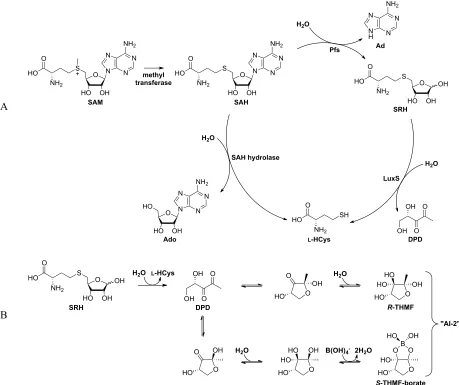
AI-2 is biosynthesized in vivo (Figure 2A) as a catabolite within a variation of the activated methyl cycle
(AMC) that is specific to bacteria. Universally, demethylation of the methyl donor S-adenosylmethionine
(SAM) results in the production of the toxic intermediate S-adenosylhomocysteine (SAH).19,20 Eukaryotes
and some bacteria then break down SAH in a single step using the enzyme SAH hydrolase. This enzyme
cleaves SAH into adenosine (Ado) and L-homocysteine (L-HCys), which can then be reused as cellular
metabolites.5
A
B
Figure 2. Biosynthetic production of AI-2 (A) Detoxification pathway of the AMC proceeds in one of two variations. The two step pathway using the enzymes Pfs and LuxS results in the formation of DPD. (B) An unstable molecule, DPD spontaneously cyclizes in aqueous solution. To date, two signaling molecules, R-THMF and S-THMF-borate, have been identified as AI-2 forms detectable by bacteria.32,33
OH OH O O O OH HO HO N N N N NH2 HO NH2 O O OH HO S N N N N NH2 HO NH2 O O OH HO S OH HO NH2 O SH SAH SRH
Ado L-HCys DPD
H2O
Ad Pfs
LuxS SAH hydrolase
H2O
H2O N N N H N NH2 HO NH2 O O OH HO S N N N N NH2 SAM methyl transferase O HO OH HO HO O OH HO O OH OH O O O OH HO O O OH HO HO HO O HO HO O OB HO OH DPD "AI-2" HO NH2 O O OH HO S OH SRH
H2O L-HCys H2O
H2O B(OH)4- 2H2O
6
Other bacteria detoxify SAH in two steps: First, SAH is hydrolyzed by the Pfs enzyme, producing
adenine (Ad) and S-D-ribosyl-L-homocysteine (SRH). In a second step, SRH is further catabolized by the
enzyme S-ribosylhomocysteinase (LuxS) into L-HCys and 4(S),5-dihydroxy-2,3-pentanedione (DPD).
DPD is an unstable compound that spontaneously cyclizes in aqueous environments, resulting in a set of
equilibrating chemical species that exist collectively as “AI-2” (Figure 2B).5,20
1.1.1.1 Discerning a Target Option in System Two QS
The luxS gene has been identified in over half of known genomes across the bacterial kingdom.34 Within
bacteria, the LuxS enzyme universally generates DPD from SRH (Figure 2B). The equilibrating nature of
AI-2 allows various species of bacteria to sense the same chemical signal, despite the expression of
different AI-2 receptor proteins.20 To date, two conformations of AI-2 have been isolated which bind
different AI-2 receptors. Chen et al. found that the species Vibrio harveyi binds a borate-containing form
of AI-2 called S-THMF-borate (Figure 2B) using the receptor LuxP.32 Miller et al. later identified the
receptor LsrB in S. Typhimurium, and characterized the bound conformation of AI-2 as R-THMF (Figure
2B).33 Considering this example of two AI-2-detecting species with differences in both their receptors and
the AI-2 conformation they are able to detect, the observation that the AI-2 biosynthesized by S.
Typhimurium invoked QS-regulated behavior changes in V. harveyi is indicative of the conformational
dynamism of DPD in biological systems. When a strain of V. harveyi deficient in the ability to produce
endogenous AI-2 was treated with in vitro synthesized DPD, endogenously-produced LuxP ligand, or endogenously-produced LsrB ligand, each trial demonstrated a quantified bioluminescence response to all treatments (also dependent on the boron equilibrium). This dynamic equilibrium between DPD, R-THMF, and S-THMF-borate33 indicates that targeting LuxS could lead to the development of a single inhibitor with the ability to slow or stop the production of AI-2 in many bacteria, broadly treating infections
1.1.1.2 Molecular Role of AI-2 in vivo
There has been some debate over whether AI-2 is an important QS signal or simply a byproduct of the
essential SAH detoxification mechanism.20 The ideas and evidence surrounding this debate are vast and
complex. A selection of interesting arguments is summarized below:
• One hypothesis suggests that, in certain cases, a phenotype resembling a gene-activated behavior change could arise as the result of a defective metabolic route. This idea has been countered in a
number of cases by restoring function in mutants lacking the ability to produce AI-2 by
complementing the mutation with the introduction of chemically-prepared DPD.5
• The presence of AI-2 can be viewed as a marker for “fitness of population,” non-coincidentally produced when bacterial populations would most benefit from collective gene regulation.
Increased methylation is correlated with cellular growth occurring in the log phase, and microbial
populations are often successful when behavioral changes occur within a thriving population.5,20
• Some bacteria (e.g., P. aeruginosa) degrade or uptake AI-2 as a possible carbon source, but this behavior has also been suggested as a means of depleting the communal AI-2 signal for the
benefit of a particular species’ advantage in colonization.35 Even as a metabolic byproduct, the
presence of AI-2 could serve as a signal to other species benefiting somehow from the makeup of
a complex bacterial community.5
• Another interesting question regarding the signaling nature of AI-2 is the rationale behind the evolution of the two-step detoxification mechanism. If SAH is easily detoxified in one step by
SAH hydrolase, is there a significance to the evolution of a two-step sequence for another
purpose (i.e., signaling), or is this process genetically conserved simply because of its
involvement in the AMC?5,36
8
The fact that SAM is also a precursor to other types of species-specific AI’s suggests there is some
relationship between the AMC and QS.5,20 Nevertheless, while the function of AI-2 has not been
universally made clear, evidence does suggest that in many circumstances AI-2 is an important factor in
QS-regulated gene expression.
1.1.2 Targeting and Suppressing System Two QS
There are several intriguing facts about system two QS and its suitability as an anti-infective target.
Namely, it is important for the coordination of certain virulent behaviors (Table 2). AI-2 is utilized by a
significant number of bacterial species (including Gram-negative and Gram-positive pathogens), and the
absence of LuxS in eukaryotes could enable it to be targeted without affecting regular cellular function in
humans and other species.7 These features make system two QS a worthy subject for drug development
research.
To this end, studies blocking AI-2 detection or using null mutant luxS strains have shown some
interesting results regarding bacterial response to antibiotic treatments. For example, an increase in
susceptibility to conventional antibiotics in luxS mutants was demonstrated by Nibras et al.37 In these
studies, Streptococcus anginosus luxS mutants showed increased susceptibility to two common antibiotics
(erythromycin and ampicillin) when compared to a wild-type strain. Furthermore, when QS was
complemented in the same S. anginosus luxS mutant by the addition of wild-type supernatant (presumably
containing AI-2) or by the addition of DPD, susceptibility to both antibiotics decreased. This indicated
that QS-based therapies may also be useful in weakening virulent populations to a level at which existing
antibiotics may prove more effective.
This same trend of using a QS signaling prevention therapy in conjunction with a bactericidal treatment
was demonstrated using DPD analogues to treat biofilms in combination with the antibiotic gentamicin.
inhibitory DPD analogue alone, preexisting biofilms exposed to a therapeutic combination of both the
DPD analogue and gentamicin deteriorated more effectively than when treated with the antibiotic alone.38
Additionally, these results were acquired using gentamicin in amounts similar to the minimal inhibitory
concentration required for treatment of these species in the “planktonic” free swimming form rather than
the increased dosage necessary when treating biofilms. This suggests an anti-QS treatment could improve
susceptibility to antibiotics while also decreasing the concentration of antibiotic required to treat
infection, addressing an issue around dosage which can be simultaneously detrimental to non-virulent
microflora.39
1.2 Competitive Inhibition of LuxS Using SRH Analogues
Past research targeting the LuxS enzyme has resulted in the development of a number of SRH
analogues.40-44 In modifying the LuxS substrate, SRH, the objective is to create a competitive inhibitor
with the ability to bind the LuxS active site and significantly slow AI-2 production from endogenous
SRH.40 Such SRH analogues can be strategically designed to impact a particular aspect of LuxS catabolic
activity, since the mechanistic action of the enzyme has been well-studied.
1.2.1 The LuxS Mechanism
The crystal structure of the LuxS enzyme has been determined by a number of groups.45 The enzyme
exists as a homodimer, with its pair of active sites utilizing residues from both peptide subunits. Pei’s
group has elucidated a mechanism for SRH metabolism (Figure 3) guided by these crystal structures and
by the identification of catalytically-competent intermediates.46,47 Catalysis by LuxS utilizes an iron (II)
ion cofactor along with key amino acid residues E57 (α-subunit) and C84 (β-subunit). These components
assist in the migration of the carbonyl group from the C-1 aldehyde to the C-3 position on the ribose
moiety of the SRH open chain. Ultimately β-elimination cleaves the thioether to yield L-HCys and a DPD
10
Figure 3. Catalytic mechanism of LuxS deduced by Pei and coworkers Within the active site of LuxS, an iron (II) ion (represented Fe2+) in conjunction with a glutamate residue at position 57 on the α-subunit (E57) and a cysteine at position 84 on the β-subunit (C84) assist in an eventual β-elimination whereby L-HCys and DPD and produced from SRH (adapted from Pei).46
Because the ribose moiety of SRH undergoes many intramolecular conversions on the path to eventual
β-elimination of L-HCys to produce DPD, many SRH analogues have been developed with modification
about the carbohydrate moiety in efforts to prohibit this sequence of reactions.40-44 Presented in Figure 4
are some of the molecules developed with this objective. By removing or replacing key functional groups -O
NH3+ O O OH HO S OH Fe2+ OH2 S C84
H2O -O
on SRH, previously generated analogues were designed to directly affect the catalytic mechanism. These
works have resulted in a number of SRH analogues possessing competitive inhibitory character, although
in moderate concentrations.40-43,49
A B C D
Figure 4. SRH analogues modified at the ribose moiety A selection of SRH analogues with alteration in the carbohydrate moiety. Each has demonstrated a degree of competitive inhibition of the LuxS active site.40-43
The most potent competitive inhibitor developed to date (Figure 4A) was reported by Shen, et al.42 When
evaluated in vitro by an assay using B. subtilis LuxS, KI values were reported in the submicromolar range
when tested against SRH for both the Co(II) form of the enzyme (KI = 0.37 +/- 0.04 µM) and with the
native Fe(II) form (KI = 0.43 +/- 0.02 µM).
1.2.2 Ellman’s Bioassay for LuxS Activity
The Ellman’s assay provides a method to quantify free thiols and has been applied to measure the activity
of the LuxS enzyme in vitro. When LuxS cleaves the SRH thioether bond, DPD and L-HCys are released.
The Ellman’s assay uses 5,5’-dithiobis-(2-nitrobenzoic acid) (DTNB) to react with available thiols, in this
case present on the liberated L-HCys. This reaction forms a stoichiometrically equivalent pigmented ion
(NTB) quantifiable by colorimetric spectroscopy at 412 nm, which can be used to determine the
equivalent concentration of AI-2 released by LuxS in the presence of SRH.50
Figure 5. The Ellman’s assay applied to LuxS Activity DTNB binds the thiol of L-HCys, releasing the measurable pigmented ion 2-nitro-5-thiobenzoate (NTB). This is stoichiometrically equivalent to the amount of DPD released from the activity of LuxS.51
HO NH2 O
O
OH HO
S HO
NH2 O
O OH HO S
OH HO
NH2 O
H N
OH HO S HO
NH2 O
N H OH OH S
12
This test may be also used to measure the ability of molecules to inhibit LuxS. An inhibitor may be
introduced to the assay mixture, where it can compete with SRH for the enzyme and reduce the release of
HCys and AI-2.41-43 The result is a decreased absorbance at 412 nm.
1.3 Chemical Synthesis of SRH
The work performed for this thesis focuses on the need for a robust SRH synthesis. There are two desired
outcomes within this goal. First, in order to screen LuxS activity and the inhibitory characteristics of SRH
analogues in vitro, the Ellman’s assay requires the use of significant quantities of SRH. Ideally, this SRH
should be rigorously evaluated for purity and aliquotted exactly for reliable KM (activity) and KI
(inhibition) determination. Thus, the desire to manufacture SRH in analytically pure, stable, and
measureable form with the best possible yield and by a cost effective route was prioritized. Second, upon
trials of various methods available for generating the SRH scaffold, in particular by creation of the central
thioether bond, the complexity of the synthesis of SRH-like compounds might be better understood and
applied to the thioether creation for future candidate LuxS analogues.
1.3.1 Routes to Thioether Generation
Past reports of the preparation of SRH and its analogues have employed a number of different strategies.
At the core of each exists the challenge of producing the thioether carbon-sulfur bond with high
efficiency. Consideration of C-S coupling from a biological perspective is possible, but is limited to a
particular enzyme or specific amino acid residue to form thioether linkages in aqueous matrices. While
SRH has been successfully produced enzymatically from SAH in situ, its final concentration can only be
estimated by assuming quantitative conversion by the enzyme.43,50
From a traditional synthetic perspective, a number of thioether-generating mechanisms are available; the
challenge is identifying which can be applied successfully and with good yield for the preparation of SRH
mechanisms are demonstrated to be robust and yield good results, but they rely on functional groups that
are impractical for our synthesis (i.e., thioether generation using aryl thiols). One such example,
represented in Scheme 1A, is a one-pot reaction by Cheng et al. which is able to join thioether bonds
using aryl thiols in a Grignard reaction in the presence of N-chlorosuccinimide (NCS).52
Tabor reviewed multiple approaches used for generating thioethers between amino acids for lantibiotic
development, and provided much insight around synthetic strategies for stereospecific targets requiring
protection on amino and carboxylate groups.53 In her review, examples of Michael addition approaches
were demonstrated in good yield, but have resulted in non-stereospecific outcomes, such as the mixture of
diastereomers, 5 (2:3 ratio), resulting from work by Bradley and coworkers54 presented in Scheme 1B.
Furthermore, methods using desulfurization of disulfides may yield target products, but result in poor
yields due to reaction reversibility and would also narrow the options for the choice of protecting groups
available. Olsen et al. used this method to create unsymmetrical lanthionines for lantibiotic research
(Scheme 1C).55 Tabor also reviewed SN2 couplings, which have worked in applications to lantibiotic
research, although many variables must be optimized for the specific reaction being performed. These
include close monitoring of reaction sensitivity due to conditions, troubleshooting protecting group
options, steric effects, and electrophile choice, all of which contribute to the level of success and potential
for competing reactions.53 Again citing lanthionine synthesis, Zhu and Schmidt used sodium bicarbonate
as a base in a SN2 reaction between starting components 10 and 4 to obtain a single stereoisomer of the
14
AB
C
D
E
12 13
Scheme 1. Sample applications of various mechanisms for thioether synthesis52-57 (A) An effective synthetic approach to thioether formation specific for use with aryl-thiols. Tabor reviewed the use of (B) Michael addition, (C) desulfurization of differential disulfides, and (D) nucleophilic substitution for thioether development applicable to lantibiotic research. (E) The thiol-ene coupling reaction may be applied to biological molecules demonstrated by Triola et al.
An adaptation of the previously mentioned Michael addition is the thiol-ene coupling reaction (TEC),
which may be propagated by use of a radical mechanism. Like the Michael addition, these reactions may
result in undesired stereochemistry, although they can be used under mild conditions with fast and good NH
S O tBuO
1. DTT, CH2Cl2, 16h
2. Hexadecene, AIBN
DCE, 90oC, O/N
3. TFA/TES in CH2Cl2
2
FMoc NH
S O HO FMoc
yielding outcomes.57 Among these examples is the report by Triola et al., who created cysteine derivatives
(i.e., target molecule 13) conjugated with S-linked alkyl groups utilizing
2,2’-azobis(2-methylpropionitrile) (AIBN) as the radical initiator (Scheme 1E).57
While the previously listed mechanisms for thioether formation are not exhaustive (i.e., unmentioned
organometallic reactions), two strategies were determined to be most suitable for SRH synthetic studies
after consideration of reaction efficiency, necessary purification steps, cost, number of intermediates
involved, and relationship to the existing groundwork research previously performed in our lab. This
thesis follows the application of the bimolecular nucleophilic substitution (SN2) and the thiol-ene coupling
(TEC) reaction to SRH synthesis.
1.3.2 Groundwork SRH Thioether Generation by Bimolecular Nucleophilic Substitution
Acquisition of SRH by means of the SN2 mechanism was first demonstrated in low yield by Guillerm and
Allart (Scheme 2A).58 A tritium-labeled SRH was created by heating tosyl-activated electrophile 14 in
solution with thiolate nucleophile 15, yielding protected derivative 16 in 22% yield. After acid
deprotection of 16 (not shown) and subsequent lyophilization, the tritium-labeled SRH was isolated in 5%
overall yield.
A
14 15 16
22%
B
17 18 19a
50-70%
Scheme 2. Early SRH thioether generation58,59 (A) Tritium-labeled protected SRH 16 was synthesized by Guillerm and Allart (B) Mitsunobu-type synthesis of 19a was demonstrated by Zhao et al.
O O MOMO TsO 3H
O NH2 SNa O NaO O O MOMO
S 3H O NH2
O HO
+ DMF, 80 oC, 16 h
O OMe O O HO NH S O O 2 O O O NH O O O O OMe O O S +
16
Later Zhao et al. improved SRH synthesis by employing a Mitsunobu-type coupling reaction to create a
protected SRH from starting components 17 and 18 (Scheme 2B).59 The disulfide bond of the
homocystine derivative 18 is reduced by triethylphosphine, generating a thiolate nucleophile in situ which
reacts in the presence of pyridine in an SN2-fashion with the protected ribose 17. After flash column
chromatography, the protected product 19a was isolated with improved yield (50-70%) over Guillerm and
Allart’s coupling and later deprotected in two steps to a SRH.TFA salt (not shown).59
Under trials performed in our lab, the Zhao strategy was both inconvenient in practice and inconsistent
with the published results. Furthermore, it proceeds over many days, the progress of the reaction is not
easily monitored due to apparent decomposition, and two steps are necessary to deprotect the SRH
derivative 19a. The reaction also uses an excess of 18 derived from the specialty chemical
L,L-homocystine. For these reasons the motivation existed to develop a more straightforward synthesis of
SRH that follows a more traditional SN2 mechanism, uses more easily accessible starting materials, and
has the ability to globally deprotect the new protected SRH molecule to high purity in a single step.
Initiating investigation into the desired improvement of SRH synthesis, former graduate student Ruoyi
Liu performed work in our lab by adapting ideas from previously reported publications.60 While
attempting the Zhao method of C – S bond formation, decomposition was observed. After establishing
that the disulfide was successfully cleaved by the phosphine reagent, it was suspected that the native
unactivated 5’-hydroxyl group on the ribose derivative 17 might account for the poor nucleophilic
coupling. Influenced by the work of Wnuk41 in the context of SRH analogue preparation, Liu proposed
that introduction of a better leaving group would improve the coupling. After ascertaining that the
introduction of the mesylate leaving group onto ribose component 20a successfully promoted SRH
synthesis using unprotected HCys under basic conditions (not quantified, Scheme 3A), attention was
turned toward protecting groups for the amino acid. Although coupling proved successful without
problems resulting from the absence of HCys protection on product 21 and complications from byproduct
contamination. Derivative 22 using methyl ester protection of the carboxyl group of HCys then failed to
produce a coupled product under the alkaline reaction conditions used (Scheme 3B). This trend continued
to be problematic when applied to SRH analogue production. Trials using the typical SN2 strategy for the
coupling of thiol 23 and sulfonates 20a or 20b (Scheme 3C) resulted in no reaction.60 It was proposed that
protecting group identities were significant contributors to the failure of these couplings.
A
20a 21
B
22 20a (R = Ms) 19a 20b (R = Ts)
C
23 20a (R = Ms) 24 20b (R = Ts)
D
7 20a (R = Ms) 19b 20b (R = Ts)
70%
Scheme 3. Investigation into thioether coupling by SN260 (A) Successful coupling was observed between unprotected HCys and an activated ribose derivative. Under alkaline conditions, amino acid protecting groups on the HCys moiety were suspected to impede the successful coupling in (B) protected SRH and (C) an SRH analogue. (D) Use of robust protecting groups under basic conditions resulted in successful production of protected SRH (up to 70%).
NH2 SH O
HO NaOH, H2O
60oC + O OMe O O MsO HO NH2 O O OMe O O S D/L-homocysteine NH SH O
MeO BuLi, DMF
0oC to RT
+ O OMe O O RO MeO NH Boc O O OMe O O S Boc NH SH O
EtO BuLi, DMF
0oC to RT + O OMe O O RO EtO NH PMP O O OMe O O S PMP NH SH O
tBuO BuLi, DMF
0oC to RT
18
Utilizing the bulky tert-butyl carboxylate protecting group in conjunction with Boc carbamate protection
on 7, coupling with electrophiles 20a or 20b, Liu was able to successfully prepare the fully protected
SRH 19b by SN2 in an alkaline environment in 70% yield (from 20b) of the coupling reaction (Scheme
3D).60
After these key observations were recorded, the focus of future research was directed to understanding the
effect of each individual variable on this synthesis. Solvent and base identities, as well as equivalent
reactant concentrations were strategically selected moving forward. Additionally, structural variables
conducive to promoting successful coupling were also examined such as electrophile leaving group and
amino acid protecting group identities.
1.3.3 Radical Generation of Thioethers
An alternate mechanism for formation of thioethers is the use of the intriguing radical-induced thiol-ene
coupling (TEC) reaction. This “click” reaction couples thiol and olefin components together by a radical
mechanism.61 Although they are more commonly used in polymer synthetic chemistry, examples of
TEC-based couplings may also be used for application with biological molecules.62 Broadly setting the
groundwork for our strategy, Dondoni’s group has used TEC to synthesize a number of compounds
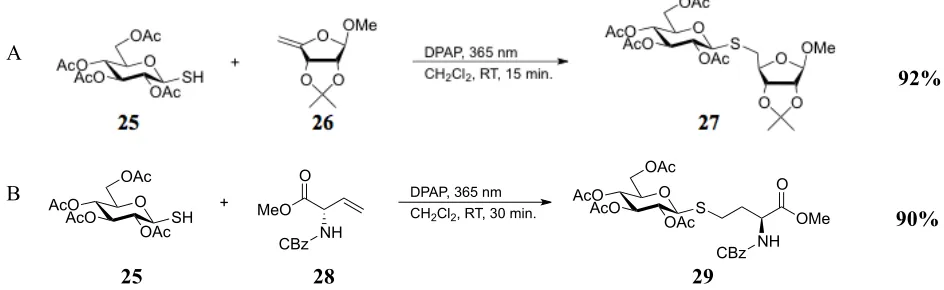
relevant to our research.62-64 In one of these reports by Fiore et al., erythrofuranoside derivative 26 was
used in the joining of carbohydrates via S-glycoside bond formation with high efficiency using
2,2-dimethoxy-2-phenylacetophenone (DPAP) as the radical initiator (Scheme 4A).63 In a later work, Fiore
and coworkers also used DPAP to couple carbohydrates with amino acid residues, including examples
resulting in the products containing HCys moieties (i.e., product 29, Scheme 4B), mirroring SRH-type
targets for development in our research.64 These reports assisted in laying out a clear strategy for the
development of an SRH synthesis that would be expedient and high-yielding, using the mild conditions of
A
92%
B
25 28 29
90%
Scheme 4. Applications of the TEC reaction to biological molecule synthesis63,64 Literature precedents have used radical-induced TEC reactions to create (A) S-linked alkyl cysteines (B) S-glycoside bonds, and (C) S-glycopeptides.
1.4 Project Summary
This project employs four routes to generation of the protected SRH thioether, visualized in the
retrosynthetic breakdown to the necessary coupling components (Figure 6). Two possible approaches are
outlined for each of the two mechanisms considered.
Figure 6. Retrosynthetic analysis of protected SRH Suggested disconnection of the thioether on either side of the sulfur atom leaves carbohydrate and amino acid components. Here two mechanisms are considered; SN2 (red and blue) and TEC (purple and orange) mechanisms would generate the thioether in the forward direction.
Chapter 2 outlines the methods for the SN2 reaction. After a set of conditions is optimized, the SN2 is
facilitated with the selection of an electrophile-bound leaving group used to react with a thiol-containing
coupling partner. The thiol and leaving group functionalities are affixed to opposite partners to test the
two SN2 approaches (Figure 6, red and blue), and after reversing the nucleophile/electrophile roles,
theoretic improvements to the SN2 are assessed. O
SH OAc AcO
AcO OAc
NH O MeO
O S OAc AcO
AcO OAc
O OMe NH DPAP, 365 nm
CH2Cl2, RT, 30 min.
+
20
Navigation of the TEC mechanism for thioether generation is described in Chapter 3. Thiol- and
alkene-equipped partners are joined after irradiation of a radical initiator. Again, functional group roles are
reversed on the coupling components (Figure 6, purple and orange) and tested after investigation into the
stereochemical outcomes of the TEC synthesis. Optimization considerations are then outlined for the TEC
reaction and its application to SRH synthesis.
This thesis concludes with notes on efficient thioether generation for SRH synthesis and suggestions for
further completion of this work. Based upon the information gleaned from the four approaches used in
this research, future directions on preparation of some analogue options are also outlined, as well as
Chapter 2. Preparation of the SRH Thioether by Bimolecular Nucleophilic Substitution
The bimolecular nucleophilic substitution (SN2) is a straightforward mechanism that can be adapted for
many purposes. As outlined in Chapter 1, past use of the SN2 has successfully generated the thioether
bond in synthetically prepared SRH (and has similarly been utilized for thioether creation in several SRH
analogues). As noted, however, many factors can influence the degree to which the SN2 is successful.
Previous reports in the literature that have employed SN2 for SRH and analogue synthesis have used a
number of different reaction conditions.40-44 In an effort to develop a focused route toward SRH synthesis
by the SN2 method, a selection of conditions based on theory was considered before optimization.
2.1 Previously Reported Generation of SRH-Related Thioethers by SN2
SRH and many SRH-related thioethers have been synthesized by SN2 with yields ranging from 22-92%.
41-43,58,59 Reaction conditions have differed in choice of solvent (DMF,41-44,58 MeOH/water41), base identity
(LDA,41-43 BuLi,41,44 NaOH41), and reaction time (hours,41,43,44,58 days40-43,59). Table 3 outlines past
strategies for using SN2 to prepare the thioether bond of SRH and analogues. Given the variations in
approach, it was deemed prudent to consider from first principles the many factors involved for the
Ta b le 3 . S u m m ar y o f r ep or te d p re p ar at io n s o f t h e t h io et h er b on d in S R H a n d an al ogu es 40 -44, 58, 59 En tr y Au th or s Co m po un d/ Cl as s Re ac ti on Ro le Re ag en t So lv en t Ti m e (h ) Te m pe ra tu re ( o C) Yi el d (% ) Am in o Ac id Ca rb oh yd ra te 1 Gu il le rm & Al la rt Nu cl eo ph il e El ec tr op hi le a N/ A DM F 16 80 22 2 Zh ao e t a l. Nu cl eo ph il e El ec tr op hi le a Et3 P Py ri di ne 72 RT 50 -70 3 Al fa ro e t a l. Nu cl eo ph il e El ec tr op hi le a Et3 P Py ri di ne 72 RT 49 4 Al fa ro et al . Nu cl eo ph il e El ec tr op hi le a Et3 P Py ri di ne 72 RT 34 5 Sh en et al . Nu cl eo ph il e a El ec tr op hi le LD A DM F 48 0 - RT 50 6 Sh en et al . Nu cl eo ph il e a El ec tr op hi le LD A DM F 48 0 - RT 36 7 Wn uk et al . b Nu cl eo ph il e El ec tr op hi le a Na OH H2 O Me O H 12 60 28 -31 8 Wn uk et al . Nu cl eo ph il e El ec tr op hi le a Bu L i DM F 4 0 - RT 67 9 Wn uk et al . Nu cl eo ph il e El ec tr op hi le a LD A DM F 28 0 - RT 92 10 Ma ll ad i et al . Nu cl eo ph il e El ec tr op hi le a LD A DM F 24 - 48 0 - RT 45 - 86 11 Ma ll ad i et al . Nu cl eo ph il e El ec tr op hi le a Na H DM F 12 0 - RT 75 c 12 Go pi sh et ty et al . Nu cl eo ph il e El ec tr op hi le a Bu L i DM F 4 0 - RT 80 13 Go pi sh et ty et al . d Nu cl eo ph il e El ec tr op hi le a K2 CO 3 Ac et on e 3 - 4 re fl ux 49 - 84
a lim
itin
g r
ea
ge
nt
b th
re e e xa m ple s
c ra
ce m ic m ix tu re
d tw
2.1.1 Previously Reported SRH Generation
As discussed in Chapter 1, two previous synthetic approaches have been reported for SRH. The Guillerm
and Allart strategy (Scheme 5A) generated the partially protected tritium-labeled SRH 16 in low yield
(22%) after heating the tritium-labeled tosylate 14 and unprotected cysteinate 15 starting components in
DMF for 16 hours.58 Later, Zhao used a Mitsunobu-inspired approach (Scheme 5B) to produce the
protected SRH 19a from the homocysteine thiolate generated in situ before reaction with the protected
carbohydrate 17.59 While this method resulted in improved yields (50-70% reported), it did not provide a
reliable synthesis in our hands.
A
14 15 16
B
17 18 19a
Scheme 5. Previous synthesized protected SRH molecules58,59 (A) Guillerm and Allart generated a
tritium-labeled SRH and (B) Zhao et al. used Mitsunobu-like coupling approach for SRH synthesis.
Additionally, the required excess of the nucleophile derived from specialty chemical L,L-homocystine
(HCySS), difficult reaction monitoring (in pyridine solvent), a long reaction time (3 d), required multistep
deprotection, and the presence of the persistent, difficult to remove triethylphosphine oxide byproduct
made this reaction undesirable for routine use.
2.1.2 Previously Reported SRH Analogues
Synthetic approaches towards SRH analogues have largely relied on either the aforementioned
Mitsunobu-type coupling59 or a traditional SN2 reaction for thioether generation.41-44 Nearly all of the
approaches reported in the literature use excess nucleophile in combination with a base of varying
strength.40,41,43,44,59 Among these syntheses, the variety of conditions indicate no particular pattern for the O
O MOMO TsO 3H
O NH2 SNa O NaO O O MOMO
S 3H O NH2
O HO
+ DMF, 80 oC, 16 h
O OMe O O HO NH S O O 2 O O O NH O O O O OMe O O S +
24
most effective solvent, reaction time, base, or temperature. The moderate success of couplings by Wnuk,
Malladi, and Gopishetty (all of the same research team; Table 3, Entries 8-12) suggest that some new
combination using a non-nucleophilic base in a convenient solvent under controlled temperature might be
explored for the development of a revised SN2 approach.41,43,44 To facilitate a plan for investigation, some
of the general features of the SN2 were considered.
2.2 General Features of the Bimolecular Nucleophilic Substitution Mechanism
As a generic description of the mechanism (Figure 7), the SN2 requires a lone pair of electrons on a
nucleophilic species (Nu) to first attack the carbon adjacent (α) to a suitable leaving group. In a single
step, the nucleophile attacks from the “back side,” opposite a leaving group, forming a new covalent bond
as the existing bond between the carbon and the leaving group is simultaneously broken. This transition
state is represented in central structure of Figure 7. As the leaving group is ejected, a new bond results
between the original nucleophilic species and the carbon atom.65
Figure 7. Generic SN2 reaction between a negatively charged nucleophile and neutral electrophile65 The electrons on the nucleophile (Nu) attack the “back side” of the carbon α to the leaving group (LG). A new covalent bond is formed in the transition state as the existing bond to the leaving group is broken. In this example, the negative charge is dispersed through the transition state, and is better solvated than the nucleophile by aprotic, less polar solvents.
Several factors contribute to both the efficacy and the rate of this reaction. The size of the nucleophilic
atom and, if present, the formal charge on that atom are important variables contributing to nucleophilic
strength. For example, an anion will always have greater nucleophilic character than its conjugate acid.
Also affected by the species involved is the ease of formation of the SN2 transition state. This can be
influenced by the sterics around the α and β positions (Figure 7) of the electrophile. If branching exists in
either location, the transition state is established with greater difficulty, and thus negatively affects the
Nu C LG
R2 R3
Nu C
LG
R2 R3
LG C
R2 R3 Nu
α β
R1 R1
R1
β β
α α
rate of reaction. Furthermore, the identity of the leaving group directly affects the rate because it is
removed in the rate-determining step, and the ease of its departure corresponds to its stability after
removal.66 The stability of a free leaving group is typically inverse to that species’ strength as a base.
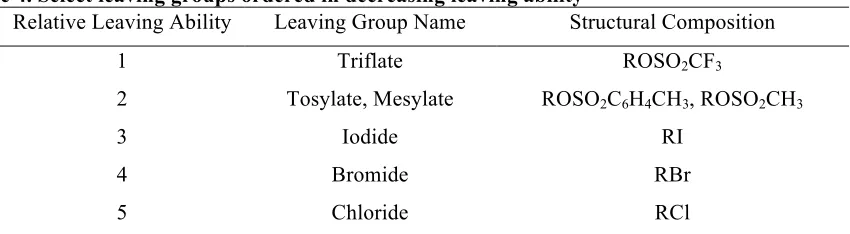
Some representative leaving groups are noted in Table 4, organized by their relative leaving ability.66
Table 4. Select leaving groups ordered in decreasing leaving abilitya
Relative Leaving Ability Leaving Group Name Structural Composition
1 Triflate ROSO2CF3
2 Tosylate, Mesylate ROSO2C6H4CH3, ROSO2CH3
3 Iodide RI
4 Bromide RBr
5 Chloride RCl
aAdapted from March’s Advanced Organic Chemistry66
Additionally, choice of solvent can be very influential toward nucleophile strength. In the generation of
SRH-related thioethers, the use of a thiolate anion nucleophile and a neutral electrophile is often
employed. The negative charge of the nucleophile is “dispersed” through the transition state (Figure 7),66
so use of a less polar solvent is more effective in stabilizing the transition state. In addition, aprotic
solvents are more preferred than protic solvents in this scenario because the transition state is better
solvated than the negatively charged nucleophile. This increased energy around the nucleophile reduces
the needed activation energy and favors the reaction.67
2.3 New SN2 Conditions for Preparing the SRH Thioether
For the synthesis of the SRH thioether, a thiol-containing species is a logical option for use as the
nucleophile. After the thiol is converted into a more nucleophilic thiolate anion under basic conditions,
this thiolate could then attack a suitable electrophilic species, which upon release of the leaving group
forms the desired thioether.65 Using this approach for SRH synthesis, compatible coupling partners could
be prepared from accessible starting materials for use in either of two methods. SN2 method “A” (Figure
8A) would use an amino acid derivative in the role of the nucleophile while the carbohydrate species is
26
carbohydrate derivative will act as the nucleophilic thiol in reaction with an electrophilic amino acid partner. Each of the methods should result in the formation of the desired protected SRH. Although to date method “A” has been the typical approach for this type of coupling, consideration of method “B” offers a potentially desirable advantage due to the steric accessibility around the carbon bearing the leaving group.
A
B
Figure 8. Postulated approaches for creation of the SRH thioether bond After deprotonation by a base, the nucleophilic thiolate resides on either (A) the amino acid component or (B) the carbohydrate derivative before a substitution reaction with the appropriate coupling partner forms the thioether.
In addition to nucleophilic and electrophilic roles, other variables will first be standardized for equivalent application to both SN2 method “A” and method “B.” As was conveyed by some of the more positive outcomes for past SRH-related syntheses (Table 3), the desired strategy first necessitates the use of alkaline conditions to drive the initial deprotonation of the thiol used for each approach (Figure 8A or 8B). Therefore a non-nucleophilic base as well as a suitable solvent will be selected. Next, the identity of the leaving group that will be fixed onto either the electrophilic carbohydrate (method “A”) or amino acid (method “B”) will be determined. Finally, the limits of amino acid protecting groups will be tested to determine non-interfering protection options under these conditions.
2.3.1 SN2 Retrosynthesis “A”: Nucleophilic Homocysteine
SN2 retrosynthesis “A” employs the amino acid as the nucleophile (Figure 9). With guidance from
previous syntheses, nucleophilic derivatives can easily be synthesized from L,L-homocystine (HCySS), forming the desired thiol-containing HCys derivatives needed for nucleophilic coupling.
Figure 9. SN2 retrosynthesis “A” Starting components are generated after standard transformations from
HCySS and D-ribose.
Protection and electrophilic activation of D-ribose produces viable electrophilic coupling partners for this strategy. First, a set of trials were executed to determine SN2 reaction conditions.
2.3.1.1 Reaction Condition Selection: Base and Solvent*
Initially, the reaction conditions for the SN2 thioether generation required optimization. To test for
appropriate conditions, standard starting components were first selected. A proven stable and successful nucleophile under basic conditions, and capable of one step deprotection from Liu’s previous work (outlined in Chapter 1),60 the tert-butyl ester / Boc protected thiol 7 was prepared from HCySS. Standard amino acid protections were followed by tris(2-carboxyethyl)phosphine (TCEP)-mediated reduction of the disulfide into the respective thiol 7.41,47,68 Propyl iodide served as a sterically available electrophile bearing a moderately reactive leaving group.
* Investigation of these reaction conditions was performed by M. Bolitho.
O NH P1
O
O OMe
O O S
P2 NH
P2 O
O P1
+
L,L-homocystine D-ribose
O OMe
28
7 33 34
Scheme 6. Optimization of SN2 thioether generation using a protected HCys and propyl iodide
Non-nucleophilic baseKHMDS produced relative product ratio of 33 to 34 (19:1 respectively) by 1H NMR.
For use in the reaction depicted in Scheme 6, a pool of non-nucleophilic bases was tested for the ability to
facilitate this reaction with minimal disulfide byproduct formation. Consistent with past analogue
preparations, thiol 7 was treated for 30 minutes with a candidate base at 0 oC before the electrophile was introduced at room temperature; the conversion of starting materials was monitored by TLC.69 THF
served as a less polar, aprotic solvent alternative to DMF, the solvent used in a number of
previously-reported analogue preparations (see Table 3). Additionally, using THF allowed for a more expedient
workup free from lingering residual water. After assessment of factors including reaction time and the
ratio of formation of the desired product 33 to an unexpected oxidation byproduct 34 (yield not
quantified, 19:1 product ratio by 1H NMR), potassium hexamethyldisilazane (KHMDS) was determined
to be most effective base tested (data not shown) with minimal byproducts and no observed
decomposition of starting components.69 The competing disulfide product was observed despite
precautions used to maintain an inert atmosphere and anhydrous solvents, and the reason behind its
formation is unknown.
2.3.1.2 Electrophile Screen for Efficient Coupling
From the starting place of the ribose component used for Zhao’s modified Mitsunobu coupling,59 only
minor transformations were necessary to develop protected ribose derivatives 20 needed to carry out an electrophile screen under the newly defined SN2 reaction conditions (Scheme 7).
NH SH O
O
O O
1. base (3 equiv.), THF, 0oC to RT, 30 min 2.
THF, RT
O NH O O
O
S
NH S O
O 2
O O +
Scheme 7. Standard conditions for use in SN2 coupling trials The tBu/Boc-protected homocysteine
derivative 7 served as a standard nucleophile in the SN2 reaction with KHMDS in THF. Candidate
electrophiles 20a-20b and 20d-20f were screened for reaction efficiency.
Informed by species used in previously reported analogue syntheses (Table 3), the next variable
scrutinized for this thioether generation strategy was the identification of an optimal leaving group on the carbohydrate moiety.41-43 A series of candidate leaving groups were considered within the relative range of leaving ability for groups used in similar successful thioether syntheses. Trifluoromethanesulfonyl (Tf), toluenesulfonyl (Ts), and methanesulfonyl (Ms) sulfonates as well as iodide (I), bromide (Br), and chloride (Cl) halides were chosen as candidate leaving groups to affix to the C-5 position of the protected ribose (Scheme 7).41-43,66
All derivatives were prepared from D-ribose after standard protection to 17 (Scheme 8).70 Derivatives 20a
and 20b were obtained as crystalline solids easily recovered in good yields (78% and 74%, respectively) after recrystallization from hot (~75o C) ethanol.41,71 Triflate 20c, isolated as a yellow-brown oil,72
experienced rapid decay overnight under refrigeration.† Due to this instability, derivative 20c was
dismissed as an impractical option for this synthesis. The halogen-bearing electrophiles 20d, 20e, and 20f were each prepared readily from mesylate derivative 20a using the lithium or sodium salt of the desired halide.73,74 Each was recovered as an oil after flash column chromatography in good yield (65 - 82%).
† The mesylate 20a decays in a similar way over an extended period of time (months) under refrigeration, while the
30
Scheme 8. Preparation of electrophilic ribose derivatives41,70-74After standard protection to 17, ribose
derivatives bearing various sulfonate and halide leaving groups at the ribose C-5 position were generated.
Electrophiles 20a-20b and 20d-20f were each assessed for efficiency in both the formation of coupled product 19b and the absence of oxidation and elimination byproducts (34 and 26 respectively), using the predetermined conditions with the base KHMDS and THF as the solvent (Table 5). Examination of the
success of each electrophile for SRH synthesis was performed by running three simultaneous trials on the
same scale (~50 mg), using the different ribose derived electrophiles in reaction with the thiol 7.‡
Coupling products were monitored for completion by TLC, and characterized by 1HNMR to determine
the relative ratios of products.
Table 5. Electrophile screen summary under standard conditions
aAll trials run on 100 mM scale of 7 in THF bAdded as 1 M concentration in THF cDetermined by TLC (1:3 EtOAc/hexanes) as consumption of starting materials dYields not calculated, product ratios determined by integration of peaks in 1H NMR crude analysis eND = not detected
The rate of SN2 coupling using the halogen derivatives varied significantly, with iodide 20f capable of
completion within 3 h (Table 5, Entry 3) while bromide 20e progressed in >8 h (Table 5, Entry 2). Both the iodide and bromide trials resulted in oxidation and elimination byproduct formation (34 and 26 respectively) in addition to the desired product 19b. Somewhat unsurprisingly, derivative 20d bearing the weaker chloride leaving group never reached completion after >8 h, with notable E2 elimination
byproduct formation before the reaction was stopped (Table 5, Entry 1). Predictably, iodide 20f initially resulted in the most promising outcome among the halogen derivatives and was selected to run in parallel trials with sulfonates 20a and 20b (Table 5, Entries 4-6).
Although the iodide 20f completed in a shorter reaction period (2.5 h) than the sulfonates, the ratios of byproducts complicated the coupling reaction and would most certainly decrease overall yield (Table 5, Entry 4). Mesylate derivative 20a and tosylate 20b afforded very similar coupling outcomes based on reaction time and product ratios, both completing within 6 h, with relatively minimal byproduct formation (Table 5, Entries 5 and 6). Mesylate 20a was selected in preference to the tosylate as the electrophile of
Entrya Electrophile Electrophile
Equivalentsb Equivalents KHMDS Rxn Time c
(h)
Product Ratiod
32
choice for standardized SRH coupling due to its more expedient preparation. In further trials (Table 5,
Entries 7-9) adjusting for electrophile and base equivalents, reaction conditions from Table 5, Entry 7
were chosen for preparative scale synthesis using the mesylate 20a as the electrophile.
After scaling up to a 0.5 g preparative scale with 20a as the electrophile, TLC monitoring and crude 1H
NMR analysis showed consistent consumption of thiol 7. Isolation of the target product 19b resulted in
reproducible modest yields of up to 47%. These results are not unlike the yields isolated from some SRH
analogue coupling reactions using similar conditions, reagents, and the nucleophile as the limiting reagent
(Table 3). Further, the consistency of this reaction provides a means of reliable preparation of SRH with a
faster coupling time and improved one-step deprotection compared to Zhao’s preparation.59
2.3.1.3 Protecting Group Strategy
As demonstrated by the work of Ruoyi Liu (summarized in Chapter 1), the identity of the protecting
groups on some homocysteine-derived coupling molecules can contribute significantly to the success or
failure of the SN2 thioether generation.60 Using mesylate derivative 20a as the electrophile (Scheme 9),
several variations in protection on the HCys backbone were prepared by graduate student colleague Emily
Showell-Rouse75 and used for testing under the conditions described above (Section 2.3.1.1). Protecting
groups were selected with the ultimate objective of one-step deprotection capability. Only two thiol
derivatives, 22 (P1=Me, P2=Boc) and 7 (P1=tBu, P2=Boc) successfully coupled under these conditions
with 5% and 47% percent yields, respectively.
Scheme 9. Evaluation of protecting group options Severalprotection options were attempted to couple
Several other protection combinations were tried, but resulted in decomposition or no reaction.75 The
bulky tert-butyl ester protection (P1) for the carboxylate moiety was viewed as necessary after other esters
(i.e., Me, Et, Bz) proved very sensitive to KHMDS under these conditions.76 Several additional carbamate
protecting groups were also screened (i.e., Troc, Fmoc, Cbz), with only Boc-protection resulting in
successful product formation.75 While some rationale existed for why the ester protection failed (due to
base sensitivity), with such poor yields resulting, the carbamate protecting group strategies did not work
well enough to warrant troubleshooting or full investigation into their failure.
2.3.1.4 Summary of SRH Thioether Generation by SN2 Approach “A”
In consideration of yield, this optimized synthesis is not an improvement over Zhao’s reported method.59
These efforts, however, do offer a number of enhancements to SRH synthesis. First, the acid-labile
protecting groups throughout both moieties allow for expedient global deprotection in a single step.60
With an equal number of steps (5 conversions), as well as the coupling reaction executed in <8 h in
comparison to three days, this coupling offers a much faster rate of preparation.69 Cost considerations of
this synthesis are also better, with the precursor HCySS derivative used as the limiting reagent rather than
in 3-equivalent excess used by Zhao.59 Table 6 summarizes the results of this strategy compared to those
employed by Guillerm and Allart and those used by Zhao et al.58,59
Table 6. Summary of synthetic routes to SRH
Guillerm and Allart58 Zhao59 This work
Coupling Yield % 22 50-70 47
Overall Yield % 5 52 26
Reaction Time (h) 16 72 7
Leaving Group OTs OPEt3 OMs
Limiting Reagent electrophile electrophile nucleophile
Deprotection steps 1 2 1
Number of Synthetic Steps to Unprotected SRH
8a 5 5
34
Most importantly, this synthesis provides a reliable method for SRH synthesis to use in our lab, resulting
in very pure chemically synthesized product easy for use in biochemical assays.69
2.3.2 SN2 Retrosynthesis “B”: Nucleophilic Thioribose
The alternate SN2 strategy outlined in the following retrosynthesis (Figure 10) reverses the electrophilic
and nucleophilic identity between the carbohydrate and amino acid components.
Figure 10. SN2 retrosynthesis “B” Starting components are generated after standard transformations from L-aspartic acid and D-ribose.
This SN2 strategy “B” theoretically has some advantages over approach “A.” First, the amino acid
derivative bearing the leaving group “X” (Figure 10) offers less sterically hindered access for nucleophilic
attack than the ribose derived electrophiles 20a-20f. The reduced branching around the α and β carbons
relative to the leaving group in an L-aspartic acid-derived electrophile is proposed to improve the SN2 by
potentially increasing the rate of reaction and/or improved yield over the SN2 approach “A” which
employs an electrophile bearing more branching proximal to the leaving group.65 Second, the mechanistic
competition of an E2 reaction, which was observed in approach “A,” is largely minimized due to the
unlikely formation of a monosubstituted alkene from the activated L-homoserine electrophile.77 Finally,
both starting components can be prepared from easily obtained and inexpensive commodity chemicals:
the thioribose is produced from D-ribose, and the homoserine derivative from L-aspartic acid. O
NH P1
O
O OMe
O O S
P2 NH
X
P2 O
O P1
+
O OMe
O O HS
2.3.2.1 Preparation of Amino Acid Derived Electrophile
In conjunction with efforts from undergraduate researchers Diana Cudia and Emily Murzinski, tert-butyl
ester / Boc protected homoserine 30 was developed through synthetic Scheme 10 after appropriate
troubleshooting.40,78-82 While it should be noted that aspartate 38 is commercially available ($258.30/5g,
Bachem), a thorough study of the synthetic pipeline leading up to 30 was deemed critical to
understanding what possibilities exist for the future development of SRH analogues which would require
manipulation in the midst of these earlier chemical transformations.
First, L-aspartic acid was selectively esterified with methyl protection before additional Boc carbamate
and tert-butyl ester protection.40,78-82 No additional purification steps (apart from standard workup) were
performed before crude aspartate derivative 37 was obtained after simple filtration.