A CBR BASED APPROACH FOR WEB SERVICE
AUTOMATIC DISCOVERY
1IBRAHIM EL BITAR, 2FATIMA-ZAHRA BELOUADHA, 3OUNSA ROUDIES
1Ph.D. candidate, 2Habilitated Professor, 3Full Professor
Siweb Research Team, Department of Computer Engineering, Ecole Mohammadia d’Ingénieurs, Mohammed V – Agdal University, Rabat, Morocco.
E-mail: [email protected], [email protected], [email protected]
ABSTRACT
The semantic Web service discovery has been given massive attention within the last few years. With the increasing number of available Web services (WS) on the web, looking for a particular service has become very difficult, especially with the evolution of the clients’ needs, those who have become more and more demanding. In this context, various approaches of WS Discovery have been proposed ranging from UDDI syntactic approach to semantic approaches including the intelligent discovery approaches based on CBR (Case Based Reasoning). In this paper, we present our approach CBR4WSD (CBR based approach for WS Discovery) that fits into the category of CBR based approaches for semantic WS discovery. Our contribution outline includes a set of aspects which aim to overcome the limitations of existing approaches and to mark the originality of our CBR4WSD approach. These aspects are mainly related to the rationalization of the processing, the control and mastery of the operated WS’ volume, the alignment with standards as well as the improvement of the results quality in terms of their ability to meet the functional and non- functional clients’ needs.
Keywords: WS dynamic discovery, CBR, W3C standards, WS community, client satisfaction.
1. INTRODUCTION
Commonly, WS descriptions are published in specially designed registries like UDDI (Universal Description Discovery and Integration). These registries are used to facilitate the research of published WS for different business organizations wishing to use specific WS. Locating a WS with a particular interest from the pool of available services is the fundamental task of any WS discovery approach [1]. In other words, WS discovery is the act of locating a machine-treatable description of a WS which is not known before and whose properties essentially meet specific functional criteria [2]. However, mechanisms are still required to ensure an efficient selection of the WS appropriate instance in terms of quality and performance factors all through the WS consumption [3].
Thus, in response to the identified needs in its query, the client receives a list of WS descriptions that he should manually scan to select the services which exactly meet its needs. However, in the environment of distributed systems dynamic integration, a rapid, semantic and automatic WS discovery is highly recommended, and proceeds by
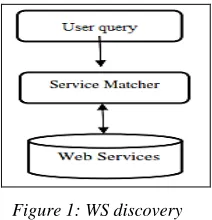
[image:1.612.369.475.468.578.2]matching between the elements of the query and the WS descriptions that are published in a registry (Figure 1).
Figure 1: WS discovery
In fact, the current standard for WS discovery is the UDDI registry. This discovery is purely syntactic and does not support the automatic discovery of WS. Therefore, the approaches proposed in the literature have focused on the use of semantic matching process for WS automatic discovery [4, 5, 6, 7, 8, 9, 10, 11]. Consequently, they integrate semantics in the WS description to ensure a better interpretation and subsequently warrant an efficient discovery by identifying and selecting the appropriate services.
discovery. Moreover, Artificial Intelligence reasoning stepped in to fill this rough need of automating the discovery, in order to lead a dynamic WS discovery. In this context, several approaches have been proposed. Particularly, we find CBR based approaches [12, 13, 14, 15, 16, 17, 18]. As per these approaches, they were able to satisfy the need for automating the discovery, but they have several problems that restrict their use.
Hence, we present in this paper our approach CBR4WSD which fits into the special category of CBR-based approaches for discovering semantic WS. Our contribution outline includes a set of aspects which aim to overcome the limitations of existing approaches and to mark the originality of our CBR4WSD approach.
The rest of this paper is organized as follows. Section 2 outlines the motivations of this paper after a comparative synthesis of the WS discovery approaches. In section 3, we present our list of improvements towards a better approach for WS discovery. We present in section 4 the model and the architecture of our CBR4WSD approach. Section 5 concludes this work and emerges a synthesis.
2. BACKGROUND AND MOTIVATION
The WS discovery process starts with a query launched by a client who is looking for a particular WS. Afterward, the matching stage begins and so seeking the correspondence between the query’s parameters and their equivalent elements in the published WS descriptions. This matching has been the subject of a wide range of approaches under the label "WS Discovery".
While reviewing the WS discovery domain, we found that the realized works in the literature opt for three approaches in terms of formalism and adopted reasoning to perform the matching: the algebraic approach, the deductive approach and the hybrid approach. The analysis of these approaches has concluded that the deductive approach opts for greater accuracy in the calculation of similarity between concepts than the algebraic approach, which itself guarantees more precision in the calculation of the overall similarity (aggregating the similarities between pairs of concepts). The hybrid approach, meanwhile, seeks to maximize the accuracy of the similarity calculation by combining both approaches algebraic and deductive.
Moreover, the formalism and reasoning used for matching WS is a crucial and primary criterion. Nevertheless this criterion is not exclusive to
evaluate WS discovery approaches. Other criteria, namely the level, scope and type of match as well as the dimension of human intervention and type of targeted services, are also important to evaluate the adaptation of these approaches to the WS context. By analyzing these criteria, we note that the approaches belonging to the hybrid and deductive classes, in particular, SAWSDL-MX [10], OWLS-MX [9] and WSMO-OWLS-MX [11], are more efficient than those of the algebraic approach. Moreover, the major limitation of most of them resides in the fact that the proposed matchmakers are:
i) limiting the matching to functional properties,
ii) only designed to match a query and a service using the same ontology,
iii) not aligned with the W3C standard for WS description.
Only the SAWSDL-MX matchmaker uses SAWSDL standard and is suitable for any ontology [19].
The enduring need of discovery automation has involved Artificial Intelligence reasoning to guide a dynamic WS discovery. In this range of intelligent approaches, the CBR has scored a great success compared to existing work due to the opportunity of returning back in the experience history that it presents specifically in the case of WS, where usually a service’s behavior is difficult to assume before its execution. Truthfully, CBR based approaches for WS discovery still having some limitations that researchers are working on to fulfill them.
Briefly, we recall that the CBR is a reasoning by analogy consisting on considering and solving a new problem (target case) from experiences or cases previously encountered and solved (source cases). The goal is to use information and knowledge from previous cases to solve new problems.
In fact, all of the existing CBR-based approaches belong to the hybrid class of approaches and use the OWL ontology to describe their applications, but the major fault occurs when it comes to alignment with the W3C standards regarding the WS description. However, only the approach of De Franco Rosa and De Oliviera [12], is aligned with the W3C recommendations and uses SAWSDL to describe WS.
defines the client's query and solution defines the service answering this query. Yet, this doesn’t mean that all of the studied approaches handle similarly these case components. Each approach is based on the definition of its own attributes that meet the requested needs. However, we can’t say they have the same degree of expressiveness especially with the distinction of two types of properties that must be taken into account in the description of the client's query. We mean by that, functional and non-functional properties. Only the S-CBR approach [15] [16] satisfies this property. Matching services in CBR systems binds to the “Retrieve” phase where the matching algorithm uses similarity measures specifically designed to select the most suitable services in response to the client's query. Different matching methods were adopted, using syntactic or semantic similarity measures with or without considering the weight attribute in the calculation of similarity.
Organizing the case base and indexing its cases are absolutely necessary to select rapidly the WS and so satisfy the client with a minimal response time. Indeed, both approaches applying indexation of their case base [15] [18] are not really effective especially with a syntactic indexing using vocabulary in a semantic reasoning or even using ontology classification that do not really help in a functionality based selection.
Lastly, an approach that effectively meets all criteria is lacking in our study. Also, any new approach for WS discovery, regardless of the vision on which it is based, must first benefits of its predecessors’ advantages and fulfills the gaps. We present in the next section the criteria that we find essential to proceed to an efficient approach for WS discovery.
3. CRITERIA AND IMPROVEMENTS TO
CONSIDER
Prospecting literature works has allowed us to highlight a number of criteria that we consider essential to guide any possible contribution in this direction. These criteria can contribute to improve the WS discovery and are summarized in the following:
• Description Expressiveness
The lack of consideration of the WS semantics’ in the WSDL (Web Service Description Language) standard does not promote their automatic discovery. Also, several semantic models for describing WS were proposed in the literature (OWL-S, WSMO, SAWSDL) [19][20]. However,
an expressive model for WS description, which integrates the semantic aspect but also, covers both WS functional and non-functional properties, remains fundamental for the automatic discovery process. This model contributes to the efficiency of the discovery process, since it allows to achieve meaningful results, in terms of expected response to functional needs, but also to respond to other requirements as the non-functional preferences.
• Alignment with standards
The “alignment with standards” criterion is justified by the tendency of the IT industry and that is to opt for standards. In the case of WS discovery, the matching process explores elements used for the description. Formerly, it would be more appropriate that its approach will be aligned with recommended WS description standards, namely the W3C standards. Any developed approach in this direction would be able, first, to explore the available WSs on the Internet that are described according to standards, and secondly, to use when required existing technologies or tools on the market, which are for most of them aligned with the W3C standards.
•
Processing rationalizationThe WS automatic discovery is generally based on their matching. This stands enormously expensive in terms of processing due to the high number of available WS on the Internet. Also, any WS discovery approach should be rational in terms of processing. In this context, we believe that an effective approach should avoid duplicating expensive processing. Otherwise, this approach should be based on the processing’s mutualization so that the results of a specific processing can be shared among similar queries. However, most of the WS discovery approaches proceed by matching each one of the received queries with all services published in a UDDI registry.
•
Volumetry control and masteryThe WS discovery may be a costly process in terms of performance time given the large number of services on the Internet. Therefore, any approach developed in this direction must be able to ensure the control and mastery of the services volumetry in order to optimize the time of discovery and processing. In this context, some approaches propose to syntactically index the WS registries.
efficient WS discovery approach should provide a mechanism for organizing the handled WS so as to not only optimize the time to access to them but also the time needed for their processing.
The set of criteria mentioned in this paragraph reflects the drives of the presented work. They suggest possible improvements in the WS discovery area. These tracks are axes that our approach contributes in through a set of mechanisms and fundamentals.
4. MECHANISMS AND FUNDAMENTALS
In particular, our CBR4WSD approach proposes a semantic model aligned with standards to ensure expressive WS description in accordance with standards. It opts for (CBR) Case-Based Reasoning for the processing rationalization. Also, it proposes a WS-Community based indexing for the control and mastery of the WS volumetry.
4.1. Semantic description model aligned with W3C standards
To meet the previously mentioned criteria, we propose a WS semantic model which is aligned with W3C standards: WSDL 2.0, WS-Policy and SAWSDL [21].
Integrating semantics in the WS description has allowed evolving mechanisms for discovery beyond the usual syntactic ones. OWL-S, SAWSDL and WSMO approaches have proposed semantic models for the WS description through semantic concepts from ontologies.
However, OWL-S and WSMO are research products that have not been standardized and are more dependent on a specific ontology language, OWL for OWL-S and WSML for WSMO. It is in this context that we have opted for the SAWSDL standard, which is scalable and compatible with existing WS standards, especially with WSDL, to define a semantic model to describe WS. It defines an annotation mechanism for WSDL elements with one or several ontologies regardless of any semantic representation language (WSML, OWL, etc..).
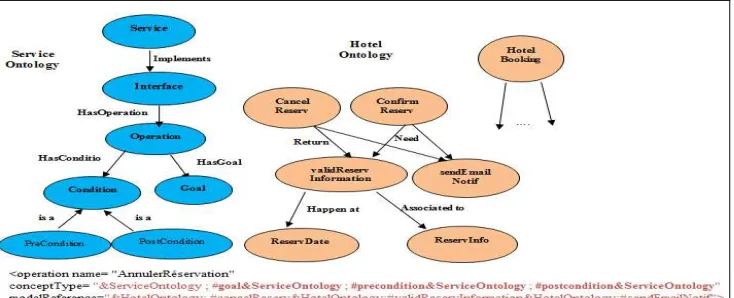
Our WS semantic description model allows annotating a service operation with a list of semantic concepts such as its goal (purpose), its postconditions and preconditions. However, in order to facilitate the matching process that needs to identify the elements of the list as such, we adopt the means of annotation given by Chabeb (YASAWSDL services) and Aljoumaa (Intentional services) [22] [23]. This extension remains aligned with the SAWSDL standard which is expandable by definition, moreover it doesn’t impose any adaptation constraint in the user platforms.
[image:4.612.124.491.493.642.2]It consists on introducing a new attribute that we call "ConceptType" to specify the types of concepts which correspond one by one in the order of their declaration, to ontology concepts referenced in the attribute "modelReference" of SAWSDL.
Figure 2: Example Of Semantic Annotation Of A SAWSDL Service.
As illustrated in Figure 2, the attribute "modelReference" annotates the operation “CancelReservation" with three concepts of the Hotel Ontology: "cancelReserv", "validReservInfo" and "sendEmailNotif". The attribute
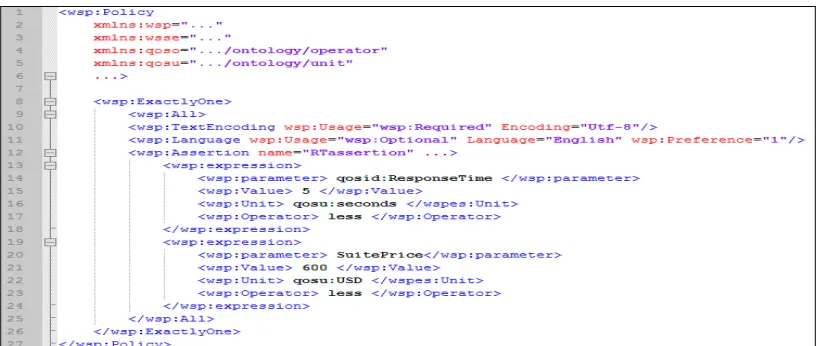
Furthermore, besides covering the functional properties and the WS semantic aspect, our model also covers the non-functional properties according to the WS-Policy standard. This standard allows WS providers as well as their consumers to express requirements or preferences in terms of security and quality of service for each operation of the manipulated WS. We illustrate in the Figure 3 an excerpt from the WS-Policy description corresponding to the "bookSuite" operation.
In this description, we do call special ontologies to express constraints as atomic formulas
specifically those describing the quality of service (QoS). Thus, an expression composed of the quadruplet <parameter,value,unit,operator> will be associated with each such constraint. This is the case of ResponseTime and SuitePrice (lines 14, 20).
[image:5.612.102.511.246.419.2]However, the constraints which are not related with the QoS will be expressed in accordance with the WS-Policy standards. Consequently, we define the encoding type (line 10) and the used language used (ligne11) here.
Figure 3: Excerpt From The Non-Functional Description Associated To The "Booksuite" Operation From The Hotel Reservation Service.
4.2. Case Based Reasoning (CBR)
In order to rationalize the WS discovery processing, our approach is founded on the principle of returning back in the experience history, particularly on the CBR mechanisms. Rightly, this should allow our approach to capitalize on the experience, to deliver solutions inspired from similar previously processed cases, and also to select the best on the basis of their execution experience.
Choosing to use CBR is justified by the fact that previous and traditional reuse systems (systems by reuse) which are Rule-based systems have many limitations, such as:
- difficulties in knowledge acquisition, - inability to capitalize on experience via a
problem solving memory,
- inefficiency of both inference and handling exceptions,
- feeble performance of the whole system, etc. [24].
In particular, a CBR system is a knowledge-based system which consists on collecting, displaying and memorizing experiences (cases), instead of identifying a set of rules that may be non-exhaustive and therefore unreliable.
Moreover, it is based on calculating similarity between cases and adapting them, principles that constitute when compared to Rule-based systems, an exceptional solution for processing cases where knowledge is insufficient or incomplete. A CBR system is also a system that is capable to ensure self-learning by means of new cases to produce refined solutions.
As part of the WS discovery, the CBR system can start with a limited number of available cases and gradually expand its Case Base throughout processing the received queries.
4.3. Service Communities
approach aims to organize the Case Base so as to optimize the discovery process. Although this remains important, we found that the existing CBR-based approaches for WS discovery were not interested in organizing their Case Bases or they simply apply a syntactic indexing.
In this context, we propose to index the Case Base through service communities in order to ensure efficient and faster retrieval, by reducing the research field to adequate source cases and consequently reducing the tasks of the matching process. We call service community, the group of WS which are functionally similar [25] .Also, we propose to organize the Case Base by service communities where each of which includes the services (or the solutions) responding to problems expressing similar functional requirements regardless of the non-functional requirements or preferences they reflect.
Our aim is to locate a service community, therefore the group of cases we have to explore in order to search a solution for a given target problem. Formalizing our communities on the base of the functional aspect is obvious, since logically the objective of any client is to find a solution that must meet its functional needs, and responds as possible to its non-functional requirements or preferences. Moreover, steadily while solving problems, service communities can be enriched with new cases and new communities can be downright introduced in the Case Base. The semantic aspect will also be considered for indexing the cases.
5. CBR4WSD LAYERS AND MODELS
5.1. Processing layers
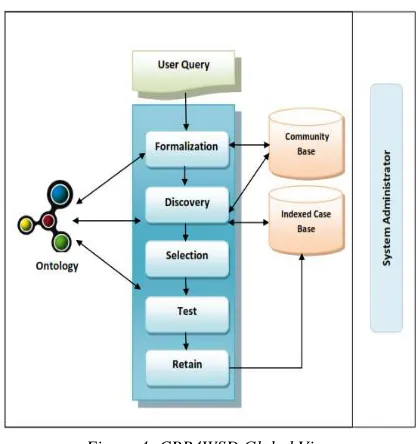
As shown in Figure 4, the CBR4WSD approach that we propose is founded on five processing layers which, by means of using ontologies, take into account the WS semantic aspect, in order to spot among the available cases the most similar to the target case, propose a better solution, and so, enrich the Case Base with the new identified case(s) of which the test has been validated.
A cross layer is also considered for the system administration (acquiring and updating the basic knowledge, such as the Case Base and the ontologies used for semantic processing). The five major processing layers consist of formalizing the client's query, discovering the services that may respond to this query, selecting the most appropriate services, testing services and memorizing new cases which were identified and
[image:6.612.313.522.144.366.2]validated for the enrichment of the Case Base. In this section we briefly describe the functionality of each layer before presenting the detailed architecture of our approach CBR4WSD.
Figure 4: CBR4WSD Global View
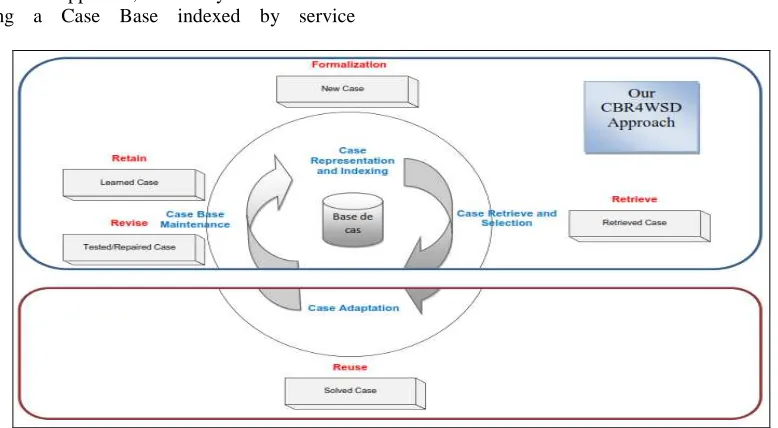
The "Formalization" layer is the first layer which aims to represent the query in a format allowing its automatic processing. It consists in expressing the query which constitutes the problem part in the target case, as a set of descriptors in conformity with the CBR principles. In the case of our approach, these descriptors are split into functional and non-functional descriptors which respectively reflect the functional requirements of the client and his non-functional preferences. As shown in Figure 5, the layer "Formalization" corresponds to the "Elaboration" CBR stage which consists in formalizing the description of the problem to be solved by assigning values to the descriptors in the target case.
The second layer, called "Discovery", takes the target case which is formalized in the "Formalization" layer to compare it with the available cases. This layer searches for the services that can respond to the target case from those in the source cases. As shown in Figure 5, this layer corresponds to a phase of the CBR second stage which is called "Retrieve", whose objective is to find the source cases similar to a target problem in in order to solve it.
In our approach, this layer consists in exploring a Case Base indexed by service
communities to discover the cases which are functionally similar to the target case. As we have mentioned before, this will optimize the discovery time by searching only in the cases associated with the appropriate service community.
[image:7.612.121.510.224.438.2]A semantic matching algorithm is used to calculate the Functional Similarity Measure (FSM) consisting of aggregation of local similarities performed on the cases functional descriptors.
Figure 5: Localization of our approach in the CBR cycle
Furthermore, as shown in Figure 5, the "Selection" layer corresponds to the selection phase of the CBR "Retrieve" stage. It considers the results of the "Discovery" layer to select among them the source cases which are non-functionally most similar to the target case. At this point, a Non-Functional Similarity Measure (NFSM) is calculated. This measure is the aggregation of local similarities performed on the cases’ non-functional descriptors. The NFSM is self-aggregated to the FSM so as to generate a Global Similarity Measure (GSM) which allows identifying the most appropriate service(s) that better meet both functional and non-functional requirements expressed in the target case.
The “Reuse” CBR stage consists in adapting a solution of a retrieved source case to solve the target problem if among the descriptors of this solution, there are some that do not quite meet the client’s needs. However, in the particular case of WS discovery, the adaptation of an available service is within the jurisdiction of a system
dedicated for the discovery, and should be considered only as a part of the process of services’ maintenance and adaptation, that is triggered by a service provider wishing to improve its services so as to meet the clients’ needs. Furthermore, the service which is selected as the most appropriate solution to a target problem will be automatically recommended to the client.
Regarding the “Revise” stage, it consists in testing the adapted solution to check whether it is suitable to solve the problem or not before deciding to memorize it.
process of updating and cleaning the Case Base. The client who made the test can detect that the proposed service has been disabled or has undergone changes by the provider and so, he informs the system’s administrator who will subsequently proceed with updating or deleting the relevant cases.
The “Retain” layer corresponds to the "Retain" stage in the CBR cycle. It consists in updating the Case Base by introducing a resolved target case if this one is not equivalent but rather similar to an existing source case. The concerned new case is inserted in the service community corresponding thereto.
Finally, referring to the "mapping" between the CBR cycle and our CBR4WSD approach, we find that the latter covers only the following stages of CBR cycle: "Elaboration", "Retrieve", "Revise" and "Retain". The fact of not taking into account the "Reuse" stage is justified by the specificity of the application domain which is the WS discovery. After having outlined our approach, we present in the following the details of our discovery process
5.2. Discovery Process
[image:8.612.90.523.267.669.2]In this section, we expose the concrete process of WS discovery in our CBR4WSD approach.
Figure 6: WS Discovery process in the CBR4WSD approach
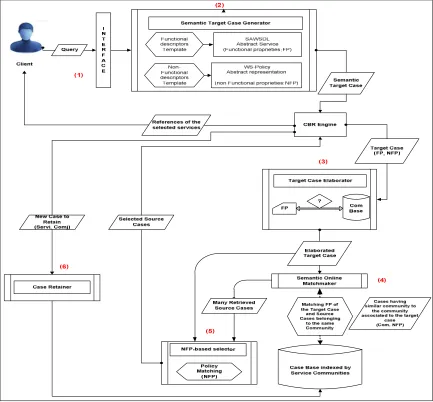
As shown in Figure 6, this process starts with transforming the query’s data, which is retrieved through the "Template" filled in by the client, into a target case aligned with the following W3C
descriptors, those which are divided into functional and non-functional descriptors, in addition to the descriptors of the solution that this process will attempt to instantiate with a discovered WS. Alternatively, problem descriptors represent an abstract WS, while the solution descriptors represent the corresponding concrete WS.
The act of generating the target case is followed by its elaboration in order to complete the stage of formalizing this case. Notably, in a CBR system engine, the component target case elaborator is responsible to complete the target case description by annotating the service community to which it corresponds. It must identify, using the functional descriptors of the target problem, from a Community Base, the community which is associated with the target case.
Moreover, the overall discovery process continues by retrieving source cases similar to the target case. At this level, the component called "Semantic Online Matchmaker" proceeds, after identifying the source cases of which the associated service community is equivalent to the community associated to the target case, to the calculation of their functional similarity (FSM) alongside the target case. Upon completion of this operation, a set of source cases of which the calculated similarity meets a defined threshold will be retrieved.
The set of retrieved source cases is then projected into a selector that identifies the best case fulfilling the required non-functional properties. This component is able to perform a "matching" applied to the source and target policies to calculate the NFSM and subsequently generate the global similarity measure (GSM) between the source cases and the target case. The goal is to identify the WS to be recommended to the client, these services are the solutions associated with the source cases whose global similarity measure (GSM) is the highest.
Finally, after receiving the test results performed by the client, only the satisfying WS(s) are used to instantiate the solution descriptors of the target case. Resulting cases will be introduced in the Case Base via the component called "Case Retainer". According to the test result, notifications can also be sent to the administrator of the system to proceed with updating the Case Base if a deactivation or a change occurs and recommended services have been detected.
6. SYNTHESIS
Many works in the literature have proposed different approaches for WS discovery, starting from UDDI-based approaches to CBR-based approaches. The CBR4WSD approach fits into this second category. It is a CBR-based approach for semantic WS discovery. Its outline contribution includes a set of aspects which aim to overcome the limitations of existing approaches and gives the originality of our CBR4WSD approach. These aspects are mainly related to the processing rationalization, the control and mastery of the treated WS volumetry and the alignment with standards, without forgetting the improvement of the results’ quality in terms of their ability to meet both functional and non-functional client’s needs.
In this context, the CBR4WSD approach is based on a semantic model aligned with the W3C standards dedicated for WS descriptions which are devoted in the WS discovery process. This choice should expand the scope of application of our approach so that it is not only confined to laboratories. It also allows, through its enriched semantics and its coverage of functional and non-functional aspects, to not only hearten the discovery of the WS responding to the client query but to also select the best from the top covering services of non-functional properties.
The CBR4WSD approach spreads over CBR mechanisms and proposes to index the Case Base by service communities in order to rationalize the processing and to optimize the time of discovery. The discovery process covers five processing layers: Formalization, Discovery, Selection, Testing and Memorization.
REFRENCES:
[1] E. Savitha, “A comparative evaluation of semantic web service discovery algorithms and engines”, Master of science thesis, Athens, The University of Georgia 2009. [2] D. Booth, H. Haas, F. McCabe, E. Newcomer,
M. Champion, C. Ferris and D. Orchard, “Web Services Architecture,” W3C Web Services
Architecture Working Group note, 2004.
http://www.w3.org/TR/ws-arch/
[3] P. Netra and G. Arpita, “Comparative Study of Mechanisms for Web Service Discovery based on Centralized Approach Focusing on UDDI”,
International Journal of Computer
Applications (0975 – 8887) Volume 14– No.1,
[4] M. Schumacher, H. Helin, and H. Schuldt, “Semantic Web Service Coordination”. Chapter 4, CASCOM: Intelligent Service Coordination in the Semantic Web, Birkhäuser Basel, 2008.
[5] M. Stollberg, U. Keller, H. Lausen, and S. Heymans, “Two-Phase Web Service Discovery Based on Rich Functional Descriptions”. In
ESWC ’07: Proc. of the 4th European conference on The Semantic Web, pages 99–
113, Berlin, Heidelberg, 2007. Springer-Verlag.
[6] F. Kaufer and M. Klusch, WSMO-MX : “A Logic Programming Based Hybrid Service Matchmaker”. In European Conference on
Web Services, pages 161–170, Los Alamitos,
CA, USA, 2006. IEEE Computer Society. [7] C. Kiefer, A. Bernstein, H. J. Lee, M. Klein,
and M. Stocker, “Semantic process retrieval with iSPARQL”. In ESWC, pages 609–623, 2007.
[8] C. Kiefer and A. Bernstein. “The Creation and Evaluation of iSPARQL Strategies for Matchmaking”. In Proceedings of the 5th
European Semantic Web Conference (ESWC),
volume 5021 of Lecture Notes in Computer Science, pages 463–477. Springer-Verlag Berlin Heidelberg, 2008.
[9] M. Klusch, B. Fries, and K. Sycara. “Automated semantic web service discovery with OWLSMX”. In Proc. of the fifth
international joint conference on Autonomous agents and multiagent systems, pages 915–922,
New York, NY, USA, 2006. ACM Press. [10]M. Klusch and P. Kapahnke. “Semantic Web
Service Selection with SAWSDL-MX”. In R.
L. Hernandez, T. D. Noia, and I. Toma, editors, SMRR, volume 416 of CEUR Workshop
Proceedings. CEUR-WS.org, 2008.
[11]U. Küster and B. Konig-Ries. “Evaluating semantic web service matchmaking effectiveness based on graded relevance”. In
Proc. of the 2nd International Workshop SMR on Service Matchmaking and Resource Retrieval in the Semantic Web at the 7th
International Semantic Web Conference
(ISWC08), Karlsruhe, Germany, October 2008.
[12]F. De Franco Rosa et J.M. De Oliviera. “An approach to search Web Services using Ontologies and CBR”, The 11th IEEE
International Conference on Computational Science and Engineering – Workshops, 2008.
[13]S. Lajmi, C. Ghedira, K. Ghedira, “How to apply CBR method in web service composition”, 2nd International Conference on
Signal-Image Technology & Internet based Systems (SITIS’2006), Springer Verlag ed.
Hammamet (Tunisie). LNCS series, 2006a. [14]S. Lajmi, C. Ghedira, K. Ghedira, D.
Benslimane, “Wesco_cbr : How to compose web services via case based reasoning”, IEEE
International Symposium on Service-Oriented Applications, Integration and Collaboration held with the IEEE International Conference on e-Business Engineering (ICEBE 2006),
Shanghai, China, 2006b.
[15]T. Osman, D. Thakker, D. Al-Dabass; “Semantic-Driven Matchmaking of Web Services Using Case-Based Reasoning”.
School of Computing and Informatics,
Nottingham Trent University, Nottingham, UK, Naval Academy of France, Ecole Navale, BP
600, 29240 Brest, France, 2006
[16]T. Osman, D. Thakker, D. Al-Dabass; “S-CBR: Semantic Case Based Reasoner for Web Services Discovery and Matchmaking”, School
of Computing and Informatics, Nottingham Trent University, Nottingham, UK, Naval Academy of France, Ecole Navale, BP 600,
29240 Brest, France, 2006.
[17]Z. Sun, J. Han, D. Ma. “A Unified CBR Approach for Web Services Discovery, Composition and Recommendation”, 2009
International Conference on Machine Learning and Computing IPCSIT vol.3 (2011) © (2011)
IACSIT Press, Singapore.
[18]L. Wang, and J. Cao; “Web Services Semantic Searching enhanced by Case Reasoning”, 18th
International Workshop on Database and Expert Systems Applications, 2007.
[19]I. EL Bitar, F.Z. Belouadha, O. Roudies, “Review of Web services description approaches”, In proceeding of: 8th
International Conference on Intelligent
Systems: Theories and Applications (SITA),
Rabat, Morocco, 8-9 May 2013.
[20]H. Omrana, I. EL Bitar, F.Z. Belouadha, O. Roudies, “A Comparative Evaluation of Web Services Description Approaches”, 10th
International Conference on Digital
Information Technology: New Generations (ITNG), Las Vegas, Nevada, USA, 15-17 April
2013.
[21]I. EL Bitar, F.Z. Belouadha, O. Roudies, “Towards a semantic description model aligned with W3C standards for WS automatic discovery”. The 4th International Conference
on Multimedia Computing and Systems (ICMCS'14) April 14-16 2014, Marrakesh,
[22]Y. Chabeb and S. Tata,. “Yet Another
Semantic Annotation for WSDL
(YASA4WSDL)”. In IADIS WWW/Internet 2008 Conference pages 462–467, October 2008.
[23]K. Aljoumaa, S. Assar, C. Souveyet, “Publishing intentional services using new annotation for WSDL”. In Proceedings of the
12th International Conference on Information Integration and Web-based Applications & Services (iiWAS) 8, 10 November 2010, Paris,
France.
[24]I. El Bitar, "CBR: design, implementation and improvement of similarity measures applied to the field of industrial diagnosis", Master
Thesis, Lebanese University, Doctoral School
of Sciences and Technology, 2010, unpublished.
[25]Belouadha.F.Z., “Génération dynamique de communautés de services web”, Proceedings
du Workshop WOTIC’07, Workshop sur les nouvelles Technologies de l’Information et de la Communication, pp. 47-50, Rabat, 5-6 juillet
2007.
[26]I. EL Bitar, F.Z. Belouadha, O. Roudies, “Taxonomy and synthesis of Web services querying languages”, International Journal of
Science and Advanced Technology (ISSN
2221-8386), Volume 1 No 4 June 2011,