032
PROPERTIES OF BITUMINOUS BINDER MODIFIED WITH HIGH DENSITY
POLYETHYLENE
Zahra Kalantar, Abdelaziz Mahrez and Mohamed Rehan Karim
Civil Engineering Department, Faculty of Engineering, University of Malaya, Malaysia Email: [email protected]
ABSTRACT
The purpose of this research is to investigate the possibility of using High Density Polyethylene as polymer additives in Bituminous Mix. The characteristics of HDPE-modified binder obtained by fix mixing time and fix mixing temperature. was investigated. The binders were prepared by mixing the HDPE in 0.5%, 1%, 2% and 4% (by the weight of optimum bitumen) with 80/100 penetration grade bitumen at temperature of 180 ºC and 60 min of mixing time. It may be inferred that HDPE-modified bituminous binders provide better resistance against permanent deformations due to their higher complex shear modulus and lower phase angle as compared to conventional binder. It also contributes to recirculation of plastic wastes as well as to the protection of the environment.
Keywords: High density polyethylene, modified bitumen, binder test.
INTRODUCTION
It has been known that the addition of some waste material and certain polymers to asphalt binders can improve the performance of asphalt concrete [1]. The use of recycled instead of virgin materials will help to ease landfill pressures and reduce demands of extraction. This is especially the case in surface layers of asphalt pavements that may represent a value application for recycled solid waste material [2].
Polyethylene has been found to be one of the most effective polymer additives [1]. The use of polymer in asphalt mixture as a modifier started in the eighties and has been tested in a number of countries around the world. The addition of polymers typically increases the stiffness of the bitumen and improves the rutting resistance of mixture in hot climates and allows the use of relatively softer base bitumen, which in turn provides better low temperature performance [3].
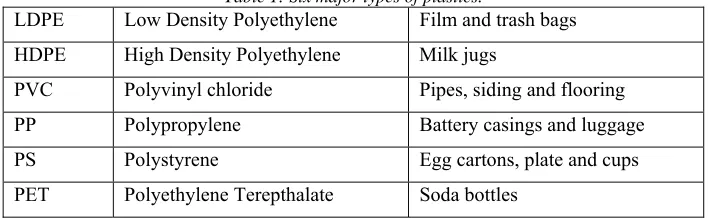
[image:1.595.121.477.539.648.2]Plastic material can be classified into 6 major types which are listed in Table 1 [4].
Table 1: Six major types of plastics.
LDPE Low Density Polyethylene Film and trash bags HDPE High Density Polyethylene Milk jugs
PVC Polyvinyl chloride Pipes, siding and flooring PP Polypropylene Battery casings and luggage PS Polystyrene Egg cartons, plate and cups PET Polyethylene Terepthalate Soda bottles
MATERIALS AND METHODS
Modified Binder Materials
HDPE modified bitumen was prepared by mixing 80/100 penetration-grade bitumen with various percentages of HDPE. The content of HDPE additive was varied to see the effect of HDPE contents. Four levels of HDPE content were used, namely 0.5%, 1%, 2% and 4% by mass of bitumen. The HDPE modified bitumen was prepared using the high shear mixer. Mixing is done at a speed of 250 rpm for one hour at 180ºC.
Binders Testing
Binders were characterised by using a number of standard physical tests such as penetration test (temperature, load and time are 25ºC, 100g and 5sec respectively), softening point test, viscosity test using Brookfield viscometer (temperature range from 90 to 170ºC, spindle No.27, and a rotating speed of 20rpm), and also rheological measurements by using a Dynamic Shear Rheometer (tests conducted by using a fix temperature 76 ºC, and the frequency is 1.159Hz).
RESULTS AND DISCUSSIONS
Penetration Test Results
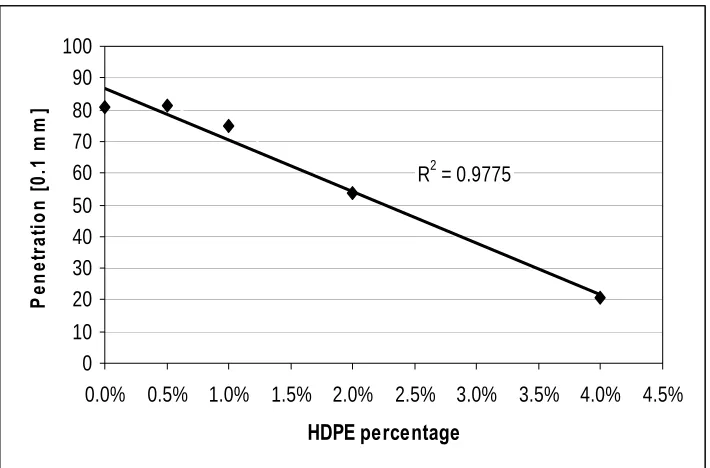
Penetration is an empirical measure of asphalt consistency. Figure 1 shows the variation of penetration value with the various percentages of bitumen and it shows that consistency decreases with the addition of HDPE. The penetration values for the modified binders decrease as the HDPE content in the mix increase. The decrease is approximately 8%, 34% and 75 % with the addition of 1%, 2 % and 4% of HDPE, respectively, as compared to the original bitumen. This means that the addition of HDPE makes the modified bitumen harder and more consistent. This is good in one sense since it might improve the rutting resistance of the mix, but on the other hand this may affect flexibility of the bitumen by making the asphalt much stiffer, thus the resistance to fatigue cracking can be affected.
R2 = 0.9775
0 10 20 30 40 50 60 70 80 90 100
0.0% 0.5% 1.0% 1.5% 2.0% 2.5% 3.0% 3.5% 4.0% 4.5%
HDPE percentage
P
ene
tr
at
ion [
0.
1 m
m
[image:2.595.121.476.441.675.2]]
softening point also increase. This phenomenon indicates that the resistance of the binder to the effect of heat is increased and it will reduce its tendency to soften in hot weather. Thus, with the addition of HDPE the modified binder will be less susceptible to temperature changes.
The effect of softening point of a binder on resistance to permanent deformation of bituminous pavement mixes has been studied by various researchers. An example is hot rolled asphalt where it was found that the rate of rutting in the wheel tracking test at 45°C, was halved by increasing softening point by approximately 5ºC [5]. Therefore it is expected that by using the HDPE in the bituminous mix the rate of rutting will decrease due to the increase in softening point.
R2 = 0.9924
40 45 50 55 60 65 70 75
0.0% 0.5% 1.0% 1.5% 2.0% 2.5% 3.0% 3.5% 4.0% 4.5%
HDPE percentage
So
ft
en
in
g
Po
in
t [
°C
[image:3.595.121.477.189.424.2]]
Figure 2 Softening point in various percentage of HDPE
Viscosity Test Results
[image:3.595.134.469.575.695.2]Modified asphalt binders are usually more viscous than unmodified ones [6]. Figure 3 shows the viscosity curves of Modified bitumen and Table 2 shows the ratio of viscosity of the modified asphalt binders to viscosity of the base binder at 135 °C. This ratio varies between 1 and 3.5 for the modifiers used in this study. In the extreme case of adding 4% HDPE to the base binder, the viscosity increased from 400 mPas to 2413 mPas. This value is less than 3000 mPas and therefore satisfies the ASTM D6373 criterion for asphalt binder workability [6].
Table 2: Viscosity of modified asphalt binders.
Sample Viscosity (mPas) Viscosity Ratio
Original Binder 400.0 --
Average 0.5% 412.5 1
Average 1% 444.0 1.1
Average 2% 681.5 1.5
0 2000 4000 6000 8000 10000 12000 14000
80 100 120 140 160 180
Temprature (°C)
vi
sc
o
s
it
y
(
M
p
a
)
[image:4.595.121.473.72.301.2]Control 0.5% HDPE 1% HDPE 2% HDPE 4% HDPE
Figure 3 Viscosity vs. Temperature
Dynamic Shear Rheometer (DST) Test Results
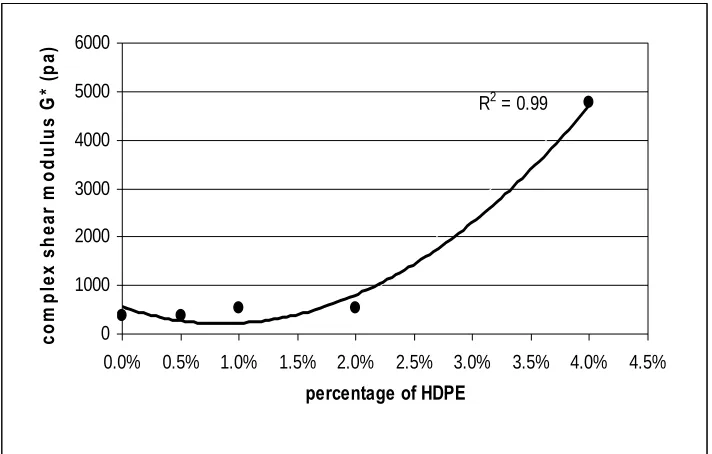
The complex shear modulus (G*) is a ratio of the applied shear stress ( ) to the resulting shear strain ( ). The phase angle, δ , provides a relative indication of the viscous and elastic behavior of the asphalt binder. Figure 4 shows G* increases with increasing the HDPE content. a lower value of complex shear modulus G* means that the asphalt is softer, and it can deform without developing large stresses [7]. In addition binders with high complex shear modulus G* may reduce rutting problems (deformations) in the asphalt.
R2 = 0.99
0 1000 2000 3000 4000 5000 6000
0.0% 0.5% 1.0% 1.5% 2.0% 2.5% 3.0% 3.5% 4.0% 4.5%
percentage of HDPE
co
m
p
le
x s
h
ea
r
m
o
d
u
lu
s G
*
(p
a)
[image:4.595.120.476.436.663.2]R2 = 0.99
60 65 70 75 80 85 90 95
0.0% 0.5% 1.0% 1.5% 2.0% 2.5% 3.0% 3.5% 4.0% 4.5%
HDPE percentage
P
h
as
e a
n
g
le
δ
[°
[image:5.595.119.476.75.302.2]]
Figure 5 Phase angles vs. different percentage of HDPE
CONCLUSIONS
From the findings of the present work it may be concluded that the bituminous binders modified with HDPE showed encouraging results. It appears that high density polyethylene decreases the consistency and increases the resistance of the material to temperature changes while the resistance to flow also increases. Further tests are required especially on bituminous mixes in order to have a greater understanding about the effect of this type of modifier on mix properties.
REFERENCES
1. Hinisliglu, S. & Agar, E. (2004) Use of waste high density polyethylene as bitumen modifier in asphalt concrete mix. Journal of Materials letters, vol. 58, 267-271.
2. Yue, H., Bird, R. N. & Heidrich, O. (2007) A review of the use of recycled solid waste materials in asphalt pavements. Journal of Resources, conservation and recycling, vol. 52, No. 1, 58-73.
3. Awwad, M. T. & Shbeeb, L. (2007) The Use of Polyethylene in Hot Asphalt Mixtures. American Journal of
Applied Sciences, vol. 4, No.6, 390-396.
4. U.S. Army Corps of Engineers, Use of waste material in pavement construction (1999)
5. Fernando, M.J. and Guirguis, H.R. (1984) Natural rubber for improved surfacing, Proceedings 12th ARRB conference, Part 2, 121-130.
6. Aflaki, S. & Tabatabaee, N. (2008) Proposals for modification of Iranian bitumen to meet the climatic requirements of Iran. Journal of Construction and Building Materials, vol. 10, No. 1. 1-10