Georgia State University Georgia State University
ScholarWorks @ Georgia State University
ScholarWorks @ Georgia State University
Religious Studies Theses Department of Religious Studies
Spring 5-10-2014
In the Shadow of the Beast: The Impact of Aleister Crowley on
In the Shadow of the Beast: The Impact of Aleister Crowley on
New Religious Movements and Contemporary Culture
New Religious Movements and Contemporary Culture
Robert Jones
Follow this and additional works at: https://scholarworks.gsu.edu/rs_theses
Recommended Citation Recommended Citation
Jones, Robert, "In the Shadow of the Beast: The Impact of Aleister Crowley on New Religious Movements and Contemporary Culture." Thesis, Georgia State University, 2014.
https://scholarworks.gsu.edu/rs_theses/46
IN THE SHADOW OF THE BEAST: THE IMPACT OF ALEISTER CROWLEY ON NEW
RELIGIOUS MOVEMENTS AND CONTEMPORARY CULTURE
by
ROBERT ANTHONY JONES
Under the Direction of Louis A. Ruprecht Jr.
ABSTRACT
In late 19th century Great Britain, there was a revival of interest in the magic and occultism
that emerged during the Renaissance. Aleister Crowley (1875-1947) was a product of that
revival, one who has had an ironically long afterlife, despite all of the controversy that has
surrounded him. Crowley should also be remembered as a significant influence upon the
founders of a variety of New Religious Movements (such as Gerald Gardner and L. Ron
Hubbard). There was increased interest in his work and personality that emerged several
decades after his death, as evidenced by the use of his image on the cover of a Beatles album, an
increase in the sales of his books, and an emerging new status as a countercultural icon.
The purpose of this study is to perform a history of the reception of Crowley’s ideas, focusing
primarily on the self-promotion of a “beastly” persona, his subsequent and post-humous
demonization, his rehabilitation in the 1960’s, his repeated demonization in the 1980’s, and the
fairly recent (if gradual) acceptance of his importance to the scholarly study of New Religious
Movements (NRMs).
IN THE SHADOW OF THE BEAST: THE IMPACT OF ALEISTER CROWLEY ON NEW
RELIGIOUS MOVEMENTS AND CONTEMPORARY CULTURE
by
ROBERT ANTHONY JONES
A Thesis Submitted in Partial Fulfillment of the Requirements for the Degree of
Master of Arts
in the College of Arts and Sciences
IN THE SHADOW OF THE BEAST: THE IMPACT OF ALEISTER CROWLEY ON NEW
RELIGIOUS MOVEMENTS AND CONTEMPORARY CULTURE
by
ROBERT ANTHONY JONES
Committee Chair: Louis A. Ruprecht Jr.
Committee: Nadia Latif
David Bell
Electronic Version Approved:
Office of Graduate Studies
College of Arts and Sciences
Georgia State University
DEDICATION
This thesis is dedicated to Fenella Roche. During this process, she was my personal
manifestation of the goddess Kali. To my children, Tiffani, Carlescia, Alexandra, Erique, and
grandson Gregory. To my parents, Jimmy and Joan Jones. This would not have been possible
ACKNOWLEDGEMENTS
I would like to express my gratitude to Dr. Louis A. Ruprecht Jr. for his wonderful guidance and
encouragement while sorting through a very complex and engaging topic. He has been an
unforgettable mentor. Thanks to my committee members Dr. Nadia Latif and Dr. David Bell for
their valued insight and willingness to take a look into the often marginalized and misunderstood
persona and works of Aleister Crowley. For long distance consultation and inspiration, many
thanks to Dr. Hugh Urban of The Ohio State University. And, to Dr. Molly Bassett for
informing a class of students that it is alright to shift your scholarly emphasis while in graduate
TABLE OF CONTENTS
ACKNOWLEDGEMENTS...v
LIST OF FIGURES...vii
PROLOGUE: RECONSIDERATION OF THE BEAST...1
1 MAGIC(K), MYSTERY, AND MEANING...11
2 WEAVING THE WEB...20
3 SEX, DRUGS, ROCK N’ ROLL...26
4 THE SEASON OF THE WITCH...35
EPILOGUE: THROUGH THE LOOKING GLASS...41
LIST OF FIGURES
1. http://www.mastertherion.org/photo2.html...viii
2. http://www.mastertherion.org/photo3.html...8
3. http://mysteryofmystery.com/Pics/Crowley/Aleister_Crowley_06.jpg...17
4. http://2.bp.blogspot.com-P7_DdDv7tJE/TojVZb7YPpl/AAAAAAAAETk/uj9UQ6jzRtY/
s1600/Aleister_Crowley.jpg...23
5.http://113.bp.blogspot.com/qa1mzX90wsU/TojTbOx4PZl/AAAAAAAAETc/faJmiXv14BM/s
1600/Thelema_Abbey_2.jpg...32
6.
http://juanangeljuristo.files.wordpress.com/2011/07/fernando-pessoa-jugando-al-ajedrez-con-aleister-crowley.jpg...38
7.
PROLOGUE: RECONSIDERATION OF THE BEAST
“Any publicity is good publicity.” - P.T. Barnum
The ambiguous term ‘occult’ has a long history of attracting both curiosity and fear. Many
religious traditions contain certain esoteric elements that may be classified as occult. The term
itself refers to that which is hidden or obscured, mostly pertaining to doctrine and ritual practices
which are only accessible to those initiated into higher degrees within a given tradition. Occult
philosophy is also associated with a less provocative term, ‘esotericism.’ There have been
esoteric components found in religious practices dating back to ancient Babylon, Egypt, and
Greece.1 The Early Modern interest in occult ideas began with the so-called Hermetic traditions
originating in Florence during the Renaissance period, and later found greater expression in an
“occult revival” that started in France with the work of Eliphas Levi (1810-1875)2
, and
flourished in England from the late 1800’s through the 1920’s. This was Crowley’s milieu.
The culture, ideas, and tensions of fin-de-siècle Europe produced many notable occultists who
blended popular interest in Spiritualism with Romantic notions of the contemporary relevance of
early Egyptian, Greek, and Eastern religious theory and symbolism. The most influential group
of this period, the Hermetic Order of the Golden Dawn, was established in 1888 by William
Wynn Westcott (1848-1925) and Samuel Liddell MacGregor-Mathers (1854-1918). Aleister
Crowley (1875-1947) began his journey into occultism as an initiate of this group. He was
1 These esoteric strands were thought to be woven together in the mythic figure known as Hermes Trismegistus. He
was created from the merging of the Greek god, Hermes, and the Egyptian God, Thoth. The foundational text of
Renaissance Hermeticism is Marsilio Ficino’s Corpus Hermeticum (a 15th century Latin translation of a collection of Greek texts). See Ebeling, p. 29-31; Drury, The Watkins Dictionary of Magic, p. 133; Davies, p. 46.
2 Born Alphonse Louis Constant, Levi was removed from the priesthood for teaching “doctrines contrary to the
perhaps the most notorious, the most accomplished, and the most influential figure that came to
prominence in the early 20th century occult scene. Although extensively demonized in the
media, he is also the occultist who has arguably had the greatest impact on contemporary culture
and other, more popular New Religious Movements (NRMs). And yet, Crowley is generally not
mentioned in the Religious Studies academic discourse on NRM’s, despite being the founder of a
religion known as Thelema,3 and a profound influence on some of the NRM founders whom we
do discuss. This of course, is largely due to Crowley’s unseemly reputation. However, it is
interesting to note that other disreputable figures are considered essential to this history, even
those directly influenced by Crowley. In this thesis, I will examine the motivations and causes
behind this erasure.
In the academic study of NRM’s, it is the history and social context from which the groups
emerge that become the methodological foundation upon which our analysis should rest. Then,
our scholarly focus will be aimed primarily at the perceived innovation and unorthodoxy
displayed within both the doctrine and the ritual performance of these groups, as well as at the
charisma of the founders. Many of the subjects who have attracted academic interest range from
the controversial (Joseph Smith), to the seemingly bizarre (Marshall Applewhite),4 and even the
tragic (Jim Jones). All of these figures have been discussed extensively in the scholarly
literature. When considering this, attention must be drawn to the fact that Crowley, one of the
most influential and iconoclastic NRM founders of the 20th century, is still often overlooked in
the field of Religious Studies.
3 The name derives from the Greek word for “will.” Crowley’s inspiration to use the word was a 1534 novel,
Gargantua and Pantagruel by Franҫois Rabelais, a Franciscan monk. See Sutin, p. 126, 280; Kaczinski, Perdurabo, p. 128, 293.
4 Founder of Heaven’s Gate. The group is known for it participation in a 1997 ritual mass suicide during the passing
The purpose of this thesis is neither to further vilify Aleister Crowley, nor to attempt to
rehabilitate his reputation. Instead, I am offering a reception history intended to underscore his
continued relevance in the spheres of contemporary culture and religious movements, while
proposing the validity of his inclusion in the canon of legitimate NRM founders. Many of the
mixed feelings that are associated with Crowley were actually the result his own desire for
notoriety and infamy. The motivating factors behind this desire will also be discussed. As we
will see, a number of his actions which elicit disgust, when examined from the perspective of
their esoteric meaning, can appear in a very different light. Yet, my efforts are not directed
toward the justification of these acts, only an investigation of their contexts and meaning. The
main purpose here is not to focus on Crowley’s reputation, but on his innovation, the effects of
his far-reaching influence, the time and society of which Crowley was a product, and why the
acknowledgement of his impact should be seriously considered when attempting to understand
the cultural and religious climate of the late 19th to the early 20th centuries. Of several figures
whose names were appeared many times in the sources consulted during my preliminary
research on NRM’s (Helena Blavatsky, Gerald Gardner, Austin Osman Spare, Rosaleen Norton,
Grant Morrison, and Dion Fortune) there was one name that seemed to overshadow them all:
Aleister Crowley.
As I began to investigate Crowley’s life and ideas, the range of his influence became far more
apparent. It was surprising to see the variety of notable figures who counted him as a direct
influence, such as Jack Parsons (rocket scientist); Mary Butts (writer); Somerset Maugham
(novelist); Fernando Passoa (poet); Austin Osman Spare (artist); and Jimmy Page (musician).
Grimston (The Process Church of the Final Judgment), and Genesis P. Orridge (Thee Temple ov
Psychick Youth). Later, I will examine the extent of Crowley’s influence on the 1960’s
counterculture, comic books, Rock n’ Roll music, literature, film, and the creation of several
more recent religious communities.
Crowley’s ideas appear to have been the result of a complex mixture of disparate and
potentially contradictory cultural influences such as Faustian mythology, turn-of-the-century
optimism, Bohemianism, Max Nordau’s philosophy of Degeneration,5and the disillusionment
brought on by World Wars. In many ways, Crowley can be seen as an extreme embodiment of
the varied social preoccupations of his time. During his lifetime as a man with many drives and
talents, Crowley had been a world-class mountaineer, chess master, poet, novelist, playwright,
artist, world traveler, government agent, practicing occultist, founder of a new religious
movement, and a modern pioneer in the religious use of psychedelics. Having also been
untrammeled in his quest to satisfy a pronounced sexual appetite, he eventually studied ancient
methods used for the re-application of those erotic energies into ritual efficacy, while creating
modern forms of spirituality that attempt to re-frame the dynamics of desire and concepts of the
self.
As a result of his association with what has come to be known as sex magick, reports of his
invocation of demons, drug addiction, and proclamations of being the Antichrist, Crowley has
been viewed as an egotistical, manipulative, sex-crazed, satanic drug fiend. While there are
some obvious contributing factors to this image, his cultural and religious relevance cannot be
reduced to such infamy. Many of the other NRM founders who are always included in the
Religious Studies dialogue have not produced the same amount of literature, nor as elaborate a
cosmology, nor enjoyed the range of influence, nor had as interesting a biography as Aleister
Crowley. In the subsequent chapters, I will examine his life and the distinct time and place of
which he was a product. The effects of the misinterpretation of his character and works will be
explored, as well as some lesser-known details of his life and work that are likely to affect
common perceptions of what Crowley represents within the context of contemporary culture.
A complex and diverse personality, Crowley was quite adept in the arts of self re-creation and
generating publicity. These qualities, coupled with his apparently genuine conviction of being
the prophet of a new age (The Aeon of Horus), and a penchant for pushing every experiential and
moral boundary, Crowley’s cultural and literary presence is perhaps the most pervasive and
noteworthy of any figure associated with NRM’s. There are several subfields within the History
of Religions field for which theoretical understanding would be quite incomplete without a
serious consideration of Aleister Crowley. His life and work offer us a glimpse into the extreme
expressions of both the transcendent and carnal impulses (and the systematic ritual union of the
two) that are some of the hallmarks of human experience.
In order to establish a context for this study, I will begin with a brief history of magic as a
conceptual category. Here I will focus on the magical practices of the Renaissance, their place
within religious concepts of the time, and how these practices were believed to be distinct from
witchcraft. Though the idea of magic be can traced to much earlier cultures, varied geographic
locales, and cosmologies, it was during the Renaissance that distinctly modern and more
systematic forms of magical practice were introduced. As I noted, Crowley’s introduction to the
London occult scene came in 1898, through being accepted as an initiate into the premier
esoteric group of the day, the Hermetic Order of the Golden Dawn. Several noteworthy
invention of Crowley’s image through sensationalist media and his own preoccupation with
shock value. Then, the effects of his influence will be followed through the notable works of
those who were directly affected by their encounters with him. Further consideration will be
given to the significance of his emergence as a cultural icon in the late 1960’s, some two decades
after his ironic death, in penniless obscurity. This, of course, is intended to open a discussion of
the surprisingly wide-ranging application of his writings and image that one is able to observe
today.
In the past decade, we have seen another wave of interest in Crowley, arguably more academic
in nature. Recent scholarly interest in Western Esotericism (as evidenced in a surge of new
peer-reviewed journals, blogs, conferences, and publications)6 has included Crowley as an essential
subject in the ongoing academic discussion. Most of these scholars are from disciplines other
than Religious Studies, but there are a few who express the need for the subjects of Esotericism
and the Occult to find greater presence in the History of Religions literature7. The purpose of
this work is to strengthen the case for moving beyond a blind prejudice that seems to be the
result of an intense moral judgment that is not applied as emphatically to other figures. It seems
as if Crowley may have set out to inspire such extreme infamy with the intent of drawing more
attention to his work in the future.
It appears as though the life, work, and reception history of Aleister Crowley serve as a
window through which one might view a distinct succession of contexts that shaped 20th century
conceptions of spirituality, occultism, and new religious movements. Crowley was a product of
6
Many recent articles on Crowley and his impact have appeared in journals such as The Pomegranate, Nova Religio, and Aries on a regular basis. Along with recent and forthcoming biographies, chapters in books of collected scholarly essays and online academic journals such Heterodoxology and Societas Magica, the current information available on Crowley has become quite extensive.
7 Most notably, Hugh B. Urban of The Ohio State University, Egil Asprem of The University of California at Santa
Victorian England and the Occult Revival during the Fin-de-Siècle, growing in fame and
notoriety as a practitioner of ritual magic and prolific author during the first three decades of the
20th century, then falling into obscurity in the 1940’s. Crowley died in 1947, still holding on to
the vision of being the prophet of a New Age.
The seeds that Crowley planted seemed to germinate in the late 1960’s counterculture. As the
Beatles said in the song “Sgt. Pepper’s Lonely Hearts Club Band” (1967), “It was twenty years
ago today. Sgt. Pepper taught the band to play. They’ve been going in and out of style, but
they’re guaranteed to raise a smile.” From there, Crowley’s impact was evident through the late
1970’s. The presumably diabolical aspects of his teachings and reputation caused Crowley to
become linked to the wave of Satanic Heavy Metal groups and the stories told by “survivors” of
Satanic cult child abuse (most of which being later debunked) during the Evangelical Satanic
Panic of the 1980’s. Finally, at the beginning of the 21st century, Crowley has become the
subject of more reasoned discussion.
The timeline to be considered is as follows:
1910-1930: Crowley’s greatest fame and notoriety
1930-1946: the decline of his reputation and death in penniless obscurity 1960s: the Crowley revival
1980-2005: a reaction against the 1960s, especially a religious reaction
2005- : a more neutral and less ideological perspective on the 1960s, and NRMs
While all dated historical bookends have a certain arbitrariness, the year 2005 possesses some
real heuristic and descriptive value. It seems to represent a crossroads of sorts with regard to
publication about Crowley specifically, his influence on subsequent NRMs, and magic as
A number of important essays have appeared in journals such as:
ARIES (founded in 2000, I note essays by Jennifer Hallett and by Christopher Miles in 2006, by Egil Asprem in 2007, and by Gordan Djurdevic in 2010);
Nova Religio: The Journal of Alternative and Emergent Religions (founded in 1997, I highlight the important essay by Hugh Urban in 2012);
Pessoa Plural (founded in 2012, I note the essay by Marco Pasi and Patricio Ferrari in 2012);
The Pomegranate (founded in 1998, I note important essays by Henrik Bogdan and by Martin Starr in 2006, by Egil Asprem in 2007, by Caroline Tully in 2010, and by Mogg Morgan in 2011);
Scandanavian Studies (founded in 1928, I note the essay by Giuliano d’Amico in 2012);
and Theology and Sexuality (founded in 1994, I note the important essay by Jo Pearson in 2005).
In addition, The Journal of Literature and Science and The Journal of Thelemic Studies were
both founded in 2007, with important inaugural essays by Justin Sausman and Erwin Hessle
respectively.
Representative book-length studies titles that have appeared in this same time period include:
2005
Nevill Drury, The Watkins Dictionary of Magic Emily Edwards, Metaphysical Media
2006
Gavin Flood, The Tantric Body Hugh Urban, Magia Sexualis
2007
Florian Ebeling, The Secret History of Hermes Trismegistus Dave Evans, The History of British Magick after Crowley
2009
Owen Davies, Grimoires: A History of Magic Books Susan Greenwood, The Anthropology of Magic
Richard Kaczynski, The Weiser Concise Guide to Aleister Crowley Gary Laderman, Sacred Matters
2011
Nevill Drury, Stealing Fire From Heaven
Wouter Hanegraaff and Jeffrey Kripal, Hidden Intercourse Richard Kaczynski, Perdurabo: A Life of Aleister Crowley Jeffrey Kripal, Mutants and Mystics
Grant Morrison, Supergods
2012
Candace Black, Satanica Sexualis
Henrik Bogdan and Martin Starr, Aleister Crowley and Western Esotericism
Stephen Flowers, Lords of the Left-Hand Path: Forbidden Practices and Spiritual Heresies James Wasserman, In the Center of the Fire: A Memoir of the Occult
2013
Lance Parkin, Magic Words
2014
Tobias Churton, Aleister Crowley: The Beast in Berlin
Gary Lachman, Aleister Crowley: Magick, Rock and Roll, and The Wickedest Man in the World Christopher Partridge, The Lyre of Orpheus
Marco Pasi, Aleister Crowley and the Temptation of Politics
Clearly, the proliferation of such studies is indicative of the fact that we are entering an
important new phase in scholarly research on Aleister Crowley and his influence. In this study, I
will give serious consideration to the meaning and timeliness of Crowley’s contributions: by
looking into the wide range of reaction to his work and image; by explaining what those
reactions tell us about the society of which Crowley was a part; and by suggesting what this
1 MAGIC(K), MYSTERY, AND MEANING
“Magic leads us to exhilaration and ecstasy; into insight and understanding; into changing
ourselves and the world in which we participate. Through magic we may come to explore the
possibilities of freedom.” - Phil Hine (Condensed Chaos, 1995)
Much of the controversy surrounding Aleister Crowley involves his application of magical ritual
technique and the cosmology that supported these practices. Not only does the cultural context
of the time in question warrant consideration, but so does the context that Crowley created, as
well as his more personal views on magic. If the range of influences and the goals of his
practices are examined in their particular context, then perhaps some of his actions and ideas
may be viewed more sympathetically. However, my intent is not to propose justification for
some of Crowley’s more notorious deeds (real or imagined), but simply to present a fair and
balanced assessment of his notable contributions to contemporary Western culture, particularly
in the areas of spirituality, sexuality and occultism.
The term religion does not contain an inherent meaning that lends itself to universal
application, nor does the term magic. These terms are employed as general categories that may
be useful analytical tools when looking into elements of diverse ritual practices and cosmologies
that appear to have certain family resemblances. Crowley has probably had a more profound
influence on the way that modern magic is imagined, represented, and practiced than any other
single 20th century figure, he even provides us with a distinct spelling of the word, magick. This
that attracted ‘dilettanti and eccentrics’ who sought an escape from reality.”8
His own working
definition of magick was this: “The Science and Art of causing Change to occur in conformity
with Will.”9
Always striving for concrete results, he used methods ancient and modern, sacred
and profane. This approach led to experimentation that far exceeded the previous limits of his
own already expansive personal boundaries and carnal preoccupations. Crowley is perhaps best
known for two phrases that have been grossly misinterpreted by those who have never examined
the passages in their contexts: “Do What Thou Wilt”10; and “Every Man and Woman is a Star.”
By the turn of the century, Crowley was unavowedly bisexual, used psychotropic drugs, and
explored Eastern esoteric traditions such as Hindu Tantrism, Yoga, Buddhism, and Taoism (he
traveled to India and China in the first decade of the 20th century). When considering the 1960’s
revival of interest in Crowley’s life and legend, his renewed status as a countercultural icon
should come as no surprise.
Who was Aleister Crowley? What did he accomplish? Whom did he influence? What is the
significance of his work and image? Edward Alexander Crowley (1875-1947) was born in
Warwickshire, England. As the son of a Plymouth Brethren preacher and heir to a thriving
family-owned ale company, Crowley was the product of a upper middle class Christian
upbringing in Victorian England. Early on, he displayed a very curious and bold nature. His
mother had referred to him as the “Beast” already when he was thirteen years old; this happened
after Crowley was caught having sexual intercourse with one of the house maids.11 He later
8 Sutin, p. 6
9 Crowley, Magick: Book Four, p. 126 10
The most (in)famous and misapplied quote attributed to Crowley. It is a line from the phrase, “There is no law beyond Do what thou wilt. Do what thou wilt shall be the whole of the Law. Love is the Law. Love under Will.”
from Crowley’s “The Book of the Law” (1904). See Flowers, p. 248-250; Drury, Stealing Fire from Heaven, p. 86.
11 Prior to his formal study of ritual transgression, Crowley had already displayed an interest in testing moral
attended Cambridge University, where he was a member of the Chess Club, Freethought
Association, and the debate team.12 He was also heavily influenced by James Frazer’s The
Golden Bough, the work of the “Cambridge Ritualists,” (Frances Cornford, Jane Harrison,
Gilbert Murray) and Egyptologist Margaret Murray. Even before attending university, Crowley
had studied Latin and Greek. During this time, he also changed his first name to Aleister (a
variant of the Gaelic name for Alexander), as he felt that his given name did not properly suit
him.13 Upon receiving his inheritance, Crowley dropped out and left Cambridge without
receiving a degree.
“Spiritualism” (communication with the dead and other spiritual entities through seances) had
become popular in England and France, and as previously noted an occult revival was underway
in England. While the Theosophical Society had been formed in the year of Crowley’s birth (a
fact that Crowley saw as significant), the Hermetic Order of the Golden Dawn opened its first
temple in 1888. The magical practices, secrecy, initiatory rites, ancient Egyptian and Greek
imagery seemed more appealing to Crowley than did the Theosophists’ methods, though,
Crowley was heavily influenced by Indian and Chinese philosophies and imagery, as were the
Theosophists.14 It must be noted that many esoteric groups were formed during this period, due
to a growing popularity of forms of spirituality and occult knowledge. When referring to this
period, Alison Butler states that,
In an era of immense occult and esoteric activity such an establishment was scarcely remarkable on the surface. The Order of the Golden Dawn, however, proved to be truly unique in that it appeared to have no precedent for its focus on practical and ceremonial magic.
Emerging in a society accustomed to the hierarchical and secretive nature of Freemasonry,
12
the ghostly realm of the Spiritualists, and the mysticism and mythology of the Theosophists, the Order of the Golden Dawn stood out for its emphasis on ceremonial magic. It was an esoteric society for practicing magicians.15
This was a persistent cultural feature in London during most of Crowley’s lifetime. And, due to
his newfound wealth, Crowley was able to indulge his interests fully, even to the extent of
traveling to exotic locales to have first-hand contact with practitioners of various esoteric
religious methodologies.
A basic understanding of the cultural context from which Crowley emerged is necessary for an
assessment of his innovative contributions. First of all, this was the Victorian Era, which to this
day is thought of as a period of significant sexual repression. However, there was a Romantic
undercurrent that produced attractive reinterpretations of the “virtues” of hedonistic sinfulness as
evidenced in Oscar Wilde’s promotion of a “New Hellenism” and his admonition to “be thyself.”
Likewise, Aubrey Beardsley’s renderings of the Greek God, Pan, inspired those who wished to
move beyond the standard Christian moral framework in the search for amorality.16
In the 1890’s, as the subculture of Victorian decadence gained momentum, feminism was also
on the rise. Feminism and decadence were connected through a climate of repressive sexual
politics, and a mutual attraction to the occult groups such as the Theosophical Society and the
Hermetic Order of the Golden Dawn. According to Alex Owens, “Occultism was itself bound
up with a spiritualized vision of social change that called upon those ideals of regeneration and
self-fulfillment that were deeply attractive to feminists of the period, and offered a ‘new’
religiosity capable of outstripping the conventional Victorian association of femininity with a
15 Butler, p. 78-79.
domesticated spirituality.”17
Crowley began his involvement with occultism in this environment,
while being subject to these (and other) influences. While Crowley, due to some of his own
statements, at times may be viewed as misogynist, the role of women within the orders that he
either belonged to or founded, were by no means marginal.
Romantic notions of Oriental “mysticism” were also woven into the fabric of English colonial
culture.18 The prospect of adopting “exotic” religious practices became appealing to those
wishing to escape the clutches of Christian moral conservatism. This led several occult groups to
begin offering access to so-called secret knowledge of the East. With this also came a rise of
interest in the “Paganism” of Ancient Greece, Rome, and the British Isles, which some groups
found attractive due to a more local cultural connection. Crowley eventually blended such
diverse elements as the I-Ching, Kabbalah, Gnosticism, Hindu Tantra, Buddhism,
Rosicrucianism, Egyptian mythology, and the Greco-Roman Pantheon as the basis for his own
religion. Among the variety of esoteric groups that existed in England at the end of the
nineteenth century, the Hermetic Order of the Golden Dawn was unique due to “its emphasis on
ceremonial magic.”19
The group’s membership included notables such as Mina Bergson (wife of the founder Samuel
MacGregor-Mathers, and sister of Henri Bergson), poet W.B. Yeats, Allan Bennett (one of the
first Westerners to become ordained as a Buddhist monk), Sarah Allgood (stage and film
actress), Sax Rohmer (novelist), and Bram Stoker (author of “Dracula”). Though Crowley, after
his departure from the group, did retain much of their ritual theory, he decided to focus on what
he considered to be practical, results-based magick. Thus, he adopted and developed ritual
activity that was much more comprehensive and quite controversial when compared to other
spiritual groups of his time.
The psychological aspects of magical ‘reality’ were not overlooked by Crowley.20 The Will
was seen as the ultimate source of magical phenomena, with instrumental entities (angels,
demons, spirits) being projections within the mind.21 Yet, if the Will is not enlightened, efforts
to engage it in the use of magick may prove not only futile, but detrimental. “We postulate the
existence of intelligences, either within or without the diviner, of which he is not immediately
conscious. It does not matter to the theory whether the communicating spirit so-called is an
objective entity or a concealed portion of the diviner’s mind.”22
Much of the controversy
surrounding Crowley came through an association with ritual sex magick and the Enochian (or
Goetic) magick that had been practiced by John Dee (1527-1608), an astrologer and alchemist
who had been a consultant to Queen Elizabeth. Dee used a grimoire23 called the Goetia (or the
Lesser Key of Solomon) for conjuring angels and demons. Crowley considered himself to be
reincarnation of Dee’s assistant, necromancer and interpreter of angelic language, Edward Kelly
(1555-1597).24 What may be classified as “magic” can vary according to time and context. In
England, there was a long history of magic being perceived as demonic, as was any ritual activity
that was not sanctioned by the Church.
In the Middle Ages, the Jewish mystical teachings of the Kabbalah were reapplied by Pico
della Mirandola (1463-94) when occultists of the late fifteenth century saw the mythic Hermes
20 In The Confessions of Aleister Crowley: An Autohagiography, Crowley reveals how he applied the influence of
William James, Sigmund Freud, and C.G. Jung to his own work. Crowley, Confessions, p. 19, 245, 889.
21 Luck, p. 208-209, 220. 22
Crowley, Magick: Book Four, p. 250.
23 Grimoires are magic handbooks that document the experiments and results of magical ritual practices, and
instructions on creating amulets and talismans. Some of these texts were rumored to have ancient origins and were sought after during the 15th and 16th centuries, when it is likely that they were actually written. There was a peak of interest in grimoires during the 17th through 19th centuries. Modern grimoires are still being produced. Guiley, 143-144; Davies, Grimoires: A History of Magic Books.
Trismegistus as the archetype for the Renaissance Magus. Pico believed that, “mastery of the
Kabbalah can give a person unimagined magical skill, though a dabbler who uses the Kabbalah
carelessly can be destroyed by demons...[and that] magic grounded in the Kabbalah is the only
effective magic.”25
The Hermetic Order of the Golden Dawn reintroduced the use of the
Kabbalah into occult practice some four-hundred years later. Crowley also incorporated it as the
basis for many of his teachings. Crowley’s flamboyance and penchant for ritual taboo caused
eventual dissension with other members. W.B. Yeats while acknowledging Crowley’s talent as a
poet, also considered him dangerous and perhaps even insane.26
It is also important to note that Crowley’s association with the number 666 came about after
leaving the order. In 1904, while in Cairo, his wife Rose Kelly began to have revelations that led
to the reception of the Book of the Law from the supernatural entity known as Aiwass, whom
Crowley believed to be his long sought after Holy Guardian Angel.27 Crowley tested Rose (who
had no knowledge of Egyptian deities) by having her identify the god Horus in a museum. She
pointed out the stelae that she felt most drawn to, and its display number just happened to be 666.
Crowley then began to identify as the Beast 666, alluding to Revelation 13:18, further
reinterpretations of the biblical images of the Beast, the Whore of Babylon, and Lucifer were to
follow. It should also be noted that Crowley identified Aiwass with Satan and with Horus’
brother Seth, who is considered the ancient Egyptian equivalent to the Christian Devil.28 Such
25
Kieckhefer, p. 144-149.
26 Crowley, taking advantage of division within the order, attempted an unsuccessful takeover which brought about
his expulsion from the group. See Owen, p. 192; Drury, Stealing Fire from Heaven, p. 83; Sutin, p. 76-79.
27
claims increased his infamy and diabolical reputation, which many of the tenets of his new
religion, Thelema, seem to contradict.29
Within movements that may be considered spiritual and/or religious there are notable figures
who come to the forefront. These individuals often embody the combined elements of their
sphere of activity to a greater extent than their predecessors, while also introducing innovations
and reinterpretations that actually change the practice and the reception of the given discipline.
In terms of ritual and cosmological aspects of magic and the occult, Aleister Crowley appears to
be the most influential and iconoclastic figure of early 20th century. His work has since been
subject to a variety of reinterpretations, with the exhaustive range of Crowley’s work leading to
the exhaustive range of its applications. Thus having led to both uncredited influence and
unfounded claims of personal connection to Crowley. Next, I will examine the process of the
promotion of his persona and the development of his new religion.
2 WEAVING THE WEB
“Magic is sometimes said to be a primitive form of science, but it is very much nearer to poetry
than to even the most rudimentary science and, like poetry, it relies extensively on the use of
analogy. The whole magical universe itself is built on the analogy of the human body.”
-Richard Cavendish (The Black Arts, 1967)
This chapter will explore the building of Crowley’s reputation, the forming of his persona, and
the tireless social networking that insured the wide range of his influence. His many
achievements, travels, and diverse social circles will be investigated and contrasted. Crowley
was exhaustive in his social networking. Having extraordinary charisma, coupled with a
penchant for adventure, Crowley laid a very suitable foundation of personal accomplishment and
acquisition of knowledge upon which a lasting legacy could be built.
Having been considered a spiritual prodigy, he very quickly rose through the ranks of the
Hermetic Order of the Golden Dawn. Even establishing a faction within the organization when
he perceived that its leader was no longer receiving direct communication from the group’s
guiding spiritual entities known the Secret Chiefs. After an ill-fated attempt at a coup, Crowley
departed from the group and began period of travel that would prove most essential to his quest
occult knowledge. Of course, his travels led him to the East (India, Sri Lanka, China, and
Egypt). Having previously climbed mountains in Tibet and Nepal as a world-class mountaineer,
this journey seemed to be directed towards more explicitly spiritual aspirations.30
From 1909 to 1913, Crowley published a semiannual periodical called The Equinox. It was
the official magazine of the Astrum Argentum (A:.A:.) 31, the first magical order that Crowley
founded. Mark Morrison also notes that, “[Crowley] needed the magazine to lend an aura of
scientific, and even experimental, legitimacy to his ‘scientific illuminism,’ as he styled the
mission of the A.A.”32
During a period in which occult publications became increasingly
popular, The Equinox left an indelible mark on the genre. A legal dispute arose with the
Hermetic Order of the Golden Dawn, due to Crowley’s putting modified versions of “secret”
rituals into print.33 After Crowley was initiated in the Ordo Templi Orientis (O.T.O) in 1910, a
similar dispute occurred when O.T.O. leader Theodore Reuss (1855-1923) accused Crowley of
publishing secret sex magic rituals. However, upon realizing that Crowley had not been privy to
this particular information, it was concluded that Crowley, through his diligence, had attained a
higher level of intuition without having gone through the process of initiation. Reuss then placed
Crowley as head of the O.T.O. in the U.K., with the authority to establish lodges
internationally.34
Fascinated with an idealized “mystic” East,35 Crowley was a true Orientalist who later gone to
went to the extreme of having pictures of himself taken while wearing Indian and Chinese
garments, and even giving these images names such as “Kwaw Li Ya” and “Paramananda Guru
Swamiji.” In 1915, as Kwaw Li Ya, Crowley contributed a series of columns to Vanity Fair
magazine36 several years after striking up a friendship with the editor Frank Crowninshield in
31 According to Richard Kaczinski, “The three dots arranged in the shape of a triangle is a common Masonic symbol
indicating the abbreviation of a sacred word or concept.” See Kaczinski, The Weiser Concise Guide to Aleister Crowley, p. 36.
32 Morrison, Mark, p. 18 33
1900. This was during a stay in New York City37, where he rented an apartment in Greenwich
Village, before going to Mexico, and then California to establish an O.T.O. lodge. It was at this
time that Crowley initiated maverick rocket scientist John “Jack” Whiteside Parsons (1914-1952)
as the head of the California O.T.O. lodge. Under Parsons’ tutelage was the future founder of
Scientology, L. Ron Hubbard, who retained some of the O.T.O. symbols, terminology, and
transformative psychological techniques, later reworked as features within his own religion. In
1946 Parsons wrote a letter to Crowley, in reference to Hubbard, stating, “although Ron has no
formal training in Magic, he has an extraordinary amount of experience and understanding in the
field...he is in touch with some higher intelligence...he is the most thelemic person I have ever
met and is in complete accord with our own principles. He is also interested in establishing the
New Aeon.”38
Parsons, a noted figure in the history of occultism, is also known for his role in
the development of solid rocket fuel. His wife, Marjorie Cameron (1922-1995), was an artist,
occultist, and actress known for playing dark, mysterious roles in art films. She was Parsons’
Scarlet Woman in his own version of Crowley’s Babalon Working sex magick rituals designed to
bring about the apocalypse that would usher in the Aeon of Horus.39
Another student of Crowley’s during this time was the noted London artist, Austin Osman
Spare (1886-1956). Known for his realistic portraits and nude renderings, Spare (at age17) was
the youngest artist to have works on display at the Royal Academy of Art. He pursued a
growing interest in occultism, as well as Hindu and Buddhist Tantra, finally contacting Crowley
through a mutual friend. After a brief tutelage, Spare developed his own occult theory based on
a system of creating sigils (talismanic symbols)40, the regulation of KIA (life force similar to chi
37
Sutin, p. 81-82.
38 Urban in Bogdan and Starr eds., p. 339.
or prana), and a subconscious style of “automatic” drawing.41 Spare is also considered the father
of Chaos Magic, a form of magic founded by Ray Sherwin and Peter Carroll in the 1980’s in
London.42 The NRM known as Discordianism43 (centered around the Greek goddess Eris) was a
predecessor to the Chaos Magic movement. Both groups acknowledge Crowley and Spare as
having been significant influences.
From 1905 until the early 1940’s Crowley produced an impressive number of books on the
subjects of ritual theory, magick, and yoga. He also wrote novels (Diary of a Drug Fiend,
Moonchild) and plays. A biography was published in 1930,44 as well as his collected works and
essays. Crowley drew quite a following from the British upper classes, as did most other esoteric
orders. Pursuit of the occult seemed to be a preoccupation that appealed mostly to a segment the
elite. And Crowley, due to his wealth and assertiveness, appears to have felt perfectly at home in
these circles. He networked extensively in artistic and literary scenes, even inspiring works by
those who were not particularly fond of him. Writers Somerset Maugham (The Magician, The
Razor’s Edge) and Dennis Wheatley (The Devil RidesOut) created diabolical characters based
on Crowley. Maugham was introduced to Crowley by a mutual friend. He found Crowley both
repulsing and fascinating, due to his perception that Crowley was a complete self-fabrication.45
In 1920, Crowley and Leah Hirsig (his Scarlet Woman at that time) founded the Abbey of
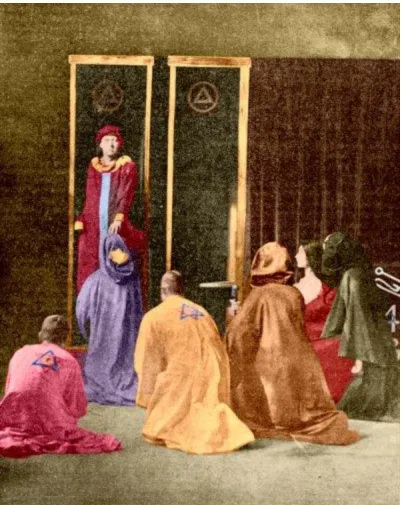
Thelema in Cefalù, Sicily. It was set up as a commune and a center for the study of magick.
Crowley covered the wall with murals that depicted spiritual realms, supernatural beings, sexual
41 Baker, p. 115. 42
Morris, p. 303-304; Evans, p. 354-358; Davis, Erik in Metzger ed., p. 142.
43 Whose holy book is the known as the Principia Discordia: Or, How I Found Goddess, And What I Did To Her
imagery and cryptic messages.46 The residents of the village grew suspect when they learned of
Crowley’s identity. With the sight of followers decked in robes and sounds of late night
incantations, rumors started to circulate. Hirsig presided over many of the ritual activities, with
Crowley taking on a submissive role. He took himself well beyond his previous applications of
ritual transgression,47 while employing severe meditational practices, along with very liberal use
of drugs and sex. Several visitors came for instruction in Thelemic philosophy and to participate
in rituals designed to bring them into communion with their Holy Guardian Angel.48
After a series of unfortunate events (his girlfriend’s miscarriage, disenchantment due to
extreme austerities, a bloody confrontation, and the death of a disciple), the community that was
falling apart, was now being expelled by Mussolini’s government and the European press was
quick to demonize Crowley.49 Although he did enjoy a brief period of influence in the Berlin art
scene during the early 1930’s, Crowley had spent the last of his fortune. Through the generosity
of a few close friends, Crowley was able to spend to last years of his life in a boarding house.
Though he still produced work, he died in obscurity, addicted to heroin, penniless, and lonely.
46
Sutin, p. 278-281.
47 Djurdjevic in Bogdan and Starr eds., p. 122-127. 48 Sutin, p. 284; Kaczinski, Perdurabo, p. 358-362.
3 SEX, DRUGS, ROCK N’ ROLL
“He [Crowley] was expounding a theory of self-liberation... I’ve employed his system in my
own day-to-day life... The thing is to come to terms with one’s free will, discover one’s place
and what one is, and from that you can go ahead and do it and not spend your whole life
suppressed and frustrated.” -Jimmy Page (guitarist of the band, Led Zeppelin)
Two decades after Crowley’s death, there was a resurgence of interest in his life and works.50
In 1967, free love, free thought, psychedelic drugs, Eastern religions, and occult imagery
colored the cultural landscape from London’s Carnaby Street to San Francisco’s Haight-Asbury
district. Several of the preoccupations and excesses of the late 1960’s had parallels with the
lifestyle and mindset of Crowley. His image (at the urging of John Lennon) was used on the
cover of the Beatles’ “Sergeant Pepper’s Lonely Hearts Club Band” album, which set new
standards for modern recording technology and creative artistic expression in popular music.
This seemed to serve as a catalyst that contributed to Crowley’s post-humous designation as a
counterculture icon. A wide range of artists became fascinated with Crowley, musicians in
particular. Many of his ideas found their way into expressions of the so-called ‘Dawn of the
Aquarian Age’ through Rock n’ Roll music, along with a variety of esoteric reinterpretations of
Western occult and Eastern religious thought. This era saw a greater number of novice
experiential adventurers as compared to Crowley’s time. It seemed as though occultism had
become mainstream.
50
The use of sex, psychoactive substances,51 and music in ritual activity can be traced to
antiquity, as evidenced in many shamanic and tantric rites which may also include the
consumption of what may be considered in some contexts to be transgressive pollutants (alcohol,
sexual fluids, forbidden foods, human flesh and excrement), along with the implementation of
gender-bending, psychodramatic performance, and journeys into the underworld.52
The popular music scene during the rise of 1960’s counterculture served as a platform for
occult imagery and ideals, mainly due to the fact that many artists were exploring these themes
in their personal lives, thus reflecting it in their forms of artistic expression. Even the mythology
of the musician who makes a pact with the Devil in hopes of fortune and fame had a strong
comeback at this time. The Rock n’ Roll of the 1950’s was a hybrid of Rhythm & Blues, Jump
Music (a derivative of Swing), and Country & Western. In the early 1960’s many young British
musicians became obsessed with American Blues recording from the 1930’s to the early
1950’s.53
This was music that had long been associated with Faustian myth through the legend
of Robert Johnson (who allegedly sold his soul to the Devil for talent and fame), and lyrics that
made reference to the supernatural uses of roots, mojo, and “black catbones.”54 Many of the
Rock n’ Roll performers of the 1960’s and 1970’s maintained personae that were larger than life,
while enjoying both massive concert attendance and extraordinary record sales. These facts only
served to make the myths surrounding these figures more believable and attractive.
It appears that during the late nineteenth century, in spite of Victorian repression, there was an
undercurrent of fascination with sexuality and exotic forms of eroticism.55 Occultism provided a
suitable justification for the implementation of ritual sex acts, presenting an “erotic pathway to
51 Schultes and Hofmann, p. 9. 52
wisdom,”56
many of these being fashioned from certain elements of Hindu Tantra. Through the
process of colonization, India had become romanticized as the mysterious “other” in the English
imagination. Although Crowley was not the first Englishman to claim knowledge of tantric
techniques of ecstasy and enlightenment, he was perhaps the Western world’s most vocal and
visible exponent of Tantra in the early twentieth century. Hugh Urban has stated that, “many
European men and women of the late nineteenth century, it would seem, were working through
their own deep ambivalence surrounding sexuality and religion; and they found in Tantra a
wonderfully ‘other’ form of spirituality a kind of empty mirror onto which they could project
their own most intense anxieties, fears, hopes, and forbidden desires.”57
While tantric practices
were only marginally sexual, these components seemed to be the most attractive to curious
Westerners.
The modern system of sex magic (as well as the term itself) started with the work of Paschal
Beverly Randolph (1825-1875),58 a black American whose teachings were later implemented by
groups such as The Hermetic Brotherhood of Luxor (neo-Rosicrucian)and Ordo Templi Orientis
(which Crowley joined, and eventually headed). Randolph viewed orgasm as being the opening
through which magical intent could be channeled for the desired outcome to occur. But, he felt
that this would only work if ritual coitus was performed by a married couple who were in love.
Orgasm outside of this framework was thought to be inefficacious.59 Crowley took this concept
much further to include the use of prostitutes, masturbation, and homosexual intercourse. In his
1913 article “Energized Enthusiasm,” Crowley suggested that “divine consciousness” could be
56
Uždavinys, p. 78.
57 Urban in Hanegraaff and Kripal eds., p. 104. 58Deveney in Hanegraaff and Kripal eds., p. 357-358.
realized through “the sacramental use of the sexual act.”60
Much of Crowley’s infamy is in
relation to his sexual appetites as expressed in some rituals. He has often been considered
depraved and perverted, perhaps due to a lack of information regarding the history of ritualized
sex as a vital component found in a variety of religious practices,61 and the Victorian attitudes
regarding the secrecy of sexuality.62 Ironically, the “secrecy” that was most likely a response to
“repression”, seemed to encourage a kind of sexually charged subculture in which bordellos,
pornography, and burlesque shows attracted a significant following. During the first two
decades of the twentieth century, Crowley was not only at the vanguard of London’s
esoteric/occult scene, he had also been active in the European art scene as a novelist, poet, and
painter. Crowley’s artistic works were often inspired by personal experiences involving drug
use, occult ritual, and spiritual revelation.
Much of the 20th century fascination with the relationship between sex and spirituality was
directly influenced by Crowley. Although he was not the originator of these concepts, his
innovation and personality led to what was arguably most effective representation of these
themes. In the summer of 1911, Crowley wrote his first “sex magick” treatise called Liber
Stellae Rubeae (The Book of the Ruby Star) in which the star ruby represents the lingam (the
Tantric phallus). This book, which was deemed holy by Crowley, “was [his] first formal ritual
expression of the dynamics of sexual magic. His primary influence was not Indian Tantra, but
rather that strand of the Western esoteric tradition that interpreted alchemical symbols in sexual
terms and believed in the possibility of a summum bonum or philosopher’s stone being created,
60
on a physical level, by the esoteric preparation and admixture of sexual fluids.”63 While
Crowley did incorporate Tantric and Yogic elements into his ritual activity,64 his primary sex
ritual was known as “Babalon Working.”65
The spelling of the name Babylon was altered to give
it more numerological power.66
Crowley had reinterpreted the significance of the “Beast” and the “Whore of Babylon” from
the New Testament Book of Revelation, with himself playing the Beast and his “Scarlet Woman”
playing the Whore of Babylon. This of course, would be taken as an admission of association
with the Devil, but Crowley seemed to have a very personal interpretation of these scriptures.
After his 1904 experience with the supernatural entity Aiwass, Crowley believed himself to be
the prophet of the coming Aeon of Horus, and Babalon Working was thought to be the prescribed
ritual method for the introduction of a spiritual offspring that would initiate, “The Aeon of Horus
[which] is the duration of the Apocalypse, that period when Choronzon67 shall rule over the
cosmos and visit destruction upon mankind. And the Apocalypse is a mental transformation that
will occur, or is presently occurring, within the collective unconscious of the human race.”68
It
would appear that much of Crowley’s cosmology was constructed upon the self-awareness of a
what could be considered an inner “mindscape.” In many cases, he described demons and
angels as mental constructs69 and the Apocalypse as a mental state. According to Crowley, to
operate on the Astral Plane, and to interact with entities thought to reside therein, one must
develop the ability to appropriately navigate the mental terrain despite the risks involved.
63 Sutin, p. 216;
64Djurdjevic, p. 86; Crowley, Magick: Book Four, p. 170-172, 638-640. 65
Owen in Bogdan and Starr eds., p. 24; Urban, Magia Sexualis, p. 136-137.
66 Crowley, Magick: Book Four, p. 424.
67 A demonic entity that Crowley invoked in a ritual in Algiers. Kenneth Grant later linked the demon to author
H.P. Lovecraft’s Cthultu mythos, and created his own Typhonian Order of the O.T.O. See Evans, p. 306-307, 338-340; Drury, p. 107-109, Lachman, p. 198-200.
68 Tyson in Metzger ed., p. 194-195.
The Astral Plane real or imaginary is a danger to anybody who takes it without the grain of salt contained in the Wisdom of the above point of view; who violates its laws, either
wilfully, carelessly, ignorantly, or by presuming that their psychological character differentiates them from physical laws in the narrower sense; or who abdicates his autonomy, on the ground that the subtler nature of astral phenomena guarantees their authority and integrity.70
This idea of exploring astral planes became very popular in the late 1960’s psychedelic
subculture. It was considered to be one of many methods that could be applied to direct and
frame the psychedelic experience. Perhaps the most visible spokesman of this period was former
Harvard psychology professor and researcher, Timothy Leary. Known for the phrase “Turn on,
tune in, drop out”, Leary, in a televised interview (now posted on YouTube), claimed to be
carrying on the work of Crowley, who had allegedly done the same. In the 1980’s, Leary
became an initiate of the Illuminates of Thanateros, a group (an inner circle) started by the
founders of Chaos Magic, who saw themselves as carrying on the work of Crowley’s pupil,
Austin Osman Spare.
Sexual freedom and experimentation, mystical experience through meditation and/or drugs,
contemporary reinterpretation of ancient religious symbolism and practices, along with visions of
apocalyptic new age regeneration all have been strongly associated with the 1960’s; they were
major factors in Crowley’s lifestyle many years prior. Being a product of his time who pushed
all of the boundaries, Crowley may have expressed a cultural and religious potentiality that the
first half of the century was not ready for. Even the participants in the 1960’s counterculture
may not have been ready for it, as evidenced in the implosion and disillusionment that occurred
century civilization and foreshadows what would follow in the decades after his death. Shepherd
notes that Crowley’s attack on established institutions, his will to transgress all laws, and his
dream of a utopian new world personified many of the excesses and contradictions of our own
contemporary American culture.”72
In the 1970’s, Jimmy Page, the songwriter/guitarist of Led
Zeppelin (second only to the Beatles in terms of total record sales) amassed the largest collection
of Crowley memorabilia and Austin Osman Spare artwork in the world. He even purchased the
house that Crowley once owned at Loch Ness, which was the site of the infamous six month long
Abramelin73
ritual. Copies of the album “Led Zeppelin 3” even had “Do What Thou Wilt”
pressed into the vinyl.74
Crowley’s legacy exhibits a multidimensionality that continues to attract interest regardless of
changes in social climate. Despite being called The Great Beast 666 and “the wickedest man in
the world,” Crowley never considered himself a Satanist, though his name and legacy have
consistently been thought to be connected to it.75 In the musical genre known as Black Metal or
Death Metal, liberal use has been made of Crowley’s image, words, and religious symbols. He is
often seen as the Devil’s emissary through iconic appeal to the darker side of the religious
imagination.76 Though few Rock n’ Roll fans may have considered themselves explicitly
religious, the liminal state produced by the live concert, the transformative experience of
listening to the recordings, and the deification of the performers display all of the elements of a
72
Urban, The Beast with Two Backs, p. 21.
73 The arduous Abramelin ritual is an invocation of angels, (allegedly translated from Hebrew into French by
Eliphas Levi) which if performed improperly, may invoke demons. See Wilson, p. 463-463; Sutin, p. 53-54; Crowley, “Confessions,” p. 177-192.
74
Wall, p. 197-198, 228.
75 An early 1970’s mass market paperback edition of “The Confessions of Aleister Crowley” features the publisher’s
description of its contents on the cover. It states that the book is, “The profane and uninhibited memoirs of the most notorious magician, satanist, and drug cultist of the 20th century.” This of course, was an attempt to sensationalize the subject, thus perpetuating the darker side of the Crowley mythos while insuring good sales.
76 This can also be seen in the number of “evil” fictional characters that have been fashioned after
kind of free-form religion.77 And, the phrase, “Do What Thou Wilt” seems to be the
movement’s most appropriate mantra.
Figure 5: The dilapidated Abbey of Thelema
4 THE SEASON OF THE WITCH
“His [Crowley’s] true place in religious history, as opposed to that in the history of
magic(k), may be as the godfather of Wicca rather than as the father of Thelema.”
-Ronald Hutton
Crowley was the founder of a religion known as Thelema, which still has a following. But, his
presence is largely felt throughout the world of contemporary witchcraft.78 Though many
practitioners of witchcraft have chosen to distance themselves from any association with
Crowley, several elements of these practices can be traced directly to him. This fact was perhaps
intentionally downplayed by some of the foundational figures of Modern Witchcraft, so that
Crowley’s reputation would not become a stumbling block in the path toward mainstream
acceptance.
As Gerald Gardner (1884-1964) was laying the foundation for modern witchcraft, the laws
against such practices were being repealed,79 and his associate Doreen Valiente was seeking
validation for witchcraft as a recognized religion. It was toward this end that she suggested to
Gardner the avoidance of any association with Crowley, although several key ritual techniques
and use of a ‘Book of Shadows’ had been direct imports from Crowley’s methodology.80 There
has been much debate regarding the extent of Crowley’s influence on Wicca, because Gardner
had left the O.T.O to start his own group, and Crowley’s own negative opinion of “witch cults.”
Yet the facts surrounding Gardner’s brief, but noteworthy, association with Crowley should not
be overlooked.81 Gardner had been actively researching the available information on early
Paganism in Great Britain and claimed to have been initiated into a coven in 1939, a decade
before meeting Crowley.82 Crowley initiated Gardner into the O.T.O. and commission him to
operate a new lodge. A few years later, after attracting only a very small group of disciples,
Gardner decided to leave the O.T.O., started his own coven, and called the practice Wicca.83
Wicca and Neopaganism both claim ancient Celtic roots. Anthropologist Margaret Murray’s
work The Witch-Cult in Western Europe (1921) included claims of an unbroken pre-Christian
lineage that could be linked to Roman worship of the horned god Janus (or Dianus). It was
asserted that remnants of this Dianic Cult still existed as an indigenous English tradition. After
being subject to much scrutiny, the claims were largely disputed. However, the seeds were
planted for a revival of interest in ancient paganism and Early Modern witchcraft. Of course, in
English antiquity, those traditions were associated with the Devil, again due to their
non-Christian ritual activity and cosmologies.84
Crowley saw himself as being part of what he called Hermetic and Enochian lineages. His
forms of magic were decidedly cosmopolitan, as opposed to rural folk magic. He also viewed
himself as the prophet of a new age, a modern magician, not as an ambassador for the archaic.
Yet his impact on modern witchcraft is undeniable. Not only had Gardner (whose teachings
became known as Gardnerian witchcraft)been a disciple of Crowley’s, but Alex Sanders
(founder of Alexandrian witchcraft) made an unfounded claim to have received a direct blessing
from Crowley as a child. This seemed to be a ploy to gain credibility through being associated
81
Morris, p. 281; Evans, p. 49; Greenwood, The Encyclopedia of Magic & Witchcraft, p. 190.